weight TOYOTA YARIS HATCHBACK 2008 User Guide
[x] Cancel search | Manufacturer: TOYOTA, Model Year: 2008, Model line: YARIS HATCHBACK, Model: TOYOTA YARIS HATCHBACK 2008Pages: 400, PDF Size: 6.56 MB
Page 267 of 400

254 4-3. Do-it-yourself maintenance
nRoutine tire inflation pressure checks
The tire pressure warning system does not replace routine tire inflation
pressure checks. Make sure to check tire inflation pressure as part of
your routine of daily vehicle checks.
nMaximum load of tire
Check that the maximum load of the re placed tire is greater than 1/2 of
the Gross Axle Weight Ratings (GAWR) of either the front axle or the
rear axle, whichever is greater.
As for the maximum load of the tire, see the load limit at maximum cold
tire inflation pressure mentioned on the sidewall of the tire, and as for the
Gross Axle Weight Ratings (GAWR) , see the Certification Label. (→P.
258, 350).
nTire types
1 Summer tires
Summer tires are high-speed performance tires best suited to highway
driving under dry conditions. Sinc e summer tires do not have the same
traction performance as snow tire s, summer tires are inadequate for
driving on snow-covered or icy roads. For driving on snow-covered
roads or icy roads, the use of snow tires is recommended. When
installing snow tires, be sure to replace all four tires.
2 All season tires
All season tires are designed to provide better traction in snow and to
be adequate for driving in most winter conditions, as well as for use
year round. All season tires, however, do not have adequate traction
performance compared with snow tires in heavy or loose snow. Also,
all season tires fall short in acceleration and handling performance
compared with summer tires in highway driving.
3Snow tires For driving on snow-covered roads or icy roads, we recommend using
snow tires. If you need snow tires, select tires of the same size, con-
struction and load capacity as the or iginally installed tires. Since your
vehicle has radial tires as original equipment, make sure your snow
tires also have radial construction. Do not install studded tires without
first checking local regulations for possible restriction. Snow tires
should be installed on all wheels. ( →P. 151)
Page 273 of 400

260 4-3. Do-it-yourself maintenance
nTire inflation pressure check interval
You should check tire pressure every two weeks, or at least once a
month.
Do not forget to check the spare tire.
nEffects of incorrect tire inflation pressure
Driving with incorrect tire inflation pressure ma y result in the following:
lReduced fuel efficiency
lReduced driving comfort and tire life
lReduced safety
lDamage to the drive train
If a tire needs frequent refilling, have it checked by your Toyota dealer.
n
Instructions for checking tire inflation pressure
When checking tire inflation pressure, observe the following:
lCheck only when the tires are cold.
If your vehicle has been parked for at least 3 hours and has not been
driven for more than 1 mile or 1.5 km, you will get an accurate cold
tire inflation pressure reading.
lAlways use a tire pressure gauge.
The appearance of the tire can be mi sleading. In addition, tire infla-
tion pressures that are even just a few pounds off can degrade ride
and handling.
lDo not bleed or reduce tire inflation pressure after driving. It is normal
for the tire inflation pressure to be higher after driving.
lNever exceed the vehicle capacity weight.
Passengers and luggage weight should be placed so that the vehicle
is balanced.
Page 275 of 400
262
4-3. Do-it-yourself maintenance
Wheels
nWhen replacing wheels
The wheels of your Toyota are equipped with sensors that allow the tire
pressure warning system sensors to provide advanced warning in the
event of a loss in tire inflation pressure. Whenever wheels are replaced,
the tire pressure warning valve and transmitter must be switched over
from the old wheels. (→P. 253)
If a wheel is bent, cracked or heavily corroded, it should be
replaced.
Otherwise, the tire may separate from the wheel or cause loss of
handling control.
n Wheel selection
When replacing wheels, care should be taken to ensure that
they are equivalent to those removed in load capacity, diameter,
rim width, and offset.
Replacement wheels are available at your Toyota dealer.
Toyota does not recommend using:
lWheels of different sizes or types
l Used wheels
l Bent wheels that have been straightened
n Aluminum wheel precautions (if equipped)
lUse only Toyota wheel nuts and wrench designed for use with
your aluminum wheels.
l When rotating, repairing or changing your tires, check that the
wheel nuts are still tight after driving 1000 miles (1600 km).
l Be careful not to damage the aluminum wheels when using
tire chains.
l Use only Toyota genuine balance weights or equivalent and a
plastic or rubber hammer when balancing your wheels.
Page 318 of 400

306 5-2. Steps to take in an emergency
nKey reminder buzzer
The buzzer indicates that the key has not been removed (with the engine
switch in the ACC or LOCK position and the driver’s door opened).
n Light reminder buzzer
The buzzer indicates that the headlight switch is left on (with the key
removed and the driver’s door opened).
n If the malfunction indicator lamp comes on while driving
First check the following:
l Is your vehicle low on gas?
If it is, refuel the vehicle immediately.
l Is the fuel tank cap loose?
If it is, tighten it securely.
The light will go off after taking several driving trips.
If the light does not go off even after several trips, contact your Toyota dealer
as soon as possible.
n Front passenger detect ion sensor and passenger seat belt reminder
If luggage or other load is placed on the front passenger seat, depending on
its weight, the reminder light to flash and buzzer to sound.
n
When the tire pressure warning light comes on
Check the tire inflation pressure and adjust to the appropriate level.
nThe tire pressure warning light ma y turn on due to natural causes
The tire pressure warning light may turn on due to natural causes such
as natural air leaks or tire inflation pressure changes caused by temper-
ature. In this case, adjusting the ti re inflation pressure will turn off the
warning light after a few minutes.
nWhen a tire is replaced with a compact spare tire
The compact spare tire is not equipped with the tire pressure warning
valve and transmitter. If a tire goes flat, the warning light will not turn off
even though the flat tire is replac ed with the compact spare tire. Replace
the compact spare tire with the repaired tire and adjust the proper tire
inflation pressure. The ti re pressure warning light will turn off after a few
minutes.
Page 324 of 400
312 5-2. Steps to take in an emergency
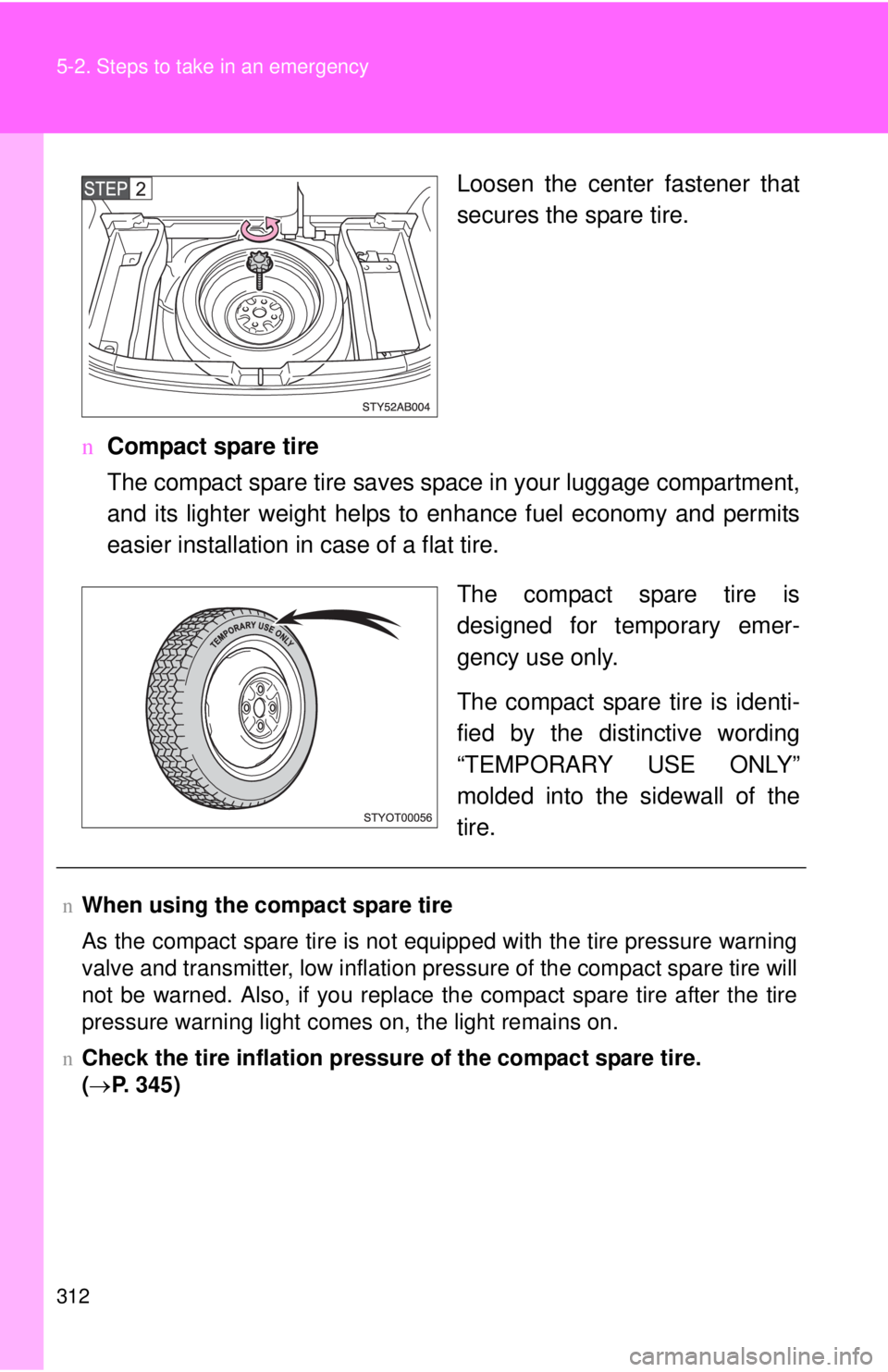
Loosen the center fastener that
secures the spare tire.
n Compact spare tire
The compact spare tire saves space in your luggage compartment,
and its lighter weight helps to enhance fuel economy and permits
easier installation in case of a flat tire.
The compact spare tire is
designed for temporary emer-
gency use only.
The compact spare tire is identi-
fied by the distinctive wording
“TEMPORARY USE ONLY”
molded into the sidewall of the
tire.
nWhen using the compact spare tire
As the compact spare tire is not equipped with the tire pressure warning
valve and transmitter, low inflation pr essure of the compact spare tire will
not be warned. Also, if you replace the compact spare tire after the tire
pressure warning light comes on, the light remains on.
nCheck the tire inflation pressure of the compact spare tire.
( → P. 345)
Page 349 of 400
338
6-1. Specifications
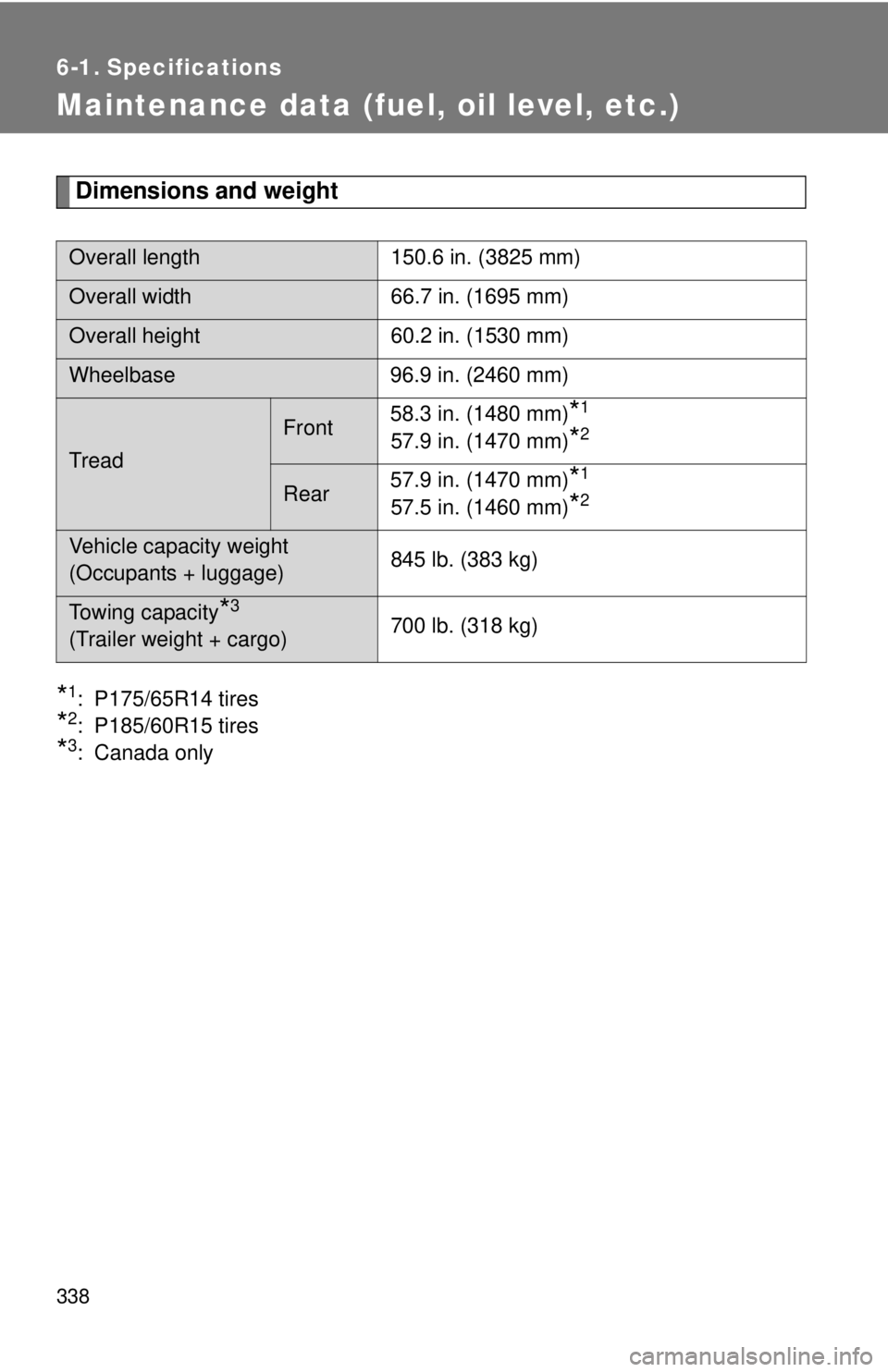
Maintenance data (fuel, oil level, etc.)
Dimensions and weight
*1: P175/65R14 tires
*2: P185/60R15 tires
*3: Canada only
Overall length150.6 in. (3825 mm)
Overall width66.7 in. (1695 mm)
Overall height 60.2 in. (1530 mm)
Wheelbase96.9 in. (2460 mm)
Tread
Front58.3 in. (1480 mm)*1
57.9 in. (1470 mm)*2
Rear57.9 in. (1470 mm)*1
57.5 in. (1460 mm)*2
Vehicle capacity weight
(Occupants + luggage) 845 lb. (383 kg)
Towing capacity*3
(Trailer weight + cargo)700 lb. (318 kg)
Page 368 of 400
357
6-1. Specifications
6
Vehicle specifications
Warning: The temperature grades for this tire are established for a tire
that is properly inflated and not overloaded.
Excessive speed, underinflation, or
excessive loading, either sepa-
rately or in combination, can caus e heat buildup and possible tire fail-
ure.
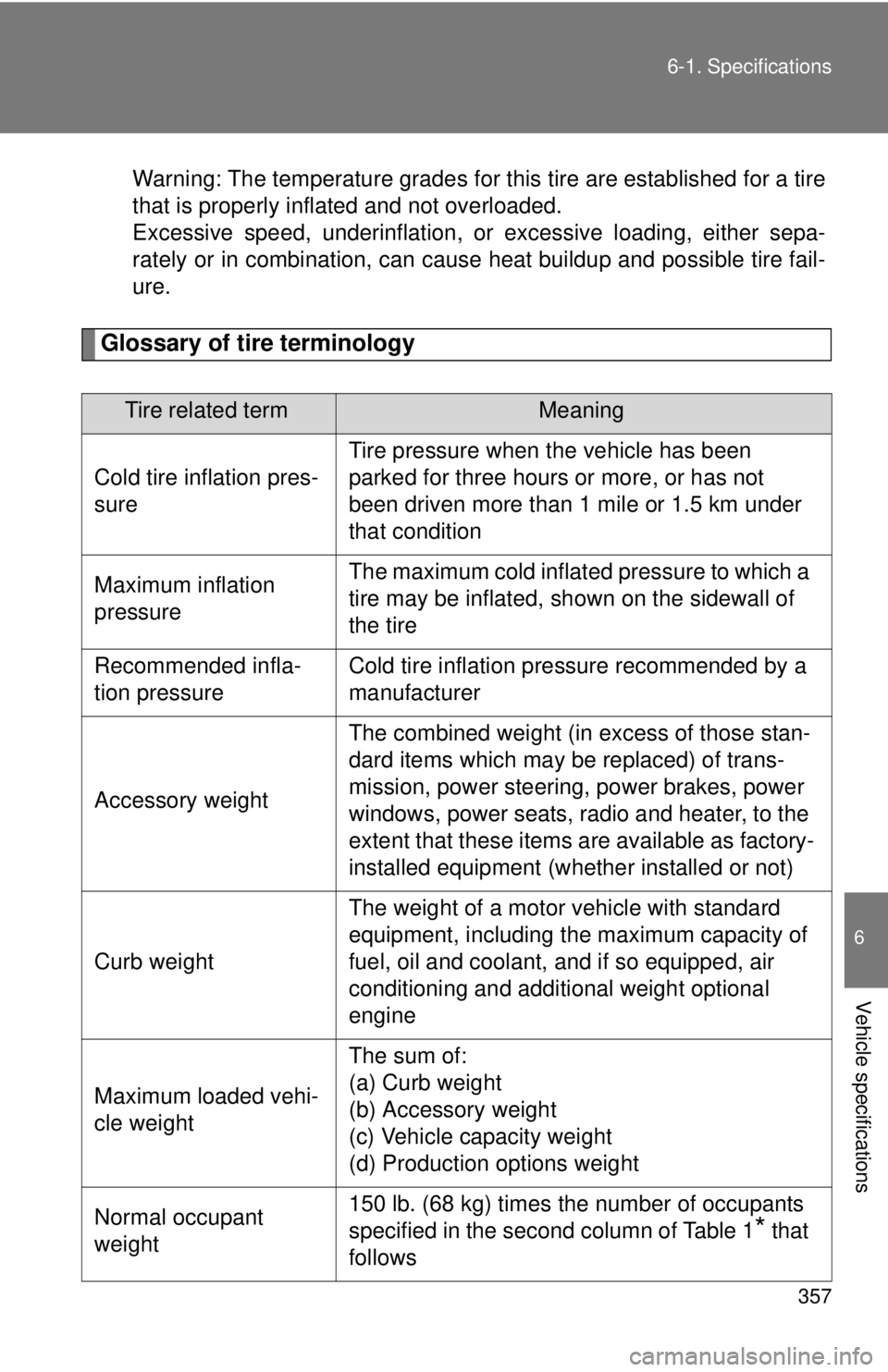
Glossary of tire terminology
Tire related termMeaning
Cold tire inflation pres-
sure
Tire pressure when the vehicle has been
parked for three hours or more, or has not
been driven more than 1 mile or 1.5 km under
that condition
Maximum inflation
pressureThe maximum cold inflated pressure to which a
tire may be inflated, s hown on the sidewall of
the tire
Recommended infla-
tion pressureCold tire inflation pressure recommended by a
manufacturer
Accessory weight
The combined weight (in excess of those stan-
dard items which may be replaced) of trans-
mission, power steering, power brakes, power
windows, power seats, radio and heater, to the
extent that these items are available as factory-
installed equipment (whether installed or not)
Curb weight
The weight of a motor vehicle with standard
equipment, including the maximum capacity of
fuel, oil and coolant, and if so equipped, air
conditioning and additional weight optional
engine
Maximum loaded vehi-
cle weight
The sum of:
(a) Curb weight
(b) Accessory weight
(c) Vehicle capacity weight
(d) Production options weight
Normal occupant
weight150 lb. (68 kg) times the number of occupants
specified in the second column of Table 1
* that
follows
Page 369 of 400
358 6-1. Specifications
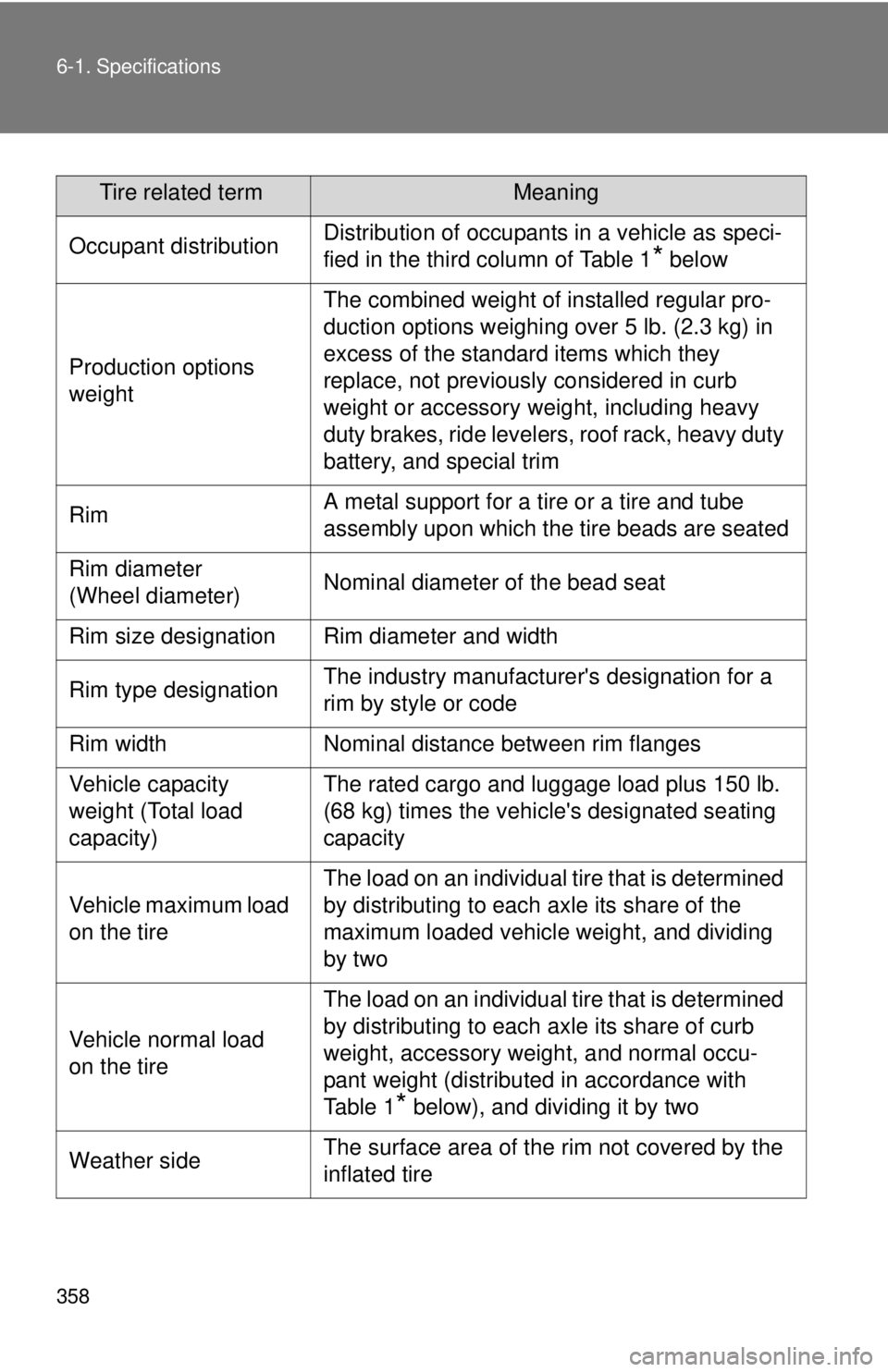
Tire related termMeaning
Occupant distributionDistribution of occupants in a vehicle as speci-
fied in the third column of Table 1
* below
Production options
weight
The combined weight of installed regular pro-
duction options weighing over 5 lb. (2.3 kg) in
excess of the standard items which they
replace, not previously considered in curb
weight or accessory weight, including heavy
duty brakes, ride levelers, roof rack, heavy duty
battery, and special trim
RimA metal support for a tire or a tire and tube
assembly upon which the tire beads are seated
Rim diameter
(Wheel diameter)Nominal diameter of the bead seat
Rim size designationRim diameter and width
Rim type designationThe industry manufacturer's designation for a
rim by style or code
Rim widthNominal distance between rim flanges
Vehicle capacity
weight (Total load
capacity)The rated cargo and luggage load plus 150 lb.
(68 kg) times the vehicle's designated seating
capacity
Vehicle maximum load
on the tire
The load on an individual tire that is determined
by distributing to each axle its share of the
maximum loaded vehicle weight, and dividing
by two
Vehicle normal load
on the tire
The load on an individual tire that is determined
by distributing to each axle its share of curb
weight, accessory weight, and normal occu-
pant weight (distributed in accordance with
Ta b l e 1
* below), and dividing it by two
Weather sideThe surface area of the rim not covered by the
inflated tire
Page 371 of 400
360 6-1. Specifications
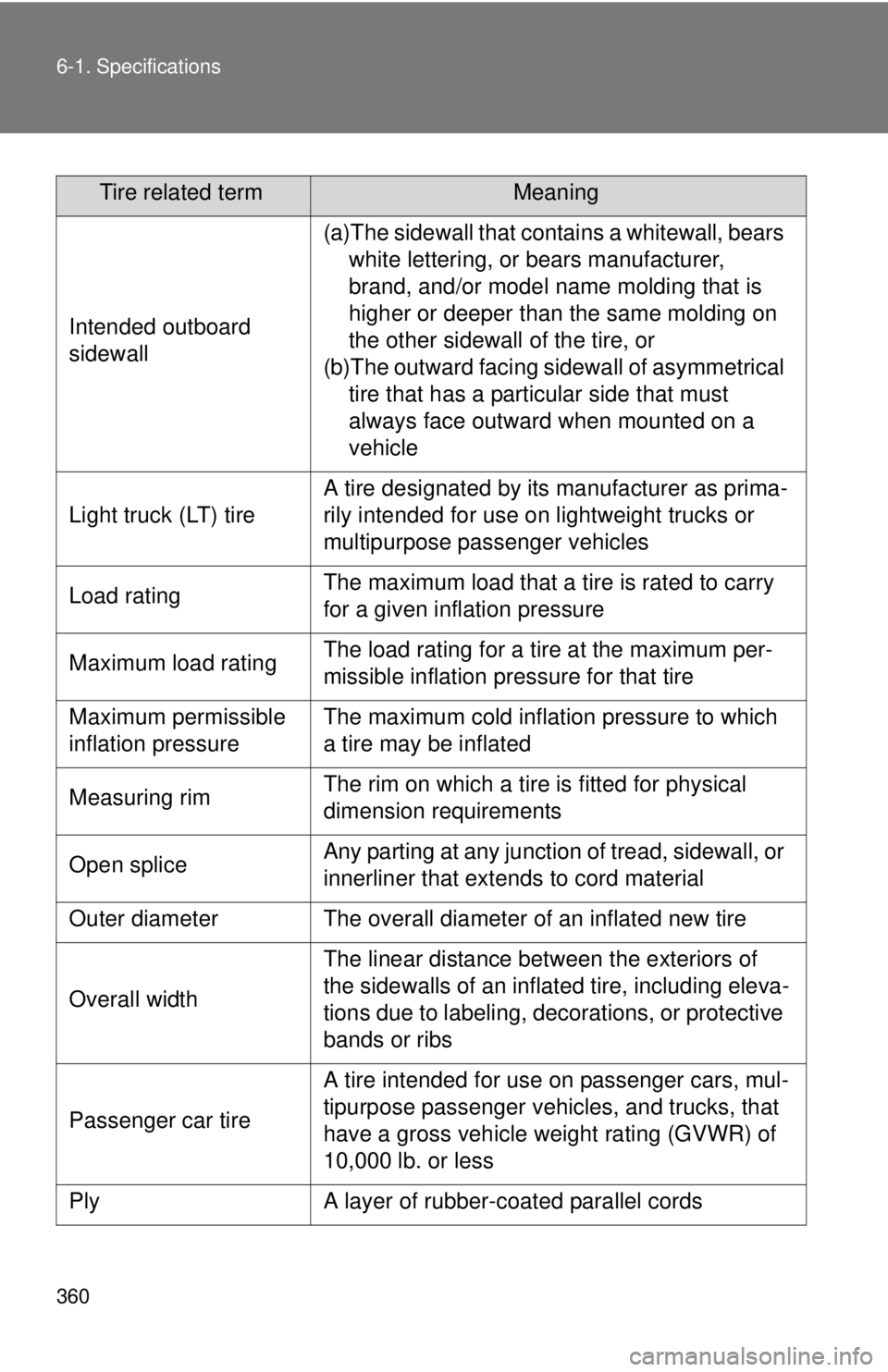
Tire related termMeaning
Intended outboard
sidewall
(a)The sidewall that contains a whitewall, bears white lettering, or bears manufacturer,
brand, and/or model name molding that is
higher or deeper than the same molding on
the other sidewall of the tire, or
(b)The outward facing sidewall of asymmetrical tire that has a particular side that must
always face outward when mounted on a
vehicle
Light truck (LT) tire
A tire designated by its manufacturer as prima-
rily intended for use on lightweight trucks or
multipurpose passenger vehicles
Load ratingThe maximum load that a tire is rated to carry
for a given inflation pressure
Maximum load ratingThe load rating for a tire at the maximum per-
missible inflation pressure for that tire
Maximum permissible
inflation pressureThe maximum cold inflation pressure to which
a tire may be inflated
Measuring rimThe rim on which a tire is fitted for physical
dimension requirements
Open spliceAny parting at any junction of tread, sidewall, or
innerliner that extends to cord material
Outer diameterThe overall diameter of an inflated new tire
Overall width
The linear distance between the exteriors of
the sidewalls of an inflated tire, including eleva-
tions due to labeling, decorations, or protective
bands or ribs
Passenger car tire
A tire intended for use on passenger cars, mul-
tipurpose passenger vehicles, and trucks, that
have a gross vehicle weight rating (GVWR) of
10,000 lb. or less
PlyA layer of rubber-coated parallel cords
Page 389 of 400

381
Alphabetical index
Uniform tire quality
grading ............................... 355
Tires Chains .................................. 151
Checking .............................. 252
If you have a flat tire ............. 310
Identification number ............ 350
Inflation pressure .......... 258, 345
Inflation pressure sensor ...... 253
Information ........................... 350
Replacing ..................... 252, 310
Rotating tires ........................ 252
Size ...................................... 345
Snow tires............................. 151
Spare tire .............................. 310
Tire pressure warningsystem........................ 252, 303
Warning light ........................ 303
Tools......................................... 310
Total load capacity .................. 150
Towing Dinghy towing ............... 164, 165
Emergency towing ................ 290
Trailer towing ................ 155, 156
Trip meter................................. 132
Turn signal lights Indicator................................ 126
Lever .................................... 126
Replacing light bulbs ............ 280
Switch ................................... 126
Wattage ................................ 346
Vanity mirrors .......................... 214
Vehicle identification number................................... 339
Warning buzzers Brake system........................ 300
Seat belt reminder ................ 303
Warning lights ABS ...................................... 301
Airbag system....................... 301 Anti-lock brake system ..........301
Brake system ........................300
Charging system ....
...............301
Driver’s seat belt ...................303
Electric power steering system ................................301
Electronic engine control system ................................301
Engine oil replacement..........303
EPS system...........................301
Front passenger occupant classification system ...........301
Front passenger’s seat belt ...303
High engine coolant temperature ........................301
Low brake fluid ......................300
Low engine oil pressure ........301
Low fuel level ........................303
Low tire inflation pressure .....303
Low washer fluid ...................303
Malfunction ............................301
Open door .............................303
Seat belt ................................303
Seat belt pretensioner system ................................301
SRS .......................................301
SRS airbag system ...............301
Tire pressure .........................303
Tire pressure warning
system ................................303
Washer Checking ...............................250
Preparing and checking
before winter .......................151
Switch....................................142
Warning light .........................303
Washing and waxing ...............222
Weight Cargo capacity ......................147
Load limits .............................150
Weight ...................................338
Wheels ......................................262
V
W