ECU TOYOTA YARIS HATCHBACK 2008 Owner's Manual
[x] Cancel search | Manufacturer: TOYOTA, Model Year: 2008, Model line: YARIS HATCHBACK, Model: TOYOTA YARIS HATCHBACK 2008Pages: 400, PDF Size: 6.56 MB
Page 120 of 400
104 1-7. Safety information
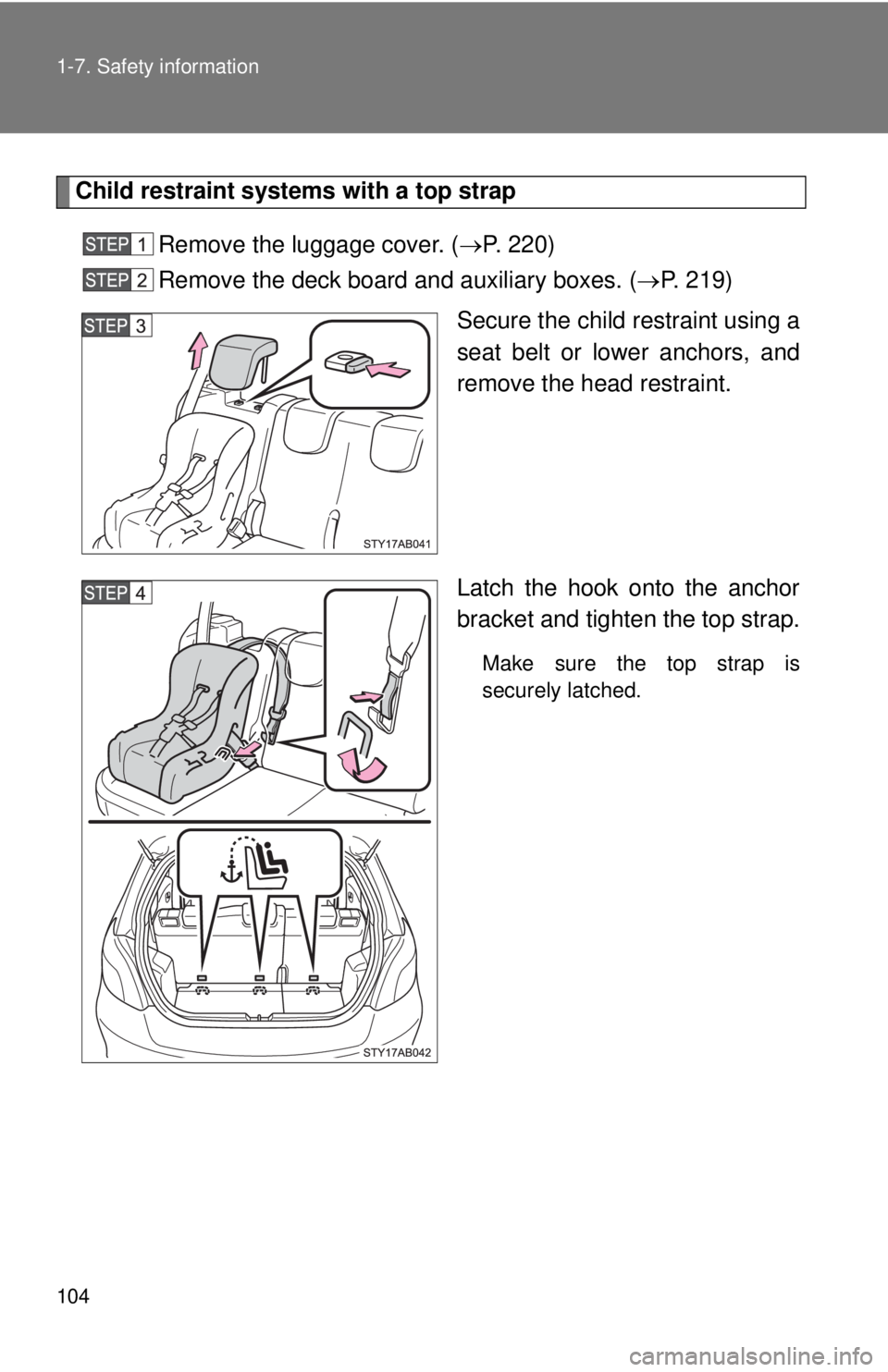
Child restraint systems with a top strapRemove the luggage cover. (→ P. 220)
Remove the deck board and auxiliary boxes. (→P. 219)
Secure the child restraint using a
seat belt or lower anchors, and
remove the head restraint.
Latch the hook onto the anchor
bracket and tighten the top strap.
Make sure the top strap is
securely latched.
Page 122 of 400
106 1-7. Safety information
CAUTION
nWhen installing a child restraint system
Follow the directions given in the child restraint system installation manual
and fix the child restraint system securely in place.
If the child restraint system is not correctly fixed in place, the child may be
seriously injured or even killed in the event of sudden braking or an accident.
lSplit rear seats: When installing a child restraint system in the rear center
position, adjust both seat cushions to the same position and align both
seatbacks at the same angle. Otherwise, the child restraint system cannot
be securely restrained and this may cause death or serious injuries in a
collision.
l Split rear seats: When installing a rear-facing child restraint system in the
rear seat, move the rear seat to the rear-most position to prevent the child
restraint system from interfering with the front seat.
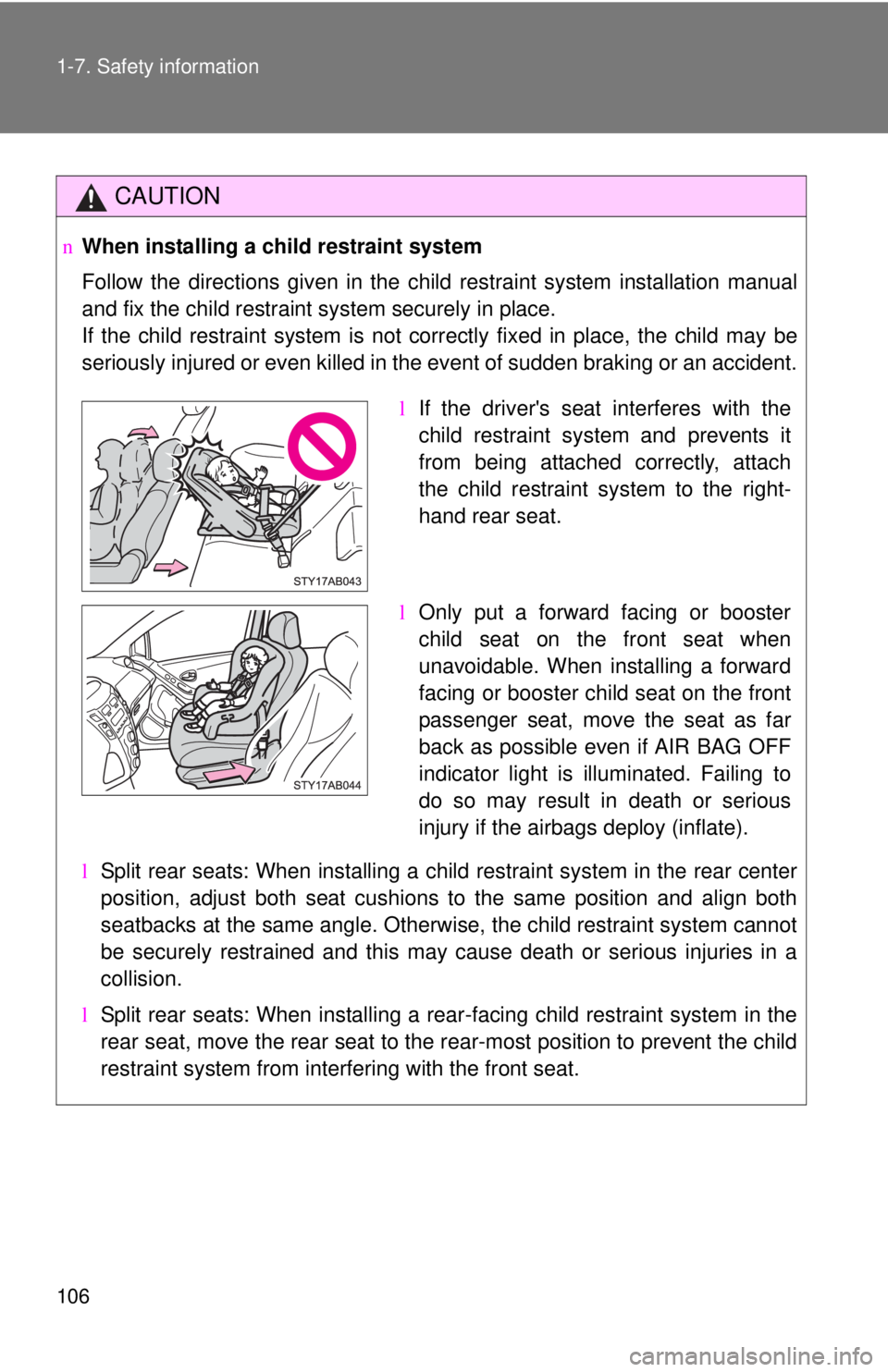
lIf the driver's seat interferes with the
child restraint system and prevents it
from being attached correctly, attach
the child restraint system to the right-
hand rear seat.
l Only put a forward facing or booster
child seat on the front seat when
unavoidable. When installing a forward
facing or booster child seat on the front
passenger seat, move the seat as far
back as possible even if AIR BAG OFF
indicator light is illuminated. Failing to
do so may result in death or serious
injury if the airbags deploy (inflate).
Page 123 of 400

107
1-7. Safety information
1
Before driving
CAUTION
n
When installing a child restraint system
lWhen a booster seat is installed, always ensure that the shoulder belt is
positioned across the center of the child's shoulder. The belt should be
kept away from the child's neck, but not so that it could fall off the child's
shoulder. Failing to do so may result in death or serious injury in the event
of an accident or sudden braking.
l Ensure that the belt and tab are securely locked and the seat belt is not
twisted.
l Push and pull the child restraint system in different directions to be sure it
is secure.
l Follow all installation instructions provided by the child restraint system
manufacturer.
n Do not use a seat belt extender
If a seat belt extender is used when installing a child restraint system, the
seat belt will not securely hold the child restraint system, which could cause
death or serious injury to the child or other passengers in the event of a colli-
sion.
n To correctly attach a child restraint system to the anchorages
When using the lower anchorages, be sure that there are no foreign objects
around the anchorages and that the seat belt is not caught behind the child
restraint. Make sure the child restraint system is securely attached, or it may
cause death or serious injury to the child in the event of a sudden stop or
accident.
Page 131 of 400

116 2-1. Driving procedures
CAUTION
nWhen the vehicle is parked
lAlways apply the parking brake, shift the shift lever to P (automatic trans-
mission only), stop the engine and lock the vehicle.
Do not leave the vehicle unattended while the engine is running.
l Do not touch the exhaust pipe while the engine is running or immediately
after turning the engine off.
Doing so may cause burns.
l Do not leave the engine running in an area with snow build-up, or where it
is snowing. If snowbanks build up around the vehicle while the engine is
running, exhaust gases may collect and enter the vehicle. This may lead
to death or a serious health hazard.
n Exhaust gases
Exhaust gases include harmful carbon monoxide (CO) that is colorless and
odorless. Inhaling exhaust gases may lead to death or a serious health haz-
ard.
lIf the vehicle is in a poorly ventilated area, stop the engine. In a closed
area, such as a garage, exhaust gases may collect and enter the vehicle.
This may lead to death or a serious health hazard.
l The exhaust should be checked occasionally. If there is a hole or crack
caused by corrosion, damage to a joint or abnormal exhaust noise, be
sure to have the vehicle inspected and repaired by your Toyota dealer.
Failure to do so may allow exhaust gases to enter the vehicle, resulting in
death or a serious health hazard.
n When taking a nap in the vehicle
Always turn the engine off. Otherwise, you may accidentally move the shift
lever or depress the accelerator pedal, which could cause an accident or fire
due to engine overheating. Additionally, if the vehicle is parked in a poorly
ventilated area, exhaust gases may collect and enter the vehicle, leadin\
g to
death or a serious health hazard.
n When braking the vehicle
lWhen the brakes are wet, drive more cautiously.
Braking distance increases when the brakes are wet, and may cause one
side of the vehicle to brake differently than the other side. Also the parking
brake may not securely hold the vehicle.
Page 162 of 400
147
2
When driving
2-5. Driving information
Cargo and luggage
Capacity and distributionCargo capacity depends on the total weight of the occupants.
(Cargo capacity) = (Total load capacity) − (Total weight of occupants)
Steps for Determining Correct Load Limit—
(1) Locate the statement “The co mbined weight of occupants and
cargo should never exceed XXX kg or XXX lbs.” on your vehicle’s
placard.
(2) Determine the combined weight of the driver and passengers that will be riding in your vehicle.
(3)Subtract the combined weight of the driver and passengers from XXX kg or XXX lbs.
(4) The resulting figure equals the av ailable amount of cargo and lug-
gage load capacity.
For example, if the “XXX” amount equals 1400 lbs. and there will
be five 150 lb passengers in your vehicle, the amount of available
cargo and luggage load capacity is 650 lbs. (1400 − 750 (5 × 150)
= 650 lbs.)
(5) Determine the combined weight of luggage and cargo being loaded on the vehicle. That weight may not safely exceed the
available cargo and luggage load capacity calculated in Step 4.
Take notice of the following information about storage precau-
tions, cargo capacity and load.
lStow cargo and luggage in the luggage compartment whenever
possible.
l Be sure all items are secured in place.
l Be careful to keep the vehicle level. Placing the weight as far for-
ward as possible helps maintain vehicle balance.
l For better fuel economy, do no t carry unnecessary weight.
Page 164 of 400

149
2-5. Driving information
2
When driving
CAUTION
nThings that must not be carried in the luggage compartment
The following things may cause a fire if loaded in the luggage compart-
ment.
lReceptacles containing gasoline
lAerosol cans
nStorage precautions
lDo not place anything on the luggage cover, and do not stack anything
in the luggage compartment higher than the seatbacks.
Such items may be thrown about and possibly injure people in the
vehicle during sudden braking or in an accident.
lDo not drive with objects on top of the instrument panel.
They may interfere with the driver’s field of view or move during sharp
acceleration or turning, thus impairing the driver’s control of the vehi-
cle. In an accident they may injure the vehicle occupants.
lSecure all items in the occupant compartment, as they may shift and
injure someone during an accident or sudden braking.
lNever allow anyone to ride in the luggage compartment. It is not
designed for passengers. They should ride in their seats with their seat
belts properly fastened. Otherwise,
they are much more likely to suffer
serious bodily injury, in the even t of sudden braking or a collision.
nCapacity and distribution
lDo not exceed the maximum axle weight rating or the total vehicle
weight rating.
lEven if the total load of occupant’s weight and the cargo load is less
than the total load capacity, do no t apply the load unevenly. Improper
loading may cause deterioration of st eering or braking control which
may cause death or serious injury.
Page 173 of 400

158 2-5. Driving information
Towing a trailerConsult your Toyota dealer for further information about additional
requirements such as a towing kits, etc.
n Before towing
Check that the following conditions are met:
lEnsure that your vehicle’s tires are properly inflated. ( →P. 345)
l Trailer tires should be inflated according to the trailer manufacturer’s rec-
ommendation.
l All trailer lights work to be legal.
l Confirm all lights work each time you connect them.
l Check that your vehicle remains level when a loaded or unloaded trailer
is hitched. Do not drive if the vehicle is not level, and check for improper
tongue load, overloading, worn suspension, or other possible causes.
l Make sure the trailer cargo is securely loaded.
l Check that your rear view mirrors conform to any federal, state/provincial
or local regulations. If they do not, install rear view mirrors appropriate for
towing purposes.
n Break-in schedule
lToyota recommends that you do not use a new vehicle or a vehicle with
any new power train components (engine, transmission, differential,
wheel bearings, etc.) to tow a trailer for the first 500 miles (800 km) of
driving.
n Maintenance
lIf you tow a trailer, your vehicle will require more frequent maintenance
due to the additional load. (See “Scheduled Maintenance Guide” or
“Owner’s Manual Supplement”.)
l Retighten the fixing bolts of the towing ball and bracket after approxi-
mately 600 miles (1000 km).
Page 174 of 400
159
2-5. Driving information
2
When driving
CAUTION
n
To avoid accident or injury
lThe total trailer weight (trailer weight plus the weight of cargo) must not
exceed 700 lb. (318 kg)
l Do not exceed the trailer hitch assembly weight, gross vehicle weight,
gross axle weight and trailer tongue load capacities.
n Hitches
Trailer hitch assemblies have different weight capacities established by the
hitch manufacturer. Even though the vehicle may be rated for towing a
higher weight, the operator must never exceed the maximum weight rating
specified for the trailer hitch.
lIf you wish to install a trailer hitch, your Toyota dealer should be consulted.
l Use only a hitch that conforms to the total trailer weight requirement.
l Follow the directions supplied by the hitch manufacturer.
l Lubricate the hitch ball with a light coat of grease.
l Remove the trailer hitch whenever you are not towing a trailer to reduce
the possibility of additional damage caused by the hitch if your vehicle is
struck from behind.
n When towing a trailer
lNever tap into your vehicle’s hydraulic system, as this will lower the vehi-
cle’s braking effectiveness.
l Never tow a trailer without using a safety chain securely attached to both
the trailer and the vehicle. If damage occurs to the coupling unit or hitch
ball, there is danger of the trailer wandering into another lane.
Page 232 of 400

218
3-5. Other interior features
Floor mat
CAUTION
nWhen inserting the floor mat
Observe the following precautions.
Failure to do so may result in the floor mat slipping and interfering wi\
th the
movement of the pedals during driving, resulting in an accident.
lMake sure the floor mat is properly placed on the vehicle carpet and the
correct side faces upward.
l Do not place floor mats on top of existing mats.
Securely place a mat that matches the size of the space on the car-
pet.
Secure the driver's floor mat
using the hooks provided.
Page 243 of 400

230 4-2. Maintenance
Vehicle interior
ItemsCheck points
Accelerator pedal • Moves smoothly (without uneven
pedal effort or catching)?
Automatic transmission “Park”
mechanism • Can the vehicle be hold securely
on an incline with the shift lever in
P?
Brake pedal • Moves smoothly?
• Does it have appropriate clear-
ance and correct amount of free
play?
Brakes • Not pull to one side when
applied?
• Loss of brake effectiveness?
• Spongy feeling brake pedal?
• Pedal almost touches floor?
Clutch pedal • Moves smoothly?
• Does it have correct amount of
free play?
Head restraints • Move smoothly and lock
securely?
Indicators/buzzers • Function properly?
Lights • Do all the lights come on?
• Headlights aimed correctly?
Parking brake • Moves smoothly?
• Can hold the vehicle securely on
an incline?
Seat belts • Does the seat belt system oper-
ate smoothly?
• Are the belts undamaged?
Seats • Do the seat controls operate
properly?