belt TOYOTA YARIS HATCHBACK 2008 Owner's Guide
[x] Cancel search | Manufacturer: TOYOTA, Model Year: 2008, Model line: YARIS HATCHBACK, Model: TOYOTA YARIS HATCHBACK 2008Pages: 400, PDF Size: 6.56 MB
Page 96 of 400

80 1-7. Safety information
nIf the SRS airbags deploy (inflate)
lThe front windshield may crack.
n Operating conditions (front airbags)
l The SRS front airbags will deploy if the severity of the frontal impact is
above the designed threshold level, comparable to an approximate 15
mph (25 km/h) collision when the vehicle impacts straight into a fixed bar-
rier that does not move or deform.
However, this threshold velocity will be considerably higher if the vehicle
strikes an object, such as a parked vehicle or sign pole, which can move or
deform on impact, or if the vehicle is involved in an underride collision (e.g.
a collision in which the front of the vehicle “underrides”, or goes under, the
bed of a truck, etc.).
l It is possible that in some collisions where the forward deceleration of the
vehicle is very close to the designed threshold level, the SRS front air-
bags and the seat belt pretensioners may not activate together.
l The SRS front passenger airbag will not activate if there is no passenger
sitting in the front passenger seat. However, the front passenger airbag
may deploy if luggage is put in the seat, even if the seat is unoccupied.
(→ P. 8 9 )
n Operating conditions (side airbag s and curtain shield airbags [if
equipped])
l The SRS side airbags and curtain shield airbags are designed to inflate
when the passenger compartment is subjected to a severe impact from
the side.
l The SRS side airbag on the passenger seat will not activate if there is no
passenger sitting in the front passenger seat. However, the side airbag
on the passenger seat may deploy if luggage is put in the seat, even if
the seat is unoccupied. ( →P. 89)
Page 100 of 400

84 1-7. Safety information
CAUTION
nSRS airbag precautions
Observe the following precautions regarding the airbags.
Failure to do so may cause death or serious injury.
lThe driver and all passengers in the vehicle must wear their seat belts
properly.
The SRS airbags are supplemental devices to be used with the seat belts.
l The SRS driver airbag deploys with considerable force, and can cause
death or serious injury especially if the driver is very close to the airbag.
The National Highway Traffic Safety Administration (“NHTSA”) advises:
Since the risk zone for driver airbag is the first 2 - 3 in. (50 - 75 mm) of infla-
tion, placing yourself 10 in. (250 mm) fr om your driver airbag provides you
with a clear margin of safety. This distance is measured from the center of
the steering wheel to your breastbone. If you sit less than 10 in. (250 mm)
away now, you can change your driving position in several ways:
• Move your seat to the rear as far as you can while still reaching thepedals comfortably.
• Slightly recline the back of the seat. Although vehicle designs vary, many drivers can achieve the 10 in.
(250 mm) distance, even with the driver seat all the way forward, sim-
ply by reclining the back of the seat somewhat. If reclining the back of
your seat makes it hard to see the road, raise yourself by using a firm,
non-slippery cushion, or raise the seat if your vehicle has that feature\
.
• If your steering wheel is adjustable, tilt it downward. This points the air- bag toward your chest instead of your head and neck.
The seat should be adjusted as recommended by NHTSA above, while still
maintaining control of the foot pedals, steering wheel, and your view of the
instrument panel controls.
Page 101 of 400
85
1-7. Safety information
1
Before driving
CAUTION
n
SRS airbag precautions
lThe SRS front passenger airbag also deploys with considerable force, and
can cause death or serious injury especially if the front passenger is very
close to the airbag. The front passenger seat should be as far from the air-
bag as possible with the seatback adjusted, so the front passenger sits
upright.
l Improperly seated and/or restrained infants and children can be killed or
seriously injured by a deploying airbag. An infant or child who is too small
to use a seat belt should be properly secured using a child restraint sys-
tem. Toyota strongly recommends that all infants and children be placed in
the rear seats of the vehicle and properly restrained. The rear seats are
the safest for infants and children. ( →P. 94)
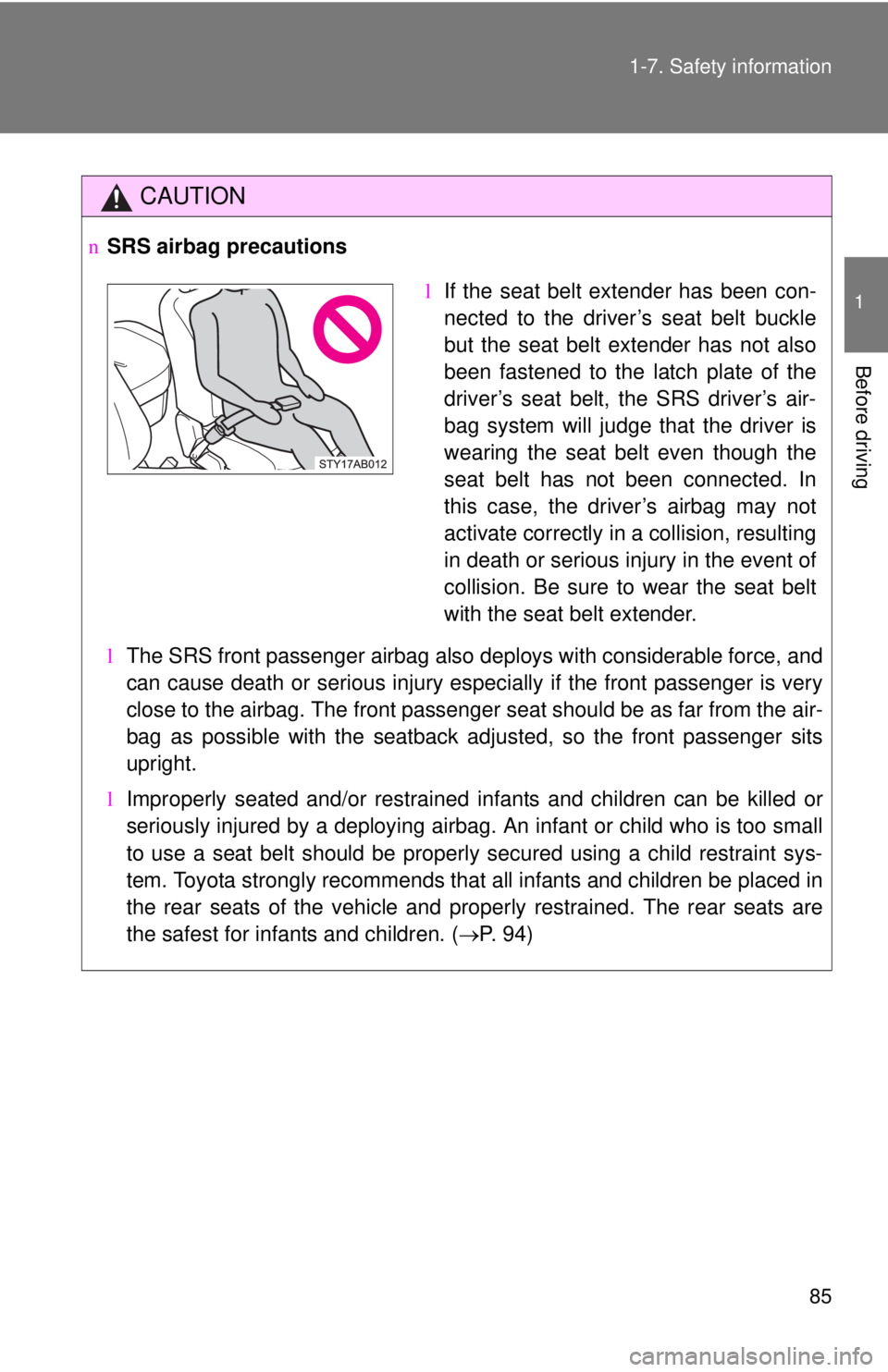
lIf the seat belt extender has been con-
nected to the driver’s seat belt buckle
but the seat belt extender has not also
been fastened to the latch plate of the
driver’s seat belt, the SRS driver’s air-
bag system will judge that the driver is
wearing the seat belt even though the
seat belt has not been connected. In
this case, the driver’s airbag may not
activate correctly in a collision, resulting
in death or serious injury in the event of
collision. Be sure to wear the seat belt
with the seat belt extender.
Page 105 of 400
89
1
1-7. Safety information
Before driving
Front passenger occupant classification system
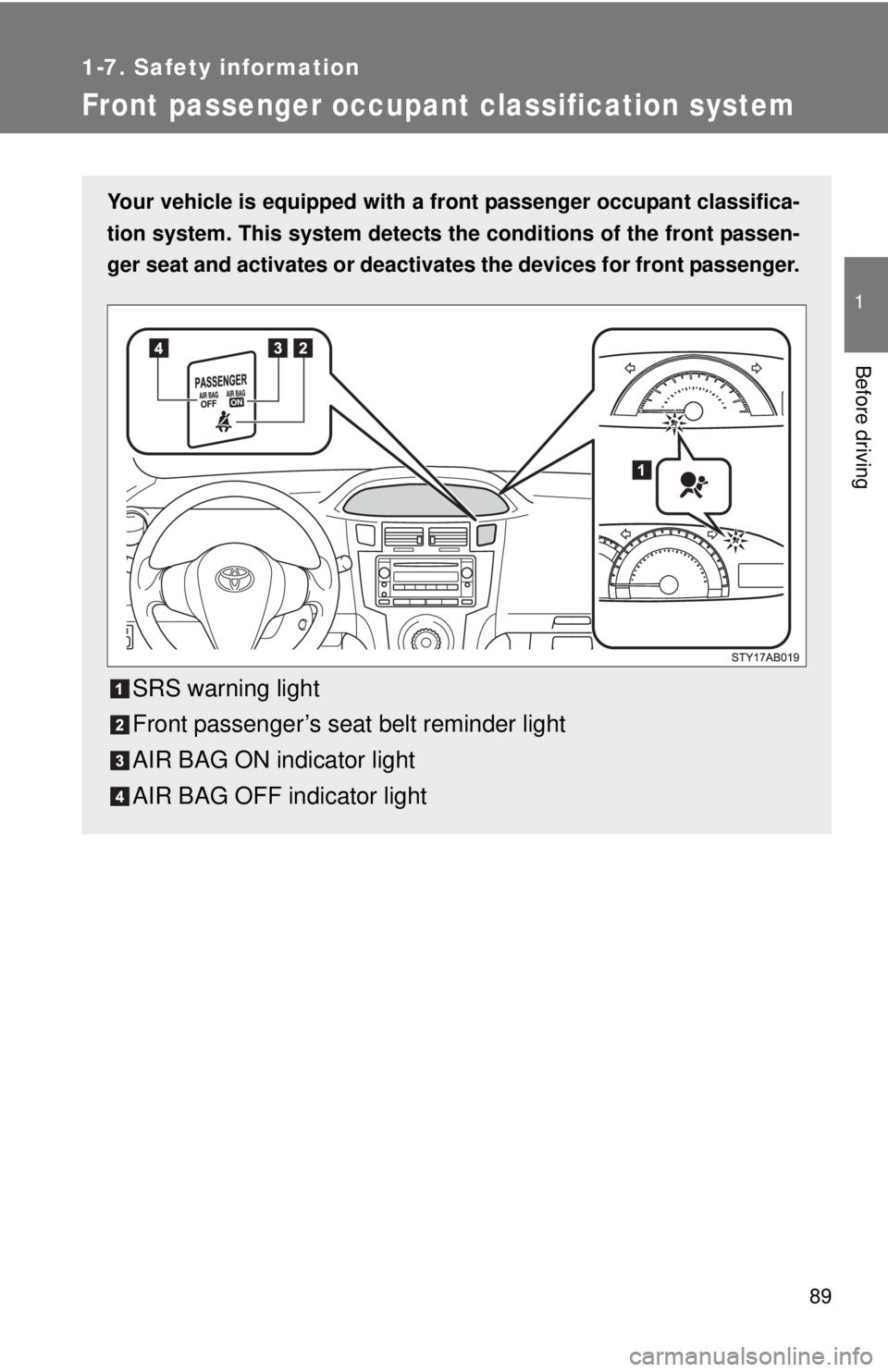
Your vehicle is equipped with a front passenger occupant classifica-
tion system. This system detects the conditions of the front passen-
ger seat and activates or deactivates the devices for front passenger.
SRS warning light
Front passenger’s seat belt reminder light
AIR BAG ON indicator light
AIR BAG OFF indicator light
Page 106 of 400

90 1-7. Safety information
Condition and operation in the front passenger occupant classification system
nAdult *1
nChild*3 or child restraint system*4
nUnoccupied
Indicator/
warning light AIR BAG ON and AIR BAG OFF indicator
lights AIR BAG ON
SRS warning light Off
Front passenger’s seat belt reminder light Flashing
*2
DevicesFront passenger airbag
Activated
Side airbag on the front passenger seat
Curtain shield airbag in the front passenger side
Front passenger’s seat belt pretensioner
Indicator/
warning light AIR BAG ON and AIR BAG OFF indicator
lights AIR BAG
OFF
*5
SRS warning light Off
Front passenger’s seat belt reminder light Flashing
*2
DevicesFront passenger airbag
Deactivated
Side airbag on the front passenger seat
Curtain shield airbag in the front passenger side Activated
Front passenger’s seat belt pretensioner
Indicator/
warning light AIR BAG ON and AIR BAG OFF indicator
lights
Not illuminated
SRS warning light Off
Front passenger’s seat belt reminder light
Devices Front passenger airbag
Deactivated
Side airbag on the front passenger seat
Curtain shield airbag in the front passenger side Activated
Front passenger’s seat belt pretensioner Deactivated
Page 107 of 400

91
1-7. Safety information
1
Before driving
n
There is a malfunction in the system
*1:The system judges a person of adult size as an adult. When a
smaller adult sits in the front pa ssenger seat, the system may rec-
ognize him/her as a child dependi ng on his/her physique and pos-
ture.
*2:In the event the front passenge r does not wear a seat belt.
*
3:When a larger child who has outgrow n a child restraint system sits
in the front passenger seat, the system may recognize him/her as
an adult depending on his/her physique or posture.
*4:Never install a rear-facing child restraint system on the front pas-
senger seat. A forward-facing child restraint system should only be
installed on the front passenger seat when it is unavoidable. ( →P.
94)
*5:In case the indicator is not illum inated, consult this manual as for
installing the child restraint system properly. ( →P. 9 8 )
Indicator/
warning light AIR BAG ON and AIR BAG OFF indicator
lights AIR BAG
OFF
SRS warning light On
Front passenger’s seat belt reminder light Off
Devices Front passenger airbag
Deactivated
Side airbag on the front passenger seat
Curtain shield airbag in the front passenger side Activated
Front passenger’s seat belt pretensioner
Page 108 of 400

92 1-7. Safety information
CAUTION
nFront passenger occupant cl assification system precautions
Observe the following precautions regarding front passenger occupant clas-
sification system.
Failure to do so may cause death or serious injury.
l Wear the seat belt properly.
l Make sure the front passenger’s seat belt tab has not been left inserted
into the buckle before someone sits in the front passenger seat.
l Make sure the AIR BAG OFF indicator light is not illuminated when using
the seat belt extender for the front passenger seat. If the AIR BAG OFF
indicator light is illuminated, disconnect the extender tongue from the seat
belt buckle, then reconnect the seat belt. Reconnect the seat belt extender
after making sure the AIR BAG ON indicator light is illuminated. If you use
the seat belt extender while the AIR BAG OFF indicator light is illuminated,
the front passenger airbag and side airbag on the front passenger side
may not activate correctly, which could cause death or serious injury in the
event of collision.
l Do not apply a heavy load to the front passenger seat or equipment.
l Do not put weight on the front passenger seat by putting your hands or
feet on the front passenger seat seatback from the rear passenger seat.
l Do not let a rear passenger lift the front passenger seat with their feet or
press on the seatback with their legs.
l Do not put objects under the front passenger seat.
l Do not recline the front passenger seatback so far that it touches a rear
seat. This may cause the AIR BAG OFF indicator light to be illuminated,
which indicates that the passenger’s airbags will not deploy in the event of
a severe accident. If the seatback touches the rear seat, return the seat-
back to a position where it does not touch the rear seat. Keep the front\
passenger seatback as upright as possible when the vehicle is moving.
Reclining the seatback excessively may lessen the effectiveness of the
seat belt system.
Page 109 of 400

93
1-7. Safety information
1
Before driving
CAUTION
n
Front passenger occupant cl assification system precautions
l If an adult sits in the front passenger seat, the AIR BAG ON indicator light
is illuminated. If the AIR BAG OFF indicator is illuminated, ask the passen-
ger to sit up straight, well back in the seat, feet on the floor, and with the
seat belt worn correctly. If the AIR BAG OFF indicator still remain illumi-
nated, either ask the passenger to move to the rear seat, or if that is not
possible, move the front passenger seat fully rearward.
l When it is unavoidable to install the forward-facing child restraint system
on the front passenger seat, install the child restraint system on the front
passenger seat in the proper order. ( →
P. 9 8)
l Do not modify or remove the front seats.
l Do not kick the front passenger seat or subject it to severe impact. Other-
wise, the SRS warning light may come on to indicate a malfunction of the
detection system. In this case, contact your Toyota dealer immediately.
l Child restraint systems installed on the rear seat should not contact the
front seatbacks.
Page 110 of 400
94
1-7. Safety information
Child restraint systems
Points to rememberStudies have shown that installing a child restraint on a rear seat is
much safer than installing one to the front passenger seat.
l Choose a child restraint system appropriate to the age and size of
the child.
l For installation details, follow the instructions provided with the
child restraint system.
General installation instructions are provided in this manual.
(→ P. 9 8 )
Types of child restraints
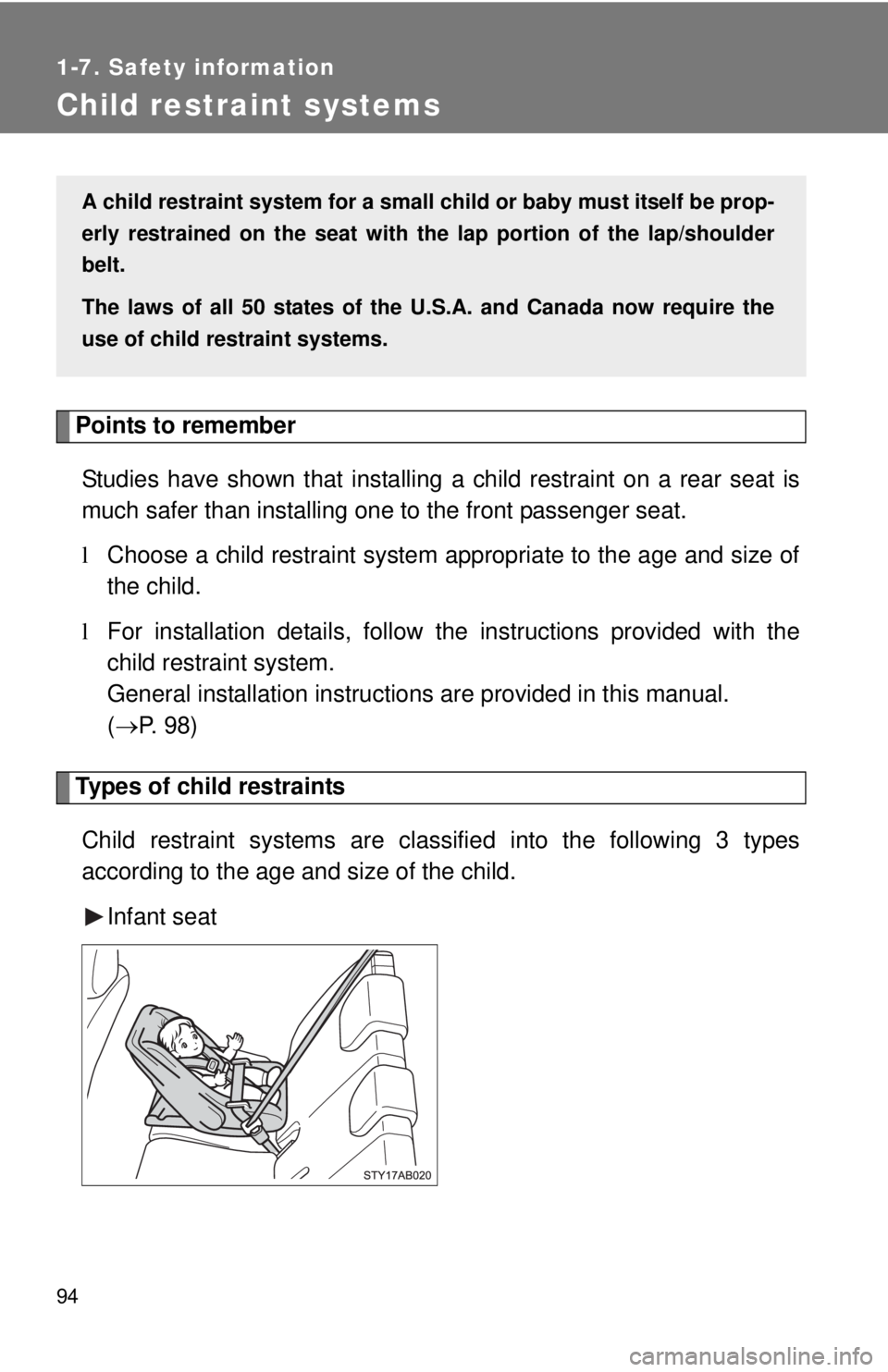
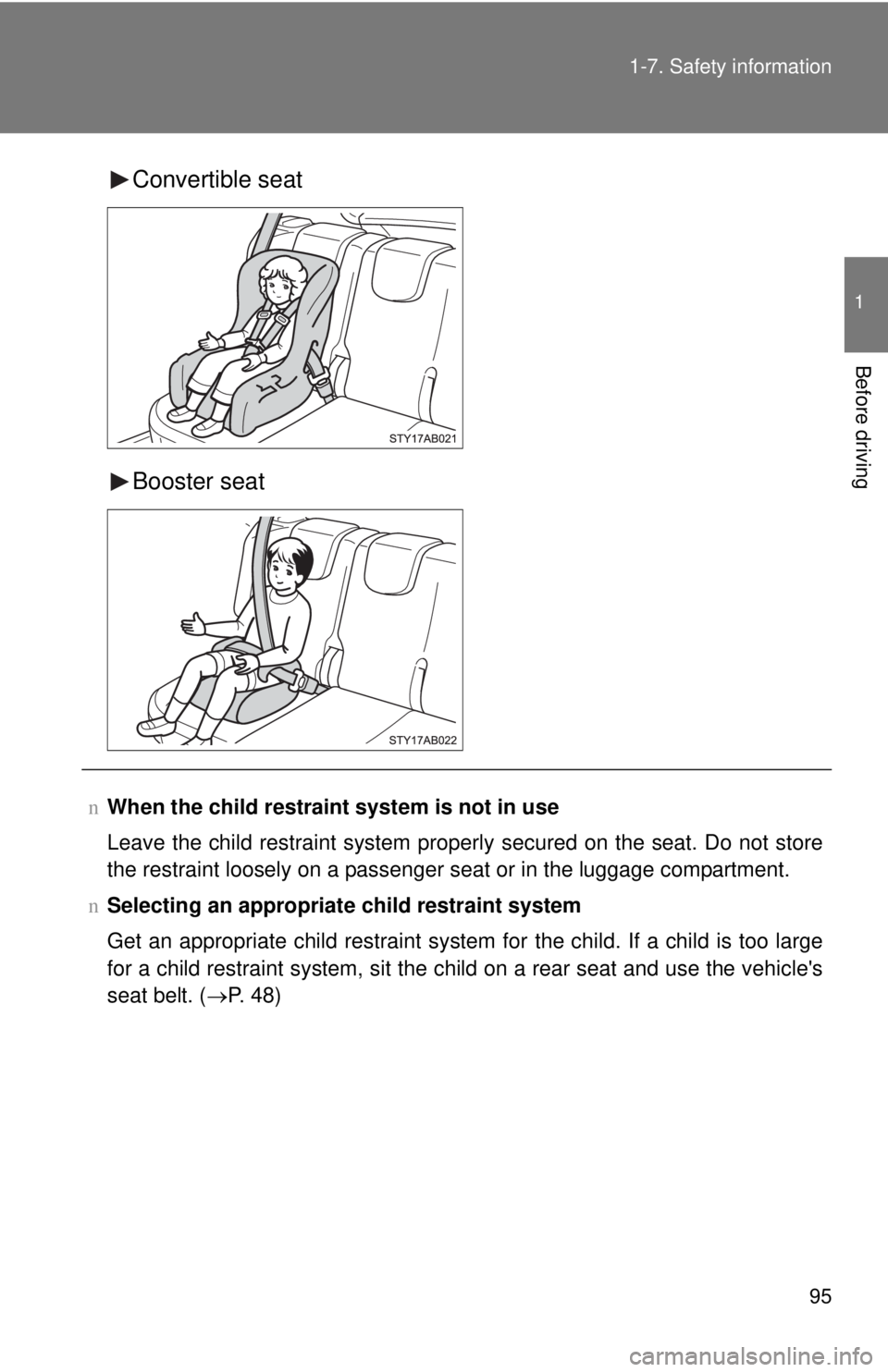
Child restraint systems are clas sified into the following 3 types
according to the age and size of the child.
Infant seat
A child restraint system for a small ch ild or baby must itself be prop-
erly restrained on the seat with the lap portion of the lap/shoulder
belt.
The laws of all 50 states of the U.S.A. and Canada now require the
use of child restraint systems.
Page 111 of 400
95
1-7. Safety information
1
Before driving
Convertible seat
Booster seat
n
When the child restrain t system is not in use
Leave the child restraint system properly secured on the seat. Do not store
the restraint loosely on a passenger seat or in the luggage compartment.
n Selecting an appropriat e child restraint system
Get an appropriate child restraint system for the child. If a child is too large
for a child restraint system, sit the child on a rear seat and use the vehicle's
seat belt. ( →P. 48)