light TOYOTA YARIS HATCHBACK 2008 Repair Manual
[x] Cancel search | Manufacturer: TOYOTA, Model Year: 2008, Model line: YARIS HATCHBACK, Model: TOYOTA YARIS HATCHBACK 2008Pages: 400, PDF Size: 6.56 MB
Page 175 of 400

160 2-5. Driving information
Trailer towing tipsYour vehicle will handle differently when towing a trailer. The three
main causes of vehicle-trailer ac cidents are driver error, excessive
speed and improper trailer loading. Keep these in mind when towing.
l Before starting out, check the trailer’s light and the vehicle-trailer
connections. Recheck after driving a short distance.
l Practice turning, stopping and reve rsing with the trailer attached in
an area away from traffic until you become accustomed to the feel
of the vehicle.
NOTICE
n When installing a trailer hitch
Use only the position recommended by your Toyota dealer. Do not install the
trailer hitch on the bumper; this may cause body damage.
n Brakes
Toyota recommends trailers with brakes that conform to any applicable fed-
eral and state/provincial regulations.
n Safety chain
A safety chain must always be used between the towing vehicle and the
trailer. Leave sufficient slack in the chain for turns. The chain should cross
under the trailer tongue to prevent the tongue from dropping to the ground in
the case that it becomes damaged or separated. For the correct safety chain
installation procedure, ask your Toyota dealer.
n Do not directly splice trailer lights
Directly splicing may damage your vehicle’s electrical system and cause a
malfunction.
Page 189 of 400
175
3-1. Using the air conditioning system and defogger
3
Interior features
Rear window defogger (if equipped)
nThe rear window defogger can be operated when
The engine switch must be in the ON position.
NOTICE
n To prevent battery discharge
Do not leave the rear window defogger on longer than necessary when the
engine is stopped.
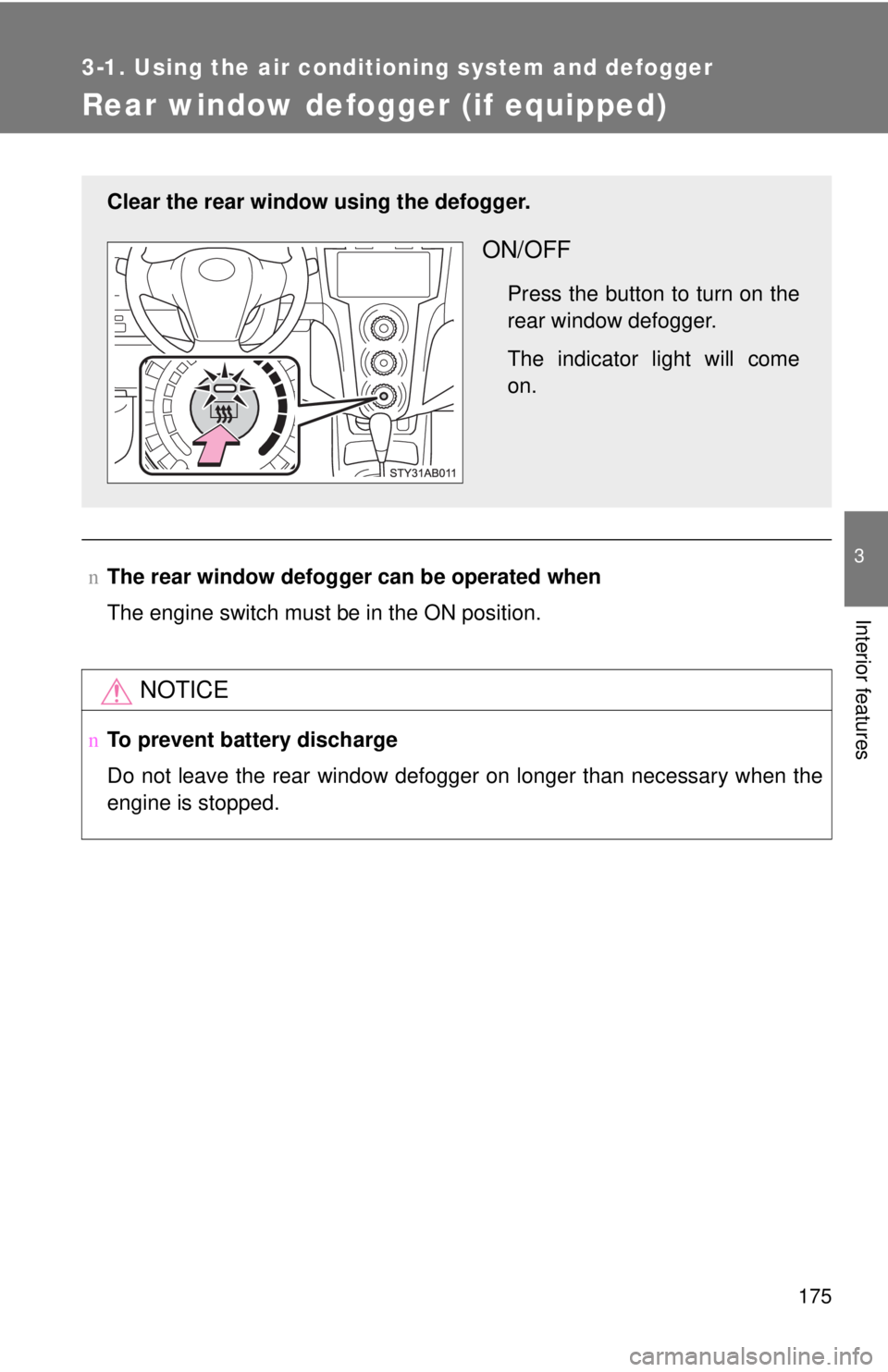
Clear the rear window using the defogger.
ON/OFF
Press the button to turn on the
rear window defogger.
The indicator light will come
on.
Page 198 of 400

184 3-2. Using the audio system
nCleaning the cassette player
Cassette player components (heads, capstan, pinch rollers) should be
cleaned at least once a month using a cleaning tape to remove dirt and dust
that can easily build up.
n Using long playing cassette tapes
Avoid using tapes with a length of more than 90 minutes, as the tape used is
very thin and may become tangled in the cassette player.
NOTICE
nCassette tapes that cannot be used
Do not use a cassette tape if it has been damaged or tangled or if its label is
peeling off. Such tapes may affect playing speed and may also get stuck in
the player.
n Cassette player precautions
lStore cassette tapes away from direct sunlight.
l Do not insert anything other than cassette tapes into the cassette player.
l Do not apply oil to the cassette player.
Page 205 of 400
191
3-2. Using the audio system
3
Interior features
NOTICE
n
CD player precautions
Failure to follow the precautions below may result in serious damage to the
CDs or the player itself.
lDo not insert anything other than CDs into the CD slot.
l Do not apply oil to the CD player.
l Store CDs away from direct sunlight.
l Never try to disassemble any part of the CD player.
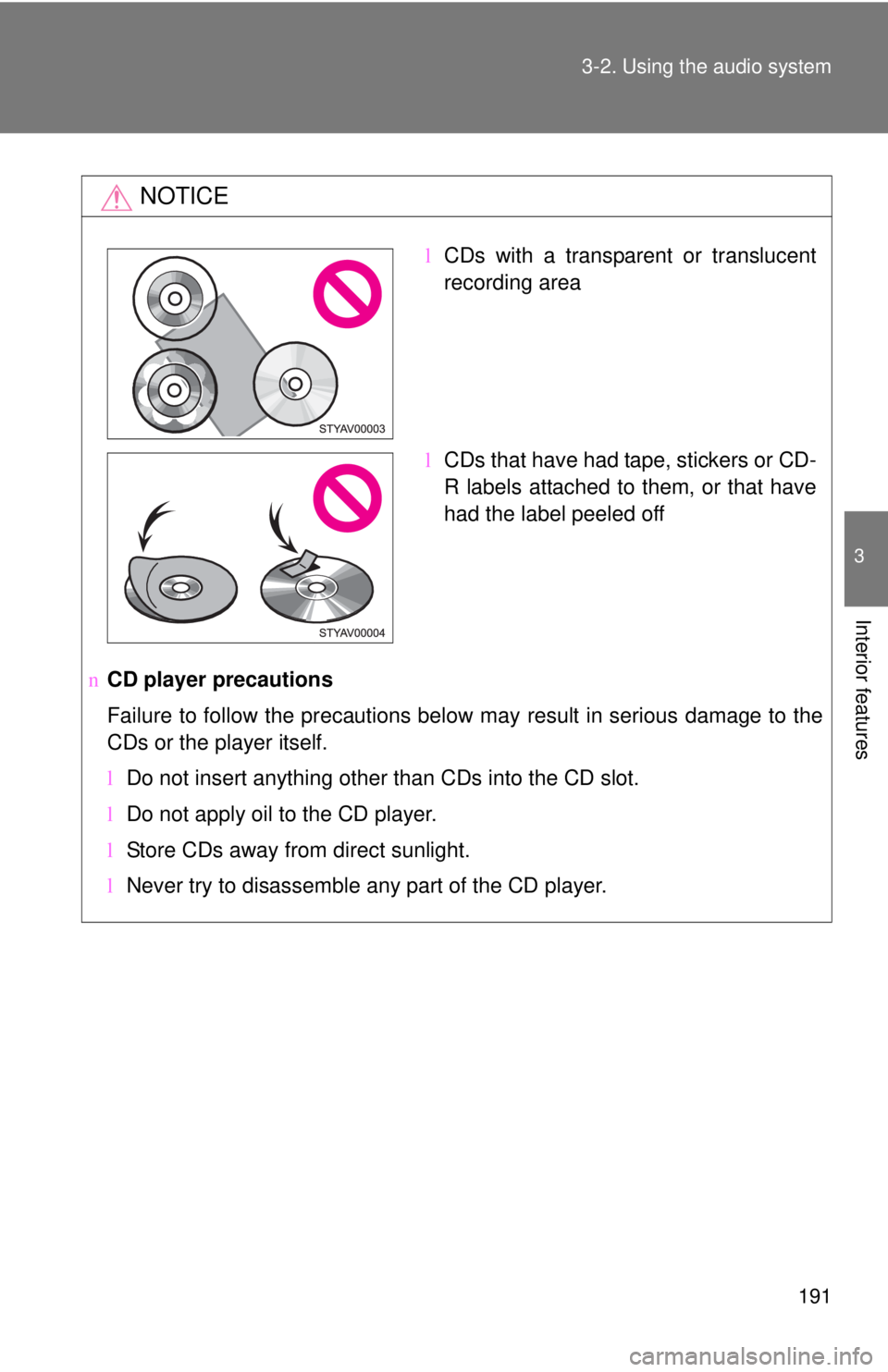
lCDs with a transparent or translucent
recording area
l CDs that have had tape, stickers or CD-
R labels attached to them, or that have
had the label peeled off
Page 218 of 400
204
3-3. Using the interior lights
Interior lights list
nIlluminated entry system
When the interior light switch is in the DOOR position, the interior light auto-
matically turns on/off according to whether the doors are locked/unlocked
and whether the doors are open/closed and the engine switch position.
n To prevent the battery from being discharged
If the interior light remains on when the door is not fully closed and the inte-
rior light switch is in the DOOR position, the light will go off automatically
after 20 minutes.
n Customization that can be co nfigured at Toyota dealer
Settings (e.g. The time elapsed before lights turn off) can be changed.
(Customizable features →P. 363)
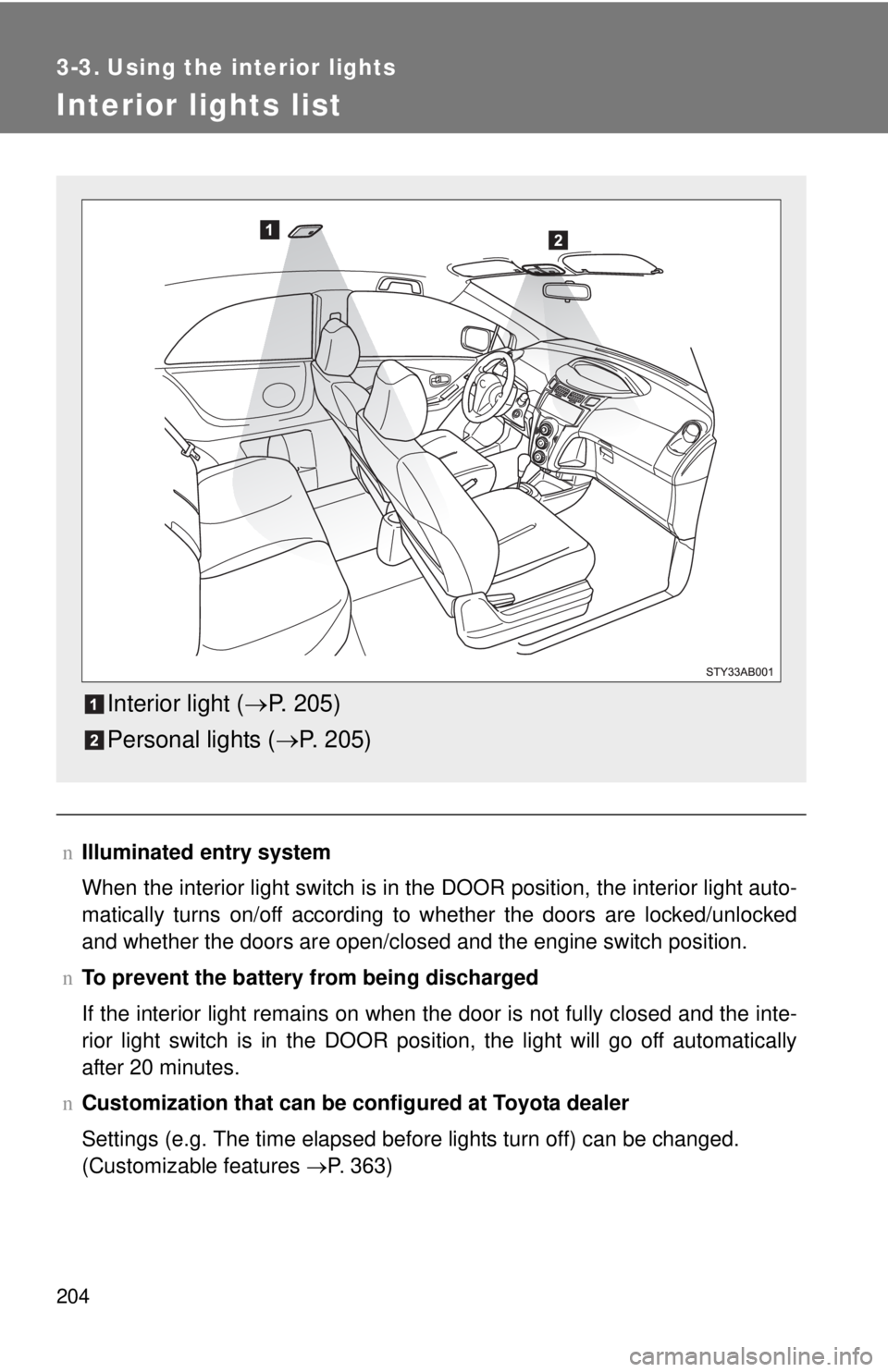
Interior light (→P. 205)
Personal lights ( →P. 205)
Page 219 of 400
205
3-3. Using the interior lights
3
Interior features
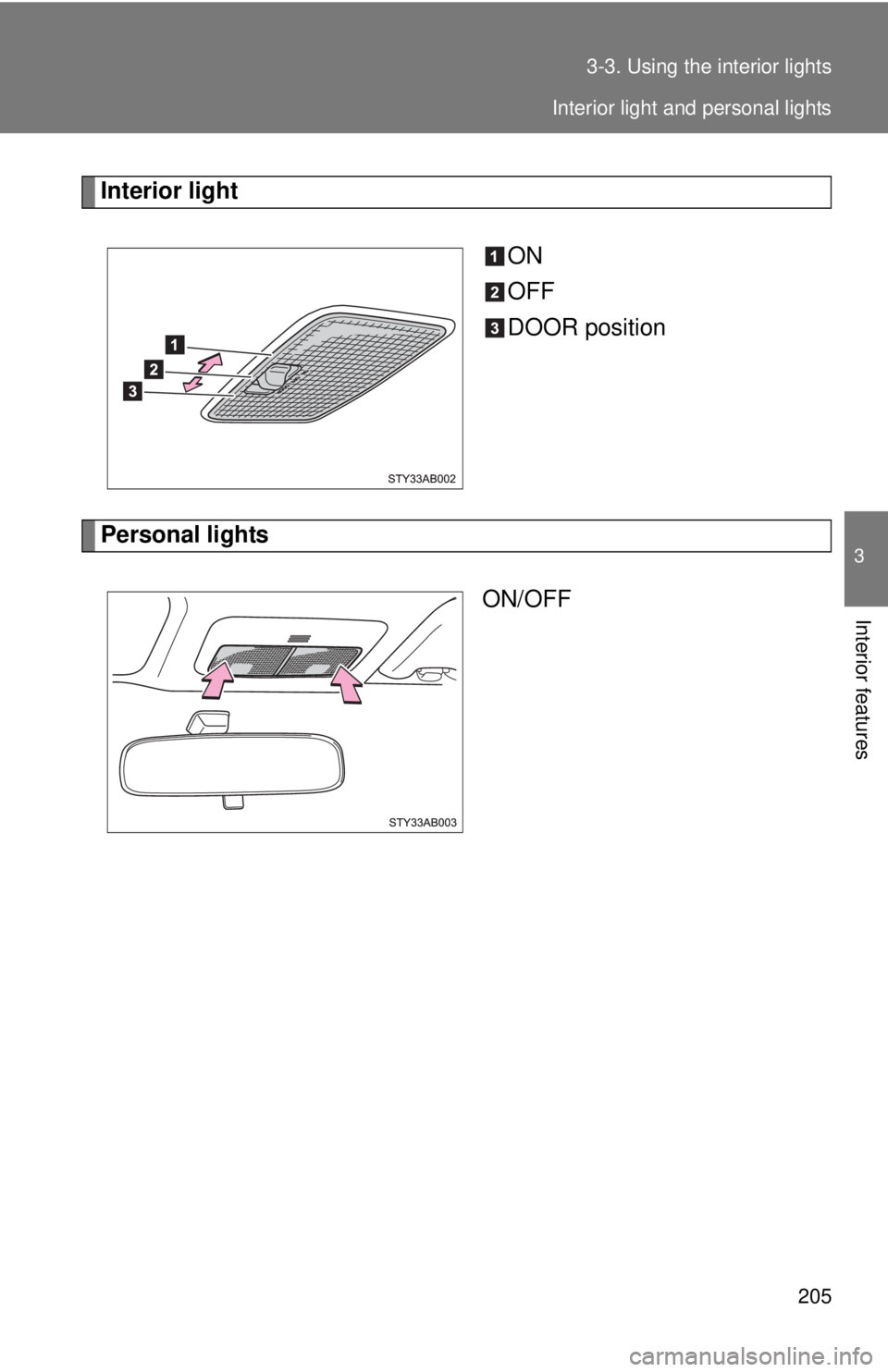
Interior light
ON
OFF
DOOR position
Personal lightsON/OFF
Interior light and personal lights
Page 221 of 400
207
3-4. Using the
storage features
3
Interior features
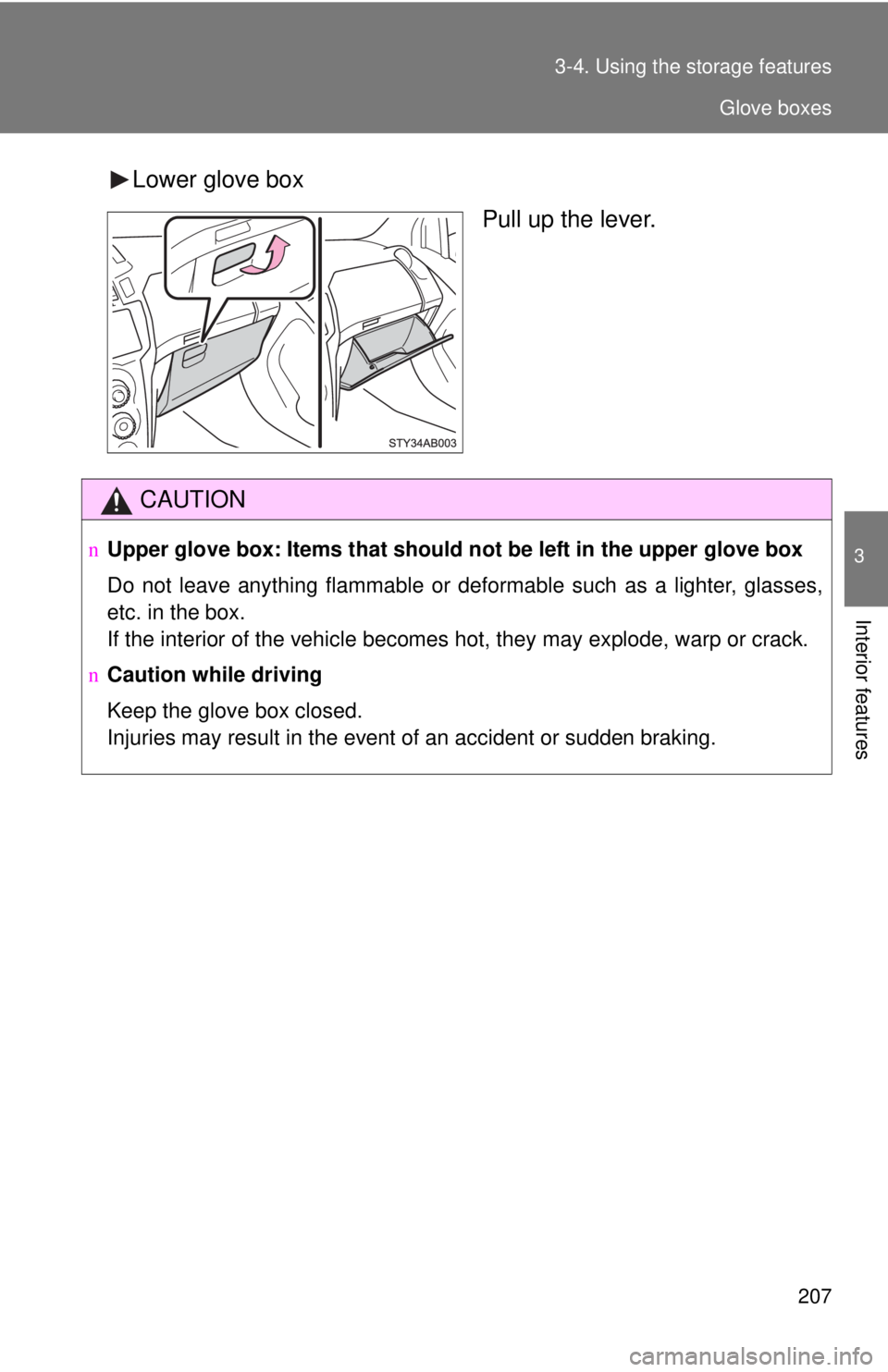
Lower glove box
Pull up the lever.
CAUTION
nUpper glove box: Items that should not be left in the upper glove box
Do not leave anything flammable or deformable such as a lighter, glasses,
etc. in the box.
If the interior of the vehicle becomes hot, they may explode, warp or crack.
n Caution while driving
Keep the glove box closed.
Injuries may result in the event of an accident or sudden braking.
Glove boxes
Page 226 of 400

212 3-4. Using the storage features
CAUTION
nType A: Items that should not be left in the auxiliary box
Do not leave anything flammable or deformable such as a lighter, glasses,
etc. in the box.
If the interior of the vehicle becomes hot, they may explode, warp or crack.
n Caution while driving
Keep the auxiliary box closed.
Injuries may result in the event of an accident or sudden braking.
Auxiliary boxes
Page 236 of 400
223
4-1. Maintenance and care
4
Maintenance and care
n
To prevent deteriorati on and body corrosion
l Wash the vehicle immediately in the following cases:
• After driving near the sea coast
• After driving on salted roads
• If you see coal tar or tree sap on the paint surface
• If you see dead insects or insect droppings on the paint
• After driving in an area contaminated with soot, oily smoke, mine dust,
iron powder or chemical substances
• If the vehicle becomes heavily soiled in dust or mud
• If liquids such as benzene and gasoline are spilled on the paint surface
l If the paint is chipped or scratched, have it repaired immediately.
CAUTION
nCaution about the exhaust pipe
Exhaust gasses cause the exhaust pipe to become quite hot.
When washing the vehicle, be careful not to touch the pipe until it has cooled
sufficiently, as touching a hot exhaust pipe can cause burns.
NOTICE
nTo protect your vehicle’s painted surfaces
Do not use organic cleaners such as benzene or gasoline.
n Cleaning the exterior lights
lWash carefully. Do not use organic substances or scrub with a hard brush.
This may damage the surfaces of the lights.
l Do not apply wax on the surfaces of the lights.
Wax may cause damage to the lenses.
n To prevent damage to the windshield wiper arms
When lifting the wiper arms away from the windshield, pull the driver side
wiper arm upward first, and repeat for the passenger side. When returning
the wipers to their original position, do so from the passenger side first.
Page 239 of 400

226 4-1. Maintenance and care
NOTICE
nCleaning detergents
Do not use organic substances such as benzene or gasoline, acidic or alka-
line solutions, dye, bleach or other detergent. Doing so may discolor the
vehicle interior or cause streaks or damage to painted surfaces.
n Preventing damage to leather surfaces
Observe the following precautions to avoid damage to and deterioration o\
f
leather surfaces.
lRemove any dust or dirt on leather surfaces immediately.
l Do not expose the vehicle to direct sunlight for extended periods of time.
Park the vehicle in the shade, especially during summer.
l Do not place items made of vinyl, plastic, or that contain wax on the uphol-
stery, as they may stick to the leather surface if the vehicle interior heats
up significantly.
n Water on the floor
Do not wash the vehicle floor with water.
Vehicle systems such as the audio system may be damaged if water comes
into contact with electrical components under the floor of the vehicle, and
may also cause the body to rust.
n Cleaning the inside of the rear window
Be careful not to scratch or damage the heater wires.