Tail TOYOTA YARIS HATCHBACK 2009 User Guide
[x] Cancel search | Manufacturer: TOYOTA, Model Year: 2009, Model line: YARIS HATCHBACK, Model: TOYOTA YARIS HATCHBACK 2009Pages: 402, PDF Size: 7.61 MB
Page 158 of 402
145
2
When driving
2-3. Operating the lights and wipers
Headlight switch
Turning on the high beam headlights
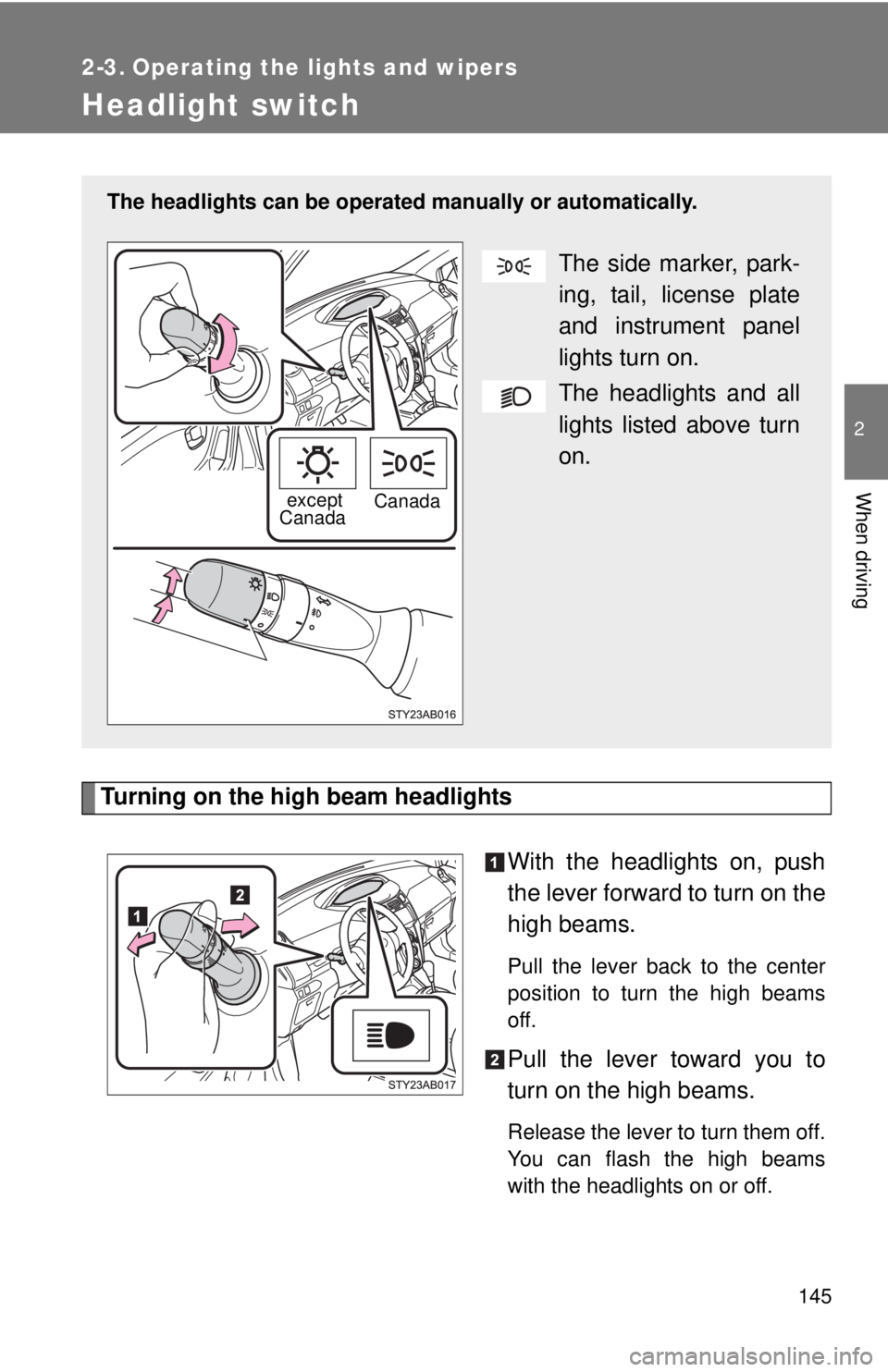
With the headlights on, push
the lever forward to turn on the
h
igh beams.
Pull the lever back to the center
position to turn the high beams
off.
Pull the lever toward you to
turn on the high beams.
Release the lever to turn them off.
You can flash the high beams
with the headlights on or off.
The headlights can be operated manually or automatically.
The side marker, park-
ing, tail, license plate
an
d instrument panel
lights turn on.
The headlights and all
lights listed above turn
on
.
except
Canada Canada
Page 173 of 402
160
2-5. Driving information
Vehicle load limits
nTotal load capacity and seating capacity
These details are also described on the tire and loading information
label.(→P. 2 6 4
)
CAUTION
nOverloading the vehicle
Do not overload the vehicle.
It may not only cause damage to the ti res, but also degrade steering and
braking ability, resulting in an accident.
Vehicle load limits include total load capacity, seating capacity,
towing capacity and cargo capacity.
n Total load capacity: 845 lb. (383 kg)
Total load capacity means the combined weight of occupants,
car
go and luggage.
n Se
ating capacity: 5 occupants (Front 2, Rear 3)
Seating capacity means the ma ximum n
umber of occupants
whose estimated average weight is 150 lb. (68 kg) per person.
Even if the number of occupants are within the seating capacity,
do no
t exceed the total load capacity.
n T
owing capacity (Canada): 700 lb. (318 kg)
Towing capacity means the maximum gross trailer weight (trailer
weigh
t plus its cargo weight) that your vehicle is able to tow.
n T
owing capacity (except Canada)
Toyota does not recommend towing a trailer with your vehicle.
n Cargo cap
acity
Cargo capacity may increase or decrease depending on the
weigh
t and the number of occupants.
Page 176 of 402
163
2-5. Driving information
2
When driving
CAUTION
n
Driving with snow tires
Observe the following precautions to reduce the risk of accidents.
Failing to do so may result in a loss of vehicle control and cause death or
serious injury.
l Use tires of the size specified for your vehicle.
l Maintain the recommended level of air pressure.
l Do not drive in excess of 75 mph (120 km/h) regardless of the type of
snow tires being used.
l Snow tires should be installed on all wheels.
n Driving with snow chains
Observe the following precautions to reduce the risk of accidents.
Failing to do so may result in the vehicle being unable to be driven safely,
and may cause death or serious injury.
l Do not drive in excess of the speed limit specified for the tire chains being
used or 30 mph (50 km/h), whichever is lower.
l Avoid driving on bumpy road surfaces or over potholes.
l Avoid sudden turns and braking.
l Slow down sufficiently before entering a curve to ensure that vehicle con-
trol is maintained.
NOTICE
nRepairing or replacing snow tires
Request repairs of and obtain replacement snow tires from Toyota dealers or
legitimate tire retailers.
This is because the removal and attachment of snow tires affects the opera-
tion of the tire pressure warning valves and transmitters.
n Fitting tire chains
The tire pressure warning valves and transmitters may not function correctly
when tire chains are fitted.
Page 191 of 402
179
3-1. Using the air conditioning system
and defogger
3
Interior features
nAdjusting the fan speed
Turn the fan speed control dial clockwise (
increase) or counter-
clockwise (decrease).
Set the dial to “0” to turn the fan off.
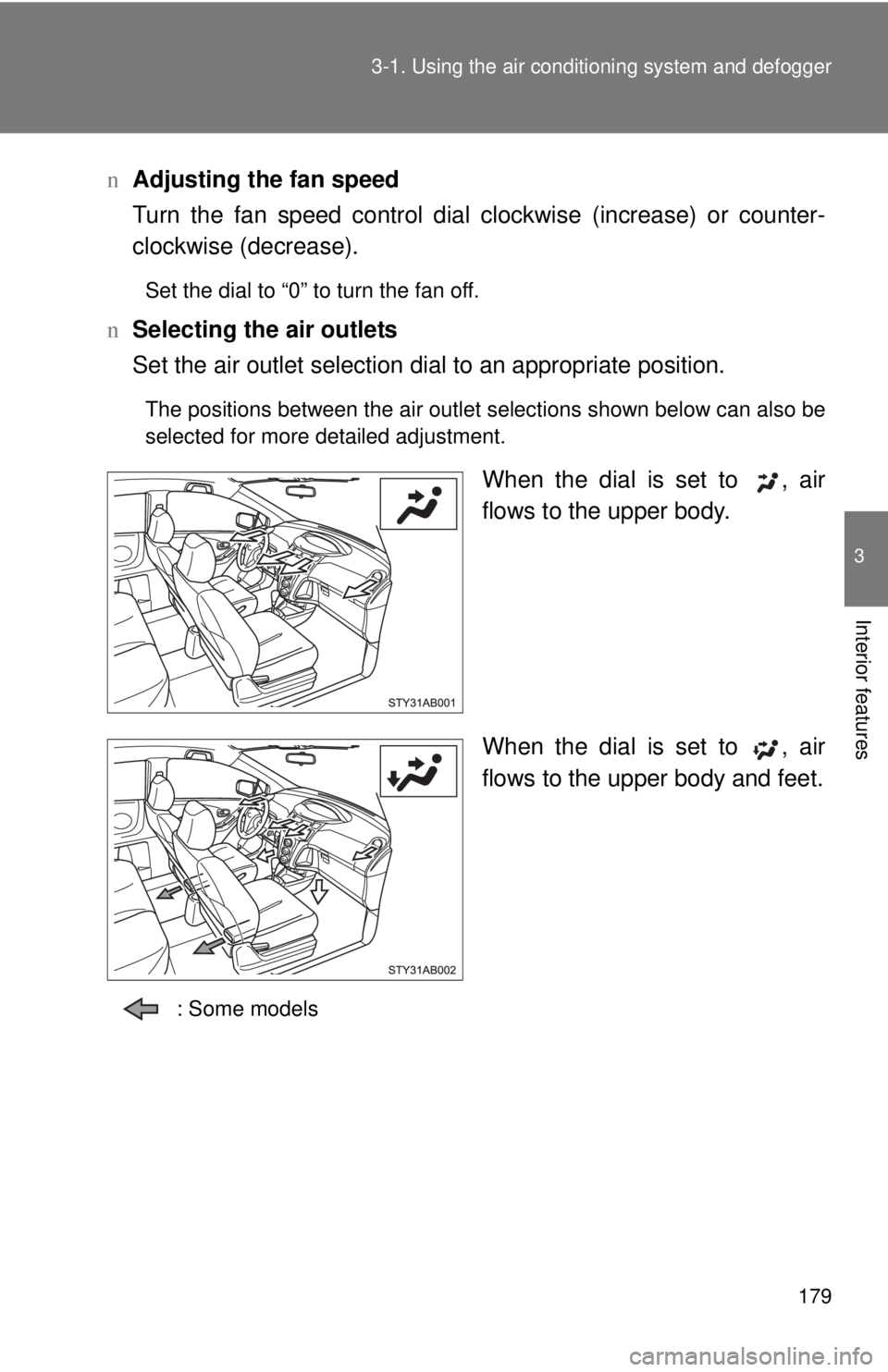
n Selecting the air outlets
Set the air outlet selection di al to
an appropriate position.
The positions between the air outlet selections shown below can also be
selected for more detailed adjustment.
When the dial is set to , air
flows to the upper body.
When the dial is set to , air
flows to the upper body and feet.
: Some models
Page 204 of 402
192 3-2. Using the audio system
nXM® Satellite Radio
An XM
® Satellite Radio is a tuner designed exclusively to receive broadcasts
provided under a separate subscription. Availability is limited to the 48 con-
tiguous states and 10 Canadian provinces.
l XM
® subscriptions
For detailed information about XM® Satellite Radio or to subscribe:
U.S.A.—
Visit on the web at www.xmradio.com
or call 1-800-967-2346.
Canada—
Visit on the web at www.xmradio.ca
or call 1-877-438-9677.
l Radio ID
You will need the radio ID when activating XM
® service or reporting a
problem. Select “CH000” using , and the receiver’s 8-character ID
number will appear.
l Satellite tuner
The tuner supports only Audio Services (Music and Talk) and the accom-
panying Text Information of XM
® Satellite Radio.
n If the satellite radio does not operate normally
If a problem occurs with the XM
® tuner, a message will appear on the dis-
play. Refer to the table below to identify the problem, and take the suggested
corrective action.
ANTENNA The XM
® antenna is not connected. Check
whether the XM® antenna cable is attached
securely.
There is a short-circuit in the antenna or the sur-
rounding antenna cable. See a Toyota certified
dealer.
Page 244 of 402
233
4
Maintenance and care
4-2. Maintenance
Maintenance requirements
nRepair and replacement
It is recommended that genuine Toyota parts be used for repair to ensure
perf
ormance of each system. If non-Toyota parts are used in replacement or
if a repair shop other than Toyota deal er performs repairs, confirm the war-
ranty coverage.
To ensure safe and economical driv ing, day-to-day care and regular
maintenance is essential. It is the owner’s responsibility to perform
regular checks. Toyota recommen ds the following maintenance.
nGeneral maintenance
Should be performed on a daily basis. This can be done by your -
self or by a Toyota dealer.
n Scheduled maintenance
Should be performed at specified intervals according to the
ma
intenance schedule.
For details about maintenance items and schedules, refer to the
“Scheduled Maintenance Guide” or “Owner’s Manual Supplement”.
nDo-it-yourself maintenance
You can perform some maintenance procedures yourself.
Please be aware that do-it-yourself maintenance may affect war -
ranty coverage.
The use of Toyota Repair Manuals is recommended.
For details about warranty coverage, see the separate “Owner’s
W
arranty Information Booklet”, “Owner’s Manual Supplement”.
Page 262 of 402
251
4-3. Do-it-yourself maintenance
4
Maintenance and care
n
If the coolant level drops within a short time after replenishing
Visually check the radiator, hoses, reservoir cap, radiator cap, drain cock
and water pump.
If you cannot find a leak, have your Toyota dealer pressure test the cap and
check for leaks in the cooling system.
n Coolant selec
tion
Only use “Toyota Super Long Life Coolant” or similar high quality ethylene
glycol based n
on-silicate, non-amine, non-nitrite and non-borate coolant with
long-life hybrid organic acid technology.
Except Canada:“Toyota Super Long Life Coolant” is a mixture of 50% cool -
ant and 50% deionized water. (Enabled: -31 °F [-
35°C])
Canada: “Toyota Super Long Life Coolant” is a mixture of 55% coolant and 45% deionized water
. (Enabled: -44°F [-42 °C])
For more details about engine coolant, contact your Toyota dealer.
CAUTION
n When the engine is hot
Do not remove the radiator cap.
The cooling system may be under pressure and may spray hot coolant if the
cap is removed, causing burns or other injuries.
NOTICE
nWhen adding engine coolant
Coolant is neither plain water nor strai ght antifreeze. The correct mixture of
water and antifreeze must be used to provide proper lubrication, corrosion
protection and cooling. Be sure to read the antifreeze or coolant label.
n If you spill coolant
Be sure to wash it off with water to prevent damage to parts or paint.
Page 288 of 402
277
4-3. Do-it-yourself maintenance
4
Maintenance and care
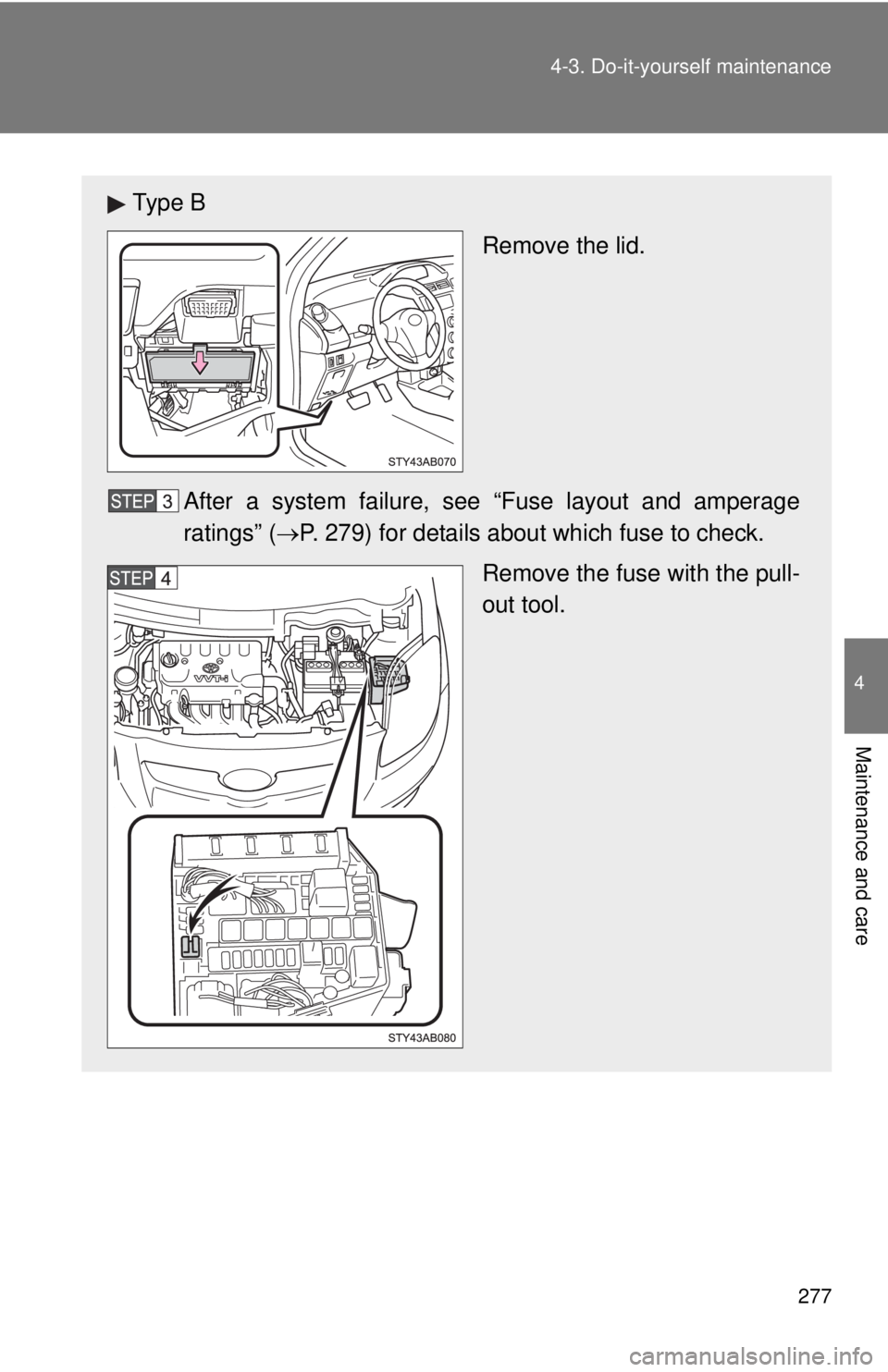
Ty p e B
Remove the lid.
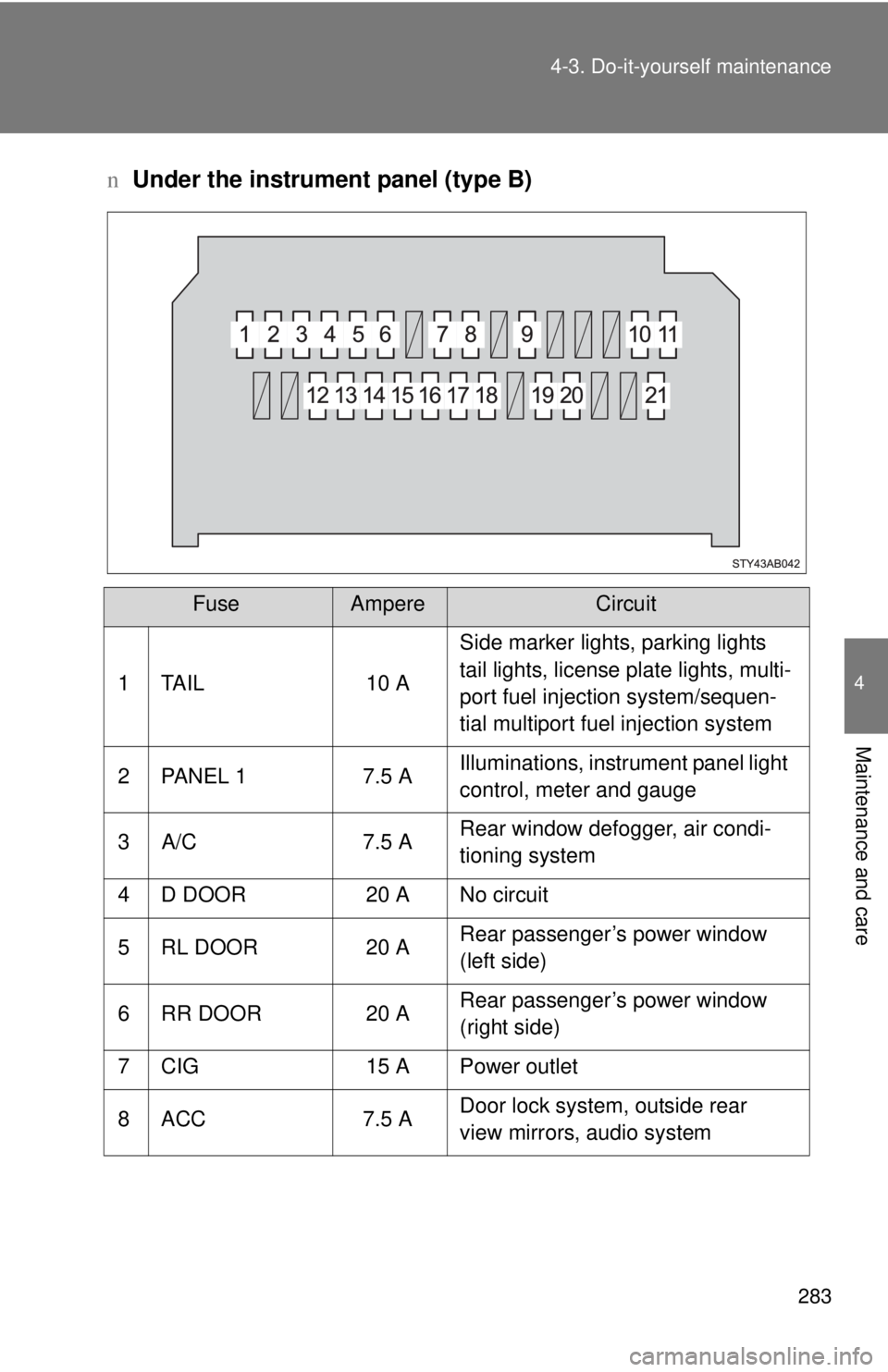
After a system failure, s ee “Fuse
layout and amperage
ratings” (→ P. 2 7 9) for details about which fuse to check.
Remove the fuse with the pull-
o
ut tool.
Page 294 of 402
283
4-3. Do-it-yourself maintenance
4
Maintenance and care
n
Under the instrument panel (type B)
FuseAmpereCircuit
1 TAIL 10 A Side marker lights, parking lights
tail lights, license plate lights, multi-
port fuel injection system/sequen-
tial multiport fuel injection system
2 PANEL 1 7.5 A Illuminations, instrument panel light
control, meter and gauge
3 A/C 7.5 A Rear window defogger, air condi-
tioning system
4 D DOOR 20 A No circuit
5 RL DOOR 20 A Rear passenger’s power window
(left side)
6 RR DOOR 20 A Rear passenger’s power window
(right side)
7 CIG 15 A Power outlet
8 ACC 7.5 A Door lock system, outside rear
view mirrors, audio system
Page 298 of 402

287
4-3. Do-it-yourself maintenance
4
Maintenance and care
Replacing light bulbs
n
Headlights
Unplug the connector.
Remove the rubber cover.
nRear bulb locations
Back-up lights
Rear turn signal lights Stop/tail and rear
side marker lights
License
plate light