brakes TOYOTA YARIS HATCHBACK 2009 User Guide
[x] Cancel search | Manufacturer: TOYOTA, Model Year: 2009, Model line: YARIS HATCHBACK, Model: TOYOTA YARIS HATCHBACK 2009Pages: 402, PDF Size: 7.61 MB
Page 184 of 402
171
2-5. Driving information
2
When driving
l
In order to maintain engine braki ng efficiency, do not use the trans -
mission in D (automatic transmiss ion
) or 5 (manual transmission).
l Du
e to the added load of the trailer, your vehicle’s engine may
overheat on hot days (at temperatures over 85°F [30°C]) when
driving up a long or steep grade. If the engine coolant temperature
gauge indicates overheating, immedi ately turn off the air condition-
ing (if in use), pull your vehicle off the road and stop in a safe spot.
( → P. 3 3 7 )
l Alw
ays place wheel blocks under both the vehicle and the trailer
wheels when parking. Apply the parking brake firmly, and put the
transmission in P (automatic transmission) or in 1 or R (manual
transmission). Avoid parking on a slope, but if unavoidable, do so
only after performing the following:
Apply the brakes and keep them applied.
Have someone place wheel blocks un
der both the vehicle and
trailer wheels.
When the wheel blocks are in pl ace, re
lease the brakes slowly
until the blocks absorb the load.
Apply the parking brake firmly.
Shift into 1 or R (manual transmission) or P (automatic trans -
mission) and turn off the engine.
l Whe
n restarting after parking on a slope:
With the transmission in P (automatic transmission) or the
clutch pedal (manual transmission) depressed, start the
eng
ine. On vehicles with an au tomatic transmission, be sure
to keep the brake pedal pressed.
Shift into a forward gear. If reversing, shift into R.
Release the parking brake (also b
rake pedal on vehicles with
an automatic transmission), and sl o
wly pull or back away from
the wheel blocks. Stop and apply the brakes.
Have someone retrieve the blocks.
Page 185 of 402

172 2-5. Driving information
CAUTION
nTo avoid an accident
lDo not exceed 45 mph (72 km/h) or posted towing speed limit, whichever
is lower. As instability (swaying) of the towing vehicle-trailer combination
increases as speed increases, exceeding 45 mph (72 km/h) may cause
loss of control.
l Slow down and downshift before descending steep or long downhill
grades. Do not make sudden downshifts.
l Avoid holding the brake pedal down too long or too frequently. This could
cause the brakes to overheat and result in reduced braking efficiency.
Page 247 of 402

236 4-2. Maintenance
Vehicle interior
ItemsCheck points
Accelerator pedal • Moves smoothly (without uneven
pedal effort or catching)?
Automatic transmission “Park”
mechanism • Can the vehicle be hold securely
on an incline with the shift lever in
P?
Brake pedal • Moves smoothly?
• Does it have appropriate clear-
ance and correct amount of free
play?
Brakes • Not pull to one side when
applied?
• Loss of brake effectiveness?
• Spongy feeling brake pedal?
• Pedal almost touches floor?
Clutch pedal • Moves smoothly?
• Does it have correct amount of
free play?
Head restraints • Move smoothly and lock
securely?
Indicators/buzzers • Function properly?
Lights • Do all the lights come on?
• Headlights aimed correctly?
Parking brake • Moves smoothly?
• Can hold the vehicle securely on
an incline?
Seat belts • Does the seat belt system oper-
ate smoothly?
• Are the belts undamaged?
Seats • Do the seat controls operate
properly?
Page 307 of 402
5
When trouble arises
297
5-1. Essential information
If your vehicle needs to be towed
Before towing
The following may indicate a problem with your transmission. Contact
your Toyota dealer before towing.
lThe en
gine is running, but the vehicle will not move.
lThe
vehicle makes an abnormal sound.
Emergency towing
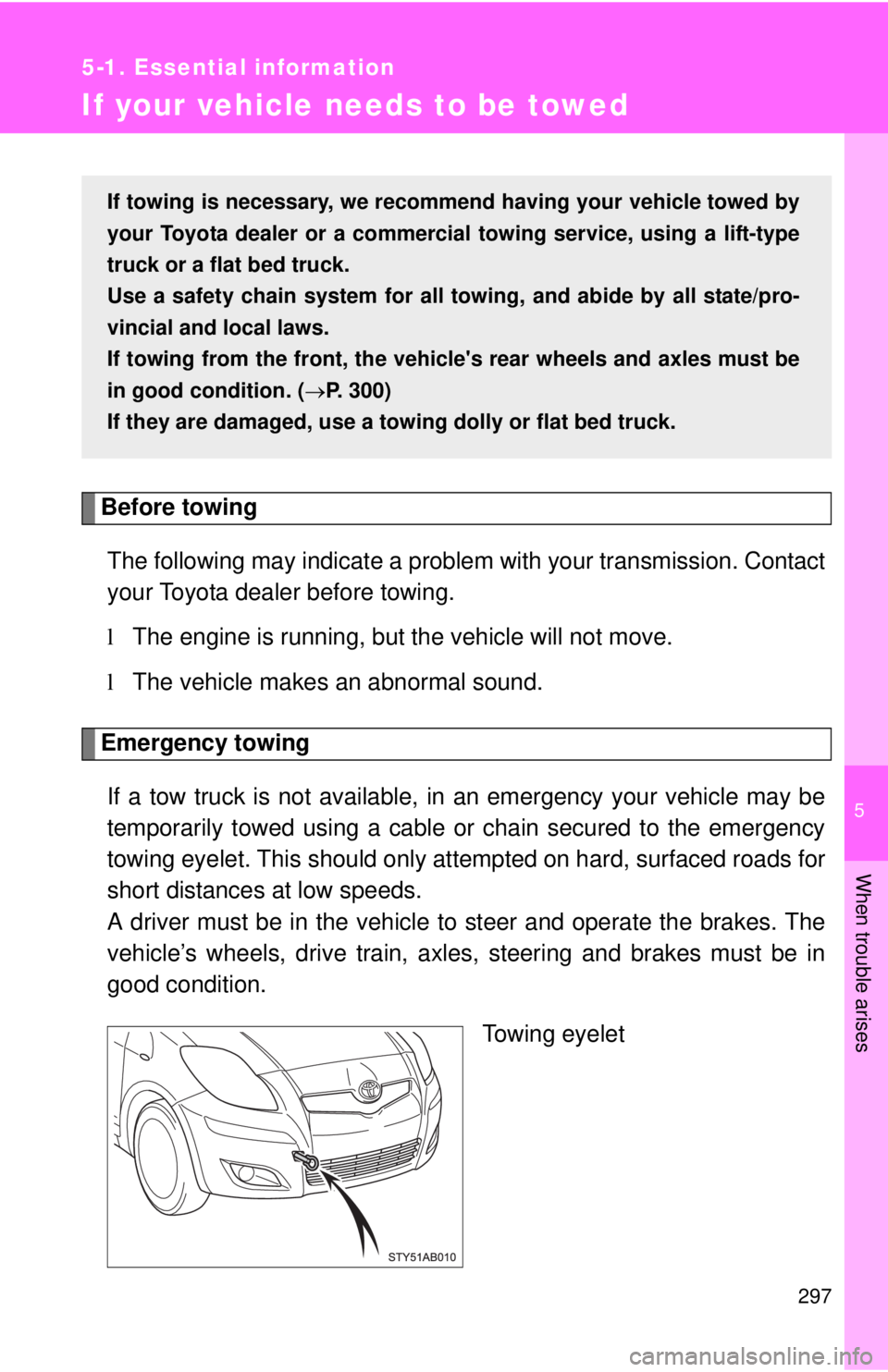
If a tow truck is not available, in an emergency your vehicle may be
temporarily towed using a cable or chain secured to the emergency
towing eyelet. This should only attempted on hard, surfaced roads for
short distances at low speeds.
A driver must be in the vehicle to steer and operate the brakes. The
ve
hicle’s wheels, drive train, axles, steering and brakes must be in
good condition.
Towing eyelet
If towing is necessary, we recommend having your vehicle towed by
your Toyota dealer or a commerci al towing service, using a lift-type
truck or a flat bed truck.
Use a safety chain system for all to wing, and abide by
all state/pro-
vincial and local laws.
If towing from the front, the vehic le's rear
wheels and axles must be
in good condition. (→P
. 300)
If they are damaged, use a towing dolly or flat bed truck.
Page 308 of 402

298 5-1. Essential information
nEmergency towin g procedure
Release the parking brake.
Put the transmission in N.
Turn the engine switch to the ACC (engine off) or ON (engine run -
ning) position.
CAUTION
nCaution while towing
lUse extreme caution when towing the vehicle.
Avoid sudden starts or erratic driving maneuvers which place excessive
stress on the emergency towing eyelet and the cables or chains.
l If the engine is not running, the power assist for the brakes and steering
will not function, making steering and braking more difficult.
NOTICE
nTo prevent causing serious dama ge to the transmission
(vehicles with an automatic transmission)
Never tow this vehicle from the rear with the front wheels on the ground.
This may cause serious damage to the transmission.
n When towing a vehicle without using a towing dolly
(vehicles with a manual transmission)
Do not tow with the key removed or in the LOCK position.
Page 324 of 402

314 5-2. Steps to take in an emergency
nCustomization that can be co nfigured at Toyota dealer
l The vehicle speed linked seat belt reminder buzzer can be disabled.
(Customizable features →P. 369)
l The key reminder buzzer can be disabled.
(Customizable features →P. 369)
l The light reminder buzzer can be disabled.
(Customizable features →P. 369)
CAUTION
nIf the tire pressure warning light comes on
Be sure to observe the following precautions. Failure to do so could
cause loss of vehicle control and re sult in death or serious injury.
lStop your vehicle in a safe place as soon as possible. Adjust the tire
inflation pressure immediately.
lIf the tire pressure warning light comes on even after tire inflation pres-
sure adjustment, it is pr obable that you have a fl at tire. Check the tires.
If the tire is flat, change to the spare tire and have the flat tire repaired
by the nearest Toyota dealer.
lAvoid abrupt maneuvering and braking. If the vehicle tires deteriorate,
you could lose control of the steering wheel or the brakes.
nIf a blowout or sudden air leakage should occur
The tire pressure warning syste m may not activate immediately.
nMaintenance of the tire
Each tire, including the spare (if provided), should be checked monthly
when cold and inflated to the inflation pressure recommended by the
vehicle manufacturer on the vehicle pl acard or tire inflation pressure
label (tire and load information label). (If your vehicle has tires of a differ-
ent size than the size indicated on the vehicle placard or tire inflation
pressure label [tire and load information label], you should determine the
proper tire inflation pr essure for those tires.)
Page 359 of 402
350 6-1. Specifications
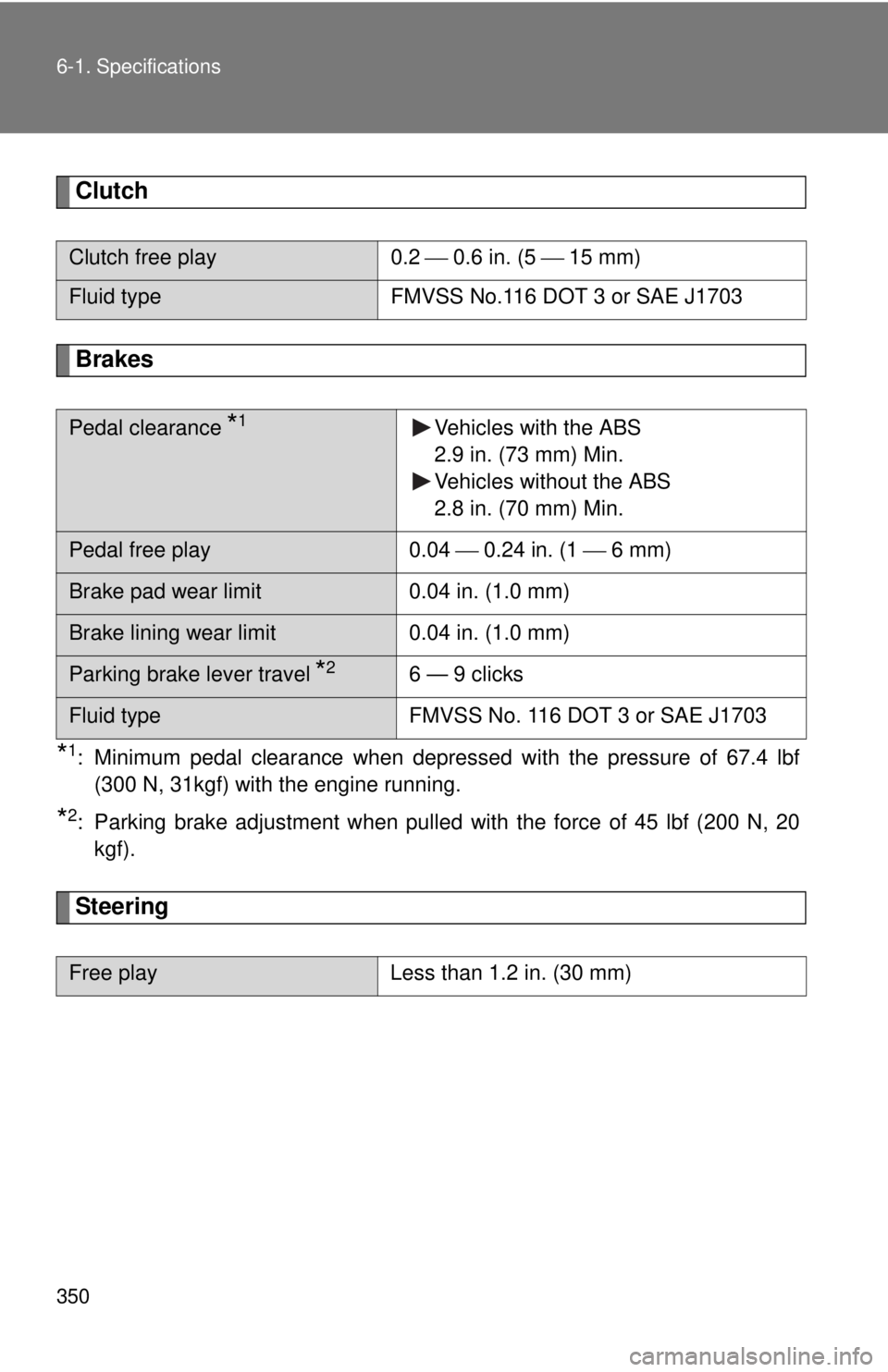
Clutch
Brakes
*1: Minimum pedal clearance when depressed with the pressure of 67.4 lbf (300 N, 31kgf) with the engine running.
*2: Parking brake adjustment when pulled with the force of 45 lbf (200 N, 20 kgf).
Steering
Clutch free play 0.2 ⎯ 0.6 in. (5 ⎯ 15 mm)
Fluid type FMVSS No.116 DOT 3 or SAE J1703
Pedal clearance *1Vehicles with the ABS
2.9 in. (73 mm) Min.
Vehicles without the ABS
2.8 in. (70 mm) Min.
Pedal free play 0.04 ⎯ 0.24 in. (1 ⎯ 6 mm)
Brake pad wear limit 0.04 in. (1.0 mm)
Brake lining wear limit 0.04 in. (1.0 mm)
Parking brake lever travel *26 — 9 clicks
Fluid typeFMVSS No. 116 DOT 3 or SAE J1703
Free playLess than 1.2 in. (30 mm)
Page 372 of 402
363
6-1. Specifications
6
Vehicle specifications
Warning: The temperature grades for this tire are established for a tire
that is properly inflated and not overloaded.
Excessive speed, underinflation, or excessive
loading, either sepa-
rately or in combination, can caus e hea
t buildup and possible tire fail-
ure.
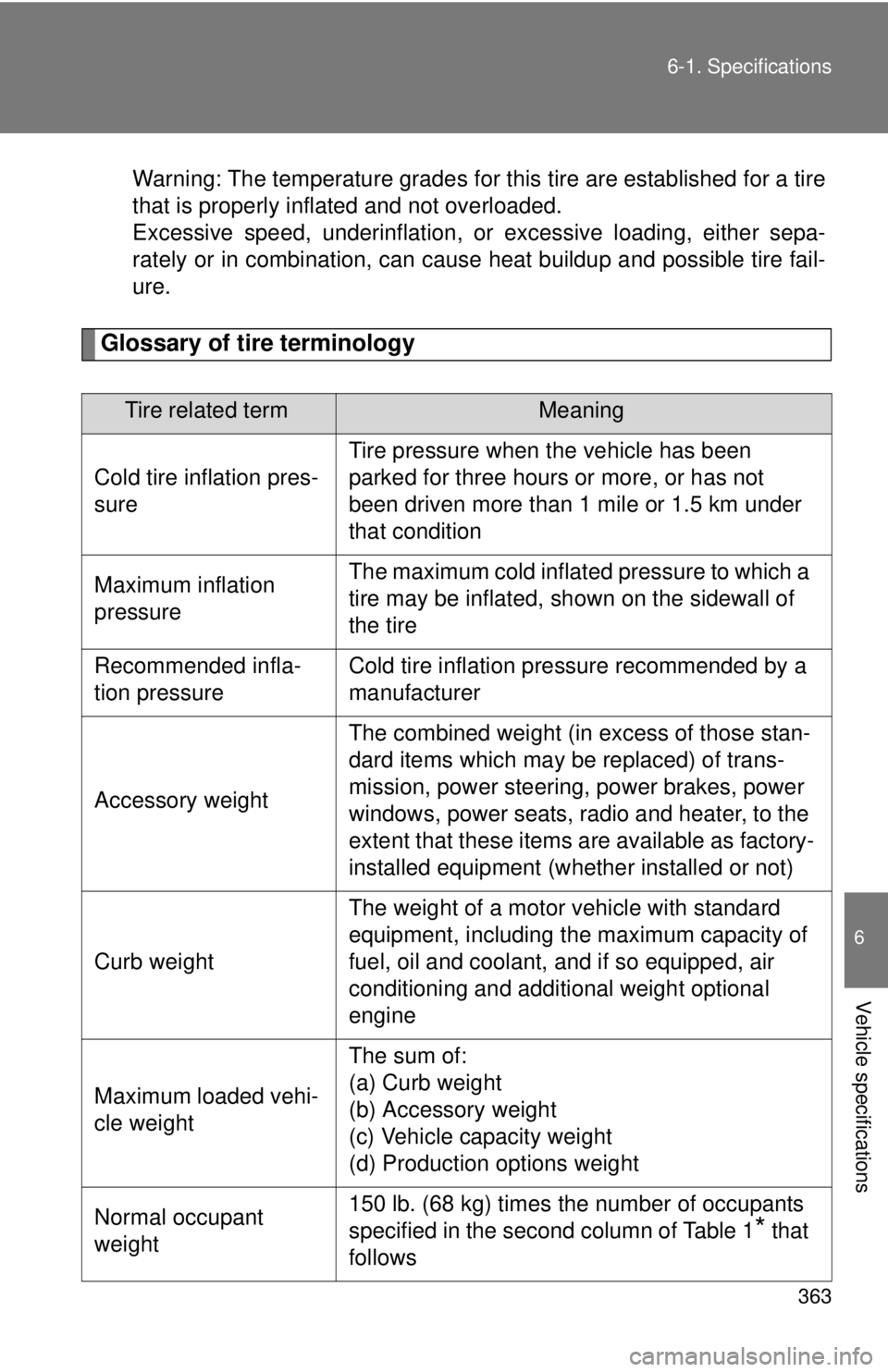
Glossary of tire terminology
Tire related termMeaning
Cold tire inflation pres-
sure
Tire pressure when the vehicle has been
parked for three hours or more, or has not
been driven more than 1 mile or 1.5 km under
that condition
Maximum inflation
pressureThe maximum cold inflated pressure to which a
tire may be inflated, s hown on the sidewall of
the tire
Recommended infla-
tion pressureCold tire inflation pressure recommended by a
manufacturer
Accessory weight
The combined weight (in excess of those stan-
dard items which may be replaced) of trans-
mission, power steering, power brakes, power
windows, power seats, radio and heater, to the
extent that these items are available as factory-
installed equipment (whether installed or not)
Curb weight
The weight of a motor vehicle with standard
equipment, including the maximum capacity of
fuel, oil and coolant, and if so equipped, air
conditioning and additional weight optional
engine
Maximum loaded vehi-
cle weight
The sum of:
(a) Curb weight
(b) Accessory weight
(c) Vehicle capacity weight
(d) Production options weight
Normal occupant
weight150 lb. (68 kg) times the number of occupants
specified in the second column of Table 1
* that
follows
Page 373 of 402
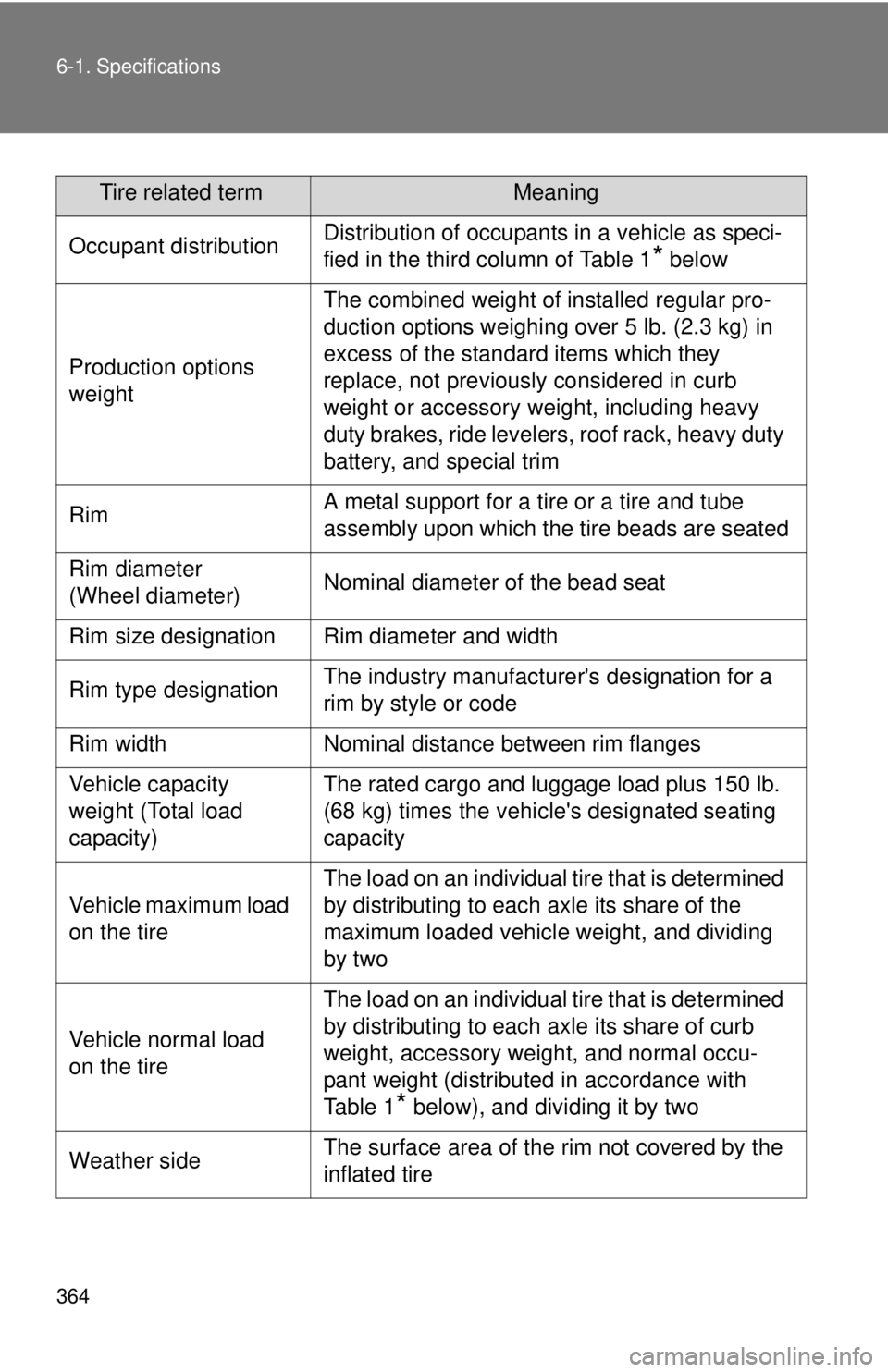
364 6-1. Specifications
Tire related termMeaning
Occupant distributionDistribution of occupants in a vehicle as speci-
fied in the third column of Table 1
* below
Production options
weight
The combined weight of installed regular pro-
duction options weighing over 5 lb. (2.3 kg) in
excess of the standard items which they
replace, not previously considered in curb
weight or accessory weight, including heavy
duty brakes, ride levelers, roof rack, heavy duty
battery, and special trim
RimA metal support for a tire or a tire and tube
assembly upon which the tire beads are seated
Rim diameter
(Wheel diameter)Nominal diameter of the bead seat
Rim size designationRim diameter and width
Rim type designationThe industry manufacturer's designation for a
rim by style or code
Rim widthNominal distance between rim flanges
Vehicle capacity
weight (Total load
capacity)The rated cargo and luggage load plus 150 lb.
(68 kg) times the vehicl e's designated seating
capacity
Vehicle maximum load
on the tire
The load on an individual tire that is determined
by distributing to each axle its share of the
maximum loaded vehicle weight, and dividing
by two
Vehicle normal load
on the tire
The load on an individual tire that is determined
by distributing to each axle its share of curb
weight, accessory weight, and normal occu-
pant weight (distributed in accordance with
Ta b l e 1
* below), and dividing it by two
Weather sideThe surface area of the rim not covered by the
inflated tire
Page 387 of 402

381
Alphabetical index
Alphabetical index
A/C ............................................178
ABS ABS ...................................... 155
Warning light ........................ 308
Air conditioning filter .............. 270
Air conditioning system Air conditioning filter ............. 270
Air conditioning
system................................ 178
Airbags
Airbag operating conditions .... 84
Airbag precautions for your
child...................................... 88
Curtain shield airbag operating
conditions ............................. 84
Curtain shield airbag
precautions .......................... 88
Front passenger occupant classification system ............ 93
General airbag precautions .... 88
Indicators ................................ 93
Locations of airbags ............... 81
Modification and disposal of
airbags ................................. 92
Proper driving posture ...... 79, 88
Side airbag operating
conditions ............................. 84
Side airbag precautions.......... 88
SRS airbags ........................... 81
Warning light ........................ 308
Alarm .......................................... 76
Antenna ............................ 191, 228
Anti-lock brake system Anti-lock brake system ......... 155
Warning light ........................ 308
Audio input .............................. 209
Audio system Antenna ................................ 191
Audio input ........................... 209
AUX adapter ......................... 209
CD player ............................. 195
MP3/WMA disc ..................... 200
Optimal use .......................... 207Portable music player............
209
Radio ..................................... 189
Type ...................................... 187
Automatic transmission
Automatic transmission ......... 128
Fluid ...................................... 349
If the shift lever cannot be
shifted from P......................331
Indicators............................... 128
Shift lock system .. .................331
AUX adapter ............................. 209
Auxiliary boxes ................ 217, 225
Back-up lights Replacing light bulbs ............. 286
Wattage ................................. 352
Back door ................................... 36
Battery
Checking ............................... 253
If the vehicle battery is
discharged ..........................333
Preparing and checking before winter .......................161
Voltage .................................. 349
Warning light ......................... 308
Bottle holders ........................... 215
Brakes
Fluid ...................................... 252
Parking brake ........................ 132
Specifications ........................ 350
Warning light .........................307
Break-in tips ............................. 118
Care Exterior .................................. 228
Interior ................................... 230
Seat belts .............................. 231
Cargo capacity ......................... 157
CD player .................................. 195
Chains ....................................... 161
A
B
C