tow TOYOTA YARIS HATCHBACK 2009 User Guide
[x] Cancel search | Manufacturer: TOYOTA, Model Year: 2009, Model line: YARIS HATCHBACK, Model: TOYOTA YARIS HATCHBACK 2009Pages: 402, PDF Size: 7.61 MB
Page 158 of 402
145
2
When driving
2-3. Operating the lights and wipers
Headlight switch
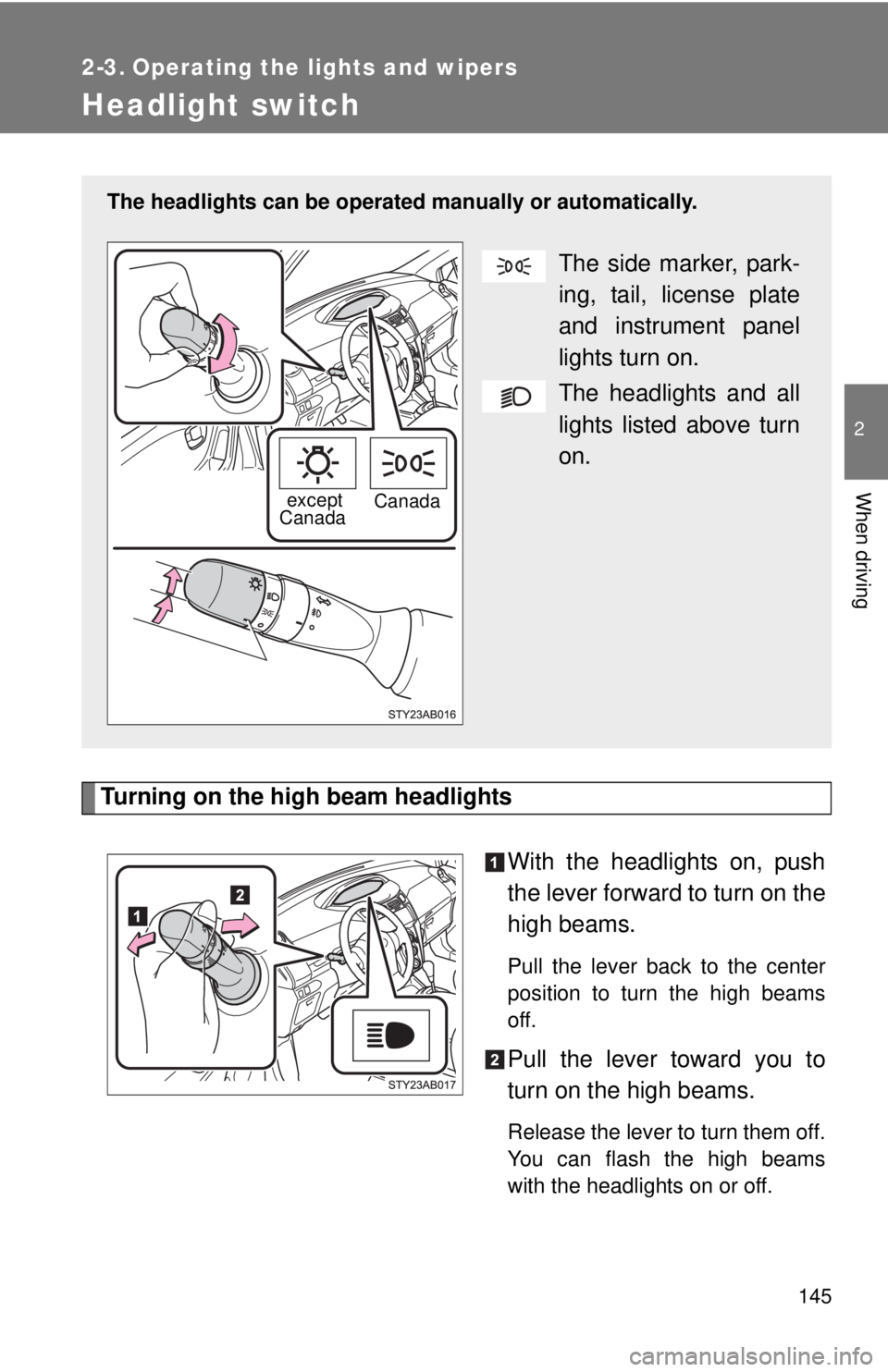
Turning on the high beam headlights
With the headlights on, push
the lever forward to turn on the
h
igh beams.
Pull the lever back to the center
position to turn the high beams
off.
Pull the lever toward you to
turn on the high beams.
Release the lever to turn them off.
You can flash the high beams
with the headlights on or off.
The headlights can be operated manually or automatically.
The side marker, park-
ing, tail, license plate
an
d instrument panel
lights turn on.
The headlights and all
lights listed above turn
on
.
except
Canada Canada
Page 163 of 402
150 2-3. Operating the lights and wipers
nThe windshield wiper and washer can be operated when
The engine switch must be in the ON position.
n If no windshield washer fluid spra
ys
Check that the washer nozzles are not blocked and if there is washer fluid in
the windshield washer fluid reserv
oir.
NOTICE
nWhen the windshield is dry
Do not use the wipers, as they may damage the windshield.
n When there is no washer fluid spray from the nozzle
Damage to the washer fluid pump may be caused if the lever is pulled
toward you and held continually.
n When a nozzle becomes block
Do not try to clear it with a pin or other object. The nozzle will be damaged.
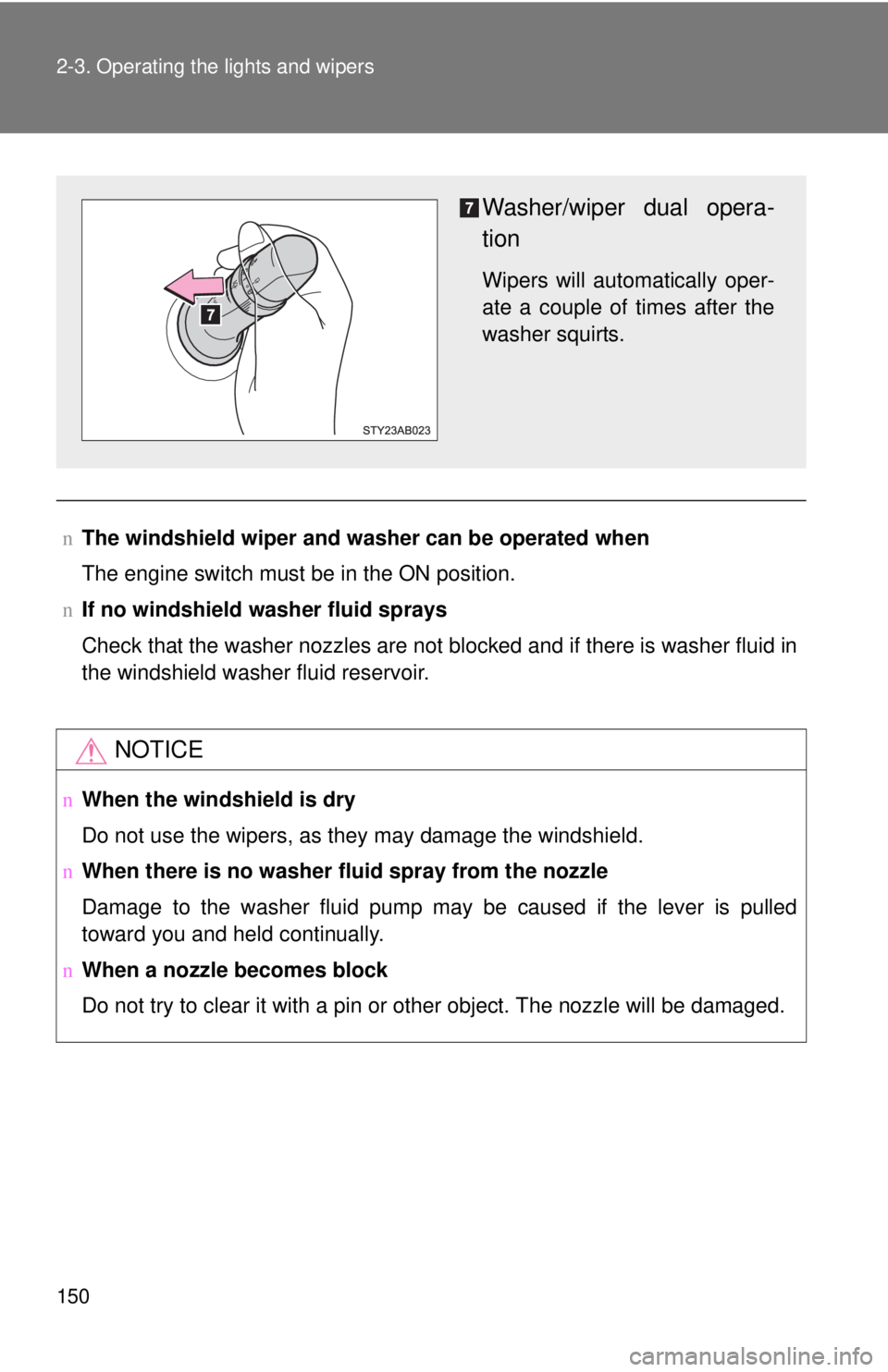
Washer/wiper dual opera-
tion
Wipers will automatically oper -
ate a couple of times after the
washer squirt
s.
Page 166 of 402
153
2-4. Using other
driving systems
2
When driving
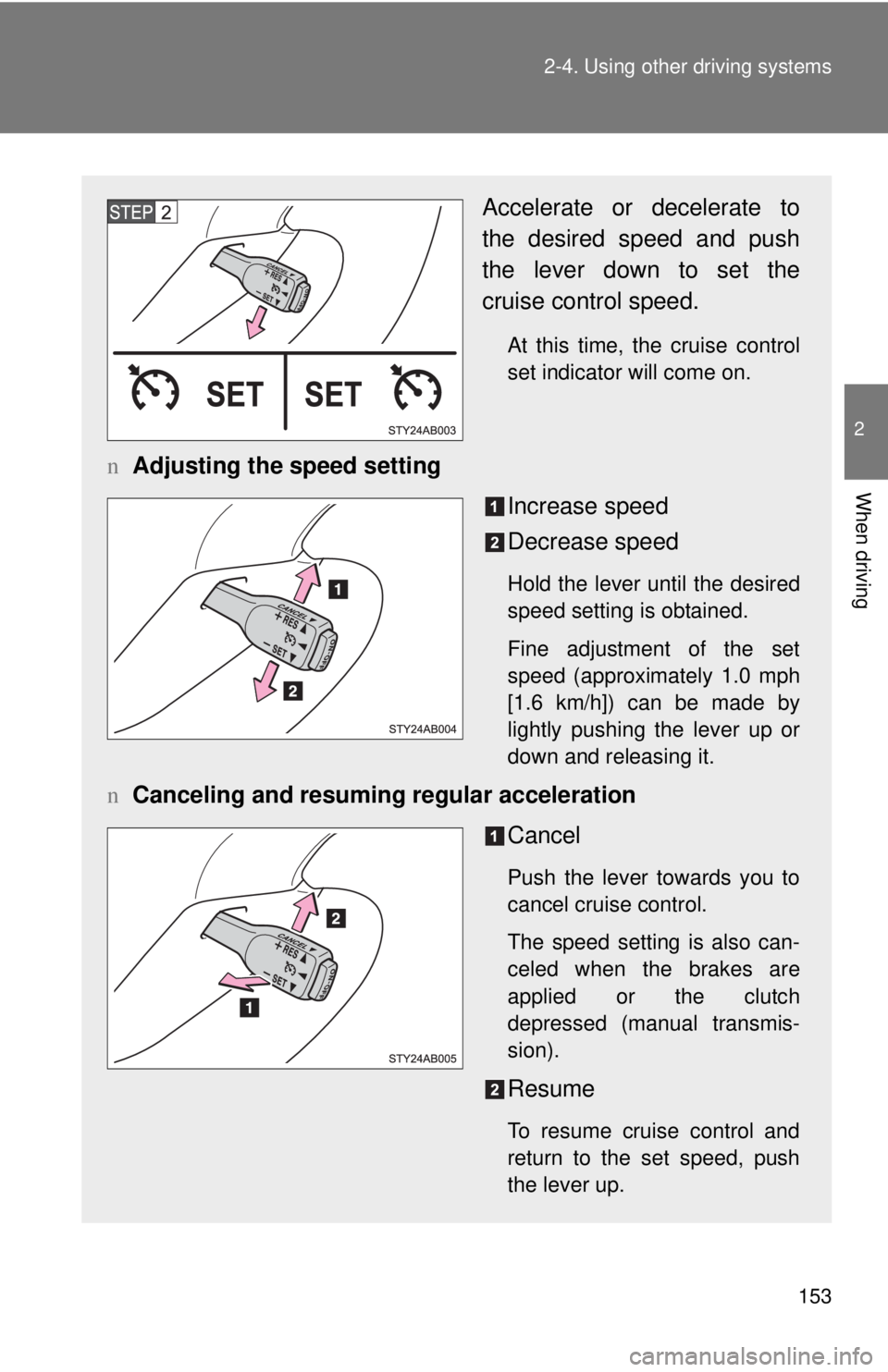
Accelerate or decelerate to
the desired speed and push
the lever down to set the
cruise control speed.
At this time, the cruise control
set indicator will come on.
nAdjusting the speed setting
Increase speed
Decrease speed
Hold the lever until the desired
speed setting is obtained.
Fine adjustment of the set
speed (approximately
1.0 mph
[1.6 km/h]) can be made by
lightly pushing the lever up or
down and releasing it.
n Canceling and resuming regular acceleration
Cancel
Push the lever towards you to
cancel cruise control.
The speed setting is also can-
celed when the brakes are
applied or the
clutch
depressed (manual transmis -
sion).
Resume
To resume cruise control and
return to the set speed, push
the lever up.
Page 167 of 402
154 2-4. Using other driving systems
nCruise control can be set when
lThe shift lever is in D or 3 (vehicles with an automatic transmission).
l V
ehicle speed is above approximately 25 mph (40 km/h).
n Accelerating
The vehicle can be accelerated normally. After acceleration, the set speed
resumes.
n Automatic cruise control cancellation
The set speed is automatically canceled in any of the following situations.
l Actual
vehicle speed falls more than 10 mph (16 km/h) below the preset
vehicle speed.
At this time, the memorized set speed is not retained.
l Actual vehicle spee
d is below 25 mph (40 km/h).
n If the cruise control mai
n indicator flashes
Press the ON-OFF button to turn the cruise control off, and then reactivate
the system.
If the cruise control speed cannot be set or if the cruise control cancels
immediately after being activated, there may be a malfunction in the cruise
control system. Have the vehicle inspected by your Toyota dealer.
CAUTION
n To avoid operating the cruise control by mistake
Keep the ON-OFF button off when not in use.
n Situations unsuitable for cruise control
Do not use cruise control in any of the following situations.
Doing so may result in control of the vehicle being lost and could cause seri-
ous or fatal accident.
l In heavy traffic
l On roads with sharp bends
l On winding roads
l On slippery roads, such as those covered with rain, ice or snow
l On steep hills
l When towing a trailer
Page 170 of 402
157
2
When driving
2-5. Driving information
Cargo and luggage
Capacity and distribution
Cargo capacity depends on the total weight of the occupants.
(Cargo capacity) = (Total load capacity) − (T
otal weight of occupants)
Steps for Determining Correct Load Limit—
(1) Locate the statement “The combined
weight of occupants and
cargo should never exceed XXX kg or XXX lbs.” on your vehicle’s
placard.
(2) Determine the combined weight of the driver and passengers that will be riding
in your vehicle.
(3)Subtract the combined weight of the driver and passengers from XXX
kg or XXX lbs.
(4) The resulting figure equals the available amount of cargo and lug -
gage load capacity.
For example, if the “XXX” amount equals 1400 lbs. and there will
be
five 150 lb passengers in your vehicle, the amount of available
cargo and luggage load capacity is 650 lbs. (1400 − 750 (5 × 150)
= 650 lbs.)
(5) Determine the combined weight of luggage and cargo being loaded on the vehicle. That weight may not safely exceed the
available cargo and luggage load capacity calculated in Step 4.
Take notice of the following information about storage precau-
tions, cargo capacity and load.
l Stow cargo and luggage in the luggage compartment whenever
possible.
l Be
sure all items are secured in place.
lBe
careful to keep the vehicle level. Placing the weight as far for -
ward as possible helps maintain vehicle balance.
l For better fuel eco
nomy, do not carry unnecessary weight.
Page 171 of 402
158 2-5. Driving information
(6) If your vehicle will be towing a trailer, load from your trailer will be
transferred to your vehicle. Consult this manual to determine how
this reduces the available cargo and luggage load capacity of your
vehicle.
Except Canada:
Toyota does not recommend towing a trailer with your vehicle. Your
vehicle is not desig
ned for trailer towing.
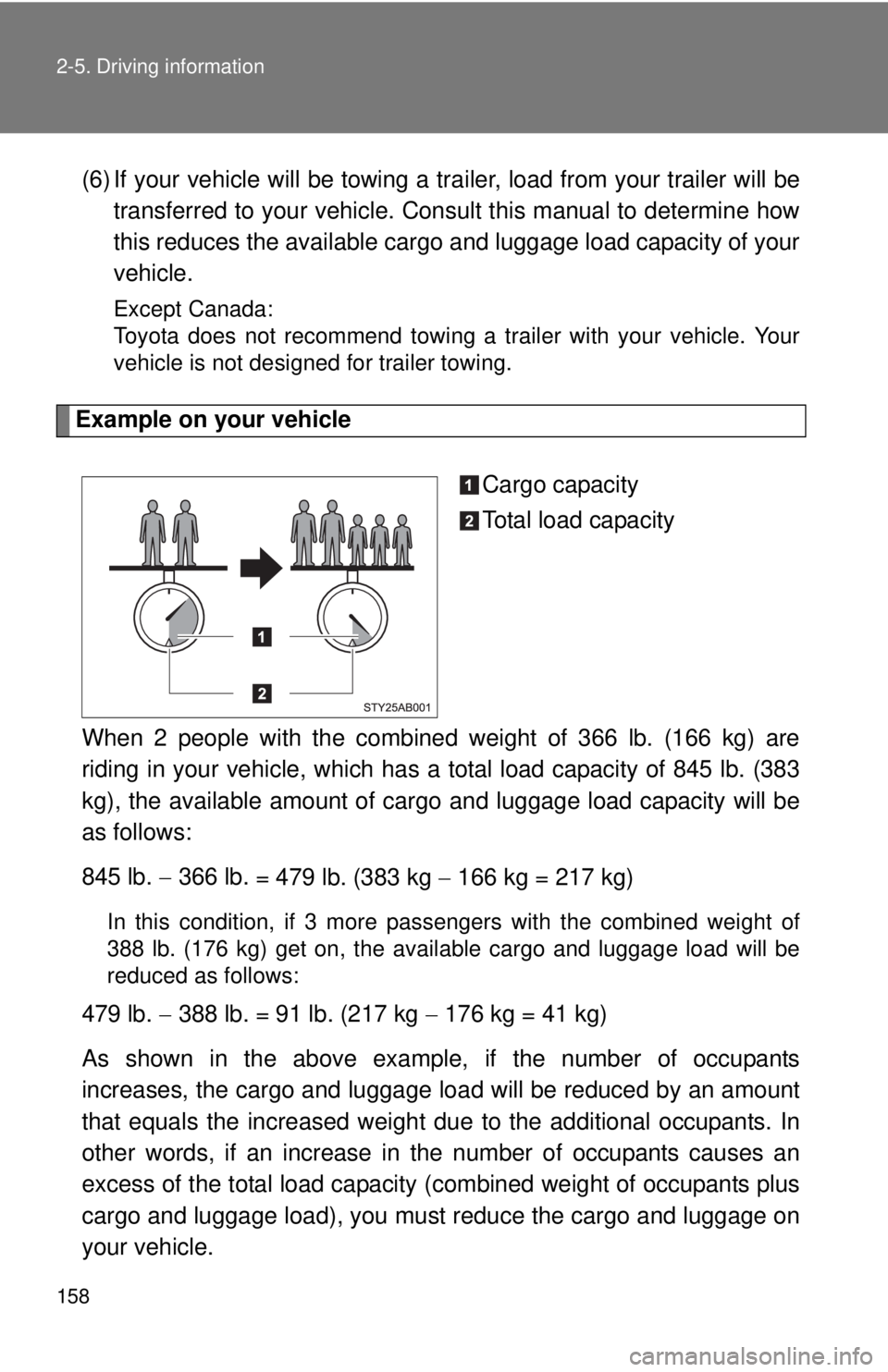
Example on your vehicle
Cargo capacity
Total load capacity
When 2 people with the combined weight of 366 lb. (166 kg) are
riding
in your vehicle, which has a total load capacity of 845 lb. (383
kg), the available amount of cargo and luggage load capacity will be
as follows:
845 lb. − 366 lb.
= 479 lb. (383 kg − 166 kg = 217 kg)
In this condition, if 3 more pass engers with the combined weight of
388 lb. (176 kg) get on , the available cargo and luggage load will be
reduced as follows:
479 lb. − 388 lb. = 91 lb. (217 kg − 176 kg = 41 kg)
As shown in the above example, if th
e number of occupants
increases, the cargo and luggage lo ad will be reduced by an amount
that equals the increased weight du e to the additional occupants. In
other words, if an increase in the number of occupants causes an
excess of the total load capacity (combined weight of occupants plus
cargo and luggage load), you must reduce the cargo and luggage on
your vehicle.
Page 173 of 402
160
2-5. Driving information
Vehicle load limits
nTotal load capacity and seating capacity
These details are also described on the tire and loading information
label.(→P. 2 6 4
)
CAUTION
nOverloading the vehicle
Do not overload the vehicle.
It may not only cause damage to the ti res, but also degrade steering and
braking ability, resulting in an accident.
Vehicle load limits include total load capacity, seating capacity,
towing capacity and cargo capacity.
n Total load capacity: 845 lb. (383 kg)
Total load capacity means the combined weight of occupants,
car
go and luggage.
n Se
ating capacity: 5 occupants (Front 2, Rear 3)
Seating capacity means the ma ximum n
umber of occupants
whose estimated average weight is 150 lb. (68 kg) per person.
Even if the number of occupants are within the seating capacity,
do no
t exceed the total load capacity.
n T
owing capacity (Canada): 700 lb. (318 kg)
Towing capacity means the maximum gross trailer weight (trailer
weigh
t plus its cargo weight) that your vehicle is able to tow.
n T
owing capacity (except Canada)
Toyota does not recommend towing a trailer with your vehicle.
n Cargo cap
acity
Cargo capacity may increase or decrease depending on the
weigh
t and the number of occupants.
Page 177 of 402
164
2-5. Driving information
Trailer towing (except Canada)
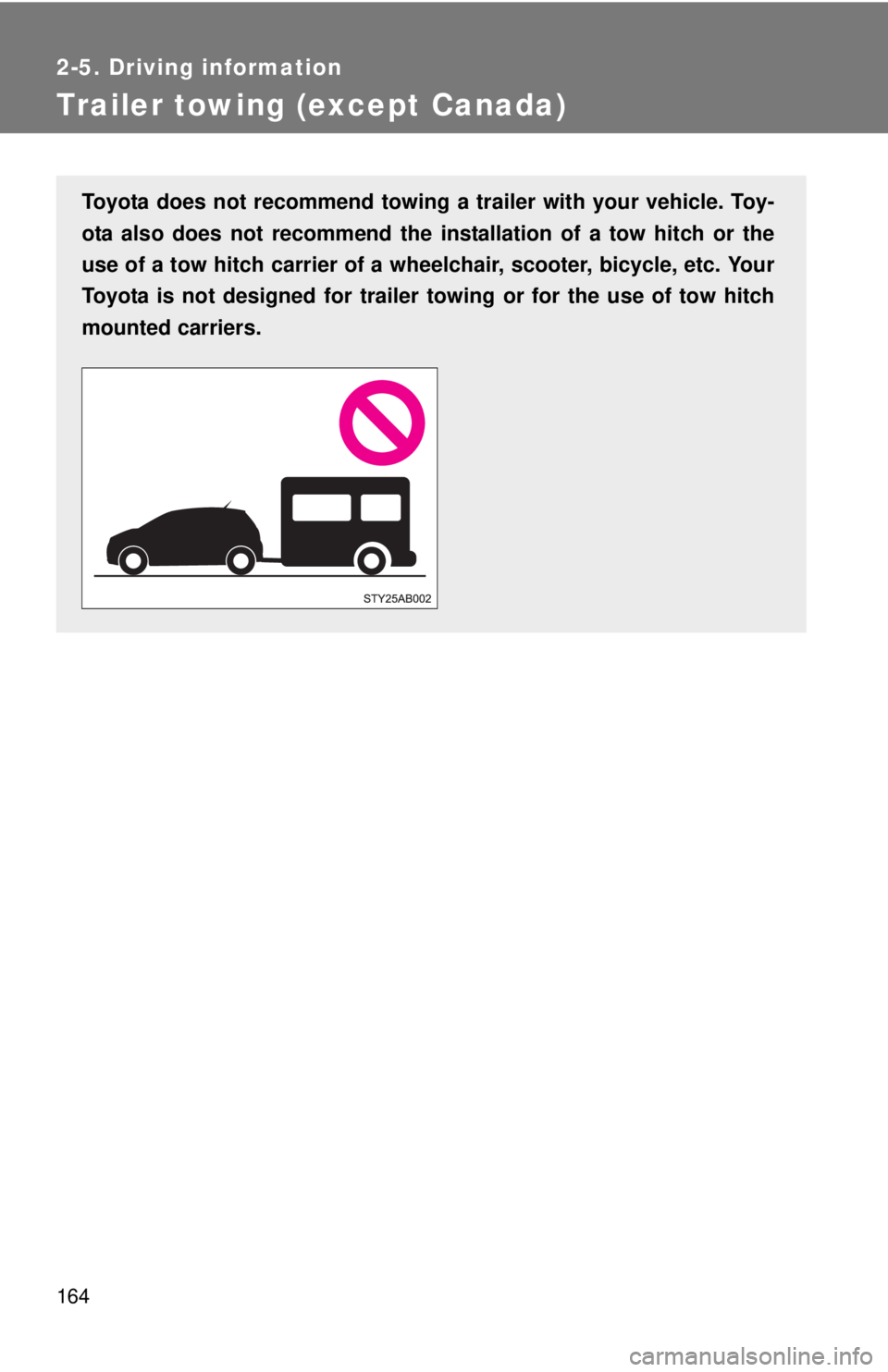
Toyota does not recommend towing a trailer with your vehicle. Toy-
ota also does not recommend the installation of a tow hitch or the
use of
a tow hitch carrier of a wheelchair, scooter, bicycle, etc. Your
Toyota is not designed for trailer towing or for the use of tow hitch
mounted carriers.
Page 178 of 402
165
2-5. Driving information
2
When driving
Trailer towing (Canada)
Your vehicle is designed primarily as a passenger-carrying vehicle,
thus towing a trailer will have an adverse effect on handling, perfor
-
mance, braking, durability, and fu el consumption. For your
safety
and the safety of others , do not overload the vehicle or trailer.
Toyota warranties do not apply to damage or
malfunction caused by
towing a trailer for commercial purposes.
n Weight limits
Confirm the total trailer weight, gross vehicle weight, gross axle
weigh
t and trailer tongue load are all within the limits.
n Gross ve
hicle weight
The gross vehicle weight must not exce
ed the Gross Vehicle
Weight Rating (GVWR) indicated on the Certification Label. The
gross vehicle weight is the sum of weights of the unloaded vehi -
cle, driver, passengers, luggage,
hitch, and the trailer tongue
load. It also includes the weight of any special equipment
installed on your vehicle.
n Gross ax
le weight
The load on either the front or re
ar axle resulting from distribu-
tion of the gross vehicle weight on b
oth axles must not exceed
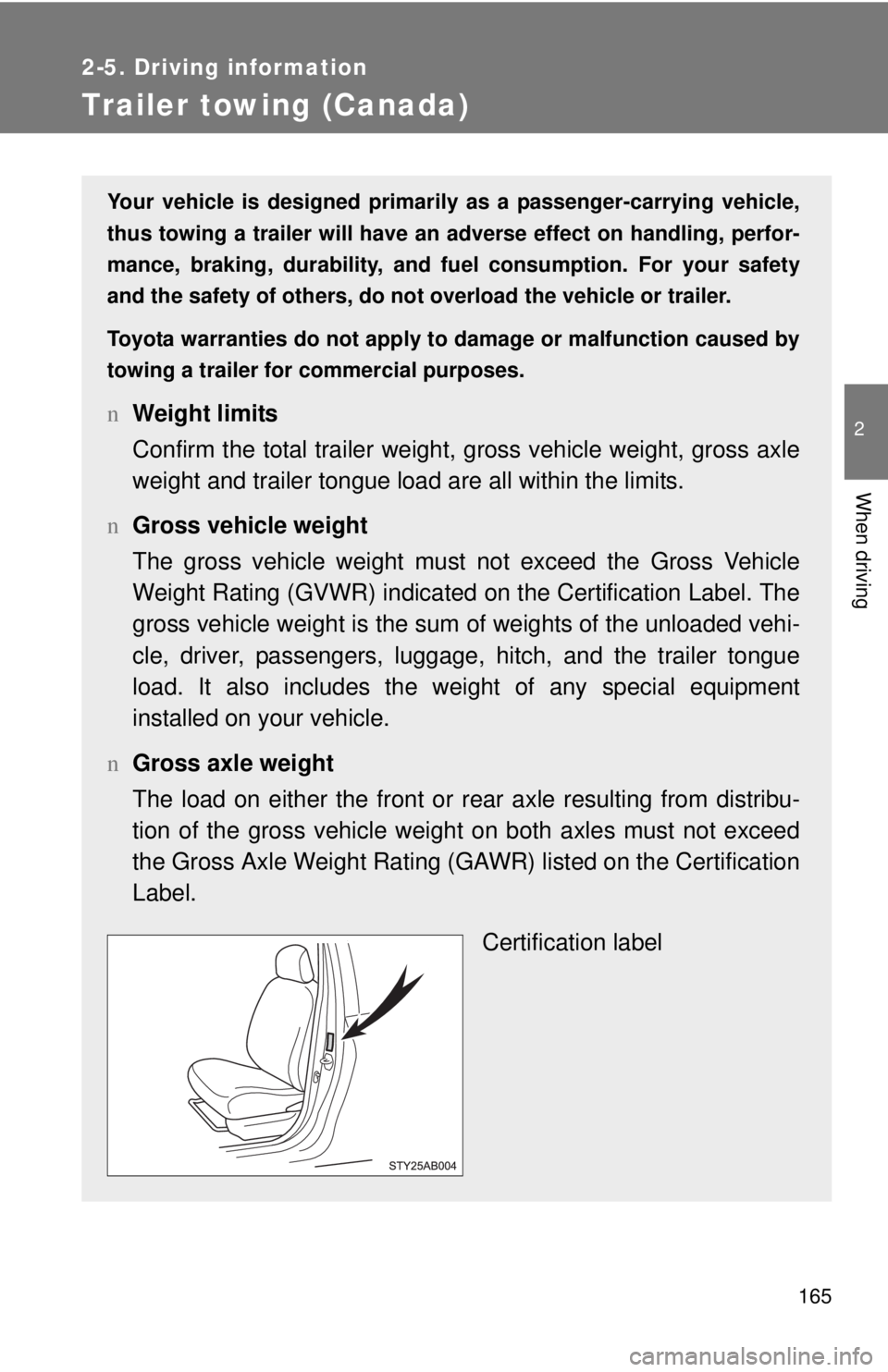
the Gross Axle Weight Rating (GAWR) listed on the Certification
Label.
Certification label
Page 179 of 402
166 2-5. Driving information
Towing a trailer
Consult your Toyota dealer for further information about additional
requirements such as a towing kits, etc.
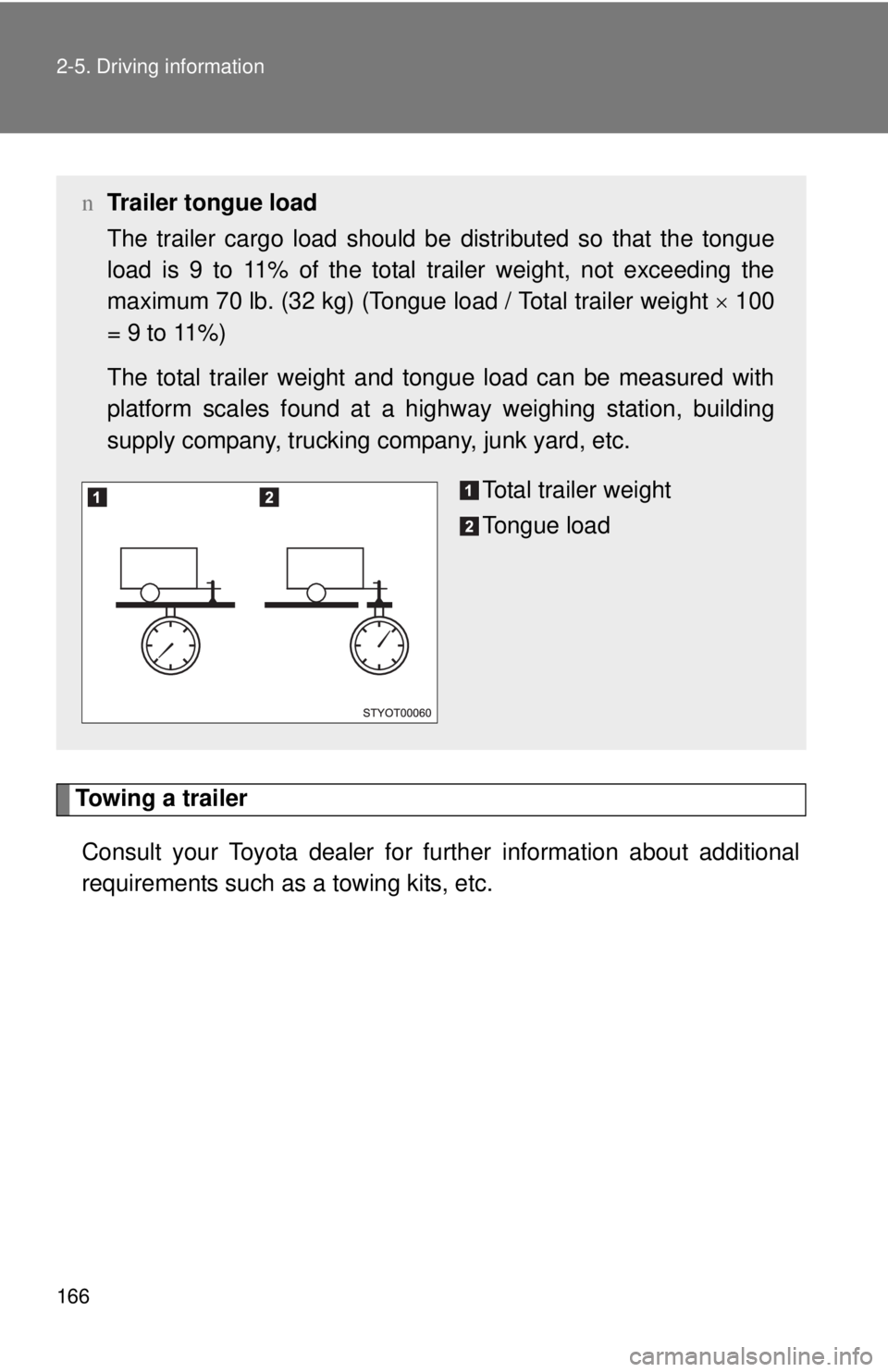
nTrailer tongue load
The trailer cargo load should be distributed so that the tongue
load is 9 to 11% of the total trailer weight, not exceeding the
maximum 70 lb. (32 kg) (Tongue load / Total trailer weight × 100
= 9 to 11%)
The total trailer weight and tongue load can be measured with
plat
form scales found at a highway weighing station, building
supply company, trucking company, junk yard, etc.
Total trailer weight
Tongue load