trailer TOYOTA YARIS HATCHBACK 2009 User Guide
[x] Cancel search | Manufacturer: TOYOTA, Model Year: 2009, Model line: YARIS HATCHBACK, Model: TOYOTA YARIS HATCHBACK 2009Pages: 402, PDF Size: 7.61 MB
Page 183 of 402

170 2-5. Driving information
lReversing with a trailer attached is difficult and requires practice.
Grip the bottom of the steering wheel and move your hand to the
left to move the trailer to the left. Move your hand to the right to
move the trailer to the right. (This is generally opposite to reversing
without a trailer attached.) Avoid sharp or prolonged turning. Have
someone guide you when reversing to reduce the risk of an acci -
dent.
l As stopp
ing distance is increased when towing a trailer, vehicle-to-
vehicle distance should be increased. For each 10 mph (16 km/h)
of speed, allow at least o ne vehicle and trailer length.
l A
void sudden braking as you may skid, resulting in jackknifing and
loss of control. This is especiall y true on wet or slippery surfaces.
l A
void jerky starts or sudden acceleration. Vehicles with a manual
transmission, prevent excessive clut ch slippage by keeping engine
rpm low and not racing the engine. Always start out in first gear.
l A
void jerky steering and sharp turns, and slow down before mak -
ing a turn.
l Note
that when making a turn, th e trailer wheels will be closer than
the vehicle wheels to the inside of the turn. Compensate by making
a larger than normal turning radius.
l Cr
osswinds and rough roads will adversely affect handling of your
vehicle and trailer, causing sway. Periodically check the rear to
prepare for being passed by large trucks or buses, which may
cause your vehicle and trailer to sway. If swaying occurs, firmly grip
the steering wheel, reduce speed immediately but gradually, and
steer straight ahead. Never increase speed. If you make no
extreme correction with the steeri ng or brakes, your vehicle and
trailer will stabilize.
l T
ake care when passing other v ehicles. Passing requires consider -
able distance. After passing a vehi cle
, do not forget the length of
your trailer, and be sure you have plenty of room before changing
lanes.
Page 184 of 402
171
2-5. Driving information
2
When driving
l
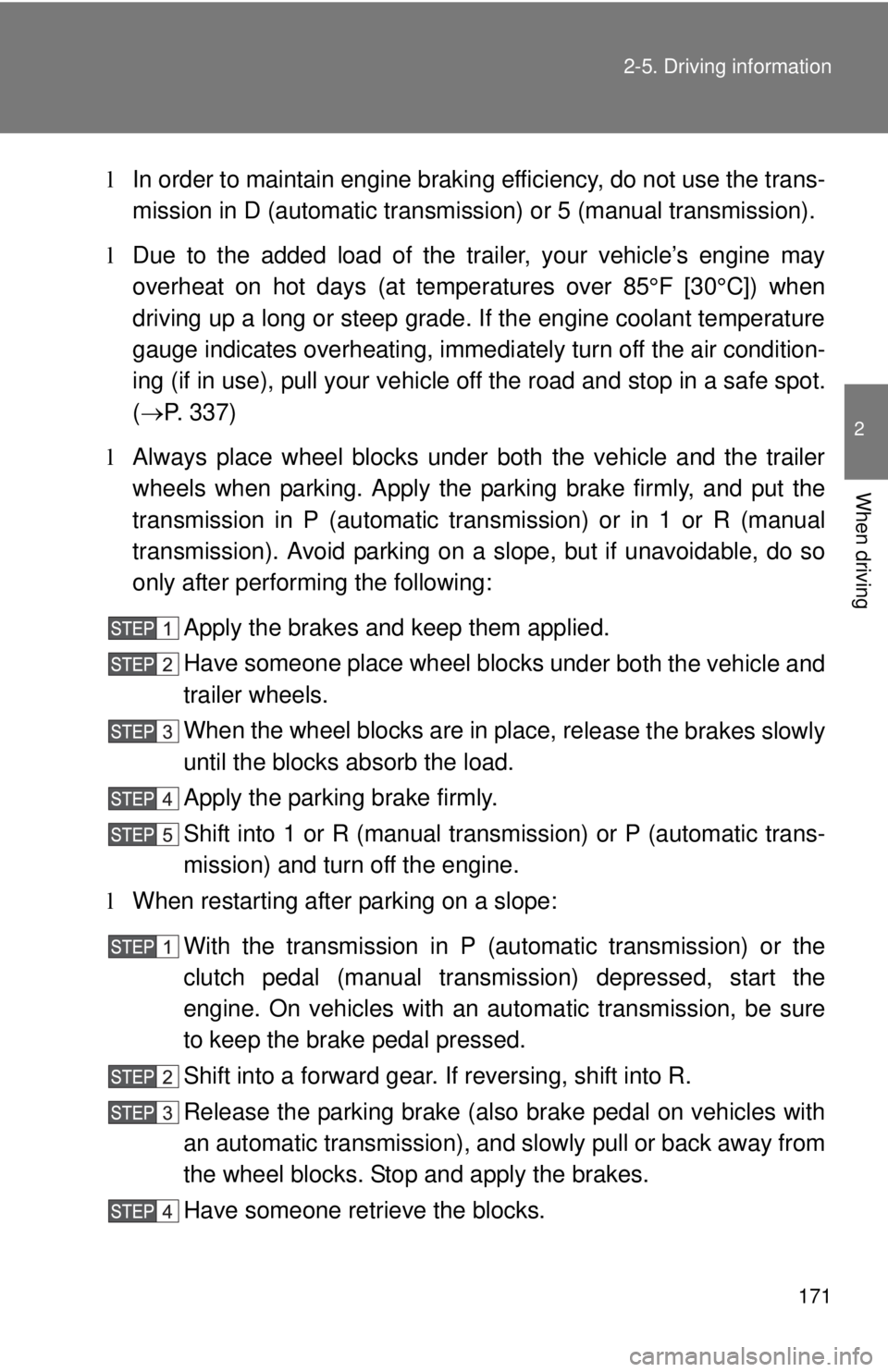
In order to maintain engine braki ng efficiency, do not use the trans -
mission in D (automatic transmiss ion
) or 5 (manual transmission).
l Du
e to the added load of the trailer, your vehicle’s engine may
overheat on hot days (at temperatures over 85°F [30°C]) when
driving up a long or steep grade. If the engine coolant temperature
gauge indicates overheating, immedi ately turn off the air condition-
ing (if in use), pull your vehicle off the road and stop in a safe spot.
( → P. 3 3 7 )
l Alw
ays place wheel blocks under both the vehicle and the trailer
wheels when parking. Apply the parking brake firmly, and put the
transmission in P (automatic transmission) or in 1 or R (manual
transmission). Avoid parking on a slope, but if unavoidable, do so
only after performing the following:
Apply the brakes and keep them applied.
Have someone place wheel blocks un
der both the vehicle and
trailer wheels.
When the wheel blocks are in pl ace, re
lease the brakes slowly
until the blocks absorb the load.
Apply the parking brake firmly.
Shift into 1 or R (manual transmission) or P (automatic trans -
mission) and turn off the engine.
l Whe
n restarting after parking on a slope:
With the transmission in P (automatic transmission) or the
clutch pedal (manual transmission) depressed, start the
eng
ine. On vehicles with an au tomatic transmission, be sure
to keep the brake pedal pressed.
Shift into a forward gear. If reversing, shift into R.
Release the parking brake (also b
rake pedal on vehicles with
an automatic transmission), and sl o
wly pull or back away from
the wheel blocks. Stop and apply the brakes.
Have someone retrieve the blocks.
Page 185 of 402

172 2-5. Driving information
CAUTION
nTo avoid an accident
lDo not exceed 45 mph (72 km/h) or posted towing speed limit, whichever
is lower. As instability (swaying) of the towing vehicle-trailer combination
increases as speed increases, exceeding 45 mph (72 km/h) may cause
loss of control.
l Slow down and downshift before descending steep or long downhill
grades. Do not make sudden downshifts.
l Avoid holding the brake pedal down too long or too frequently. This could
cause the brakes to overheat and result in reduced braking efficiency.
Page 353 of 402
344
6-1. Specifications
Maintenance data (fuel, oil level, etc.)
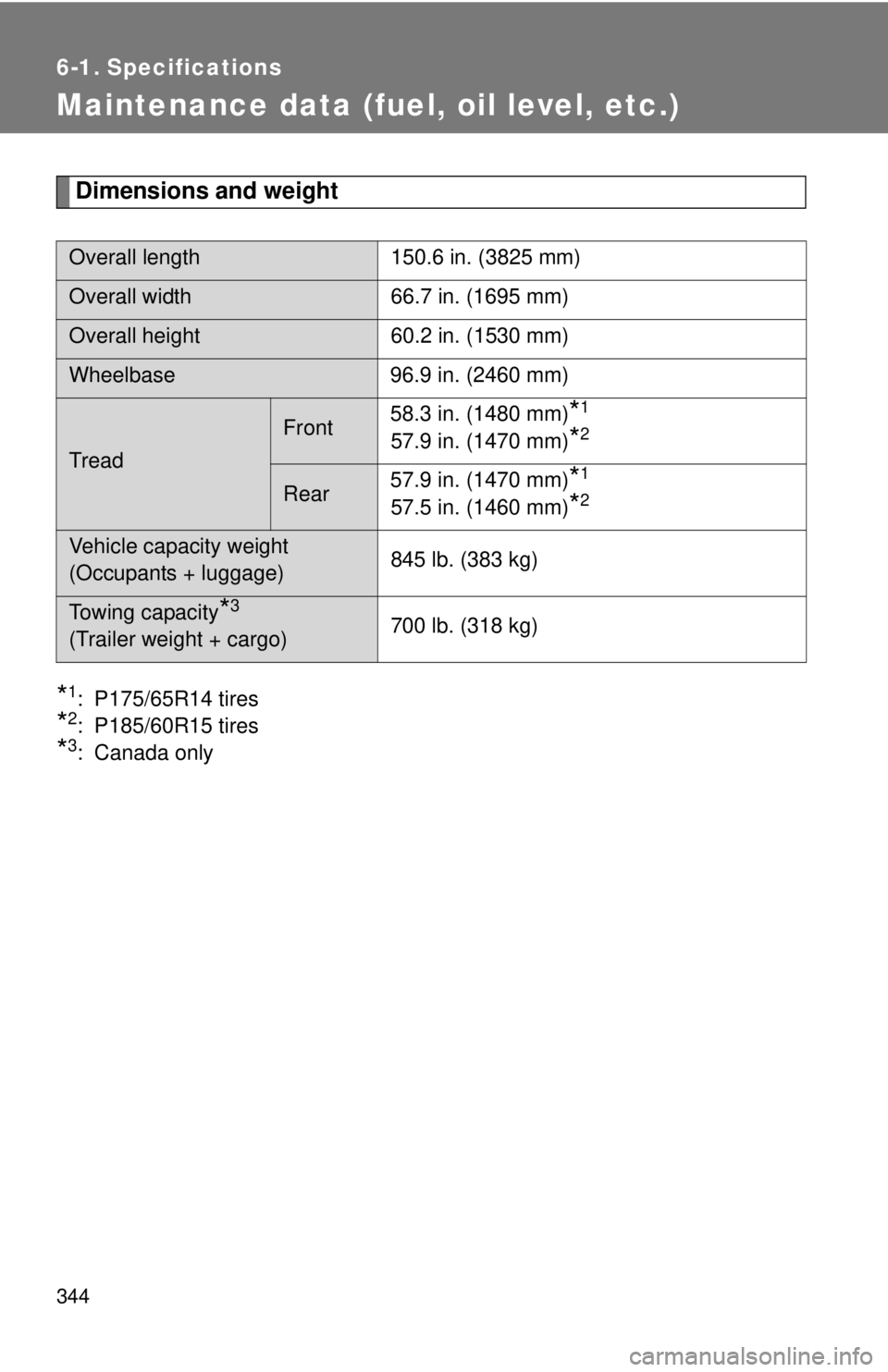
Dimensions and weight
*1: P175/65R14 tires
*2: P185/60R15 tires
*3: Canada only
Overall length150.6 in. (3825 mm)
Overall width66.7 in. (1695 mm)
Overall height 60.2 in. (1530 mm)
Wheelbase96.9 in. (2460 mm)
Tread
Front58.3 in. (1480 mm)*1
57.9 in. (1470 mm)*2
Rear 57.9 in. (1470 mm)*1
57.5 in. (1460 mm)*2
Vehicle capacity weight
(Occupants + luggage) 845 lb. (383 kg)
Towing capacity*3
(Trailer weight + cargo)700 lb. (318 kg)
Page 393 of 402

387
Alphabetical index
Fog lights switch ...................
147
Hazard lights switch ............. 296
Ignition switch ....................... 125
Headlights switch ................. 145
Light switch........................... 145
Power door lock switch........... 32
Power window switch ............. 67
Turn signal lights .................. 131
Window lock switch ................ 68
Wiper and washer ........ 148, 151
Tachometer .............................. 135
Tail lights
Indicator................................ 145
Replacing light bulbs ............ 286
Switch ................................... 145
Wattage ................................ 352
Theft deterrent system Alarm ...................................... 76
Engine immobilizer system..... 74
Theft prevention labels ........... 78
Theft prevention labels ............. 78
Tire inflation pressure ............ 264
Tire information Glossary ............................... 363
Size ...................................... 360
Tire identification number ..... 359
Uniform tire quality
grading ............................... 361
Tires Chains .................................. 161
Checking .............................. 258
If you have a flat tire ............. 317
Identification number ............ 356
Inflation pressure .......... 264, 351
Inflation pressure sensor ...... 259
Information ........................... 356
Replacing ..................... 258, 317
Rotating tires ........................ 258
Size ...................................... 351
Snow tires............................. 161
Spare tire .............................. 317Tire pressure warning
system ........................258, 310
Warning light ......................... 310
Tools ......................................... 317
Total load capacity................... 160
Towing Dinghy towing................ 173, 174
Emergency towing................. 297
Trailer towing................. 164, 165
Trip meter ................................. 138
Turn signal lights
Indicator ................................ 131
Lever ..................................... 131
Replacing light bulbs ............. 286
Switch.................................... 131
Wattage ................................. 352
Vanity mirrors........................... 220
Vehicle identification
number ...................................345
Warning buzzers Brake system ........................ 307
Seat belt reminder ................. 310
Warning lights ABS ....................................... 308
Airbag system ....................... 308
Anti-lock brake system .......... 308
Brake system ........................
307
Charging system .. .................308
Driver’s seat belt ................... 310
Electric power steering
system ................................308
Electronic engine control
system ................................308
Engine oil replacement.......... 310
EPS system........................... 308
Front passenger occupant classification system ...........308
Front passenger’s seat belt ... 310
High engine coolant
temperature ........................308
T
V
W
Page 400 of 402

1
2
3
4
5
6
7
3
2-4. Using other driving
systems
Cruise control ...................... 152
Driving assist systems ........ 155
2-5. Driving information Cargo and luggage ............. 157
Vehicle load limits ............... 160
Winter driving tips ............... 161
Trailer towing (except
Canada) ............................ 164
Trailer towing (Canada) ...... 165
Dinghy towing (vehicles with an automatic
transmission) .................... 173
Dinghy towing (vehicles with a manual
transmission) .................... 174
3-1. Using the air conditioning
system and defogger
Air conditioning system ....... 178
Rear window and outside
rear view mirror
defoggers .......................... 185
3-2. Using the audio system Audio system type............... 187
Using the radio .................... 189
Using the CD player ............ 195
Playing back MP3 and
WMA discs ........................ 200
Optimal use of the audio
system .............................. 207
Using the AUX adapter ....... 209 3-3. Using the interior lights
Interior lights list ................. 210
•Interior light ...................... 211
• Personal lights................... 211
3-4. Using the storage features List of storage features
....... 212
• Glove boxes ..................... 212
• Cup holders ...................... 214
• Bottle holders ................... 215
• Auxiliary boxes ................. 217
3-5. Other interior features
Sun visors........................... 219
Vanity mirrors ..................... 220
Clock .................................. 221
Power outlet ....................... 223
Floor mat ............................ 224
Luggage compartment features ............................ 225
4-1. Maintenance and care Cleaning and protecting
the vehicle exterior ........... 228
Cleaning and protecting
the vehicle interior ............ 230
4-2. Maintenance Maintenance
requirements .................... 233
General maintenance ......... 235
Emission inspection and
maintenance (I/M)
programs .......................... 238
3Interior features
4Maintenance and care