lights TOYOTA YARIS HATCHBACK 2009 Service Manual
[x] Cancel search | Manufacturer: TOYOTA, Model Year: 2009, Model line: YARIS HATCHBACK, Model: TOYOTA YARIS HATCHBACK 2009Pages: 402, PDF Size: 7.61 MB
Page 302 of 402
291
4-3. Do-it-yourself maintenance
4
Maintenance and care
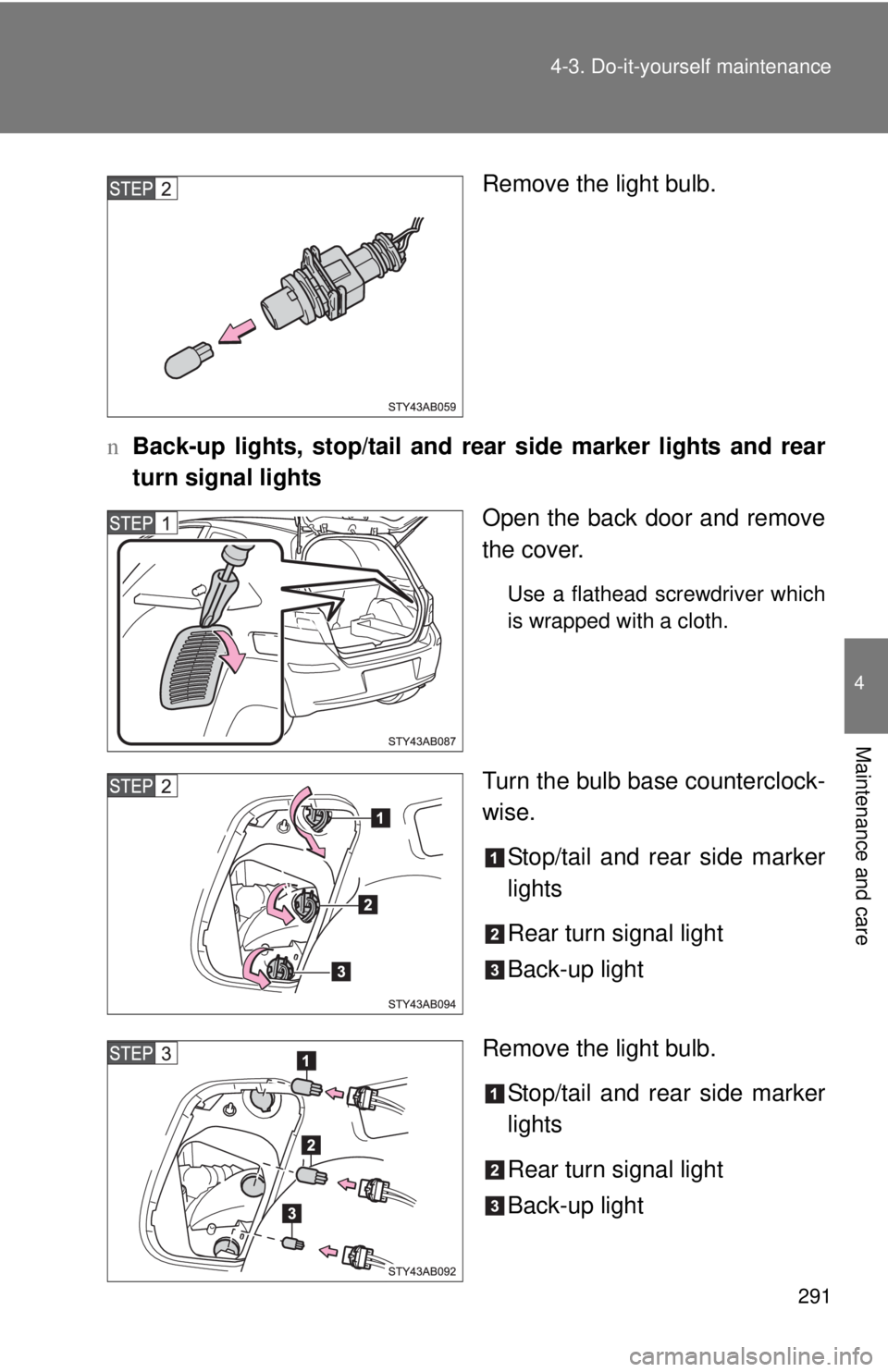
Remove the light bulb.
n Ba
ck-up lights, stop/tail and rear side marker lights and rear
turn signal lights
Open the back door and remove
the cover
.
Use a flathead screwdriver which
is wrapped with a cloth.
Turn the bulb base counterclock -
wise.
Stop/tail and rear side marker
lights
Rear turn signal light
Back-up light
Remove the light bulb. Stop/tail and rear side marker
lights
Rear turn signal light
Back-up light
Page 303 of 402
292 4-3. Do-it-yourself maintenance
nLicense plate light
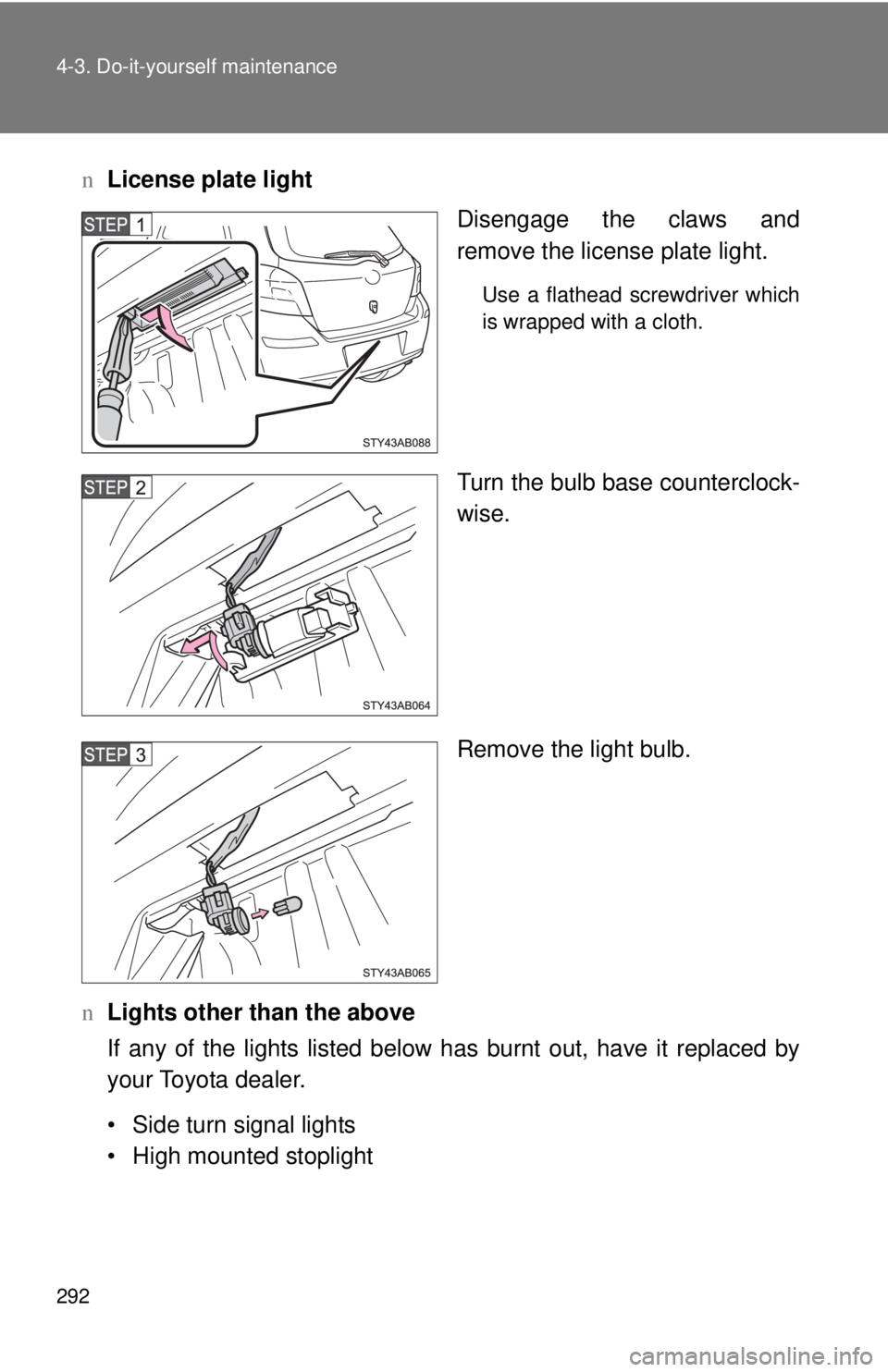
Disengage the claws and
re
move the license plate light.
Use a flathead screwdriver which
is wrapped with a cloth.
Turn the bulb base counterclock -
wise.
Remove the light bulb.
n Light
s other than the above
If any of the lights listed below h
as burnt out, have it replaced by
your Toyota dealer.
• Side turn signal lights
• High mounted stoplight
Page 304 of 402

293
4-3. Do-it-yourself maintenance
4
Maintenance and care
n
Condensation build-up on th e inside of the lens
Contact your Toyota dealer for more information in the following situations.
Temporary condensation build-up on the inside of the headlight lens does
not indicate a malfunction.
l Large drop
s of water are built up on the inside of the lens.
l W
ater has built up inside the headlight.
n LE
D high mounted stoplight
The high mounted stoplight consists of a number of LEDs. If any of the LEDs
burn
out, take your vehicle to your Toyota dealer to have the light replaced.
n Inst
alling the clips
CAUTION
nReplacing light bulbs
Turn off the headlights. Do not attempt to replace the bulb immediately after
turning off the headlights.
The bulbs become very hot and may cause burns.
n To prevent damage or fire
Make sure bulbs are fully seated and locked.
Insert the clips.
Page 305 of 402

294 4-3. Do-it-yourself maintenance
NOTICE
lHalogen bulbs have pressurized gas inside and require special handling. \
Do
not touch the glass portion of the light bulb with bare hands. Hold the bulb by
the plastic or metal portion.
If the bulb is scratched or dropped it may blow out or crack.
l Fully install light bulbs and any parts used to secure them. Failing to do so
may result in heat damage, fire, or water entering the headlight unit. This
may damage the headlights or cause condensation to build up on the lens.
Page 306 of 402
296
5-1. Essential information
Emergency flashers
NOTICE
nTo prevent battery discharge
Do not leave the emergency flashers on longer than necessary when the
engine is not running.
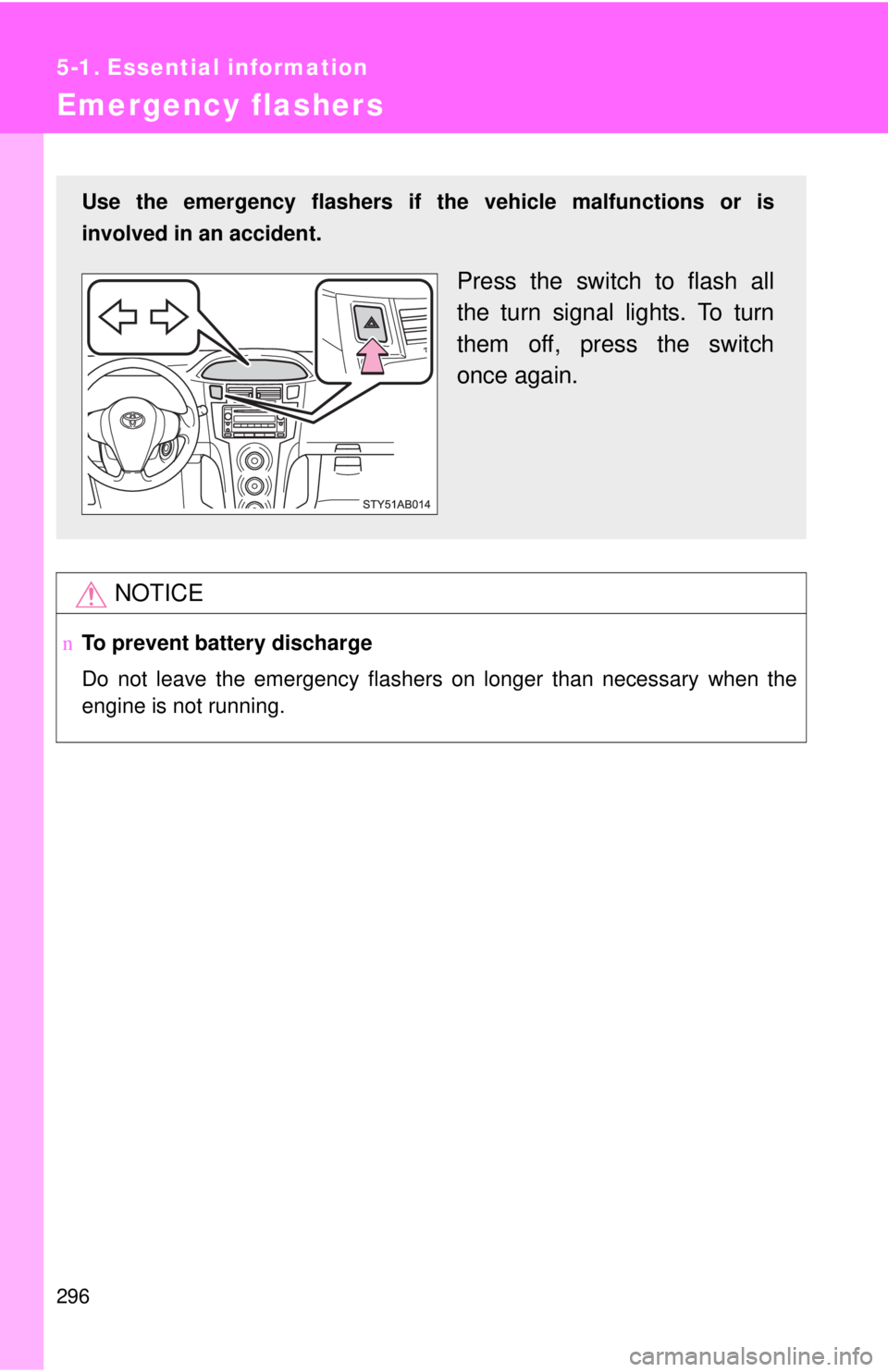
Use the emergency flashers if th e vehicle malfunctions or is
involved in an accident.
Press the switch to flash all
the turn signal lights. To turn
them off, press the switch
once again.
Page 317 of 402
5
When trouble arises
307
5-2. Steps to take in an emergency
If a war ning light turns on or a war ning buzzer sounds...
Stop the vehicle immediately. Continuing to drive the vehicle may be dangerous.
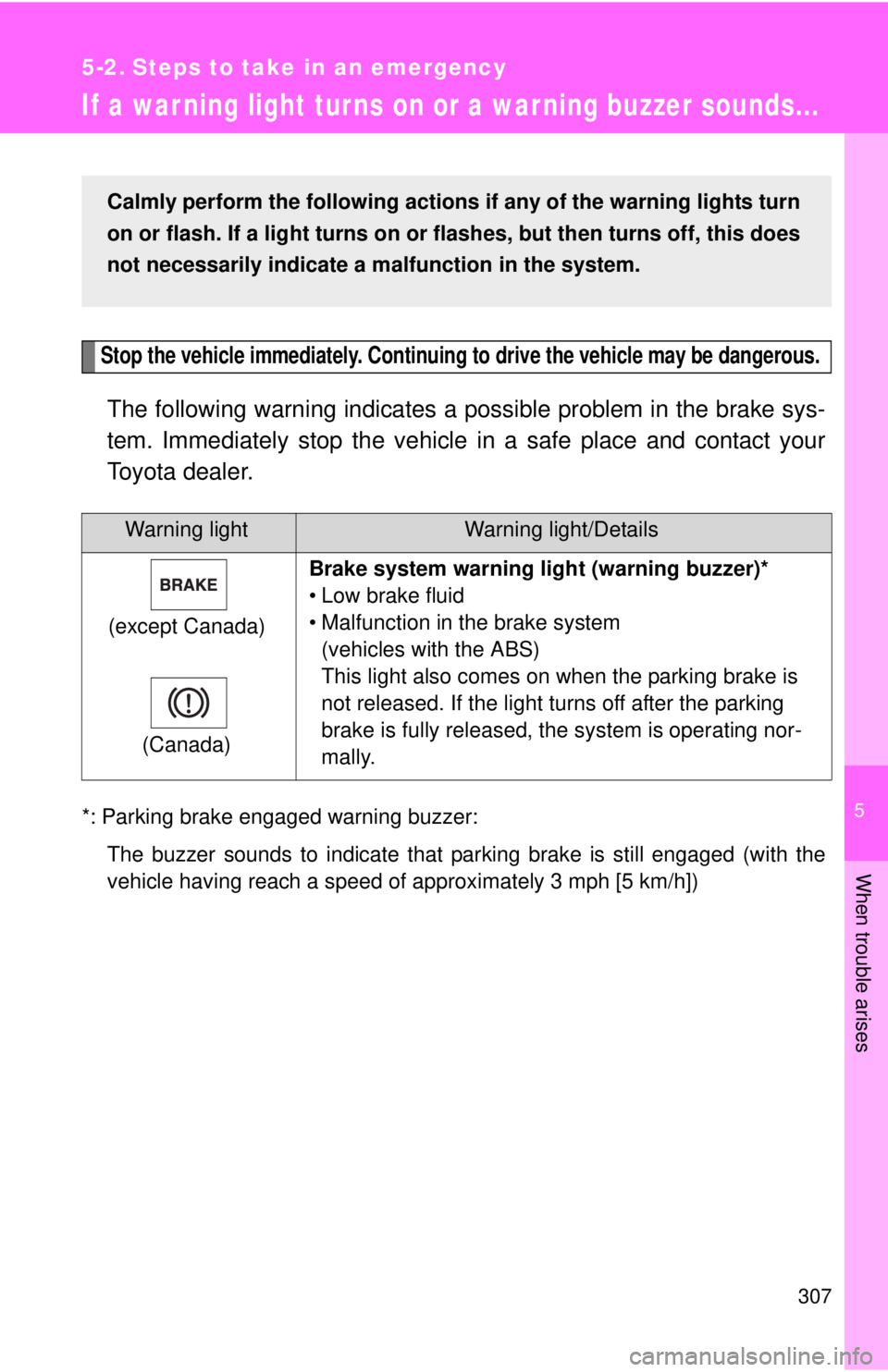
The following warning indicates a possible problem in the brake sys-
tem. Immediately stop the vehicle in
a safe place and contact your
Toyota dealer.
*: Parking brake engaged warning buzzer:
The buzzer sounds to indicate that parking brake is still engaged (with the
vehicle having reach a speed of approximately 3 mph [5 km/h])
Warning lightWarning light/Details
(except Canada)
(Canada) Brake system warning li
ght (warning buzzer)*
• Low brake fluid
• Malfunction in the brake system
(vehicles with the ABS)
This light also comes on when the parking brake is
not released. If the light turns off after the parking
brake is fully released, the system is operating nor-
mally.
Calmly perform the following actions if any of the warning lights turn
on or flash. If a light turns on or flashes, but then turns off, this does
not necessarily indicate a malfunction in the system.
Page 339 of 402
5
When trouble arises
329
5-2. Steps to take in an emergency
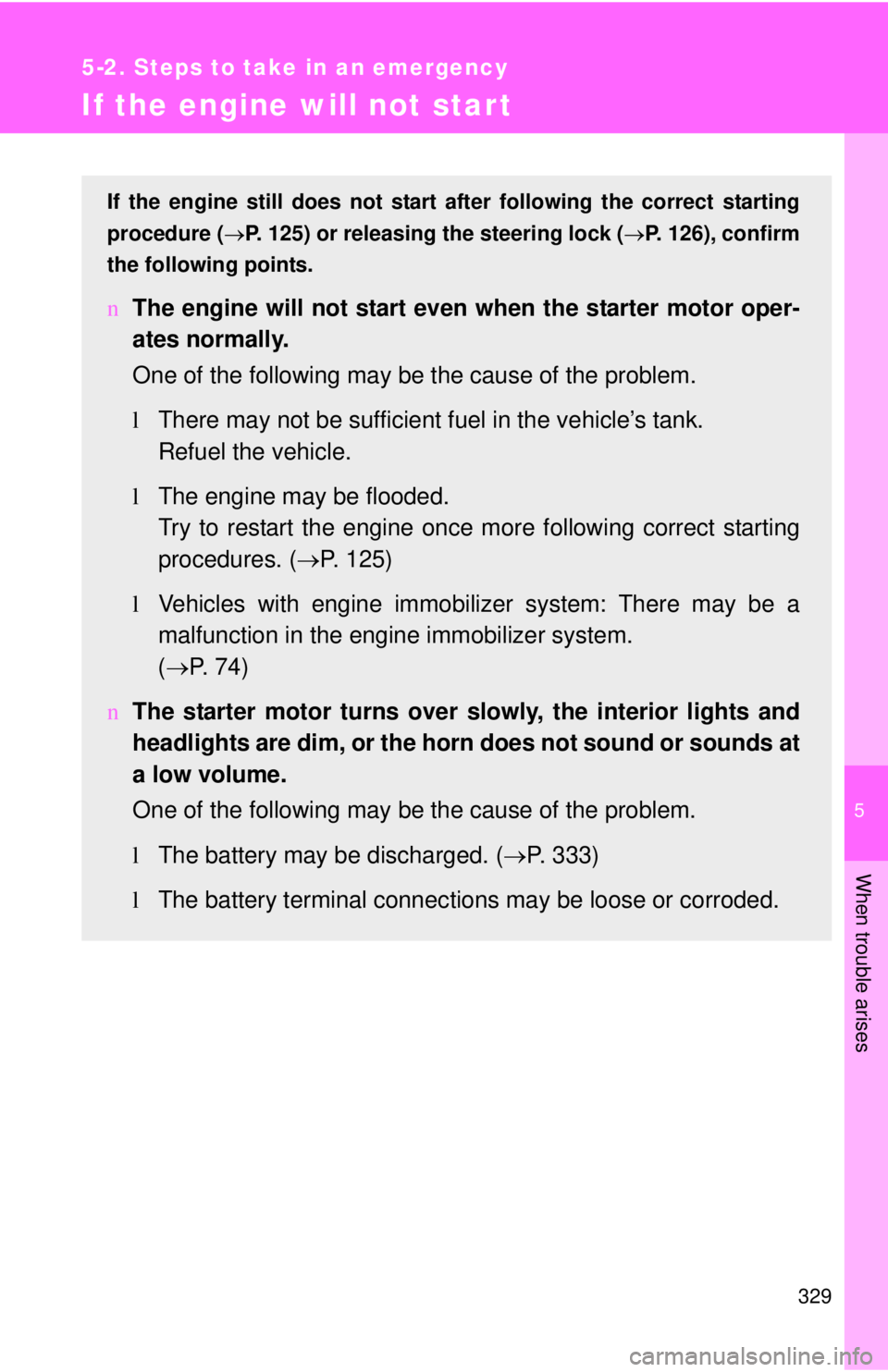
If the engine will not start
If the engine still does not start after following the correct starting
procedure ( →
P. 125) or releasing the steering lock ( →P. 126), confirm
the following points.
n The engine will not start even when the starter motor oper -
ates normally.
One of the following may be the cause of the problem.
l There
may not be sufficient fuel in the vehicle’s tank.
Refuel the vehicle.
l The eng
ine may be flooded.
Try to restart the engine once more following correct starting
pro
cedures. ( →P. 125 )
l V
ehicles with engine immobilizer system: There may be a
malfunction in the engine immobilizer system.
( → P. 7 4 )
n The
starter motor turns over slowly, the interior lights and
headlights are dim, or the horn does not sound or sounds at
a low volume.
One of the following may be the cause of the problem.
lThe battery
may be discharged. (→ P. 333)
l The
battery terminal connec tions may be loose or corroded.
Page 340 of 402
330 5-2. Steps to take in an emergency
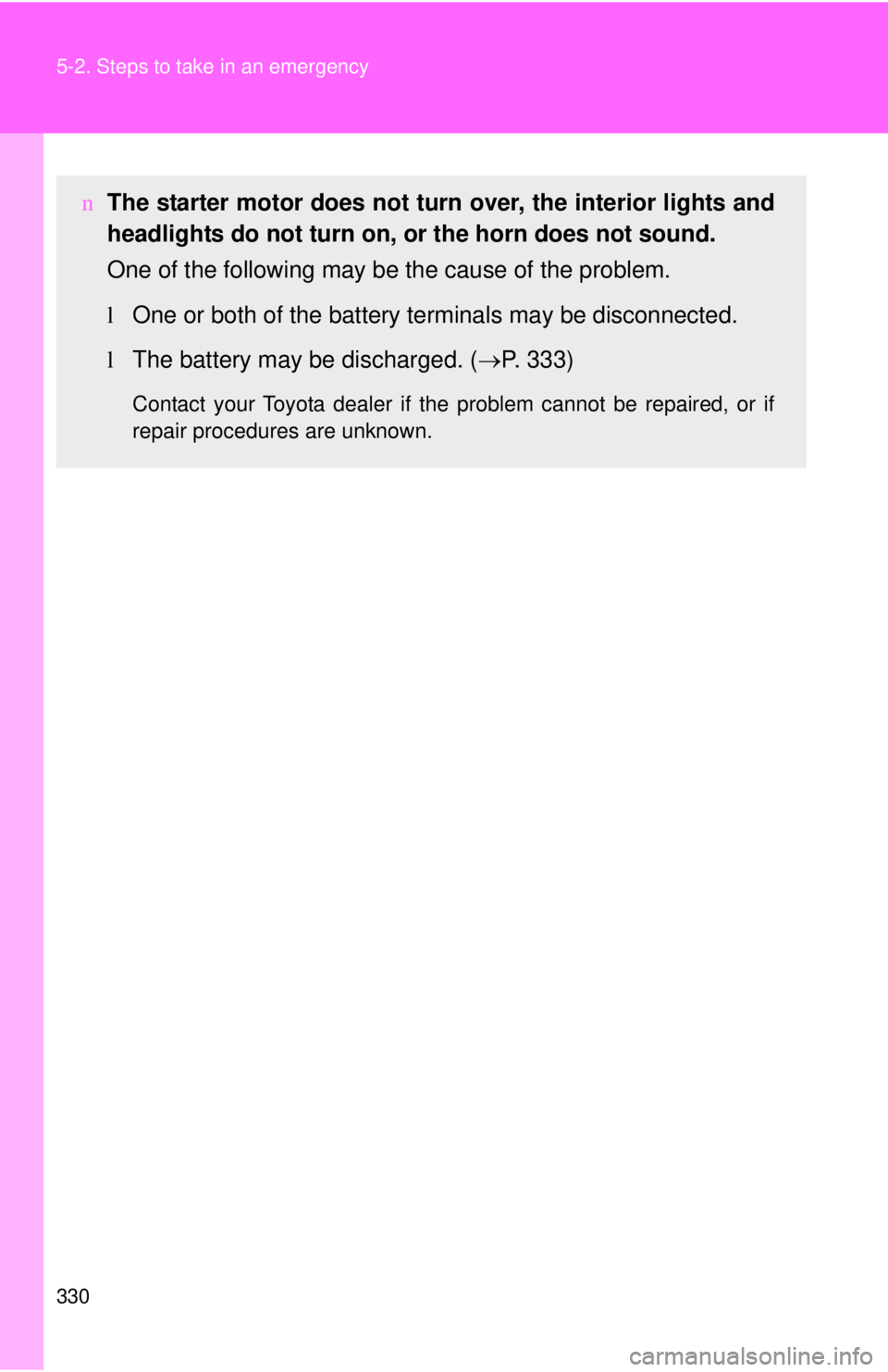
nThe starter motor does not turn over, the interior lights and
headlights do not turn on, or the horn does not sound.
One of the following may be the cause of the problem.
l One or
both of the battery terminals may be disconnected.
lThe battery
may be discharged. (→ P. 333)
Contact your Toyota dealer if the problem cannot be repaired, or if
repair procedures are unknown.
Page 345 of 402
5
When trouble arises
335
5-2. Steps to take in an emergency
n
Starting the engine when the battery is discharged (vehicles with an
automatic transmission)
The engine cannot be started by push-starting.
n A
voiding a discharged battery
lT
urn off the headlights and the audio system while the engine is turned
off.
l T
urn off any unnecessary electrical components when the vehicle is run -
ning at a low speed for an extended period, such as in heavy traffic, etc.
CAUTION
nAvoiding battery fires or explosions
Observe the following precautions to prevent accidentally igniting the flam-
mable gas that may be emitted from the battery.
lMake sure the jumper cable is connected to the correct terminal and that it
is not unintentionally in contact with any part other than the intended termi-
nal.
l Do not allow the jumper cables to come into contact with the “+” and “-” ter-
minals.
l Do not smoke, use matches, cigarette lighters or allow open flame near
the battery.
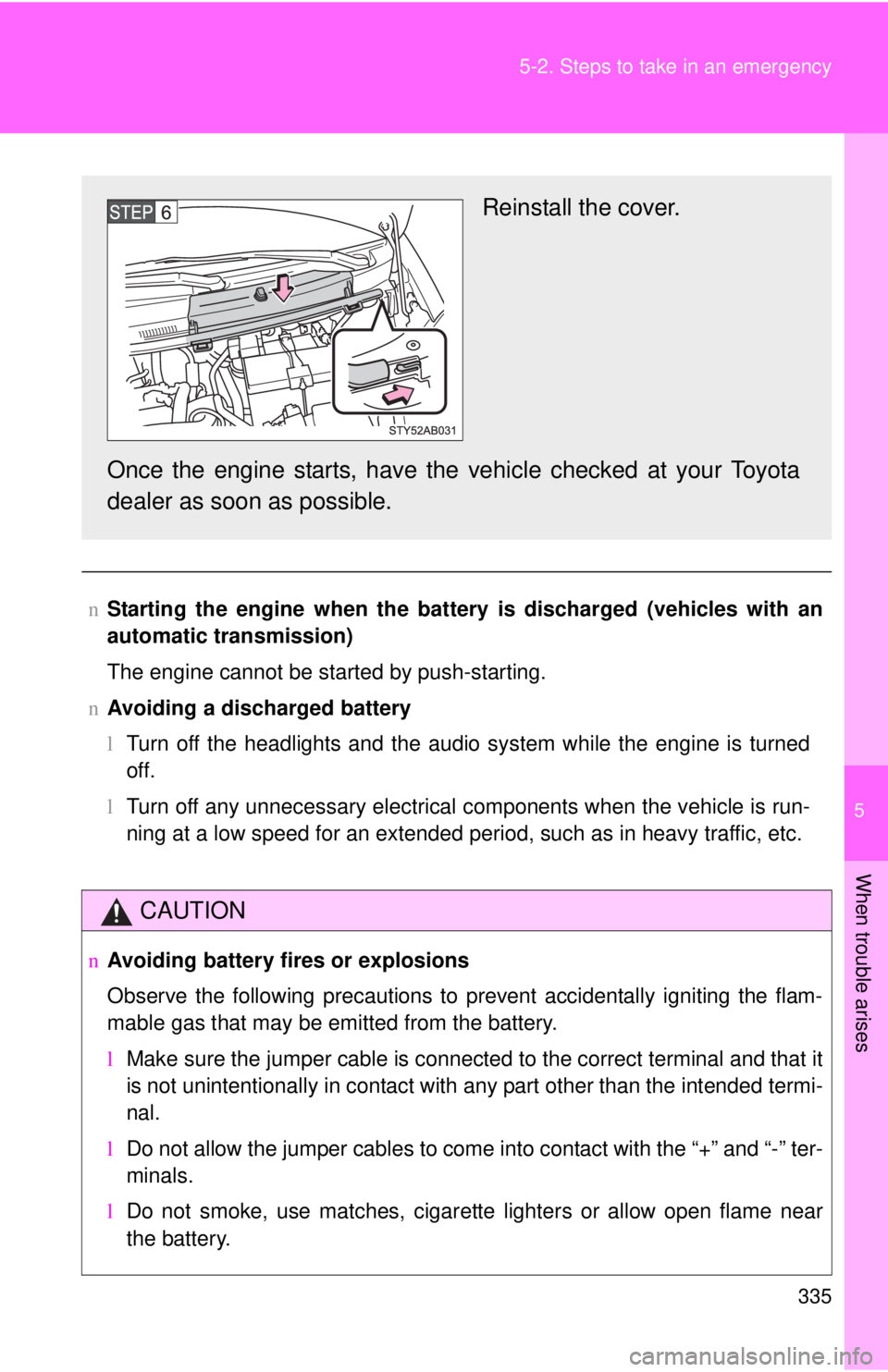
Reinstall the cover.
Once the engine starts, have the vehicle checked at your Toyota
dealer as soon as possible.
Page 358 of 402
349
6-1. Specifications
6
Vehicle specifications
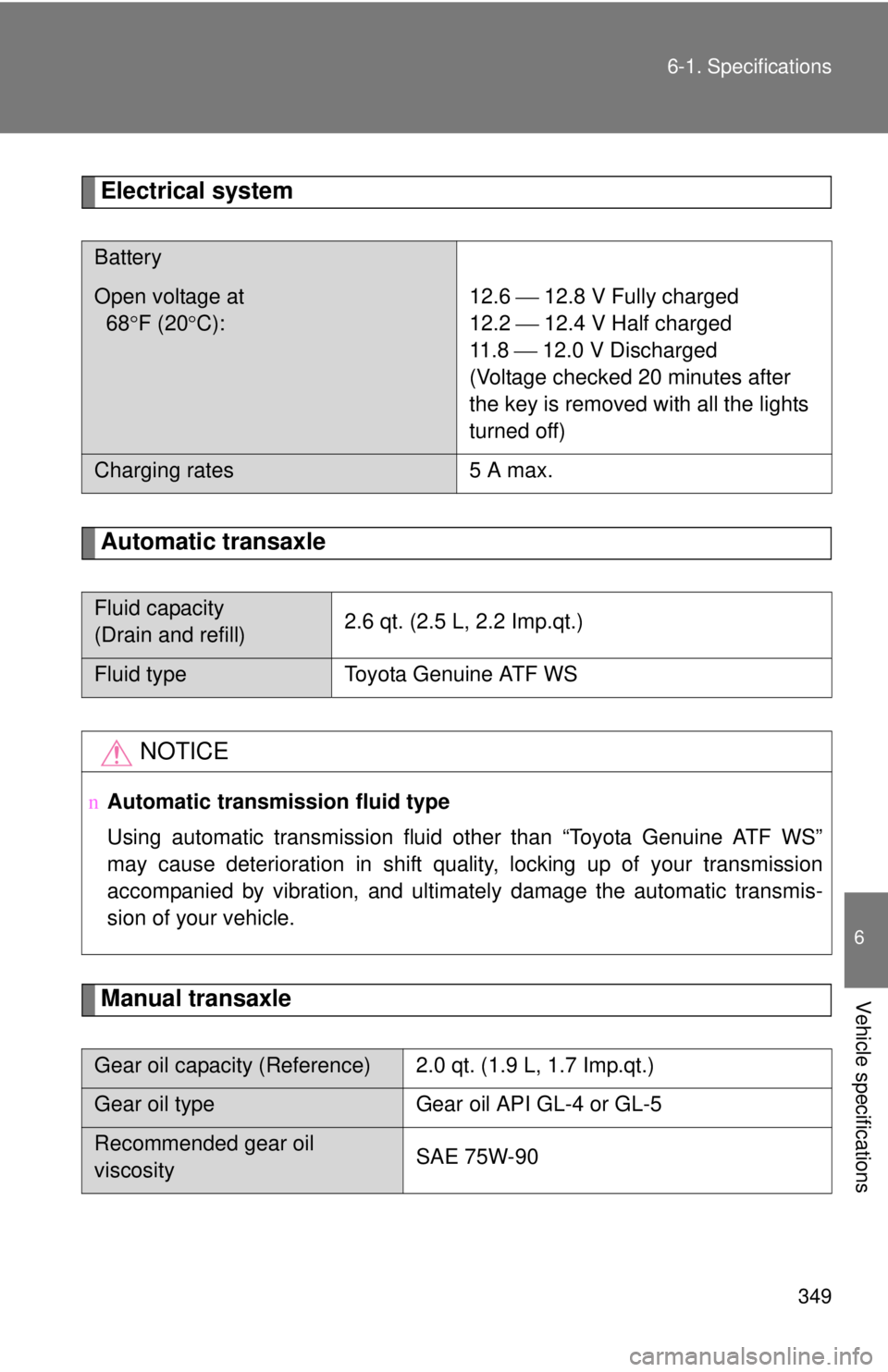
Electrical system
Automatic transaxle
Manual transaxle
Battery
Open voltage at
68°
F (20 °C): 12.6 ⎯ 12.8 V Fully charged
12.2 ⎯ 12.4 V Half charged
11 . 8 ⎯ 12.0 V Discharged
(Voltage checked 20 minutes after
the key is removed with all the lights
turned off)
Charging rates 5 A max.
Fluid capacity
(Drain and refill) 2.6 qt. (2.5 L, 2.2 Imp.qt.)
Fluid type
Toyota Genuine ATF WS
NOTICE
nAutomatic transmission fluid type
Using automatic transmission fluid other than “Toyota Genuine ATF WS”
may cause deterioration in shift quality, locking up of your transmission
accompanied by vibration, and ultimately damage the automatic transmis-
sion of your vehicle.
Gear oil capacity (Reference) 2.0 qt. (1.9 L, 1.7 Imp.qt.)
Gear oil type Gear oil API GL-4 or GL-5
Recommended gear oil
viscosity SAE 75W-90