belt TOYOTA YARIS HATCHBACK 2009 Repair Manual
[x] Cancel search | Manufacturer: TOYOTA, Model Year: 2009, Model line: YARIS HATCHBACK, Model: TOYOTA YARIS HATCHBACK 2009Pages: 402, PDF Size: 7.61 MB
Page 324 of 402
314 5-2. Steps to take in an emergency
nCustomization that can be co nfigured at Toyota dealer
l The vehicle speed linked seat belt reminder buzzer can be disabled.
(Customizable features →P. 369)
l The key reminder buzzer can be disabled.
(Customizable features →P. 369)
l The light reminder buzzer can be disabled.
(Customizable features →P. 369)
CAUTION
nIf the tire pressure warning light comes on
Be sure to observe the following precautions. Failure to do so could
cause loss of vehicle control and re sult in death or serious injury.
lStop your vehicle in a safe place as soon as possible. Adjust the tire
inflation pressure immediately.
lIf the tire pressure warning light comes on even after tire inflation pres-
sure adjustment, it is pr obable that you have a fl at tire. Check the tires.
If the tire is flat, change to the spare tire and have the flat tire repaired
by the nearest Toyota dealer.
lAvoid abrupt maneuvering and braking. If the vehicle tires deteriorate,
you could lose control of the steering wheel or the brakes.
nIf a blowout or sudden air leakage should occur
The tire pressure warning syste m may not activate immediately.
nMaintenance of the tire
Each tire, including the spare (if provided), should be checked monthly
when cold and inflated to the inflation pressure recommended by the
vehicle manufacturer on the vehicle pl acard or tire inflation pressure
label (tire and load information label). (If your vehicle has tires of a differ-
ent size than the size indicated on the vehicle placard or tire inflation
pressure label [tire and load information label], you should determine the
proper tire inflation pr essure for those tires.)
Page 327 of 402
5
When trouble arises
317
5-2. Steps to take in an emergency
If you have a flat tire
Remove the flat tire and replace it with the spare provided.
nBefore jacking up the vehicle
lS
top the vehicle on a hard, flat surface.
lSe
t the parking brake.
lSh
ift the shift lever to P (automatic transmission) or R (manual
transmission).
l S
top the engine.
lT
urn on the emergency flashers.
n Location of th
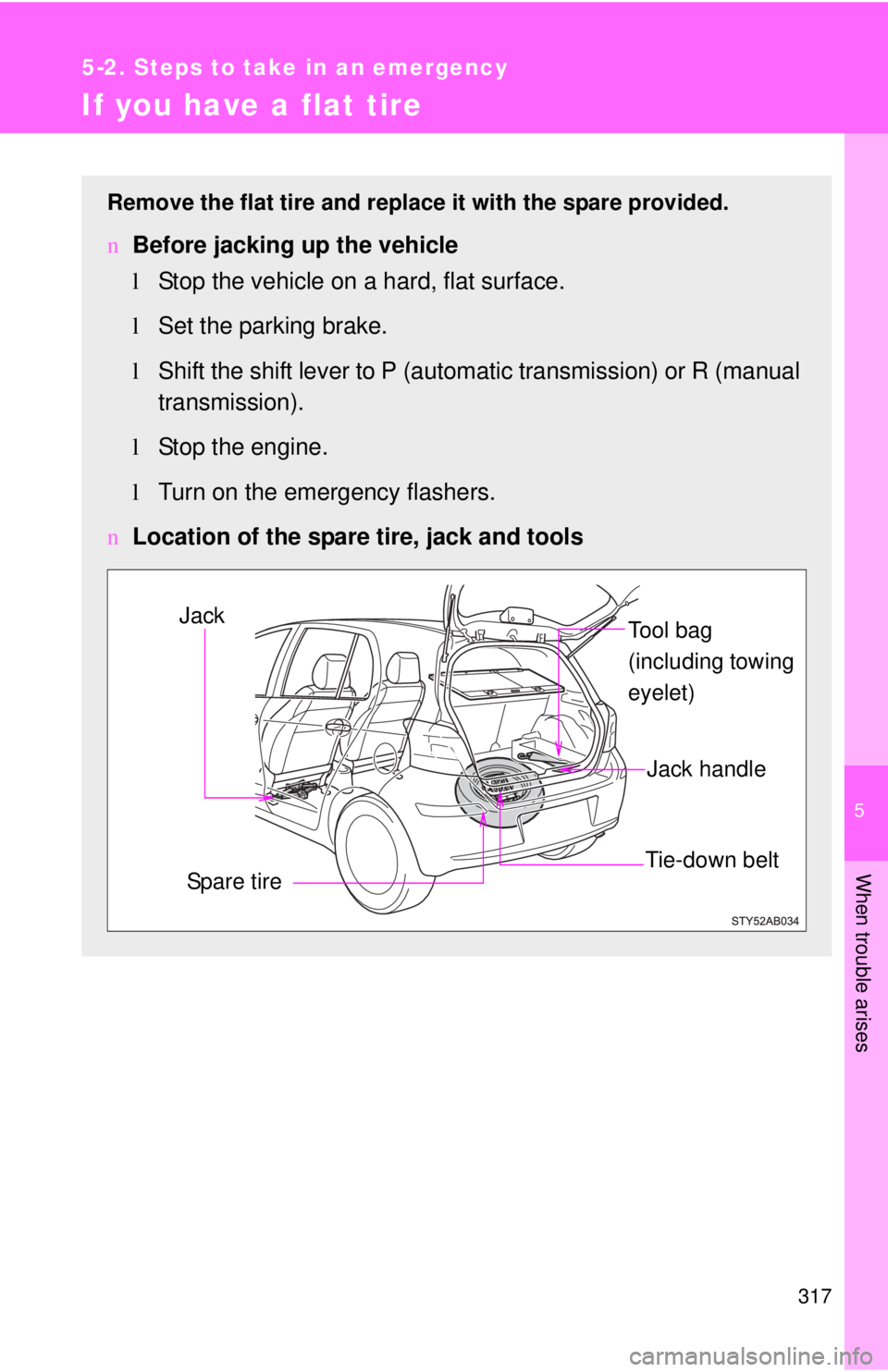
e spare tire, jack and tools
Spare tire
Jack
Jack handle
Tie-down belt
Tool bag
(including towing
eyelet)
Page 334 of 402
324 5-2. Steps to take in an emergency
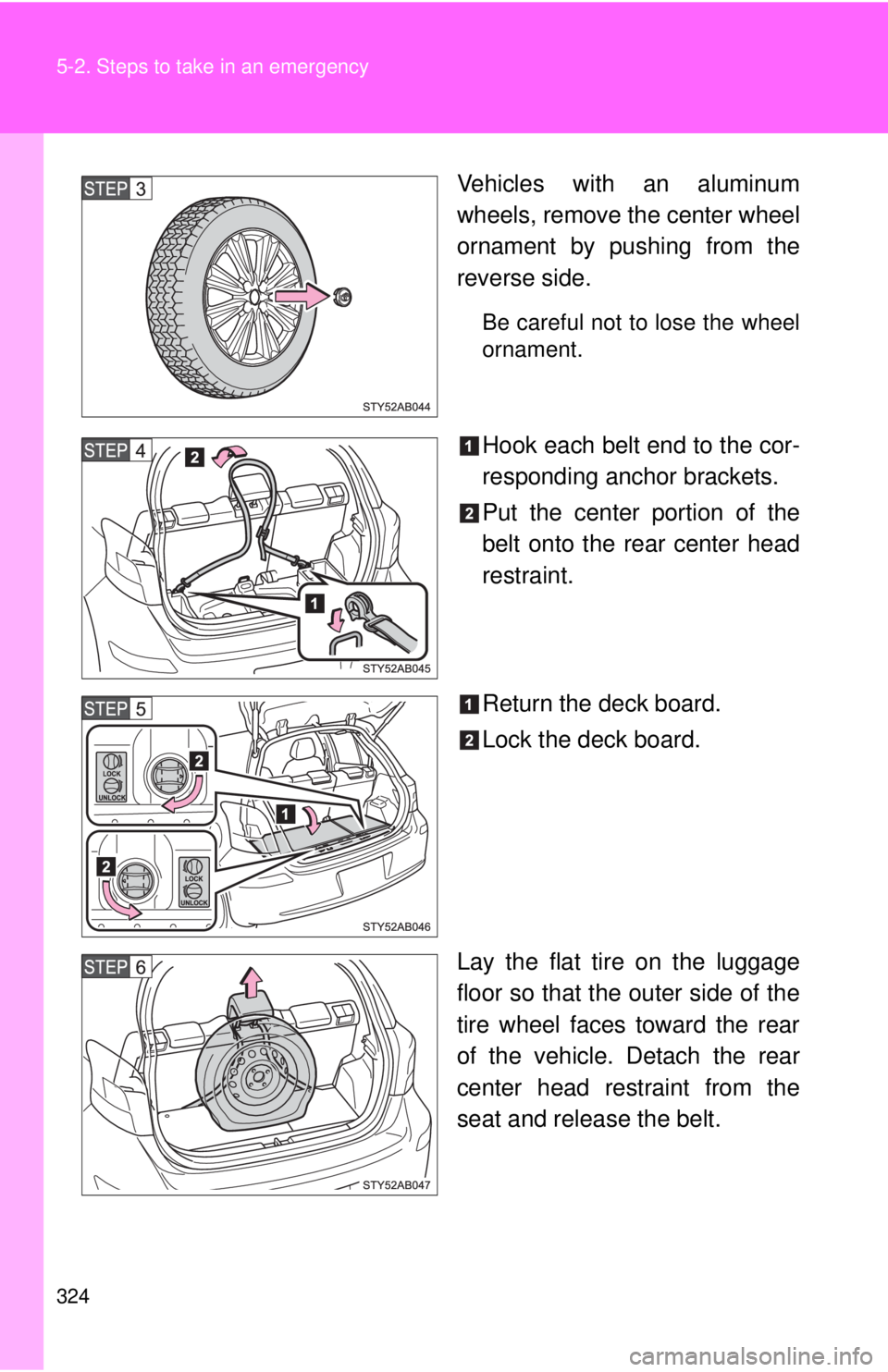
Vehicles with an aluminum
wheels, remove the center wheel
ornament by pushing from the
reverse side.
Be careful not to lose the wheel
ornament.
Hook each belt end to the cor-
responding anchor brackets.
Put the center portion of the
belt onto the rear center head
re
straint.
Return the deck board.
Lock the deck board.
Lay the flat tire on the luggage
floo
r so that the outer side of the
tire wheel faces toward the rear
of the vehicle. Detach the rear
center head restraint from the
seat and release the belt.
Page 335 of 402
5
When trouble arises
325
5-2. Steps to take in an emergency
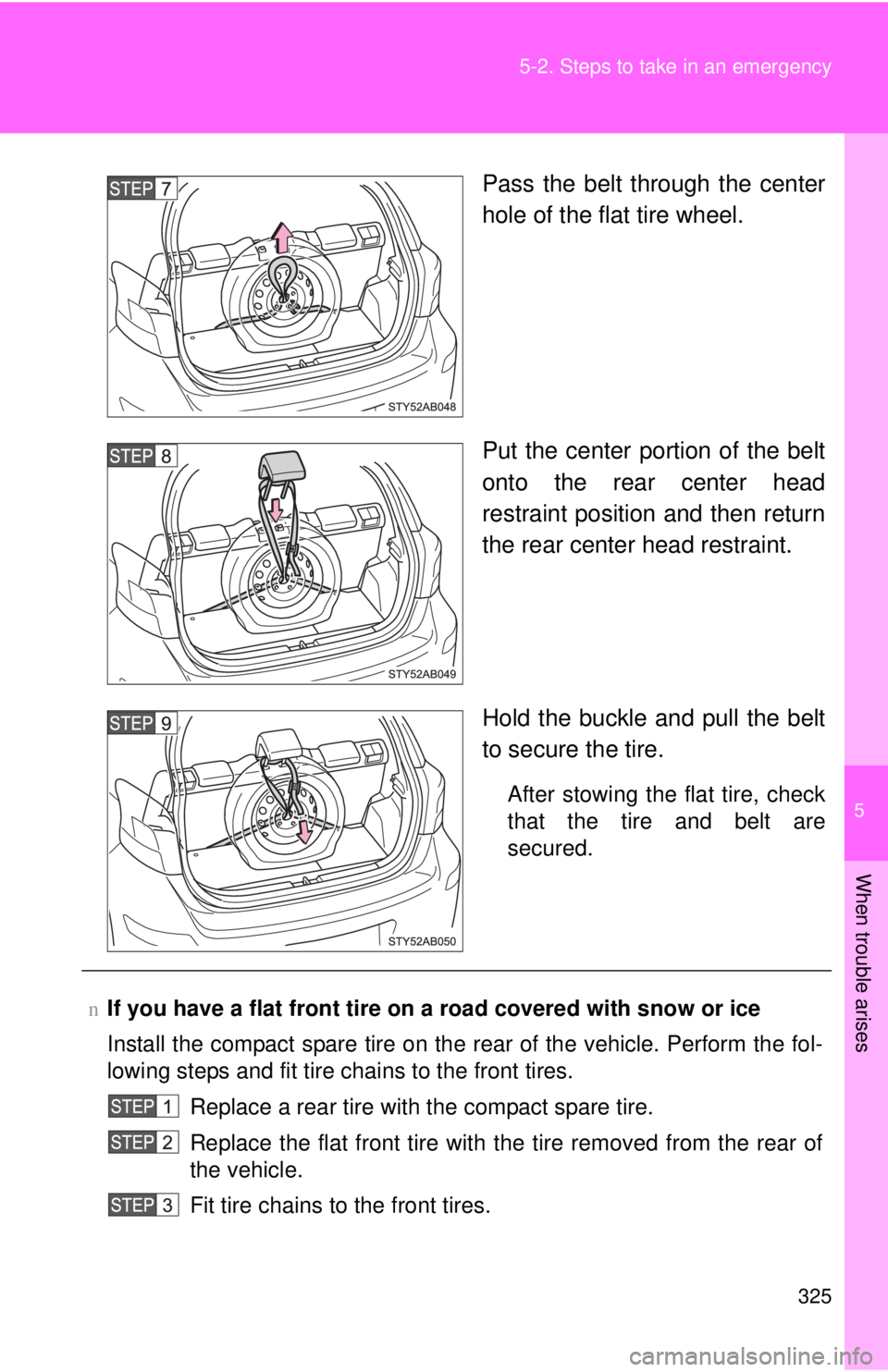
Pass the belt through the center
hole of the flat tire wheel.
Put the center portion of the belt
o
nto the rear center head
restraint position and then return
the rear center head restraint.
Hold the buckle and pull the belt
t
o secure the tire.
After stowing the flat tire, check
that the tire and belt are
secured.
nIf you have a flat front tire on a road covered with snow or ice
Install the compact spare tire on the rear of the vehicle. Perform the fol -
lowing steps and fit tire chains to the front tires.
Replace a rear tire with the compact spare tire.
Replace the flat front tire with t he tir
e removed from the rear of
the vehicle.
Fit tire chains to the front tires.
Page 346 of 402
336 5-2. Steps to take in an emergency
CAUTION
nBattery precautions
The battery contains poisonous and corrosive acidic electrolyte, while
related parts contain lead and lead compounds. Observe the following pre-
cautions when handling the battery.
lWhen working with the battery, always wear safety glasses and take care
not to allow any battery fluids (acid) to come into contact with skin, clothing
or the vehicle body.
l Do not lean over the battery.
l In the event that battery fluid comes into contact with the skin or eyes,
immediately wash the affected area with water and seek medical attention.
Place a wet sponge or cloth over the affected area until medical attention
can be received.
l Always wash your hands after handling the battery support, terminals, and
other battery-related parts.
l Do not allow children near the battery.
NOTICE
nTo prevent damaging the vehicle ( vehicles with a manual transmission)
Do not pull- or push-start the vehicle, because the three-way catalytic con-
verter may overheat and become a fire hazard.
n When handling jumper cables
Be careful that the jumper cables do not become tangled in the cooling fan
or any of the belts when connecting or disconnecting them.
Page 349 of 402
5
When trouble arises
339
5-2. Steps to take in an emergency
n
Overheating
If you observe the following, your vehicle may be overheating.
lThe high
engine coolant temperature warning light flashes or comes on
or a loss of power is experienced.
l Steam is coming from under the hood.
CAUTION
nTo prevent an accident or injury when inspecting un der the hood of
your vehicle
l If steam is seen coming from under the hood, do not open the hood until
the steam has subsided. The engine compartment may be very hot, caus-
ing serious injury such as burns.
l Keep hands and clothing away from the fan and other belts while the
engine is running.
l Do not loosen the radiator cap while the engine and radiator are hot.
Serious injury, such as burns, may result from hot coolant and steam
released under pressure.
NOTICE
n When adding engine coolant
Wait until the engine has cooled down before adding engine coolant.
When adding coolant, do so slowly. Adding cool coolant to a hot engine too
quickly can cause damage to the engine.
Page 355 of 402
346 6-1. Specifications
Engine
Fuel
Model1NZ-FE
Type 4-cylinder in line, 4-cycle, gasoline
Bore and stroke 2.95 × 3.33 in. (75.0 × 84.7 mm)
Displacement 91.3 cu.in. (1497 cm3)
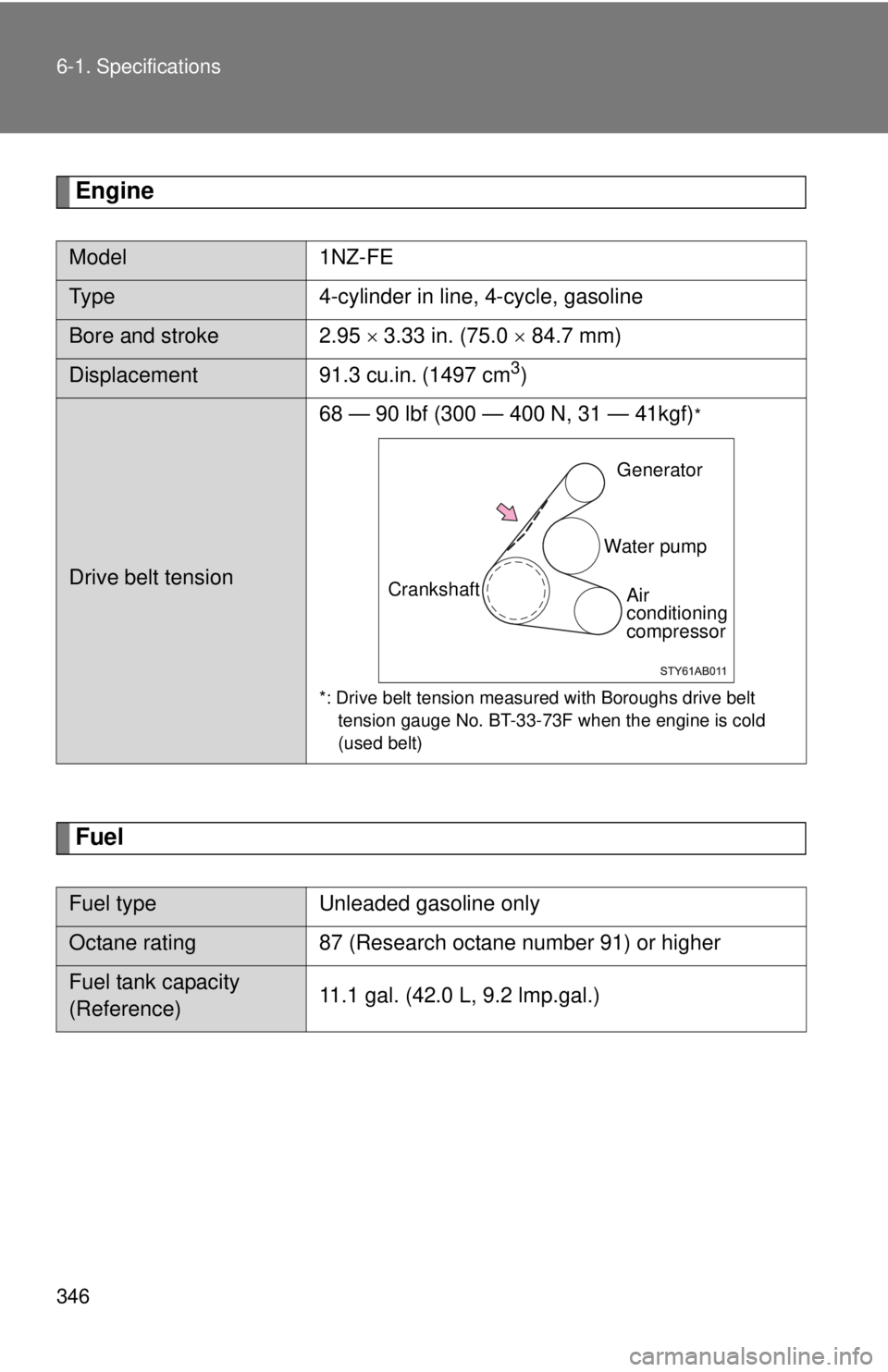
Drive belt tension 68 — 90 lbf (300 — 400 N, 31 — 41kgf)
*
*: Drive belt tension measur ed with Boroughs drive belt
tension gauge No. BT-33-73F when the engine is cold
(used belt)
Fuel type Unleaded gasoline only
Octane rating 87 (Research octane number 91) or higher
Fuel tank capacity
(Reference) 11.1 gal. (42.0 L, 9.2 lmp.gal.)
Generator
Water pump Air
conditioning
compressor
Crankshaft
Page 370 of 402
361
6-1. Specifications
6
Vehicle specifications
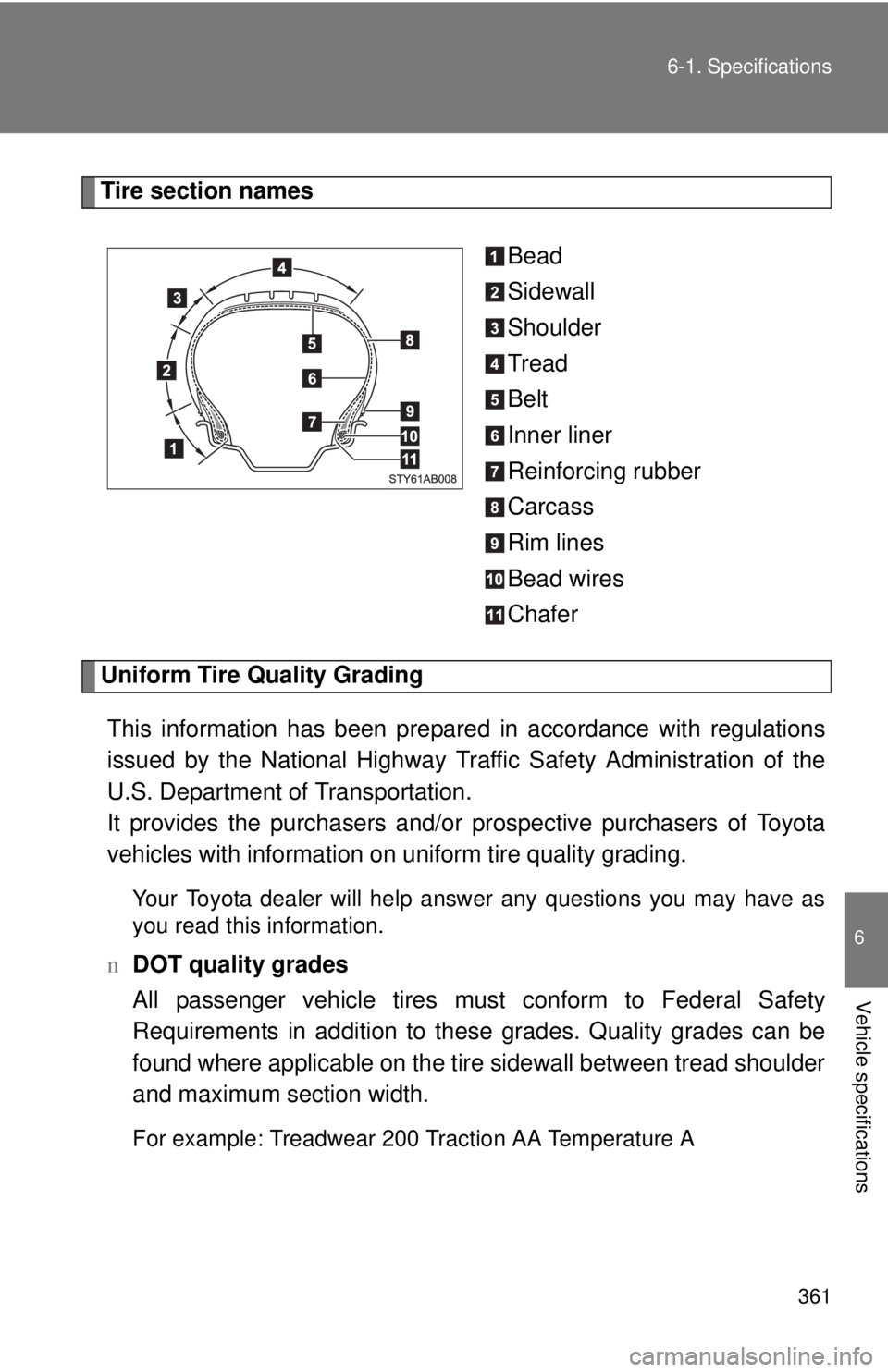
Tire section names
Bead
Sidewall
Shoulder
Tread
Belt
Inner liner
Reinforcing rubber
Carcass
Rim lines
Bead wires
Chafer
Uniform Tire Quality Grading
This information has been prepared in accordance with regulations
issued by the National Highway Tr
affic Safety Administration of the
U.S. Department of Transportation.
It provides the purchasers and/or pr
ospective purchasers of Toyota
vehicles with information on uniform tire quality grading.
Your Toyota dealer will help answ er any questions you may have as
you read this information.
n DOT quality grades
All passenger vehicle tires must c
onform to Federal Safety
Requirements in addition to these grades. Quality grades can be
found where applicable on the tire sidewall between tread shoulder
and maximum section width.
For example: Treadwear 200 Traction AA Temperature A
Page 379 of 402
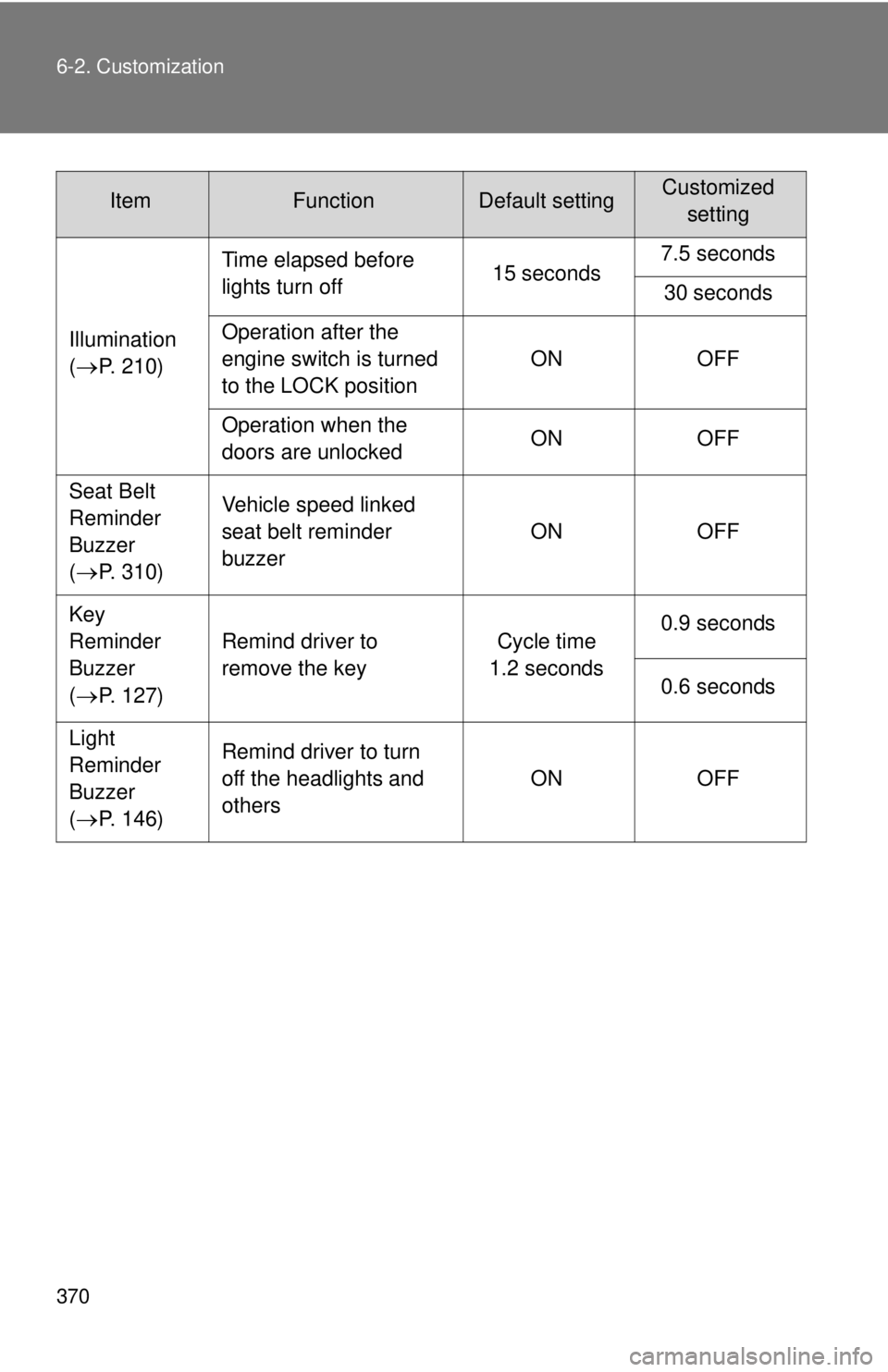
370 6-2. Customization
Illumination
(
→P. 210) Time elapsed before
lights turn off
15 seconds7.5 seconds
30 seconds
Operation after the
engine switch is turned
to the LOCK position ON OFF
Operation when the
doors are unlocked ON OFF
Seat Belt
Reminder
Buzzer
(
→P. 310) Vehicle speed linked
seat belt reminder
buzzer
ON OFF
Key
Reminder
Buzzer
(
→P. 127) Remind driver to
remove the key
Cycle time
1.2 seconds 0.9 seconds
0.6 seconds
Light
Reminder
Buzzer
(
→P. 146) Remind driver to turn
off the headlights and
others
ON OFF
ItemFunctionDefault settingCustomized
setting
Page 383 of 402
375
7
For owners
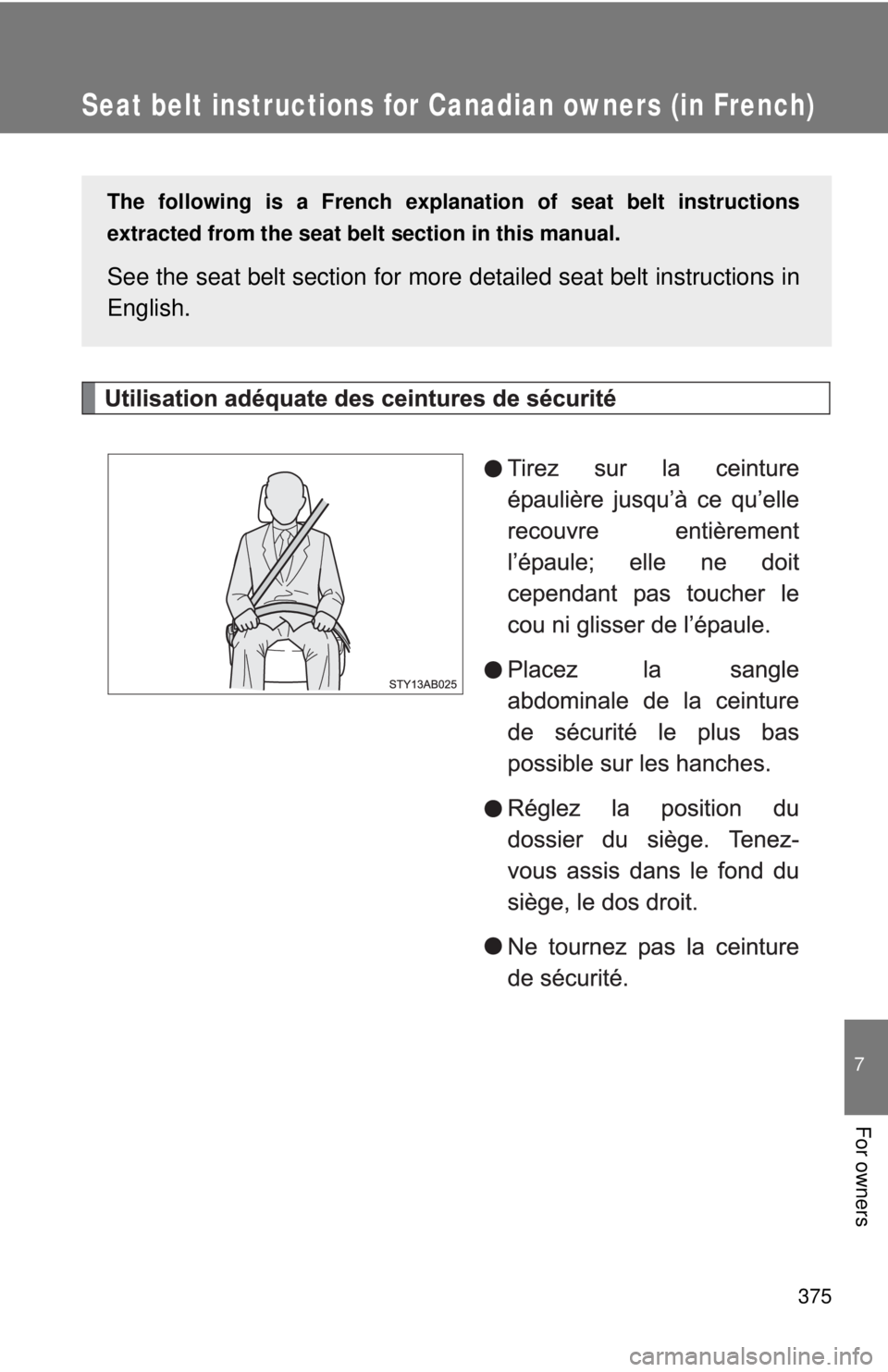
Seat belt instructions for Canadian owners (in French)
The following is a French explanation of seat belt instructions
extracted from the seat belt section in this manual.
See the seat belt section for more detailed seat belt instructions in
English.