wheel TOYOTA YARIS HATCHBACK 2009 Repair Manual
[x] Cancel search | Manufacturer: TOYOTA, Model Year: 2009, Model line: YARIS HATCHBACK, Model: TOYOTA YARIS HATCHBACK 2009Pages: 402, PDF Size: 7.61 MB
Page 279 of 402
268
4-3. Do-it-yourself maintenance
Wheels
nWhen replacing wheels
The wheels of your Toyota are equipped with tire pressure warning
valves an
d transmitters that allow the tire pressure warning system to
provide advanced warning in the event of a loss in tire inflation pressure.
Whenever wheels are replaced, the tire pressure warning valves and
transmitters must be installed. ( →P. 2 5 9 )
If a wheel is bent, cracked or heavily corroded, it should be
replaced.
Otherwise, the tire may separate from the wheel or cause loss of
ha
ndling control.
nWheel selection
When replacing wheels, care shou ld
be taken to ensure that
they are equivalent to those removed in load capacity, diameter,
rim width, and offset.
Replacement wheels are available at your Toyota dealer.
Toyota does not recommend using:
l Whee
ls of different sizes or types
lUs
ed wheels
lBe
nt wheels that have been straightened
n Aluminum wheel precau
tions (if equipped)
l Use only
Toyota wheel nuts and wrench designed for use with
your aluminum wheels.
l When
rotating, repairing or changing your tires, check that the
wheel nuts are still tight after driving 1000 miles (1600 km).
l Be
careful not to damage the aluminum wheels when using
tire chains.
l Use only T
oyota genuine balance weights or equivalent and a
plastic or rubber hammer when balancing your wheels.
Page 280 of 402

269
4-3. Do-it-yourself maintenance
4
Maintenance and care
CAUTION
nWhen replacing wheels
lDo not use wheels that are a different size from those recommended in
the Owner’s Manual, as this may re
sult in loss of handling control.
lNever use an inner tube in a leaking wheel which is designed for a
tubeless tire. Doing so may result in an accident, causing death or seri-
ous injury.
NOTICE
nReplacing tire pressure warning valves and transmitters
lBecause tire repair or replacement may affect the tire pressure warn-
ing valves and transmitte rs, make sure to have tires serviced by your
Toyota dealer or other qualified service shop. In addition, make sure to
purchase your tire pressure warning valves and transmitters at your
Toyota dealer.
lEnsure that only genuine Toyota wheels are used on your vehicle.
Tire pressure warning valves and transmitters may not work properly
with non-genuine wheels.
Page 307 of 402
5
When trouble arises
297
5-1. Essential information
If your vehicle needs to be towed
Before towing
The following may indicate a problem with your transmission. Contact
your Toyota dealer before towing.
lThe en
gine is running, but the vehicle will not move.
lThe
vehicle makes an abnormal sound.
Emergency towing
If a tow truck is not available, in an emergency your vehicle may be
temporarily towed using a cable or chain secured to the emergency
towing eyelet. This should only attempted on hard, surfaced roads for
short distances at low speeds.
A driver must be in the vehicle to steer and operate the brakes. The
ve
hicle’s wheels, drive train, axles, steering and brakes must be in
good condition.
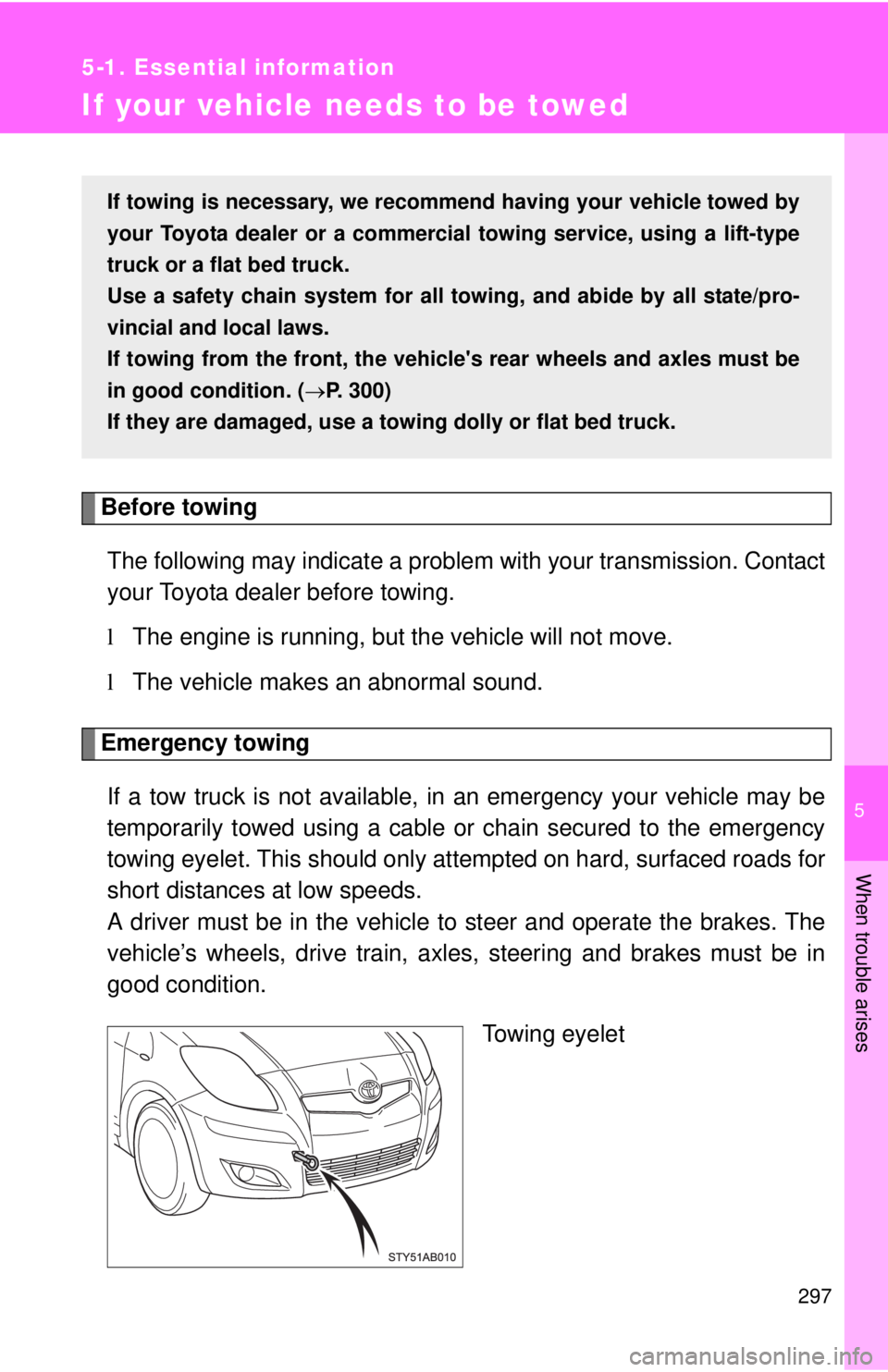
Towing eyelet
If towing is necessary, we recommend having your vehicle towed by
your Toyota dealer or a commerci al towing service, using a lift-type
truck or a flat bed truck.
Use a safety chain system for all to wing, and abide by
all state/pro-
vincial and local laws.
If towing from the front, the vehic le's rear
wheels and axles must be
in good condition. (→P
. 300)
If they are damaged, use a towing dolly or flat bed truck.
Page 308 of 402

298 5-1. Essential information
nEmergency towin g procedure
Release the parking brake.
Put the transmission in N.
Turn the engine switch to the ACC (engine off) or ON (engine run -
ning) position.
CAUTION
nCaution while towing
lUse extreme caution when towing the vehicle.
Avoid sudden starts or erratic driving maneuvers which place excessive
stress on the emergency towing eyelet and the cables or chains.
l If the engine is not running, the power assist for the brakes and steering
will not function, making steering and braking more difficult.
NOTICE
nTo prevent causing serious dama ge to the transmission
(vehicles with an automatic transmission)
Never tow this vehicle from the rear with the front wheels on the ground.
This may cause serious damage to the transmission.
n When towing a vehicle without using a towing dolly
(vehicles with a manual transmission)
Do not tow with the key removed or in the LOCK position.
Page 309 of 402
5
When trouble arises
299
5-1. Essential information
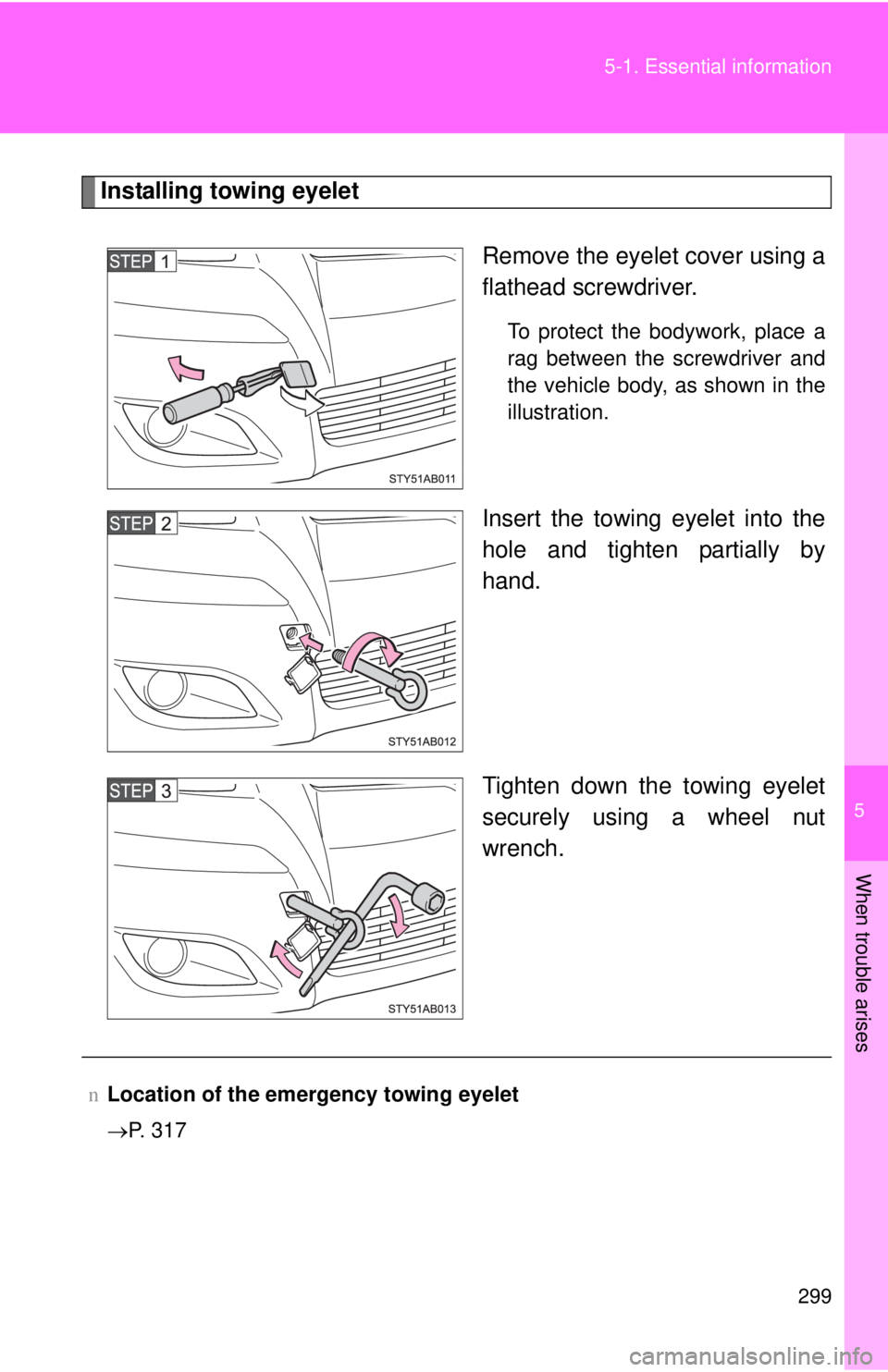
Installing towing eyelet
Remove the eyelet cover using a
flathead screwdriver.
To protect the bodywork, place a
rag between the screwdriver and
the vehicle body, as shown in the
illustration.
Insert the towing eyelet into the
hole and tighten partially by
hand.
Tighten down the towing eyelet
secure
ly using a wheel nut
wrench.
n Location of the emer gency towing eyelet
→P
. 317
Page 310 of 402
300 5-1. Essential information
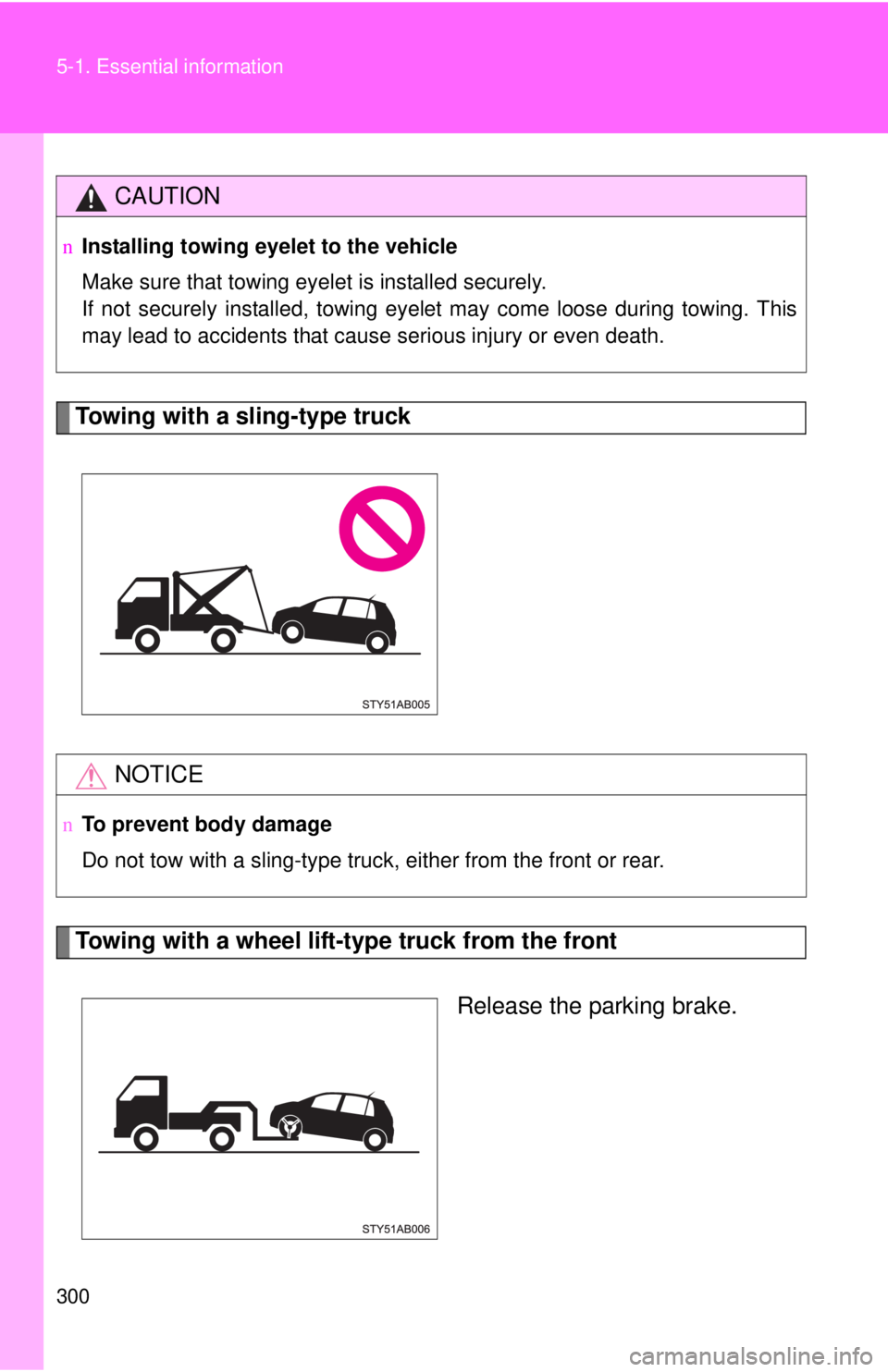
Towing with a sling-type truck
Towing with a wheel lift-type truck from the front
Release the parking brake.
CAUTION
nInstalling towing eyelet to the vehicle
Make sure that towing eyelet is installed securely.
If not securely installed, towing eyelet may come loose during towing. This
may lead to accidents that cause serious injury or even death.
NOTICE
n To prevent body damage
Do not tow with a sling-type truck, either from the front or rear.
Page 311 of 402
5
When trouble arises
301
5-1. Essential information
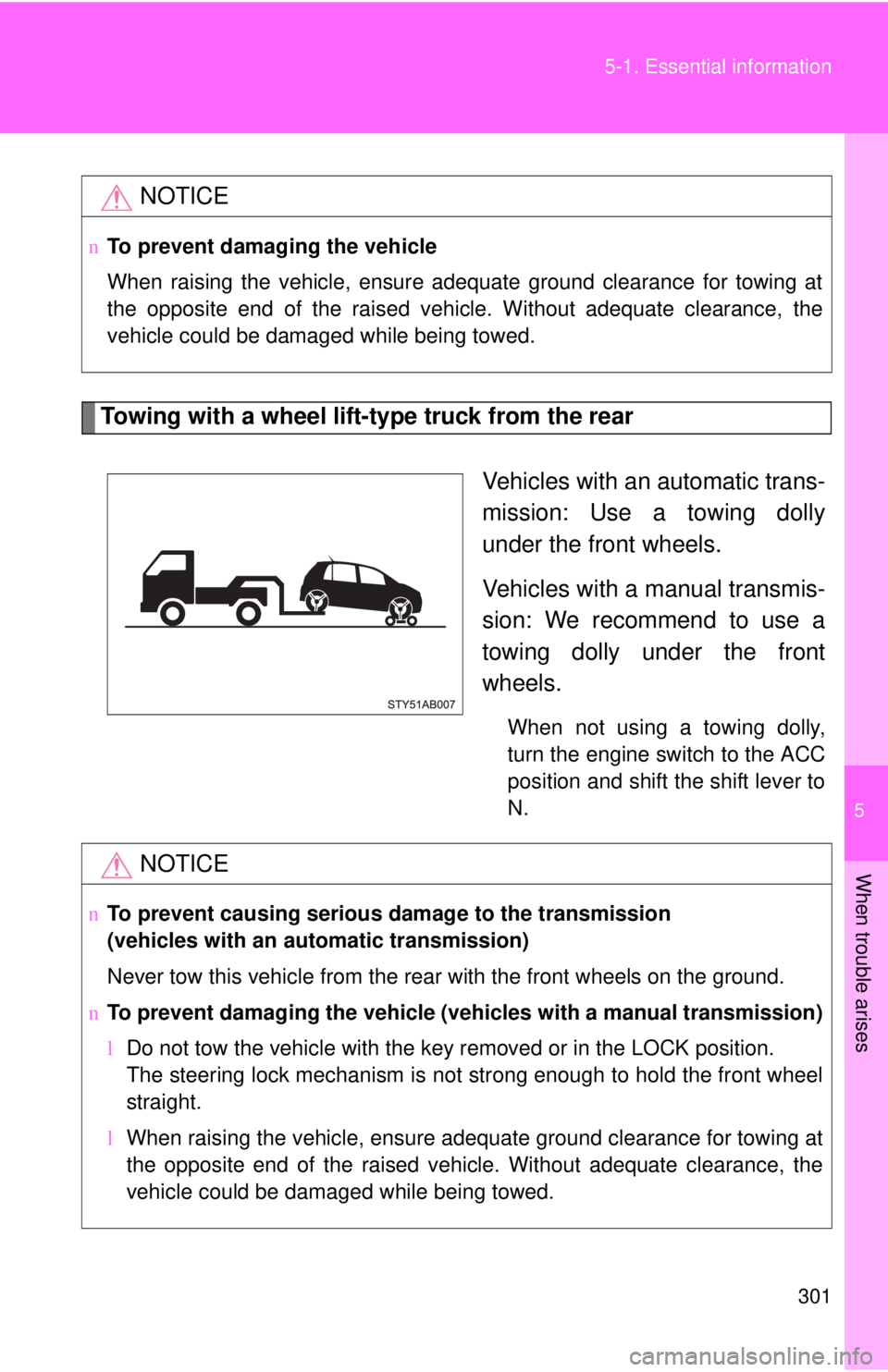
Towing with a wheel lift-type truck from the rear
Vehicles with an automatic trans-
mission: Use a towing dolly
u
nder the front wheels.
Vehicles with a manual transmis -
sion: We recommend to use a
tow
ing dolly under the front
wheels.
When not using a towing dolly,
turn the engine switch to the ACC
position and shift the shift lever to
N.
NOTICE
n To prevent damaging the vehicle
When raising the vehicle, ensure adequate ground clearance for towing at
the opposite end of the raised vehicle. Without adequate clearance, the
vehicle could be damaged while being towed.
NOTICE
nTo prevent causing serious da mage to the transmission
(vehicles with an automatic transmission)
Never tow this vehicle from the rear with the front wheels on the ground.
n To prevent damaging the vehicle (vehicles with a manual transmission)
lDo not tow the vehicle with the key removed or in the LOCK position.
The steering lock mechanism is not strong enough to hold the front wheel
straight.
l When raising the vehicle, ensure adequate ground clearance for towing at
the opposite end of the raised vehicle. Without adequate clearance, the
vehicle could be damaged while being towed.
Page 323 of 402

5
When trouble arises
313
5-2. Steps to take in an emergency
nIf the tire pressure warning system is inoperative
The tire pressure warning system will be disabled in the following condi-
tions:
(When the condition be comes normal, the system will work properly.)
lIf tires not equipped with tire pressure warning valves and transmit-
ters are used.
lIf the ID code on the tire pressure warning valves and transmitters is
not registered in the tire pressure warning computer.
lIf the tire inflation pressure is 73 psi (500 kPa, 5.1 kgf/cm2 or bar) or
higher.
The tire pressure warning system may be disabled in the following condi-
tions:
(When the condition be comes normal, the system will work properly.)
lIf electronic devices or facilities using similar radio wave frequencies
are nearby.
lIf a radio set at similar frequencies is in use in the vehicle.
lIf a window tint that affects the radio wave signals is installed.
lIf there is a lot of snow or ice on the vehicle, in particular around the
wheels or wheel housings.
lIf non-genuine Toyota wheels are used. (Even if you use Toyota
wheels, the tire pressu re warning system may not work properly with
some types of tires.)
lIf tire chains are used.
nIf the tire pressure warning light comes on after blinking for 1
minute frequently
If the tire pressure warning light comes on after blinking for 1 minute fre-
quently when the engine switch is tu rned to the ON position, have it
checked by your Toyota dealer.
n After changing the engine oil (except Canada)
Make sure to reset the oil maintenance data. ( →P. 249)
Page 324 of 402

314 5-2. Steps to take in an emergency
nCustomization that can be co nfigured at Toyota dealer
l The vehicle speed linked seat belt reminder buzzer can be disabled.
(Customizable features →P. 369)
l The key reminder buzzer can be disabled.
(Customizable features →P. 369)
l The light reminder buzzer can be disabled.
(Customizable features →P. 369)
CAUTION
nIf the tire pressure warning light comes on
Be sure to observe the following precautions. Failure to do so could
cause loss of vehicle control and re sult in death or serious injury.
lStop your vehicle in a safe place as soon as possible. Adjust the tire
inflation pressure immediately.
lIf the tire pressure warning light comes on even after tire inflation pres-
sure adjustment, it is pr obable that you have a fl at tire. Check the tires.
If the tire is flat, change to the spare tire and have the flat tire repaired
by the nearest Toyota dealer.
lAvoid abrupt maneuvering and braking. If the vehicle tires deteriorate,
you could lose control of the steering wheel or the brakes.
nIf a blowout or sudden air leakage should occur
The tire pressure warning syste m may not activate immediately.
nMaintenance of the tire
Each tire, including the spare (if provided), should be checked monthly
when cold and inflated to the inflation pressure recommended by the
vehicle manufacturer on the vehicle pl acard or tire inflation pressure
label (tire and load information label). (If your vehicle has tires of a differ-
ent size than the size indicated on the vehicle placard or tire inflation
pressure label [tire and load information label], you should determine the
proper tire inflation pr essure for those tires.)
Page 325 of 402

5
When trouble arises
315
5-2. Steps to take in an emergency
CAUTION
As an added safety feature, your v
ehicle has been equipped with a tire
pressure monitoring system (TPMS-tire pressure warning system) that
illuminates a low tire pressure telltale (tire pressure warning light) when
one or more of your tires is significantly under-inflated. Accordingly,
when the low tire pressure telltale (tire pre ssure warning light) illumi-
nates, you should stop and check your tires as soon as possible, and
inflate them to the proper pressure. Driving on a significantly under-
inflated tire causes the tire to overheat and can lead to tire failure.
Under-inflation also reduces fuel effi ciency and tire tread life, and may
affect the vehicle’s handling and stopping ability.
Please note that the TPMS (tire pressure warning system) is not a sub-
stitute for proper tire main tenance, and it is the driver’s responsibility to
maintain correct tire pressure, even if under-inflation has not reached the
level to trigger illu mination of the TPMS low ti re pressure telltale (tire
pressure warning light).
Your vehicle has also been equipped with a TPMS (tire pressure warning
system) malfunction indicator to indi cate when the system is not operat-
ing properly. The TPMS (tire pressure warning system) malfunction indi-
cator is combined with the low tire pressure telltale (tire pressure
warning light). When the system det ects a malfunction, the telltale will
flash for approximately one minute an d then remain continuously illumi-
nated. This sequence will continue upon subsequent vehicle start-ups as
long as the malfunction exists. When the malfunction indi cator is illumi-
nated, the system may not be able to detect or signal low tire pressure
as intended.
TPMS (tire pressure warning system) malfunctions may occur for a vari-
ety of reasons, including the installati on of replacement or alternate tires
or wheels on the vehicle that prevent the TPMS (tire pressure warning
system) from functioning properly. Always check the TPMS (tire pres-
sure warning system) malfunction tellt ale after replacing one or more
tires or wheels on your vehicle to ensure that the replacement or alter-
nate tires and wheels allow the TPMS (tire pressure warning system) to
continue to function properly.