coolant temperature TOYOTA YARIS HATCHBACK 2009 Owners Manual
[x] Cancel search | Manufacturer: TOYOTA, Model Year: 2009, Model line: YARIS HATCHBACK, Model: TOYOTA YARIS HATCHBACK 2009Pages: 402, PDF Size: 7.61 MB
Page 7 of 402
5
OVERVIEW
FEATURES/OPERATIONS
SAFETY AND EMERGENCY FEATURES
2For details, refer to “If a warning light turns on or a warning buzzer sounds,” Section
5-2, 2009 Owner’s Manual.
3For details, refer to “If your vehicle overheats,” Section 5-2, 2009 Owner’s Manual.
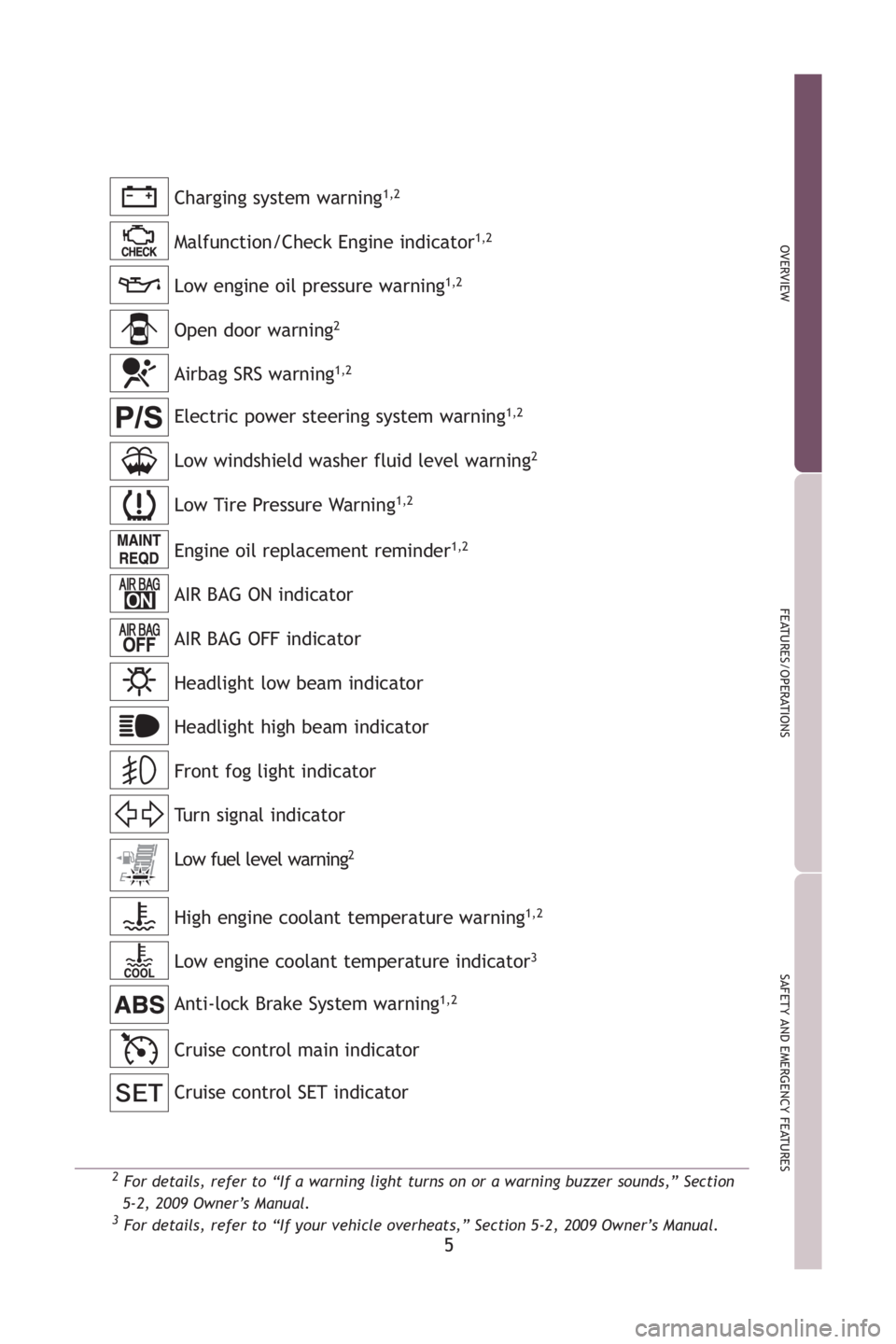
Charging system warning1,2
Low engine oil pressure warning1,2
Anti-lock Brake System warning1,2
Malfunction/Check Engine indicator1,2
Open door warning2
Low windshield washer fluid level warning2
Engine oil replacement reminder1,2
AIR BAG ON indicator
AIR BAG OFF indicator
Headlight low beam indicator
Turn signal indicator
Low fuel level warning2
Headlight high beam indicator
High engine coolant temperature warning
1,2
Airbag SRS warning1,2
Electric power steering system warning1,2
Low engine coolant temperature indicator3
Front fog light indicator
Low Tire Pressure Warning1,2
Cruise control SET indicator
Cruise control main indicator
412782M2.qxd:_412782M2 8/18/08 2:06 PM Page 5
Page 153 of 402

140 2-2. Instrument cluster
NOTICE
nTo prevent damage to the engine and its components
lDo not let the indicator needle of the tachometer enter the red zone, which
indicates the maximum engine speed.
l The engine may be overheating if the high engine coolant temperature
warning light comes on. In this case, immediately stop the vehicle in a safe
place, and check the engine after it has cooled completely. (
→P. 337)
Page 156 of 402
143
2-2. Instrument cluster
2
When driving
n
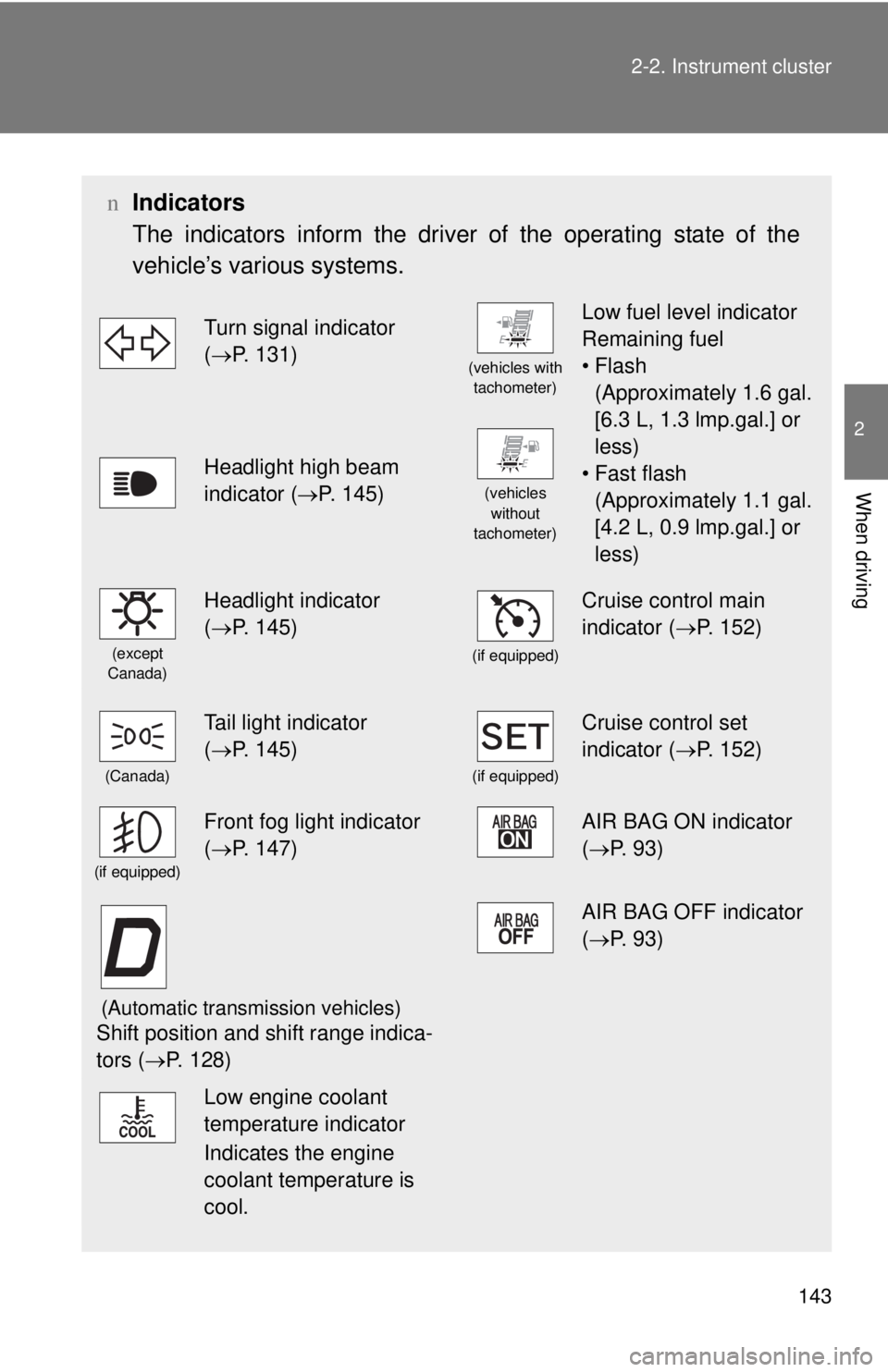
Indicators
The indicators inform the driver of the operating state of the
vehicle’s various systems.
Turn signal indicator
( →P. 131)
(vehicles with
tachometer)
Low fuel level indicator
Remaining fuel
•Flash
(Approximately 1.6 gal.
[6.3 L, 1.3 lmp.gal.] or
less)
• Fast flash
(Approximately 1.1 gal.
[4.2 L, 0.9 lmp.gal.] or
less)
Headlight high beam
indicator ( →P. 145)
(vehicles
without
tachometer)
(except
Canada)
Headlight indicator
( →P. 145)
(if equipped)
Cruise control main
indicator ( →P. 152)
(Canada)
Tail light indicator
( →P. 145)
(if equipped)
Cruise control set
indicator ( →P. 152)
(if equipped)
Front fog light indicator
( →P. 147)AIR BAG ON indicator
( →P. 93)
(Automatic transmission vehicles)
Shift position and shift range indica-
tors ( →P. 128)
AIR BAG OFF indicator
(→P. 93)
Low engine coolant
temperature indicator
Indicates the engine
coolant temperature is
cool.
Page 184 of 402
171
2-5. Driving information
2
When driving
l
In order to maintain engine braki ng efficiency, do not use the trans -
mission in D (automatic transmiss ion
) or 5 (manual transmission).
l Du
e to the added load of the trailer, your vehicle’s engine may
overheat on hot days (at temperatures over 85°F [30°C]) when
driving up a long or steep grade. If the engine coolant temperature
gauge indicates overheating, immedi ately turn off the air condition-
ing (if in use), pull your vehicle off the road and stop in a safe spot.
( → P. 3 3 7 )
l Alw
ays place wheel blocks under both the vehicle and the trailer
wheels when parking. Apply the parking brake firmly, and put the
transmission in P (automatic transmission) or in 1 or R (manual
transmission). Avoid parking on a slope, but if unavoidable, do so
only after performing the following:
Apply the brakes and keep them applied.
Have someone place wheel blocks un
der both the vehicle and
trailer wheels.
When the wheel blocks are in pl ace, re
lease the brakes slowly
until the blocks absorb the load.
Apply the parking brake firmly.
Shift into 1 or R (manual transmission) or P (automatic trans -
mission) and turn off the engine.
l Whe
n restarting after parking on a slope:
With the transmission in P (automatic transmission) or the
clutch pedal (manual transmission) depressed, start the
eng
ine. On vehicles with an au tomatic transmission, be sure
to keep the brake pedal pressed.
Shift into a forward gear. If reversing, shift into R.
Release the parking brake (also b
rake pedal on vehicles with
an automatic transmission), and sl o
wly pull or back away from
the wheel blocks. Stop and apply the brakes.
Have someone retrieve the blocks.
Page 252 of 402
241
4-3. Do-it-yourself maintenance
4
Maintenance and care
CAUTION
n
When working on the engine compartment
lTake care because brake fluid can harm your hands or eyes and damage
painted surfaces.
If fluid gets on your hands or in your eyes, flush the affected area with
clean water immediately.
If you still experience discomfort, see a doctor.
n When working near the electric cooling fan or radiator grille
Be sure the engine switch is off.
With the engine switch on, the electric cooling fan may automatically start to
run if the air conditioning is on and/or the coolant temperature is high.
n Safety glasses
Wear safety glasses to prevent flying or falling material, fluid spray, etc. from
getting in the eyes.
NOTICE
nIf you remove the air cleaner
Driving with the air cleaner removed may cause excessive engine wear due
to dirt in the air. Also a backfire could cause a fire in the engine compart-
ment.
n If the brake fluid level is low or high
It is normal for the brake fluid level to go down slightly as the brake pads
wear or when the fluid level in the accumulator is high.
If the reservoir needs frequent refilling, it may indicate a serious pro\
blem.
Page 313 of 402
5
When trouble arises
303
5-1. Essential information
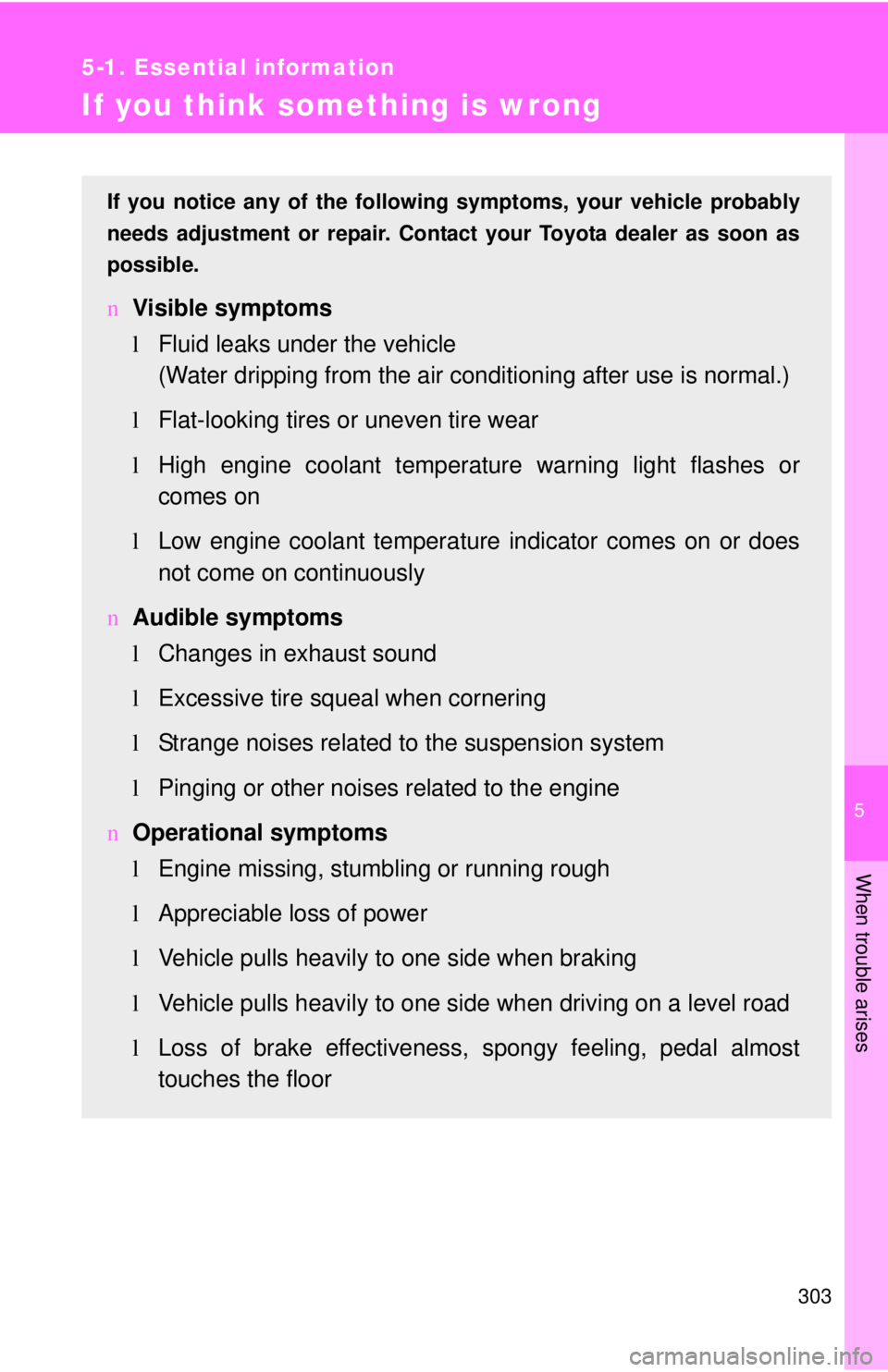
If you think something is wrong
If you notice any of the following symptoms, your vehicle probably
needs adjustment or repair. Contact your Toyota dealer as soon as
possible.
n Visible symptoms
lFlu
id leaks under the vehicle
(Water dripping from the air cond ition
ing after use is normal.)
l Fla
t-looking tires or uneven tire wear
lHigh
engine coolant temperatur e warning light flashes or
comes on
l Low
engine coolant temperature indicator comes on or does
not come on continuously
n Audible sy
mptoms
l Cha
nges in exhaust sound
lEx
cessive tire squeal when cornering
lS
trange noises related to the suspension system
l Pin
ging or other noises related to the engine
n Operat
ional symptoms
lEn
gine missing, stumbling or running rough
lAp
preciable loss of power
lV
ehicle pulls heavily to one side when braking
lV
ehicle pulls heavily to one side when driving on a level road
lLoss o
f brake effectiveness, s pongy feeling, pedal almost
touches the floor
Page 318 of 402
308 5-2. Steps to take in an emergency
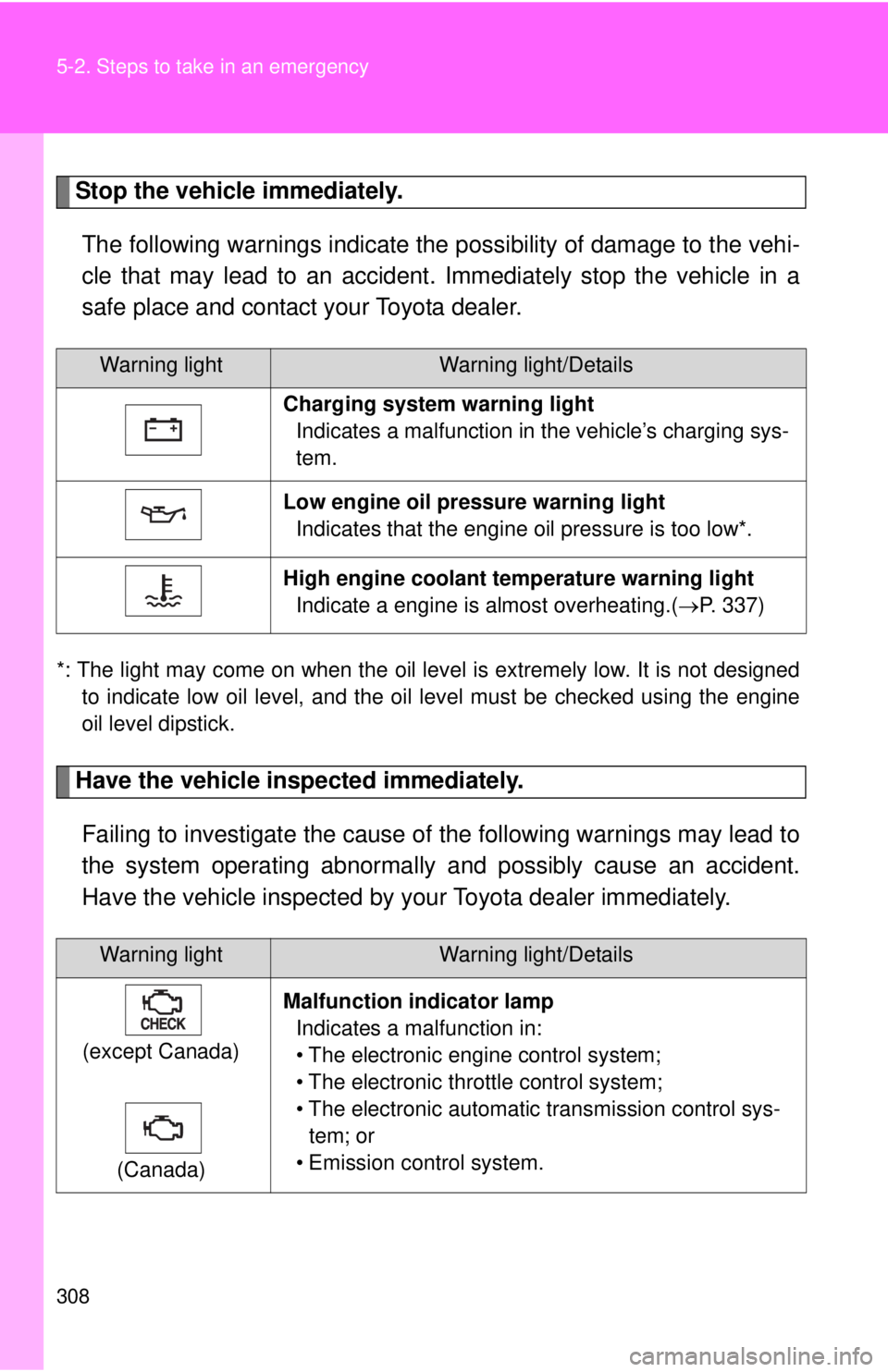
Stop the vehicle immediately.
The following warnings indicate the possibility of damage to the vehi-
cle that may lead to an accident. Immediately stop the vehicle in a
sa
fe place and contact your Toyota dealer.
*: The light may come on when the oil level is extremely low. It is not designed to indicate low oil level, and the oil level must be checked using the engine
oil level dipstick.
Have the vehicle inspected immediately.
Failing to investigate the cause of the following warnings may lead to
the system operating abnormally and possibly cause an accident.
Have the vehicle inspected by your Toyota dealer immediately.
Warning lightWarning light/Details
Charging system warning light Indicates a malfunction in the vehicle’s charging sys-
tem.
Low engine oil pressure warning light Indicates that the engine oil pressure is too low*.
High engine coolant temperature warning light Indicate a engine is almost overheating.( →P. 337)
Warning lightWarning light/Details
(except Canada)
(Canada) Malfunction indicator lamp
Indicates a malfunction in:
• The electronic engine control system;
• The electronic throttle control system;
• The electronic automatic transmission control sys-tem; or
• Emission control system.
Page 347 of 402
5
When trouble arises
337
5-2. Steps to take in an emergency
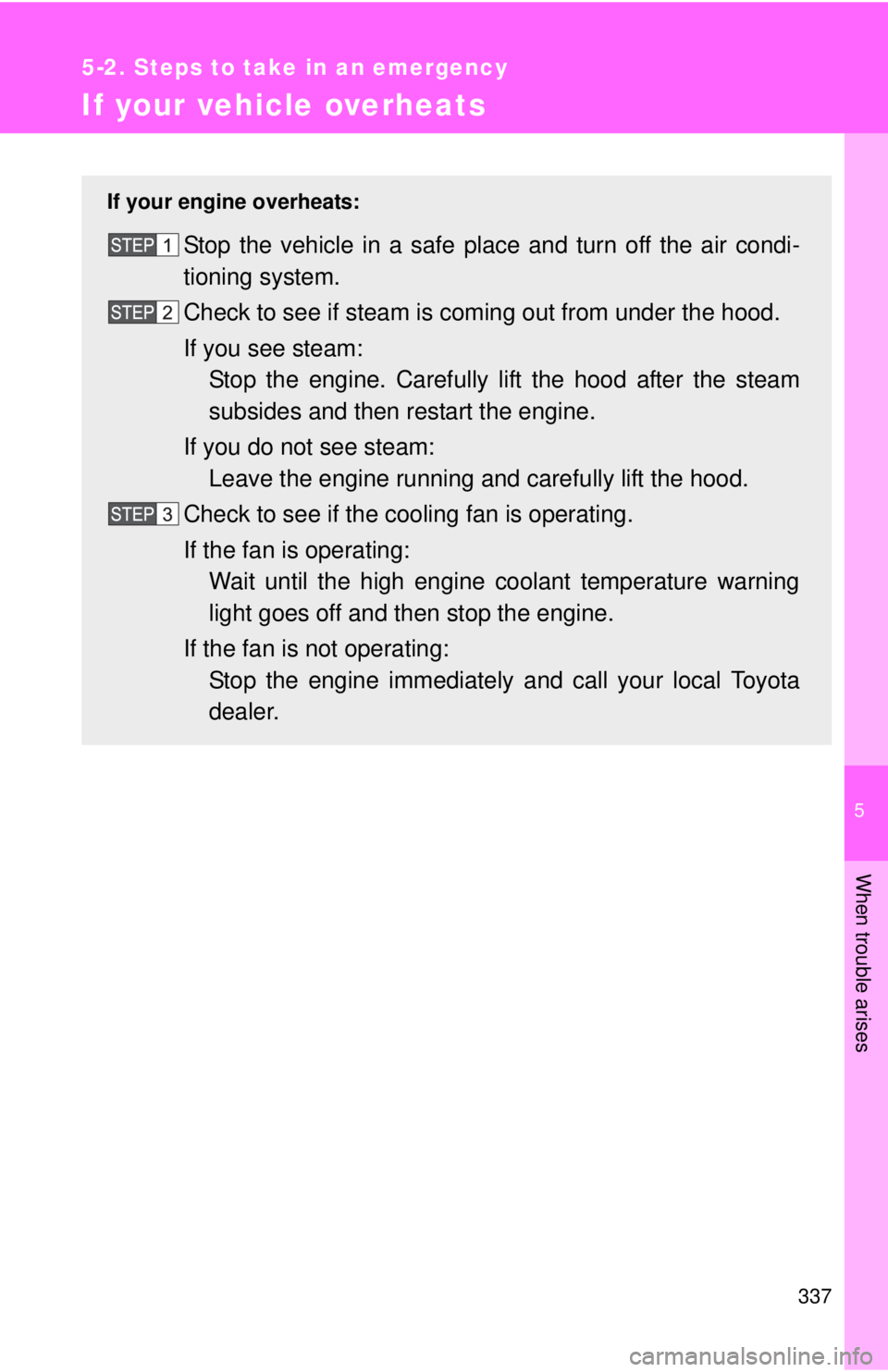
If your vehicle overheats
If your engine overheats:
Stop the vehicle in a safe place and turn off the air condi-
tioning system.
Check to see if steam is coming out from under the hood.
If you see steam:
Stop the engine. Carefully lift the hood after the steam
sub
sides and then restart the engine.
If you do not see steam:
Leave the engine running and carefully lift the hood.
Check to see if the cooling fan is operating.
If the fan is operating:
Wait until the high engine coolant temperature warning
lig
ht goes off and then stop the engine.
If the fan is not operating:
Stop the engine immediately and call your local Toyota
dea
ler.
Page 348 of 402
338 5-2. Steps to take in an emergency
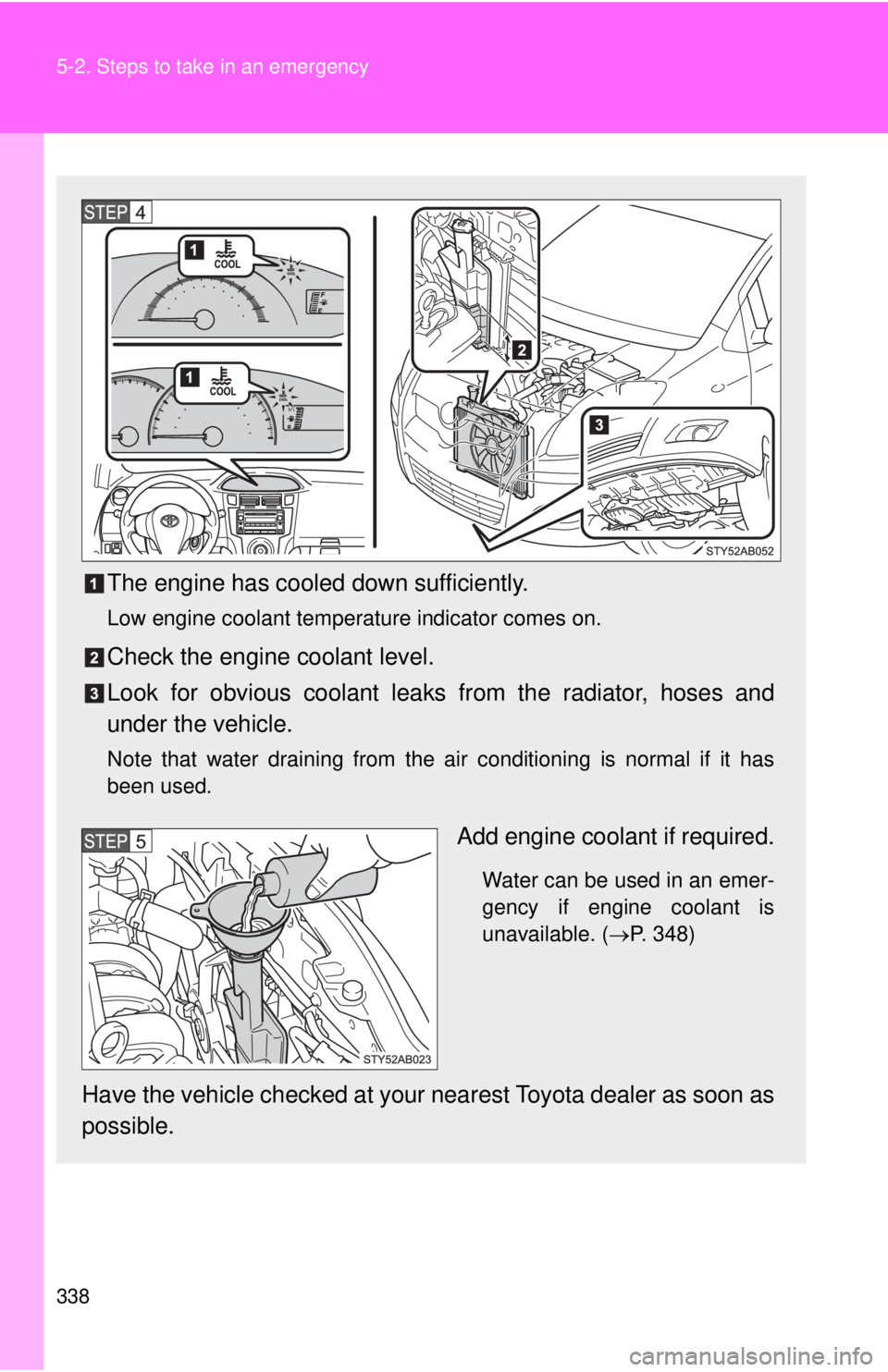
The engine has cooled down sufficiently.
Low engine coolant temperature indicator comes on.
Check the engine coolant level.
Look for obvious coolant leaks from th
e radiator, hoses and
under the vehicle.
Note that water draining from the air conditioning is normal if it has
been used.
Add engine coolant if required.
Water can be used in an emer -
gency if engine coolant is
unavailable. ( →P. 348)
Have the vehicle checked at your nea rest Toyota dealer as soon as
possible.
Page 349 of 402
5
When trouble arises
339
5-2. Steps to take in an emergency
n
Overheating
If you observe the following, your vehicle may be overheating.
lThe high
engine coolant temperature warning light flashes or comes on
or a loss of power is experienced.
l Steam is coming from under the hood.
CAUTION
nTo prevent an accident or injury when inspecting un der the hood of
your vehicle
l If steam is seen coming from under the hood, do not open the hood until
the steam has subsided. The engine compartment may be very hot, caus-
ing serious injury such as burns.
l Keep hands and clothing away from the fan and other belts while the
engine is running.
l Do not loosen the radiator cap while the engine and radiator are hot.
Serious injury, such as burns, may result from hot coolant and steam
released under pressure.
NOTICE
n When adding engine coolant
Wait until the engine has cooled down before adding engine coolant.
When adding coolant, do so slowly. Adding cool coolant to a hot engine too
quickly can cause damage to the engine.