fuel pressure TOYOTA YARIS HATCHBACK 2009 Owners Manual
[x] Cancel search | Manufacturer: TOYOTA, Model Year: 2009, Model line: YARIS HATCHBACK, Model: TOYOTA YARIS HATCHBACK 2009Pages: 402, PDF Size: 7.61 MB
Page 3 of 402
1
OVERVIEW
FEATURES/OPERATIONS
SAFETY AND EMERGENCY FEATURES
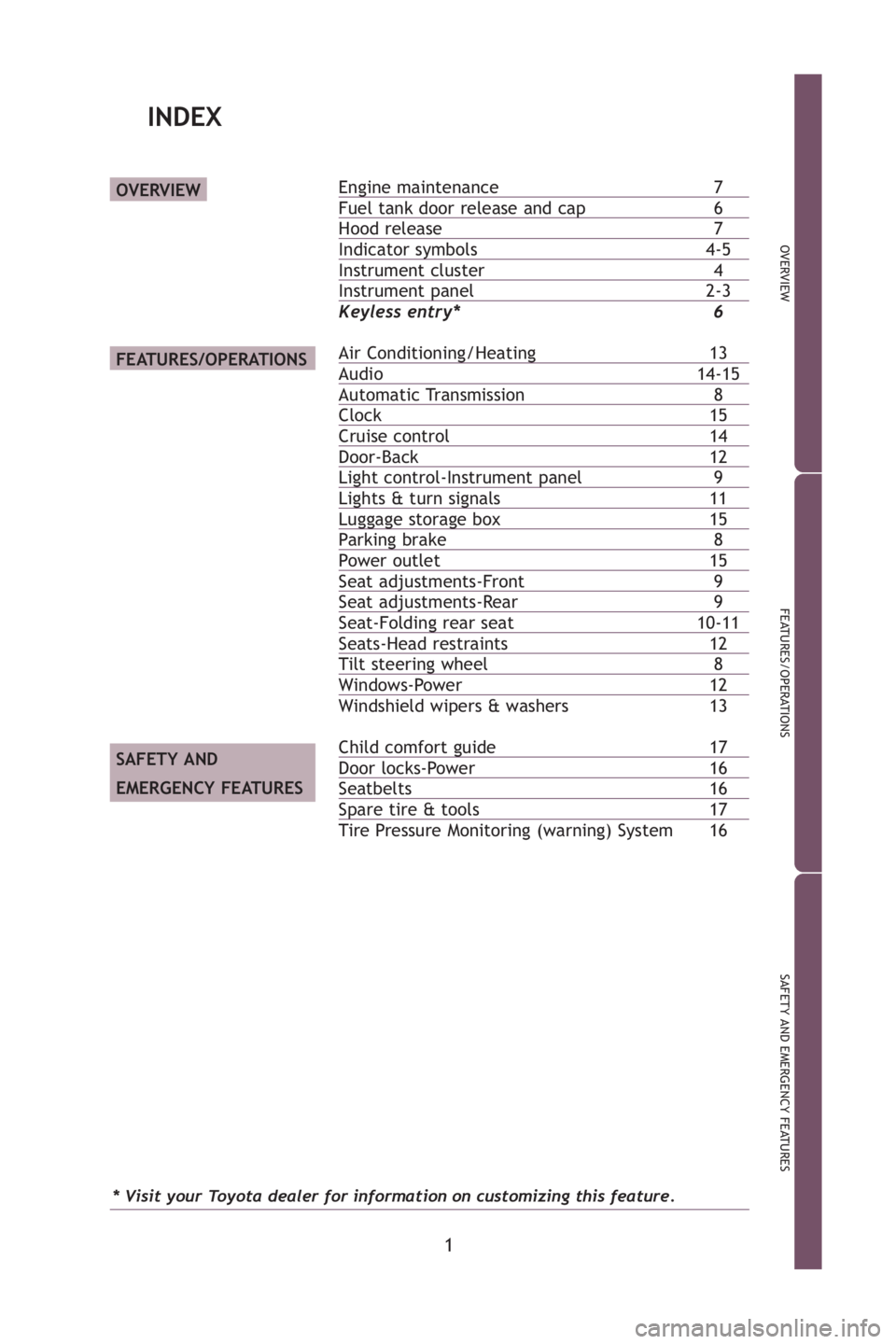
Enginemaintenance7Fuel tank door release and cap6Hood release 7Indicator symbols4-5Instrument cluster 4Instrument panel2-3
Keyless entry* 6
Air Conditioning/Heating13Audio 14-15Automatic Transmission 8Clock15Cruise control14Door-Back 12Lightcontrol-Instrument panel9Lights& turn signals11Luggagestoragebox15Parkingbrake 8Power outlet 15Seat adjustments-Front9Seat adjustments-Rear9Seat-Foldingrear seat10-11Seats-Head restraints 12Tilt steeringwheel8Windows-Power 12
Windshield wipers & washers 13
Child comfort guide17Door locks-Power 16Seatbelts16Sparetire & tools17
Tire Pressure Monitoring (warning) System 16
OVERVIEW
FEATURES/OPERATIONS
SAFETY AND
EMERGENCY FEATURES
INDEX
* Visit your Toyota dealer for information on customizing this feature.
412782M2.qxd:_412782M2 8/18/08 2:02 PM Page 1
Page 7 of 402
5
OVERVIEW
FEATURES/OPERATIONS
SAFETY AND EMERGENCY FEATURES
2For details, refer to “If a warning light turns on or a warning buzzer sounds,” Section
5-2, 2009 Owner’s Manual.
3For details, refer to “If your vehicle overheats,” Section 5-2, 2009 Owner’s Manual.
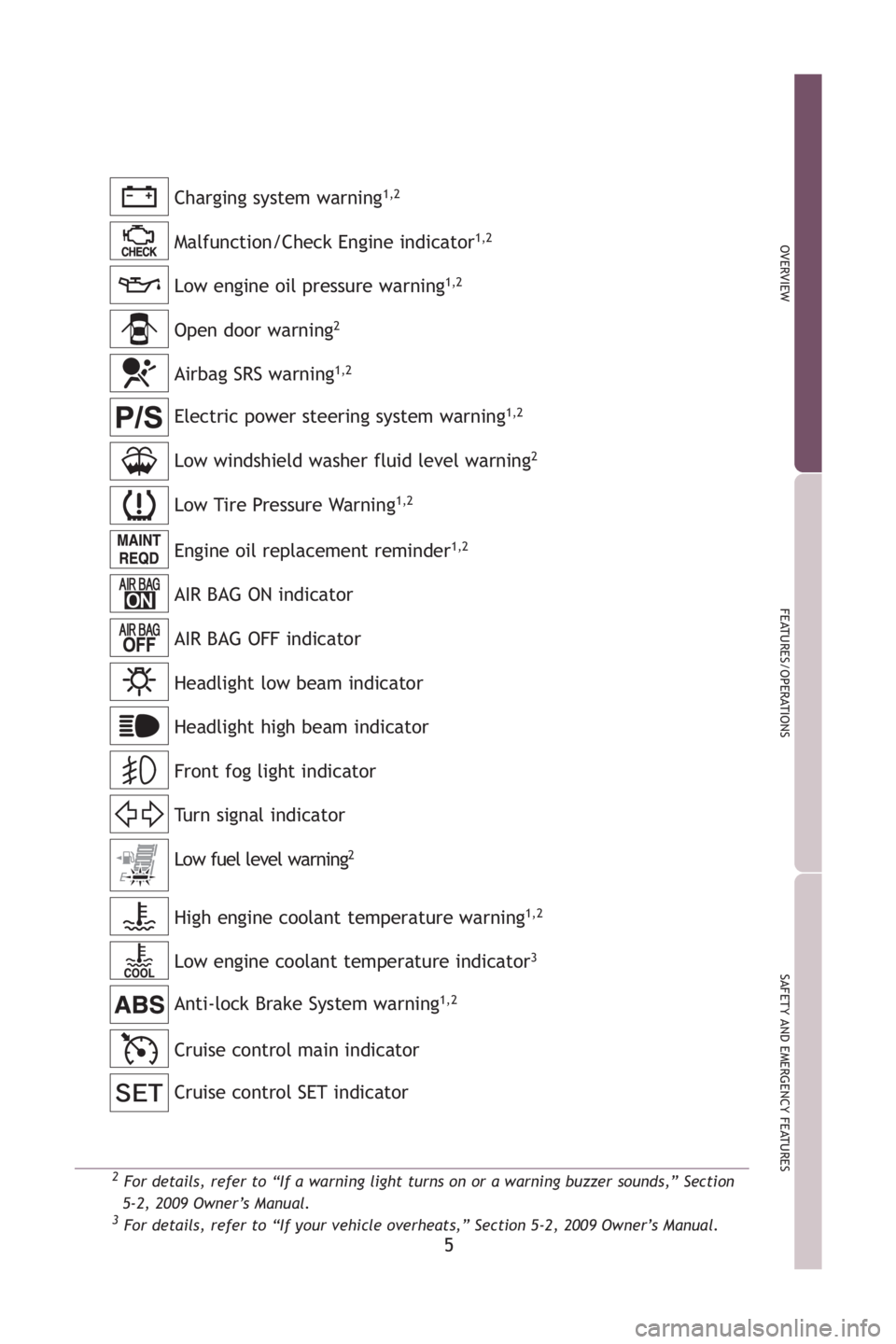
Charging system warning1,2
Low engine oil pressure warning1,2
Anti-lock Brake System warning1,2
Malfunction/Check Engine indicator1,2
Open door warning2
Low windshield washer fluid level warning2
Engine oil replacement reminder1,2
AIR BAG ON indicator
AIR BAG OFF indicator
Headlight low beam indicator
Turn signal indicator
Low fuel level warning2
Headlight high beam indicator
High engine coolant temperature warning
1,2
Airbag SRS warning1,2
Electric power steering system warning1,2
Low engine coolant temperature indicator3
Front fog light indicator
Low Tire Pressure Warning1,2
Cruise control SET indicator
Cruise control main indicator
412782M2.qxd:_412782M2 8/18/08 2:06 PM Page 5
Page 27 of 402
7
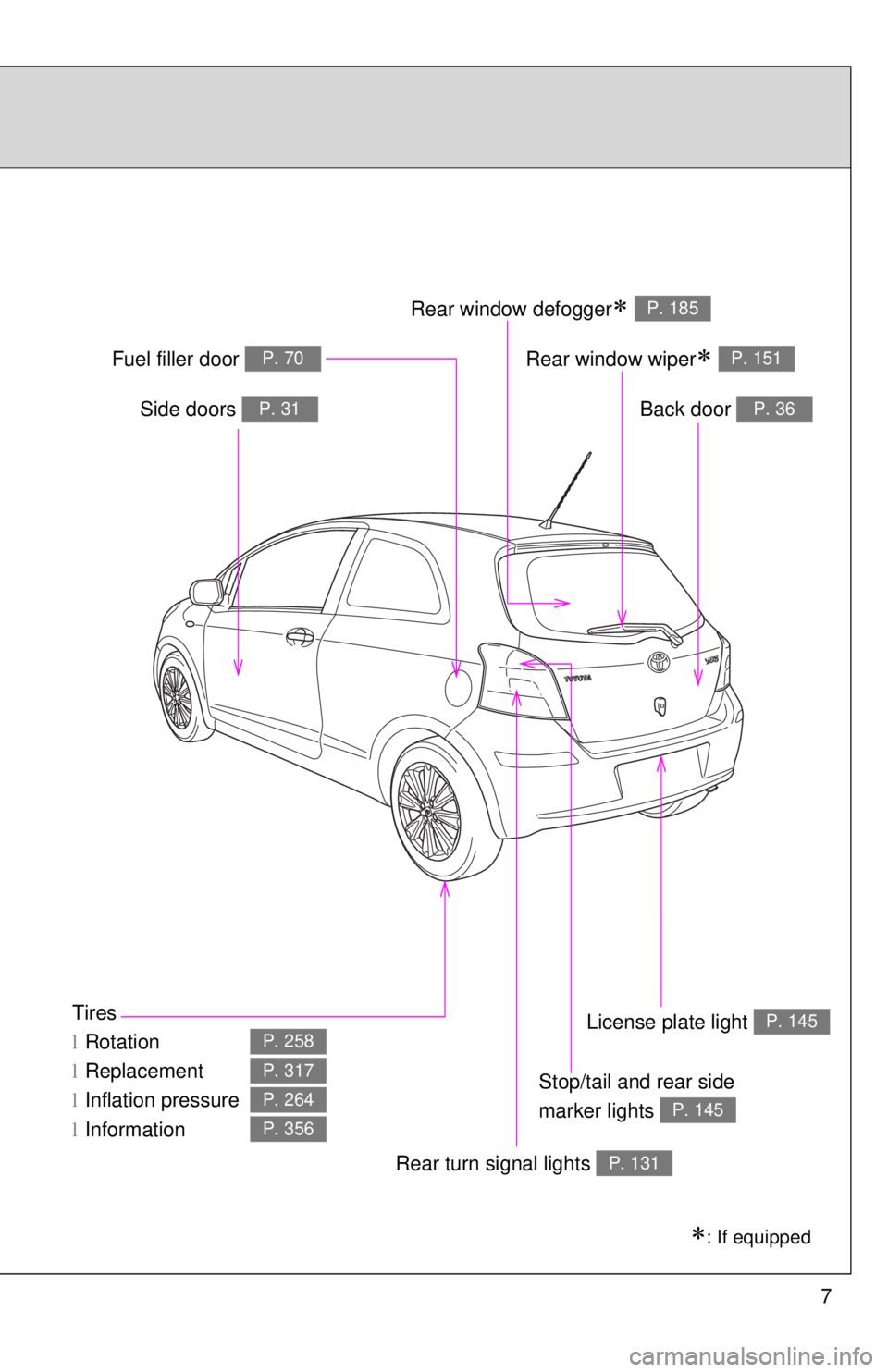
Tires
lRotation
l Replacement
l Inflation pressure
l Information
P. 258
P. 317
P. 264
P. 356
∗: If equipped
Back door P. 36Side doors P. 31
Fuel filler door P. 70
Rear turn signal lights P. 131
Rear window defogger∗ P. 185
License plate light P. 145
Stop/tail and rear side
marker lights
P. 145
Rear window wiper∗ P. 151
Page 29 of 402
9
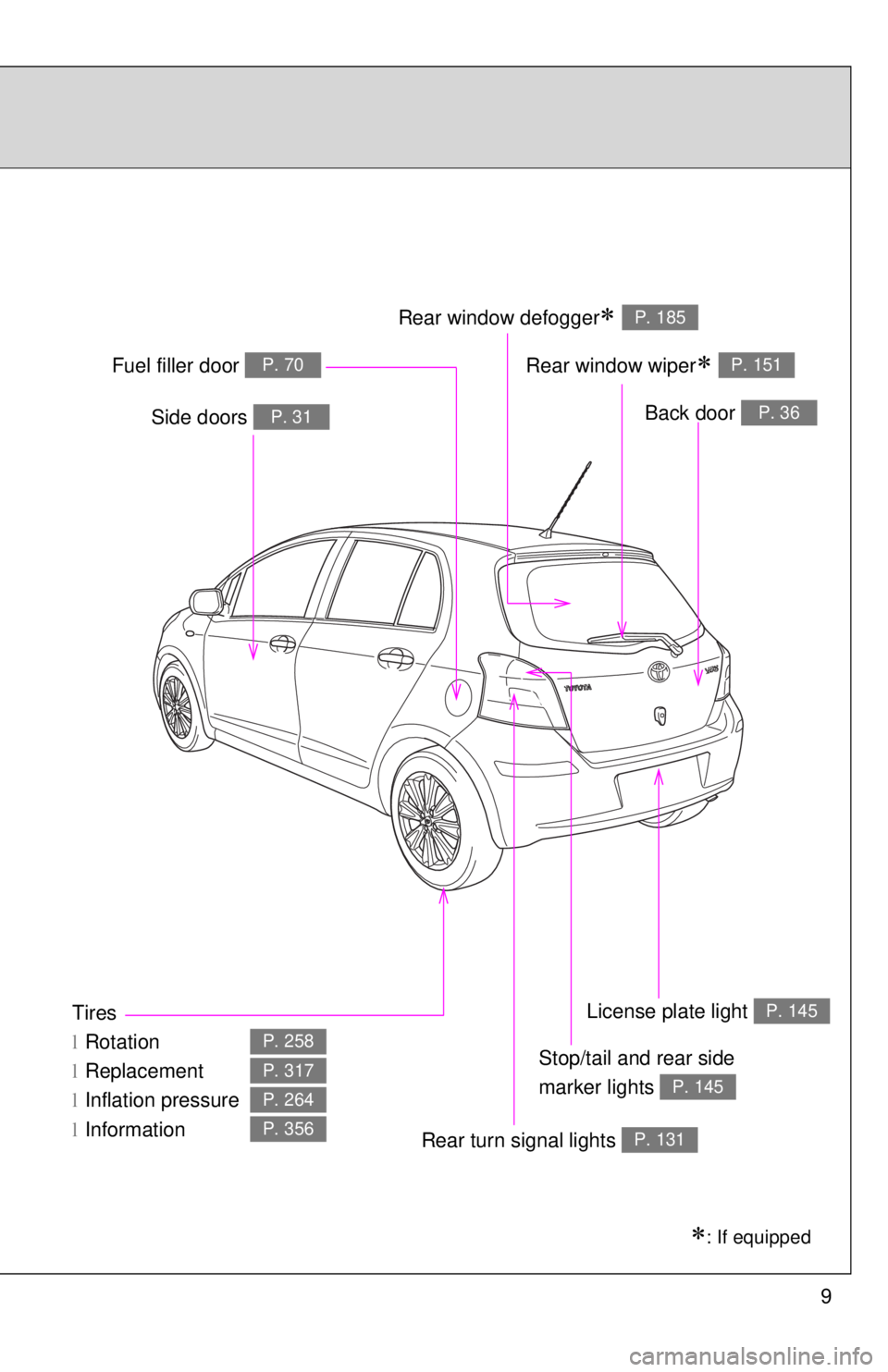
Tires
lRotation
l Replacement
l Inflation pressure
l Information
P. 258
P. 317
P. 264
P. 356
∗: If equipped
Back door P. 36Side doors P. 31
Fuel filler door P. 70
Rear turn signal lights P. 131
Rear window defogger∗ P. 185
License plate light P. 145
Stop/tail and rear side
marker lights
P. 145
Rear window wiper∗ P. 151
Page 251 of 402
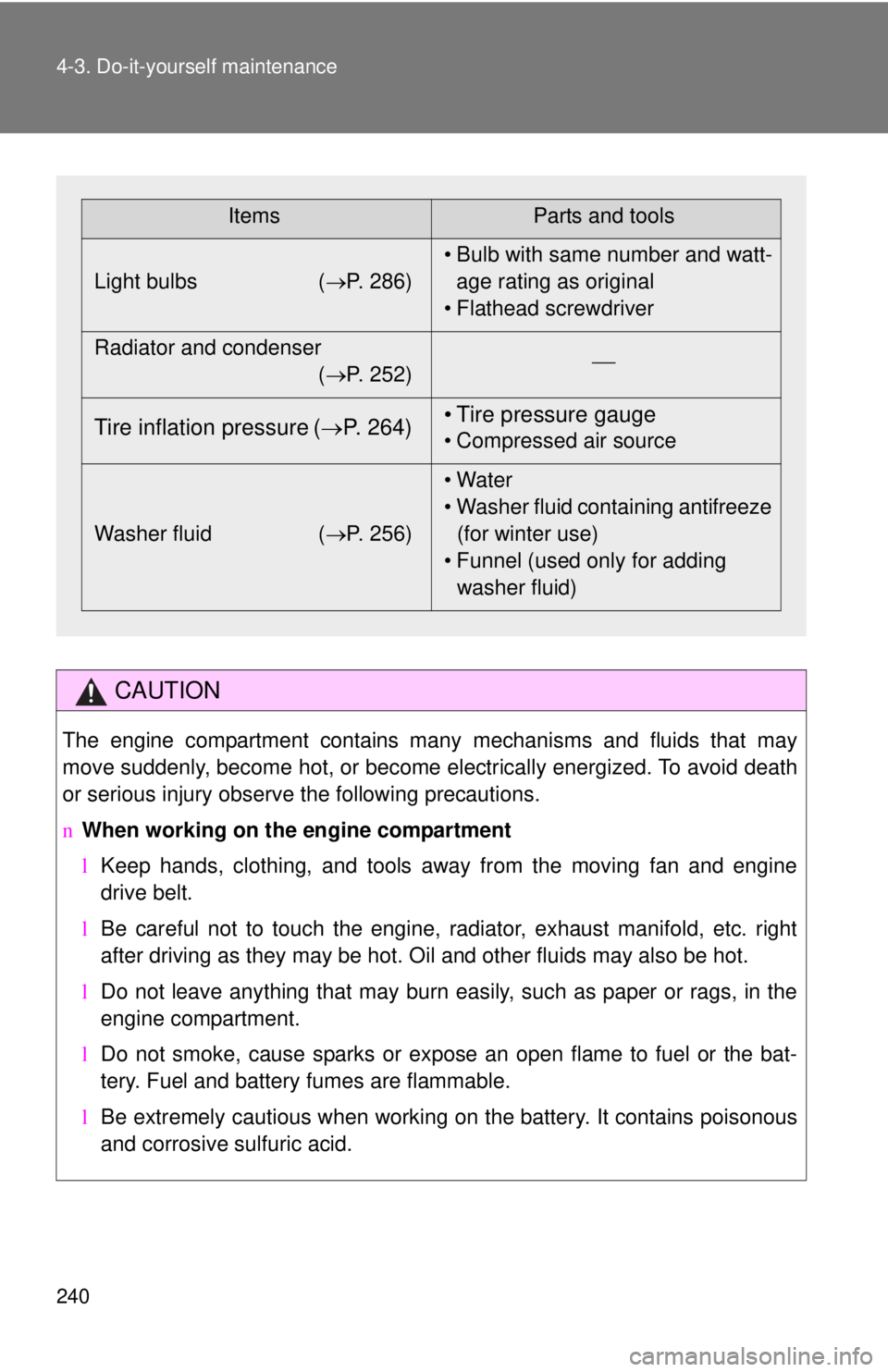
240 4-3. Do-it-yourself maintenance
CAUTION
The engine compartment contains many mechanisms and fluids that may
move suddenly, become hot, or become electrically energized. To avoid death
or serious injury observe the following precautions.
nWhen working on the engine compartment
lKeep hands, clothing, and tools away from the moving fan and engine
drive belt.
l Be careful not to touch the engine, radiator, exhaust manifold, etc. right
after driving as they may be hot. Oil and other fluids may also be hot.
l Do not leave anything that may burn easily, such as paper or rags, in the
engine compartment.
l Do not smoke, cause sparks or expose an open flame to fuel or the bat-
tery. Fuel and battery fumes are flammable.
l Be extremely cautious when working on the battery. It contains poisonous
and corrosive sulfuric acid.
ItemsParts and tools
Light bulbs ( →P. 286)• Bulb with same number and watt-
age rating as original
• Flathead screwdriver
Radiator and condenser
( →P. 252) ⎯
Tire inflation pressure (
→P. 264) • Tire pressure gauge• Compressed air source
Washer fluid ( →P. 256)• Water
• Washer fluid containing antifreeze
(for winter use)
• Funnel (used only for adding washer fluid)
Page 277 of 402

266 4-3. Do-it-yourself maintenance
nTire inflation pressure check interval
You should check tire pressure every two weeks, or at least once a
mo
nth.
Do not forget to check the spare tire.
nEffects of incorrect tire inflation pressure
Driving with incorrect ti re
inflation pressure may result in the following:
lReduced fuel efficiency
lReduced driving comfort and tire life
lReduced safety
lDamage to the drive train
If a tire needs frequent refilling, have it checked by your Toyota dealer.
n
Instructions for checking tire inflation pressure
When checking tire inflation pressure, observe the following:
lCheck only when the tires are cold.
If your vehicle has been parked for at least 3 hours and has not been
driven for
more than 1 mile or 1.5 km, you will get an accurate cold
tire inflation pressure reading.
lAlways use a tire pressure gauge.
The appearance of the tire can be mi slead
ing. In addition, tire infla-
tion pressures that are even just a few pounds off can degrade ride
a
nd handling.
lDo not bleed or reduce tire inflation pressure after driving. It is normal
for the tire inflation pressure to be higher after driving.
lNever exceed the vehicle capacity weight.
Passengers and luggage weight should be placed so that the vehicle
is bal
anced.
Page 322 of 402

312 5-2. Steps to take in an emergency
nKey reminder buzzer
The buzzer indicates that the key has not been removed (with the engine
switch in the ACC or LOCK position and the driver’s door opened).
n L
ight reminder buzzer
The buzzer indicates that the headlight switch is left on (with the key
removed and the driver
’s door opened).
n If the malfunction indic
ator lamp comes on while driving
First check the following:
l Is your vehicle low on gas?
If it is, refuel the vehicle immediately.
l Is the fue
l tank cap loose?
If it is, tighten it securely.
The light will go off after taking several driving trips.
If the light does not go off even after several trips, contact your Toyota dealer
as soon as possible.
n Front p
assenger detect ion sensor and passenger seat belt reminder
If luggage or other load is placed on the front passenger seat, depending on
it
s weight, the reminder light to flash and buzzer to sound.
n
When the tire pressure warning light comes on
Check the tire inflation pressure and adjust to the appropriate level.
nThe tire pressure warning light ma y turn on due to natural causes
The tire pressure warning light may turn on due to natural causes such
a
s natural air leaks or tire inflation pressure changes caused by temper -
ature. In this case, adjusting the ti re inflation pressure will turn of
f the
warning light (after a few minutes).
nWhen a tire is replaced with a spare tire
The compact spare tire is not equipped with the tire pressure warning
valve and trans
mitter. If a tire goes flat, the tire pressure warning light will
not turn off even though the flat tire is replaced with the spare tire.
Replace the spare tire with the repair ed tire and adjust the proper tire
inflation pressure. The ti re pressure warning light will turn off after a few
minutes.
Page 325 of 402

5
When trouble arises
315
5-2. Steps to take in an emergency
CAUTION
As an added safety feature, your v
ehicle has been equipped with a tire
pressure monitoring system (TPMS-tire pressure warning system) that
illuminates a low tire pressure telltale (tire pressure warning light) when
one or more of your tires is significantly under-inflated. Accordingly,
when the low tire pressure telltale (tire pre ssure warning light) illumi-
nates, you should stop and check your tires as soon as possible, and
inflate them to the proper pressure. Driving on a significantly under-
inflated tire causes the tire to overheat and can lead to tire failure.
Under-inflation also reduces fuel effi ciency and tire tread life, and may
affect the vehicle’s handling and stopping ability.
Please note that the TPMS (tire pressure warning system) is not a sub-
stitute for proper tire main tenance, and it is the driver’s responsibility to
maintain correct tire pressure, even if under-inflation has not reached the
level to trigger illu mination of the TPMS low ti re pressure telltale (tire
pressure warning light).
Your vehicle has also been equipped with a TPMS (tire pressure warning
system) malfunction indicator to indi cate when the system is not operat-
ing properly. The TPMS (tire pressure warning system) malfunction indi-
cator is combined with the low tire pressure telltale (tire pressure
warning light). When the system det ects a malfunction, the telltale will
flash for approximately one minute an d then remain continuously illumi-
nated. This sequence will continue upon subsequent vehicle start-ups as
long as the malfunction exists. When the malfunction indi cator is illumi-
nated, the system may not be able to detect or signal low tire pressure
as intended.
TPMS (tire pressure warning system) malfunctions may occur for a vari-
ety of reasons, including the installati on of replacement or alternate tires
or wheels on the vehicle that prevent the TPMS (tire pressure warning
system) from functioning properly. Always check the TPMS (tire pres-
sure warning system) malfunction tellt ale after replacing one or more
tires or wheels on your vehicle to ensure that the replacement or alter-
nate tires and wheels allow the TPMS (tire pressure warning system) to
continue to function properly.
Page 329 of 402
5
When trouble arises
319
5-2. Steps to take in an emergency
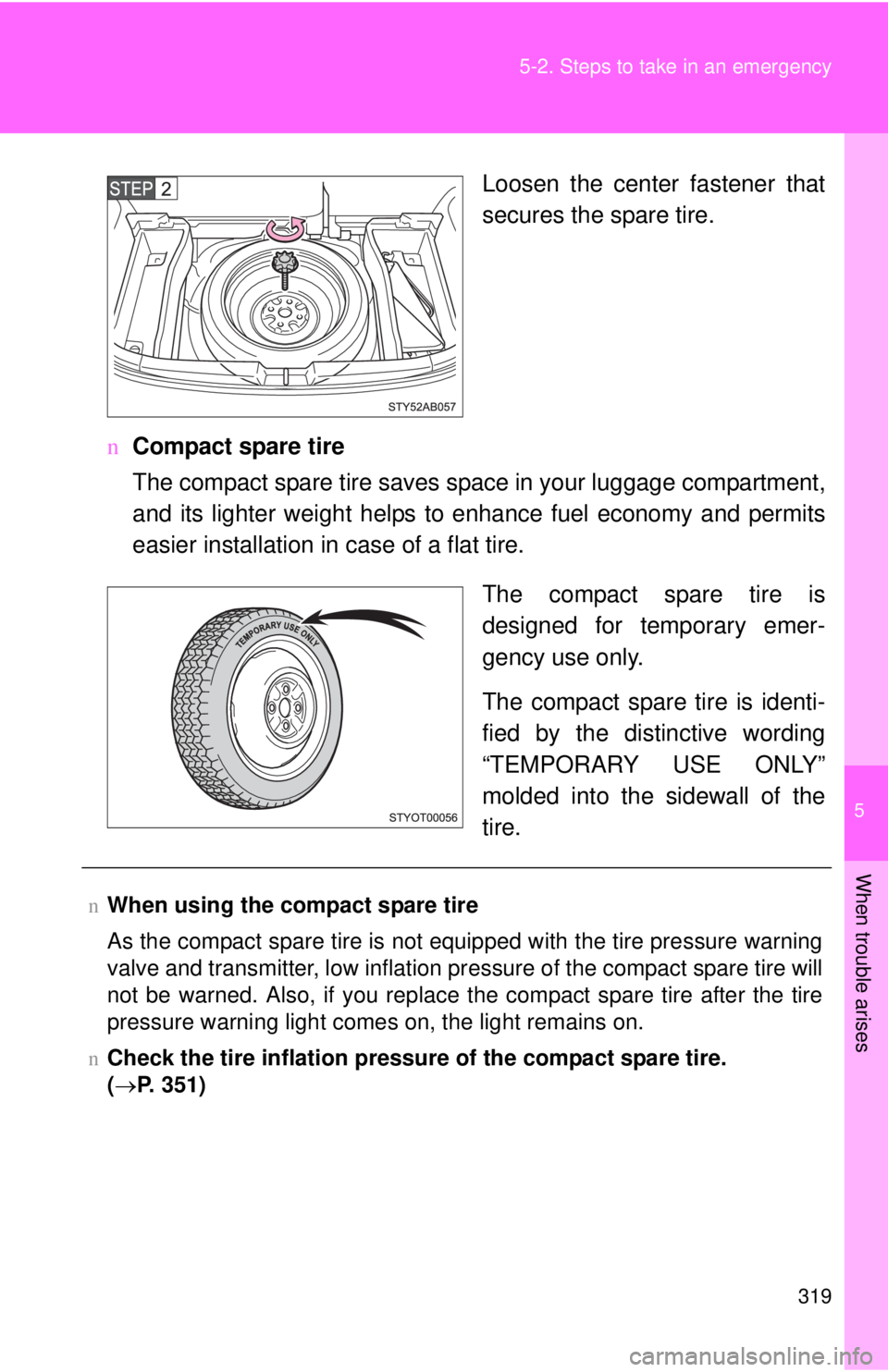
Loosen the center fastener that
secures the spare tire.
n Comp
act spare tire
The compact spare tire saves space in your luggage compartment,
and
its lighter weight helps to enhance fuel economy and permits
easier installation in case of a flat tire.
The compact spare tire is
d
esigned for temporary emer -
gency use only.
The compact spare tire is identi -
fied by the distinctive wording
“TE
MPORARY USE ONLY”
molded into the sidewall of the
tire.
nWhen using the compact spare tire
As the compact spare tire is not equipped with the tire pressure warning
valve and trans
mitter, low inflation pr essure of the compact spare tire will
not be warned. Also, if you replace the compact spare tire after the tire
pressure warning light comes on, the light remains on.
nCheck the tire inflation pressure of the compact spare tire.
( → P. 3 5 1 )
Page 372 of 402
363
6-1. Specifications
6
Vehicle specifications
Warning: The temperature grades for this tire are established for a tire
that is properly inflated and not overloaded.
Excessive speed, underinflation, or excessive
loading, either sepa-
rately or in combination, can caus e hea
t buildup and possible tire fail-
ure.
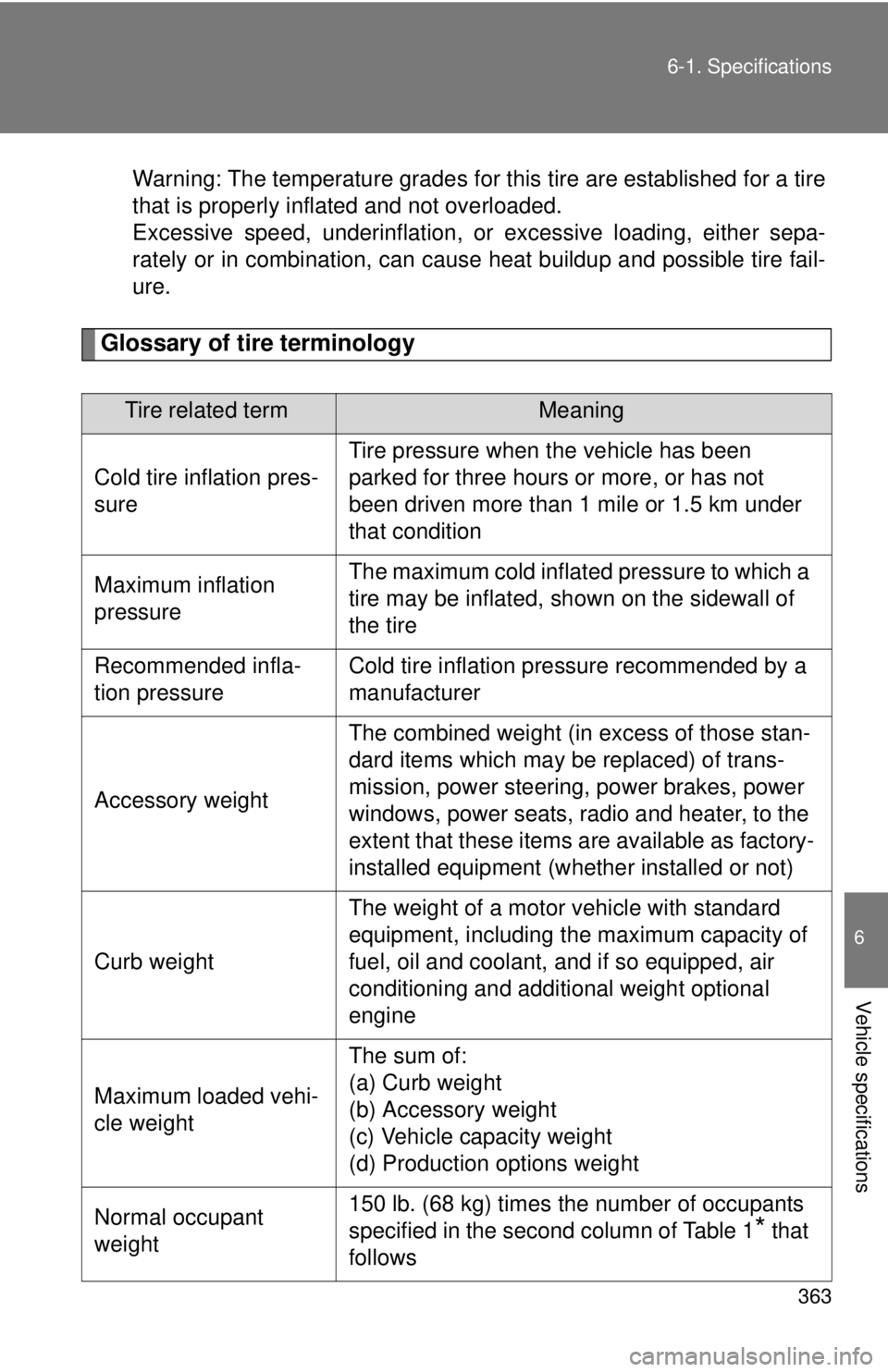
Glossary of tire terminology
Tire related termMeaning
Cold tire inflation pres-
sure
Tire pressure when the vehicle has been
parked for three hours or more, or has not
been driven more than 1 mile or 1.5 km under
that condition
Maximum inflation
pressureThe maximum cold inflated pressure to which a
tire may be inflated, s hown on the sidewall of
the tire
Recommended infla-
tion pressureCold tire inflation pressure recommended by a
manufacturer
Accessory weight
The combined weight (in excess of those stan-
dard items which may be replaced) of trans-
mission, power steering, power brakes, power
windows, power seats, radio and heater, to the
extent that these items are available as factory-
installed equipment (whether installed or not)
Curb weight
The weight of a motor vehicle with standard
equipment, including the maximum capacity of
fuel, oil and coolant, and if so equipped, air
conditioning and additional weight optional
engine
Maximum loaded vehi-
cle weight
The sum of:
(a) Curb weight
(b) Accessory weight
(c) Vehicle capacity weight
(d) Production options weight
Normal occupant
weight150 lb. (68 kg) times the number of occupants
specified in the second column of Table 1
* that
follows