manual transmission TOYOTA YARIS HATCHBACK 2009 Owners Manual
[x] Cancel search | Manufacturer: TOYOTA, Model Year: 2009, Model line: YARIS HATCHBACK, Model: TOYOTA YARIS HATCHBACK 2009Pages: 402, PDF Size: 7.61 MB
Page 6 of 402
4
OVERVIEW
Driver seatbelt reminder2
(alarm will sound if speed is over 12 mph)
Front passenger seatbelt reminder
2
(alarm will sound if speed is over 12 mph) Brake system warning
1,2
1If indicator does not turn off within a few seconds of starting engine, there may
be a malfunction. Have vehicle inspected by your Toyota dealer.2For
5-2,
3For
Indicator symbols
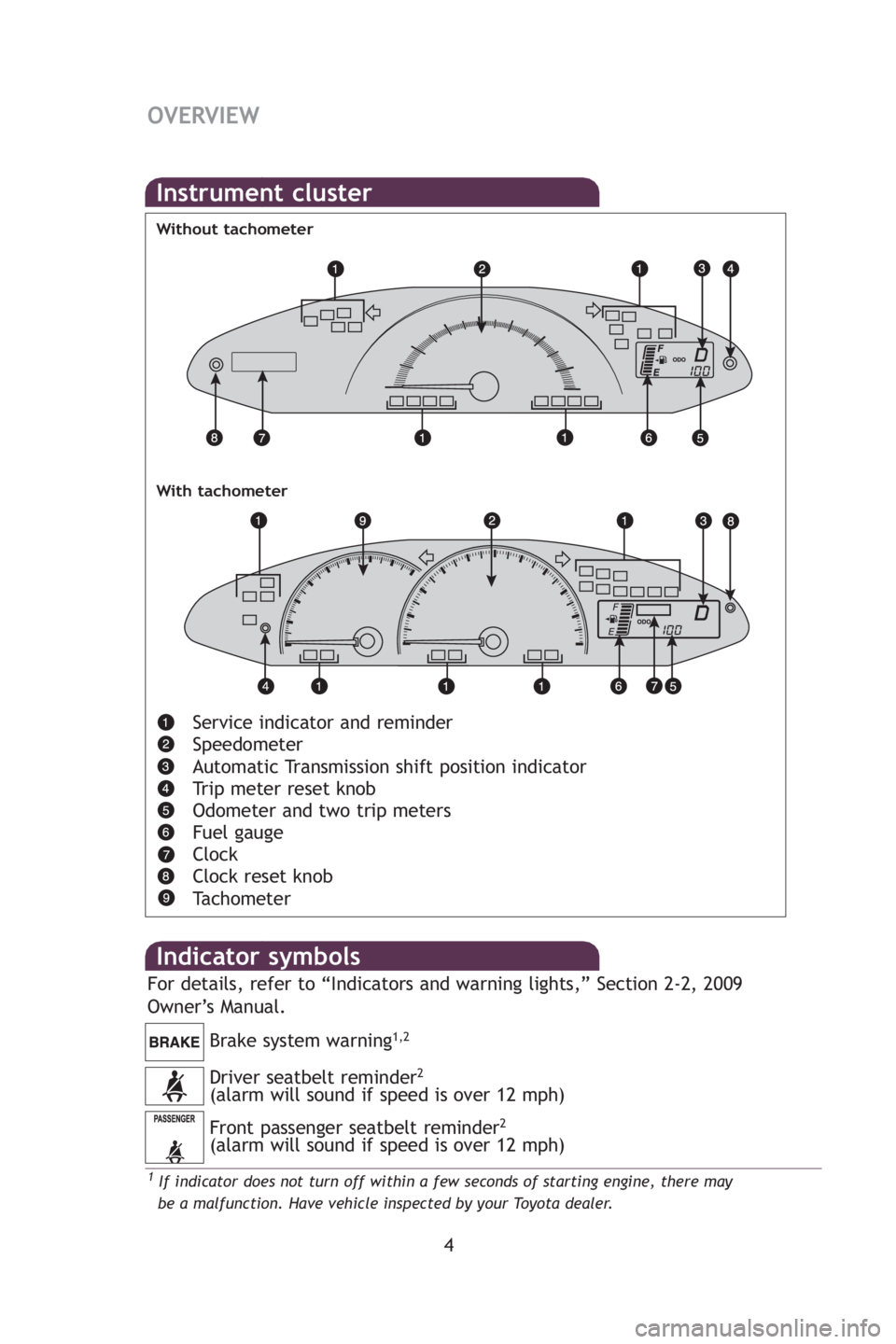
Service indicator and reminder
Speedometer
Automatic Transmission shift position indicator
Trip meter reset knob
Odometer and two trip meters
Fuel gauge
Clock
Clock reset knob
Tachometer
Instrument cluster
Without tachometer
With tachometer
For details, refer to “Indicators and warning lights,” Section 2-2, 2009
Owner’s Manual.
412782M2.qxd:_412782M2 8/18/08 2:04 PM Page 4
Page 129 of 402
116
2-1. Driving procedures
Driving the vehicle
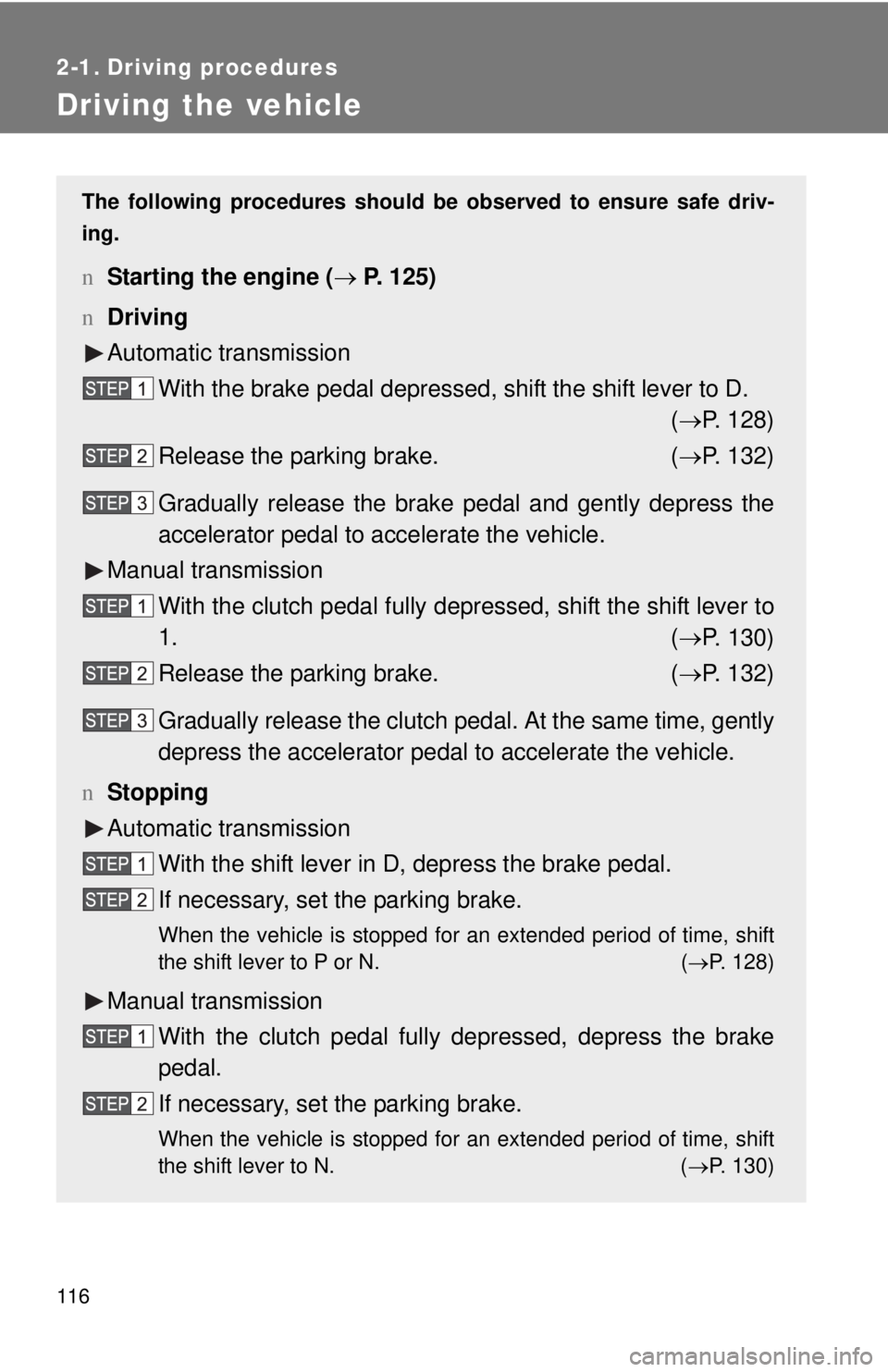
The following procedures should be observed to ensure safe driv-
ing.
n Starting the engine ( → P. 1 2 5 )
n Driving
Automatic transmission
With the brake pedal depressed, shift the shift lever to D.
( → P
. 128)
Release the parking brake. (→ P
. 132)
Gradually release the brake pedal and gently depress the
accelerator pedal to accelerate the vehicle.
Manual transmission With the clutch pedal fully depressed, shift the shift lever to
1. (→ P
. 130)
Release the parking brake. (→ P
. 132)
Gradually release the clutch pedal. At the same time, gently
depress the accelerator pedal to accelerate the vehicle.
n S
topping
Automatic transmission With the shift lever in D, depress the brake pedal.
If necessary, set the parking brake.
When the vehicle is stopped for an extended period of time, shift
the shift lever to P or N. (→P
. 128)
Manual transmission
With the clutch pedal fully depressed, depress the brake
pedal.
If necessary, set the parking brake.
When the vehicle is stopped for an extended period of time, shift
the shift lever to N. (→P
. 130)
Page 130 of 402
117
2-1. Driving procedures
2
When driving
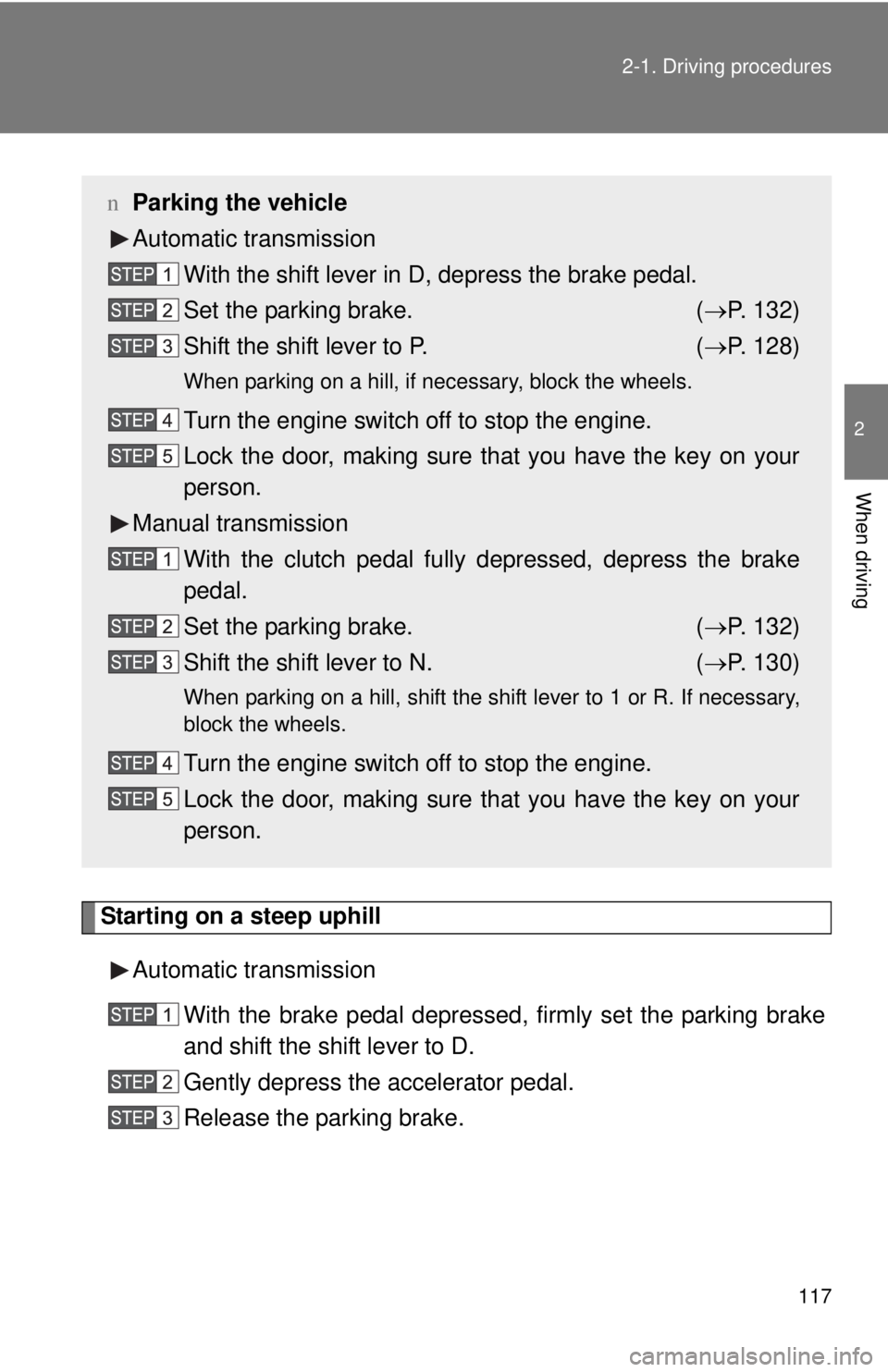
Starting on a steep uphill
Automatic transmission
With the brake pedal depressed, firmly set the parking brake
and shift the shift lever to D.
Gently depress the accelerator pedal.
Release the parking brake.
nParking the vehicle
Automatic transmission
With the shift lever in D, depress the brake pedal.
Set the parking brake. (→ P. 1 3 2 )
Shift the shift lever to P. (→ P. 1 2 8 )
When parking on a hill, if necessary, block the wheels.
Turn the engine switch off to stop the engine.
Lock the door, making sure that you have the key on your
person.
Manual transmission
With the clutch pedal fully depressed, depress the brake
pedal.
Set the parking brake. (→ P. 1 3 2 )
Shift the shift lever to N. (→ P. 1 3 0 )
When parking on a hill, shift the shift lever to 1 or R. If necessary,
block the wheels.
Turn the engine switch off to stop the engine.
Lock the door, making sure that you have the key on your
person.
Page 131 of 402
118 2-1. Driving procedures
Manual transmissionWith the parking brake firmly set and the clutch pedal fully
depressed, shift the shift lever to 1.
Lightly depress the accelerator pedal at the same time as
gradually releasing the clutch pedal.
Release the parking brake.
nDriving in the rain
lDrive carefully when it is raining, because visibility will be reduced, the
windows may become fogged-up, and the road will be slippery.
l Drive
carefully when it starts to rain, because the road surface will be
especially slippery.
l Refra
in from high speeds when driving on an expressway in the rain,
because there may be a layer of water between the tires and the road
surface, preventing the steering and brakes from operating properly.
n Breaking in your new T
oyota
To extend the life of the vehicle, the following precautions are recommended
to observ
e:
l For the first 200
miles (300 km):
Avoid sudden stops.
l For the first 500
miles (800 km):
Do not tow a trailer.
l For the first 100
0 miles (1600 km):
• Do not drive at extremely high speeds.
• Avoid sudden acceleration.
• Do not drive continuously in the low gears.
• Do not drive at a constant speed for extended periods.
n Operating your vehicle in a foreign country
Comply with the relevant vehicle registration laws and confirm the availability
of the correct fuel. ( →P. 346)
n Normal characteristics a
fter turning off the engine
Approximately five hours after the engine is turned off, you may hear sound
coming from under the
vehicle for several minutes. This is the sound of a
fuel evaporation leakage check and, it does not indicate a malfunction.
Page 132 of 402

119
2-1. Driving procedures
2
When driving
CAUTION
n
When starting the vehicle
Vehicles with an automatic transmission, always keep your foot on the brake
pedal while stopped with the engine running. This prevents the vehicle from
creeping.
n When driving the vehicle
lDo not drive if you are unfamiliar with the location of the clutch, brake and
accelerator pedals to avoid depressing the wrong pedal.
• Accidentally depressing the accelerator pedal instead of the brake
pedal will result in sudden acceleration that may lead to an accident
that could result in death or serious injury.
• When backing up, you may twist your body around, leading to a diffi- culty in operating the pedals. Make sure to operate the pedals properly.
• Make sure to keep a correct driving posture even when moving the vehicle only slightly, allowing you to depress the brake and accelerator
pedals properly.
• Depress the brake pedal using your right foot. Depressing the brake pedal using your left foot may delay response in an emergency, result-
ing in an accident.
l Do not drive the vehicle over or st op the vehicle near flammable materials.
The exhaust system and exhaust gases can be extremely hot. This may
cause a fire if there is any flammable material nearby.
l Vehicles with an automatic transmission, do not let the vehicle roll back-
wards while the shift lever is in a driving position, or roll forward while the
shift lever is in R.
Doing so may cause the engine to stall or lead to poor brake and steering
performance, resulting in an accident or damage to the vehicle.
l If the smell of exhaust is noticed inside the vehicle, open the windows and
check that the back door is closed. Large amounts of exhaust in the vehi-
cle can cause driver drowsiness and an accident, resulting in death or a
serious health hazard. Have the vehicle inspected by your Toyota dealer
immediately.
l Do not under any circumstances shift the shift lever to P, R or N (automatic
transmission) or R (manual transmission) while the vehicle is moving.
Doing so can cause significant damage to the transmission system and
may result in a loss of vehicle control.
Page 136 of 402
123
2-1. Driving procedures
2
When driving
CAUTION
n
When braking the vehicle
lIf the power brake assist function does not operate, do not follow other
vehicles closely and avoid downhills or sharp turns that require braking.
In this case, braking is still possible, but it will require more force on the
pedal than usual. Braking distance may also increase.
l Do not pump the brake pedal if the engine stalls.
Each push on the brake pedal uses up the reserve for the power-assisted
brakes.
l The brake system consists of 2 individual hydraulic systems: If one of the
systems fails, the other will still operate. In this case, the brake pedal
should be depressed more firmly than usual and braking distance
becomes longer.
Do not drive your vehicle with only a single brake system. Have your
brakes fixed immediately.
NOTICE
n When driving the vehicle
Vehicles with a manual transmission
l Do not rest your foot on the clutch pedal while driving.
Doing so may cause clutch trouble.
l Do not use any gears other than the first gear when starting off and mov-
ing forward.
Doing so may damage the clutch.
l Do not use the clutch to hold the vehicle when stopping on an uphill grade.
Doing so may damage the clutch.
Vehicles with an automatic transmission
l Do not use the accelerator pedal or depress accelerator and brake pedals
together to hold the vehicle on a hill.
n When parking the vehicle
Vehicles with an automatic transmission: Always put the shift lever in P.
Failure to do so may cause the vehicle to move or the vehicle may acceler-
ate suddenly if the accelerator pedal is accidentally depressed.
Page 139 of 402
126 2-1. Driving procedures
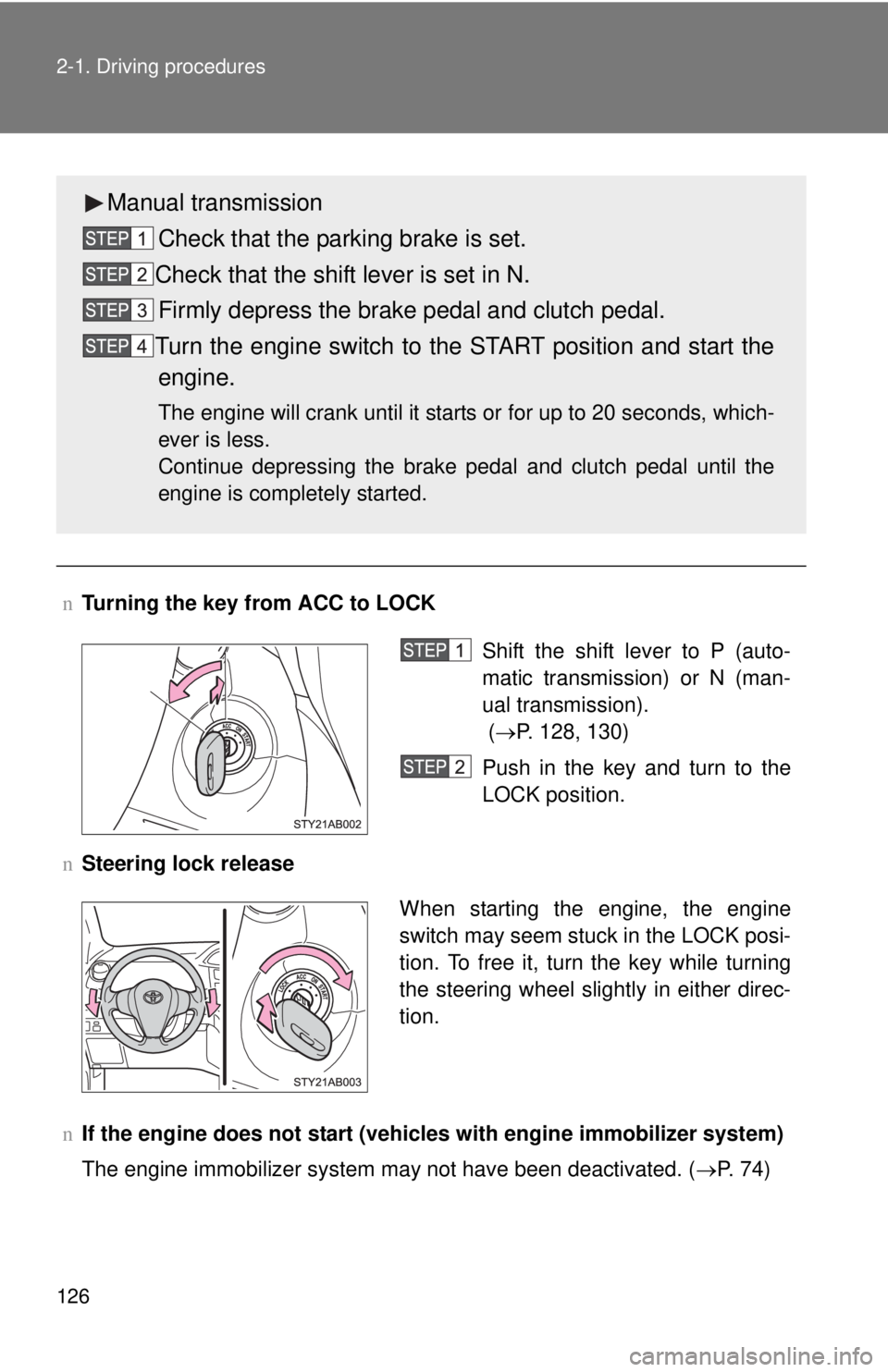
nTurning the key from ACC to LOCK
n S
teering lock release
nIf the engine does not st
art (vehicles with engine immobilizer system)
The engine immobilizer system may not have been deactivated. ( →P
. 74)
Manual transmission
Check that the parking brake is set.
Check that the shift lever is set in N. Firmly depress the brake pedal and clutch pedal.
Turn the engine switch to the START position and start the engine.
The engine will crank until it starts or for up to 20 seconds, which -
ever is less.
Continue depressing the brake pedal and clutch pedal until the
engine is completely st
arted.
Shift the shift lever to P (auto-
matic transmission) or N (man-
ual transmission).
(→P. 128, 130)
Push in the key and turn to the
LOCK position.
When starting the engine, the engine
switch may seem stuck in the LOCK posi-
tion. To free it, turn the key while turning
the steering wheel slightly in either direc-
tion.
Page 143 of 402
130
2-1. Driving procedures
Manual Transmission (if equipped)
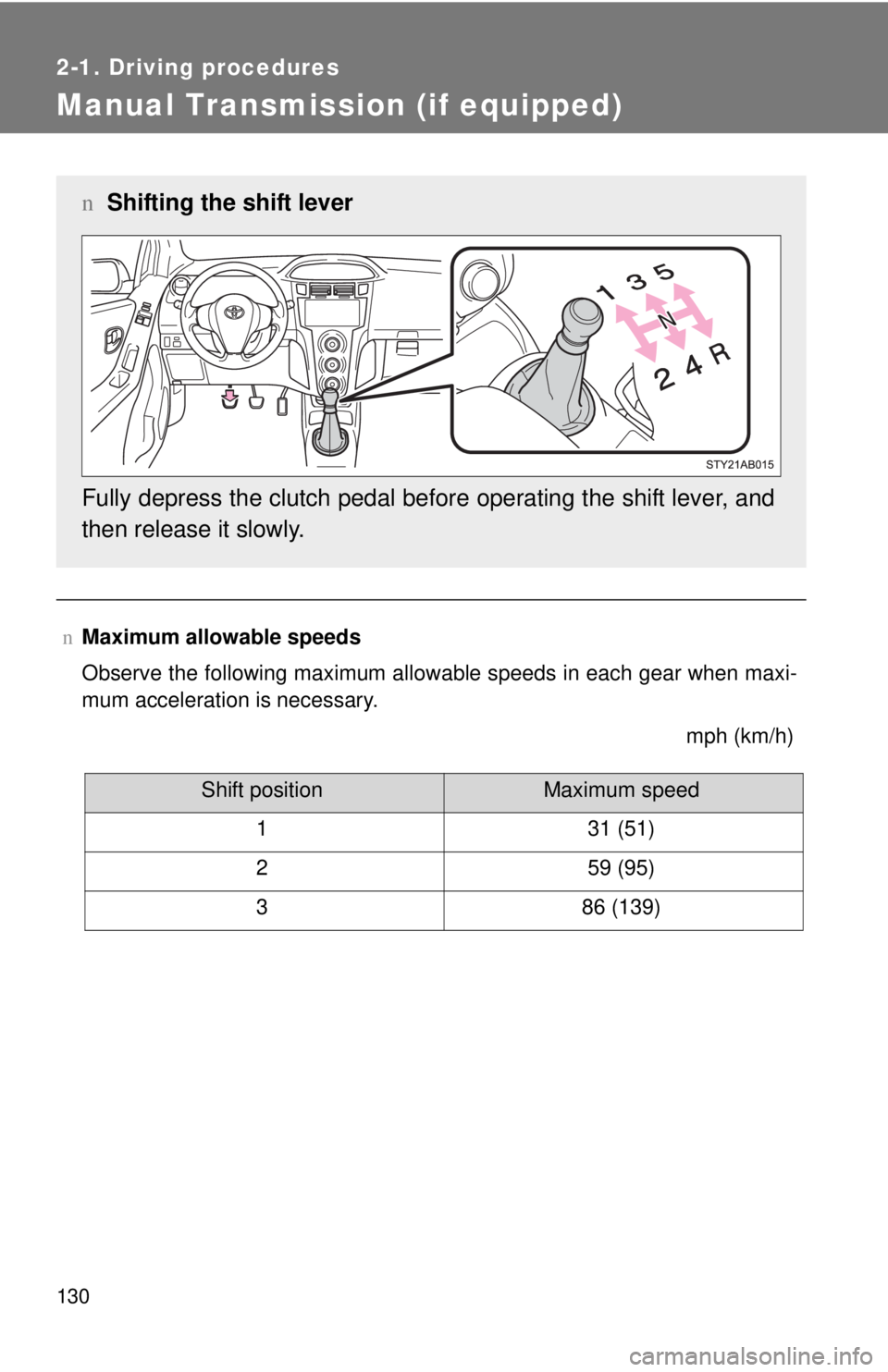
nMaximum allowable speeds
Observe the following maximum allowable speeds in each gear when maxi -
mum acceleration is necessary.
mph (km/h)
nShifting the shift lever
Fully depress the clutch pedal before operating the shift lever, and
then release it slowly.
Shift positionMaximum speed
1 31 (51)
2 59 (95)
3 86 (139)
Page 175 of 402
162 2-5. Driving information
Regulations on the use of snow chains
lRegulations regarding the use of tire chains vary according to loca-
tion and type of road. Alwa
ys check local regulations before install -
ing chains.
l Use SAE Class “
S” type radial tire chains, with the exception of
radial cable chains or V-bar type chains.
• Install the chains on the front tires.
• Refer to the explanation that co
mes with the tire chains for
installation instructions.
l Re
tighten the chains after drivi ng 1/4 - 1/2 mile (0.5 - 1.0 km).
nSnow chain installation
Observe the following precautions when installing and removing chains.
l Inst
all and remove tire chains in a safe location.
lInst
all tire chains on the front tires only. Do not install tire chains on the
rear tires.
l Inst
all the tire chains on front tires as tightly as possible.
lInst
all tire chains following the instructions provided in the accompanying
instructions.
l If
wheel ornaments are used, they will be scratched by the chain band,
so remove the ornaments before putting on the chains. ( →P. 320)
nWhen driving the vehicle
Accelerate the vehicle slowly and drive at a reduced speed suit -
able to road conditions.
n When
parking the vehicle
Park the vehicle and move the shift lever to P (automatic trans -
mission) or to 1 or R (manual transmission) without setting the
p
arking brake. The parking brak e may freeze up, preventing it
from being released.
Page 180 of 402

167
2-5. Driving information
2
When driving
n
Before towing
Check that the following conditions are met:
lEnsure that your vehicle’
s tires are properly inflated. ( →P. 351)
l T
railer tires should be inflated according to the trailer manufacturer’s rec -
ommendation.
l All trailer light
s work to be legal.
l Confirm all light
s work each time you connect them.
l Check
that your vehicle remains level when a loaded or unloaded trailer
is hitched. Do not drive if the vehicle is not level, and check for improper
tongue load, overloading, worn suspension, or other possible causes.
l Make s
ure the trailer cargo is securely loaded.
lCheck
that your rear view mirrors c onform to any federal, state/provincial
or local regulations. If they do not, inst all rear view mirrors appropriate for
towing purposes.
n Break-in schedule
l T
oyota recommends that you do not use a new vehicle or a vehicle with
any new power train components (engine, transmission, differential,
wheel bearings, etc.) to tow a trailer for the first 500 miles (800 km) of
driving.
n Main
tenance
lIf you tow a trailer
, your vehicle will require more frequent maintenance
due to the additional load. (See “Scheduled Maintenance Guide” or
“Owner’s Manual Supplement”.)
l Retighten the fixing
bolts of the towing ball and bracket after approxi -
mately 600 miles (1000 km).