weight TOYOTA YARIS HATCHBACK 2009 Owners Manual
[x] Cancel search | Manufacturer: TOYOTA, Model Year: 2009, Model line: YARIS HATCHBACK, Model: TOYOTA YARIS HATCHBACK 2009Pages: 402, PDF Size: 7.61 MB
Page 19 of 402
380
Abbreviation list
Abbreviation/Acronym list
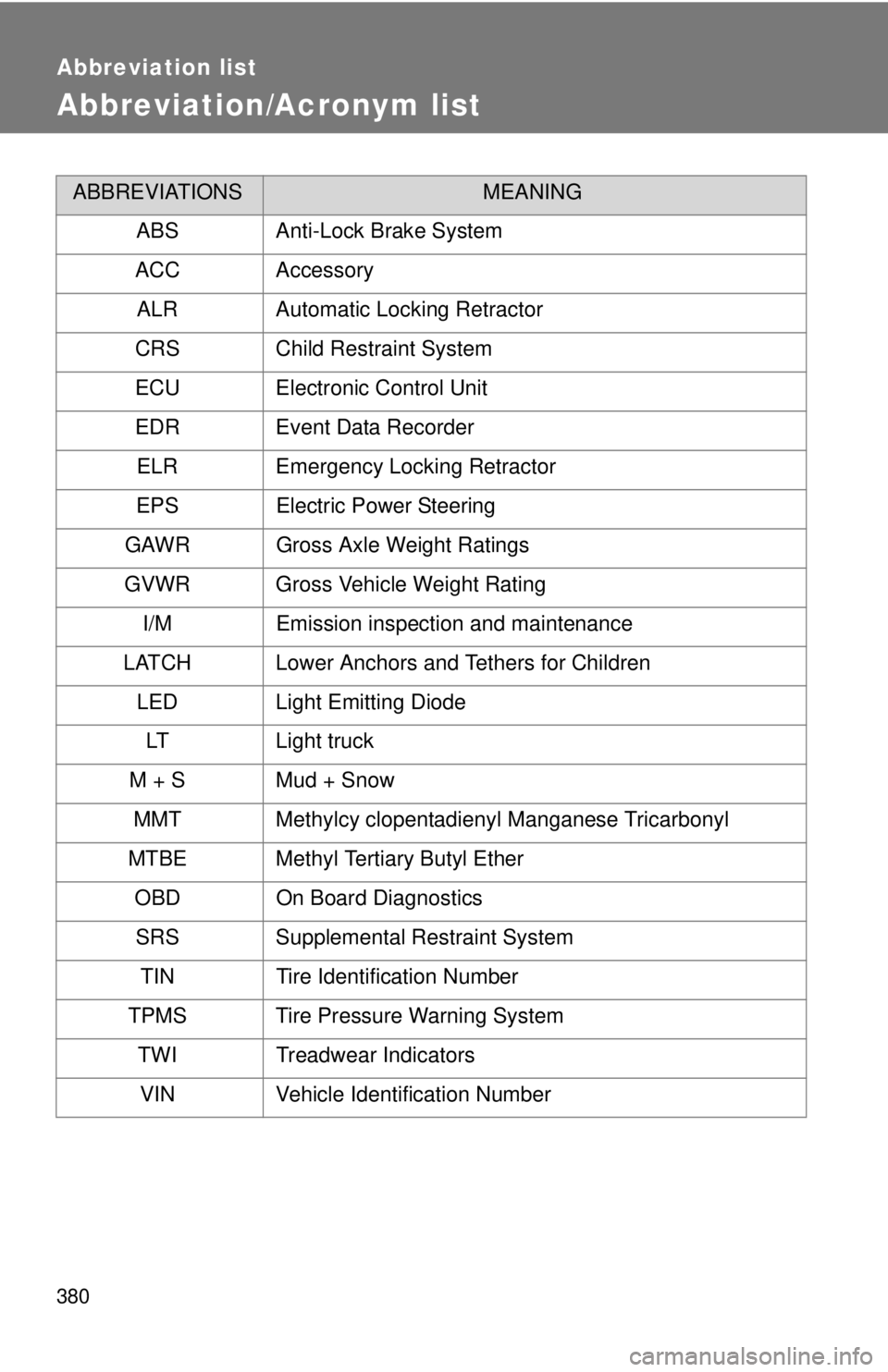
ABBREVIATIONSMEANING
ABS Anti-Lock Brake System
ACC Accessory ALR Automatic Locking Retractor
CRS Child Restraint System
ECU Electronic Control Unit
EDR Event Data Recorder ELR Emergency Locking Retractor
EPS Electric Power Steering
GAWR Gross Axle Weight Ratings
GVWR Gross Vehicle Weight Rating I/M Emission inspection and maintenance
LATCH Lower Anchors and Tethers for Children LED Light Emitting Diode
LT Light truck
M + S Mud + Snow MMT Methylcy clopentadienyl Manganese Tricarbonyl
MTBE Methyl Tertiary Butyl Ether OBD On Board DiagnosticsSRS Supplemental Restraint System
TIN Tire Identification Number
TPMS Tire Pressure Warning System TWI Treadwear Indicators
VIN Vehicle Identification Number
Page 73 of 402
59
1-3. Adjustable components (s
eats, mirrors, steering wheel)
1
Before driving
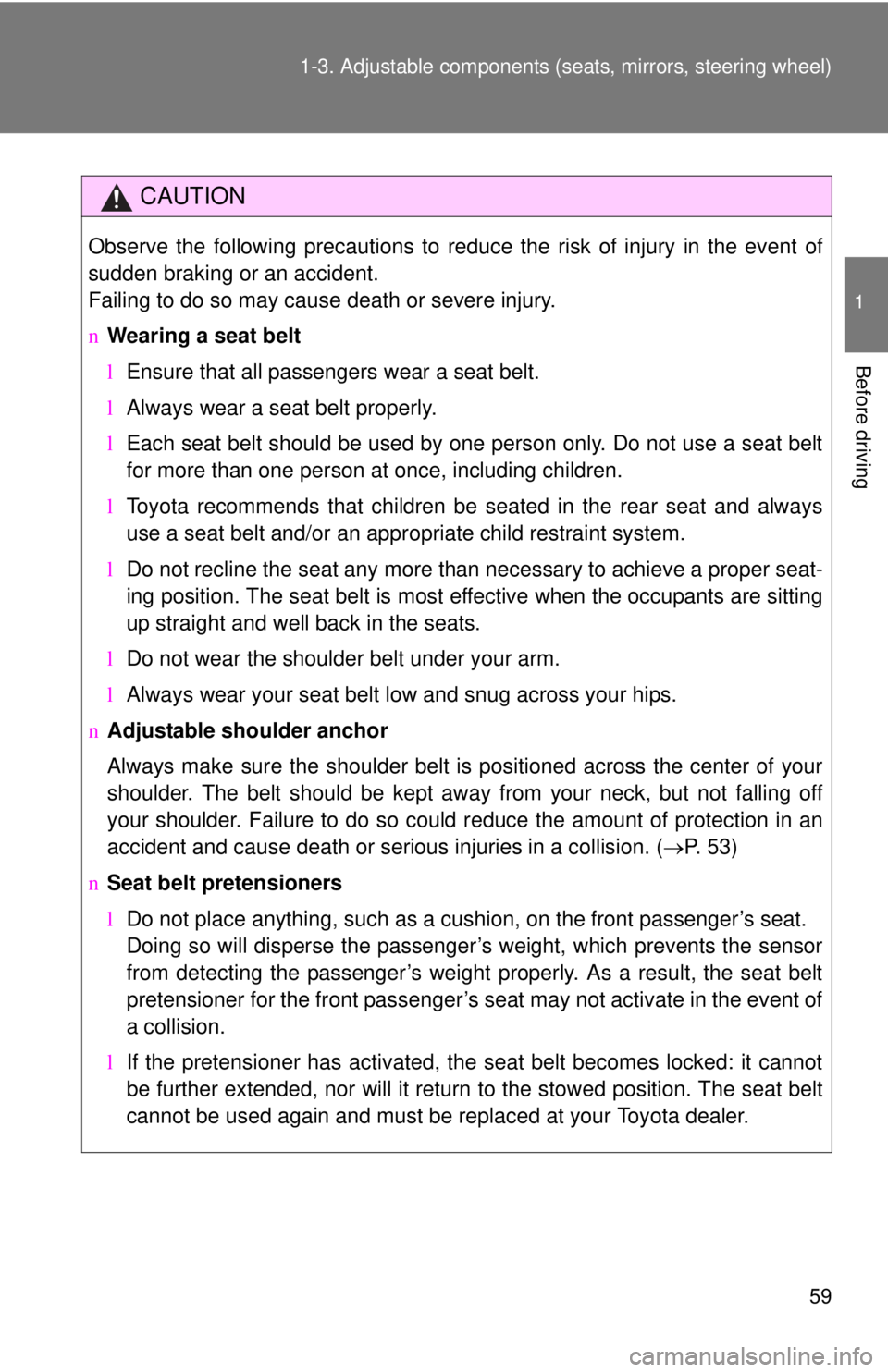
CAUTION
Observe the following precautions to reduce the risk of injury in the event of
sudden braking or an accident.
Failing to do so may cause death or severe injury.
nWearing a seat belt
lEnsure that all passengers wear a seat belt.
l Always wear a seat belt properly.
l Each seat belt should be used by one person only. Do not use a seat belt
for more than one person at once, including children.
l Toyota recommends that children be seated in the rear seat and always
use a seat belt and/or an appropriate child restraint system.
l Do not recline the seat any more than necessary to achieve a proper seat-
ing position. The seat belt is most effective when the occupants are sitting
up straight and well back in the seats.
l Do not wear the shoulder belt under your arm.
l Always wear your seat belt low and snug across your hips.
n Adjustable shoulder anchor
Always make sure the shoulder belt is positioned across the center of your
shoulder. The belt should be kept away from your neck, but not falling off
your shoulder. Failure to do so could reduce the amount of protection in an
accident and cause death or serious injuries in a collision. ( →P. 53)
n Seat belt pretensioners
lDo not place anything, such as a cushion, on the front passenger’s seat.
Doing so will disperse the passenger’s weight, which prevents the sensor
from detecting the passenger’s weight properly. As a result, the seat belt
pretensioner for the front passenger’s seat may not activate in the event of
a collision.
l If the pretensioner has activated, the seat belt becomes locked: it cannot
be further extended, nor will it return to the stowed position. The seat belt
cannot be used again and must be replaced at your Toyota dealer.
Page 110 of 402

96 1-7. Safety information
CAUTION
nFront passenger occupant cl assification system precautions
Observe the following precautions regarding front passenger occupant clas-
sification system.
Failure to do so may cause death or serious injury.
l Wear the seat belt properly.
l Make sure the front passenger’s seat belt tab has not been left inserted
into the buckle before someone sits in the front passenger seat.
l Make sure the AIR BAG OFF indicator light is not illuminated when using
the seat belt extender for the front passenger seat. If the AIR BAG OFF
indicator light is illuminated, disconnect the extender tongue from the seat
belt buckle, then reconnect the seat belt. Reconnect the seat belt extender
after making sure the AIR BAG ON indicator light is illuminated. If you use
the seat belt extender while the AIR BAG OFF indicator light is illuminated,
the front passenger airbag and side airbag on the front passenger side
may not activate correctly, which could cause death or serious injury in the
event of collision.
l Do not apply a heavy load to the front passenger seat or equipment.
l Do not put weight on the front passenger seat by putting your hands or
feet on the front passenger seat seatback from the rear passenger seat.
l Do not let a rear passenger lift the front passenger seat with their feet or
press on the seatback with their legs.
l Do not put objects under the front passenger seat.
l Do not recline the front passenger seatback so far that it touches a rear
seat. This may cause the AIR BAG OFF indicator light to be illuminated,
which indicates that the passenger’s airbags will not deploy in the event of
a severe accident. If the seatback touches the rear seat, return the seat-
back to a position where it does not touch the rear seat. Keep the front\
passenger seatback as upright as possible when the vehicle is moving.
Reclining the seatback excessively may lessen the effectiveness of the
seat belt system.
Page 170 of 402
157
2
When driving
2-5. Driving information
Cargo and luggage
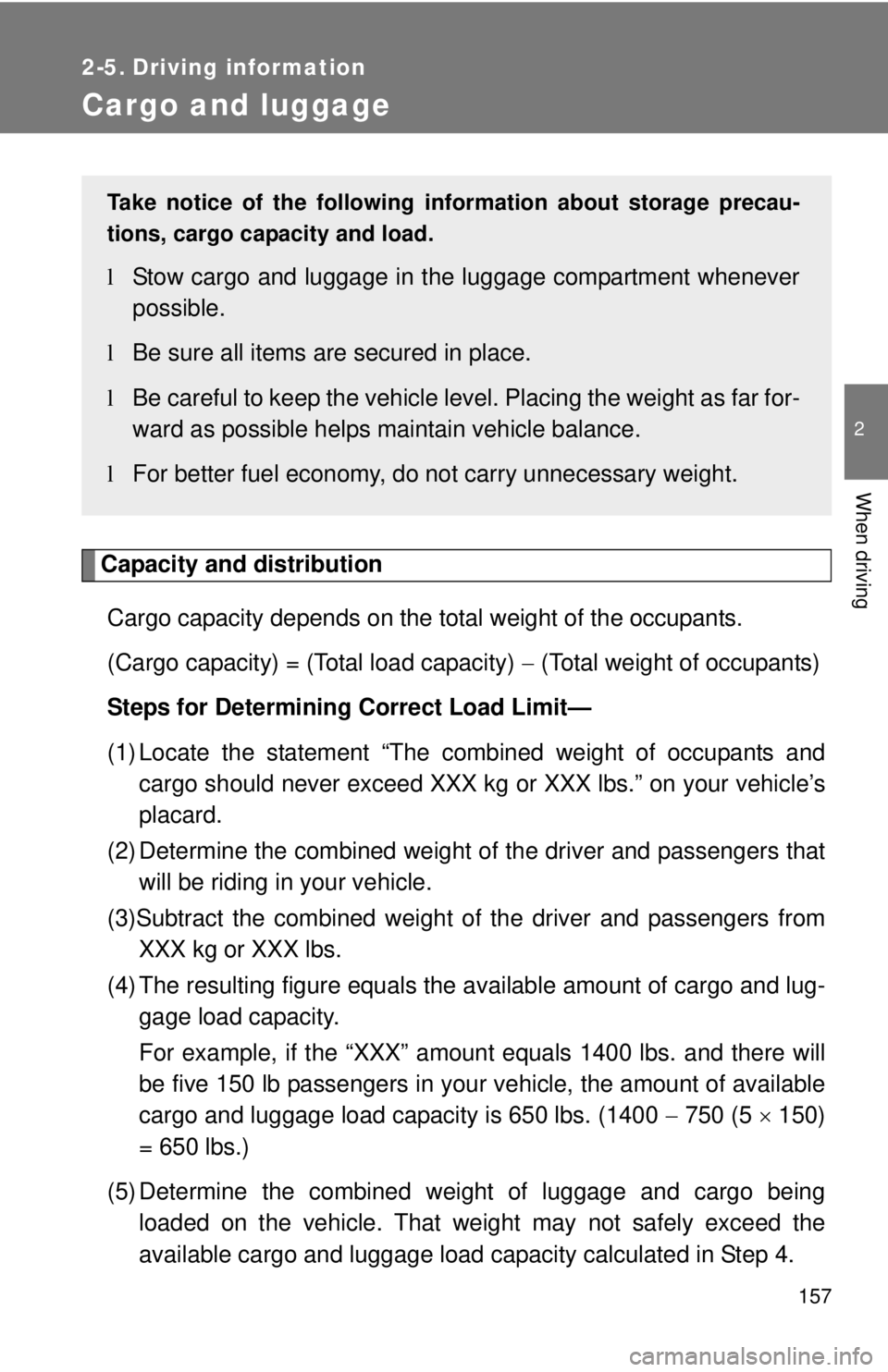
Capacity and distribution
Cargo capacity depends on the total weight of the occupants.
(Cargo capacity) = (Total load capacity) − (T
otal weight of occupants)
Steps for Determining Correct Load Limit—
(1) Locate the statement “The combined
weight of occupants and
cargo should never exceed XXX kg or XXX lbs.” on your vehicle’s
placard.
(2) Determine the combined weight of the driver and passengers that will be riding
in your vehicle.
(3)Subtract the combined weight of the driver and passengers from XXX
kg or XXX lbs.
(4) The resulting figure equals the available amount of cargo and lug -
gage load capacity.
For example, if the “XXX” amount equals 1400 lbs. and there will
be
five 150 lb passengers in your vehicle, the amount of available
cargo and luggage load capacity is 650 lbs. (1400 − 750 (5 × 150)
= 650 lbs.)
(5) Determine the combined weight of luggage and cargo being loaded on the vehicle. That weight may not safely exceed the
available cargo and luggage load capacity calculated in Step 4.
Take notice of the following information about storage precau-
tions, cargo capacity and load.
l Stow cargo and luggage in the luggage compartment whenever
possible.
l Be
sure all items are secured in place.
lBe
careful to keep the vehicle level. Placing the weight as far for -
ward as possible helps maintain vehicle balance.
l For better fuel eco
nomy, do not carry unnecessary weight.
Page 171 of 402
158 2-5. Driving information
(6) If your vehicle will be towing a trailer, load from your trailer will be
transferred to your vehicle. Consult this manual to determine how
this reduces the available cargo and luggage load capacity of your
vehicle.
Except Canada:
Toyota does not recommend towing a trailer with your vehicle. Your
vehicle is not desig
ned for trailer towing.
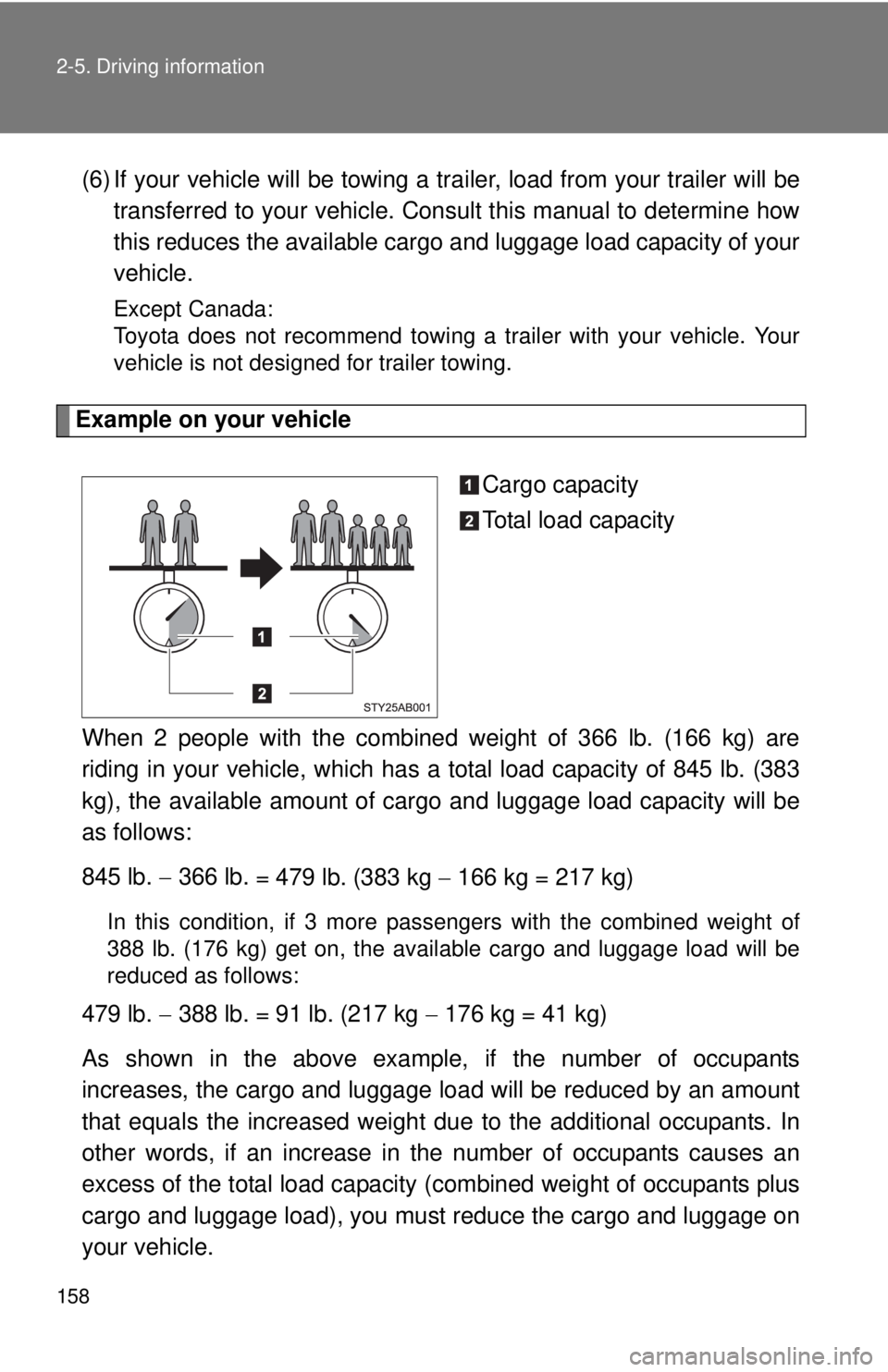
Example on your vehicle
Cargo capacity
Total load capacity
When 2 people with the combined weight of 366 lb. (166 kg) are
riding
in your vehicle, which has a total load capacity of 845 lb. (383
kg), the available amount of cargo and luggage load capacity will be
as follows:
845 lb. − 366 lb.
= 479 lb. (383 kg − 166 kg = 217 kg)
In this condition, if 3 more pass engers with the combined weight of
388 lb. (176 kg) get on , the available cargo and luggage load will be
reduced as follows:
479 lb. − 388 lb. = 91 lb. (217 kg − 176 kg = 41 kg)
As shown in the above example, if th
e number of occupants
increases, the cargo and luggage lo ad will be reduced by an amount
that equals the increased weight du e to the additional occupants. In
other words, if an increase in the number of occupants causes an
excess of the total load capacity (combined weight of occupants plus
cargo and luggage load), you must reduce the cargo and luggage on
your vehicle.
Page 172 of 402
159
2-5. Driving information
2
When driving
CAUTION
nThings that must not be carried in the luggage compartment
The following things may cause a fire if loaded in the luggage compart-
ment.
lReceptacles containing gasoline
lAerosol cans
nStorage precautions
lDo not place anything on the luggage cover, and do not stack anything
in the luggage compartment higher than the seatbacks.
Such items may be thrown about and possibly injure people in the
vehicle during sudden braking or in an accident.
lDo not drive with objects on top of the instrument panel.
They may interfere with the driver’s field of view or move during sharp
acceleration or turning, thus impairing the driver’s control of the vehi-
cle. In an accident they may injure the vehicle occupants.
lSecure all items in the occupant compartment, as they may shift and
injure someone during an accident or sudden braking.
lNever allow anyone to ride in the luggage compartment. It is not
designed for passengers. They should ride in their seats with their seat
belts properly fastened. Otherwise, th ey are much more likely to suffer
serious bodily injury, in the even t of sudden braking or a collision.
nCapacity and distribution
lDo not exceed the maximum axle weight rating or the total vehicle
weight rating.
lEven if the total load of occupant’s weight and the cargo load is less
than the total load capacity, do no t apply the load unevenly. Improper
loading may cause deterioration of st eering or braking control which
may cause death or serious injury.
Page 173 of 402
160
2-5. Driving information
Vehicle load limits
nTotal load capacity and seating capacity
These details are also described on the tire and loading information
label.(→P. 2 6 4
)
CAUTION
nOverloading the vehicle
Do not overload the vehicle.
It may not only cause damage to the ti res, but also degrade steering and
braking ability, resulting in an accident.
Vehicle load limits include total load capacity, seating capacity,
towing capacity and cargo capacity.
n Total load capacity: 845 lb. (383 kg)
Total load capacity means the combined weight of occupants,
car
go and luggage.
n Se
ating capacity: 5 occupants (Front 2, Rear 3)
Seating capacity means the ma ximum n
umber of occupants
whose estimated average weight is 150 lb. (68 kg) per person.
Even if the number of occupants are within the seating capacity,
do no
t exceed the total load capacity.
n T
owing capacity (Canada): 700 lb. (318 kg)
Towing capacity means the maximum gross trailer weight (trailer
weigh
t plus its cargo weight) that your vehicle is able to tow.
n T
owing capacity (except Canada)
Toyota does not recommend towing a trailer with your vehicle.
n Cargo cap
acity
Cargo capacity may increase or decrease depending on the
weigh
t and the number of occupants.
Page 178 of 402
165
2-5. Driving information
2
When driving
Trailer towing (Canada)
Your vehicle is designed primarily as a passenger-carrying vehicle,
thus towing a trailer will have an adverse effect on handling, perfor
-
mance, braking, durability, and fu el consumption. For your
safety
and the safety of others , do not overload the vehicle or trailer.
Toyota warranties do not apply to damage or
malfunction caused by
towing a trailer for commercial purposes.
n Weight limits
Confirm the total trailer weight, gross vehicle weight, gross axle
weigh
t and trailer tongue load are all within the limits.
n Gross ve
hicle weight
The gross vehicle weight must not exce
ed the Gross Vehicle
Weight Rating (GVWR) indicated on the Certification Label. The
gross vehicle weight is the sum of weights of the unloaded vehi -
cle, driver, passengers, luggage,
hitch, and the trailer tongue
load. It also includes the weight of any special equipment
installed on your vehicle.
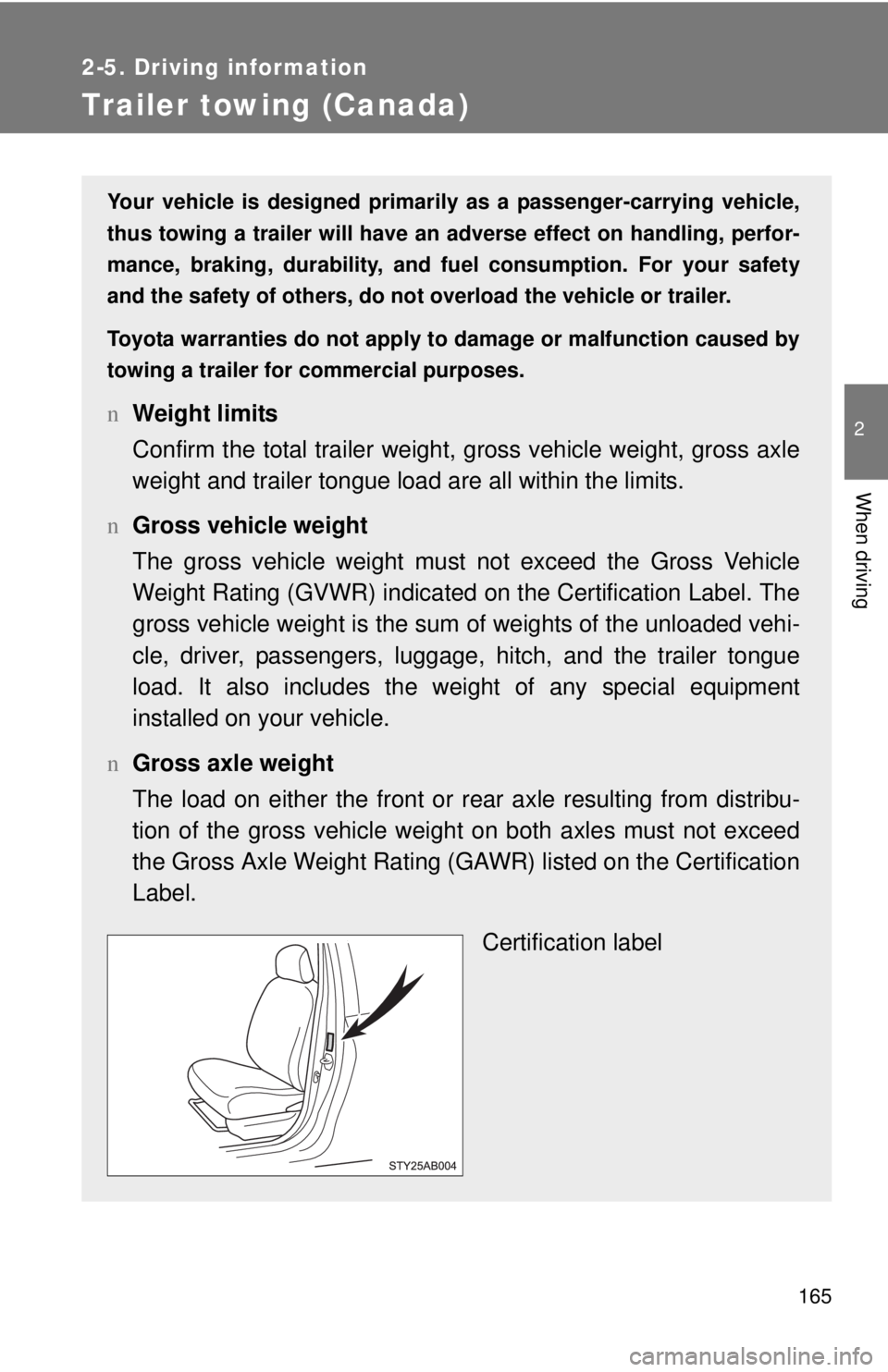
n Gross ax
le weight
The load on either the front or re
ar axle resulting from distribu-
tion of the gross vehicle weight on b
oth axles must not exceed
the Gross Axle Weight Rating (GAWR) listed on the Certification
Label.
Certification label
Page 179 of 402
166 2-5. Driving information
Towing a trailer
Consult your Toyota dealer for further information about additional
requirements such as a towing kits, etc.
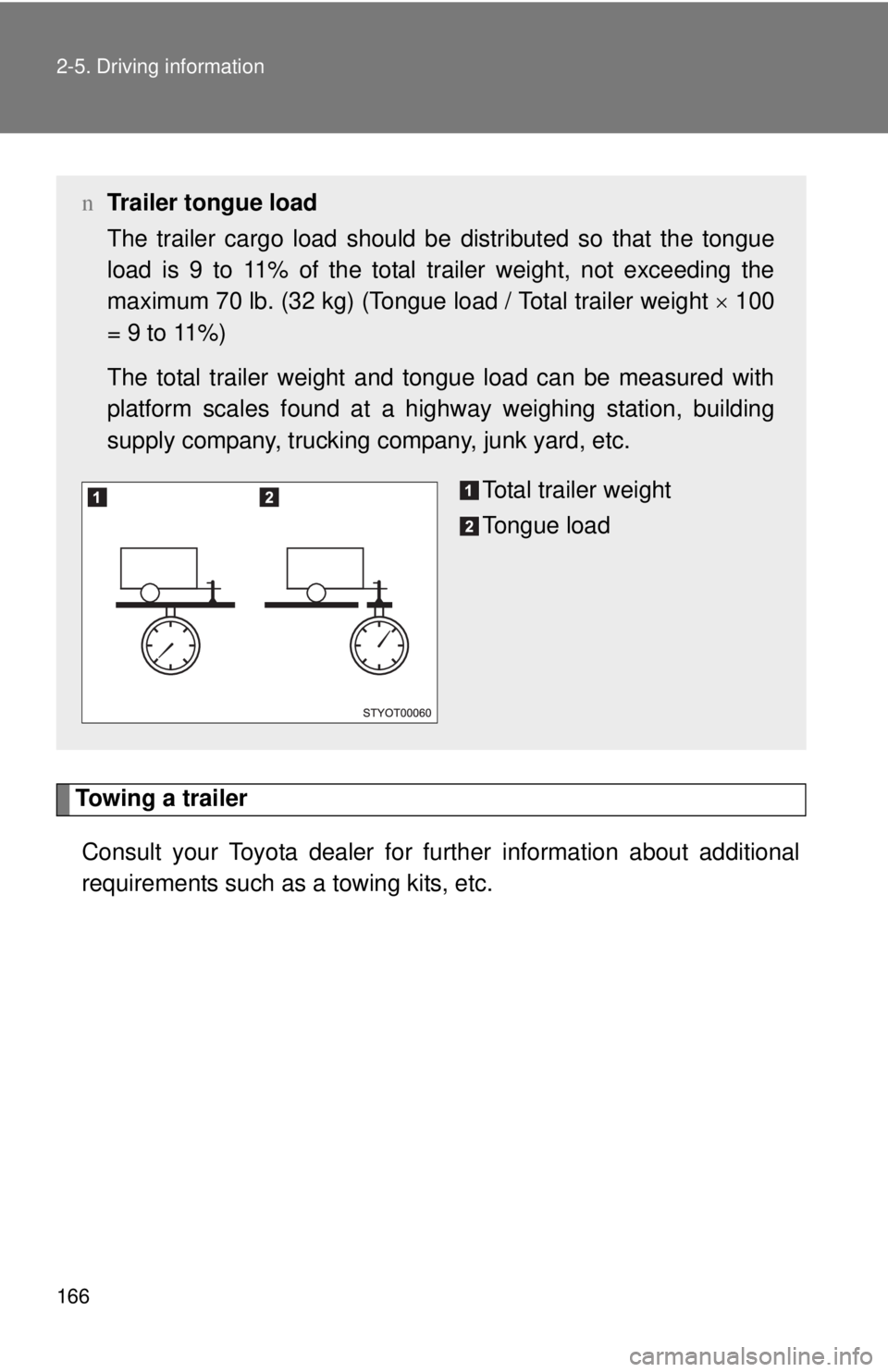
nTrailer tongue load
The trailer cargo load should be distributed so that the tongue
load is 9 to 11% of the total trailer weight, not exceeding the
maximum 70 lb. (32 kg) (Tongue load / Total trailer weight × 100
= 9 to 11%)
The total trailer weight and tongue load can be measured with
plat
form scales found at a highway weighing station, building
supply company, trucking company, junk yard, etc.
Total trailer weight
Tongue load
Page 181 of 402
168 2-5. Driving information
CAUTION
nTo avoid accident or injury
lThe total trailer weight (trailer weight plus the weight of cargo) must not
exceed 700 lb. (318 kg)
l Do not exceed the trailer hitch assembly weight, gross vehicle weight,
gross axle weight and trailer tongue load capacities.
n Hitches
Trailer hitch assemblies have different weight capacities established by the
hitch manufacturer. Even though the vehicle may be rated for towing a
higher weight, the operator must never exceed the maximum weight rating
specified for the trailer hitch.
lIf you wish to install a trailer hitch, your Toyota dealer should be consulted.
l Use only a hitch that conforms to the total trailer weight requirement.
l Follow the directions supplied by the hitch manufacturer.
l Lubricate the hitch ball with a light coat of grease.
l Remove the trailer hitch whenever y ou are not towing a trailer to reduce
the possibility of additional damage caused by the hitch if your vehicle is
struck from behind.
n When towing a trailer
lNever tap into your vehicle’s hydraulic system, as this will lower the vehi-
cle’s braking effectiveness.
l Never tow a trailer without using a safety chain securely attached to both
the trailer and the vehicle. If damage occurs to the coupling unit or hitch
ball, there is danger of the trailer wandering into another lane.