wheel size TOYOTA YARIS HATCHBACK 2009 Owners Manual
[x] Cancel search | Manufacturer: TOYOTA, Model Year: 2009, Model line: YARIS HATCHBACK, Model: TOYOTA YARIS HATCHBACK 2009Pages: 402, PDF Size: 7.61 MB
Page 72 of 402
58 1-3. Adjustable components (seats, mirrors, steering wheel)
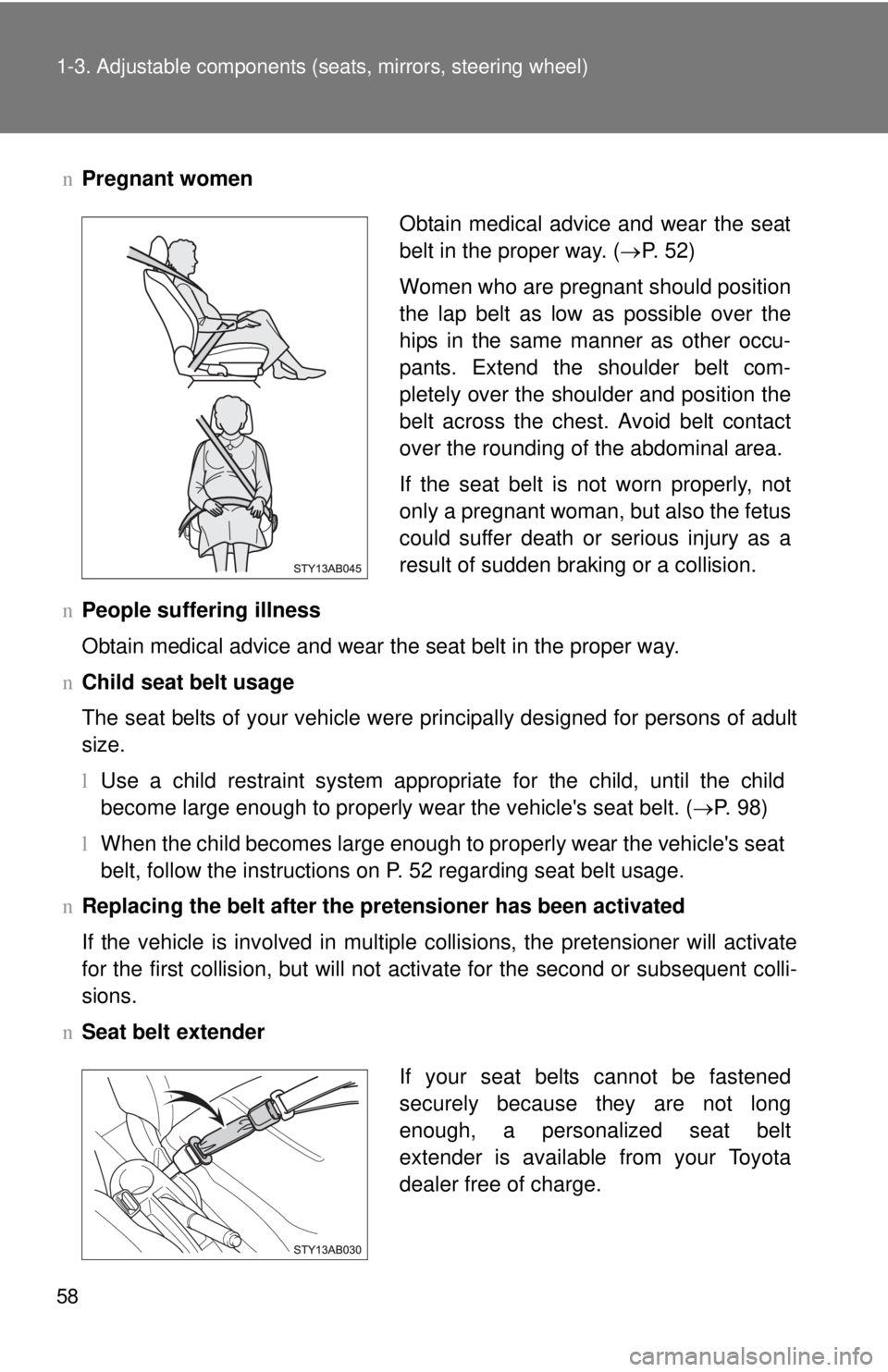
nPregnant women
n People suffering illness
Obtain medical advice and wear the seat belt in the proper way.
n Child seat bel
t usage
The seat belts of your vehicle were principally designed for persons of adult
size.
l Use
a child restraint system appropriate for the child, until the child
become large enough to properly wear the vehicle's seat belt. ( →P. 9 8)
l When the
child becomes large enough to properly wear the vehicle's seat
belt, follow the instructions on P. 5 2 regarding seat belt usage.
n Replacing the belt af
ter the pretensioner has been activated
If the vehicle is involved in multiple collisions, the pretensioner will activate
for the first
collision, but will not activate for the second or subsequent colli -
sions.
n Seat belt extender
Obtain medical advice and wear the seat
belt in the proper way. ( →P. 52)
Women who are pregnant should position
the lap belt as low as possible over the
hips in the same manner as other occu-
pants. Extend the shoulder belt com-
pletely over the shoulder and position the
belt across the chest. Avoid belt contact
over the rounding of the abdominal area.
If the seat belt is not worn properly, not
only a pregnant woman, but also the fetus
could suffer death or serious injury as a
result of sudden braking or a collision.
If your seat belts cannot be fastened
securely because they are not long
enough, a personalized seat belt
extender is available from your Toyota
dealer free of charge.
Page 169 of 402

156 2-4. Using other driving systems
CAUTION
nThe ABS does not operate effectively when
lTires with inadequate gripping ability are used (such as excessively worn
tires on a snow covered road).
l The vehicle hydroplanes while driving at high speed on the wet or slick
road.
n Stopping distance when the ABS is ope rating on the wet or slick roads
The ABS is not designed to shorten the vehicle's stopping distance. Always
maintain a safe distance from the vehicle in front of you in the following situ-
ations.
l When driving on dirt, gravel or snow-covered roads
l When driving with tire chains
l When driving over bumps in the road
l When driving over roads with potholes or uneven roads
n Replacing tires
Make sure that all tires are of the same size, brand, tread pattern and total
load capacity. In addition, make sure that the tires are inflated to the appro-
priate tire pressure level.
The ABS will not function correctly if different tires are fitted on the vehicle.
Contact your Toyota dealer for further information when replacing tires or
wheels.
n Handling of tires and suspension
Using tires with any kind of problem or modifying the suspension will affect
the driving assist systems, and may cause the system to malfunction.
Page 174 of 402
161
2-5. Driving information
2
When driving
Winter driving tips
Carry out the necessary preparations and inspections before driving
the vehicle in winter. Always drive the vehicle in a manner appropri
-
ate to the prevailing weather conditions.
n Pre-winter preparations
lUse
fluids that are appropriate to the prevailing outside tem -
peratures.
• Engine oil
• Engine coolant
• Washer fluid
l Have a se
rvice technician inspect the level and specific grav -
ity of battery electrolyte.
l Have the veh
icle fitted with four snow tires or purchase a set
of tire chains for the front tires.
Ensure that all tires are the same size and brand, and that chains
match the size of the tires.
n Before driving the vehicle
Perform the following according to the driving conditions.
lDo
not try to forcibly open a window, scrape an outside rear
view mirror surface or move a wiper or outside rear view mir -
ror that is frozen. Pour warm water over the frozen area to
me
lt the ice. Wipe away the water immediately to prevent it
from freezing.
l T
o ensure proper operation of th e climate control system fan,
remove any snow that has accumulated on the air inlet vents
in front of the windshield.
l Remove a
ny ice that has accumu lated on the vehicle chassis.
l Pe
riodically check for and remove any excess ice or snow
that may have accumulated in the wheel well or on the
brakes.
Page 176 of 402

163
2-5. Driving information
2
When driving
CAUTION
n
Driving with snow tires
Observe the following precautions to reduce the risk of accidents.
Failing to do so may result in a loss of vehicle control and cause death or
serious injury.
l Use tires of the size specified for your vehicle.
l Maintain the recommended level of air pressure.
l Do not drive in excess of 75 mph (120 km/h) regardless of the type of
snow tires being used.
l Snow tires should be installed on all wheels.
n Driving with snow chains
Observe the following precautions to reduce the risk of accidents.
Failing to do so may result in the vehicle being unable to be driven safely,
and may cause death or serious injury.
l Do not drive in excess of the speed limit specified for the tire chains being
used or 30 mph (50 km/h), whichever is lower.
l Avoid driving on bumpy road surfaces or over potholes.
l Avoid sudden turns and braking.
l Slow down sufficiently before entering a curve to ensure that vehicle con-
trol is maintained.
NOTICE
nRepairing or replacing snow tires
Request repairs of and obtain replacement snow tires from Toyota dealers or
legitimate tire retailers.
This is because the removal and attachment of snow tires affects the opera-
tion of the tire pressure warning valves and transmitters.
n Fitting tire chains
The tire pressure warning valves and transmitters may not function correctly
when tire chains are fitted.
Page 270 of 402

259
4-3. Do-it-yourself maintenance
4
Maintenance and care
Ti
Installing tire pressure warning valves and transmitters
When replacing tires or wheels, ti re pressu
re warning valves and
transmitters must also be installed.
When new tire pressure warning valves and transmitters are installed,
new tire pressure warning valve and transmitter ID codes must be regis -
tered in the tire pressure warning computer and tire pressure warning
sy
stem must be initialized. Have tire pressure warning valve and trans -
mitter ID codes registered by your Toyota dealer.
Registering ID codes
The tire pressure warning valve and transmitter is equipped with a
unique ID code. When replacing a ti re pressure warning valve and
transmitter, it is necessary to register the ID code of tire pressure
warning valve and transmitter. Have the ID code registered by your
Toyota dealer.
nWhen to replace your vehicle's tires
Tires should be replaced if:
lYou have tire damage such as cuts, splits, cracks deep enough to
expose the fabric or bulges indicating internal damage
lA tire goes flat repeatedly or c annot be properly repaired due to the
size or location of a cut or other damage
If you are not sure, consult with your Toyota dealer.
nReplacing tires and wheels
If the ID code of the tire pressure warning valve and transmitter is not
registered, the tire pre ssure w
arning system will not work properly. After
driving for about 20 minutes, the ti re pressure warning light comes on
after blinking for 1 minute to indicate a system malfunction.
nTire life
Any tire over 6 years old must be checked by a qualified technician even
if
they have seldom or never been used or damage is not obvious.
Page 271 of 402

260 4-3. Do-it-yourself maintenance
nIf the tread wears down below 0.16 in. (4 mm) on snow tires
The effectiveness of snow tires is lost.
nMaximum load of tire
Check that the maximum load of the replaced tire is greater than 1/2 of
the Gross Axle Weight Ratings (GAWR) of either the front axle or the
rear axle, whichever is greater.
As for the maximum load of the tire, see the load limit at maximum cold
tire inflation pressure mentioned on the sidewall of the tire, and as for the
Gross Axle Weight Ratings (GAWR) , see the Certification Label. (→P.
264, 356).
nTire types
1 Summer tires
Summer tires are high-speed performance tires best suited to highway
driving under dry conditions. Since summer tires do not have the same
traction performance as snow tire s, summer tires are inadequate for
driving on snow-covered or icy roads. For driving on snow-covered
roads or icy roads, the use of snow tires is recommended. When
installing snow tires, be sure to replace all four tires.
2 All season tires
All season tires are designed to provide better traction in snow and to
be adequate for driving in most winter conditions, as well as for use
year round. All season tires, however, do not have adequate traction
performance compared with snow tires in heavy or loose snow. Also,
all season tires fall short in acceleration and handling performance
compared with summer tires in highway driving.
3Snow tires For driving on snow-covered roads or icy roads, we recommend using
snow tires. If you need snow tires, select tires of the same size, con-
struction and load capacity as the or iginally installed tires. Since your
vehicle has radial tires as original equipment, make sure your snow
tires also have radial construction. Do not install studded tires without
first checking local regulations for possible restriction. Snow tires
should be installed on all wheels. ( →P. 161)
Page 279 of 402
268
4-3. Do-it-yourself maintenance
Wheels
nWhen replacing wheels
The wheels of your Toyota are equipped with tire pressure warning
valves an
d transmitters that allow the tire pressure warning system to
provide advanced warning in the event of a loss in tire inflation pressure.
Whenever wheels are replaced, the tire pressure warning valves and
transmitters must be installed. ( →P. 2 5 9 )
If a wheel is bent, cracked or heavily corroded, it should be
replaced.
Otherwise, the tire may separate from the wheel or cause loss of
ha
ndling control.
nWheel selection
When replacing wheels, care shou ld
be taken to ensure that
they are equivalent to those removed in load capacity, diameter,
rim width, and offset.
Replacement wheels are available at your Toyota dealer.
Toyota does not recommend using:
l Whee
ls of different sizes or types
lUs
ed wheels
lBe
nt wheels that have been straightened
n Aluminum wheel precau
tions (if equipped)
l Use only
Toyota wheel nuts and wrench designed for use with
your aluminum wheels.
l When
rotating, repairing or changing your tires, check that the
wheel nuts are still tight after driving 1000 miles (1600 km).
l Be
careful not to damage the aluminum wheels when using
tire chains.
l Use only T
oyota genuine balance weights or equivalent and a
plastic or rubber hammer when balancing your wheels.
Page 280 of 402

269
4-3. Do-it-yourself maintenance
4
Maintenance and care
CAUTION
nWhen replacing wheels
lDo not use wheels that are a different size from those recommended in
the Owner’s Manual, as this may re
sult in loss of handling control.
lNever use an inner tube in a leaking wheel which is designed for a
tubeless tire. Doing so may result in an accident, causing death or seri-
ous injury.
NOTICE
nReplacing tire pressure warning valves and transmitters
lBecause tire repair or replacement may affect the tire pressure warn-
ing valves and transmitte rs, make sure to have tires serviced by your
Toyota dealer or other qualified service shop. In addition, make sure to
purchase your tire pressure warning valves and transmitters at your
Toyota dealer.
lEnsure that only genuine Toyota wheels are used on your vehicle.
Tire pressure warning valves and transmitters may not work properly
with non-genuine wheels.
Page 324 of 402

314 5-2. Steps to take in an emergency
nCustomization that can be co nfigured at Toyota dealer
l The vehicle speed linked seat belt reminder buzzer can be disabled.
(Customizable features →P. 369)
l The key reminder buzzer can be disabled.
(Customizable features →P. 369)
l The light reminder buzzer can be disabled.
(Customizable features →P. 369)
CAUTION
nIf the tire pressure warning light comes on
Be sure to observe the following precautions. Failure to do so could
cause loss of vehicle control and re sult in death or serious injury.
lStop your vehicle in a safe place as soon as possible. Adjust the tire
inflation pressure immediately.
lIf the tire pressure warning light comes on even after tire inflation pres-
sure adjustment, it is pr obable that you have a fl at tire. Check the tires.
If the tire is flat, change to the spare tire and have the flat tire repaired
by the nearest Toyota dealer.
lAvoid abrupt maneuvering and braking. If the vehicle tires deteriorate,
you could lose control of the steering wheel or the brakes.
nIf a blowout or sudden air leakage should occur
The tire pressure warning syste m may not activate immediately.
nMaintenance of the tire
Each tire, including the spare (if provided), should be checked monthly
when cold and inflated to the inflation pressure recommended by the
vehicle manufacturer on the vehicle pl acard or tire inflation pressure
label (tire and load information label). (If your vehicle has tires of a differ-
ent size than the size indicated on the vehicle placard or tire inflation
pressure label [tire and load information label], you should determine the
proper tire inflation pr essure for those tires.)
Page 360 of 402
351
6-1. Specifications
6
Vehicle specifications
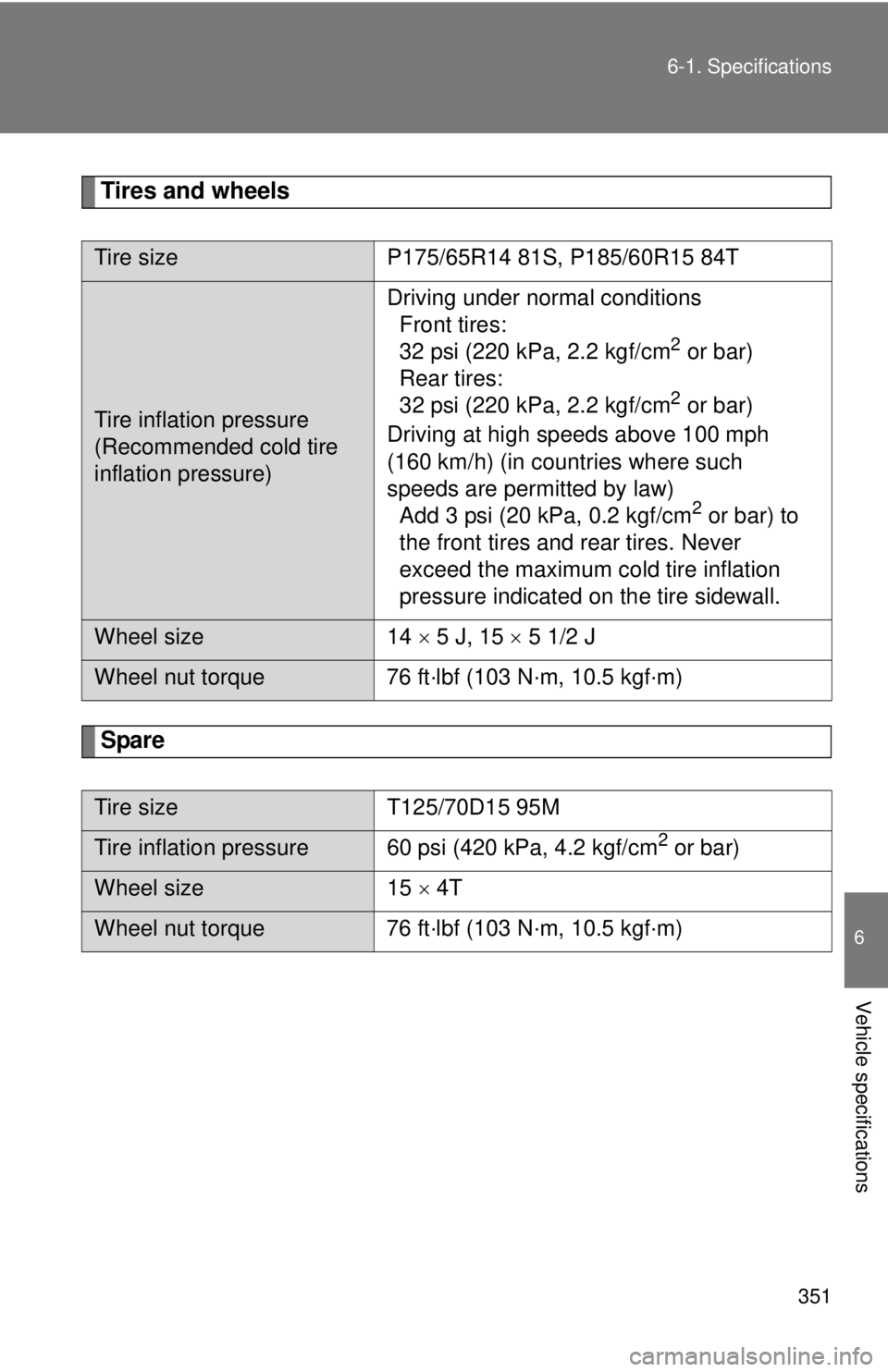
Tires and wheels
Spare
Tire size
P175/65R14 81S, P185/60R15 84T
Tire inflation pressure
(Recommended cold tire
inflation pressure) Driving under normal conditions
Front tires:
32 psi (220 kPa, 2.2 kgf/cm
2 or bar)
Rear tires:
32 psi (220 kPa, 2.2 kgf/cm
2 or bar)
Driving at high speeds above 100 mph
(160 km/h) (in countries where such
speeds are permitted by law) Add 3 psi (20 kPa, 0.2 kgf/cm
2 or bar) to
the front tires and rear tires. Never
exceed the maximum co ld tire inflation
pressure indicated on the tire sidewall.
Wheel size 14 × 5 J, 15 × 5 1/2 J
Wheel nut torque 76 ft·lbf (103 N·m, 10.5 kgf·m)
Tire size T125/70D15 95M
Tire inflation pressure 60 psi (420 kPa, 4.2 kgf/cm2 or bar)
Wheel size15 × 4T
Wheel nut torque 76 ft·lbf (103 N·m, 10.5 kgf·m)