engine TOYOTA YARIS HATCHBACK 2011 Owners Manual
[x] Cancel search | Manufacturer: TOYOTA, Model Year: 2011, Model line: YARIS HATCHBACK, Model: TOYOTA YARIS HATCHBACK 2011Pages: 428, PDF Size: 9.61 MB
Page 365 of 428
5
When trouble arises
353
5-2. Steps to take in an emergency
CAUTION
n
When attempting to free a stuck vehicle
If you choose to rock the vehicle back and forth to free it, make sure the sur-
rounding area is clear, to avoid striking other vehicles, objects or persons.
The vehicle may also lunge forward or lunge back suddenly as it becomes
free. Use extreme caution.
n When shifting the shift lever
Vehicles with automatic transmission: Be careful not to shift the shift lever
with the accelerator pedal depressed.
This may lead to unexpected rapid acceleration of the vehicle that may
cause an accident and result in death or serious injury.
NOTICE
nTo avoid damaging the transmission and other components
lAvoid spinning the wheels and do not rev the engine.
l If the vehicle remains stuck after trying these procedures, the vehicle may
require towing to be freed.
Page 366 of 428
354
5-2. Steps to take in an emergency
If your vehicle has to be stopped in an emergency
Only in an emergency, such as if it becomes impossible to stop the
vehicle in the normal way, stop the vehicle using the following pro-
cedure:
Steadily step on the brake pedal with both feet and firmly
depress it.
Do not pump the brake pedal repeatedly as this will increase the
effort required to slow the vehicle.
Shift the shift lever to N.
If the shift lever is shifted to N After slowing down, stop the vehi cle in a safe place by the
road.
Stop the engine.
If the shift lever cannot be shifted to N Keep depressing the brake pedal with both feet to reduce
vehicle speed as much as possible.
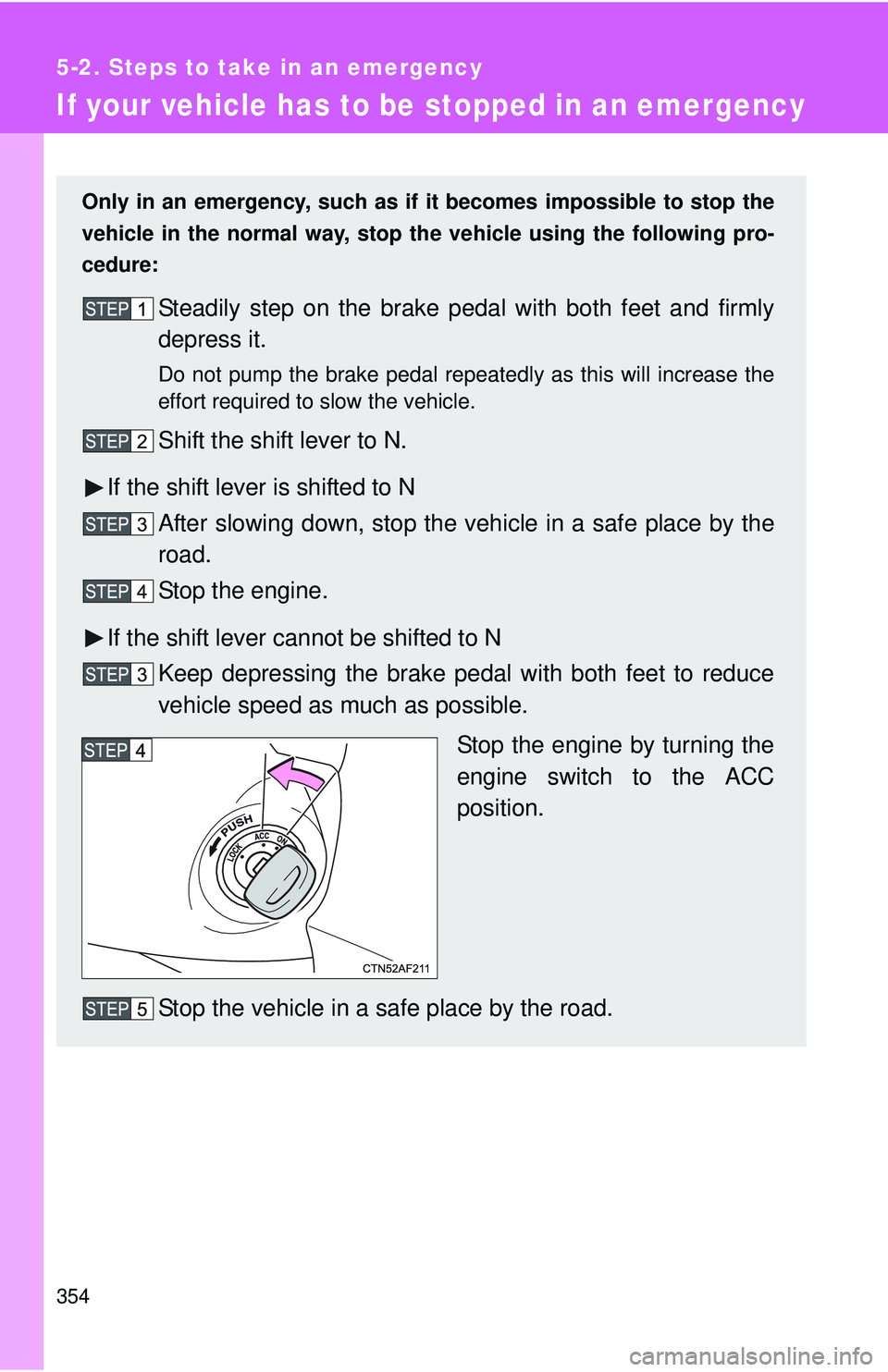
Stop the engine by turning the
engine switch to the ACC
position.
Stop the vehicle in a safe place by the road.
Page 367 of 428
5
When trouble arises
355
5-2. Steps to take in an emergency
CAUTION
n
If the engine has to be turned off while driving
lPower assist for the brakes and steering wheel will be lost, making the
brake pedal harder to depress and the steering wheel heavier to turn.
Decelerate as much as possible before turning off the engine.
l Never attempt to remove the key, as doing so will lock the steering wheel.
Page 370 of 428
359
6-1. Specifications
6
Vehicle specifications
Vehicle identification
n Vehicle identification number
The vehicle identificati on number (VIN) is the legal identifier for your
vehicle. This is the primary identification number for your Toyota. It is
used in registering the ownership of your vehicle.
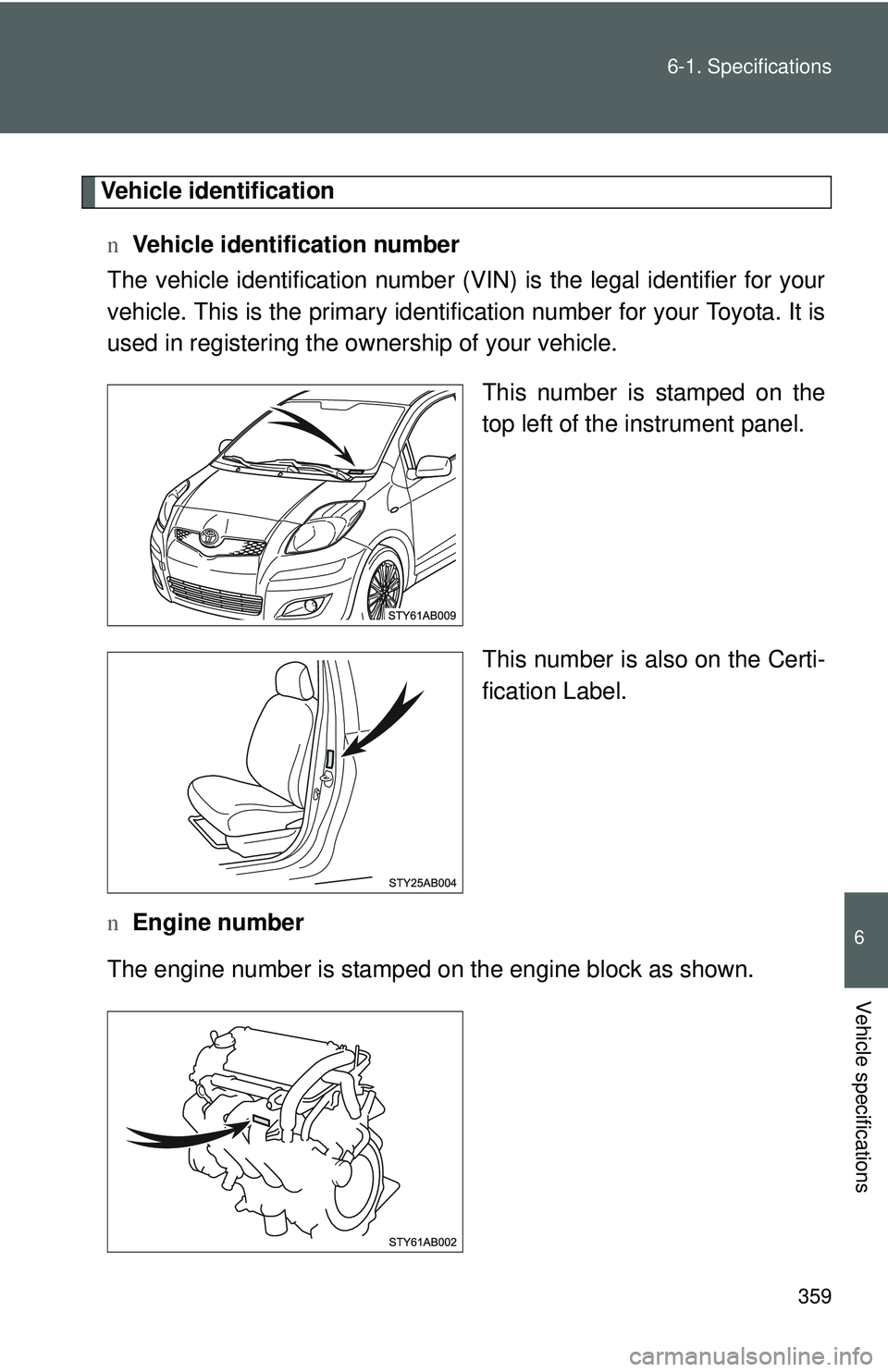
This number is stamped on the
top left of the instrument panel.
This number is also on the Certi-
fication Label.
n Engine number
The engine number is stamped on the engine bl ock as shown.
Page 371 of 428
360 6-1. Specifications
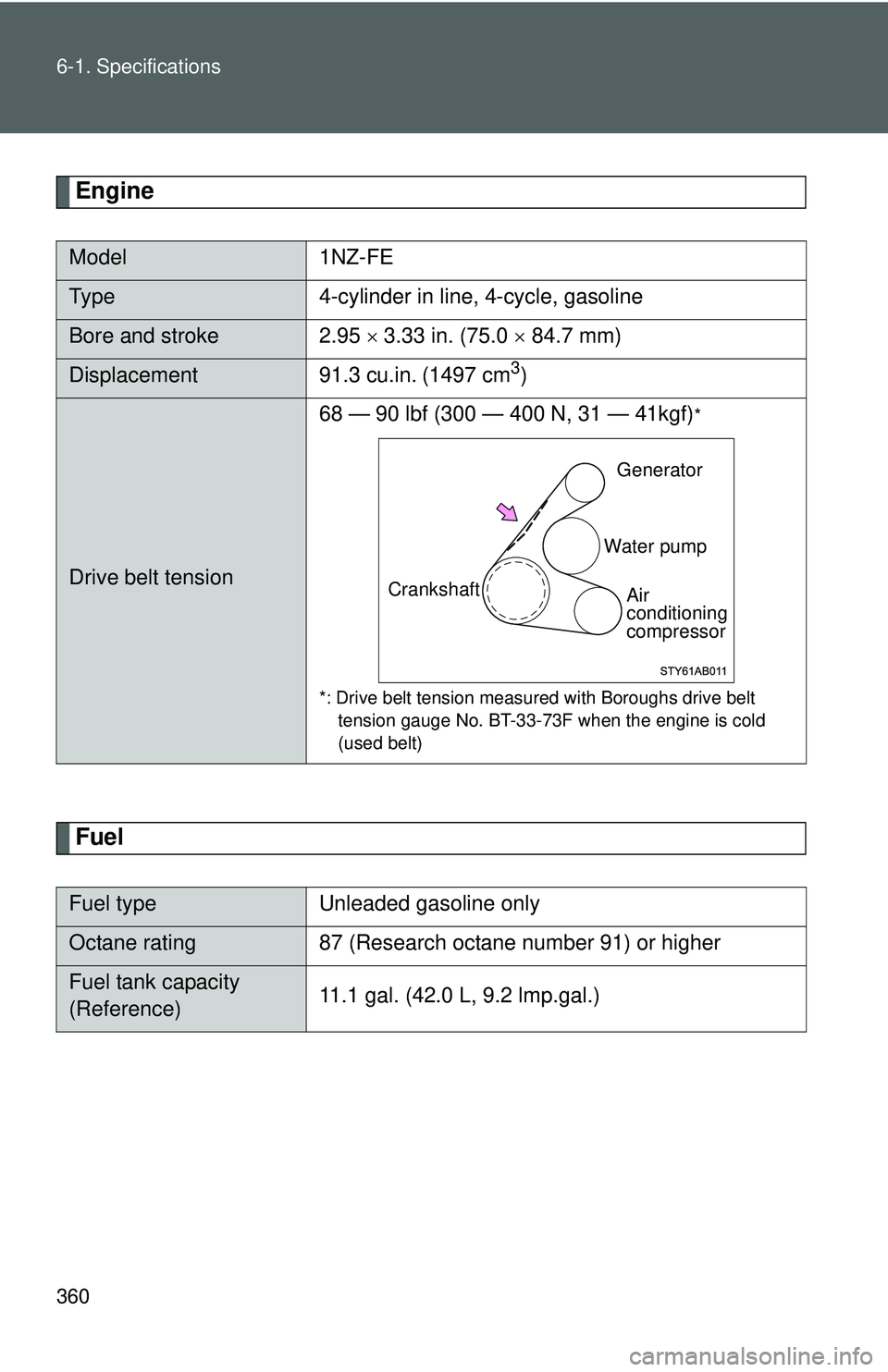
Engine
Fuel
Model1NZ-FE
Type 4-cylinder in line, 4-cycle, gasoline
Bore and stroke 2.95 × 3.33 in. (75.0 × 84.7 mm)
Displacement 91.3 cu.in. (1497 cm3)
Drive belt tension 68 — 90 lbf (300 — 400 N, 31 — 41kgf)
*
*: Drive belt tension measur ed with Boroughs drive belt
tension gauge No. BT-33-73F when the engine is cold
(used belt)
Fuel type Unleaded gasoline only
Octane rating 87 (Research octane number 91) or higher
Fuel tank capacity
(Reference) 11.1 gal. (42.0 L, 9.2 lmp.gal.)
Generator
Water pump Air
conditioning
compressor
Crankshaft
Page 372 of 428
361
6-1. Specifications
6
Vehicle specifications
Lubrication system
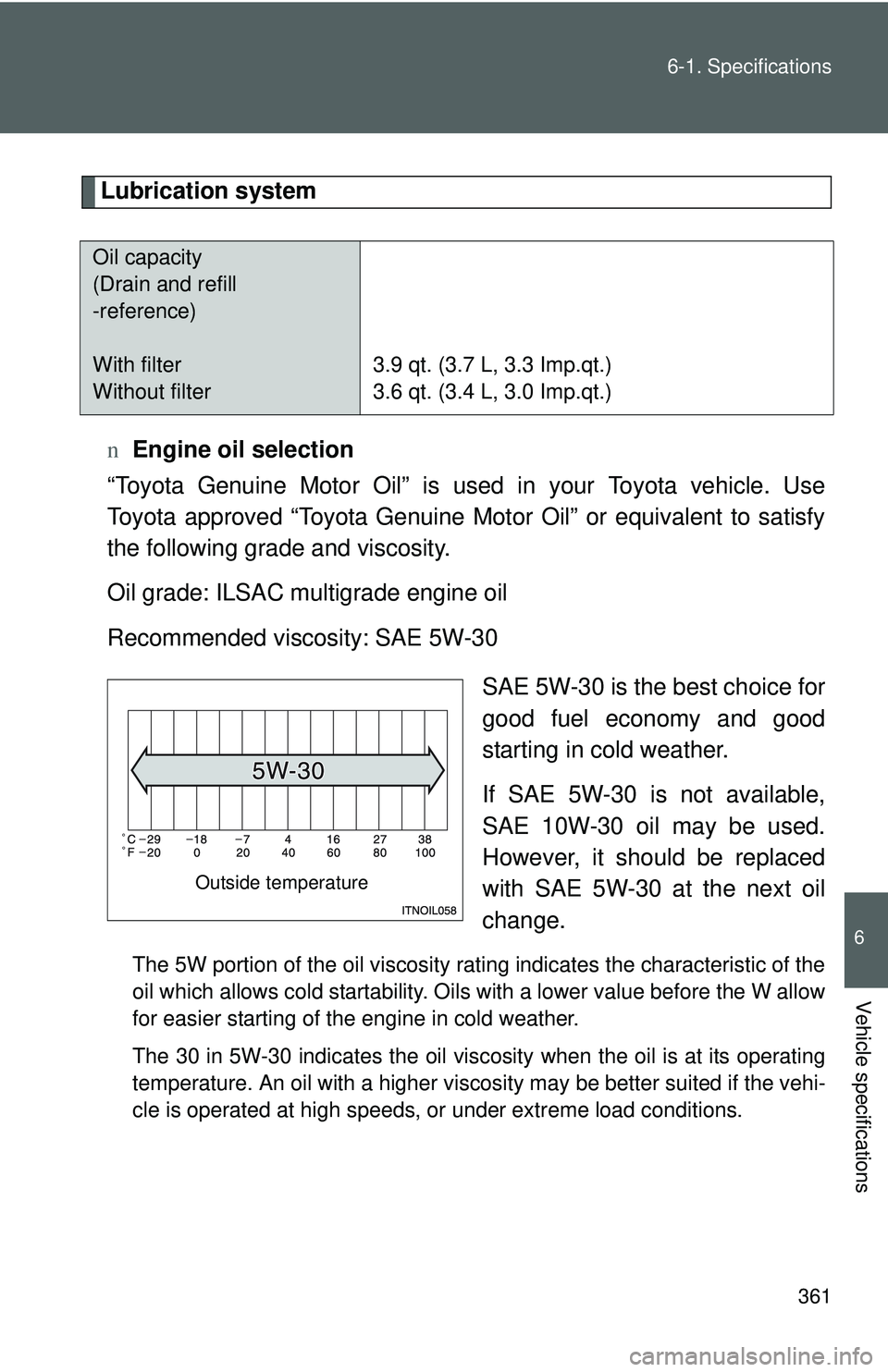
n Engine oil selection
“Toyota Genuine Motor Oil” is used in your Toyota vehicle. Use
Toyota approved “Toyota Genuine Motor Oil” or equivalent to satisfy
the following grade and viscosity.
Oil grade: ILSAC multigrade engine oil
Recommended viscosity: SAE 5W-30
SAE 5W-30 is the best choice for
good fuel economy and good
starting in cold weather.
If SAE 5W-30 is not available,
SAE 10W-30 oil may be used.
However, it should be replaced
with SAE 5W-30 at the next oil
change.
The 5W portion of the oil viscosity rating indicates the characteristic of the
oil which allows cold startability. Oils with a lower value before the W allow
for easier starting of the engine in cold weather.
The 30 in 5W-30 indicates the oil viscosity when the oil is at its operating
temperature. An oil with a higher viscosity may be better suited if the vehi-
cle is operated at high speeds, or under extreme load conditions.
Oil capacity
(Drain and refill
-reference)
With filter
Without filter3.9 qt. (3.7 L, 3.3 Imp.qt.)
3.6 qt. (3.4 L, 3.0 Imp.qt.)
Outside temperature
Page 374 of 428
363
6-1. Specifications
6
Vehicle specifications
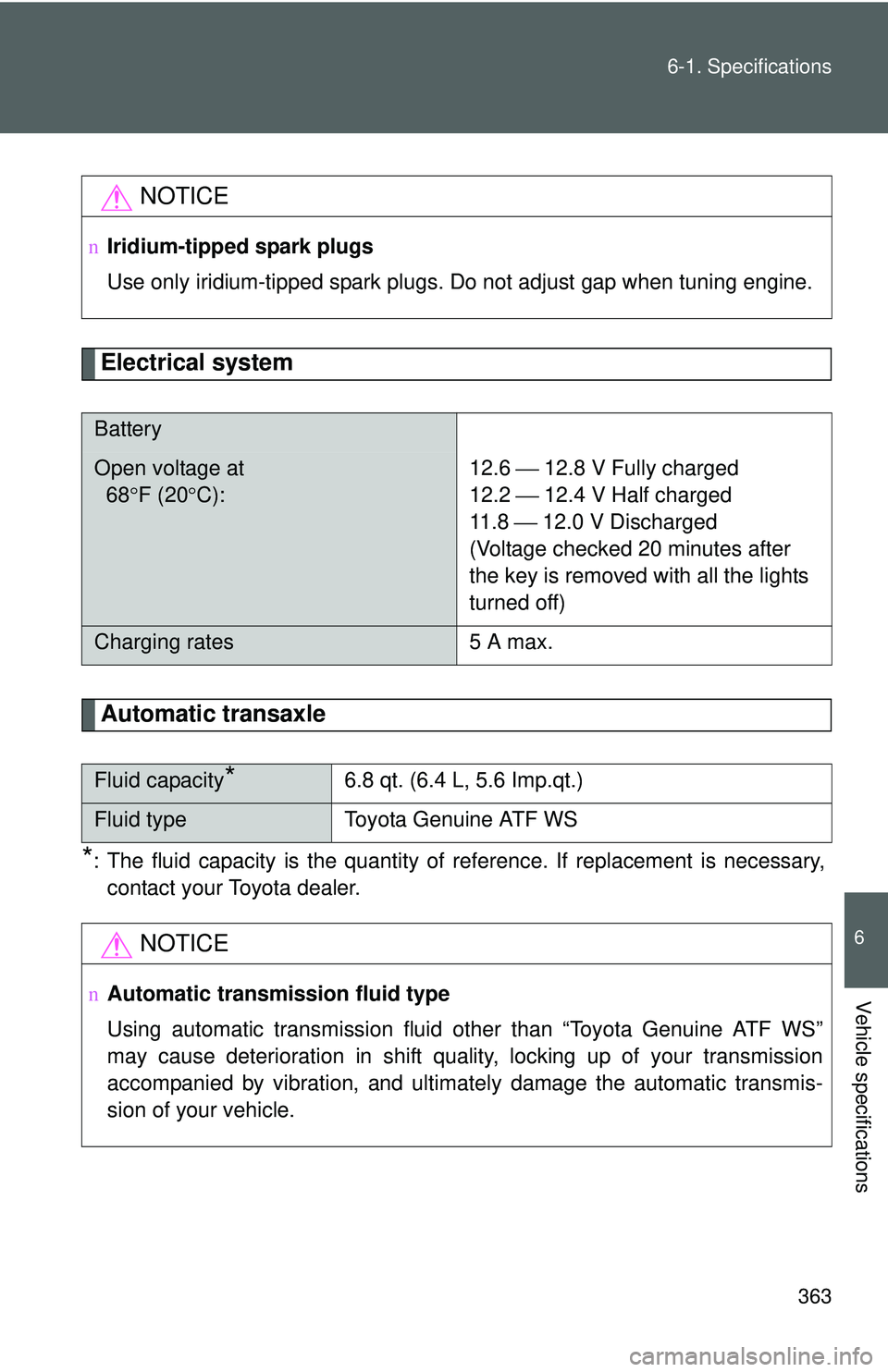
Electrical system
Automatic transaxle
*: The fluid capacity is the quantity of reference. If replacement is necessary,
contact your Toyota dealer.
NOTICE
n Iridium-tipped spark plugs
Use only iridium-tipped spark plugs. Do not adjust gap when tuning engine.
Battery
Open voltage at
68° F (20 °C): 12.6 ⎯ 12.8 V Fully charged
12.2 ⎯ 12.4 V Half charged
11 . 8
⎯ 12.0 V Discharged
(Voltage checked 20 minutes after
the key is removed with all the lights
turned off)
Charging rates 5 A max.
Fluid capacity*6.8 qt. (6.4 L, 5.6 Imp.qt.)
Fluid typeToyota Genuine ATF WS
NOTICE
nAutomatic transmission fluid type
Using automatic transmission fluid other than “Toyota Genuine ATF WS”
may cause deterioration in shift quality, locking up of your transmission
accompanied by vibration, and ultimately damage the automatic transmis-
sion of your vehicle.
Page 375 of 428
364 6-1. Specifications
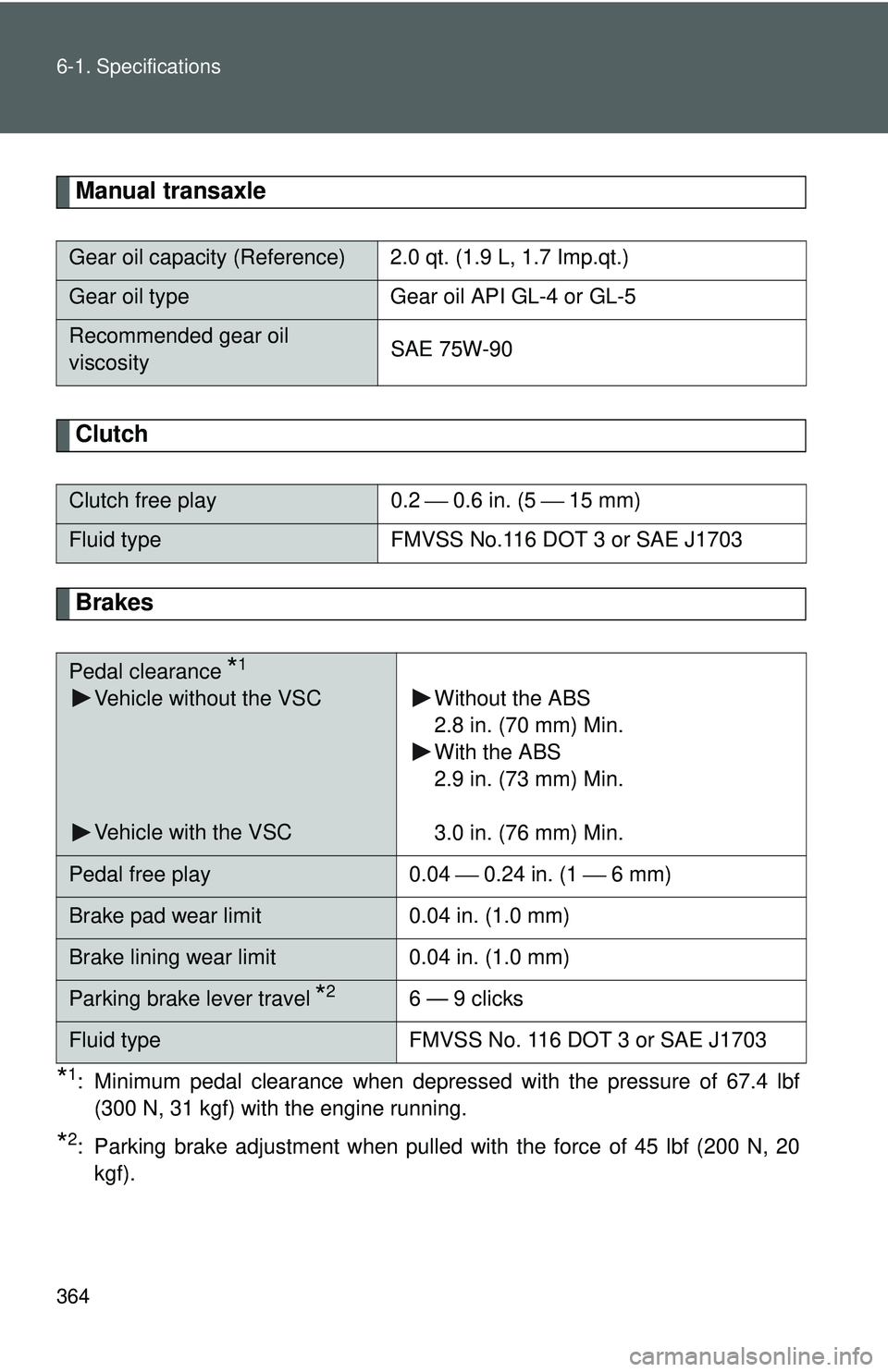
Manual transaxle
Clutch
Brakes
*1: Minimum pedal clearance when depressed with the pressure of 67.4 lbf(300 N, 31 kgf) with the engine running.
*2: Parking brake adjustment when pulled with the force of 45 lbf (200 N, 20kgf).
Gear oil capacity (Reference) 2.0 qt. (1.9 L, 1.7 Imp.qt.)
Gear oil type Gear oil API GL-4 or GL-5
Recommended gear oil
viscosity SAE 75W-90
Clutch free play
0.2 ⎯ 0.6 in. (5 ⎯ 15 mm)
Fluid type FMVSS No.116 DOT 3 or SAE J1703
Pedal clearance *1
Vehicle without the VSC
Vehicle with the VSC Without the ABS
2.8 in. (70 mm) Min.
With the ABS
2.9 in. (73 mm) Min.
3.0 in. (76 mm) Min.
Pedal free play
0.04 ⎯ 0.24 in. (1 ⎯ 6 mm)
Brake pad wear limit 0.04 in. (1.0 mm)
Brake lining wear limit 0.04 in. (1.0 mm)
Parking brake lever travel *26 — 9 clicks
Fluid typeFMVSS No. 116 DOT 3 or SAE J1703
Page 378 of 428
367
6-1. Specifications
6
Vehicle specifications
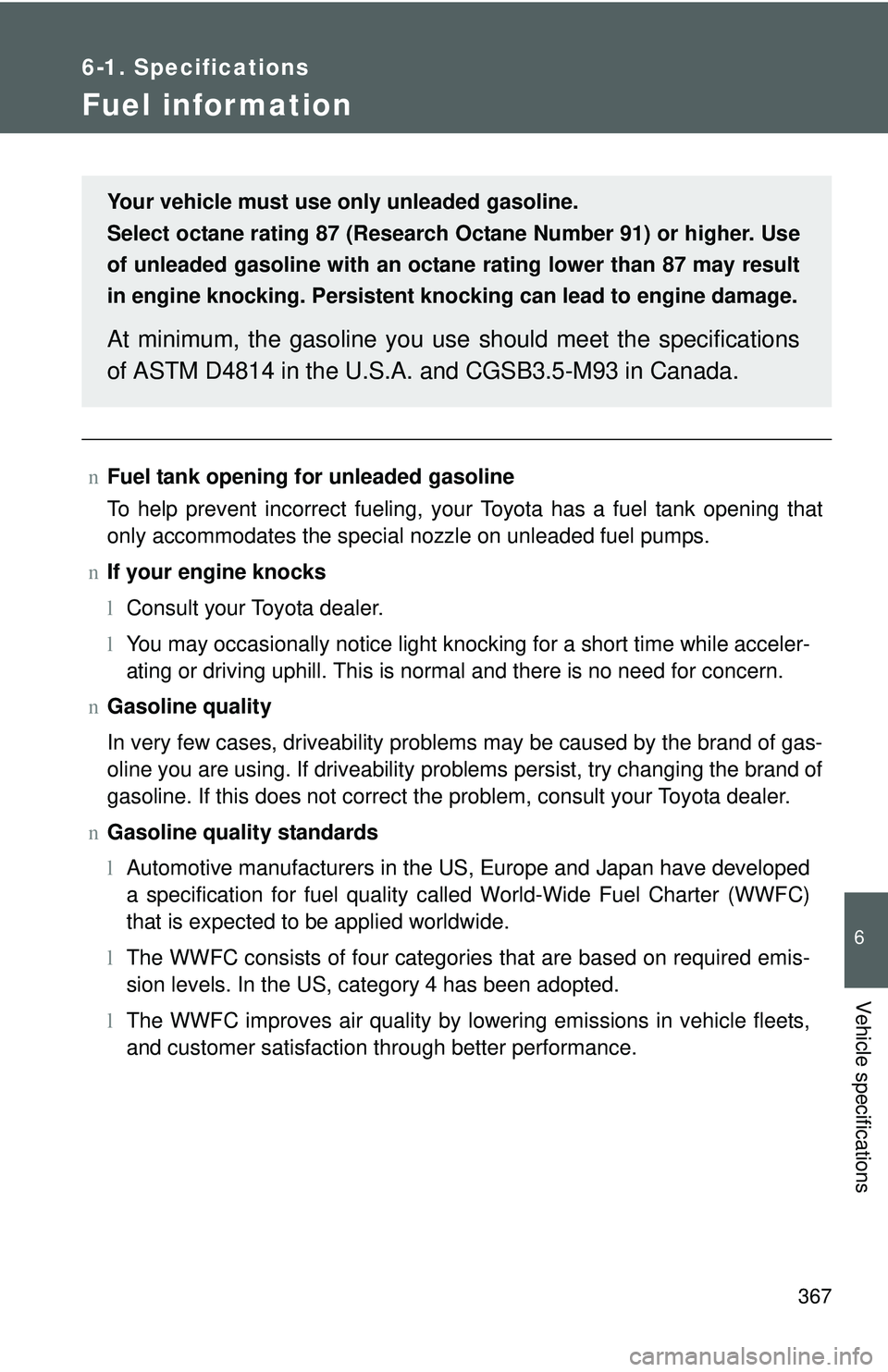
Fuel information
nFuel tank opening fo r unleaded gasoline
To help prevent incorrect fueling, your Toyota has a fuel tank opening that
only accommodates the special nozzle on unleaded fuel pumps.
n If your engine knocks
lConsult your Toyota dealer.
l You may occasionally notice light knocking for a short time while acceler-
ating or driving uphill. This is normal and there is no need for concern.
n Gasoline quality
In very few cases, driveability problems may be caused by the brand of gas-
oline you are using. If driveability problems persist, try changing the brand of
gasoline. If this does not correct the problem, consult your Toyota dealer.
n Gasoline quality standards
lAutomotive manufacturers in the US, Europe and Japan have developed
a specification for fuel quality called World-Wide Fuel Charter (WWFC)
that is expected to be applied worldwide.
l The WWFC consists of four categories that are based on required emis-
sion levels. In the US, category 4 has been adopted.
l The WWFC improves air quality by lowering emissions in vehicle fleets,
and customer satisfaction through better performance.
Your vehicle must use only unleaded gasoline.
Select octane rating 87 (Research
Octane Number 91) or higher. Use
of unleaded gasoline with an octane rating lower than 87 may result
in engine knocking. Persistent kno cking can lead to engine damage.
At minimum, the gasoline you use should meet the specifications
of ASTM D4814 in the U.S.A. and CGSB3.5-M93 in Canada.
Page 379 of 428
368 6-1. Specifications
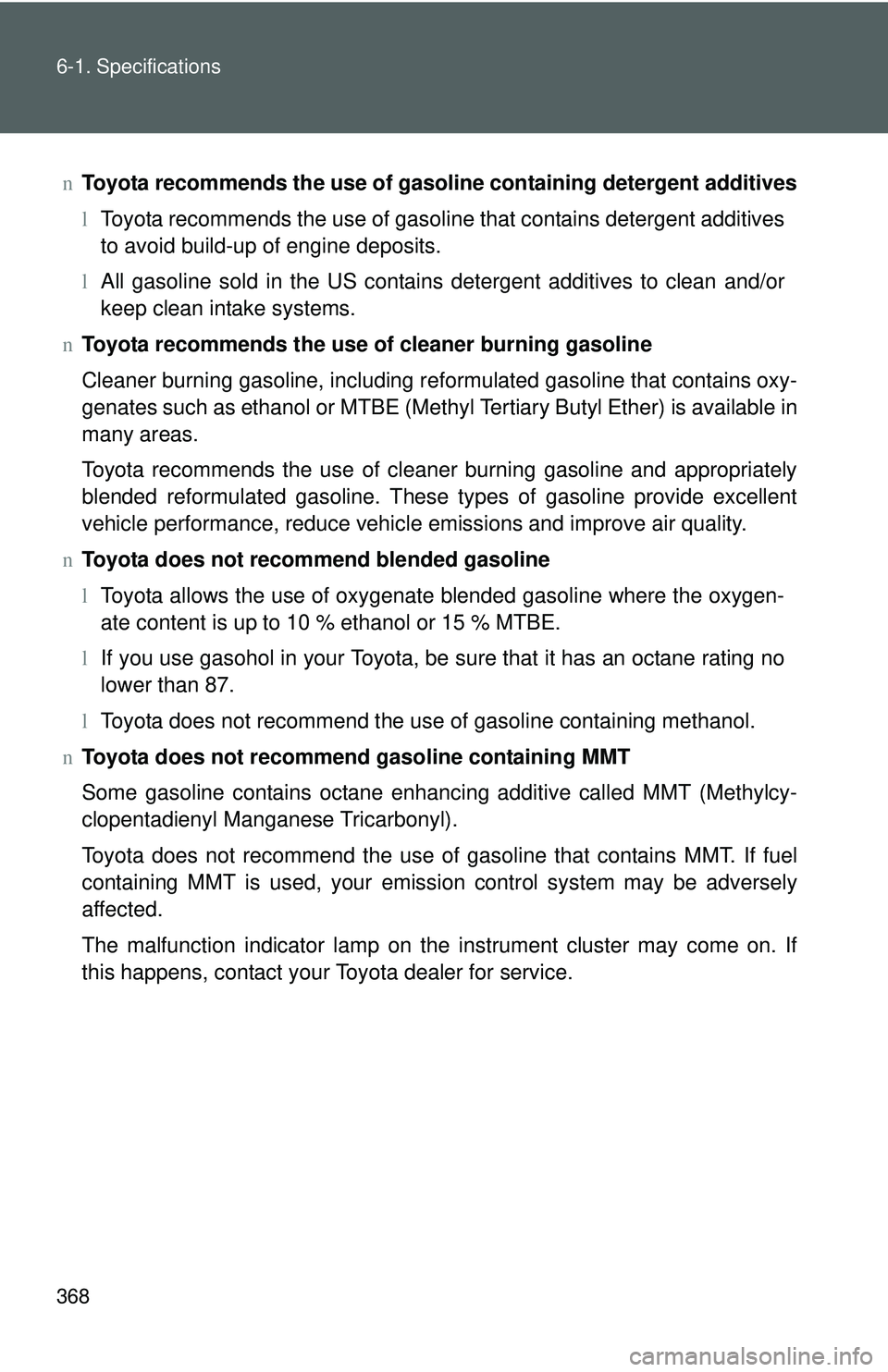
nToyota recommends the use of gaso line containing detergent additives
l Toyota recommends the use of gasoline that contains detergent additives
to avoid build-up of engine deposits.
l All gasoline sold in the US contains detergent additives to clean and/or
keep clean intake systems.
n Toyota recommends the use of cleaner burning gasoline
Cleaner burning gasoline, including reformulated gasoline that contains oxy-
genates such as ethanol or MTBE (Methyl Tertiary Butyl Ether) is available in
many areas.
Toyota recommends the use of cleaner burning gasoline and appropriately
blended reformulated gasoline. These types of gasoline provide excellent
vehicle performance, reduce vehicle emissions and improve air quality.
n Toyota does not recomm end blended gasoline
l Toyota allows the use of oxygenate blended gasoline where the oxygen-
ate content is up to 10 % ethanol or 15 % MTBE.
l If you use gasohol in your Toyota, be sure that it has an octane rating no
lower than 87.
l Toyota does not recommend the use of gasoline containing methanol.
n Toyota does not recommen d gasoline containing MMT
Some gasoline contains octane enhancing additive called MMT (Methylcy-
clopentadienyl Manganese Tricarbonyl).
Toyota does not recommend the use of gasoline that contains MMT. If fuel
containing MMT is used, your emission control system may be adversely
affected.
The malfunction indicator lamp on the instrument cluster may come on. If
this happens, contact your Toyota dealer for service.