automatic transmission TOYOTA YARIS HATCHBACK 2011 User Guide
[x] Cancel search | Manufacturer: TOYOTA, Model Year: 2011, Model line: YARIS HATCHBACK, Model: TOYOTA YARIS HATCHBACK 2011Pages: 428, PDF Size: 9.61 MB
Page 173 of 428
158 2-4. Using other driving systems
nCruise control can be set when
lThe shift lever is in D or 3 (vehicles with an automatic transmission).
l Vehicle speed is above approximately 25 mph (40 km/h).
n Accelerating
The vehicle can be accelerated normally. After acceleration, the set speed
resumes.
n Automatic cruise control cancellation
The set speed is automatically canceled in any of the following situations.
lActual vehicle speed falls more than approximately 10 mph (16 km/h)
below the preset vehicle speed.
At this time, the memorized set speed is not retained.
l Actual vehicle speed is below approximately 25 mph (40 km/h).
l VSC is activated.
n If the cruise control indicator flashes
Press the ON-OFF button to turn the cruise control off, and then reactivate
the system.
If the cruise control speed cannot be set or if the cruise control cancels
immediately after being activated, there may be a malfunction in the cruise
control system. Have the vehicle inspected by your Toyota dealer.
Page 185 of 428
170 2-5. Driving information
Regulations on the use of snow chainsl Regulations regarding the use of tire chains vary according to loca-
tion and type of road. Always check local regu lations before install-
ing chains.
l Use SAE Class “S” type radial tire chains, with the exception of
radial cable chains or V-bar type chains.
• Install the chains on the front tires.
• Refer to the explanation that comes with the tire chains for
installation instructions.
l Retighten the chains after drivi ng 1/4 - 1/2 mile (0.5 - 1.0 km).
nSnow chain installation
Observe the following precautions when installing and removing chains.
lInstall and remove tire chains in a safe location.
l Install tire chains on the front tires only. Do not install tire chains on the
rear tires.
l Install the tire chains on front tires as tightly as possible.
l Install tire chains following the instructions provided in the accompanying
instructions.
l If wheel ornaments are used, they will be scratched by the chain band,
so remove the ornaments before putting on the chains. ( →P. 332)
n When driving the vehicle
Accelerate the vehicle slowly and drive at a reduced speed suit-
able to road conditions.
n When parking the vehicle
Park the vehicle and move the shift lever to P (automatic trans-
mission) or to 1 or R (manual transmission) without setting the
parking brake. The parking brak e may freeze up, preventing it
from being released. If necessary , block the wheels to prevent
inadvertent sliding or creeping.
Page 194 of 428
179
2-5. Driving information
2
When driving
l
In order to maintain engine braking efficiency, do not use the trans-
mission in D (automatic transmiss ion) or 5 (manual transmission).
l Due to the added load of the trailer, your vehicle’s engine may
overheat on hot days (at temperatures over 85°F [30°C]) when
driving up a long or steep grade. If the engine coolant temperature
gauge indicates overheating, immedi ately turn off the air condition-
ing (if in use), pull your vehicle off the road and stop in a safe spot.
( → P. 349)
l Always place wheel blocks under both the vehicle and the trailer
wheels when parking. Apply the parking brake firmly, and put the
transmission in P (automatic transmission) or in 1 or R (manual
transmission). Avoid parking on a slope, but if unavoidable, do so
only after performing the following:
Apply the brakes and keep them applied.
Have someone place wheel blocks under both the vehicle and
trailer wheels.
When the wheel blocks are in pl ace, release the brakes slowly
until the blocks absorb the load.
Apply the parking brake firmly.
Shift into 1 or R (manual transmission) or P (automatic trans-
mission) and turn off the engine.
l When restarting after parking on a slope:
With the transmission in P (automatic transmission) or the
clutch pedal (manual transmission) depressed, start the
engine. On vehicles with an au tomatic transmission, be sure
to keep the brake pedal pressed.
Shift into a forward gear. If reversing, shift into R.
Release the parking brake (also brake pedal on vehicles with
an automatic transmission), and slowly pull or back away from
the wheel blocks. Stop and apply the brakes.
Have someone retrieve the blocks.
Page 196 of 428
181
2-5. Driving information
2
When driving
Dinghy towing (vehicles with an automatic transmission)
NOTICE
nTo avoid serious damage to your vehicle
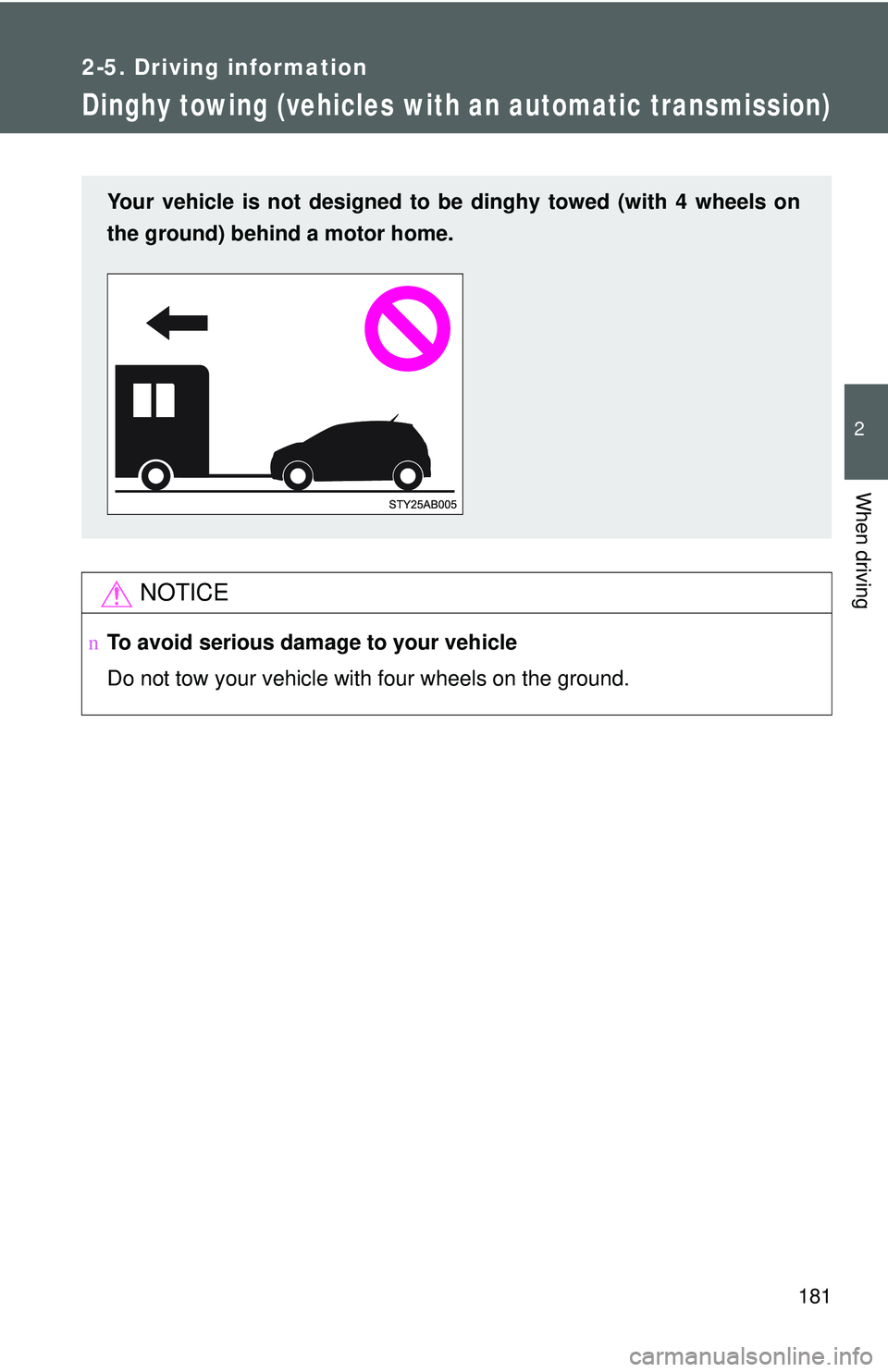
Do not tow your vehicle with four wheels on the ground.
Your vehicle is not designed to be dinghy towed (with 4 wheels on
the ground) behind a motor home.
Page 247 of 428
233
3-5. Other interior features
3
Interior features
CAUTION
n
Before driving
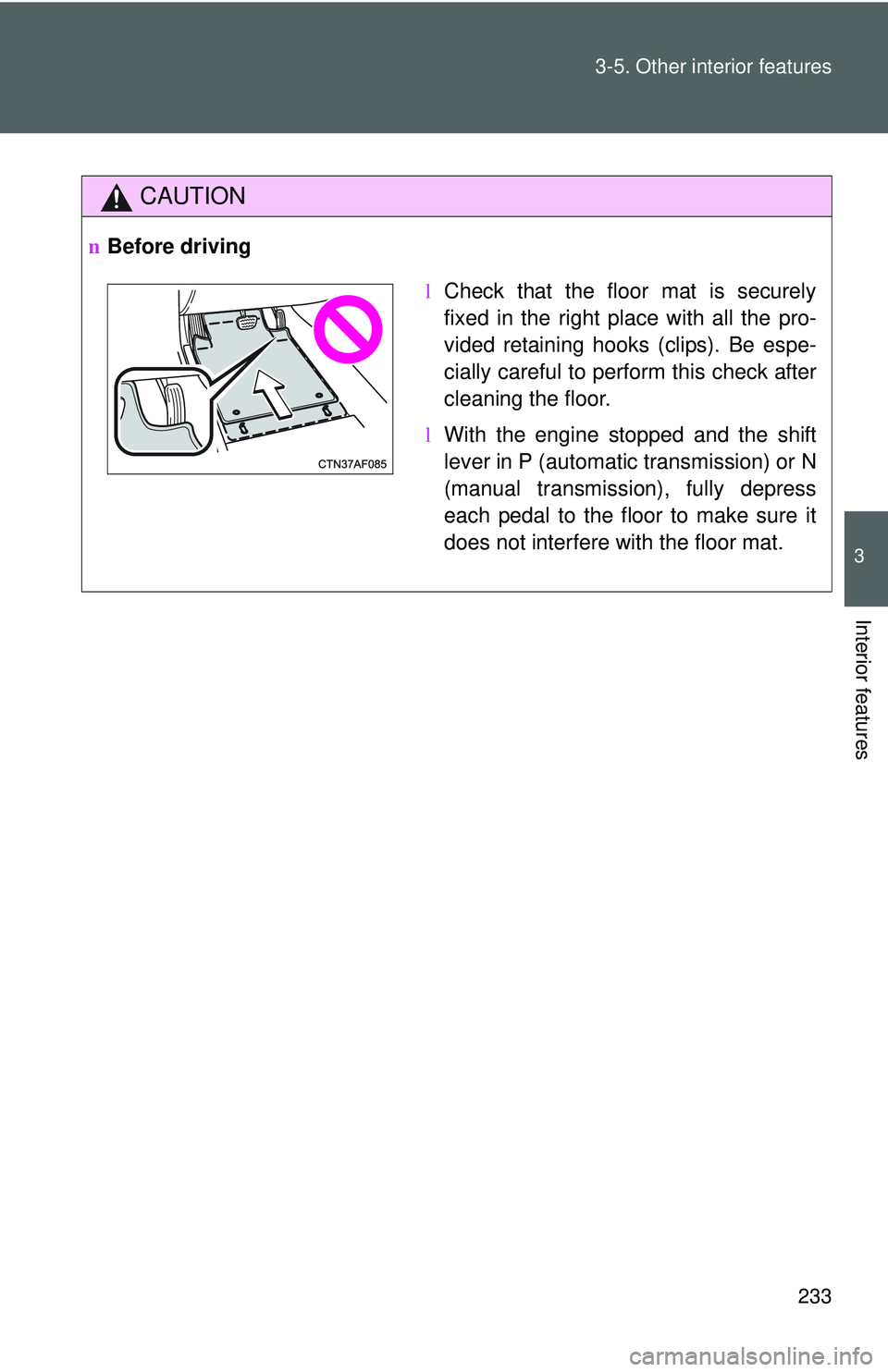
lCheck that the floor mat is securely
fixed in the right place with all the pro-
vided retaining hooks (clips). Be espe-
cially careful to perform this check after
cleaning the floor.
l With the engine stopped and the shift
lever in P (automatic transmission) or N
(manual transmission), fully depress
each pedal to the floor to make sure it
does not interfere with the floor mat.
Page 260 of 428
247
4-2. Maintenance
4
Maintenance and care
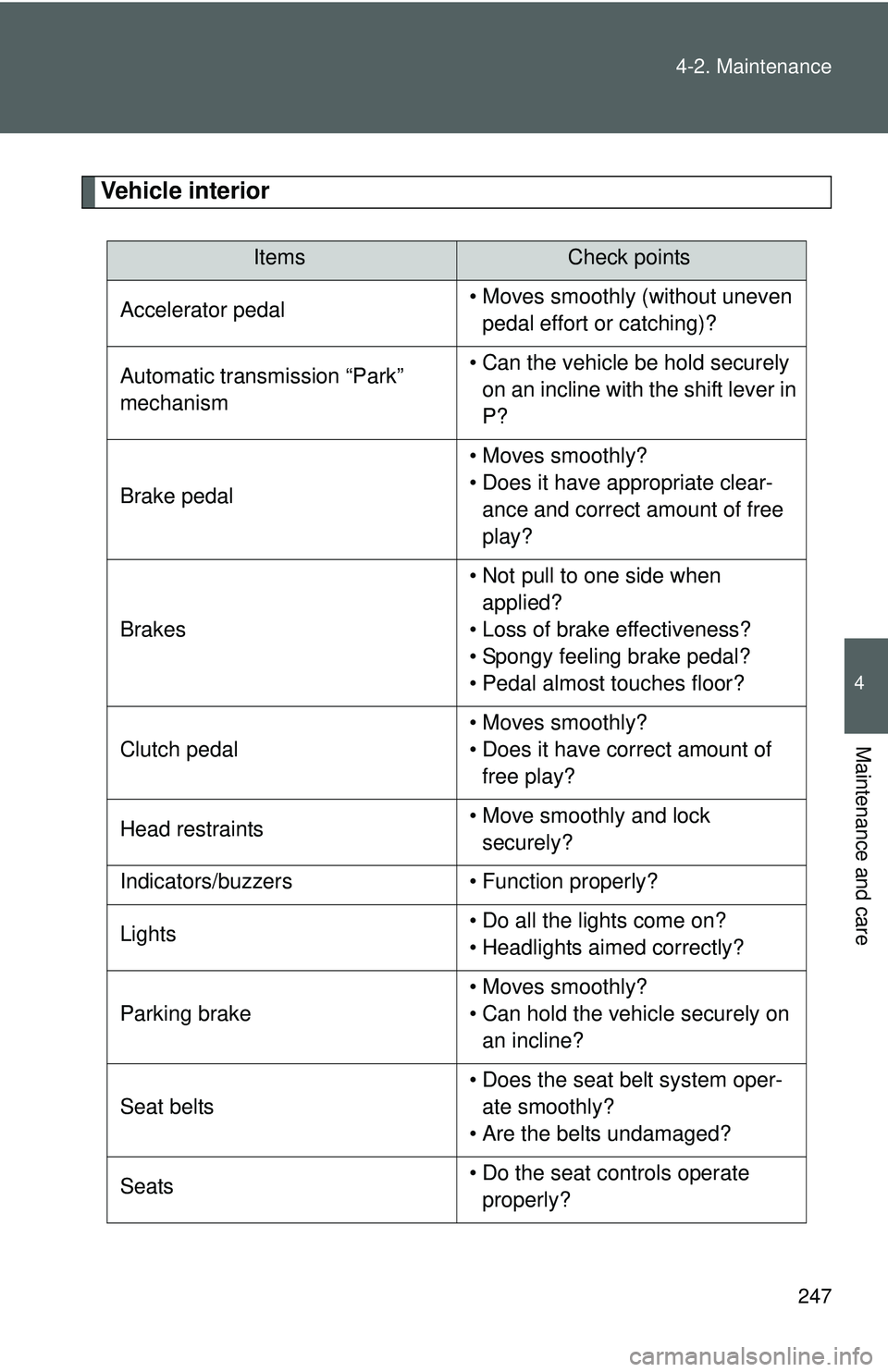
Vehicle interior
ItemsCheck points
Accelerator pedal • Moves smoothly (without uneven
pedal effort or catching)?
Automatic transmission “Park”
mechanism • Can the vehicle be hold securely
on an incline with the shift lever in
P?
Brake pedal • Moves smoothly?
• Does it have appropriate clear-
ance and correct amount of free
play?
Brakes • Not pull to one side when
applied?
• Loss of brake effectiveness?
• Spongy feeling brake pedal?
• Pedal almost touches floor?
Clutch pedal • Moves smoothly?
• Does it have correct amount of
free play?
Head restraints • Move smoothly and lock
securely?
Indicators/buzzers • Function properly?
Lights • Do all the lights come on?
• Headlights aimed correctly?
Parking brake • Moves smoothly?
• Can hold the vehicle securely on
an incline?
Seat belts • Does the seat belt system oper-
ate smoothly?
• Are the belts undamaged?
Seats • Do the seat controls operate
properly?
Page 268 of 428

255
4-3. Do-it-yourself maintenance
4
Maintenance and care
CAUTION
n
When raising your vehicle
Make sure to observe the following to reduce the possibility of death or\
seri-
ous injury.
lWhen using a floor jack, follow the instructions of the manual provided with
the jack.
l Do not use the jack that was supplied with your vehicle.
l Do not put any part of your body or get underneath the vehicle supported
only by the floor jack.
l Always use floor jack and/or automotive jack stands on a solid, flat, level
surface.
l Do not start the engine while the vehicle is supported by the floor jack.
l Stop the vehicle on level firm ground, firmly set the parking brake and put
the shift lever in P (automatic transmission) or R (manual transmission).
l Make sure to set the floor jack properly at the jack point.
Raising the vehicle with an improperly positioned floor jack will damage
the vehicle and may cause the vehicle to fall off the floor jack.
l Do not raise the vehicle while someone is in the vehicle.
l When raising the vehicle, do not place any objects on top of or underneath
the floor jack.
lLift up the vehicle using a floor jack
such as the one shown in the illustra-
tion.
Page 308 of 428
295
4-3. Do-it-yourself maintenance
4
Maintenance and care
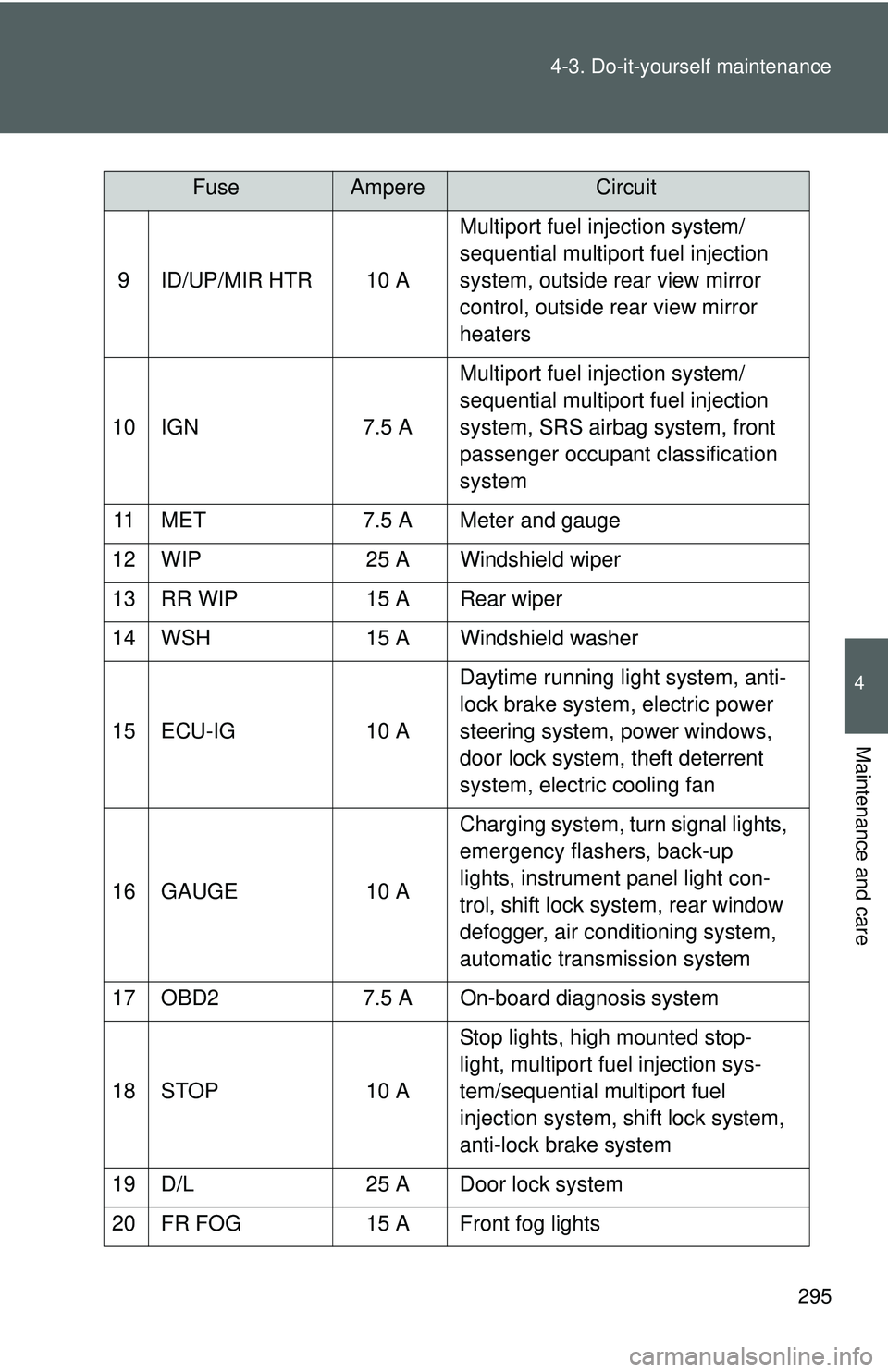
9 ID/UP/MIR HTR 10 A
Multiport fuel injection system/
sequential multiport fuel injection
system, outside rear view mirror
control, outside rear view mirror
heaters
10 IGN 7.5 A Multiport fuel injection system/
sequential multiport fuel injection
system, SRS airbag system, front
passenger occupant classification
system
11 MET 7.5 A Meter and gauge
12 WIP 25 A Windshield wiper
13 RR WIP 15 A Rear wiper
14 WSH 15 A Windshield washer
15 ECU-IG 10 A Daytime running light system, anti-
lock brake system, electric power
steering system, power windows,
door lock system, theft deterrent
system, electric cooling fan
16 GAUGE 10 A Charging system, turn signal lights,
emergency flashers, back-up
lights, instrument panel light con-
trol, shift lock system, rear window
defogger, air conditioning system,
automatic transmission system
17 OBD2 7.5 A On-board diagnosis system
18 STOP 10 A Stop lights, high mounted stop-
light, multiport fuel injection sys-
tem/sequential multiport fuel
injection system, shift lock system,
anti-lock brake system
19 D/L 25 A Door lock system
20 FR FOG 15 A Front fog lights
FuseAmpereCircuit
Page 322 of 428
310 5-1. Essential information
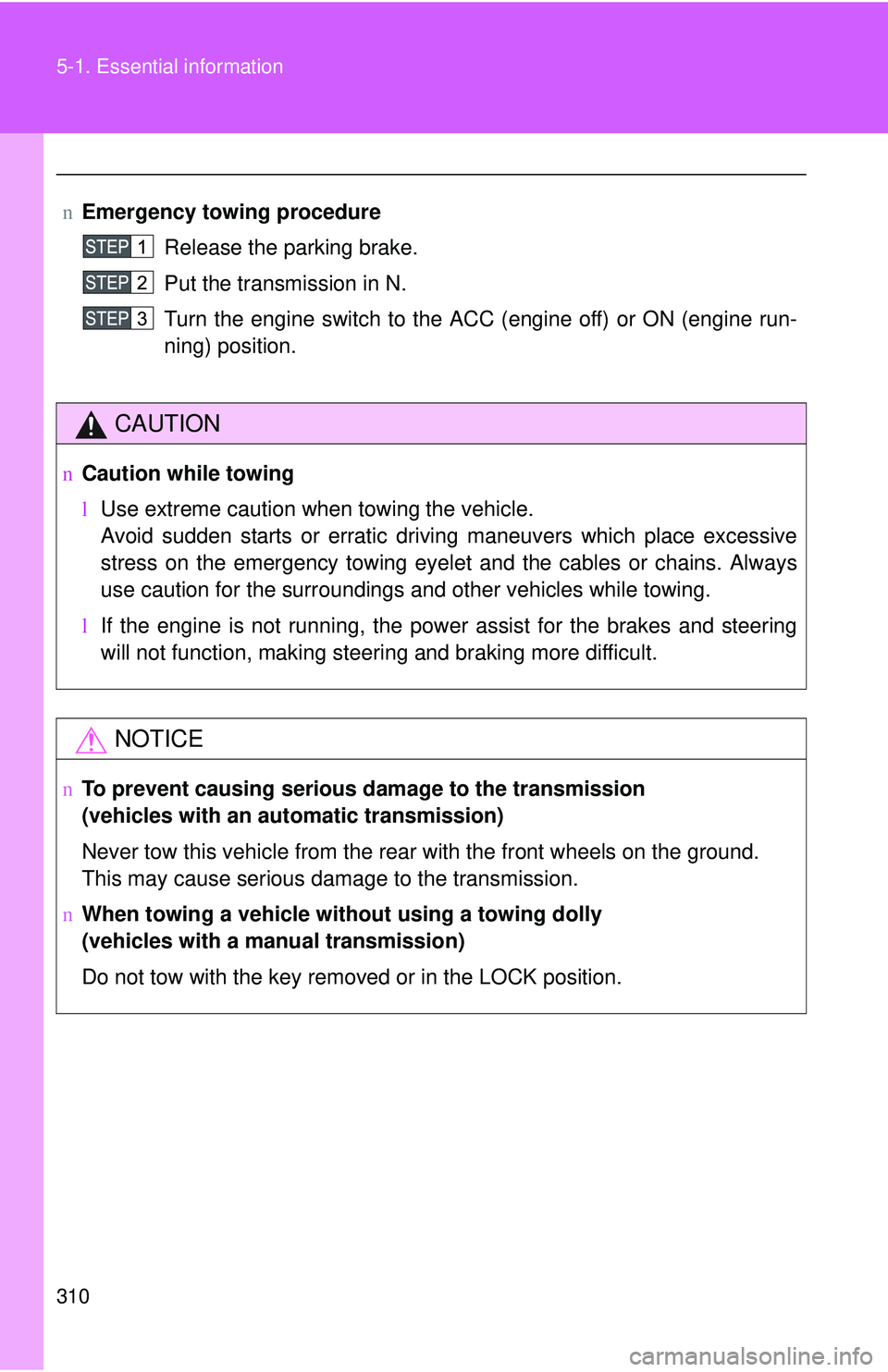
nEmergency towin g procedure
Release the parking brake.
Put the transmission in N.
Turn the engine switch to the ACC (engine off) or ON (engine run-
ning) position.
CAUTION
n Caution while towing
lUse extreme caution when towing the vehicle.
Avoid sudden starts or erratic driving maneuvers which place excessive
stress on the emergency towing eyelet and the cables or chains. Always
use caution for the surroundings and other vehicles while towing.
l If the engine is not running, the power assist for the brakes and steering
will not function, making steering and braking more difficult.
NOTICE
nTo prevent causing serious dama ge to the transmission
(vehicles with an automatic transmission)
Never tow this vehicle from the rear with the front wheels on the ground.
This may cause serious damage to the transmission.
n When towing a vehicle without using a towing dolly
(vehicles with a manual transmission)
Do not tow with the key removed or in the LOCK position.
Page 325 of 428
5
When trouble arises
313
5-1. Essential information
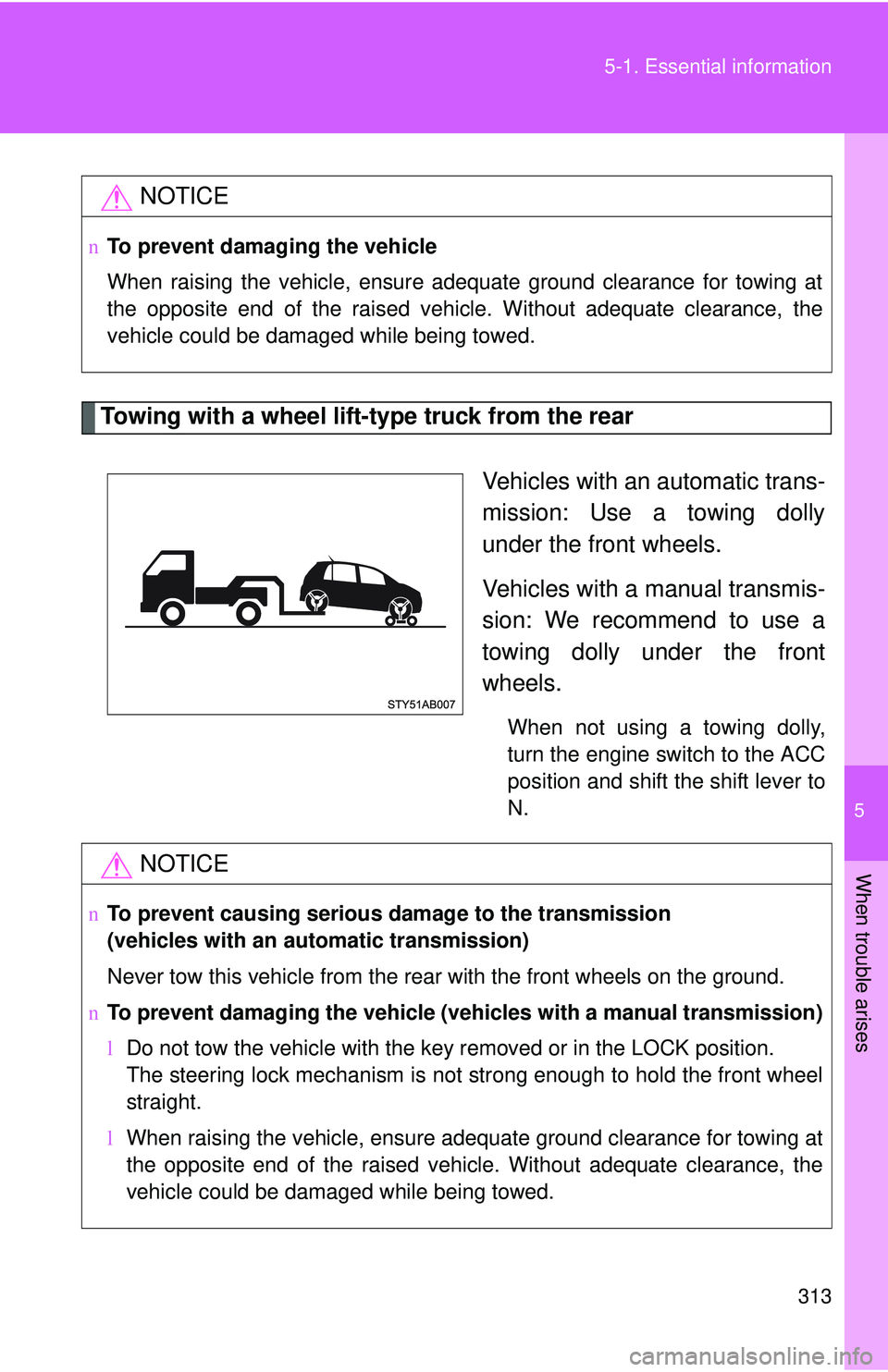
Towing with a wheel lift-type truck from the rear
Vehicles with an automatic trans-
mission: Use a towing dolly
under the front wheels.
Vehicles with a manual transmis-
sion: We recommend to use a
towing dolly under the front
wheels.
When not using a towing dolly,
turn the engine switch to the ACC
position and shift the shift lever to
N.
NOTICE
nTo prevent damaging the vehicle
When raising the vehicle, ensure adequate ground clearance for towing at
the opposite end of the raised vehicle. Without adequate clearance, the
vehicle could be damaged while being towed.
NOTICE
nTo prevent causing serious da mage to the transmission
(vehicles with an automatic transmission)
Never tow this vehicle from the rear with the front wheels on the ground.
n To prevent damaging the vehicle (vehicles with a manual transmission)
lDo not tow the vehicle with the key removed or in the LOCK position.
The steering lock mechanism is not strong enough to hold the front wheel
straight.
l When raising the vehicle, ensure adequate ground clearance for towing at
the opposite end of the raised vehicle. Without adequate clearance, the
vehicle could be damaged while being towed.