lights TOYOTA YARIS HATCHBACK 2011 Owner's Manual
[x] Cancel search | Manufacturer: TOYOTA, Model Year: 2011, Model line: YARIS HATCHBACK, Model: TOYOTA YARIS HATCHBACK 2011Pages: 428, PDF Size: 9.61 MB
Page 167 of 428
152
2-3. Operating the lights and wipers
Fog light switch∗
∗: If equipped
The fog lights improve visibility in difficult driving conditions, such
as in rain or fog. They can be turned on only when the headlights are
on low beam.
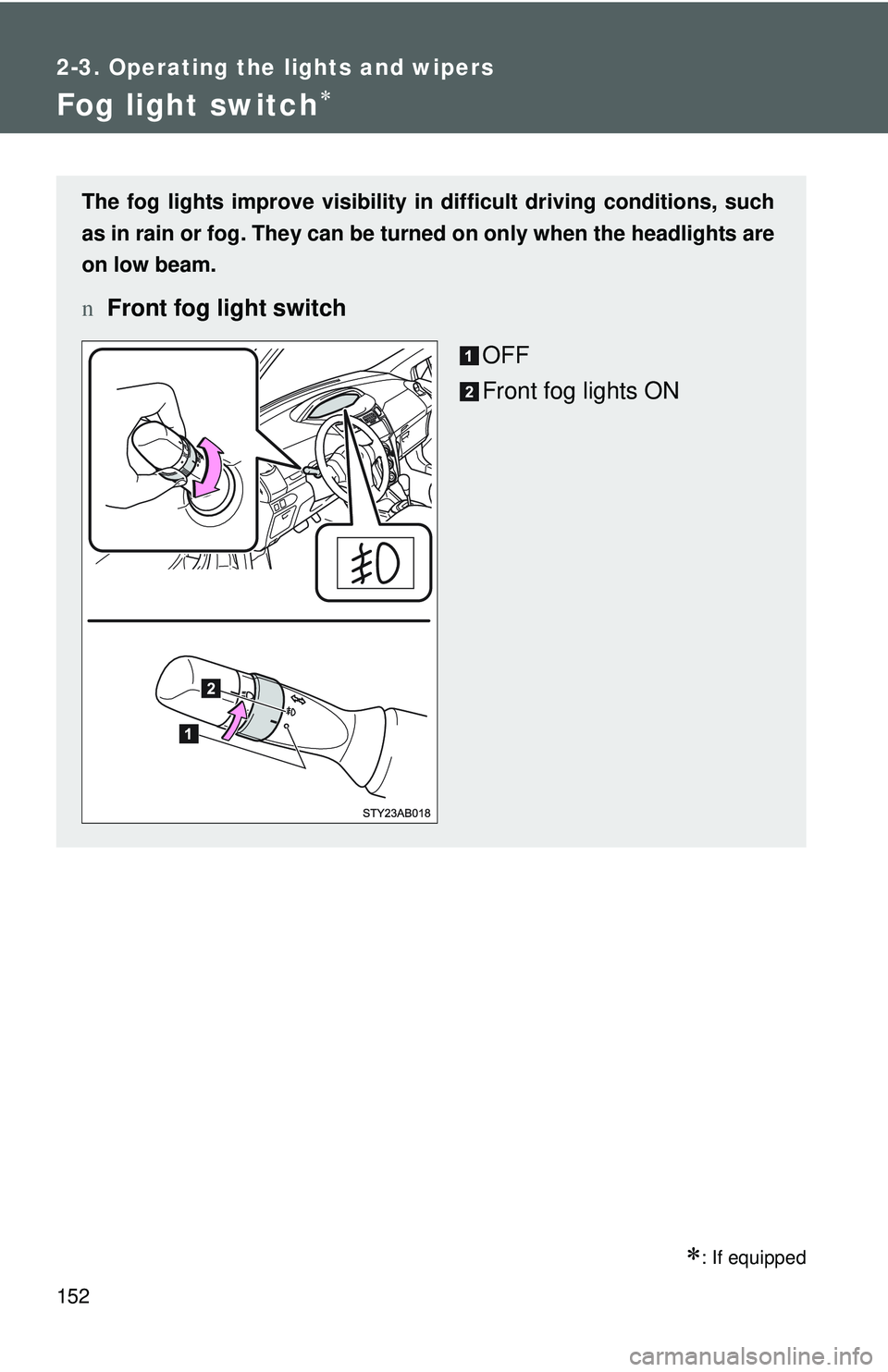
nFront fog light switch
OFF
Front fog lights ON
Page 168 of 428
153
2-3. Operating the lights and wipers
2
When driving
Windshield wipers and washer
nThe windshield wiper and washer can be operated when
The engine switch must be in the ON position.
n If no windshield washer fluid sprays
Check that the washer nozzles are not blocked and if there is washer fluid in
the windshield washer fluid reservoir.
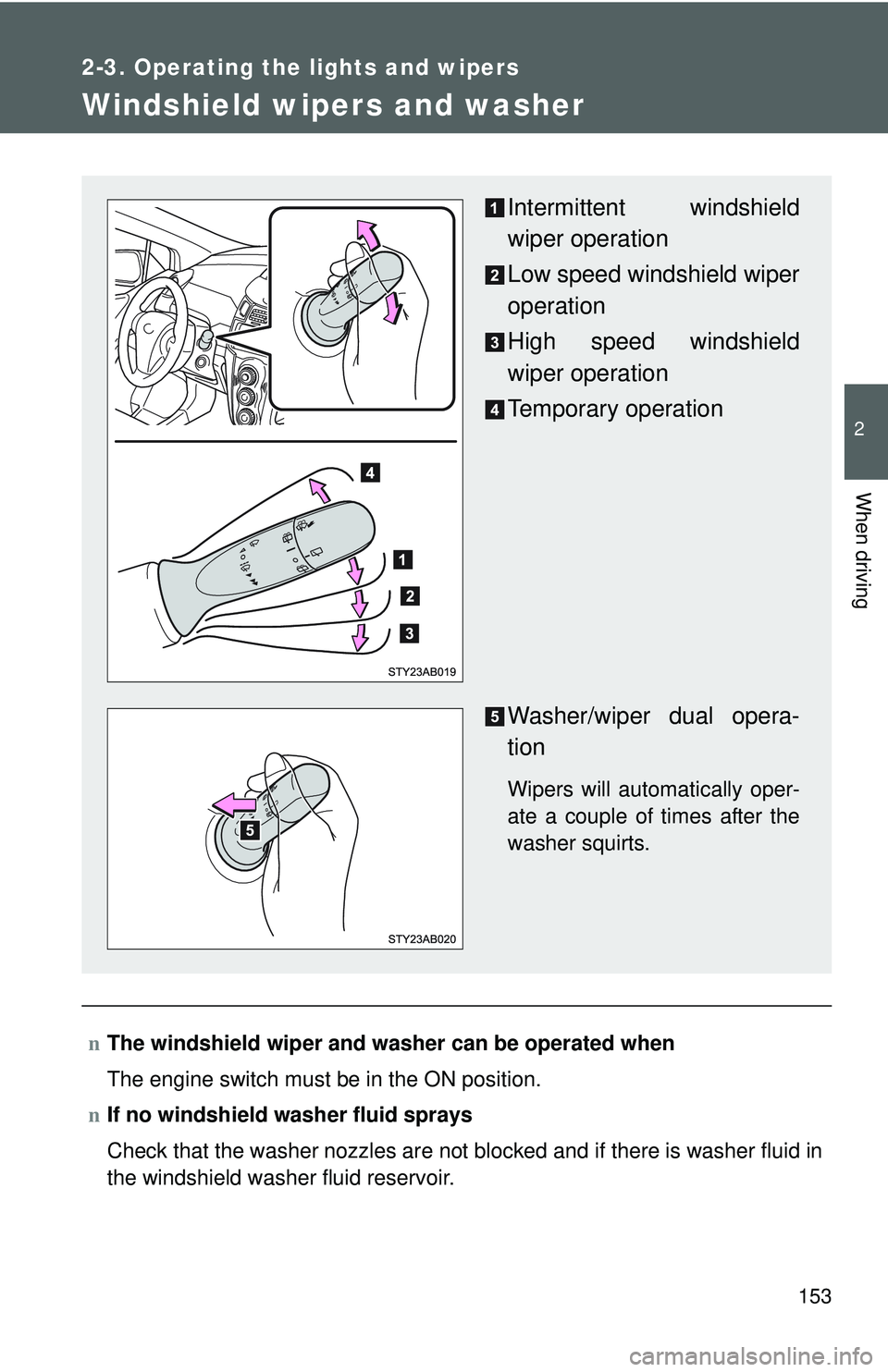
Intermittent windshield
wiper operation
Low speed windshield wiper
operation
High speed windshield
wiper operation
Temporary operation
Washer/wiper dual opera-
tion
Wipers will automatically oper-
ate a couple of times after the
washer squirts.
Page 169 of 428
154 2-3. Operating the lights and wipers
NOTICE
nWhen the windshield is dry
Do not use the wipers, as they may damage the windshield.
n When there is no washer fluid spray from the nozzle
Damage to the washer fluid pump may be caused if the lever is pulled
toward you and held continually.
n When a nozzle becomes block
Do not try to clear it with a pin or other object. The nozzle will be damaged.
Page 170 of 428
155
2-3. Operating the lights and wipers
2
When driving
Rear window wiper and washer∗
∗: If equipped
nThe rear window wiper and washer can be operated when
The engine switch must be in the ON position.
NOTICE
nWhen the rear window is dry
Do not use the wipers, as they may damage the rear window.
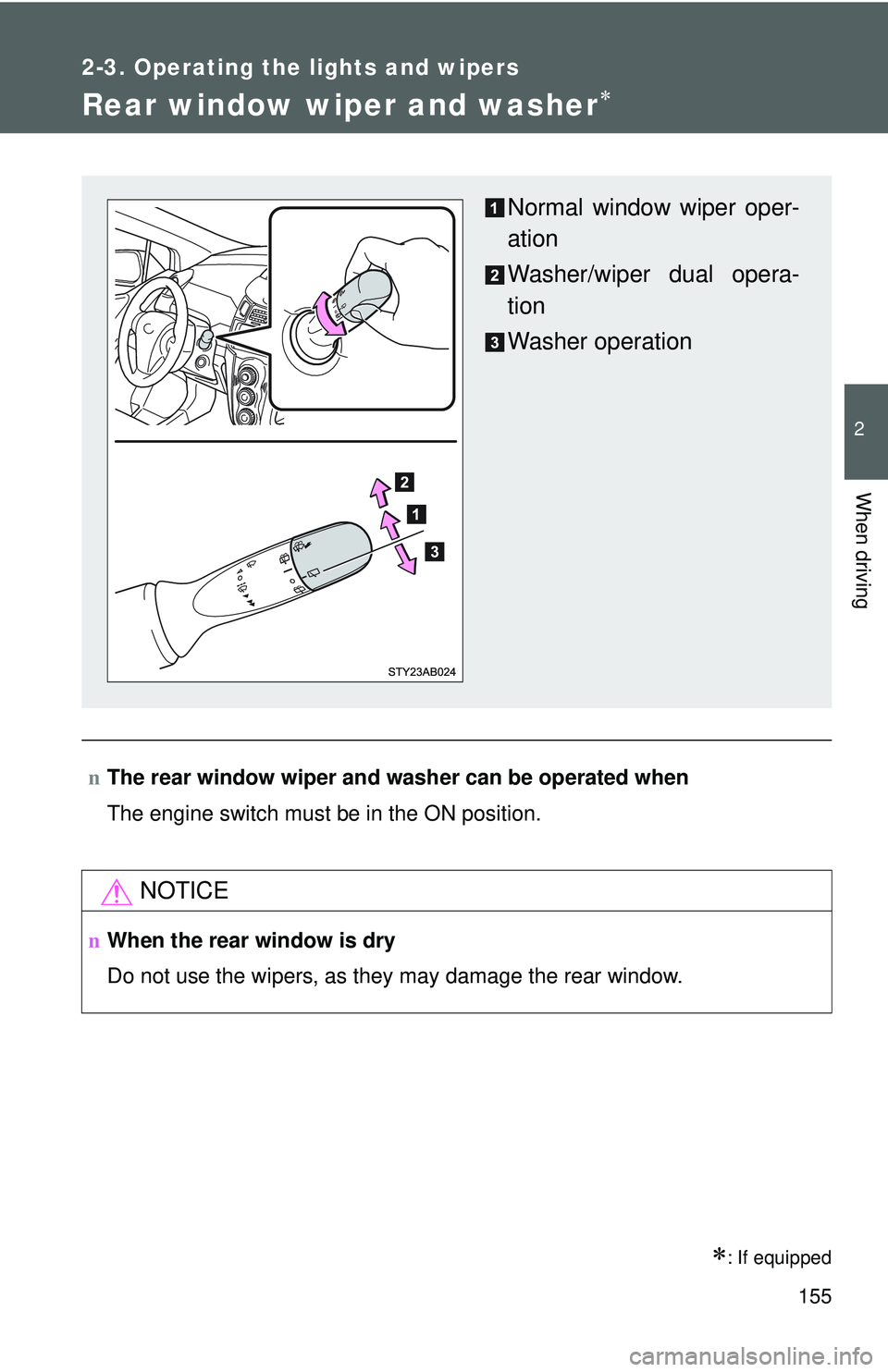
Normal window wiper oper-
ation
Washer/wiper dual opera-
tion
Washer operation
Page 178 of 428
163
2-4. Using other
driving systems
2
When driving
nAutomatic TRAC reactivation
If only the TRAC system is turned off, the TRAC system will turn on when
vehicle speed increases.
n Automatic TRAC and VSC reactivation
If the TRAC and VSC systems are turned off, the systems will not turn on
even when vehicle speed increases.
n If the slip indicator lights up
There is a malfunction in the TRAC and VSC systems. Contact your Toyota
dealer and have your Toyota inspected.
n If the brake system overheats
TRAC will cease operation and a buzzer will sound to alert the driver. Stop
the vehicle in a safe place. (There is no problem with continuing normal driv-
ing.)
n EPS operation sound
When the steering wheel operates, a motor sound (whirring sound) may be
heard.
This does not indicate a malfunction.
n Reduced effectiveness of EPS
The effectiveness of EPS is reduced to prevent the system from overheating
when there is frequent steering input over an extended period of time. The
steering wheel may feel heavy as a result. Should this occur, refrain from
excessive steering input or stop the vehicle and turn the engine off. The sys-
tem should return to normal within 10 minutes.
CAUTION
nThe ABS does not opera te effectively when
l Tires with inadequate gripping ability are used (such as excessively worn
tires on a snow covered road).
l The vehicle hydroplanes while driving at high speed on the wet or slick
road.
Page 190 of 428
175
2-5. Driving information
2
When driving
n
Before towing
Check that the following conditions are met:
lEnsure that your vehicle’s tires are properly inflated. ( →P. 365)
l Trailer tires should be inflated according to the trailer manufacturer’s rec-
ommendation.
l All trailer lights work to be legal.
l Confirm all lights work each time you connect them.
l The trailer ball is set up at the proper height for the coupler on the t\
railer.
l Check that your vehicle remains level when a loaded or unloaded trailer
is hitched. Do not drive if the vehicle is not level, and check for improper
tongue load, overloading, worn suspension, or other possible causes.
l Make sure the trailer cargo is securely loaded.
l Check that your rear view mirrors c onform to any federal, state/provincial
or local regulations. If they do not, inst all rear view mirrors appropriate for
towing purposes.
n Break-in schedule
lToyota recommends that you do not use a new vehicle or a vehicle with
any new power train components (engine, transmission, differential,
wheel bearings, etc.) to tow a trailer for the first 500 miles (800 km) of
driving.
n Maintenance
lIf you tow a trailer, your vehicle will require more frequent maintenance
due to the additional load. (See “Scheduled Maintenance Guide” or
“Owner’s Manual Supplement”.)
l Retighten the fixing bolts of the towing ball and bracket after approxi-
mately 600 miles (1000 km).
Page 192 of 428
177
2-5. Driving information
2
When driving
Trailer towing tips
Your vehicle will handle differently w hen towing a trailer. In order to
avoid accident, death or serious in jury, keep the following in mind
when towing:
l Before starting out, check the trailer’s light and the vehicle-trailer
connections. Recheck after driving a short distance.
l Practice turning, stopping and reve rsing with the trailer attached in
an area away from traffic until you become accustomed to the feel
of the vehicle.
NOTICE
n When installing a trailer hitch
Use only the position recommended by your Toyota dealer. Do not install the
trailer hitch on the bumper; this may cause body damage.
n Brakes
Toyota recommends trailers with brakes that conform to any applicable fed-
eral and state/provincial regulations.
n Safety chain
A safety chain must always be used between the towing vehicle and the
trailer. Leave sufficient slack in the chain for turns. The chain should cross
under the trailer tongue to prevent the tongue from dropping to the ground in
the case that it becomes damaged or separated. For the correct safety chain
installation procedure, ask your Toyota dealer.
n Do not directly splice trailer lights
Directly splicing may damage your vehicle’s electrical system and cause a
malfunction.
Page 232 of 428
218
3-3. Using the interior lights
Interior lights list
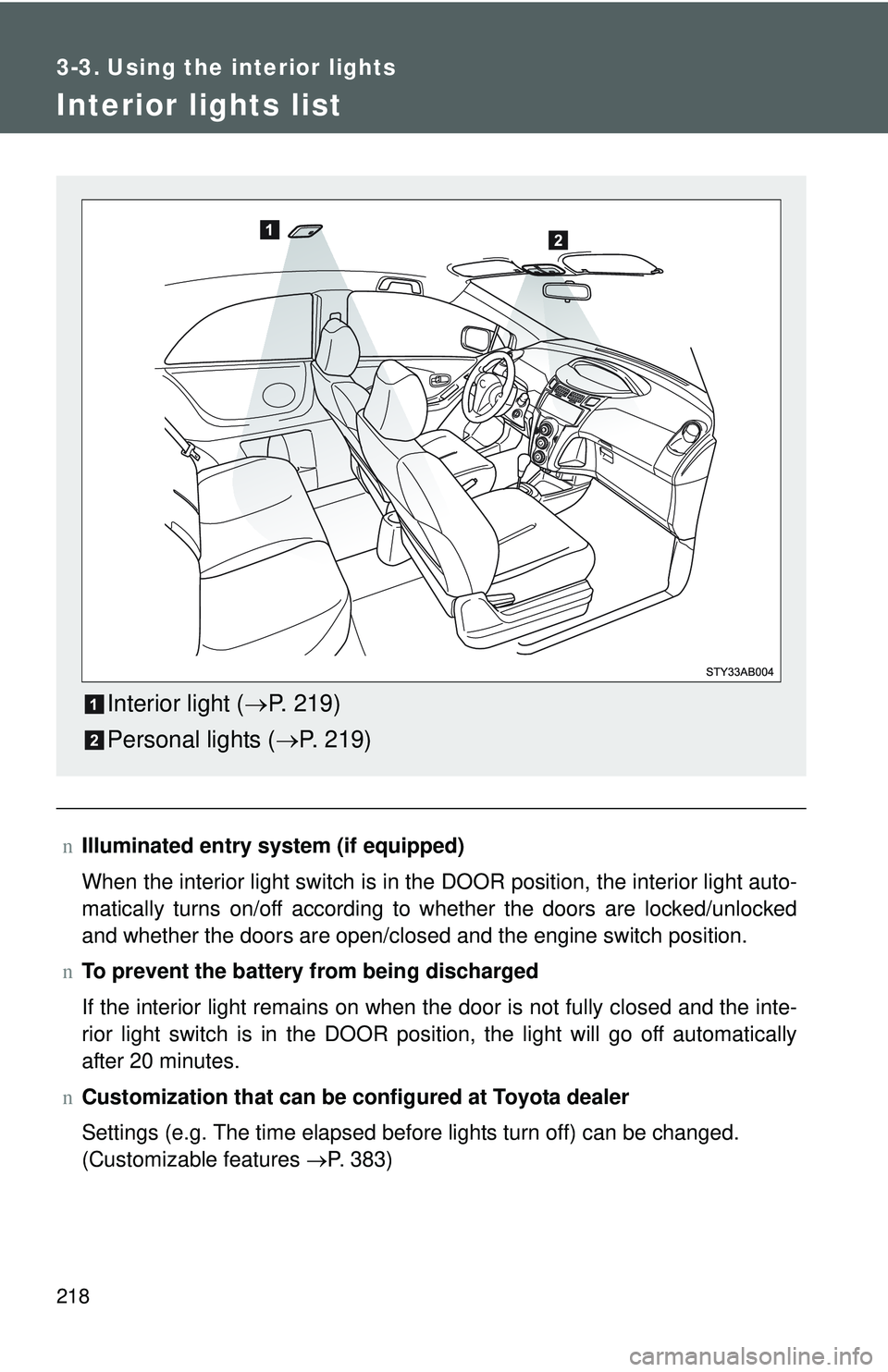
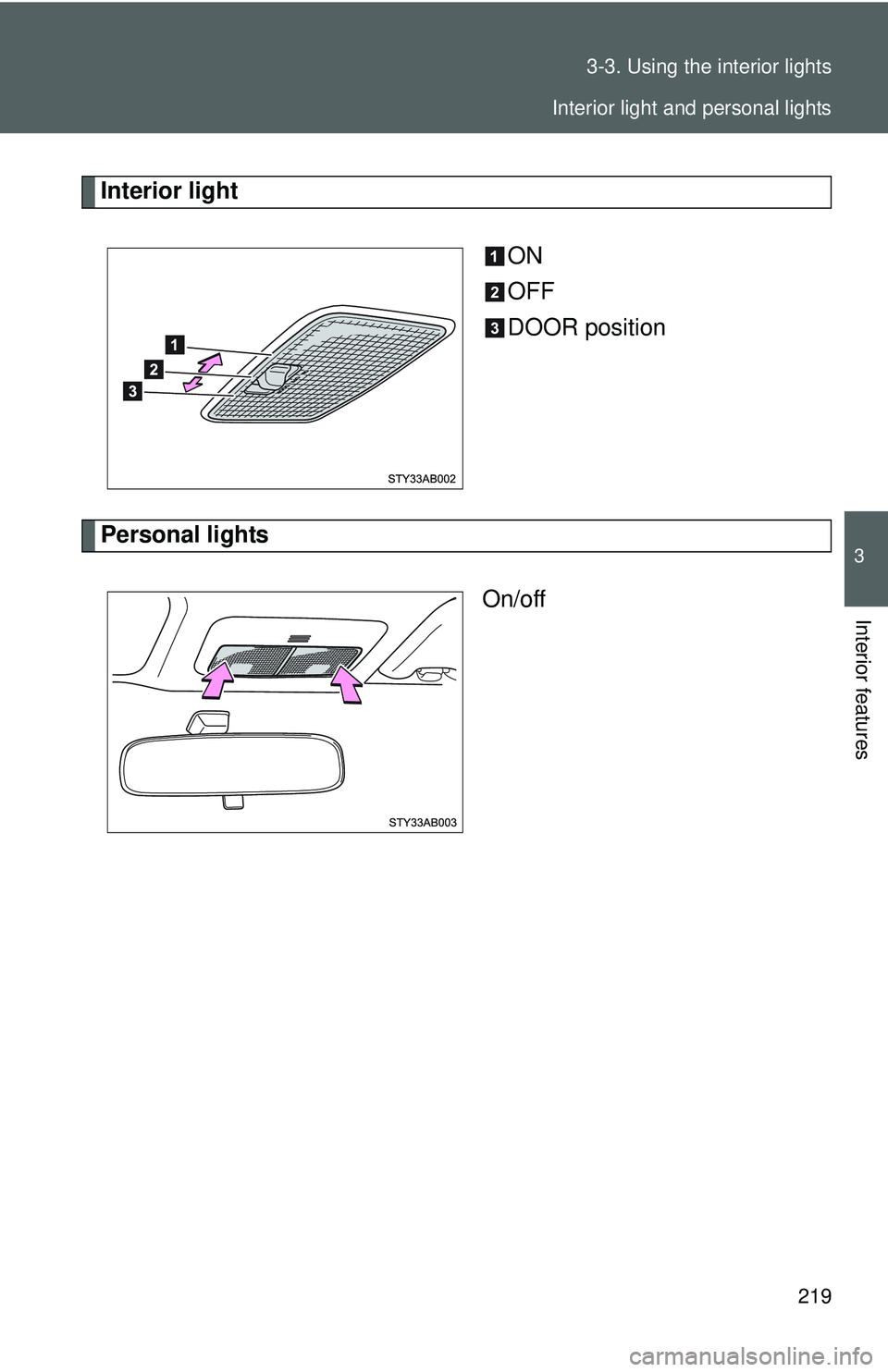
nIlluminated entry system (if equipped)
When the interior light switch is in the DOOR position, the interior light auto-
matically turns on/off according to whether the doors are locked/unlocked
and whether the doors are open/closed and the engine switch position.
n To prevent the battery from being discharged
If the interior light remains on when the door is not fully closed and the inte-
rior light switch is in the DOOR position, the light will go off automatically
after 20 minutes.
n Customization that can be co nfigured at Toyota dealer
Settings (e.g. The time elapsed before lights turn off) can be changed.
(Customizable features →P. 383)
Interior light ( →P. 219)
Personal lights ( →P. 219)
Page 233 of 428
219
3-3. Using the interior lights
3
Interior features
Interior light
ON
OFF
DOOR position
Personal lightsOn/off
Interior light and personal lights
Page 253 of 428
240 4-1. Maintenance and care
NOTICE
nCleaning the exterior lights
lWash carefully. Do not use organic substances or scrub with a hard brush.
This may damage the surfaces of the lights.
l Do not apply wax on the surfaces of the lights.
Wax may cause damage to the lenses.
n Antenna installation and removal precautions
lBefore driving, ensure that the antenna is installed.
l When the antenna is removed, such as before entering an automatic car
wash, make sure to store it in a suitable place so as not to lose it. Also,
before driving, make sure to reinstall the antenna in its original position.
n To prevent damage to the windshield wiper arms
When lifting the wiper arms away from the windshield, pull the driver side
wiper arm upward first, and repeat for the passenger side. When returning
the wipers to their original position, do so from the passenger side first.