belt TOYOTA YARIS HATCHBACK 2011 Workshop Manual
[x] Cancel search | Manufacturer: TOYOTA, Model Year: 2011, Model line: YARIS HATCHBACK, Model: TOYOTA YARIS HATCHBACK 2011Pages: 428, PDF Size: 9.61 MB
Page 255 of 428
242 4-1. Maintenance and care
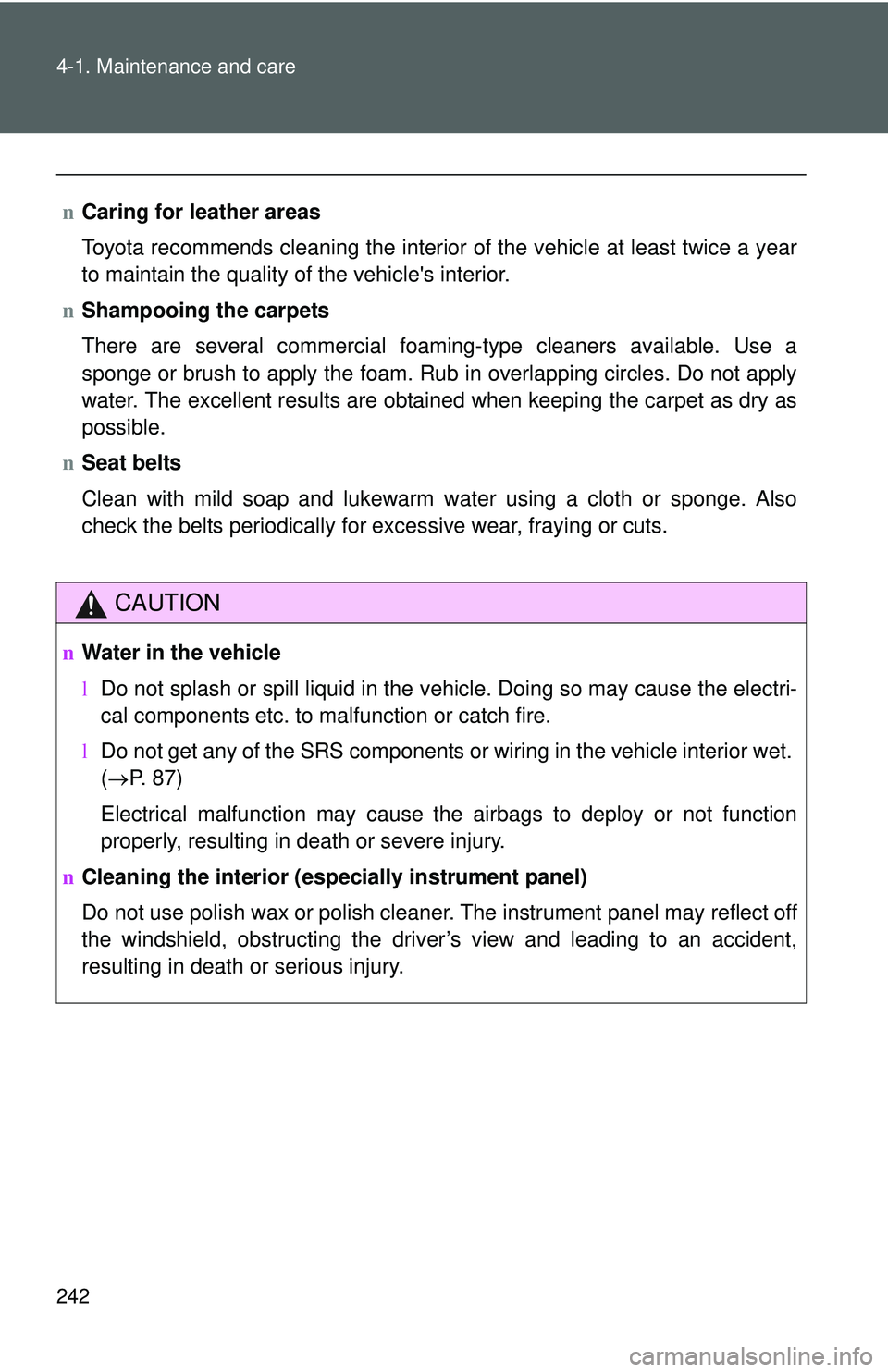
nCaring for leather areas
Toyota recommends cleaning the interior of the vehicle at least twice a year
to maintain the quality of the vehicle's interior.
n Shampooing the carpets
There are several commercial foaming-type cleaners available. Use a
sponge or brush to apply the foam. Rub in overlapping circles. Do not apply
water. The excellent results are obtained when keeping the carpet as dry as
possible.
n Seat belts
Clean with mild soap and lukewarm water using a cloth or sponge. Also
check the belts periodically for excessive wear, fraying or cuts.
CAUTION
nWater in the vehicle
lDo not splash or spill liquid in the vehicle. Doing so may cause the electri-
cal components etc. to malfunction or catch fire.
l Do not get any of the SRS components or wiring in the vehicle interior wet.
(→ P. 8 7 )
Electrical malfunction may cause the airbags to deploy or not function
properly, resulting in death or severe injury.
n Cleaning the interior (esp ecially instrument panel)
Do not use polish wax or polish cleaner. The instrument panel may reflect off
the windshield, obstructing the driver’s view and leading to an accident,
resulting in death or serious injury.
Page 260 of 428
247
4-2. Maintenance
4
Maintenance and care
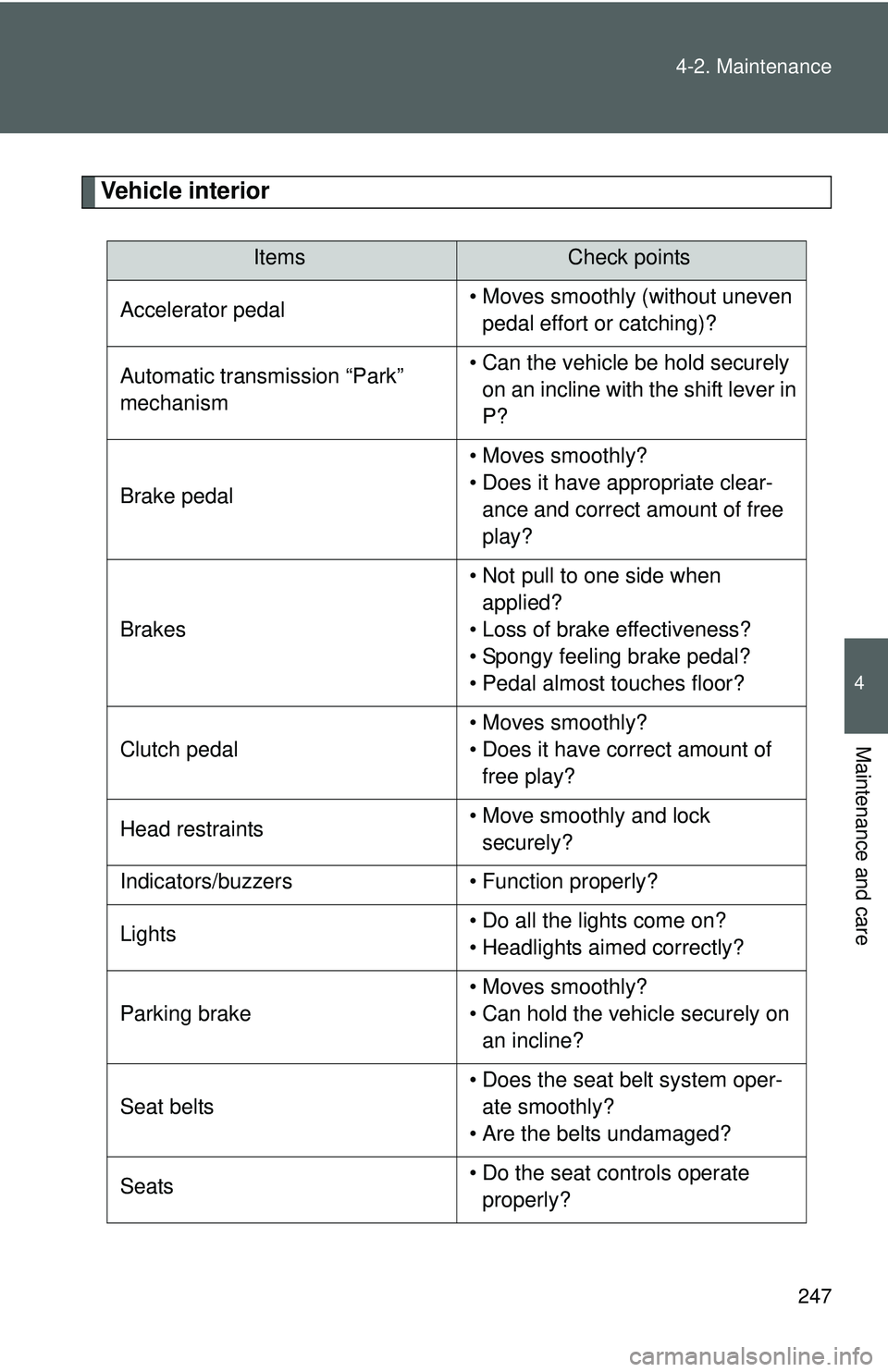
Vehicle interior
ItemsCheck points
Accelerator pedal • Moves smoothly (without uneven
pedal effort or catching)?
Automatic transmission “Park”
mechanism • Can the vehicle be hold securely
on an incline with the shift lever in
P?
Brake pedal • Moves smoothly?
• Does it have appropriate clear-
ance and correct amount of free
play?
Brakes • Not pull to one side when
applied?
• Loss of brake effectiveness?
• Spongy feeling brake pedal?
• Pedal almost touches floor?
Clutch pedal • Moves smoothly?
• Does it have correct amount of
free play?
Head restraints • Move smoothly and lock
securely?
Indicators/buzzers • Function properly?
Lights • Do all the lights come on?
• Headlights aimed correctly?
Parking brake • Moves smoothly?
• Can hold the vehicle securely on
an incline?
Seat belts • Does the seat belt system oper-
ate smoothly?
• Are the belts undamaged?
Seats • Do the seat controls operate
properly?
Page 264 of 428
251
4-3. Do-it-yourself maintenance
4
Maintenance and care
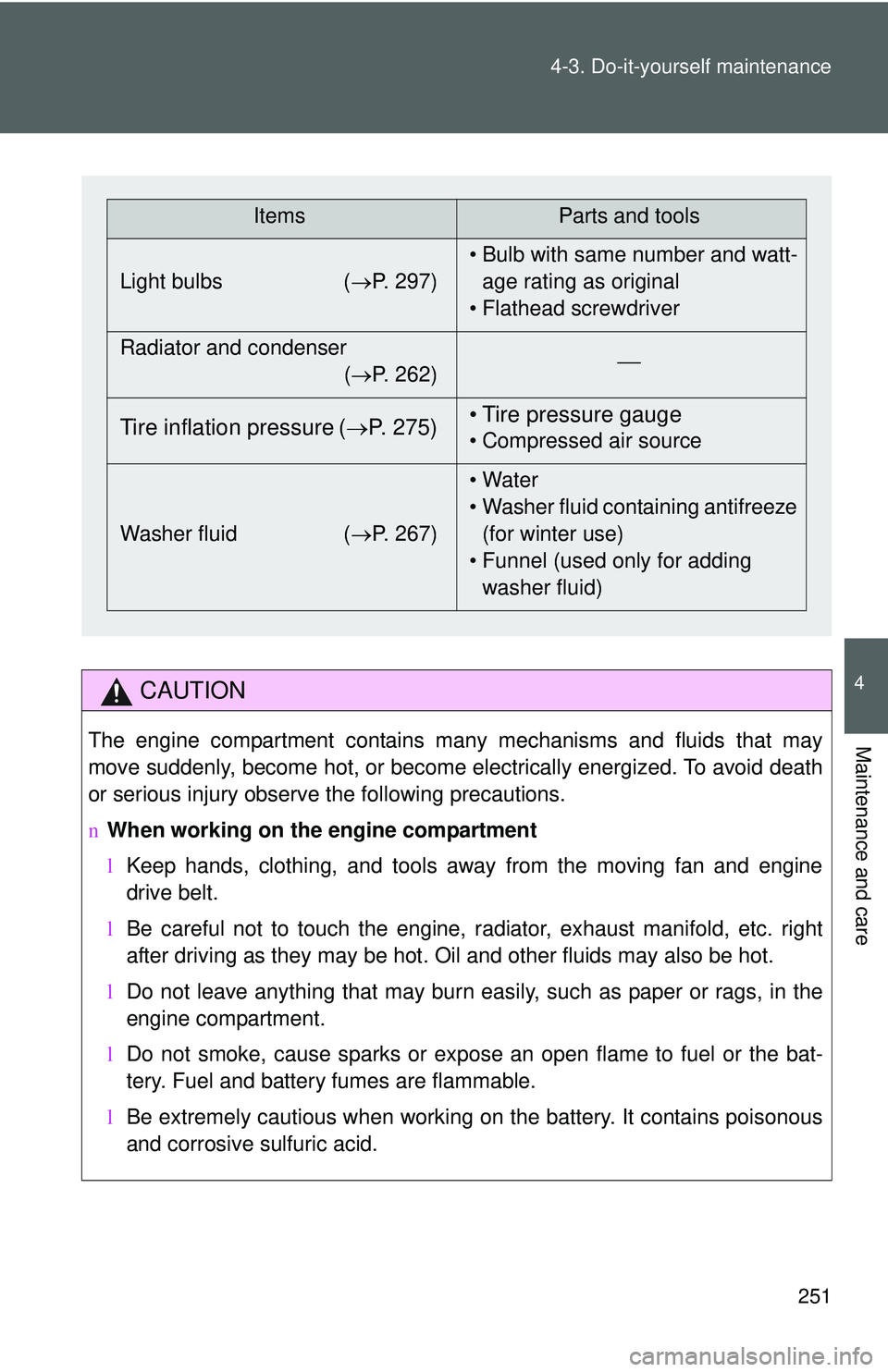
CAUTION
The engine compartment contains many mechanisms and fluids that may
move suddenly, become hot, or become electrically energized. To avoid death
or serious injury observe the following precautions.
n
When working on the engine compartment
lKeep hands, clothing, and tools away from the moving fan and engine
drive belt.
l Be careful not to touch the engine, radiator, exhaust manifold, etc. right
after driving as they may be hot. Oil and other fluids may also be hot.
l Do not leave anything that may burn easily, such as paper or rags, in the
engine compartment.
l Do not smoke, cause sparks or expose an open flame to fuel or the bat-
tery. Fuel and battery fumes are flammable.
l Be extremely cautious when working on the battery. It contains poisonous
and corrosive sulfuric acid.
ItemsParts and tools
Light bulbs ( →P. 297) • Bulb with same number and watt-
age rating as original
• Flathead screwdriver
Radiator and condenser (→ P. 262) ⎯
Tire inflation pressure (
→P. 275) • Tire pressure gauge• Compressed air source
Washer fluid ( →P. 267) • Water
• Washer fluid containing antifreeze
(for winter use)
• Funnel (used only for adding washer fluid)
Page 286 of 428
273
4-3. Do-it-yourself maintenance
4
Maintenance and care
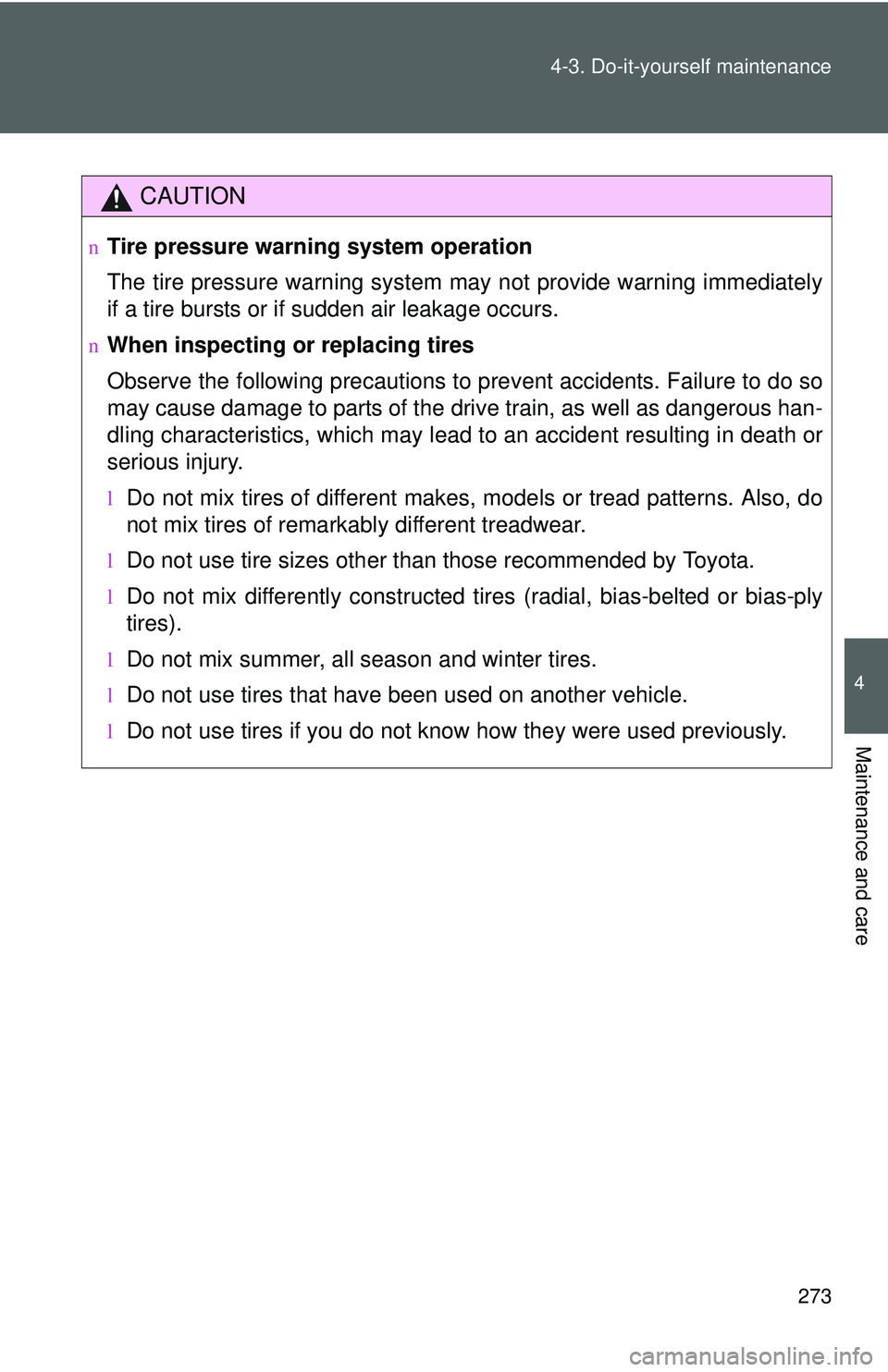
CAUTION
nTire pressure warning system operation
The tire pressure warning system may not provide warning immediately
if a tire bursts or if
sudden air leakage occurs.
nWhen inspecting or replacing tires
Observe the following precautions to prevent accidents. Failure to do so
may cause damage to parts of the drive train, as well as dangerous han-
dling characteristics, which may lead to an accident resulting in death or
serious injury.
lDo not mix tires of different makes, models or tread patterns. Also, do
not mix tires of remarkably different treadwear.
lDo not use tire sizes other than those recommended by Toyota.
lDo not mix differently constructed ti res (radial, bias-belted or bias-ply
tires).
lDo not mix summer, all season and winter tires.
lDo not use tires that have been used on another vehicle.
lDo not use tires if you do not know how they were used previously.
Page 329 of 428
5
When trouble arises
317
5-1. Essential information
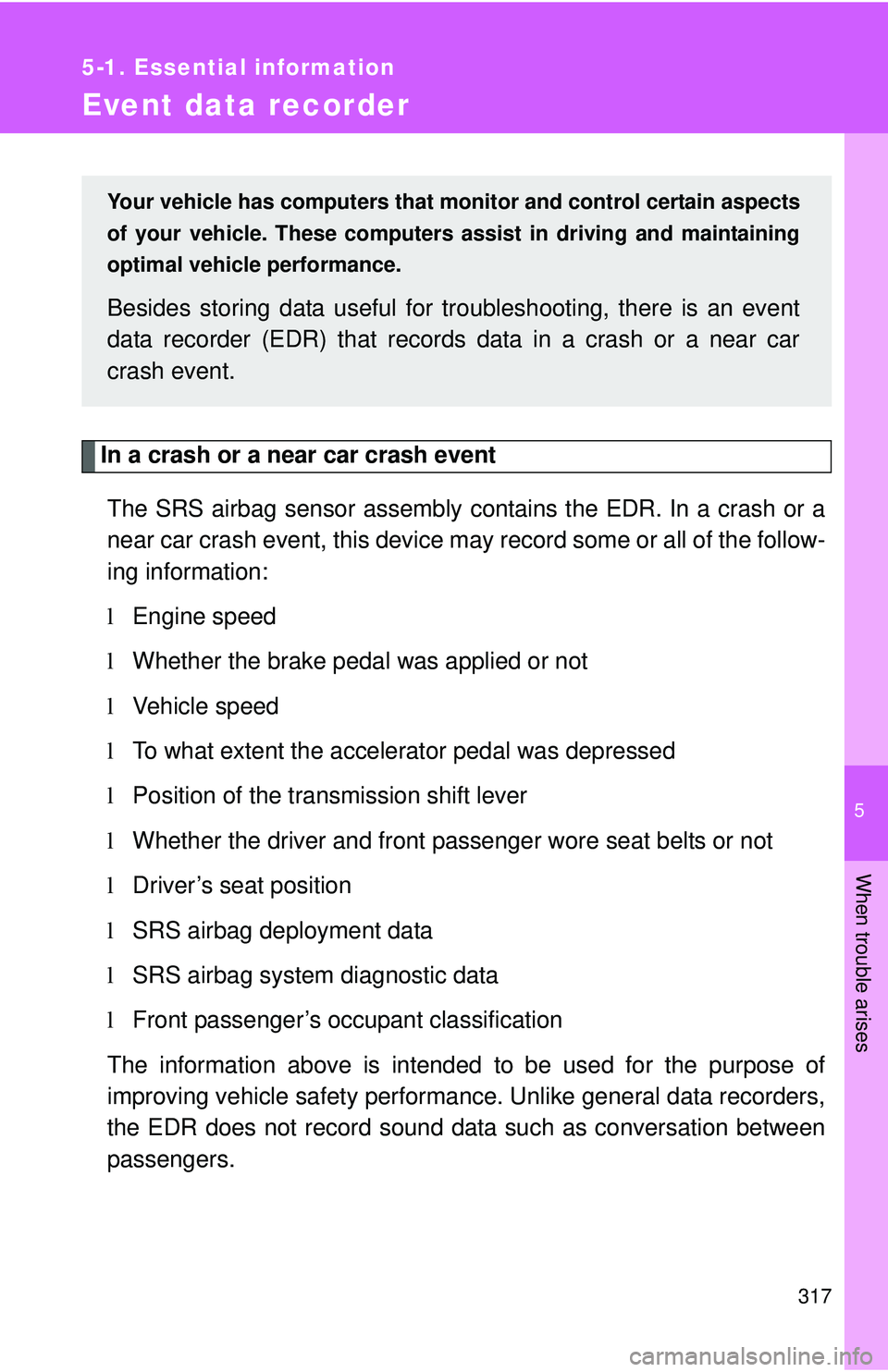
Event data recorder
In a crash or a near car crash eventThe SRS airbag sensor assembly contains the EDR. In a crash or a
near car crash event, this device may record some or all of the follow-
ing information:
l Engine speed
l Whether the brake pedal was applied or not
l Vehicle speed
l To what extent the accelerator pedal was depressed
l Position of the transmission shift lever
l Whether the driver and front passenger wore seat belts or not
l Driver’s seat position
l SRS airbag deployment data
l SRS airbag system diagnostic data
l Front passenger’s occupant classification
The information above is intended to be used for the purpose of
improving vehicle safety performance. Unlike general data recorders,
the EDR does not record sound data such as conversation between
passengers.
Your vehicle has computers that monitor and control certain aspects
of your vehicle. These computers assi st in driving and maintaining
optimal vehicle performance.
Besides storing data useful for tr oubleshooting, there is an event
data recorder (EDR) that records data in a crash or a near car
crash event.
Page 333 of 428
5
When trouble arises
321
5-2. Steps to take in an emergency
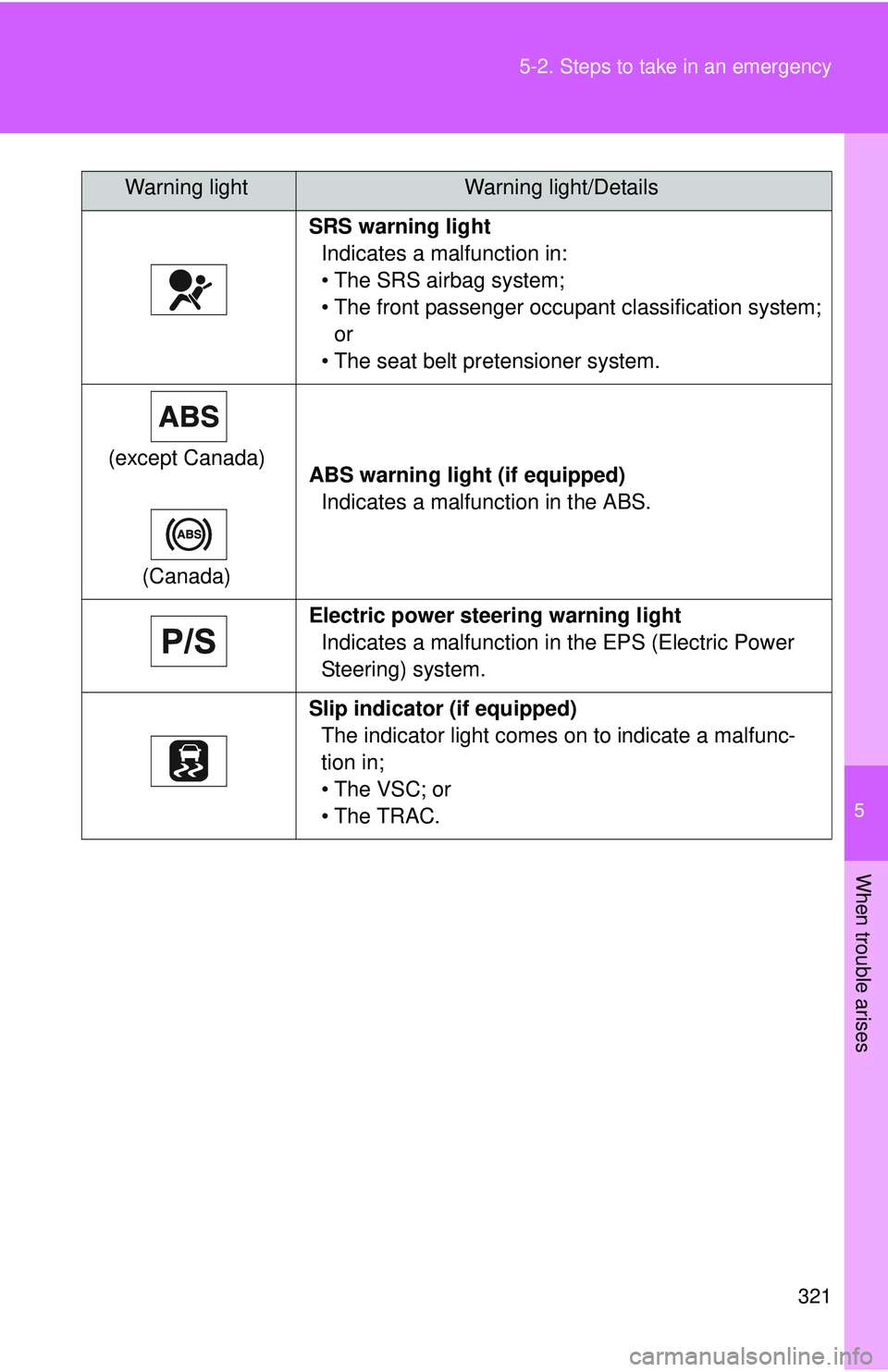
SRS warning light
Indicates a malfunction in:
• The SRS airbag system;
• The front passenger occupant classification system; or
• The seat belt pretensioner system.
(except Canada)
(Canada) ABS warning light (if equipped)
Indicates a malfunction in the ABS.
Electric power steering warning light Indicates a malfunction in the EPS (Electric Power
Steering) system.
Slip indicator (if equipped) The indicator light comes on to indicate a malfunc-
tion in;
• The VSC; or
• The TRAC.
Warning lightWarning light/Details
Page 334 of 428
322 5-2. Steps to take in an emergency
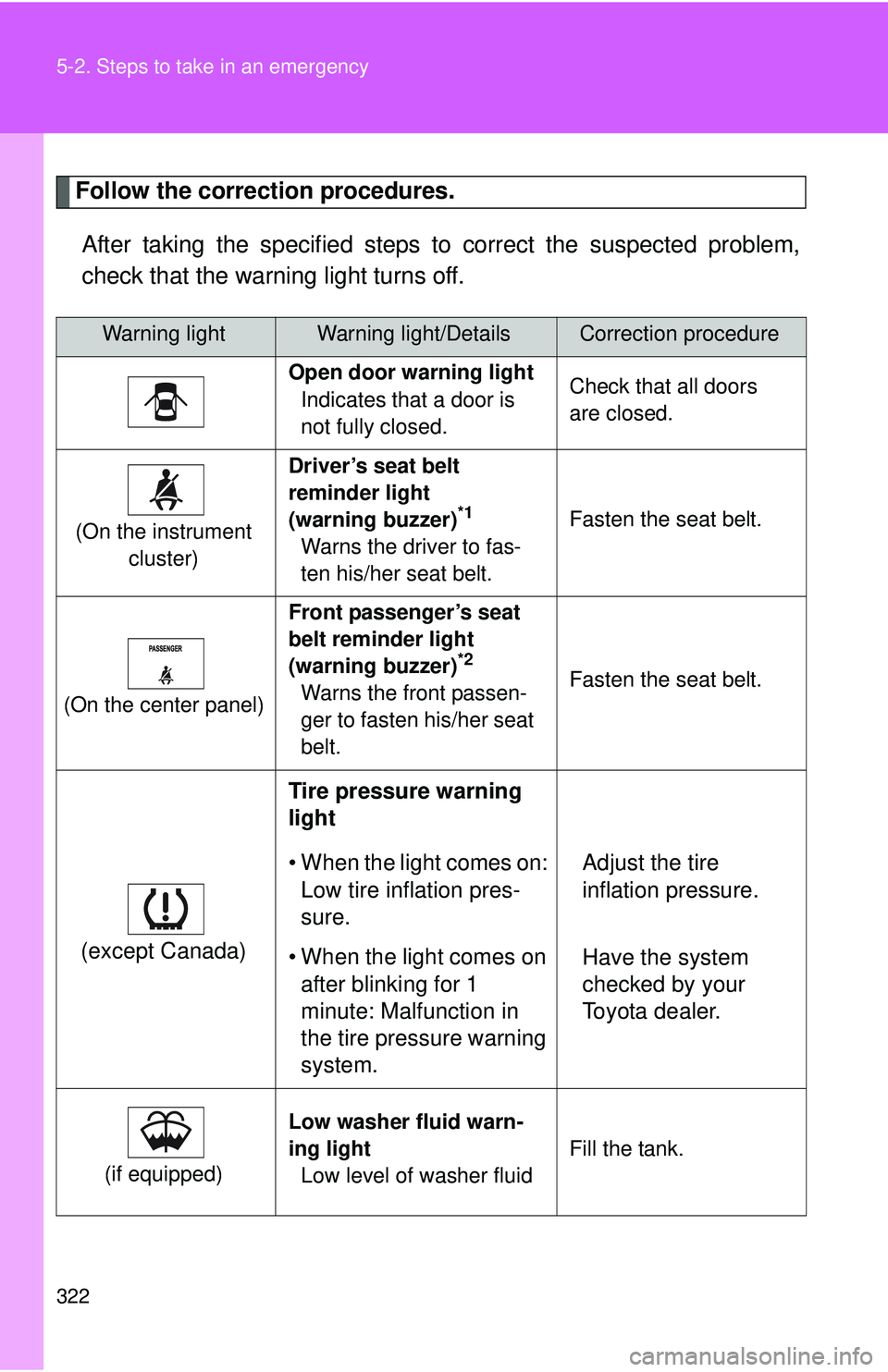
Follow the correction procedures.After taking the specified steps to correct the suspected problem,
check that the warning light turns off.
Warning lightWarning light/DetailsCorrection procedure
Open door warning light Indicates that a door is
not fully closed. Check that all doors
are closed.
(On the instrument cluster) Driver’s seat belt
reminder light
(warning buzzer)
*1
Warns the driver to fas-
ten his/her seat belt.
Fasten the seat belt.
(On the center panel) Front passenger’s seat
belt reminder light
(warning buzzer)
*2
Warns the front passen-
ger to fasten his/her seat
belt.
Fasten the seat belt.
(except Canada)Tire pressure warning
light
• When the light comes on:
Low tire inflation pres-
sure. Adjust the tire
inflation pressure.
• When the light comes on after blinking for 1
minute: Malfunction in
the tire pressure warning
system. Have the system
checked by your
Toyota dealer.
(if equipped)
Low washer fluid warn-
ing light
Low level of washer fluid Fill the tank.
Page 335 of 428
5
When trouble arises
323
5-2. Steps to take in an emergency
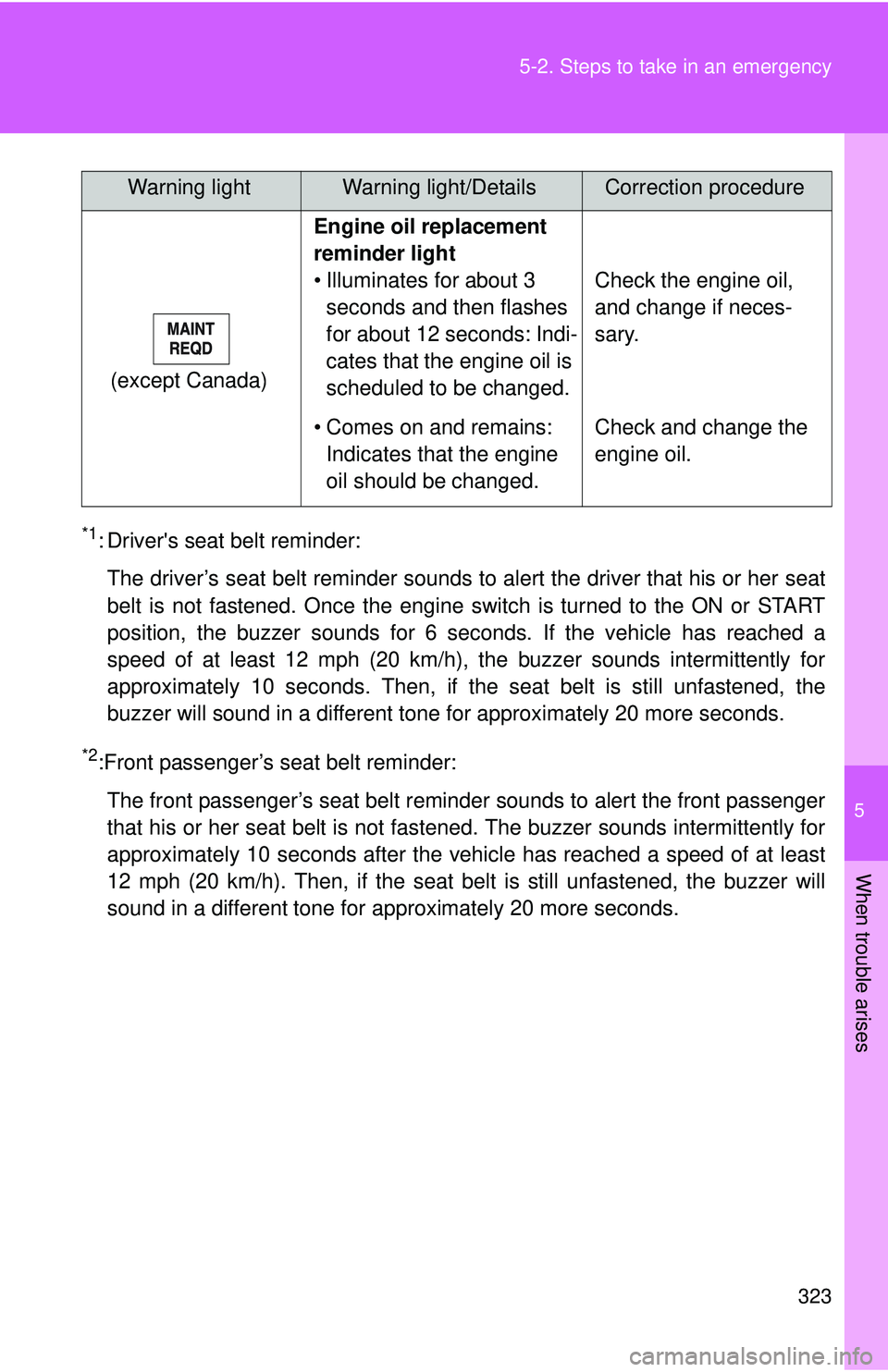
*1: Driver's seat belt reminder:
The driver’s seat belt reminder sounds to alert the driver that his or her seat
belt is not fastened. Once the engine switch is turned to the ON or START
position, the buzzer sounds for 6 seconds. If the vehicle has reached a
speed of at least 12 mph (20 km/h), the buzzer sounds intermittently for
approximately 10 seconds. Then, if the seat belt is still unfastened, the
buzzer will sound in a different tone for approximately 20 more seconds.
*2:Front passenger’s seat belt reminder:
The front passenger’s seat belt reminder sounds to alert the front passenger
that his or her seat belt is not fastened. The buzzer sounds intermittently for
approximately 10 seconds after the vehicle has reached a speed of at least
12 mph (20 km/h). Then, if the seat belt is still unfastened, the buzzer will
sound in a different tone for approximately 20 more seconds.(except Canada)
Engine oil replacement
reminder light
• Illuminates for about 3
seconds and then flashes
for about 12 seconds: Indi-
cates that the engine oil is
scheduled to be changed. Check the engine oil,
and change if neces-
sary.
• Comes on and remains: Indicates that the engine
oil should be changed. Check and change the
engine oil.
Warning lightWarning light/DetailsCorrection procedure
Page 336 of 428
324 5-2. Steps to take in an emergency
nKey reminder buzzer
The buzzer indicates that the key has not been removed (with the engine
switch in the ACC or LOCK position and the driver’s door opened).
n Light reminder buzzer
The buzzer indicates that the headlight switch is left on (with the key
removed and the driver’s door opened).
n If the malfunction indicator lamp comes on while driving
First check the following:
l Is your vehicle low on gas?
If it is, refuel the vehicle immediately.
l Is the fuel tank cap loose?
If it is, tighten it securely.
The light will go off after taking several driving trips.
If the light does not go off even after several trips, contact your Toyota dealer
as soon as possible.
n Front passenger detect ion sensor and passenger seat belt reminder
If luggage or other load is placed on the front passenger seat, depending on
its weight, the reminder light to flash and buzzer to sound.
n
When the tire pressure warning light comes on
Check the tire inflation pressure and adjust to the appropriate level.
nThe tire pressure warning light ma y turn on due to natural causes
The tire pressure warning light may turn on due to natural causes such
as natural air leaks or tire inflation pressure changes caused by temper-
ature. In this case, adjusting the ti re inflation pressure will turn off the
warning light (after a few minutes).
nWhen a tire is replaced with a spare tire
The compact spare tire is not equipped with the tire pressure warning
valve and transmitter. If a tire goes flat, the tire pressure warning light will
not turn off even though the flat tire is replaced with the spare tire.
Replace the spare tire with the repair ed tire and adjust the proper tire
inflation pressure. The ti re pressure warning light will turn off after a few
minutes.
Page 338 of 428
326 5-2. Steps to take in an emergency
nCustomization that can be co nfigured at Toyota dealer
The vehicle speed linked seat belt reminder buzzer can be disabled. (Cus-
tomizable features → P. 383)
CAUTION
nWhen the electric power steering warning light comes on
The steering wheel may become extremely heavy.
If the steering wheel becomes heavier than usual when operating, firmly
hold and operate it using more force than usual.
n
If the tire pressure warning light comes on
Be sure to observe the following precautions. Failure to do so could
cause loss of vehicle control and re sult in death or serious injury.
lStop your vehicle in a safe place as soon as possible. Adjust the tire
inflation pressure immediately.
lIf the tire pressure warning light comes on even after tire inflation pres-
sure adjustment, it is pr obable that you have a flat tire. Check the tires.
If the tire is flat, change to the spare tire and have the flat tire repaired
by the nearest Toyota dealer.
lAvoid abrupt maneuvering and braking. If the vehicle tires deteriorate,
you could lose control of the steering wheel or the brakes.
nIf a blowout or sudden air leakage should occur
The tire pressure warning syste m may not activate immediately.
nMaintenance of the tire
Each tire, including the spare (if provided), should be checked monthly
when cold and inflated to the inflation pressure recommended by the
vehicle manufacturer on the vehicle placard or tire inflation pressure
label (tire and load information label). (If your vehicle has tires of a differ-
ent size than the size indicated on the vehicle placard or tire inflation
pressure label [tire and load information label], you should determine the
proper tire inflation pr essure for those tires.)