lock TOYOTA YARIS HATCHBACK 2011 Workshop Manual
[x] Cancel search | Manufacturer: TOYOTA, Model Year: 2011, Model line: YARIS HATCHBACK, Model: TOYOTA YARIS HATCHBACK 2011Pages: 428, PDF Size: 9.61 MB
Page 123 of 428
109
1-7. Safety information
1
Before driving
Installation with LATCH system
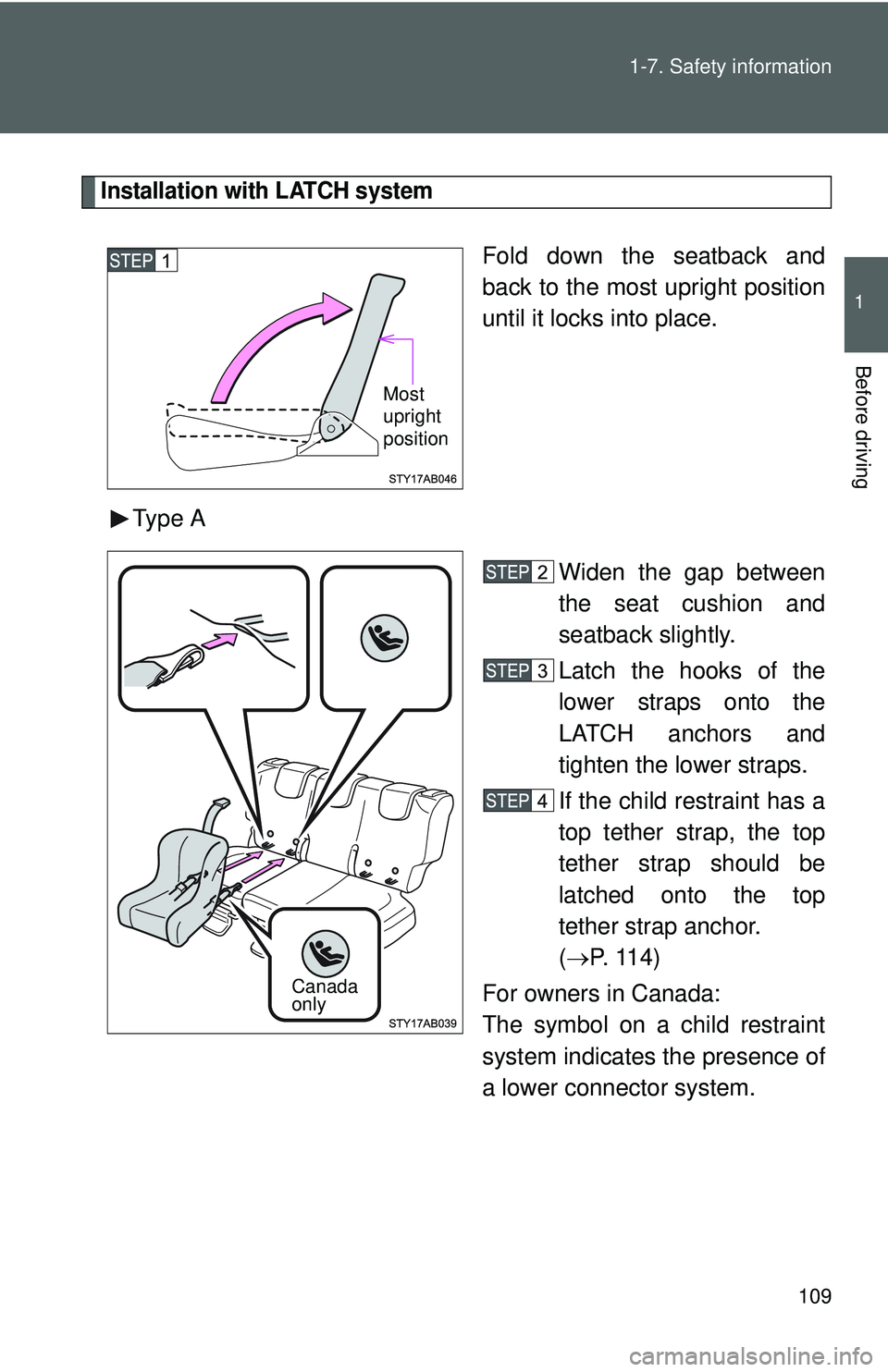
Fold down the seatback and
back to the most upright position
until it locks into place.
Type A Widen the gap between
the seat cushion and
seatback slightly.
Latch the hooks of the
lower straps onto the
LATCH anchors and
tighten the lower straps.
If the child restraint has a
top tether strap, the top
tether strap should be
latched onto the top
tether strap anchor.
(→ P. 1 1 4 )
For owners in Canada:
The symbol on a child restraint
system indicates the presence of
a lower connector system.
Most
upright
position
Canada
only
Page 124 of 428
110 1-7. Safety information
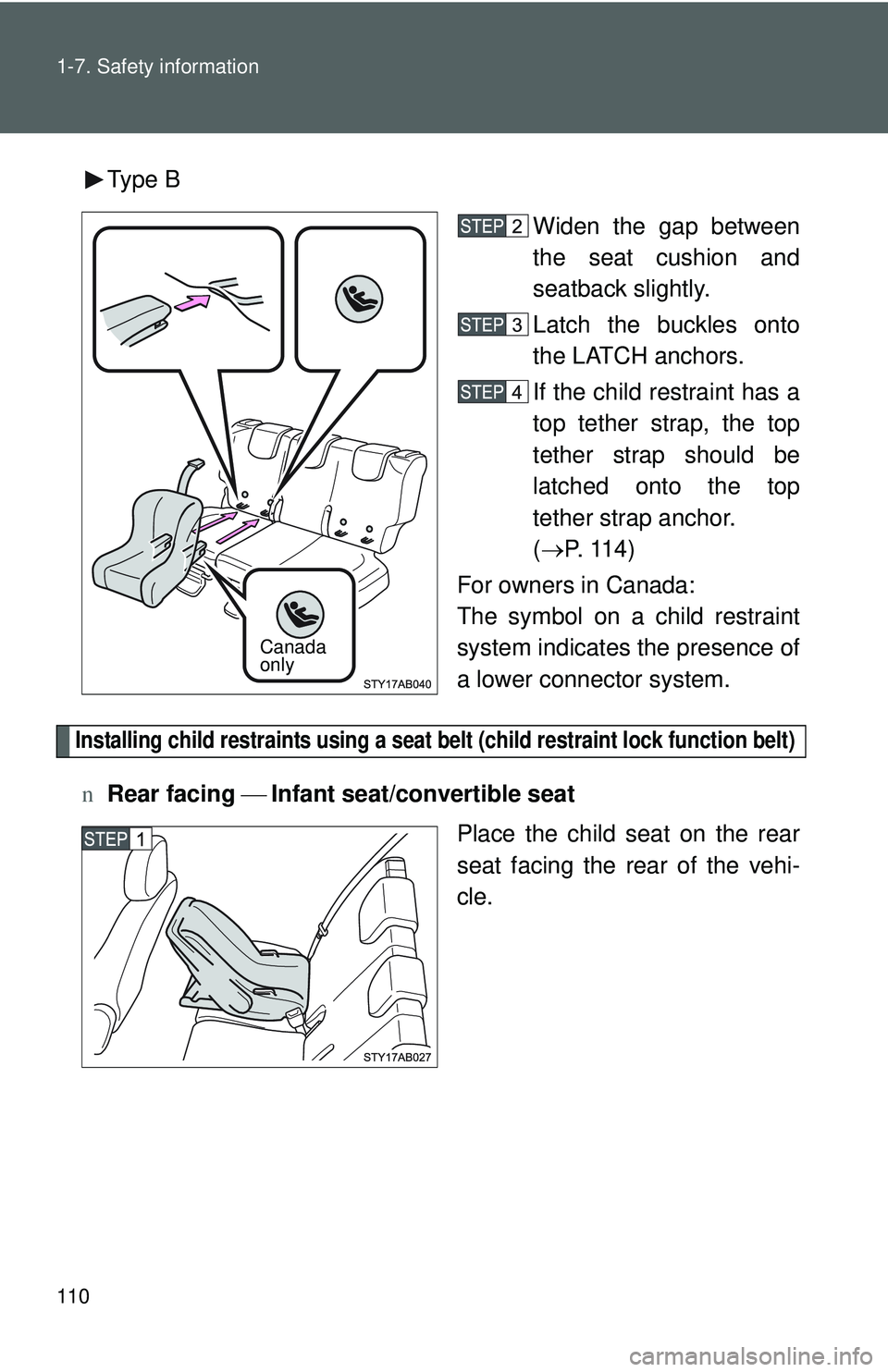
Type BWiden the gap between
the seat cushion and
seatback slightly.
Latch the buckles onto
the LATCH anchors.
If the child restraint has a
top tether strap, the top
tether strap should be
latched onto the top
tether strap anchor.
(→ P. 11 4 )
For owners in Canada:
The symbol on a child restraint
system indicates the presence of
a lower connector system.
Installing child restraints using a seat belt (child restraint lock function belt)
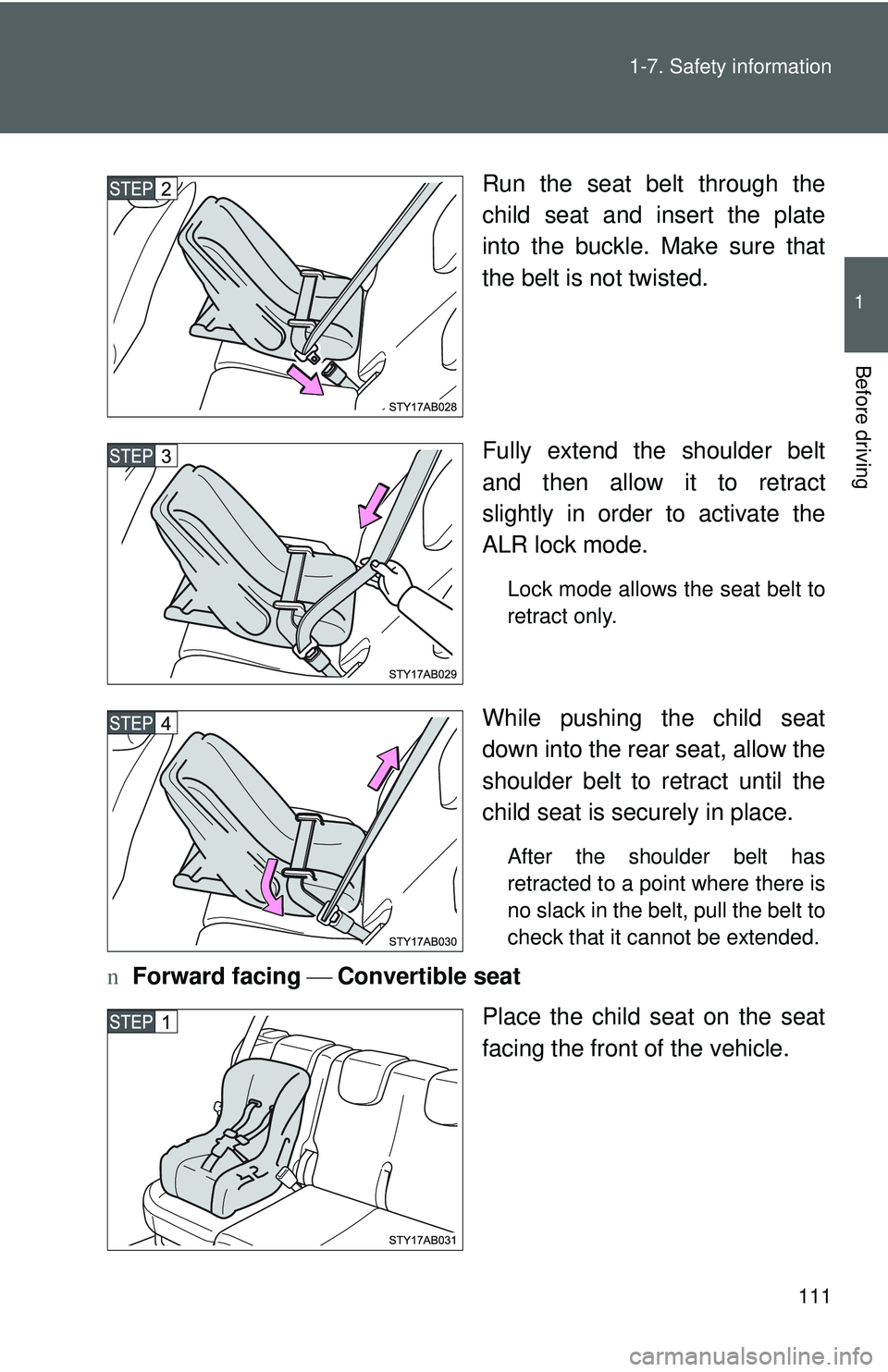
n Rear facing ⎯ Infant seat/convertible seat
Place the child seat on the rear
seat facing the rear of the vehi-
cle.
Canada
only
Page 125 of 428
111
1-7. Safety information
1
Before driving
Run the seat belt through the
child seat and insert the plate
into the buckle. Make sure that
the belt is not twisted.
Fully extend the shoulder belt
and then allow it to retract
slightly in order to activate the
ALR lock mode.
Lock mode allows the seat belt to
retract only.
While pushing the child seat
down into the rear seat, allow the
shoulder belt to retract until the
child seat is securely in place.
After the shoulder belt has
retracted to a point where there is
no slack in the belt, pull the belt to
check that it cannot be extended.
n
Forward facing ⎯ Convertible seat
Place the child seat on the seat
facing the front of the vehicle.
Page 126 of 428
112 1-7. Safety information
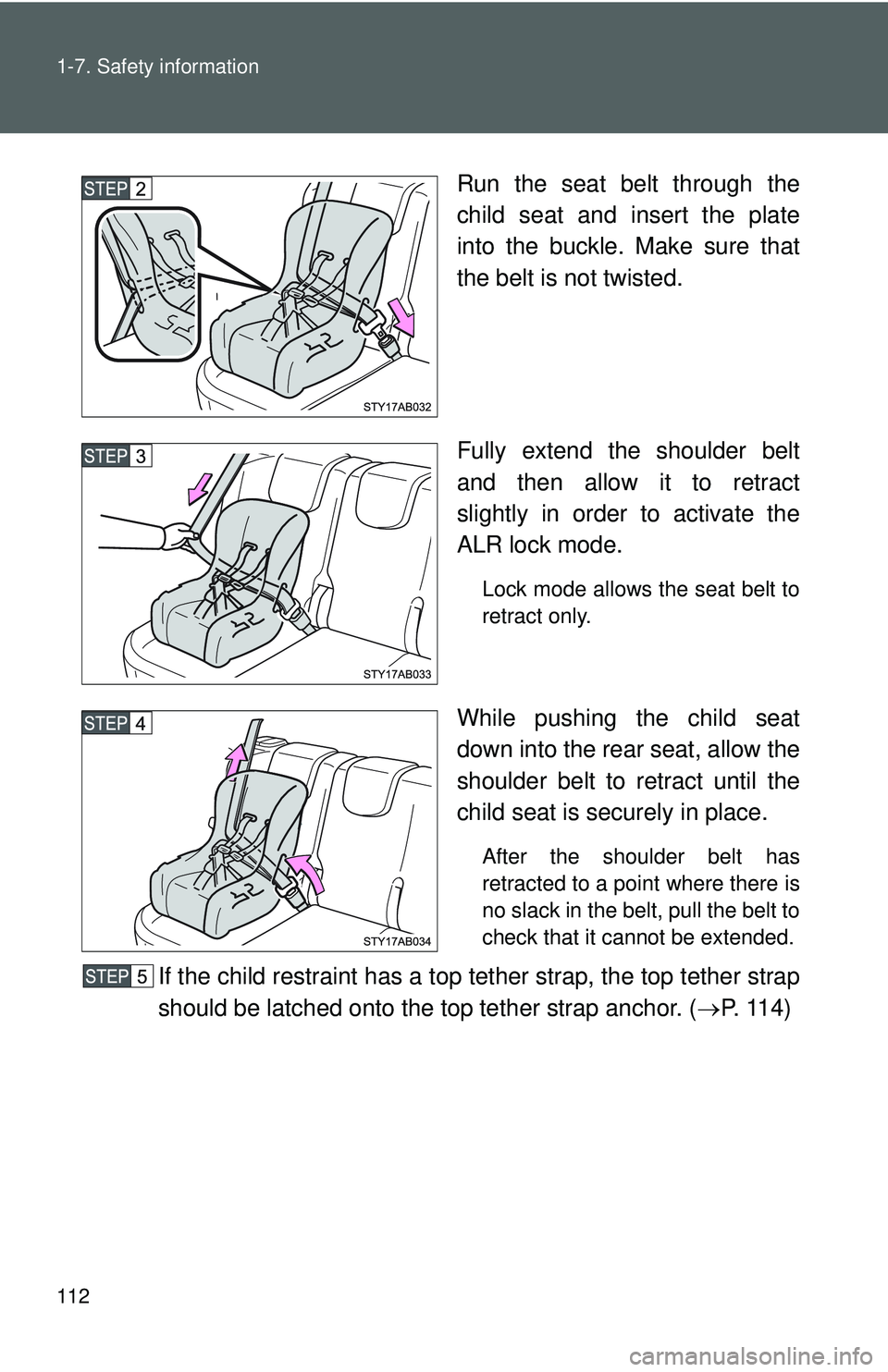
Run the seat belt through the
child seat and insert the plate
into the buckle. Make sure that
the belt is not twisted.
Fully extend the shoulder belt
and then allow it to retract
slightly in order to activate the
ALR lock mode.
Lock mode allows the seat belt to
retract only.
While pushing the child seat
down into the rear seat, allow the
shoulder belt to retract until the
child seat is securely in place.
After the shoulder belt has
retracted to a point where there is
no slack in the belt, pull the belt to
check that it cannot be extended.
If the child restraint has a top tether strap, the top tether strap
should be latched onto the top tether strap anchor. ( →P. 114)
Page 130 of 428
116 1-7. Safety information
CAUTION
nWhen installing a booster seat
Do not fully extend the shoulder belt to prevent the belt from going to ALR
lock mode. ( →P. 60)
In ALR lock mode the belt is locked in that position and cannot be extended,
which could cause injury or discomfort to the child seated in the booster
seat.
n When installing a child restraint system
Follow the directions given in the child restraint system installation manual
and fix the child restraint system securely in place.
If the child restraint system is not correctly fixed in place, the child or other
passengers may be seriously injured or even killed in the event of emer-
gency braking, sudden swerving or an accident.
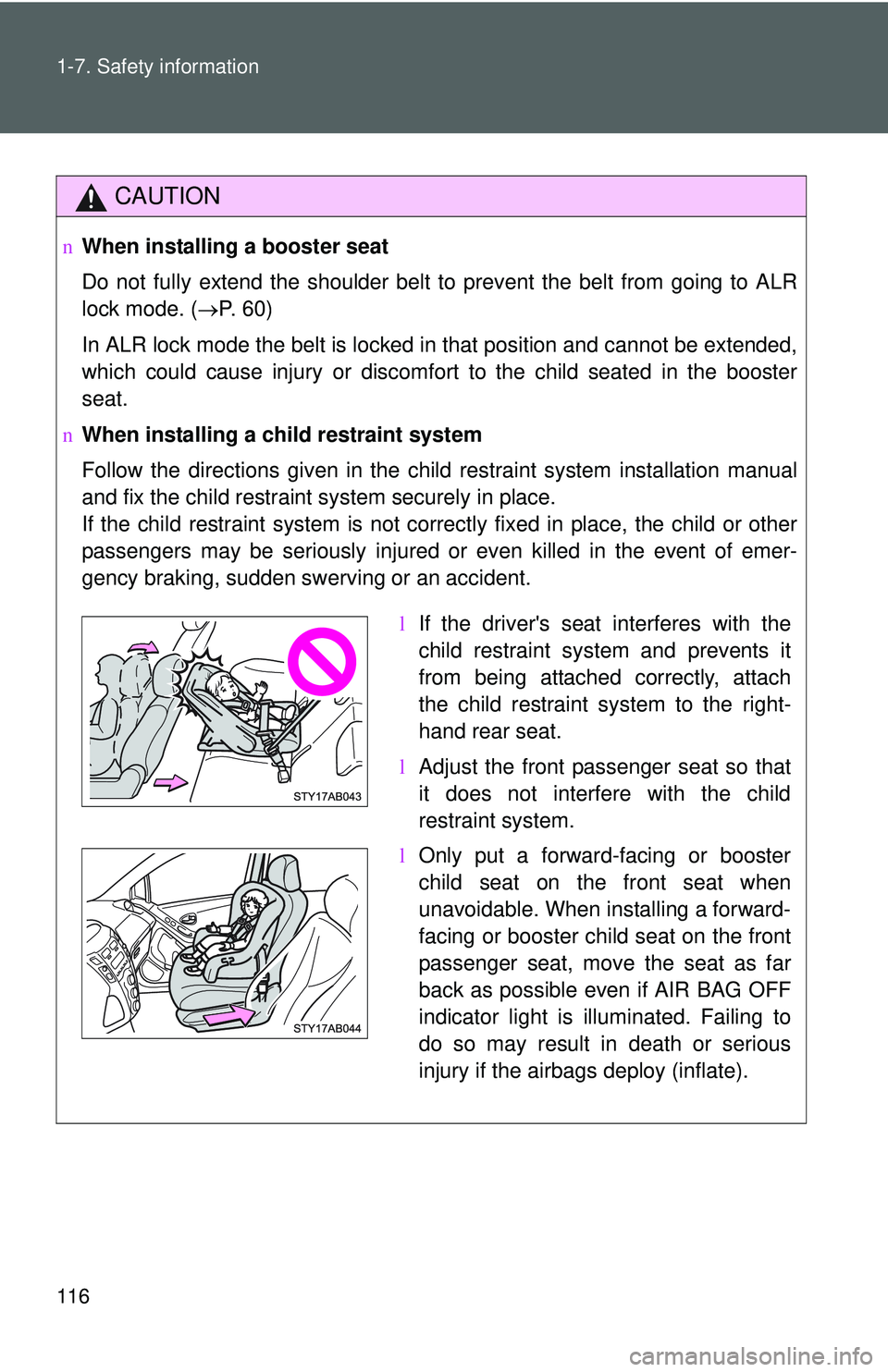
lIf the driver's seat interferes with the
child restraint system and prevents it
from being attached correctly, attach
the child restraint system to the right-
hand rear seat.
l Adjust the front passenger seat so that
it does not interfere with the child
restraint system.
l Only put a forward-facing or booster
child seat on the front seat when
unavoidable. When installing a forward-
facing or booster child seat on the front
passenger seat, move the seat as far
back as possible even if AIR BAG OFF
indicator light is illuminated. Failing to
do so may result in death or serious
injury if the airbags deploy (inflate).
Page 131 of 428
117
1-7. Safety information
1
Before driving
CAUTION
n
When installing a child restraint system
lSplit rear seats: When installing a child restraint system in the rear center
seat, adjust both seat cushions to the same position and align seatbacks
at the same angle. The seatbacks must be adjusted to the same angle.
Otherwise, the child restraint system cannot be securely restrained and
this may cause death or serious injuries in the event of emergency brak-
ing, sudden swerving or an accident.
l Split rear seats: When using the LATCH anchors for a child restraint sys-
tem, move the seat as far back as possible and adjust the seatback as
upright as possible.
l When a booster seat is installed, always ensure that the shoulder belt is
positioned across the center of the child's shoulder. The belt should be
kept away from the child's neck, but not so that it could fall off the child's
shoulder. Failing to do so may result in death or serious injury in the event
of emergency braking, sudden swerving or an accident.
l Ensure that the belt and tab are securely locked and the seat belt is not
twisted.
l Push and pull the child restraint system from side to side and forward to be
sure it is secure.
l After securing a child restraint system, never adjust the seat.
l Follow all installation instructions provided by the child restraint system
manufacturer.
l Split rear seats: When a child restraint system with a top tether strap is
installed, do not install the head restraint. The head restraint may interfere
with the top tether strap preventing secure installation of the child restraint
system.
l Split rear seats: Make sure to properly store the removed head restraint in
a secure place when you use the child restraint system on the rear seats.
Page 134 of 428
121
2-1. Driving procedures
2
When driving
Starting on a steep uphill
Automatic transmission With the brake pedal depressed, firmly set the parking brake
and shift the shift lever to D.
Gently depress the accelerator pedal.
Release the parking brake.
nParking the vehicle
Automatic transmission
With the shift lever in D, depress the brake pedal.
Set the parking brake. ( →P. 137)
Shift the shift lever to P. ( →P. 133)
When parking on a hill, if necessary, block the wheels.
Turn the engine switch off to stop the engine.
Lock the door, making sure that you have the key on your
person.
Manual transmission
With the clutch pedal fully depressed, depress the brake
pedal.
Set the parking brake. ( →P. 137)
Shift the shift lever to N. ( →P. 135)
When parking on a hill, shift the shift lever to 1 or R. If necessary,
block the wheels.
Turn the engine switch off to stop the engine.
Lock the door, making sure that you have the key on your
person.
Page 139 of 428
126 2-1. Driving procedures
CAUTION
nWhen the vehicle is parked
lAlways apply the parking brake, shift the shift lever to P (automatic trans-
mission only), stop the engine and lock the vehicle.
Do not leave the vehicle unattended while the engine is running.
l Do not touch the exhaust pipe while the engine is running or immediately
after turning the engine off.
Doing so may cause burns.
l Do not leave the engine running in an area with snow build-up, or where it
is snowing. If snowbanks build up around the vehicle while the engine is
running, exhaust gases may collect and enter the vehicle. This may lead
to death or a serious health hazard.
n Exhaust gases
Exhaust gases include harmful carbon monoxide (CO) that is colorless and
odorless. Inhaling exhaust gases may lead to death or a serious health haz-
ard.
lIf the vehicle is in a poorly ventilated area, stop the engine. In a closed
area, such as a garage, exhaust gases may collect and enter the vehicle.
This may lead to death or a serious health hazard.
l The exhaust should be checked occasionally. If there is a hole or crack
caused by corrosion, damage to a joint or abnormal exhaust noise, be
sure to have the vehicle inspected and repaired by your Toyota dealer.
Failure to do so may allow exhaust gases to enter the vehicle, resulting in
death or a serious health hazard.
n When taking a nap in the vehicle
Always turn the engine off. Otherwise, you may accidentally move the shift
lever or depress the accelerator pedal, which could cause an accident or fire
due to engine overheating. Additionally, if the vehicle is parked in a poorly
ventilated area, exhaust gases may collect and enter the vehicle, leadin\
g to
death or a serious health hazard.
n When braking the vehicle
lWhen the brakes are wet, drive more cautiously.
Braking distance increases when the brakes are wet, and may cause one
side of the vehicle to brake differently than the other side. Also the parking
brake may not securely hold the vehicle.
Page 143 of 428
130
2-1. Driving procedures
Engine (ignition) switch
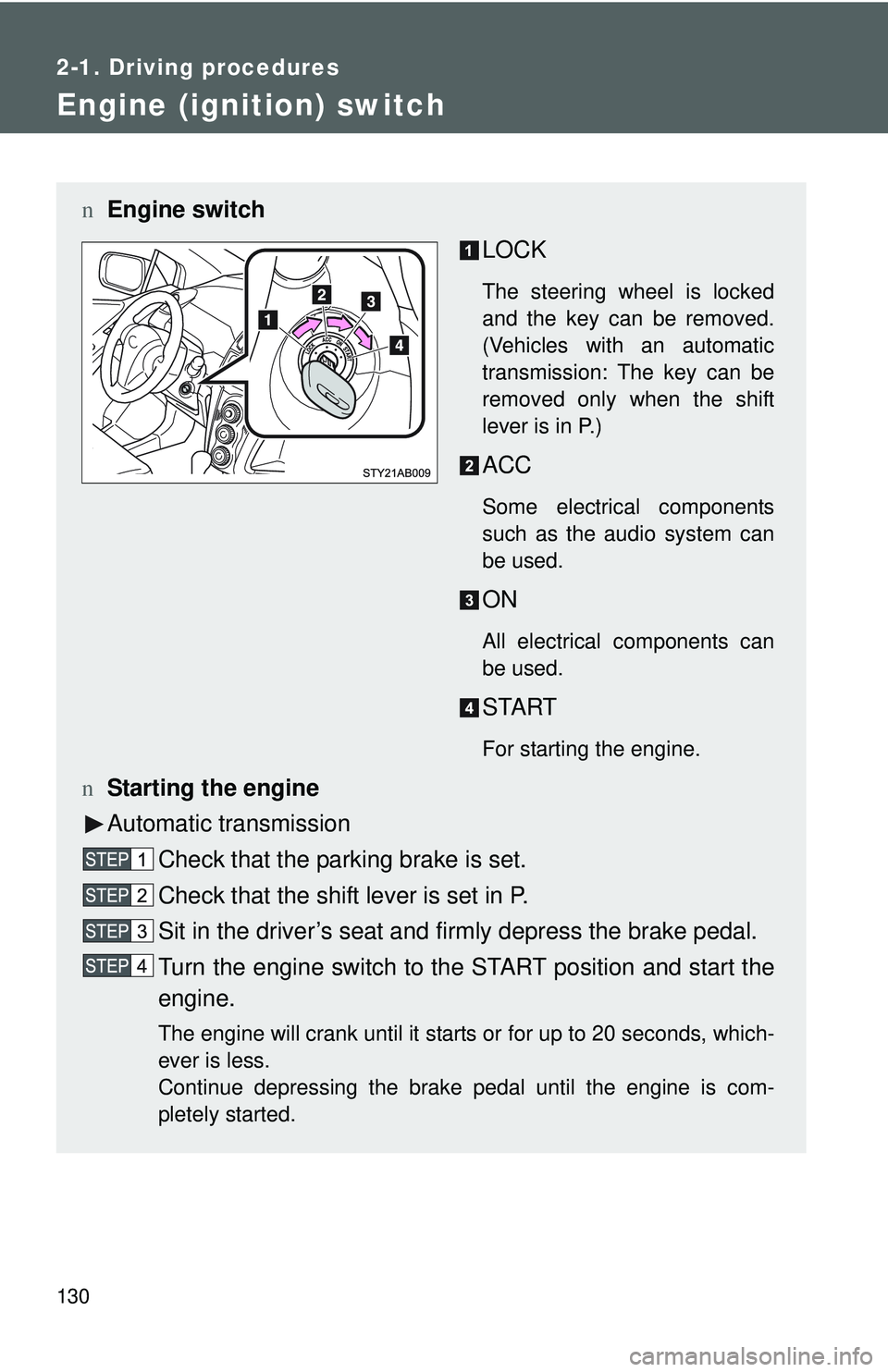
nEngine switch
LOCK
The steering wheel is locked
and the key can be removed.
(Vehicles with an automatic
transmission: The key can be
removed only when the shift
lever is in P.)
ACC
Some electrical components
such as the audio system can
be used.
ON
All electrical components can
be used.
START
For starting the engine.
nStarting the engine
Automatic transmission
Check that the parking brake is set.
Check that the shift lever is set in P.
Sit in the driver’s seat and firmly depress the brake pedal.
Turn the engine switch to the START position and start the
engine.
The engine will crank until it starts or for up to 20 seconds, which-
ever is less.
Continue depressing the brake pedal until the engine is com-
pletely started.
Page 144 of 428
131
2-1. Driving procedures
2
When driving
n
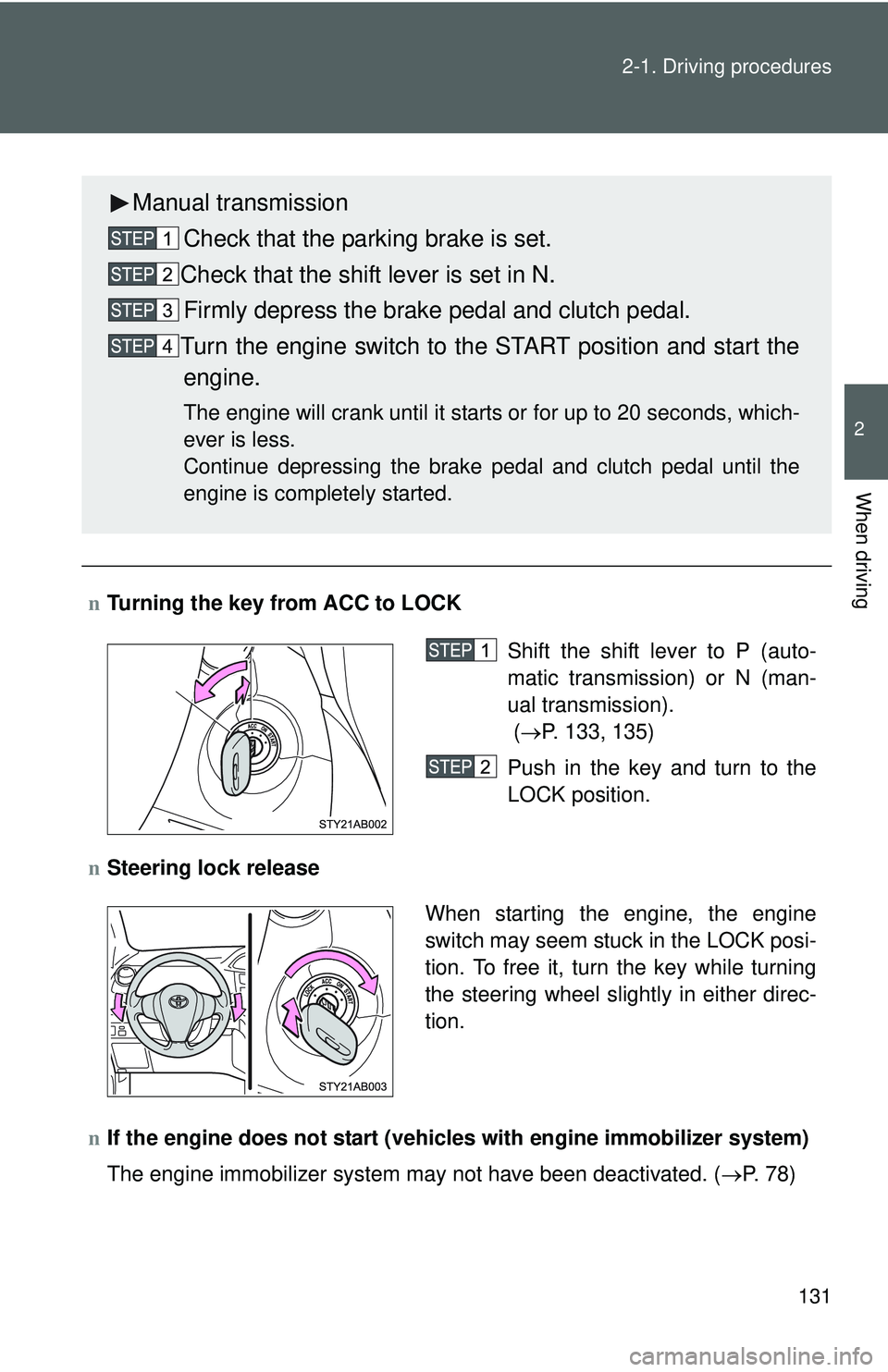
Turning the key from ACC to LOCK
n Steering lock release
n If the engine does not start (vehic les with engine immobilizer system)
The engine immobilizer system may not have been deactivated. ( →P. 78)
Manual transmission
Check that the parking brake is set.
Check that the shift lever is set in N. Firmly depress the brake pedal and clutch pedal.
Turn the engine switch to the START position and start the engine.
The engine will crank until it starts or for up to 20 seconds, which-
ever is less.
Continue depressing the brake pedal and clutch pedal until the
engine is completely started.
Shift the shift lever to P (auto-
matic transmission) or N (man-
ual transmission).
( → P. 133, 135)
Push in the key and turn to the
LOCK position.
When starting the engine, the engine
switch may seem stuck in the LOCK posi-
tion. To free it, turn the key while turning
the steering wheel slightly in either direc-
tion.