fuel TOYOTA YARIS HATCHBACK 2012 Owner's Manual
[x] Cancel search | Manufacturer: TOYOTA, Model Year: 2012, Model line: YARIS HATCHBACK, Model: TOYOTA YARIS HATCHBACK 2012Pages: 365, PDF Size: 8.17 MB
Page 258 of 365
279
4-3. Do-it-yourself maintenance
4
Maintenance and care
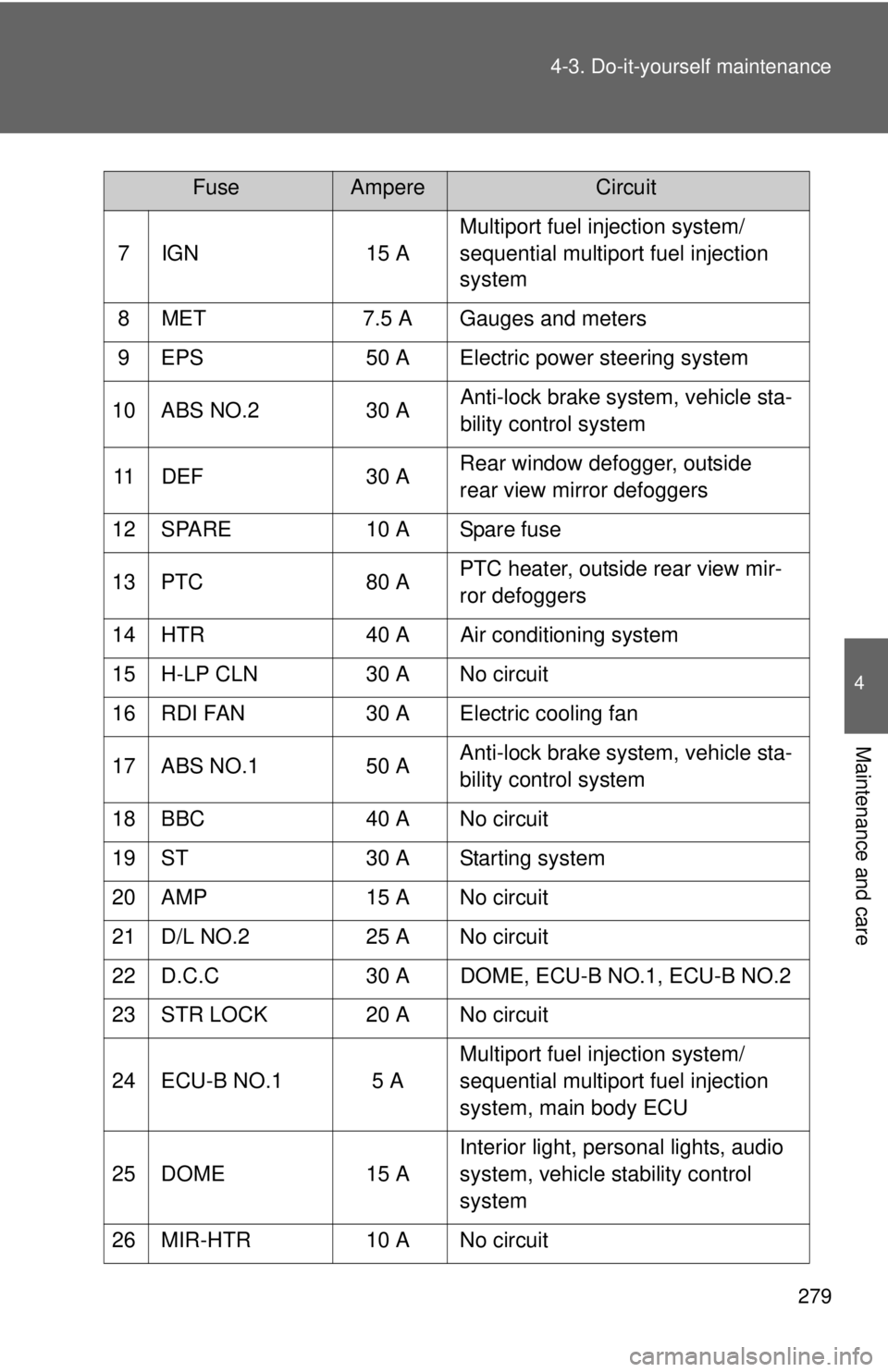
7 IGN
15 AMultiport fuel injection system/
sequential multiport fuel injection
system
8 MET 7.5 A Gauges and meters
9 EPS 50 A Electric power steering system
10 ABS NO.2 30 AAnti-lock brake system, vehicle sta-
bility control system
11 DEF 30 ARear window defogger, outside
rear view mirror defoggers
12 SPARE 10 A Spare fuse
13 PTC 80 APTC heater, outside rear view mir-
ror defoggers
14 HTR 40 A Air conditioning system
15 H-LP CLN 30 A No circuit
16 RDI FAN 30 A Electric cooling fan
17 ABS NO.1 50 AAnti-lock brake system, vehicle sta-
bility control system
18 BBC 40 A No circuit
19 ST 30 A Starting system
20 AMP 15 A No circuit
21 D/L NO.2 25 A No circuit
22 D.C.C 30 A DOME, ECU-B NO.1, ECU-B NO.2
23 STR LOCK 20 A No circuit
24 ECU-B NO.1 5 A Multiport fuel injection system/
sequential multiport fuel injection
system, main body ECU
25 DOME 15 AInterior light, personal lights, audio
system, vehicle stability control
system
26 MIR-HTR 10 A No circuit
FuseAmpereCircuit
Page 259 of 365
280 4-3. Do-it-yourself maintenance
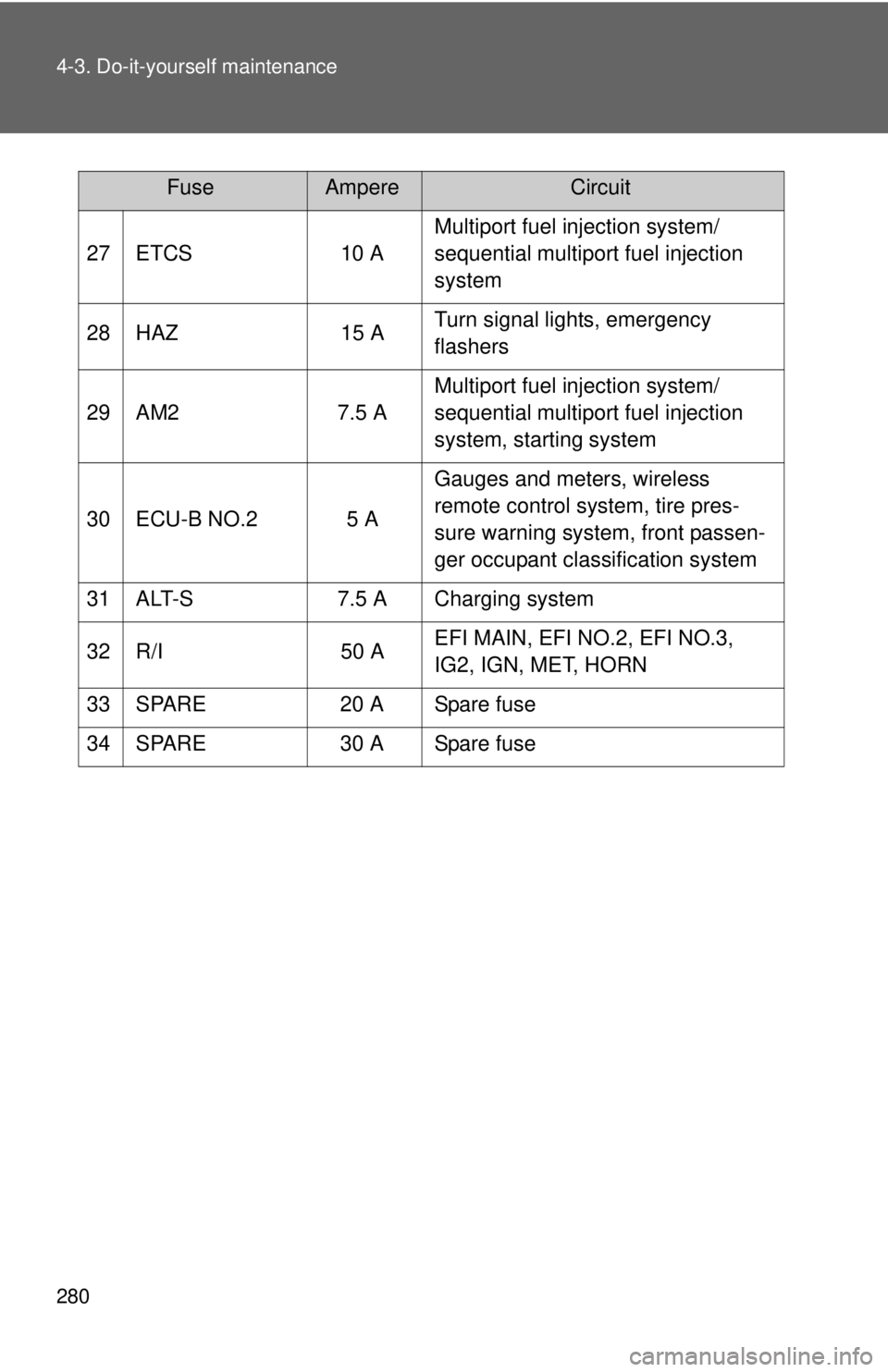
27 ETCS10 AMultiport fuel injection system/
sequential multiport fuel injection
system
28 HAZ 15 ATurn signal lights, emergency
flashers
29 AM2 7.5 AMultiport fuel injection system/
sequential multiport fuel injection
system, starting system
30 ECU-B NO.2 5 A Gauges and meters, wireless
remote control system, tire pres-
sure warning system, front passen-
ger occupant classification system
31 ALT-S 7.5 A Charging system
32 R/I 50 AEFI MAIN, EFI NO.2, EFI NO.3,
IG2, IGN, MET, HORN
33 SPARE 20 A Spare fuse
34 SPARE 30 A Spare fuse
FuseAmpereCircuit
Page 260 of 365
281
4-3. Do-it-yourself maintenance
4
Maintenance and care
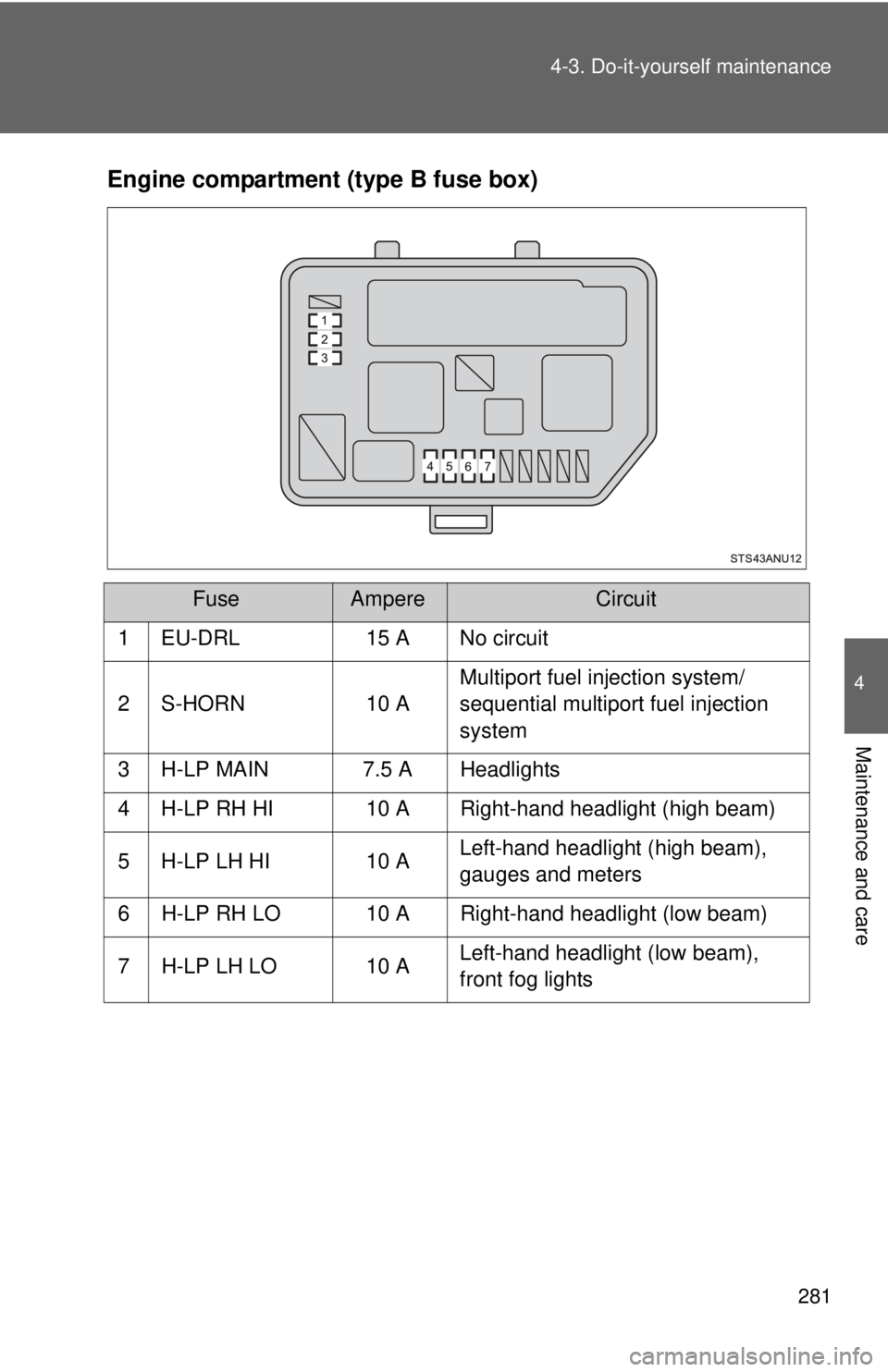
Engine compartment (type B fuse box)
FuseAmpereCircuit
1 EU-DRL 15 A No circuit
2 S-HORN 10 A Multiport fuel injection system/
sequential multiport fuel injection
system
3 H-LP MAIN 7.5 A Headlights
4 H-LP RH HI 10 A Right-hand headlight (high beam)
5 H-LP LH HI 10 A Left-hand headlight (high beam),
gauges and meters
6 H-LP RH LO 10 A Right-hand headlight (low beam)
7 H-LP LH LO 10 A Left-hand headlight (low beam),
front fog lights
Page 262 of 365
283
4-3. Do-it-yourself maintenance
4
Maintenance and care
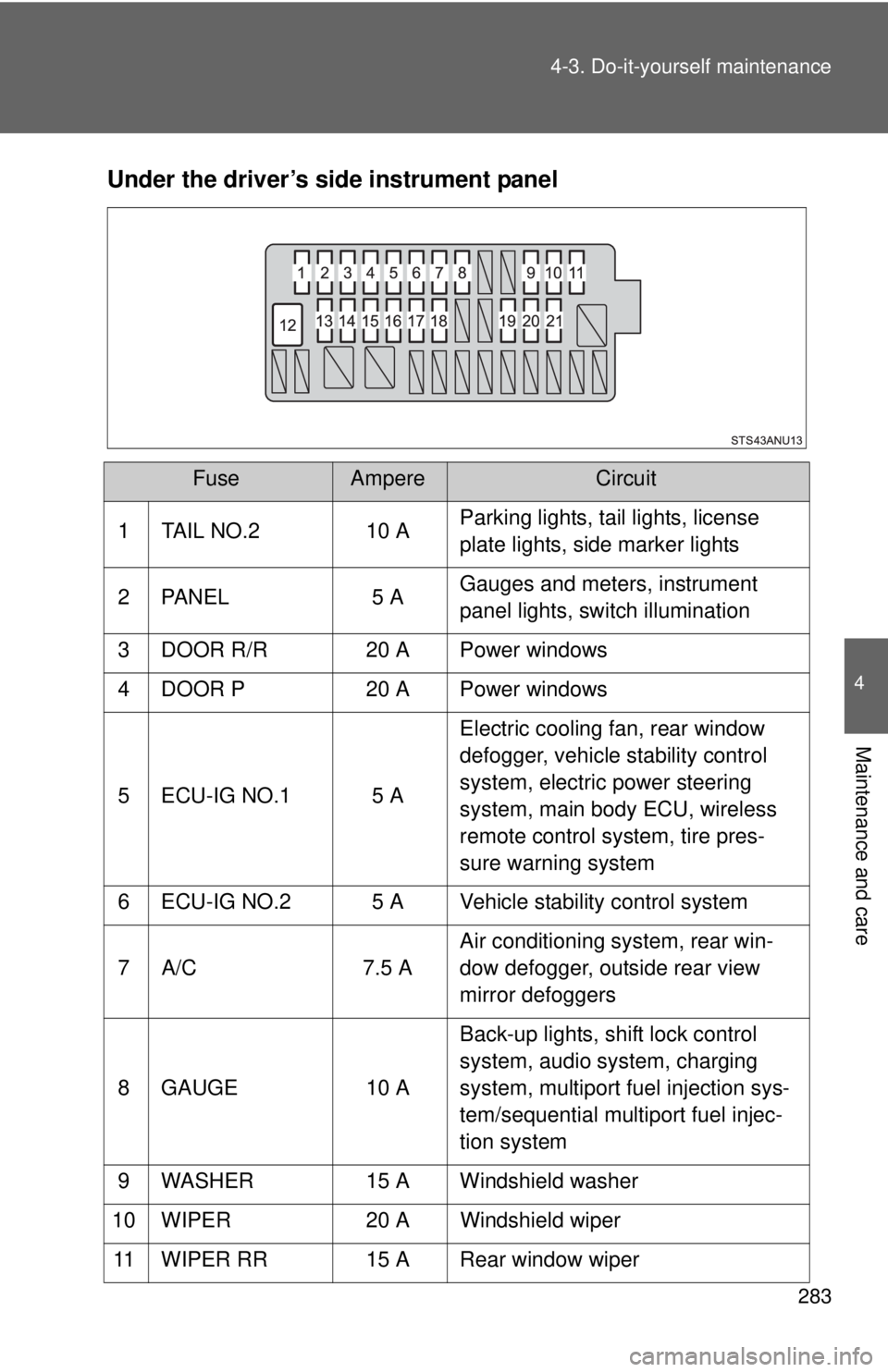
Under the driver’s side instrument panel
FuseAmpereCircuit
1 TAIL NO.2 10 A Parking lights, tail lights, license
plate lights, side marker lights
2 PANEL 5 A Gauges and meters, instrument
panel lights, switch illumination
3 DOOR R/R 20 A Power windows
4 DOOR P 20 A Power windows
5 ECU-IG NO.1 5 A Electric cooling fan, rear window
defogger, vehicle stability control
system, electric power steering
system, main body ECU, wireless
remote control system, tire pres-
sure warning system
6 ECU-IG NO.2 5 A Vehicle stability control system
7 A/C 7.5 A Air conditioning system, rear win-
dow defogger, outside rear view
mirror defoggers
8 GAUGE 10 A Back-up lights, shift lock control
system, audio system, charging
system, multiport fuel injection sys-
tem/sequential multiport fuel injec-
tion system
9 WASHER 15 A Windshield washer
10 WIPER 20 A Windshield wiper
11 WIPER RR 15 A Rear window wiper
Page 263 of 365
284 4-3. Do-it-yourself maintenance
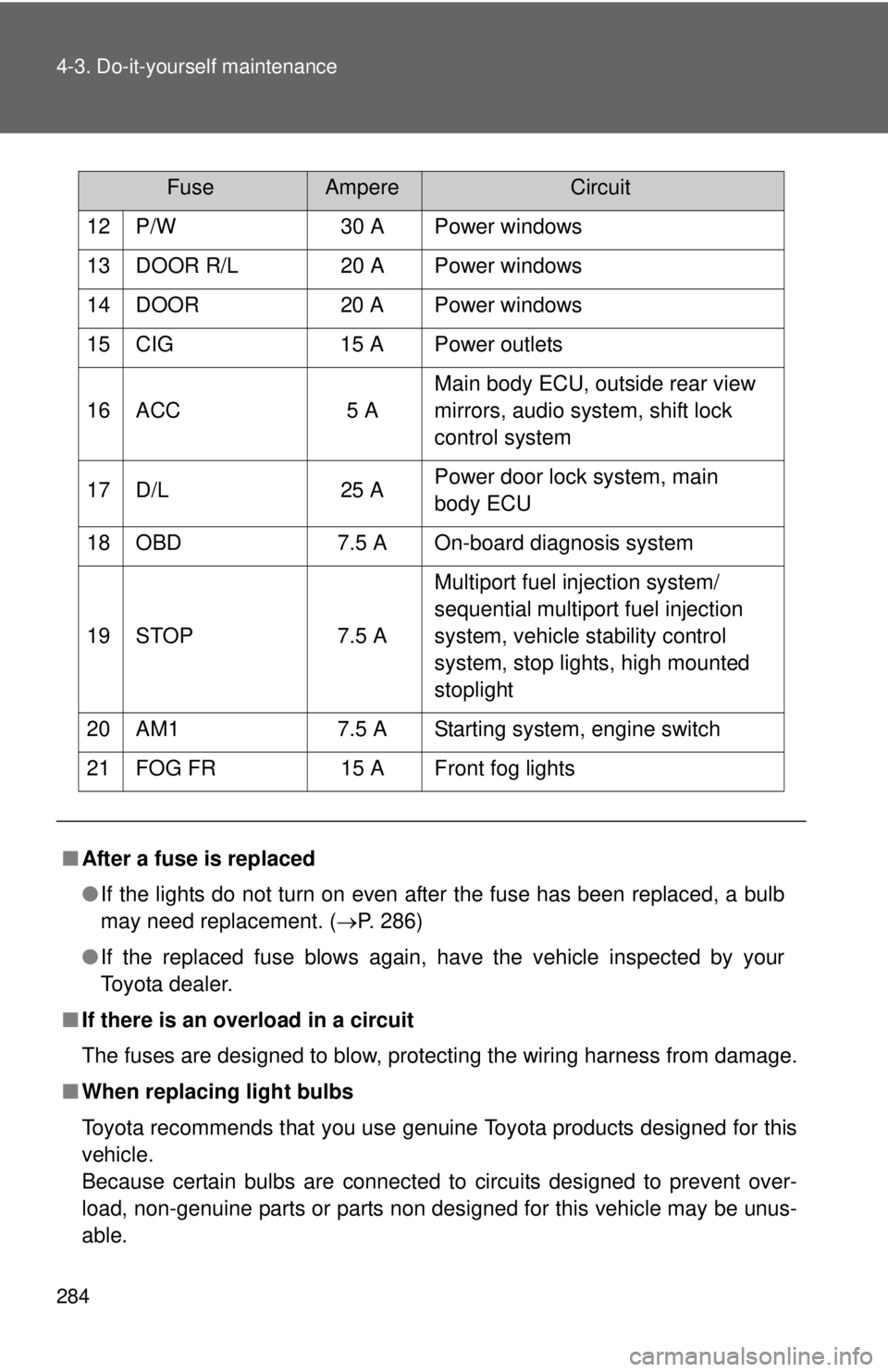
12 P/W30 A Power windows
13 DOOR R/L 20 A Power windows
14 DOOR 20 A Power windows
15 CIG 15 A Power outlets
16 ACC 5 AMain body ECU, outside rear view
mirrors, audio system, shift lock
control system
17 D/L 25 APower door lock system, main
body ECU
18 OBD 7.5 A On-board diagnosis system
19 STOP 7.5 AMultiport fuel injection system/
sequential multiport fuel injection
system, vehicle stability control
system, stop lights, high mounted
stoplight
20 AM1 7.5 A Starting system, engine switch
21 FOG FR 15 A Front fog lights
■ After a fuse is replaced
●If the lights do not turn on even after the fuse has been replaced, a bulb
may need replacement. ( →P. 286)
● If the replaced fuse blows again, have the vehicle inspected by your
Toyota dealer.
■ If there is an overload in a circuit
The fuses are designed to blow, protecting the wiring harness from damage.
■ When replacing light bulbs
Toyota recommends that you use genuine Toyota products designed for this
vehicle.
Because certain bulbs are connected to circuits designed to prevent over-
load, non-genuine parts or parts non designed for this vehicle may be unus-
able.
FuseAmpereCircuit
Page 282 of 365
304
5-1. Essential information
Fuel pump shut off system
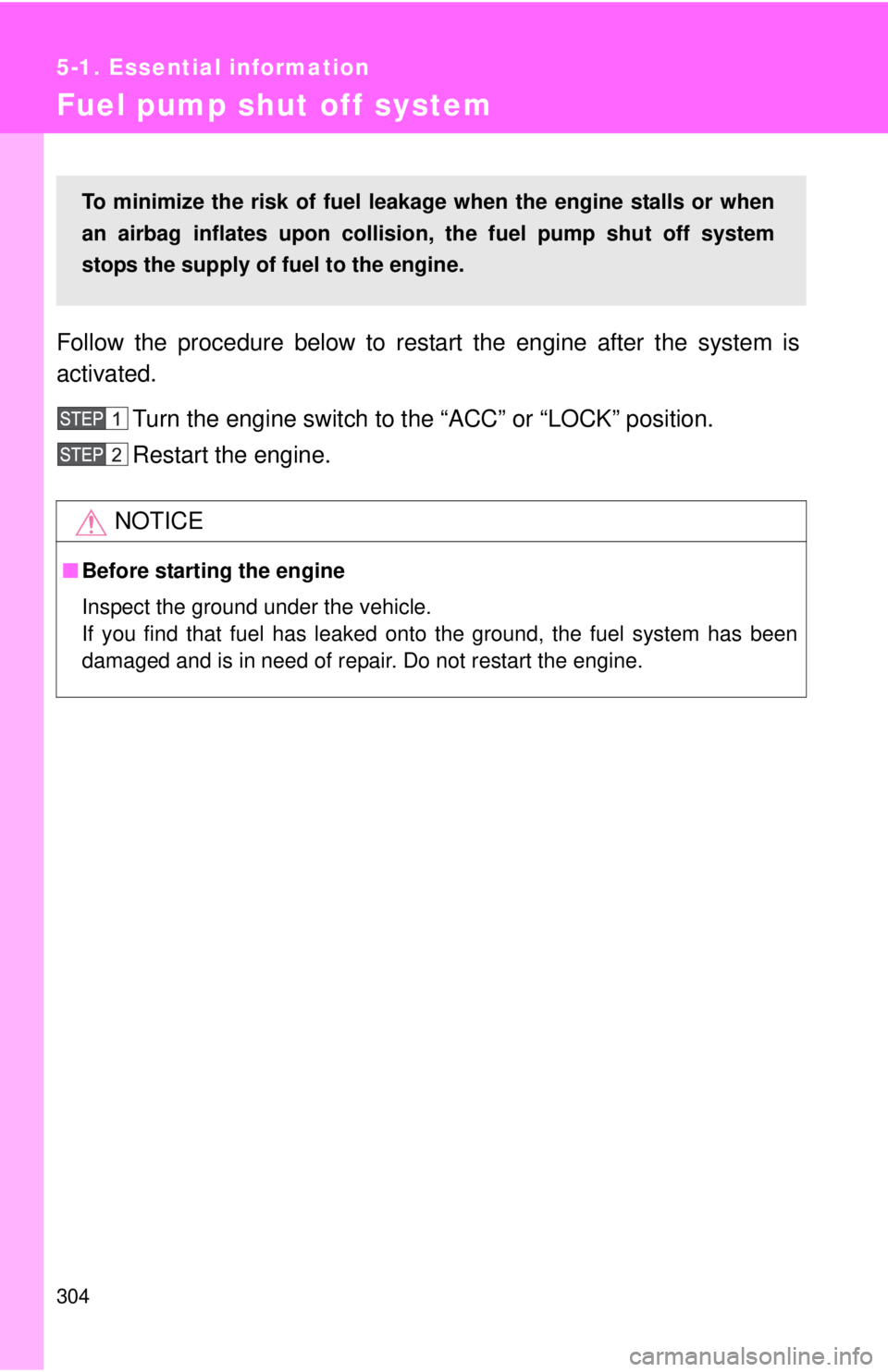
Follow the procedure below to restart the engine after the system is
activated.Turn the engine switch to the “ACC” or “LOCK” position.
Restart the engine.
NOTICE
■Before starting the engine
Inspect the ground under the vehicle.
If you find that fuel has leaked onto the ground, the fuel system has been
damaged and is in need of repair. Do not restart the engine.
To minimize the risk of fuel leakag e when the engine stalls or when
an airbag inflates upon collision, the fuel pump shut off system
stops the supply of fuel to the engine.
Page 285 of 365
5
When trouble arises
307
5-2. Steps to take in an emergency
Follow the correction procedures.
After taking the specified steps to correct the suspected problem,
check that the warning light goes off.
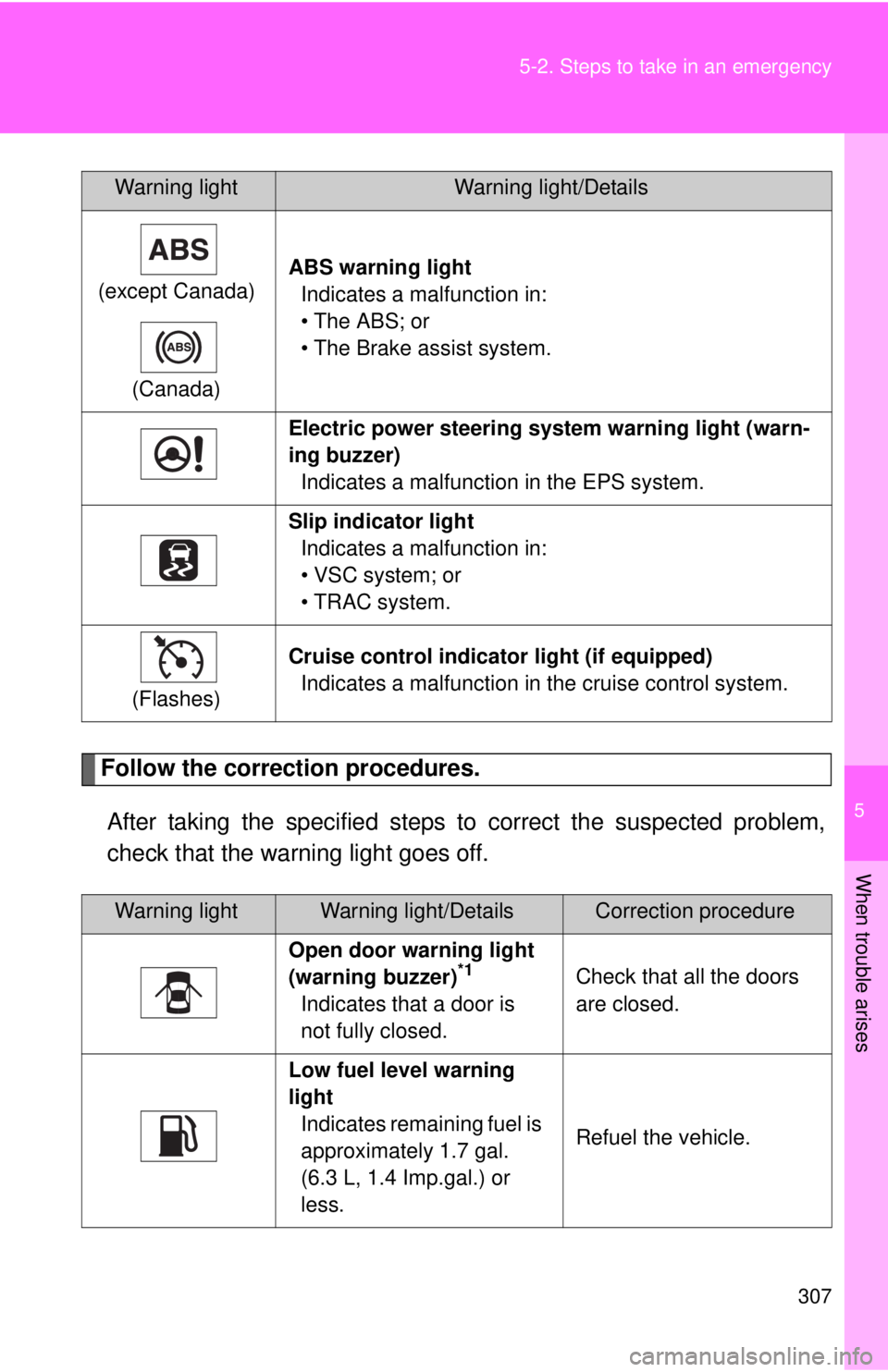
(except Canada)
(Canada) ABS warning light
Indicates a malfunction in:
• The ABS; or
• The Brake assist system.
Electric power steering syst em warning light (warn-
ing buzzer) Indicates a malfunction in the EPS system.
Slip indicator light Indicates a malfunction in:
• VSC system; or
• TRAC system.
(Flashes) Cruise control indicator light (if equipped)
Indicates a malfunction in the cruise control system.
Warning lightWarning light/DetailsCorrection procedure
Open door warning light
(warning buzzer)
*1
Indicates that a door is
not fully closed. Check that all the doors
are closed.
Low fuel level warning
light Indicates remaining fuel is
approximately 1.7 gal.
(6.3 L, 1.4 Imp.gal.) or
less. Refuel the vehicle.
Warning lightWarning light/Details
Page 288 of 365

310 5-2. Steps to take in an emergency
■SRS warning light
This warning light system monitors the airbag sensor assembly, front impact
sensors, side impact sensors, driver’s seat belt buckle switch, front passen-
ger occupant classification system (ECU and sensors), “AIR BAG ON” indi-
cator light, “AIR BAG OFF” indicator light, front passenger’s seat belt buckle
switch, seat belt pretensioner assemblies, airbags, interconnecting wiring
and power sources. ( →P. 80)
■ Front passenger detection sensor, passenger seat belt reminder and
warning buzzer
●If luggage is placed on the front passenger seat, the front passenger
detection sensor may cause the warning light to flash and the warning
buzzer to sound even if a passenger is not sitting in the seat.
● If a cushion is placed on the seat, the sensor may not detect a passen-
ger, and the warning light may not operate properly.
■ Electric power steering system warning light (warning buzzer)
The electric power steering system warning light may come on and the
warning buzzer may sound when the voltage is low or the voltage drops.
■ If the malfunction indicator lamp comes on while driving
First check the following:
● Is the fuel tank empty?
If it is, fill the fuel tank immediately.
● Is the fuel tank cap loose?
If it is, tighten it securely.
The malfunction indicator lamp will go off after several driving trips.
If the malfunction indicator lamp does not go off even after several trips, con-
tact your Toyota dealer as soon as possible.
■
When the tire pressure warning li ght comes on (vehicles with a tire
pressure warning system)
Check the tire inflation pressure and adjust to the appropriate level.
Pushing the tire pressure warning reset switch will not turn off the tire
pressure warning light.
Page 291 of 365
5
When trouble arises
313
5-2. Steps to take in an emergency
CAUTION
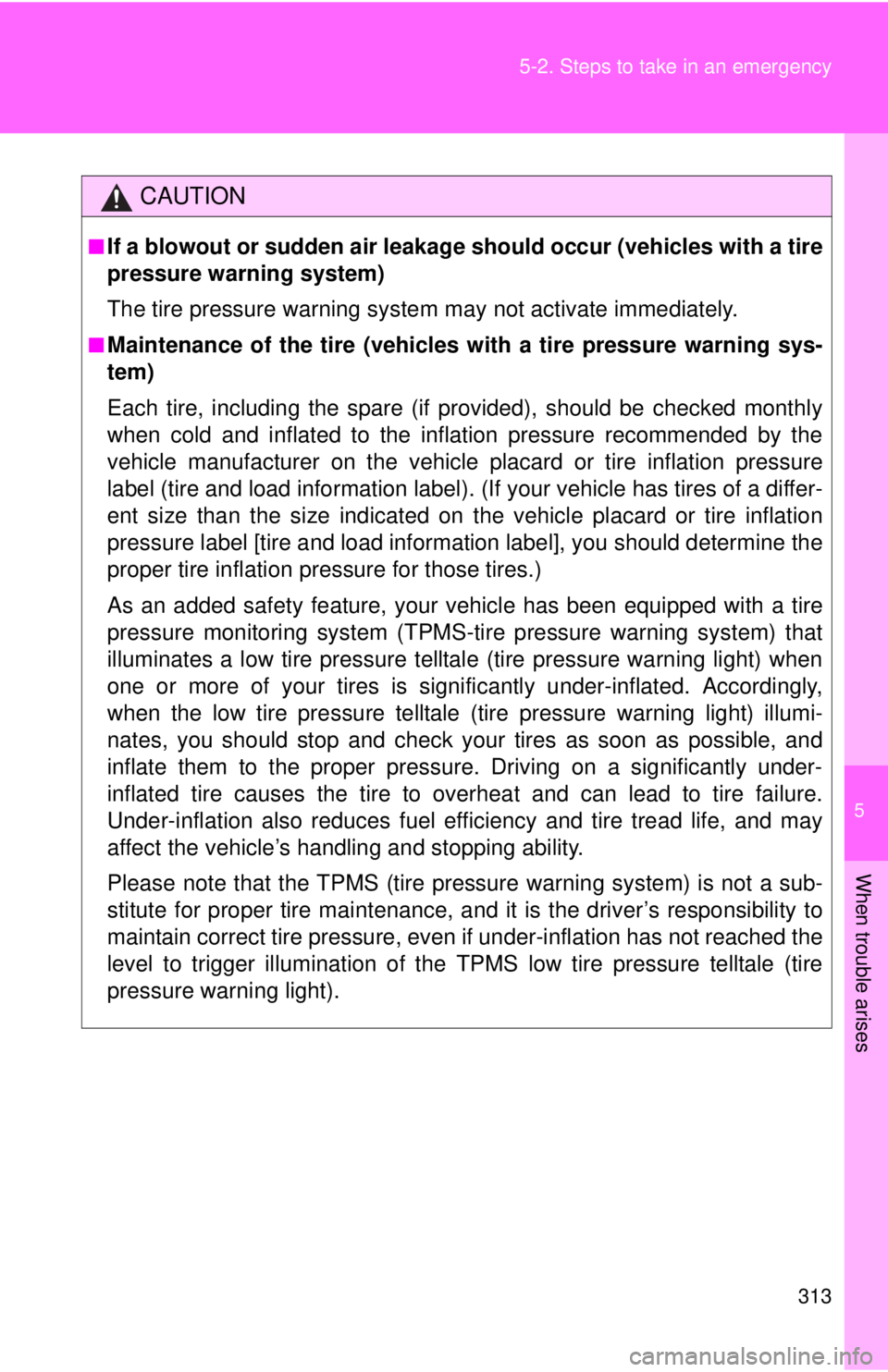
■If a blowout or sudden air leakage
should occur (vehicles with a tire
pressure warning system)
The tire pressure warning syste m may not activate immediately.
■Maintenance of the tire (vehicles with a tire pressure warning sys-
tem)
Each tire, including the spare (if provided), should be checked monthly
when cold and inflated to the inflation pressure recommended by the
vehicle manufacturer on the vehicle placard or tire inflation pressure
label (tire and load information label). (If your vehicle has tires of a differ-
ent size than the size indicated on the vehicle placard or tire inflation
pressure label [tire and load information label], you should determine the
proper tire inflation pr essure for those tires.)
As an added safety feature, your vehicle has been equipped with a tire
pressure monitoring system (TPMS-ti re pressure warning system) that
illuminates a low tire pressure telltal e (tire pressure warning light) when
one or more of your tires is significantly under-inflated. Accordingly,
when the low tire pressure telltale (tire pre ssure warning light) illumi-
nates, you should stop and check your tires as soon as possible, and
inflate them to the proper pressure. Driving on a significantly under-
inflated tire causes the tire to overheat and can lead to tire failure.
Under-inflation also reduces fuel effi ciency and tire tread life, and may
affect the vehicle’s handling and stopping ability.
Please note that the TPMS (tire pressure warning system) is not a sub-
stitute for proper tire ma intenance, and it is the driver’s responsibility to
maintain correct tire pressure, even if under-inflation has not reached the
level to trigger illu mination of the TPMS low ti re pressure telltale (tire
pressure warning light).
Page 305 of 365
5
When trouble arises
327
5-2. Steps to take in an emergency
If the engine will not start
If the engine will not start even though correct starting procedures
are being followed ( →P. 124), consider each of the following points:
■ The engine will not start even though the starter motor
operates normally.
One of the following may be the cause of the problem:
●There may not be sufficient fuel in the vehicle’s tank.
Refuel the vehicle.
● The engine may be flooded.
Try to restart the engine again following correct starting proce-
dures. ( →P. 124)
● Vehicles with engine immobilizer system: There may be a
malfunction in the engine immobilizer system. (→P. 7 2 )
■ The starter motor turns over slowly, the interior lights and
headlights are dim, or the horn does not sound or sounds at
a low volume.
One of the following may be the cause of the problem:
●The battery may be discharged. ( →P. 330)
● The battery terminal connec tions may be loose or corroded.
■ The starter motor does not turn over, the interior lights and
headlights do not turn on, or the horn does not sound.
One of the following may be the cause of the problem:
● One or both of the battery terminals may be disconnected.
● The battery may be discharged. ( →P. 330)
Contact your Toyota dealer if the problem cannot be repaired, or if
repair procedures are unknown.