lock TOYOTA YARIS HATCHBACK 2012 Owner's Manual
[x] Cancel search | Manufacturer: TOYOTA, Model Year: 2012, Model line: YARIS HATCHBACK, Model: TOYOTA YARIS HATCHBACK 2012Pages: 365, PDF Size: 8.17 MB
Page 32 of 365
50 1-3. Adjustable components (seats, mirrors, steering wheel)
CAUTION
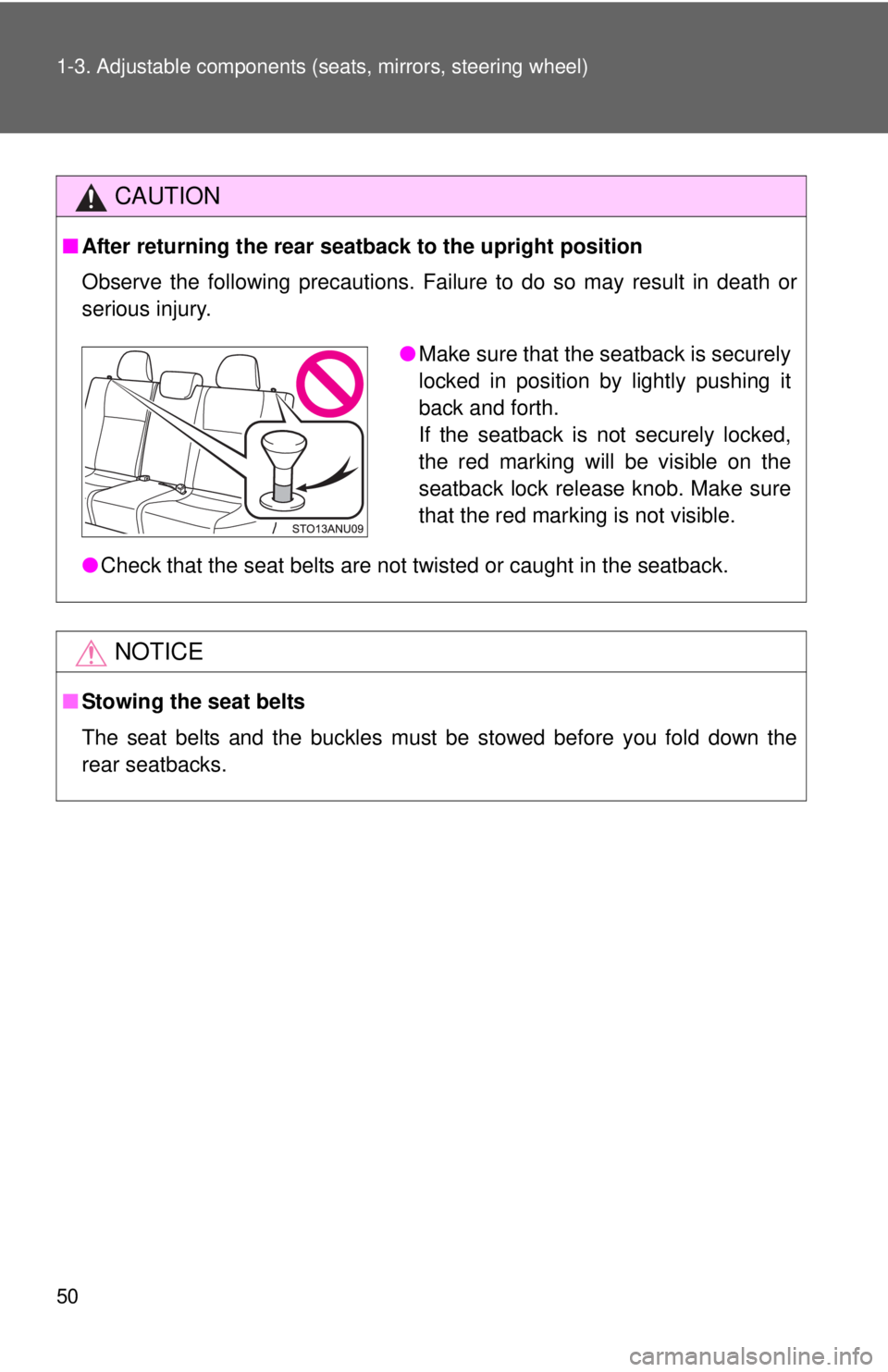
■After returning the rear seatback to the upright position
Observe the following precautions. Failure to do so may result in death or
serious injury.
●Check that the seat belts are not twisted or caught in the seatback.
NOTICE
■Stowing the seat belts
The seat belts and the buckles must be stowed before you fold down the
rear seatbacks.
●Make sure that the seatback is securely
locked in position by lightly pushing it
back and forth.
If the seatback is not securely locked,
the red marking will be visible on the
seatback lock release knob. Make sure
that the red marking is not visible.
Page 33 of 365
51
1
1-3. Adjustable components (seats, mirrors, steering wheel)
Before driving
Head restraints
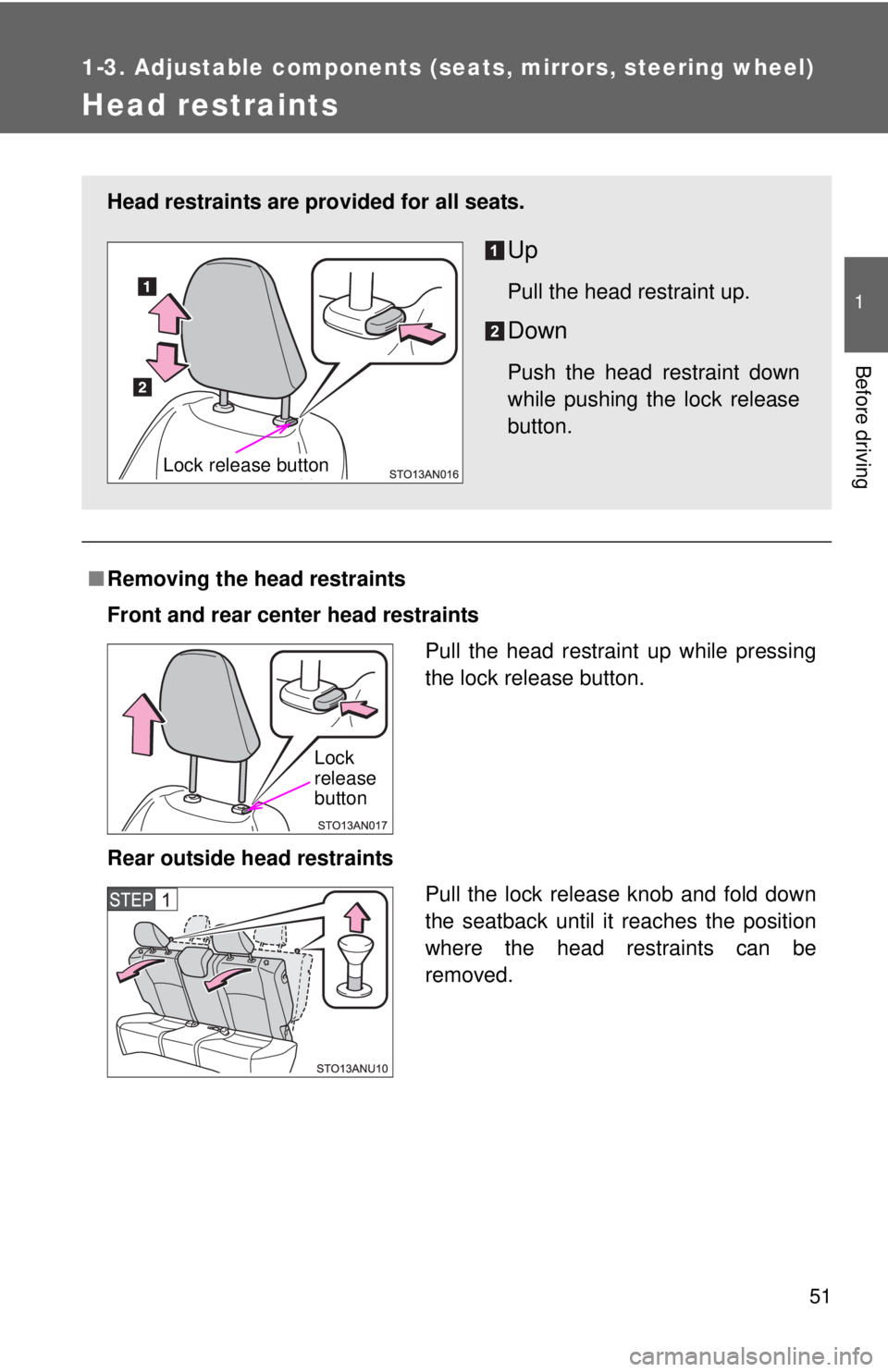
■Removing the head restraints
Front and rear center head restraints
Rear outside head restraints Head restraints are provided for all seats.
Up
Pull the head restraint up.
Down
Push the head restraint down
while pushing the lock release
button.
Lock release button
Pull the head restraint up while pressing
the lock release button.
Lock
release
button
Pull the lock release knob and fold down
the seatback until it reaches the position
where the head restraints can be
removed.
Page 34 of 365
52 1-3. Adjustable components (seats, mirrors, steering wheel)
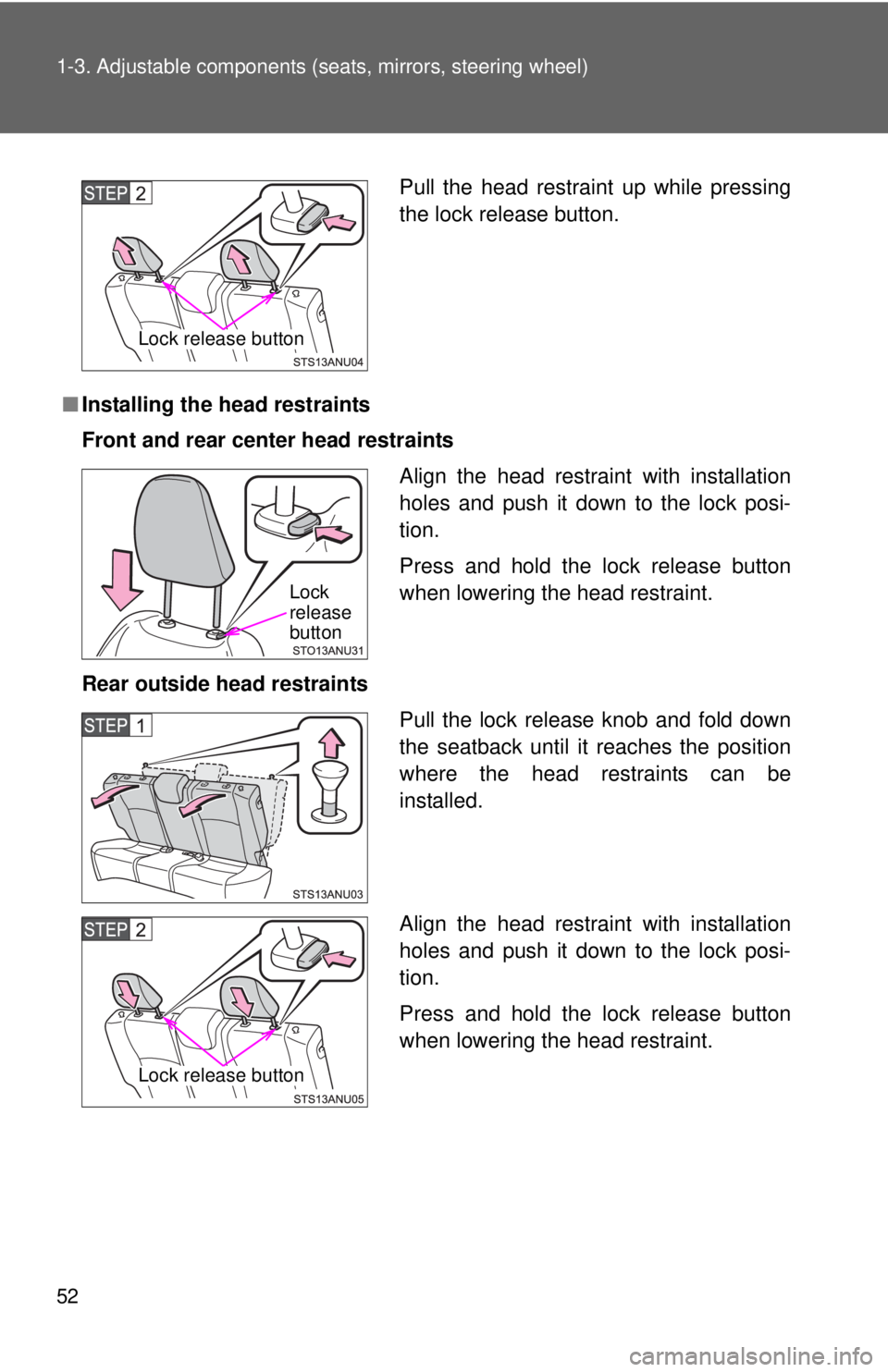
■Installing the head restraints
Front and rear center head restraints
Rear outside head restraints Pull the head restraint up while pressing
the lock release button.
Lock release button
Align the head restraint with installation
holes and push it down to the lock posi-
tion.
Press and hold the lock release button
when lowering the head restraint.
Lock
release
button
Pull the lock release knob and fold down
the seatback until it reaches the position
where the head restraints can be
installed.
Align the head restraint with installation
holes and push it down to the lock posi-
tion.
Press and hold the lock release button
when lowering the head restraint.
Lock release button
Page 35 of 365
53
1-3. Adjustable components (s
eats, mirrors, steering wheel)
1
Before driving
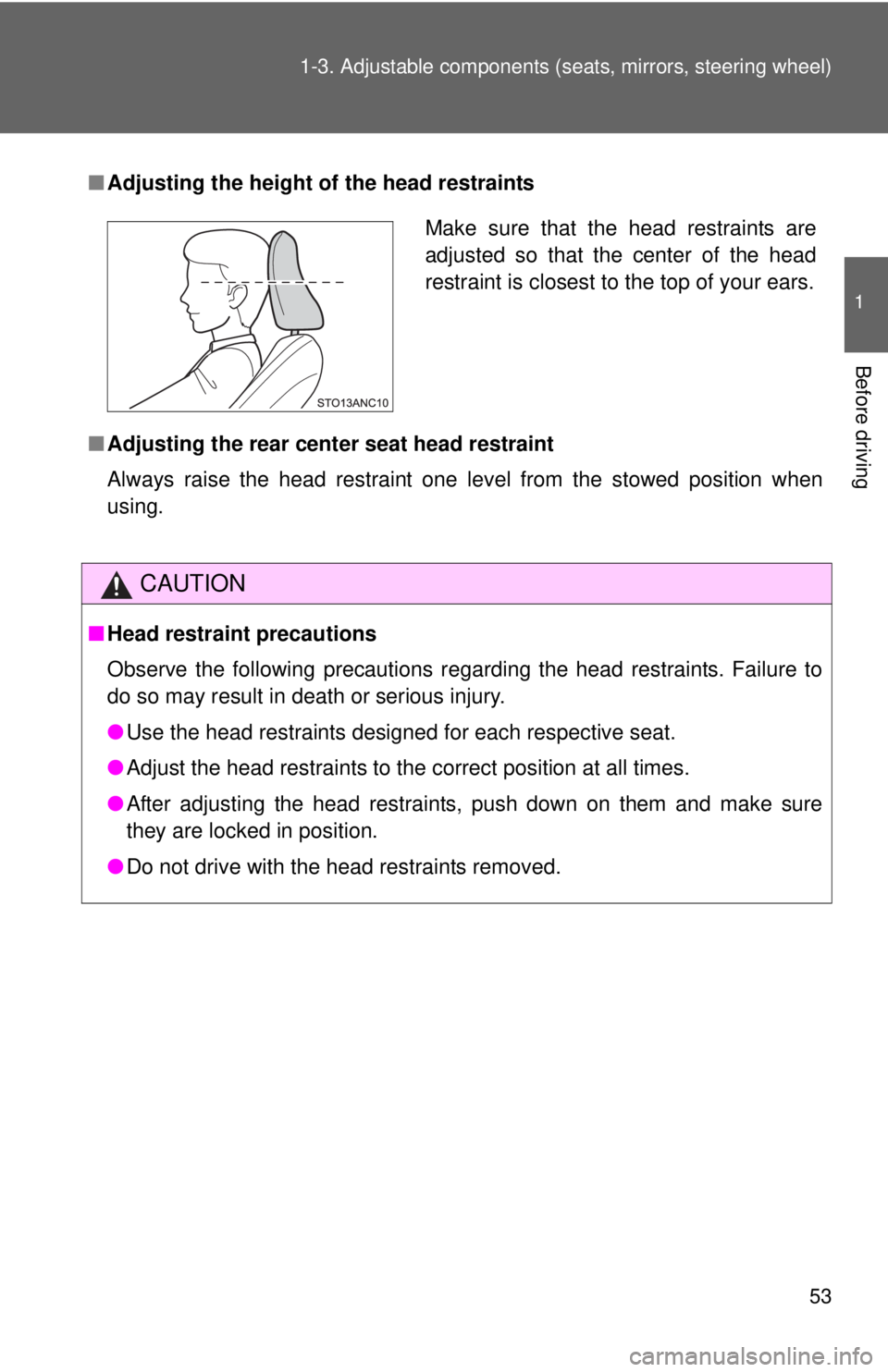
■Adjusting the height of the head restraints
■ Adjusting the rear cent er seat head restraint
Always raise the head restraint one level from the stowed position when
using.
CAUTION
■ Head restraint precautions
Observe the following precautions regarding the head restraints. Failure to
do so may result in death or serious injury.
●Use the head restraints designed for each respective seat.
● Adjust the head restraints to the correct position at all times.
● After adjusting the head restraints, push down on them and make sure
they are locked in position.
● Do not drive with the head restraints removed.
Make sure that the head restraints are
adjusted so that the center of the head
restraint is closest to the top of your ears.
Page 39 of 365
57
1-3. Adjustable components (s
eats, mirrors, steering wheel)
1
Before driving
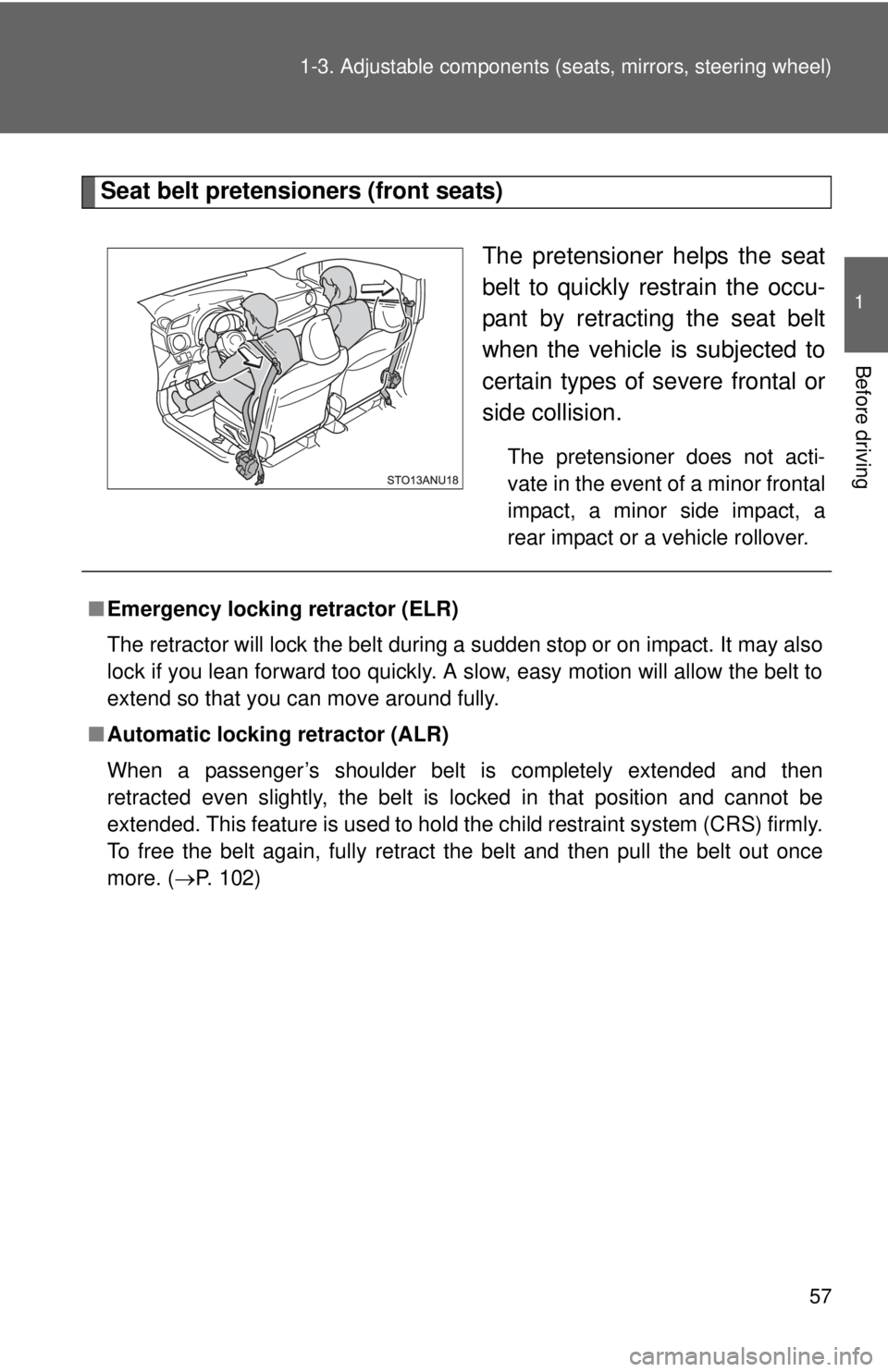
Seat belt pretensioners (front seats)
The pretensioner helps the seat
belt to quickly restrain the occu-
pant by retracting the seat belt
when the vehicle is subjected to
certain types of severe frontal or
side collision.
The pretensioner does not acti-
vate in the event of a minor frontal
impact, a minor side impact, a
rear impact or a vehicle rollover.
■Emergency locking retractor (ELR)
The retractor will lock the belt during a sudden stop or on impact. It may also
lock if you lean forward too quickly. A slow, easy motion will allow the belt to
extend so that you can move around fully.
■ Automatic locking retractor (ALR)
When a passenger’s shoulder belt is completely extended and then
retracted even slightly, the belt is locked in that position and cannot be
extended. This feature is used to hold the child restraint system (CRS) firmly.
To free the belt again, fully retract the belt and then pull the belt out once
more. ( →P. 102)
Page 42 of 365
60 1-3. Adjustable components (seats, mirrors, steering wheel)
CAUTION
■Seat belt damage and wear
●Do not damage the seat belts by allowing the belt, plate, or buckle to be
jammed in the door.
● Inspect the seat belt system periodically. Check for cuts, fraying, and loose
parts. Do not use a damaged seat belt until it is replaced. Damaged seat
belts cannot protect an occupant from death or serious injury.
● Ensure that the belt and plate are locked and the belt is not twisted.
If the seat belt does not function correctly, immediately contact your Toyota
dealer.
● Replace the seat assembly, including the belts, if your vehicle has been
involved in a serious accident, even if there’s no obvious damage.
● Do not attempt to install, remove, modify, disassemble or dispose of the
seat belts. Have any necessary repairs carried out by your Toyota dealer.
Inappropriate handling of the pretensioner may prevent it from operating
properly, resulting in death or serious injury.
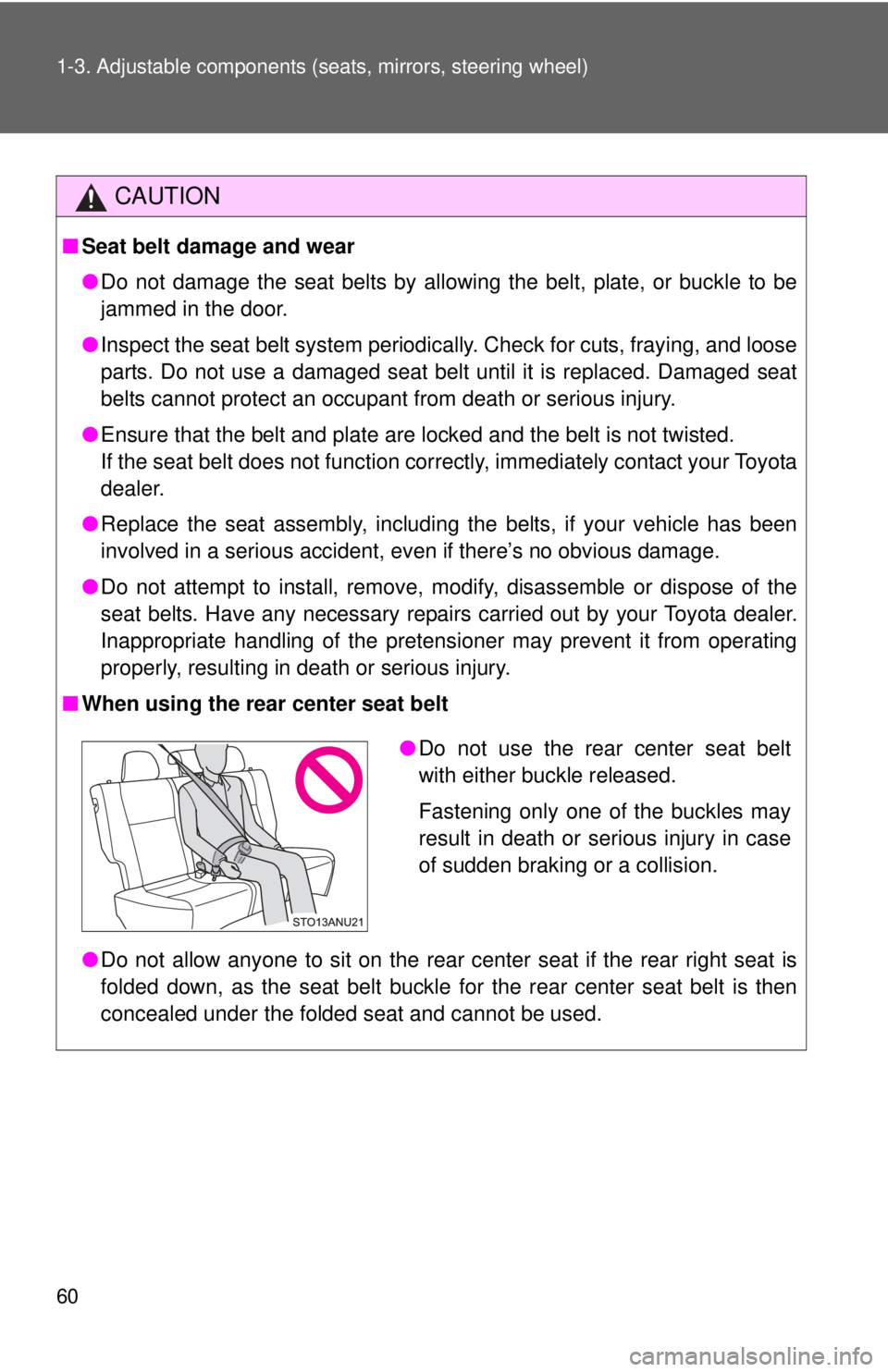
■ When using the rear center seat belt
●Do not allow anyone to sit on the rear center seat if the rear right seat is
folded down, as the seat belt buckle for the rear center seat belt is then
concealed under the folded seat and cannot be used.
●Do not use the rear center seat belt
with either buckle released.
Fastening only one of the buckles may
result in death or serious injury in case
of sudden braking or a collision.
Page 44 of 365
62
1-3. Adjustable components (seats, mirrors, steering wheel)
Steering wheel
CAUTION
■Caution while driving
Do not adjust the steering wheel while driving.
Doing so may cause the driver to mishandle the vehicle and cause an acci-
dent, resulting in death or serious injury.
■ After adjusting the steering wheel
Make sure that the steering wheel is securely locked.
Otherwise, the steering wheel may move suddenly, possibly causing an
accident, and resulting in death or serious injury.
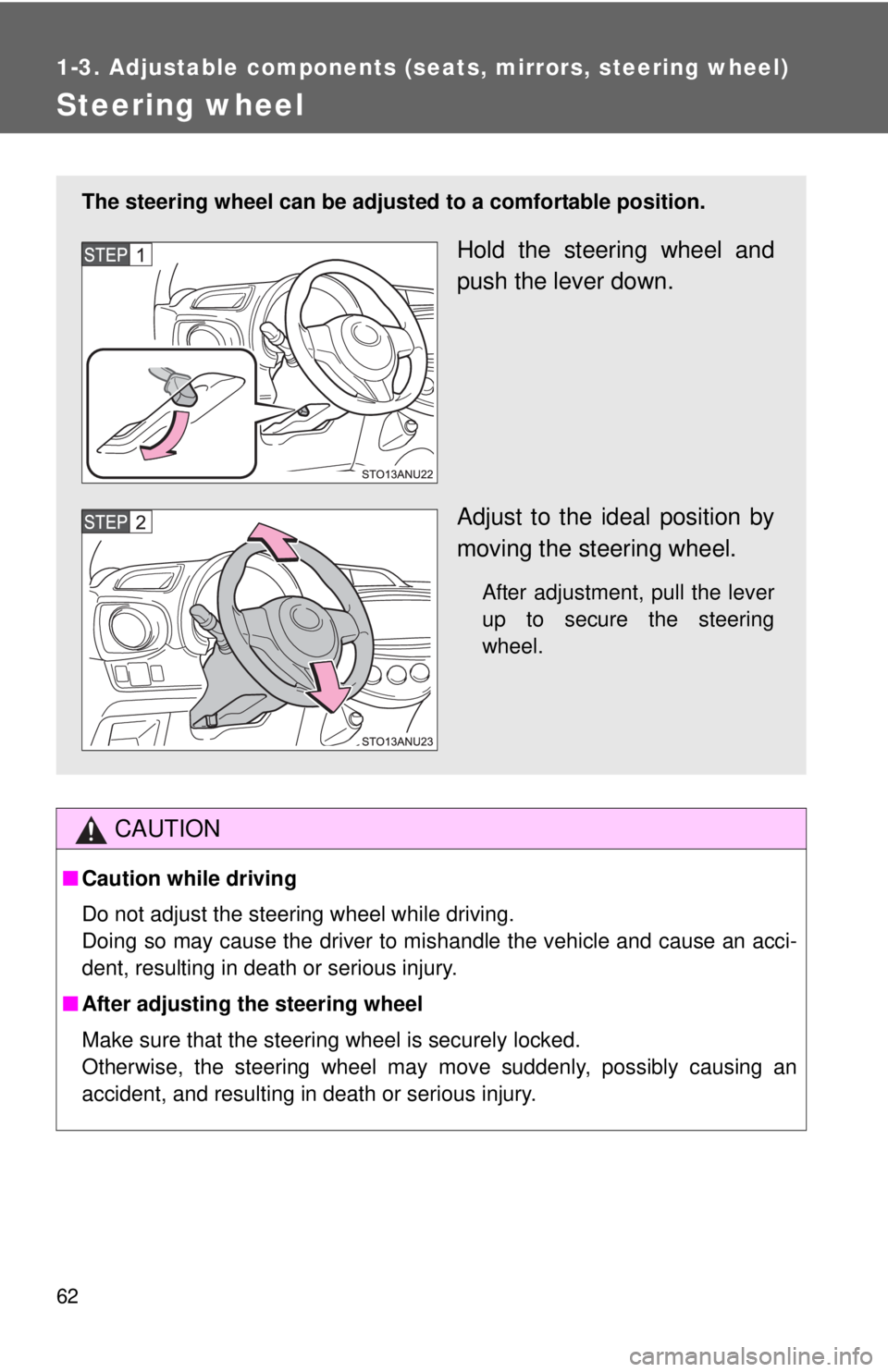
The steering wheel can be adjust ed to a comfortable position.
Hold the steering wheel and
push the lever down.
Adjust to the ideal position by
moving the steering wheel.
After adjustment, pull the lever
up to secure the steering
wheel.
Page 49 of 365
67
1
Before driving
1-4. Opening and closing the windows
Power windows∗
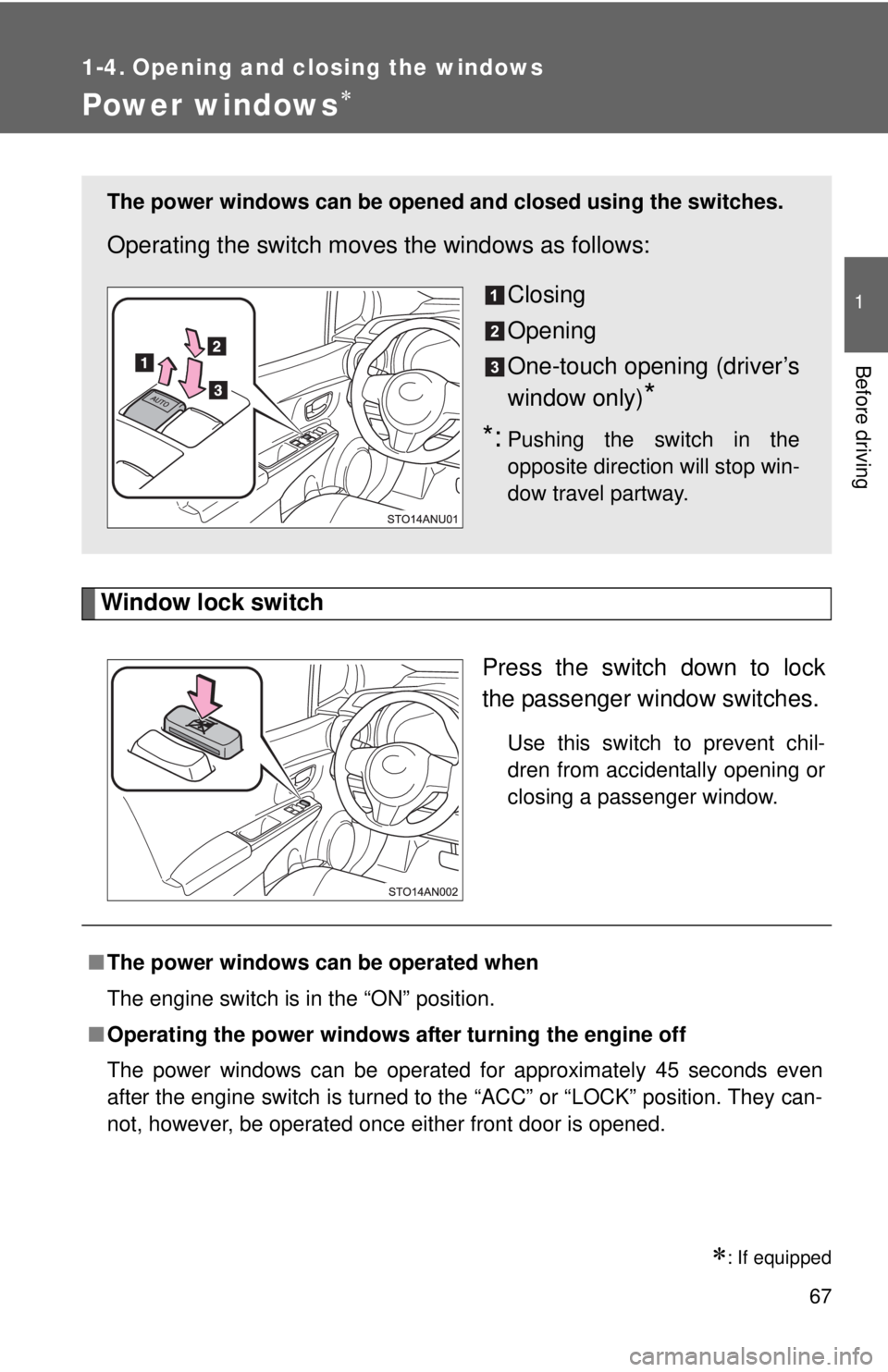
Window lock switchPress the switch down to lock
the passenger window switches.
Use this switch to prevent chil-
dren from accidentally opening or
closing a passenger window.
∗: If equipped
The power windows can be opened and closed using the switches.
Operating the switch moves the windows as follows:
Closing
Opening
One-touch opening (driver’s
window only)
*
*:Pushing the switch in the
opposite direction will stop win-
dow travel partway.
■The power windows can be operated when
The engine switch is in the “ON” position.
■ Operating the power windows after turning the engine off
The power windows can be operated for approximately 45 seconds even
after the engine switch is turned to the “ACC” or “LOCK” position. They can-
not, however, be operated once either front door is opened.
Page 56 of 365
74
1-6. Theft deterrent system
Alarm (Puerto Rico)
The system sounds the alarm and flashes the lights when forced
entry is detected.
■ Triggering of the alarm
The alarm is triggered in the fo llowing situations when the alarm
is set:
● A locked door is unlocked or opened in any way other than
using a key or wireless remote control. (The doors will lock
again automatically.)
● The hood is opened.
● The battery is reconnected.
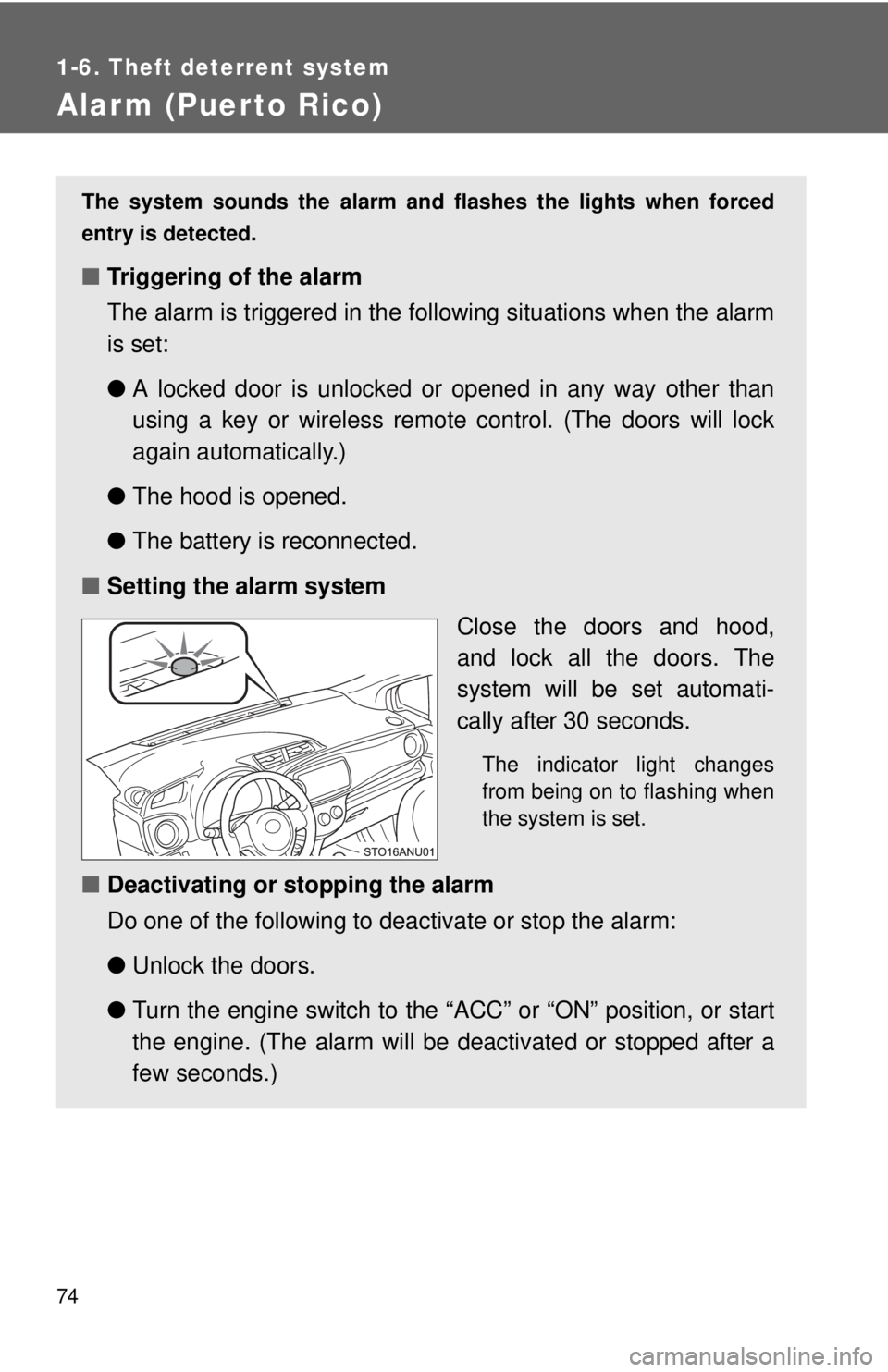
■ Setting the alarm system
Close the doors and hood,
and lock all the doors. The
system will be set automati-
cally after 30 seconds.
The indicator light changes
from being on to flashing when
the system is set.
■Deactivating or stopping the alarm
Do one of the following to deactivate or stop the alarm:
●Unlock the doors.
● Turn the engine switch to the “ACC” or “ON” position, or start
the engine. (The alarm will be deactivated or stopped after a
few seconds.
)
Page 57 of 365
75
1-6. Theft deterrent system
1
Before driving
■
System maintenance
The vehicle has a maintenance-free type alarm system.
■ Items to check before locking the vehicle
To prevent unexpected triggering of the alarm and vehicle theft, make sure
of the following:
●Nobody is in the vehicle.
● The windows are closed before the alarm is set.
● No valuables or other personal items are left in the vehicle.
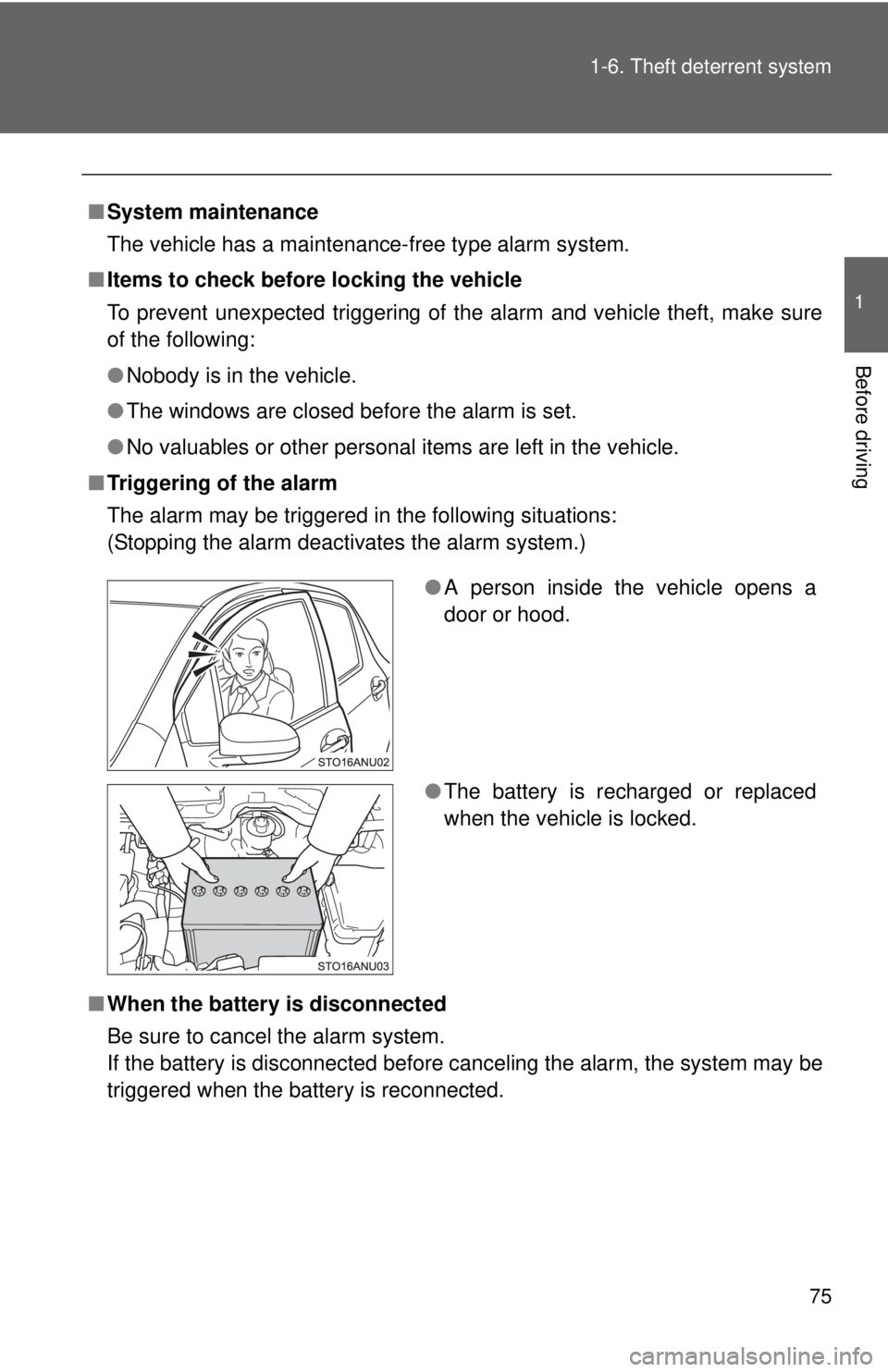
■ Triggering of the alarm
The alarm may be triggered in the following situations:
(Stopping the alarm deactivates the alarm system.)
■ When the battery is disconnected
Be sure to cancel the alarm system.
If the battery is disconnected before canceling the alarm, the system may be
triggered when the battery is reconnected. ●
A person inside the vehicle opens a
door or hood.
● The battery is recharged or replaced
when the vehicle is locked.