belt TOYOTA YARIS HATCHBACK 2012 Workshop Manual
[x] Cancel search | Manufacturer: TOYOTA, Model Year: 2012, Model line: YARIS HATCHBACK, Model: TOYOTA YARIS HATCHBACK 2012Pages: 365, PDF Size: 8.17 MB
Page 290 of 365
312 5-2. Steps to take in an emergency
●If non-genuine Toyota wheels are used (Even if you use Toyota
wheels, the tire pressure warning system may not work properly with
some types of tires.)
●If tire chains are used
■If the tire pressure warning light frequently comes on after blinking
for 1 minute (vehicles with a tire pressure warning system)
If the tire pressure warning light frequently comes on after blinking for 1
minute when the engine switch is turned to the “ON” position, have it
checked by your Toyota dealer.
■ Customization that can be co nfigured at Toyota dealer
The vehicle speed linked seat belt reminder buzzer can be disabled.
(Customizable features →P. 368) However, Toyota recommends that the
seat belt reminder buzzer be operational to alert the driver and front passen-
ger when seat belts are not fastened.
CAUTION
■ When the electric power steerin g system warning light comes on
The steering wheel may become extremely heavy.
If the steering wheel becomes heavier than usual when operating, hold
firmly and operate using more force than usual.
■
If the tire pressure warning light comes on (vehicles with a tire
pressure warning system)
Be sure to observe the following precautions. Failure to do so could
cause a loss of vehicle control and result in death or serious injury.
●Stop your vehicle in a safe place as soon as possible. Adjust the tire
inflation pressure immediately.
●If the tire pressure warning light comes on even after tire inflation pres-
sure adjustment, it is pr obable that you have a flat tire. Check the tires.
If a tire is flat, change it with th e spare tire and have the flat tire
repaired by the nearest Toyota dealer.
●Avoid abrupt maneuvering and braking. If the vehicle tires deteriorate,
you could lose control of the steering wheel or the brakes.
Page 293 of 365
5
When trouble arises
315
5-2. Steps to take in an emergency
If you have a flat tire
Remove the flat tire and replace it with the spare tire provided.
■Before jacking up the vehicle
●Stop the vehicle on a hard, flat surface.
● Set the parking brake.
● Shift the shift lever to P (vehicles with an automatic transmis-
sion) or R (vehicles with a manual transmission).
● Stop the engine.
● Turn on the emergency flashers.
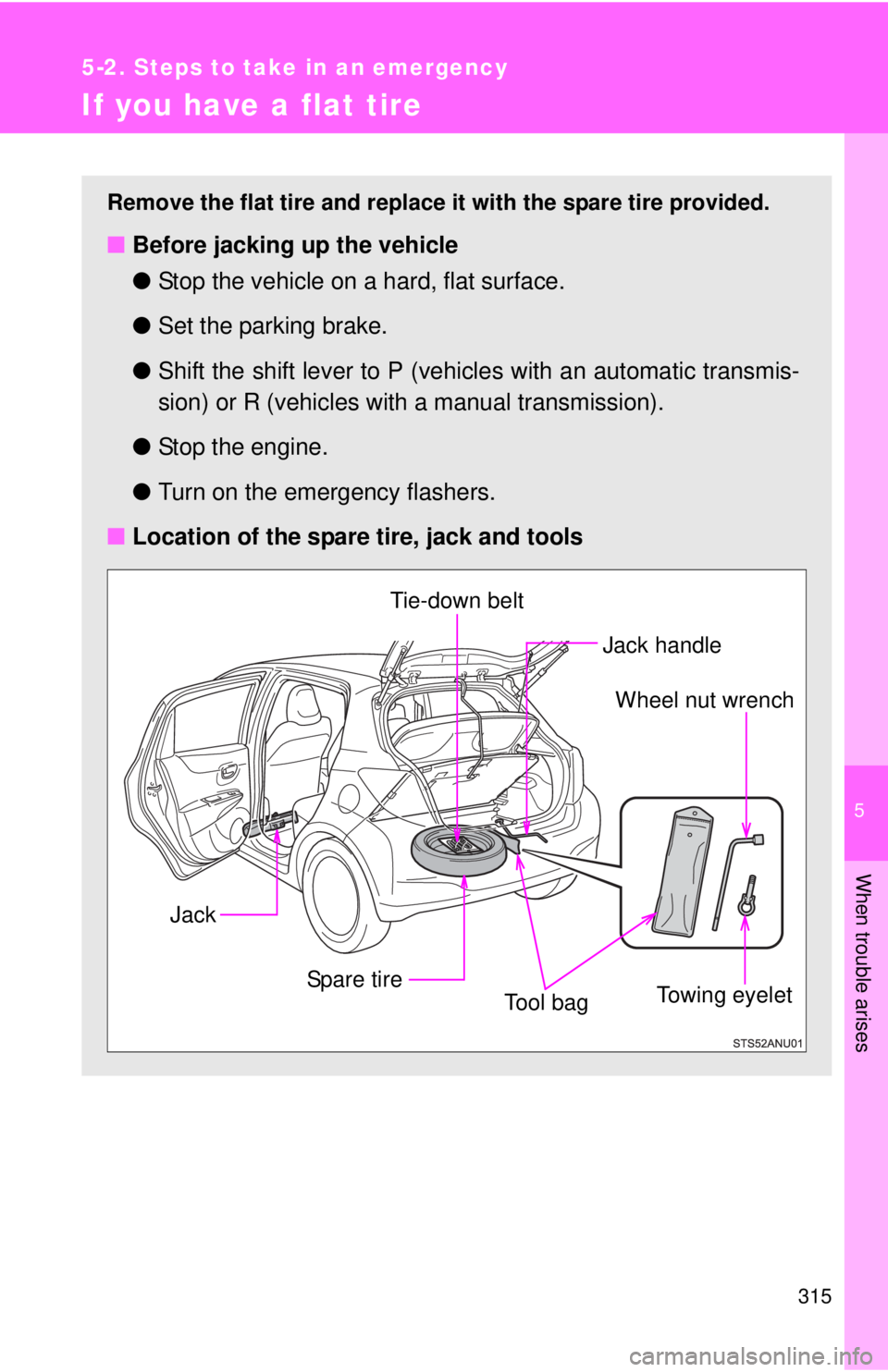
■ Location of the spare tire, jack and tools
Jack handle
Tie-down belt
Tool bag
Spare tire
Jack
Wheel nut wrench
Towing eyelet
Page 299 of 365
5
When trouble arises
321
5-2. Steps to take in an emergency
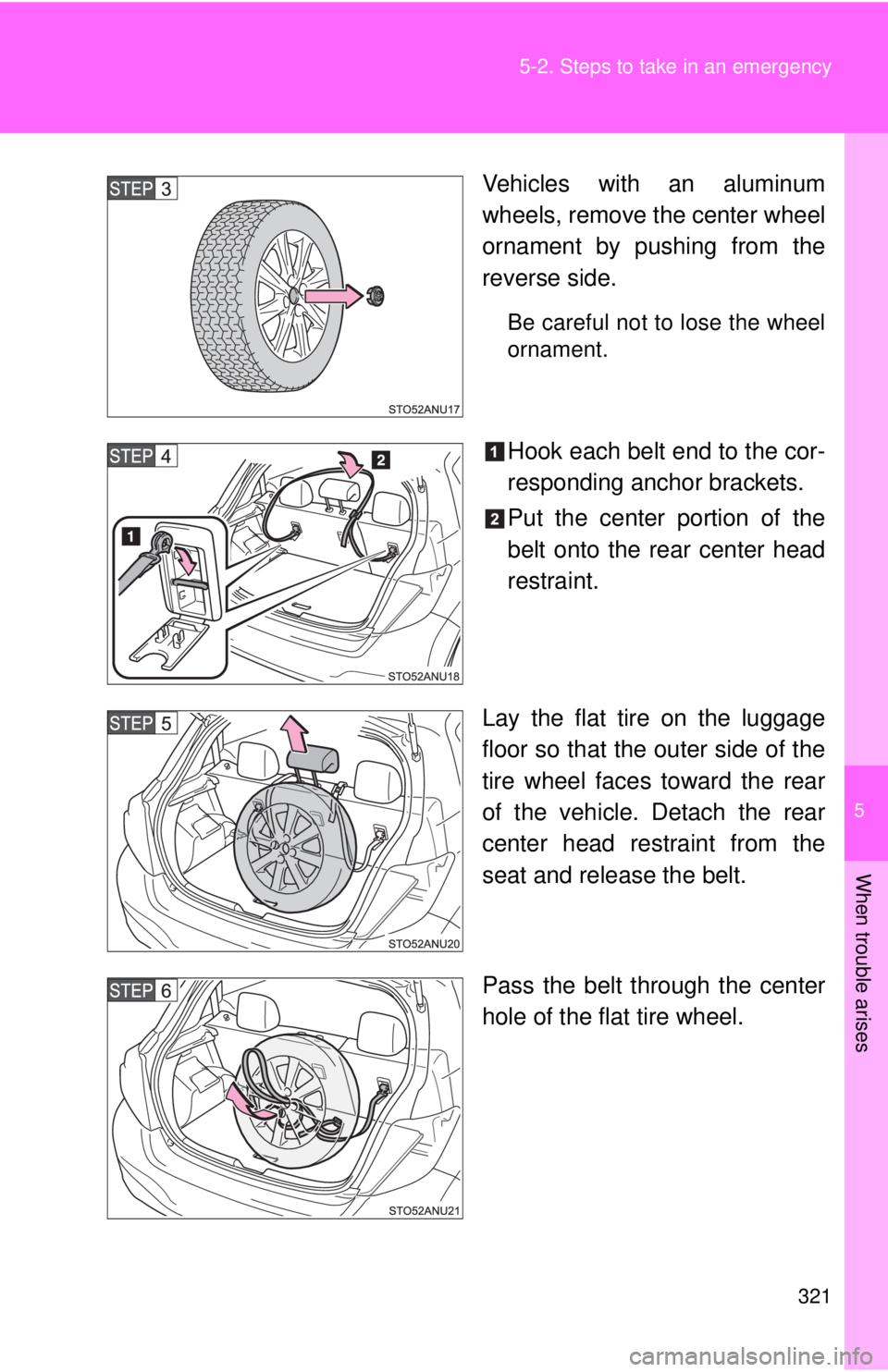
Vehicles with an aluminum
wheels, remove the center wheel
ornament by pushing from the
reverse side.
Be careful not to lose the wheel
ornament.
Hook each belt end to the cor-
responding anchor brackets.
Put the center portion of the
belt onto the rear center head
restraint.
Lay the flat tire on the luggage
floor so that the outer side of the
tire wheel faces toward the rear
of the vehicle. Detach the rear
center head restraint from the
seat and release the belt.
Pass the belt through the center
hole of the flat tire wheel.
Page 300 of 365
322 5-2. Steps to take in an emergency
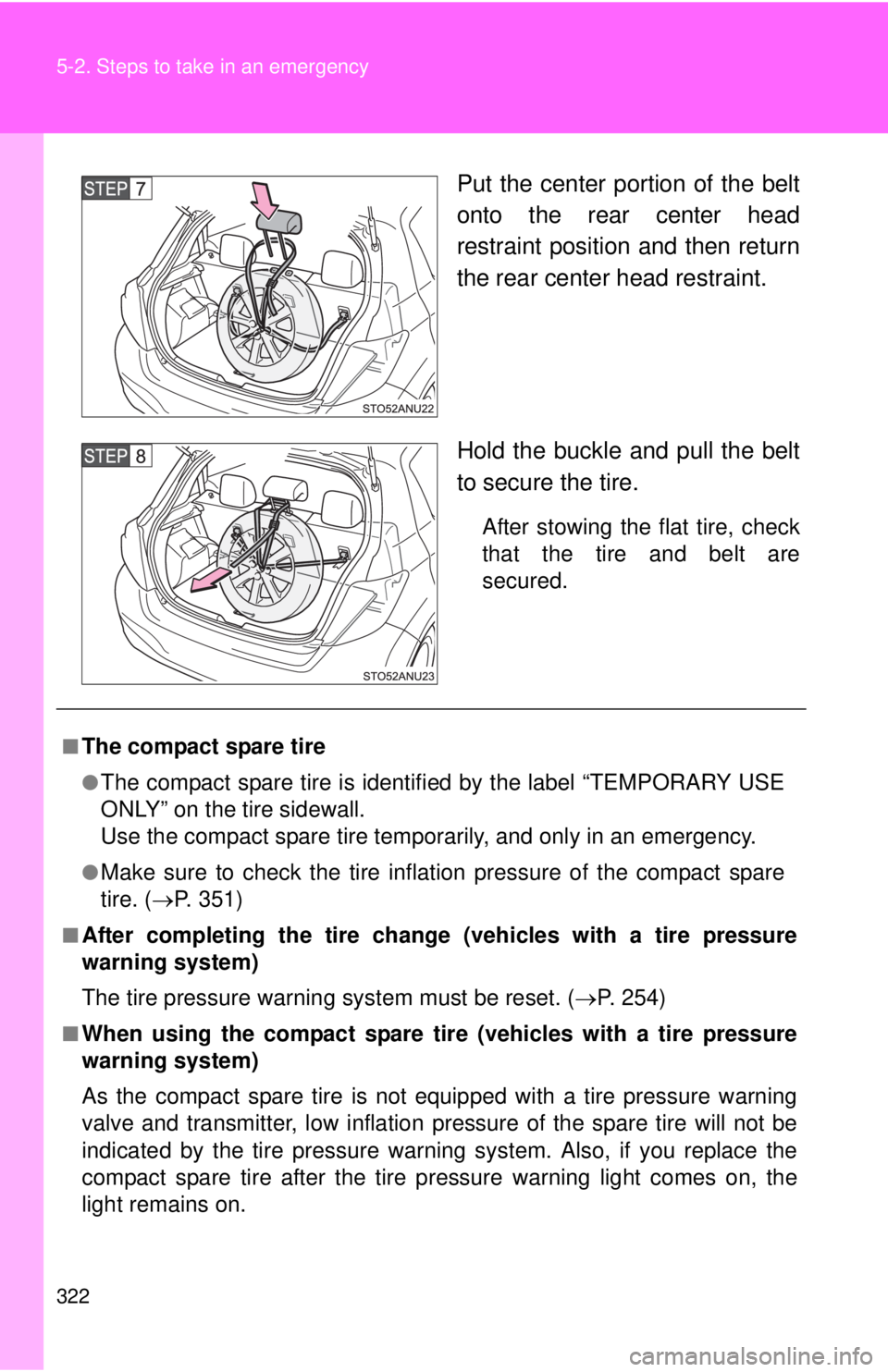
Put the center portion of the belt
onto the rear center head
restraint position and then return
the rear center head restraint.
Hold the buckle and pull the belt
to secure the tire.
After stowing the flat tire, check
that the tire and belt are
secured.
■The compact spare tire
●The compact spare tire is identified by the label “TEMPORARY USE
ONLY” on the tire sidewall.
Use the compact spare tire temporarily, and only in an emergency.
●Make sure to check the tire inflation pressu re of the compact spare
tire. ( →P. 351)
■After completing the tire change (vehicles with a tire pressure
warning system)
The tire pressure warnin g system must be reset. ( →P. 254)
■When using the compact spare tire (vehicles with a tire pressure
warning system)
As the compact spare tire is not equipped with a tire pressure warning
valve and transmitter, low inflation pressure of the spare tire will not be
indicated by the tire pressure warn ing system. Also, if you replace the
compact spare tire after the tire pressure warning light comes on, the
light remains on.
Page 303 of 365

5
When trouble arises
325
5-2. Steps to take in an emergency
CAUTION
■Replacing a flat tire
●Do not touch the disc wheels or the area around the brakes immedi-
ately after the vehicle has been driven.
After the vehicle has been driven the disc wheels and the area around
the brakes will be extremely hot.
Touching these areas with hands, feet
or other body parts while changing a tire, etc. may result in burns.
●Failure to follow these precautions could cause the wheel nuts to
loosen and the tire to fall off, resulting in death or serious injury.
• Have the wheel nuts tightened with a torque wrench to 76 ft·lbf (103 N·m, 10.5 kgf·m) as soon as po ssible after changing wheels.
• When installing a tire, only use wheel nuts that have been specifi- cally designed for that wheel.
• If there are any cracks or deformations in the bolt screws, nut threads or bolt holes of the wh eel, have the vehicle inspected by
your Toyota dealer.
• When installing the wheel nuts, be sure to install them with the
tapered ends facing inward. ( →P. 266)
■When stowing the flat tire
●Make sure the rear seats are in their original position.
● Secure it using a tire tie-down belt. Otherwise, the flat tire may fly out in
case of the sudden braking or an accident, resulting in death or serious
injury.
Page 311 of 365

5
When trouble arises
333
5-2. Steps to take in an emergency
NOTICE
■
When handling jumper cables
When connecting the jumper cables, ensure that they do not become entan-
gled in the cooling fans or belt.
Page 313 of 365
5
When trouble arises
335
5-2. Steps to take in an emergency
■
Overheating
If you observe the following, your vehicle may be overheating:
●The high engine coolant temperature warning light flashes or comes on
or a loss of power is experienced.
● Steam comes out from under the hood.
CAUTION
■To prevent an accident or injury when inspecting under the hood of
your vehicle
●If steam is seen coming from under the hood, do not open the hood until
the steam has subsided. The engine compartment may be very hot, caus-
ing serious injuries such as burns.
● Keep hands and clothing away from the fan and drive belt while the engine
is running.
● Do not loosen the radiator cap while the engine and radiator are hot.
Serious injury, such as burns, may result from hot coolant and steam
released under pressure.
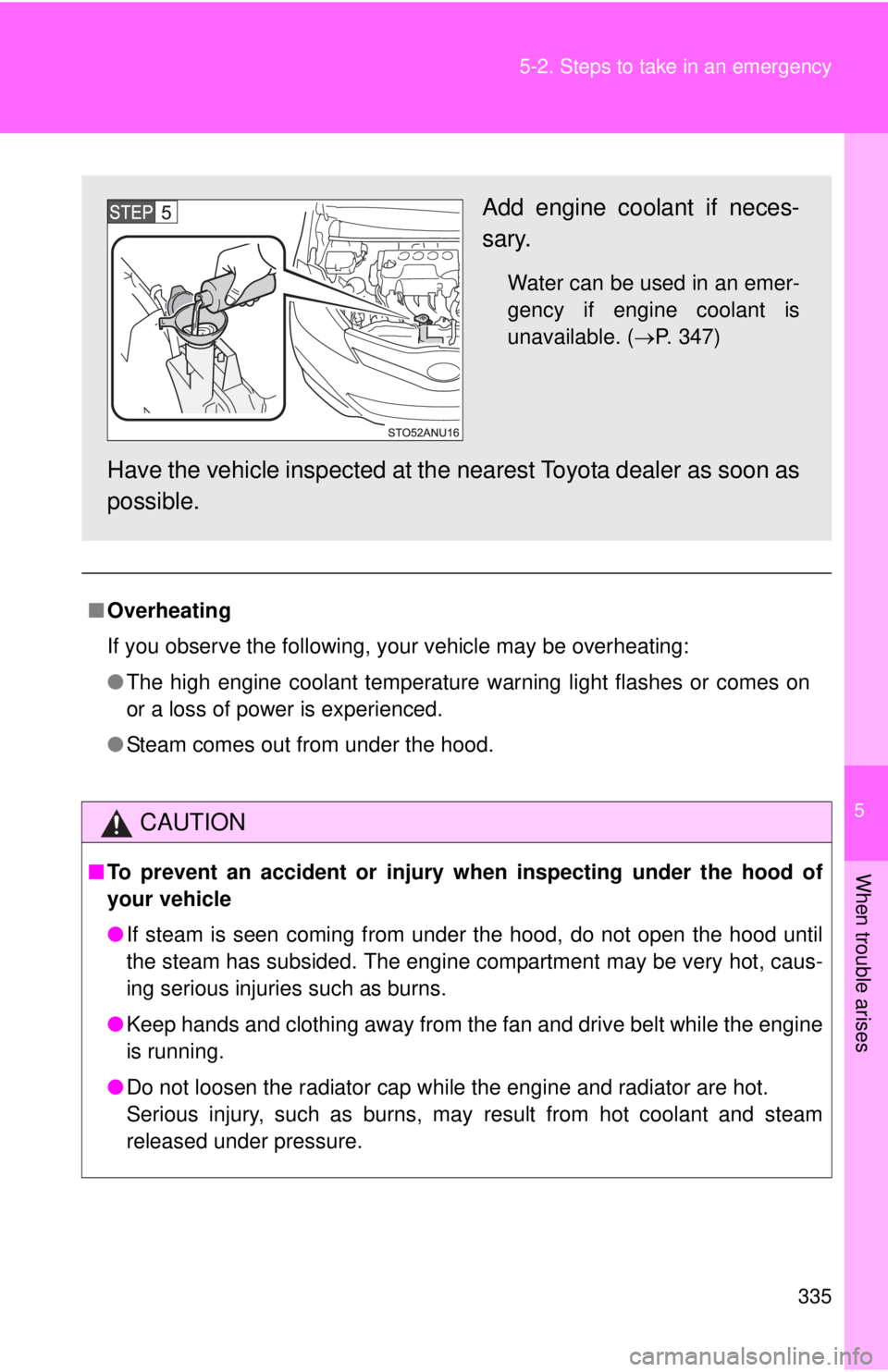
Add engine coolant if neces-
sary.
Water can be used in an emer-
gency if engine coolant is
unavailable. ( →P. 347)
Have the vehicle inspected at the nearest Toyota dealer as soon as
possible.
Page 322 of 365
345
6-1. Specifications
6
Vehicle specifications
Engine
Model
1NZ-FE
Type 4-cylinder in line, 4-cycle, gasoline
Bore and stroke 2.95 × 3.33 in. (75.0 × 84.7 mm)
Displacement 91.3 cu.in. (1497 cm3)
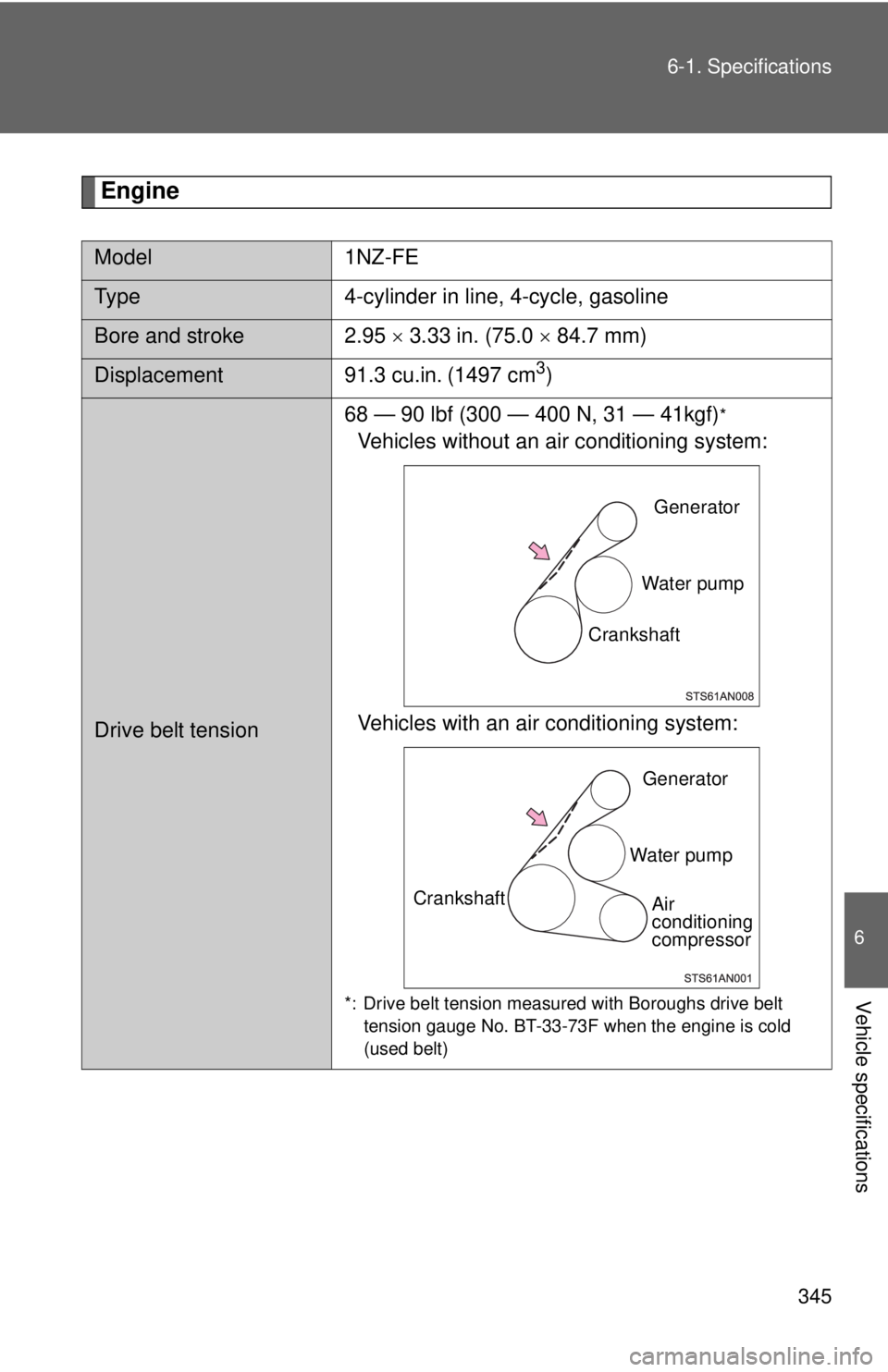
Drive belt tension 68 — 90 lbf (300 — 400 N, 31 — 41kgf)
*
Vehicles without an air conditioning system:
Vehicles with an air conditioning system:
*: Drive belt tension measured with Boroughs drive belt
tension gauge No. BT-33-73F when the engine is cold
(used belt)
Generator
Water pump
Crankshaft
Generator
Water pump Air
conditioning
compressor
Crankshaft
Page 337 of 365
360 6-1. Specifications
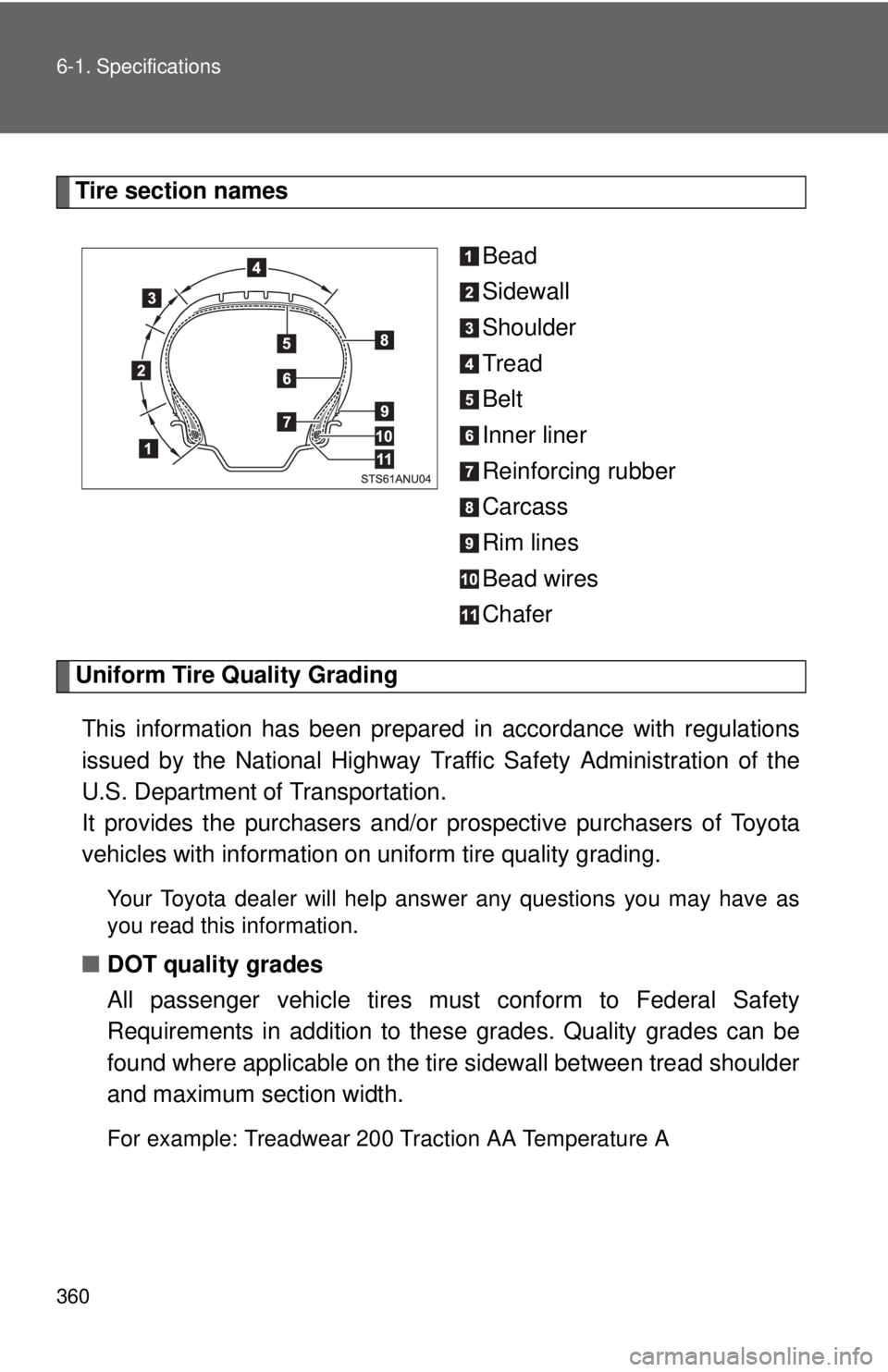
Tire section namesBead
Sidewall
Shoulder
Tread
Belt
Inner liner
Reinforcing rubber
Carcass
Rim lines
Bead wires
Chafer
Uniform Tire Quality GradingThis information has been prepared in accordance with regulations
issued by the National Highway Tr affic Safety Administration of the
U.S. Department of Transportation.
It provides the purchasers and/or prospective purchasers of Toyota
vehicles with information on uniform tire quality grading.
Your Toyota dealer will help answ er any questions you may have as
you read this information.
■ DOT quality grades
All passenger vehicle tires mu st conform to Federal Safety
Requirements in addition to these grades. Quality grades can be
found where applicable on the tire sidewall between tread shoulder
and maximum section width.
For example: Treadwear 200 Traction AA Temperature A
Page 346 of 365

369
6-2. Customization
6
Vehicle specifications
Illumination
(
→P. 202)
(vehicles
with alarm
system or
daytime run-
ning light
system) Time elapsed before
lights turn off
15 seconds7.5 seconds
30 seconds
Operation after the
engine switch is turned
to the “LOCK” position On Off
Operation when the
doors are unlocked On Off
Seat belt
reminder
buzzer
( → P. 307) Vehicle speed linked
seat belt reminder
buzzer
On Off
ItemFunctionDefault settingCustomized
setting