headlights TOYOTA YARIS HATCHBACK 2012 Owners Manual
[x] Cancel search | Manufacturer: TOYOTA, Model Year: 2012, Model line: YARIS HATCHBACK, Model: TOYOTA YARIS HATCHBACK 2012Pages: 365, PDF Size: 8.17 MB
Page 45 of 365
63
1
1-3. Adjustable components (seats, mirrors, steering wheel)
Before driving
Anti-glare inside rear view mirror
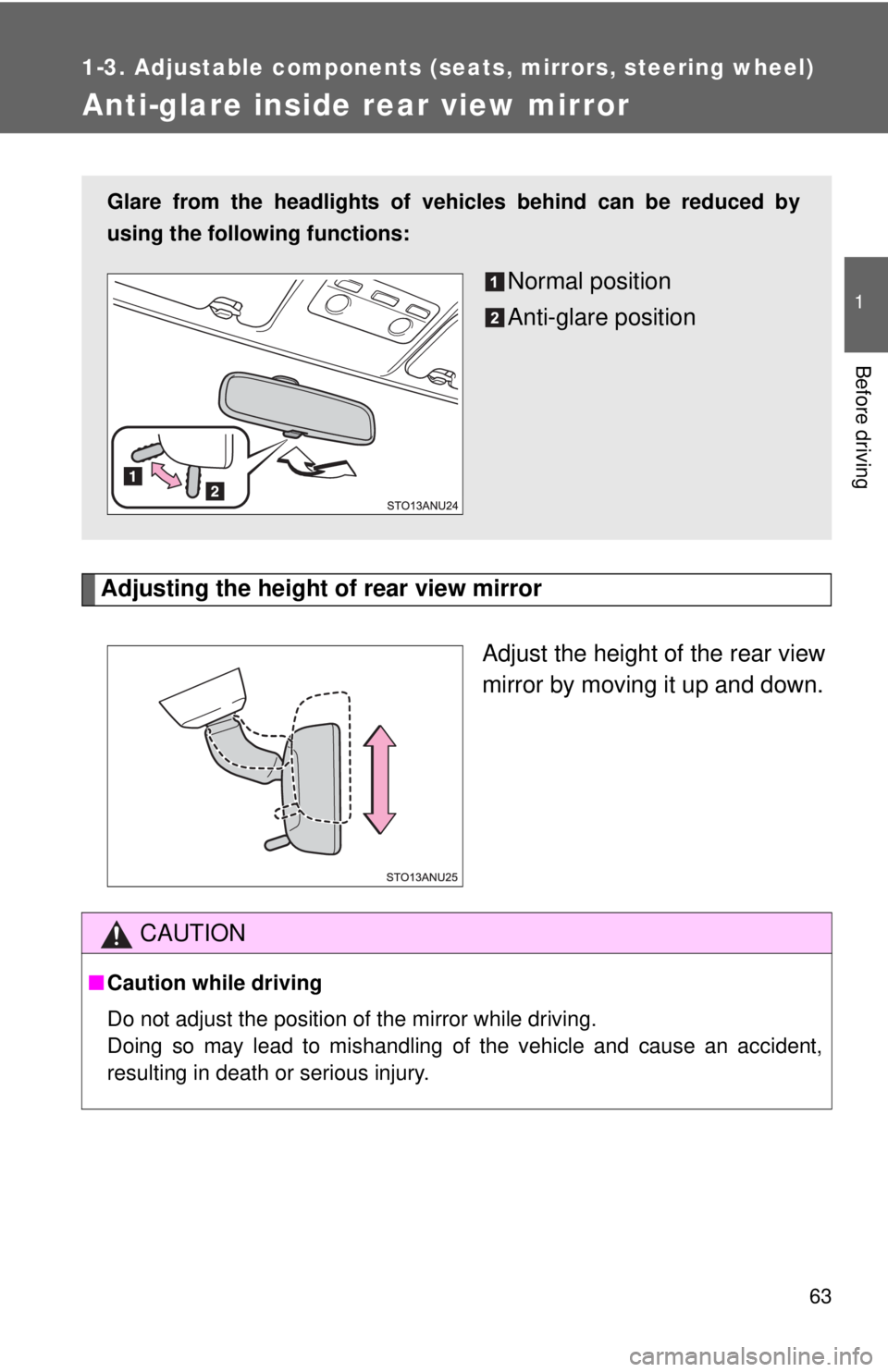
Adjusting the height of rear view mirrorAdjust the height of the rear view
mirror by moving it up and down.
Glare from the headlights of vehicles behind can be reduced by
using the following functions:
Normal position
Anti-glare position
CAUTION
■Caution while driving
Do not adjust the position of the mirror while driving.
Doing so may lead to mishandling of the vehicle and cause an accident,
resulting in death or serious injury.
Page 126 of 365
145
2
When driving
2-3. Operating the lights and wipers
Headlight switch
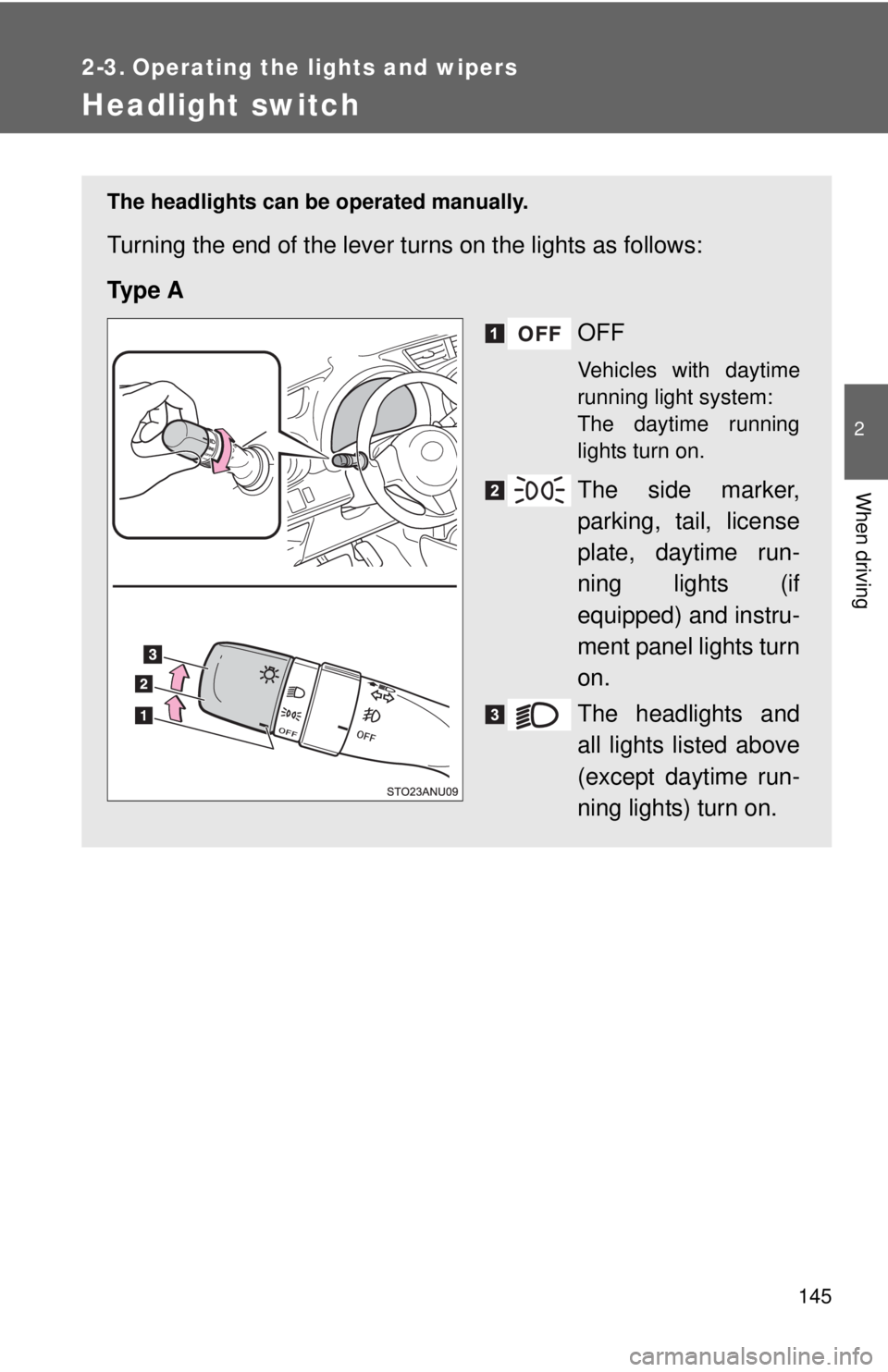
The headlights can be operated manually.
Turning the end of the lever turns on the lights as follows:
Ty p e AOFF
Vehicles with daytime
running light system:
The daytime running
lights turn on.
The side marker,
parking, tail, license
plate, daytime run-
ning lights (if
equipped) and instru-
ment panel lights turn
on.
The headlights and
all lights listed above
(except daytime run-
ning lights) turn on.
Page 127 of 365
146 2-3. Operating the lights and wipers
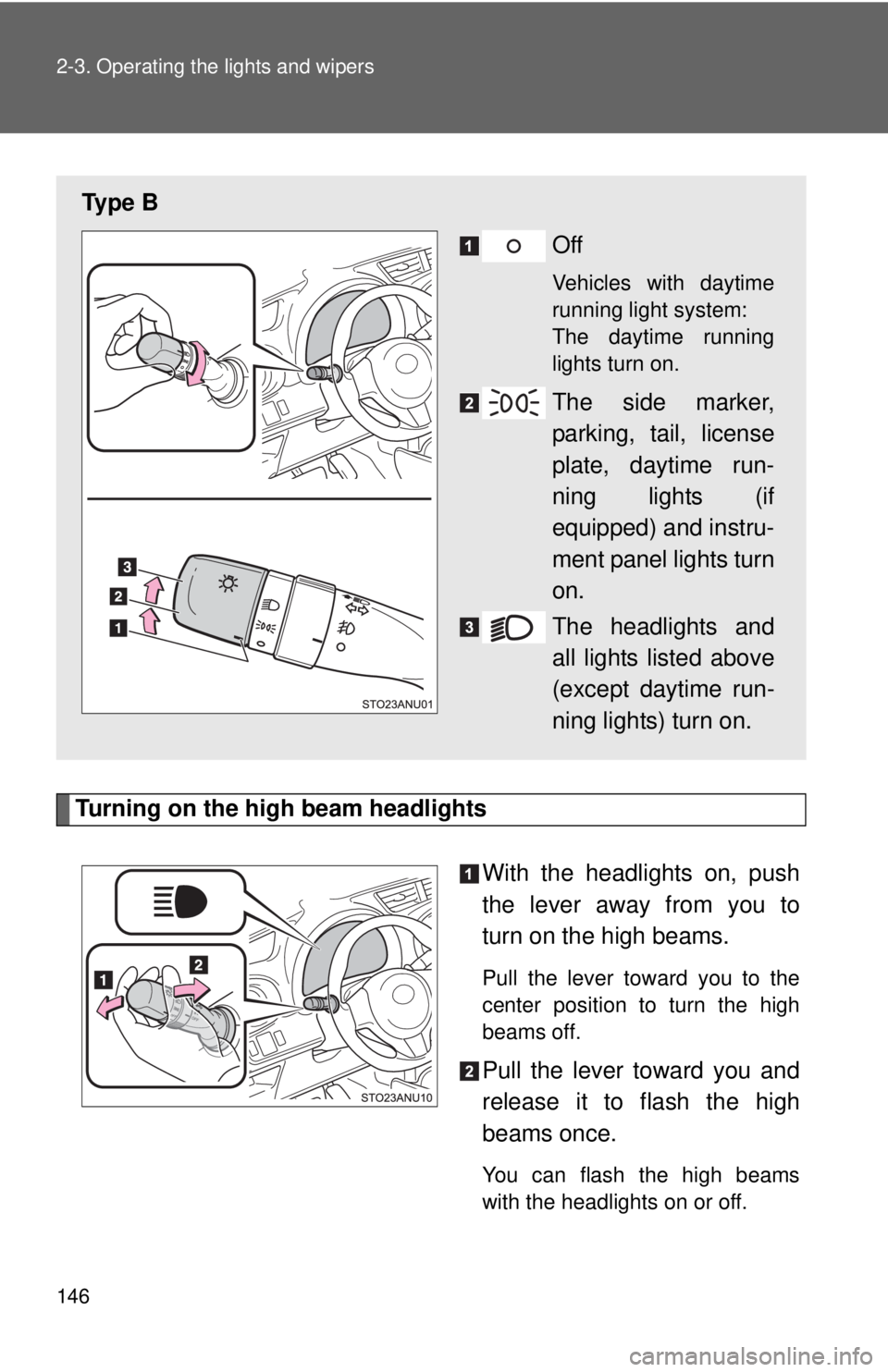
Turning on the high beam headlightsWith the headlights on, push
the lever away from you to
turn on the high beams.
Pull the lever toward you to the
center position to turn the high
beams off.
Pull the lever toward you and
release it to flash the high
beams once.
You can flash the high beams
with the headlights on or off.
Ty p e B Off
Vehicles with daytime
running light system:
The daytime running
lights turn on.
The side marker,
parking, tail, license
plate, daytime run-
ning lights (if
equipped) and instru-
ment panel lights turn
on.
The headlights and
all lights listed above
(except daytime run-
ning lights) turn on.
Page 128 of 365
147
2-3. Operating the lights and wipers
2
When driving
■
Daytime running light system (if equipped)
●To make your vehicle more visible to other drivers, the headlights turn on
automatically (at a reduced intensity) whenever the engine is started and
the parking brake is released. Daytime running lights are not designed for
use at night.
● Compared to turning on the headlights, the daytime running light system
offers greater durability and consumes less electricity, so it can help
improve fuel economy.
■ Light reminder buzzer
A buzzer sounds when the engine switch is turned to the “LOCK” or “ACC”
position and the driver’s door is opened while the lights are turned on.
■ Battery-saving function (vehicles wit h an alarm system or daytime run-
ning light system)
In all following conditions, the headlights and the other remaining lights will
go off automatically after 20 minutes in order to prevent the vehicle battery
from being discharged:
● The engine switch is in the “LOCK” position.
● The headlights and/or tail lights are on.
This function will be canceled in any of the following situations:
● When the engine switch is turned to the “ON” position.
● When the light switch is operated.
● When the door is opened or closed.
NOTICE
■To prevent battery discharge
Do not leave the lights on longer than necessary when the engine is not run-
ning.
Page 130 of 365
149
2-3. Operating the lights and wipers
2
When driving
■
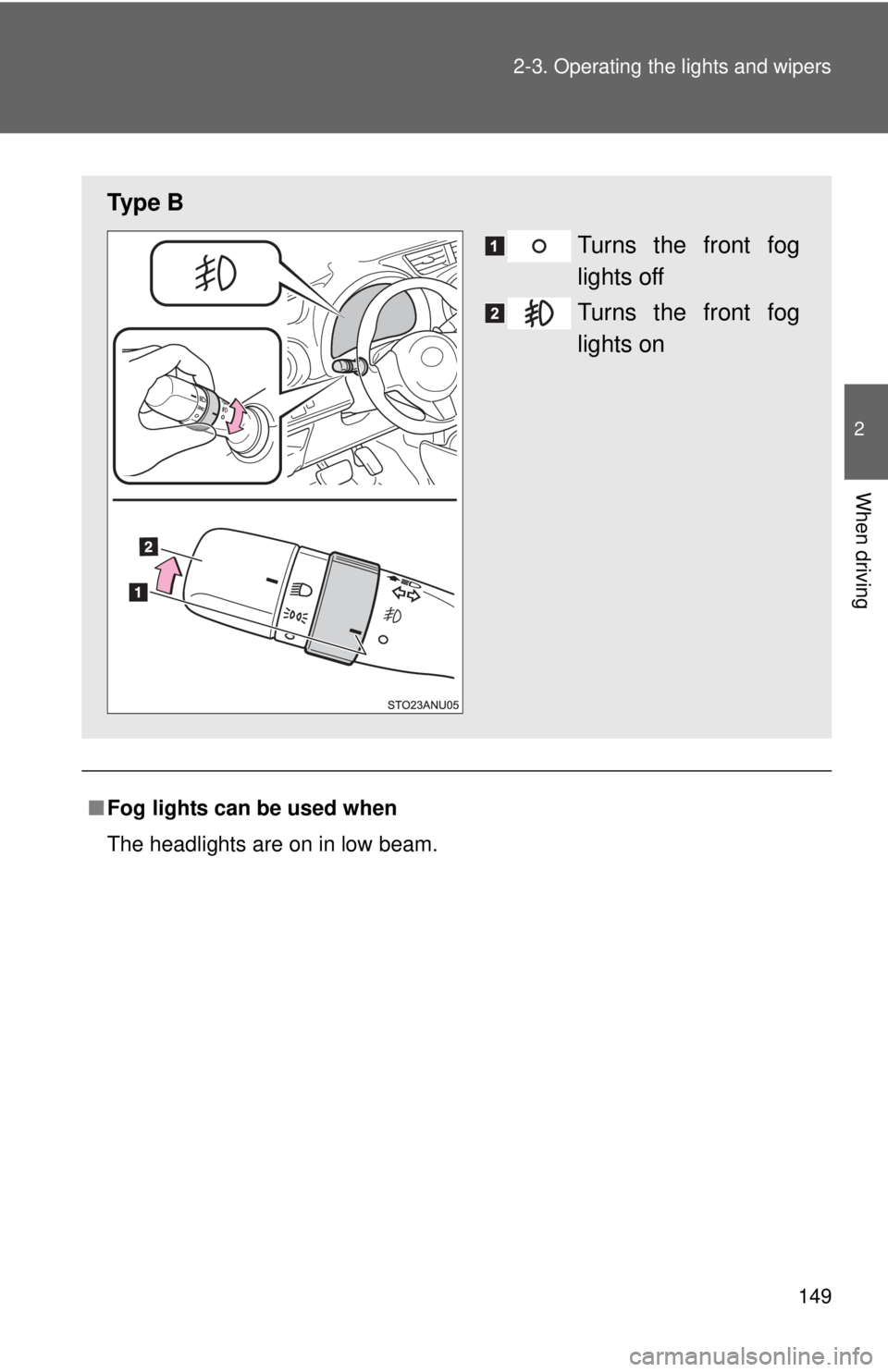
Fog lights can be used when
The headlights are on in low beam.
Ty p e B
Turns the front fog
lights off
Turns the front fog
lights on
Page 260 of 365
281
4-3. Do-it-yourself maintenance
4
Maintenance and care
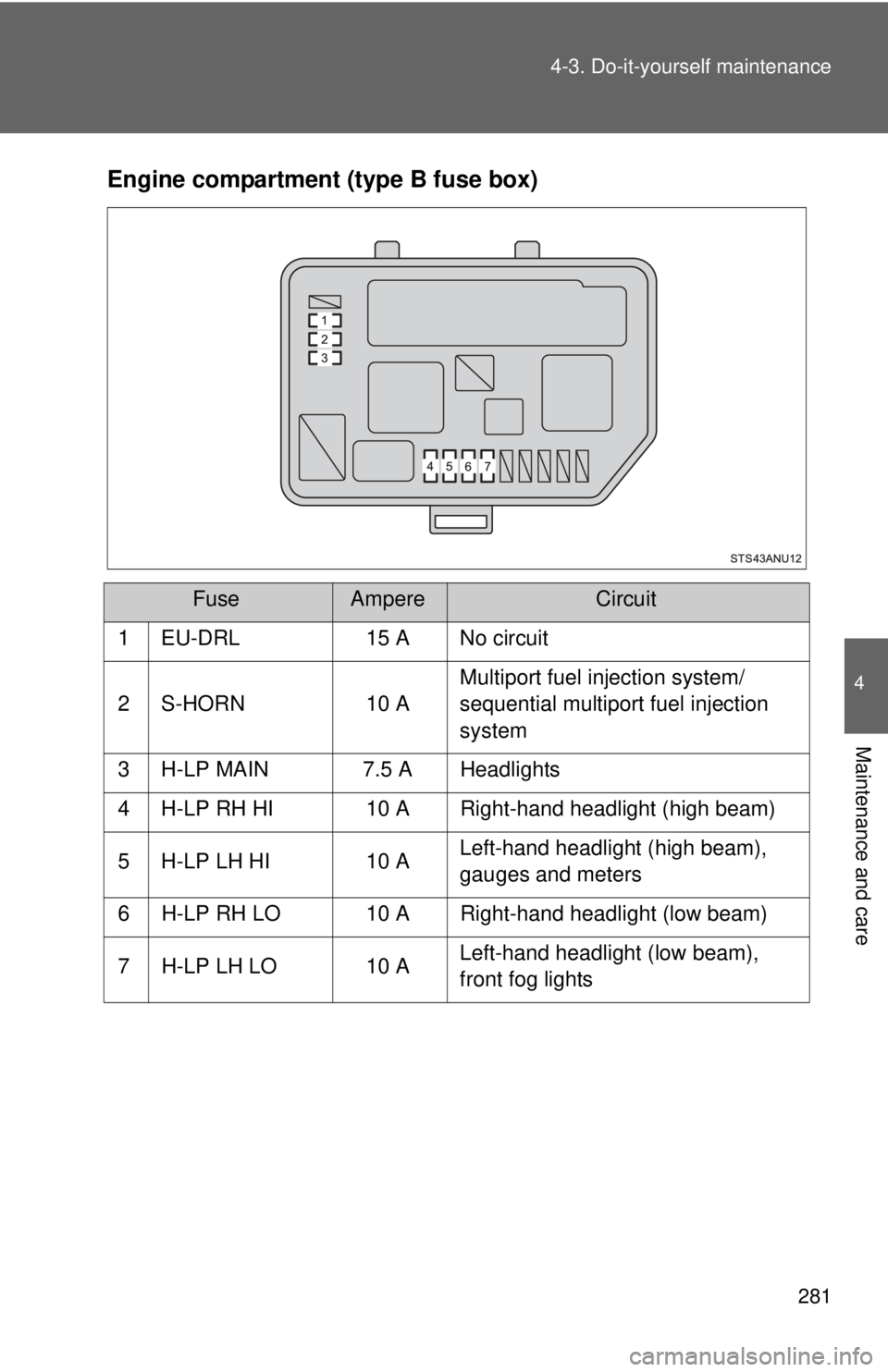
Engine compartment (type B fuse box)
FuseAmpereCircuit
1 EU-DRL 15 A No circuit
2 S-HORN 10 A Multiport fuel injection system/
sequential multiport fuel injection
system
3 H-LP MAIN 7.5 A Headlights
4 H-LP RH HI 10 A Right-hand headlight (high beam)
5 H-LP LH HI 10 A Left-hand headlight (high beam),
gauges and meters
6 H-LP RH LO 10 A Right-hand headlight (low beam)
7 H-LP LH LO 10 A Left-hand headlight (low beam),
front fog lights
Page 265 of 365
286
4-3. Do-it-yourself maintenance
Light bulbs
You may replace the following bulbs by yourself. The difficulty level
of replacement varies depending on the bulb. If necessary bulb
replacement seems difficult to perfor m, contact your Toyota dealer.
For more information about replacing other light bulbs, contact your
Toyota dealer.
■ Preparing for light bulb replacement
Check the wattage of the light bulb to be replaced. ( →P. 352)
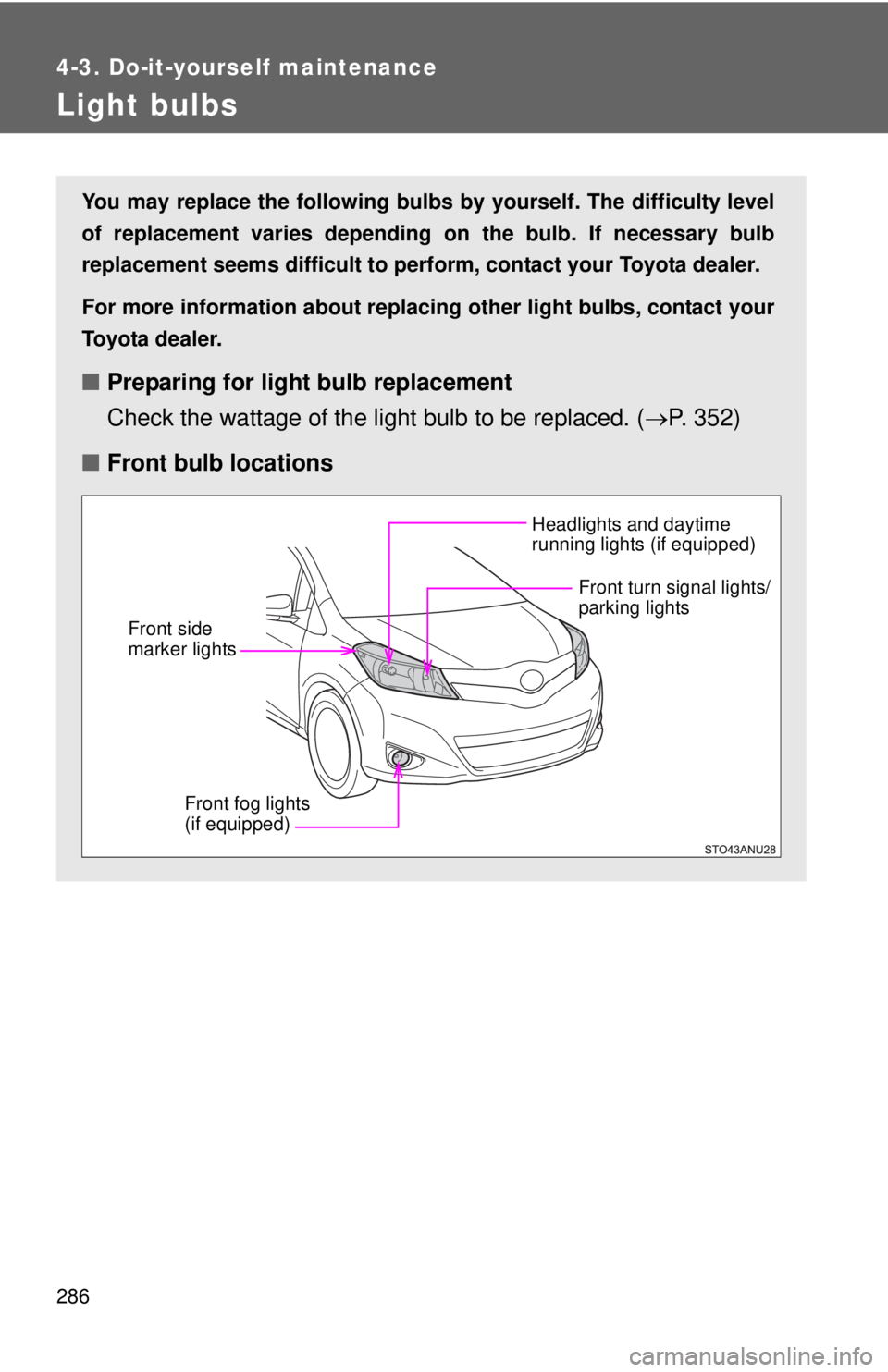
■ Front bulb locations
Headlights and daytime
running lights (if equipped)
Front fog lights
(if equipped)
Front side
marker lights
Front turn signal lights/
parking lights
Page 266 of 365
287
4-3. Do-it-yourself maintenance
4
Maintenance and care
Replacing light bulbs
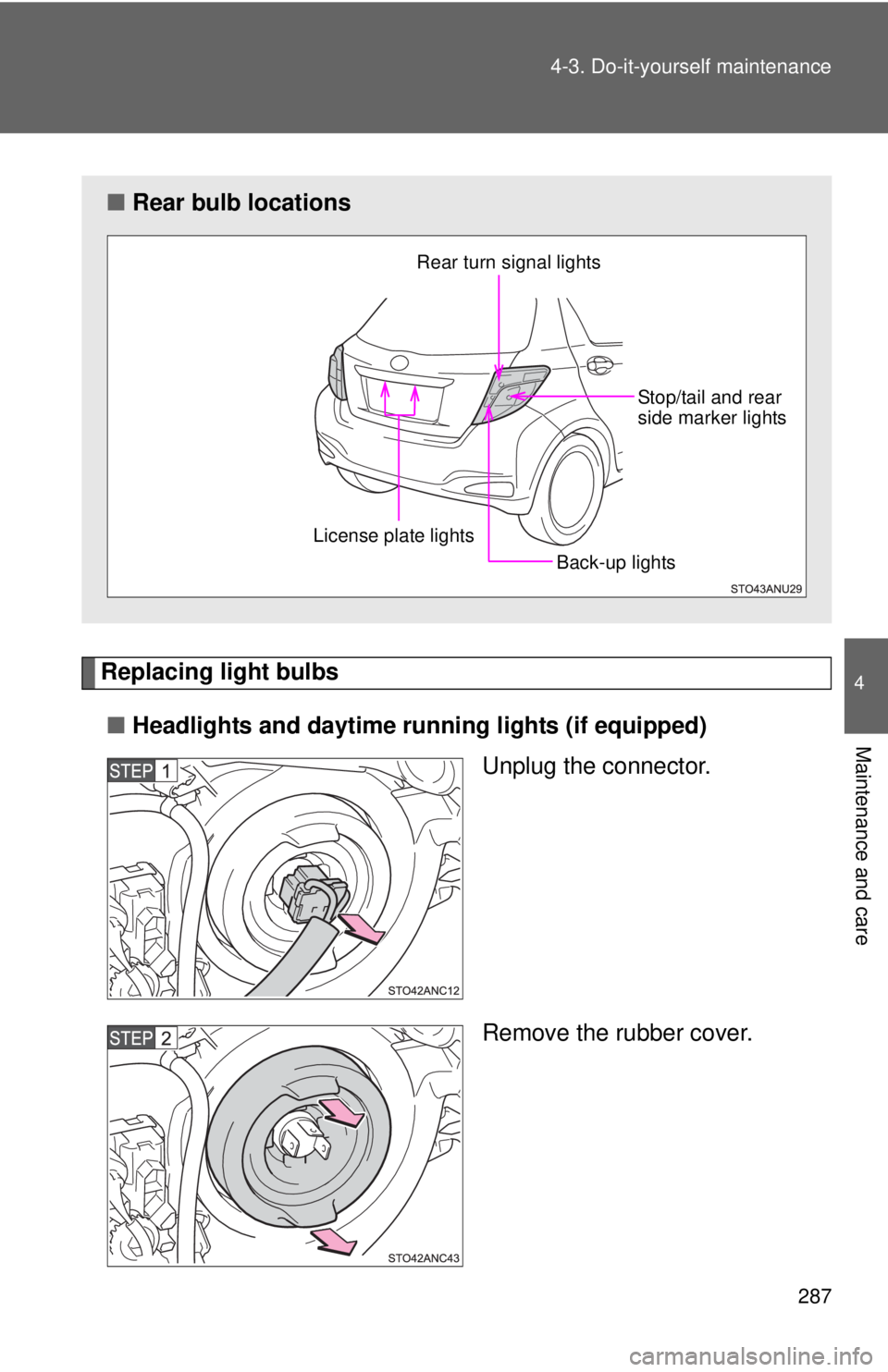
■ Headlights and daytime r unning lights (if equipped)
Unplug the connector.
Remove the rubber cover.
■Rear bulb locations
Back-up lights
Rear turn signal lights
Stop/tail and rear
side marker lights
License plate lights
Page 272 of 365
293
4-3. Do-it-yourself maintenance
4
Maintenance and care
CAUTION
■
Replacing light bulbs
●Turn off the lights. Do not attempt to replace the bulb immediately after
turning off the lights.
The bulbs become very hot and may cause burns.
● Do not touch the glass portion of the light bulb with bare hands. Hold the
bulb by the plastic or metal portion.
If the bulb is scratched or dropped, it may blow out or crack.
● Fully install light bulbs and any parts used to secure them. Failure to do so
may result in head damage, fire, or water entering the headlight unit. This
may damage the headlights or cause condensation to build up on the lens.
■ To prevent damage or fire
Make sure bulbs are fully seated and locked.
Page 305 of 365
5
When trouble arises
327
5-2. Steps to take in an emergency
If the engine will not start
If the engine will not start even though correct starting procedures
are being followed ( →P. 124), consider each of the following points:
■ The engine will not start even though the starter motor
operates normally.
One of the following may be the cause of the problem:
●There may not be sufficient fuel in the vehicle’s tank.
Refuel the vehicle.
● The engine may be flooded.
Try to restart the engine again following correct starting proce-
dures. ( →P. 124)
● Vehicles with engine immobilizer system: There may be a
malfunction in the engine immobilizer system. (→P. 7 2 )
■ The starter motor turns over slowly, the interior lights and
headlights are dim, or the horn does not sound or sounds at
a low volume.
One of the following may be the cause of the problem:
●The battery may be discharged. ( →P. 330)
● The battery terminal connec tions may be loose or corroded.
■ The starter motor does not turn over, the interior lights and
headlights do not turn on, or the horn does not sound.
One of the following may be the cause of the problem:
● One or both of the battery terminals may be disconnected.
● The battery may be discharged. ( →P. 330)
Contact your Toyota dealer if the problem cannot be repaired, or if
repair procedures are unknown.