air condition TOYOTA YARIS HATCHBACK 2015 Workshop Manual
[x] Cancel search | Manufacturer: TOYOTA, Model Year: 2015, Model line: YARIS HATCHBACK, Model: TOYOTA YARIS HATCHBACK 2015Pages: 540, PDF Size: 34.12 MB
Page 429 of 540
4298-2. Steps to take in an emergency
8
When trouble arises
YARIS_F_WE_52G04E
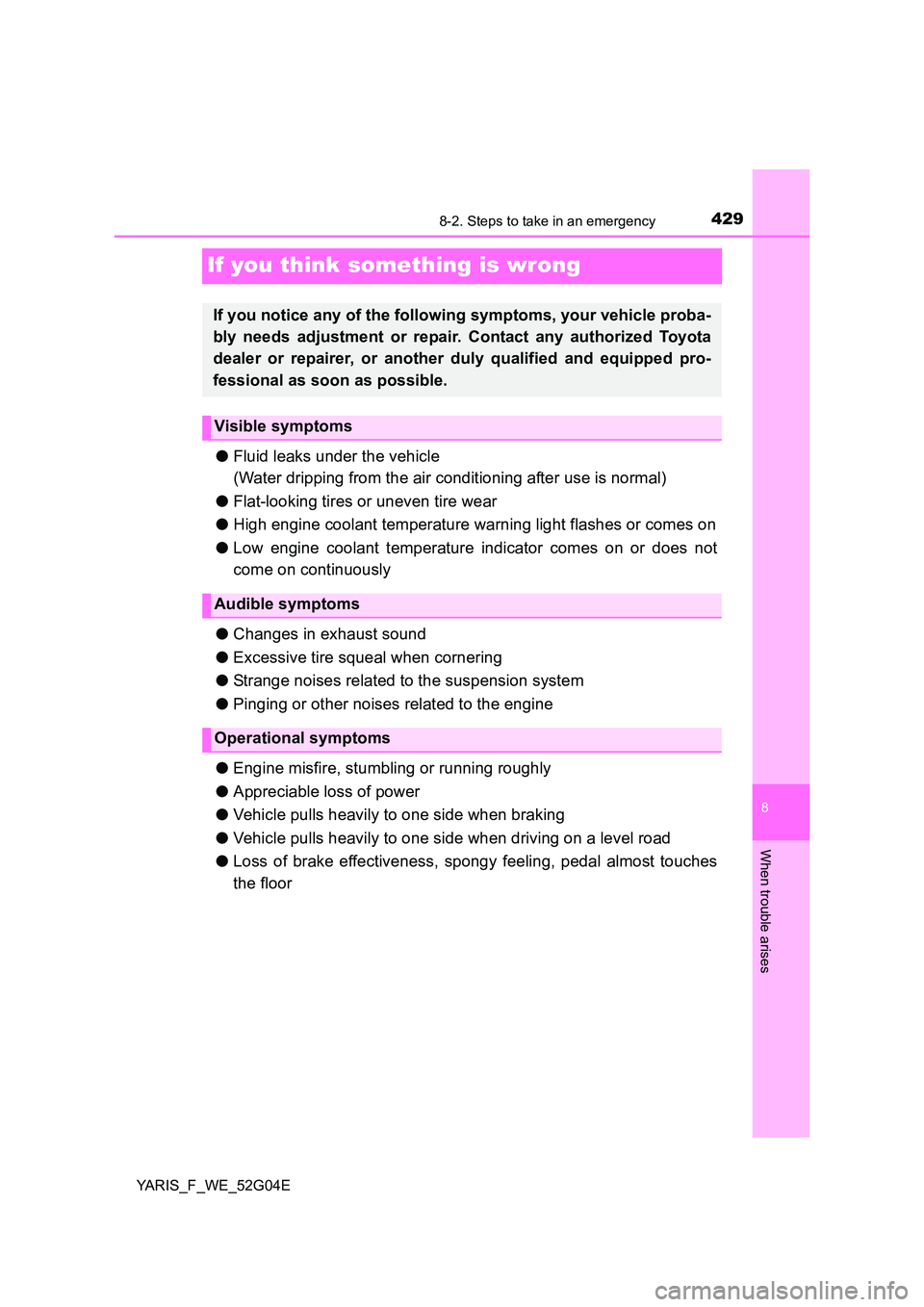
If you think something is wrong
●Fluid leaks under the vehicle
(Water dripping from the air conditioning after use is normal)
● Flat-looking tires or uneven tire wear
● High engine coolant temperature warning light flashes or comes on
● Low engine coolant temperature indicator comes on or does not
come on continuously
● Changes in exhaust sound
● Excessive tire squeal when cornering
● Strange noises related to the suspension system
● Pinging or other noises related to the engine
● Engine misfire, stumbling or running roughly
● Appreciable loss of power
● Vehicle pulls heavily to one side when braking
● Vehicle pulls heavily to one side when driving on a level road
● Loss of brake effectiveness, spongy feeling, pedal almost touches
the floor
If you notice any of the following symptoms, your vehicle proba-
bly needs adjustment or repair. Contact any authorized Toyota
dealer or repairer, or another duly qualified and equipped pro-
fessional as soon as possible.
Visible symptoms
Audible symptoms
Operational symptoms
Page 440 of 540
4408-2. Steps to take in an emergency
YARIS_F_WE_52G04E
■ The tire pressure warning light may come on due to natural causes
(vehicles with a tire pressure warning system)
The tire pressure warning light may come on due to natural causes such as
natural air leaks and tire inflation pressure changes caused by temperature.
In this case, adjusting the tire inflation pressure will turn off the warning light
(after a few minutes).
■ When a tire is replaced with a spare tire (vehicles with a tire pressure
warning system)
The spare tire is not equipped with a tire pressure warning valve and trans-
mitter. If a tire goes flat, the tire pressure warning light will not turn off even
though the flat tire has been replaced with the spare tire. Replace the spare
tire with the repaired tire and adjust the tire inflation pressure. The tire pres-
sure warning light will go off after a few minutes.
■ If the tire pressure warning system is not functioning (vehicles with a
tire pressure warning system)
The tire pressure warning system will be disabled in the following conditions:
(When the condition becomes normal, the system will work properly.)
● If tires not equipped with tire pressure warning valves and transmitters are
used
● If the ID code on the tire pressure warning valves and transmitters is not
registered in the tire pressure warning computer
● If the tire inflation pressure is 500 kPa (5.1 kgf/cm2 or bar, 73 psi) or higher
The tire pressure warning system may be disabled in the following conditions:
(When the condition becomes normal, the system will work properly.)
● If electronic devices or facilities using similar radio wave frequencies are
nearby
● If a radio set at a similar frequency is in use in the vehicle
● If a window tint that affects the radio wave signals is installed
● If there is a lot of snow or ice on the vehicle, particularly around the wheels
or wheel housings
● If non-genuine Toyota wheels are used (Even if you use Toyota wheels, the
tire pressure warning system may not work properly with some types of
tires.)
● If tire chains are used
■ If the tire pressure warning light frequently comes on after blinking for 1
minute (vehicles with a tire pressure warning system)
If the tire pressure warning light frequently comes on after blinking for 1
minute when the engine switch is turned on, have it checked by any autho-
rized Toyota dealer or repairer, or another duly qualified and equipped profes-
sional.
Page 441 of 540
4418-2. Steps to take in an emergency
8
When trouble arises
YARIS_F_WE_52G04E
WARNING
■When the electric power steering system warning light comes on
The steering wheel may become extremely heavy.
If the steering wheel becomes heavier than usual when operating, hold
firmly and operate using more force than usual.
■ When driving to clean the DPF catalytic converter
When driving, pay sufficient attention to weather, road conditions, terrain
and traffic conditions, and be sure to observe traffic laws and/or regulations.
Failure to do so may cause an unexpected accident, resulting in death or
serious injury.
■ If the tire pressure warning light comes on (vehicles with a tire pres-
sure warning system)
Be sure to observe the following precautions. Failure to do so could cause a
loss of vehicle control and result in death or serious injury.
● Stop your vehicle in a safe place as soon as possible. Adjust the tire infla-
tion pressure immediately.
● If the tire pressure warning light comes on even after tire inflation pressure
adjustment, it is probable that you have a flat tire. Check the tires. If a tire
is flat, change it with the spare tire and have the flat tire repaired by the
nearest authorized Toyota dealer or repairer, or another duly qualified and
equipped professional.
● Avoid abrupt maneuvering and braking. If the vehicle tires deteriorate, you
could lose control of the steering wheel or the brakes.
■ If a blowout or sudden air leakage should occur (vehicles with a tire
pressure warning system)
The tire pressure warning system may not activate immediately.
Page 473 of 540
4738-2. Steps to take in an emergency
8
When trouble arises
YARIS_F_WE_52G04E
WARNING
●Connect the valve and hose securely with the tire installed on the vehicle.
If the hose is not properly connected to the valve, air leakage may occur
as sealant may be sprayed out.
● If the hose comes off the valve while inflating the tire, there is a risk that
the hose will move abruptly due to air pressure.
● After inflation of the tire has completed, the sealant may splatter when the
hose is disconnected or some air is let out of the tire.
● Follow the operation procedure to repair the tire. If the procedures not fol-
lowed, the sealant may spray out.
● Keep back from the tire while it is being repaired, as there is a chance of it
bursting while the repair operation is being performed. If you notice any
cracks or deformation of the tire, turn off the compressor switch and stop
the repair operation immediately.
● The repair kit may overheat if operated for a long period of time. Do not
operate the repair kit continuously for more than 40 minutes.
● Parts of the repair kit become hot during operation. Be careful when han-
dling the repair kit during and after operation. Do not touch the metal part
around the connecting area between the bottle and compressor. It will be
extremely hot.
● Do not attach the vehicle speed warning sticker to an area other than the
one indicated. If the sticker is attached to an area where an SRS airbag is
located, such as the pad of the steering wheel, it may prevent the SRS air-
bag from operating properly.
■ Driving to spread the liquid sealant evenly
Observe the following precautions to reduce the risk of accidents.
Failing to do so may result in a loss of vehicle control and cause death or
serious injury.
● Drive the vehicle carefully at a low speed. Be especially careful when turn-
ing and cornering.
● If the vehicle does not drive straight or you feel a pull through the steering
wheel, stop the vehicle and check the following.
• Tire condition. The tire may have separated from the wheel.
• Tire inflation pressure. If the tire inflation pressure is 130 kPa (1.3 kgf/cm2
or bar, 19 psi) or less, the tire may be severely damaged.
Page 485 of 540
4858-2. Steps to take in an emergency
8
When trouble arises
YARIS_F_WE_52G04E
If your vehicle overheats
●The high engine coolant temperature warning light (P. 431)
comes on or flashes, or a loss of engine power is experienced. (For
example, the vehicle speed does not increase.)
● Steam comes out from under the hood.
Stop the vehicle in a safe place and turn off the air conditioning sys-
tem, and then stop the engine.
If you see steam:
Carefully lift the hood after the steam subsides.
If you do not see steam:
Carefully lift the hood.
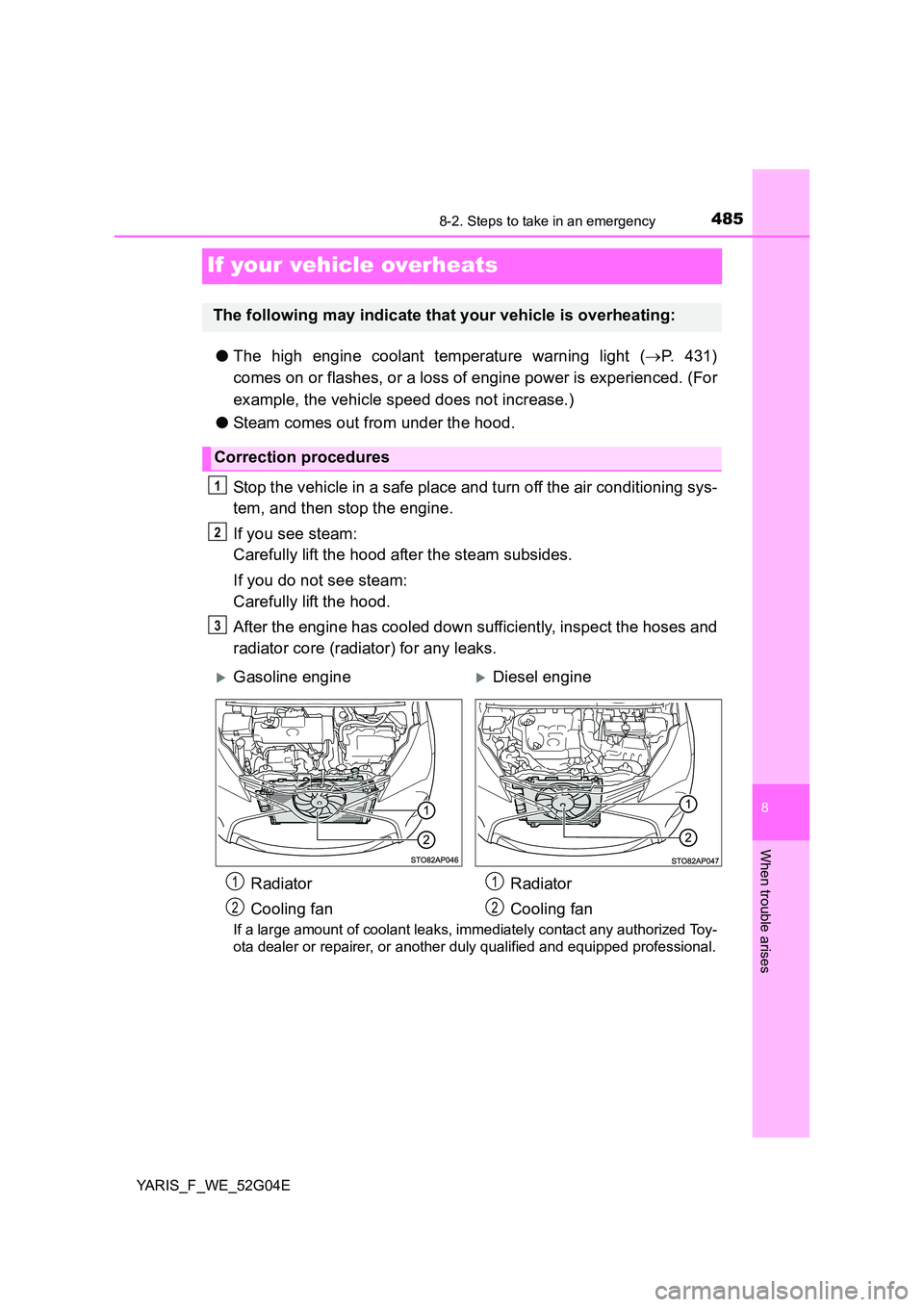
After the engine has cooled down sufficiently, inspect the hoses and
radiator core (radiator) for any leaks.
If a large amount of coolant leaks, immediately contact any authorized Toy-
ota dealer or repairer, or another duly qualified and equipped professional.
The following may indicate that your vehicle is overheating:
Correction procedures
1
2
3
Gasoline engineDiesel engine
Radiator
Cooling fan
Radiator
Cooling fan
1
2
1
2
Page 487 of 540
4878-2. Steps to take in an emergency
8
When trouble arises
YARIS_F_WE_52G04E
Start the engine and turn the air conditioning system on to check
that the radiator cooling fan operates and to check for coolant leaks
from the radiator or hoses.
The fan operates when the air conditioning system is turned on immedi-
ately after a cold start. Confirm that the fan is operating by checking the fan
sound and air flow. If it is difficult to check these, turn the air conditioning
system on and off repeatedly.
(The fan may not operate in freezing temperatures.)
If the fan is not operating:
Stop the engine immediately and contact any authorized Toyota
dealer or repairer, or another duly qualified and equipped profes-
sional.
If the fan is operating:
Have the vehicle inspected at the nearest authorized Toyota dealer
or repairer, or another duly qualified and equipped professional.
6
7
Page 503 of 540
5039-1. Specifications
9
Vehicle specifications
YARIS_F_WE_52G04E
■Engine oil selection
Vehicles without a DPF system*
“Toyota Genuine Motor Oil” is used in your Toyota vehicle. Toyota
recommends the use of approved “Toyota Genuine Motor Oil”.
Another motor oil of matching quality can also be used.
Oil grade: ACEA C2, B1, API CF-4 or CF
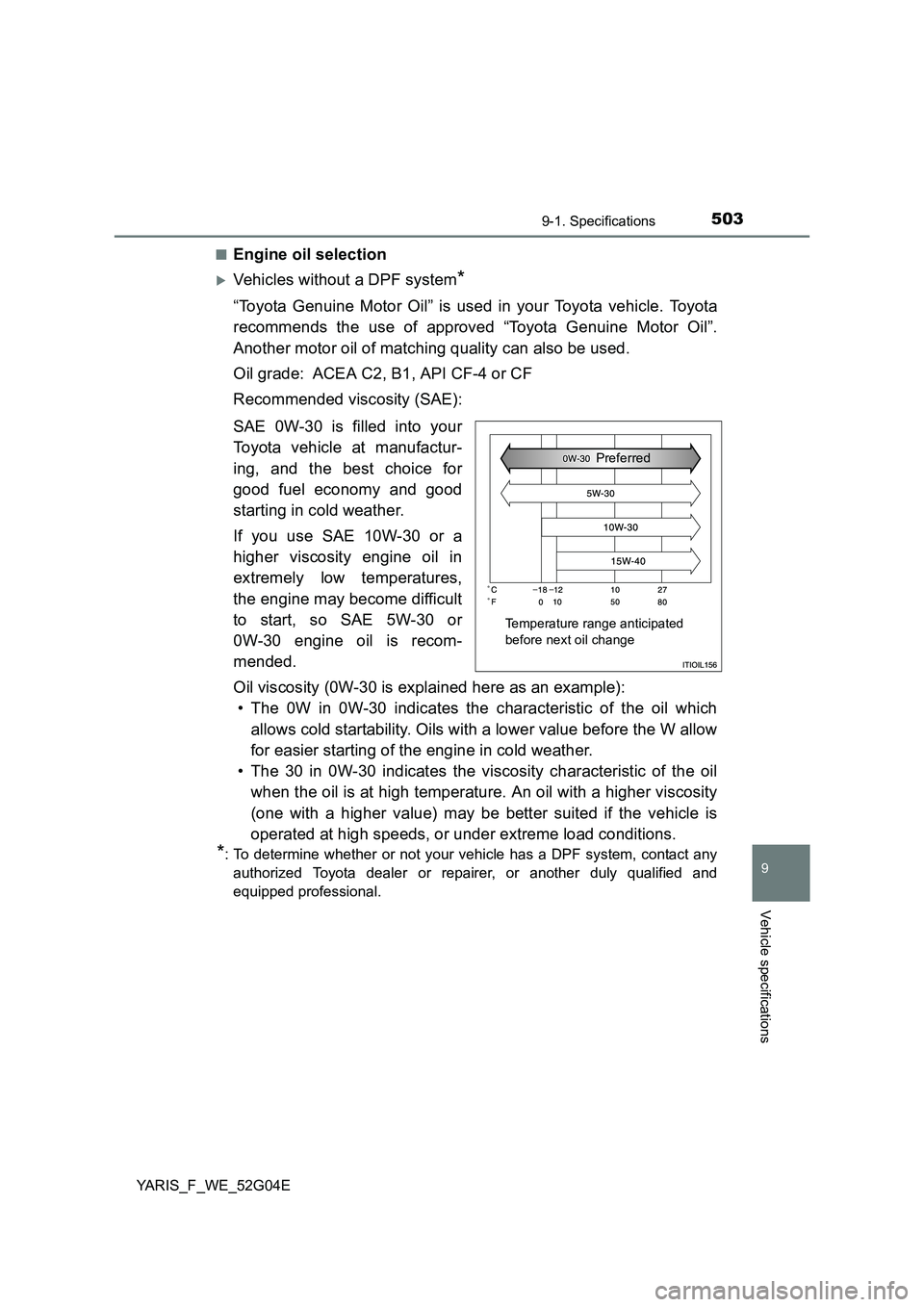
Recommended viscosity (SAE):
SAE 0W-30 is filled into your
Toyota vehicle at manufactur-
ing, and the best choice for
good fuel economy and good
starting in cold weather.
If you use SAE 10W-30 or a
higher viscosity engine oil in
extremely low temperatures,
the engine may become difficult
to start, so SAE 5W-30 or
0W-30 engine oil is recom-
mended.
Oil viscosity (0W-30 is explained here as an example):
• The 0W in 0W-30 indicates the characteristic of the oil which
allows cold startability. Oils with a lower value before the W allow
for easier starting of the engine in cold weather.
• The 30 in 0W-30 indicates the viscosity characteristic of the oil
when the oil is at high temperature. An oil with a higher viscosity
(one with a higher value) may be better suited if the vehicle is
operated at high speeds, or under extreme load conditions.
*: To determine whether or not your vehicle has a DPF system, contact any
authorized Toyota dealer or repairer, or another duly qualified and
equipped professional.
Temperature range anticipated
before next oil change
Preferred
Page 504 of 540
5049-1. Specifications
YARIS_F_WE_52G04E
Vehicles with a DPF system*
“Toyota Genuine Motor Oil” is used in your Toyota vehicle. Toyota
recommends the use of approved “Toyota Genuine Motor Oil”.
Another motor oil of matching quality can also be used.
Oil grade: ACEA C2
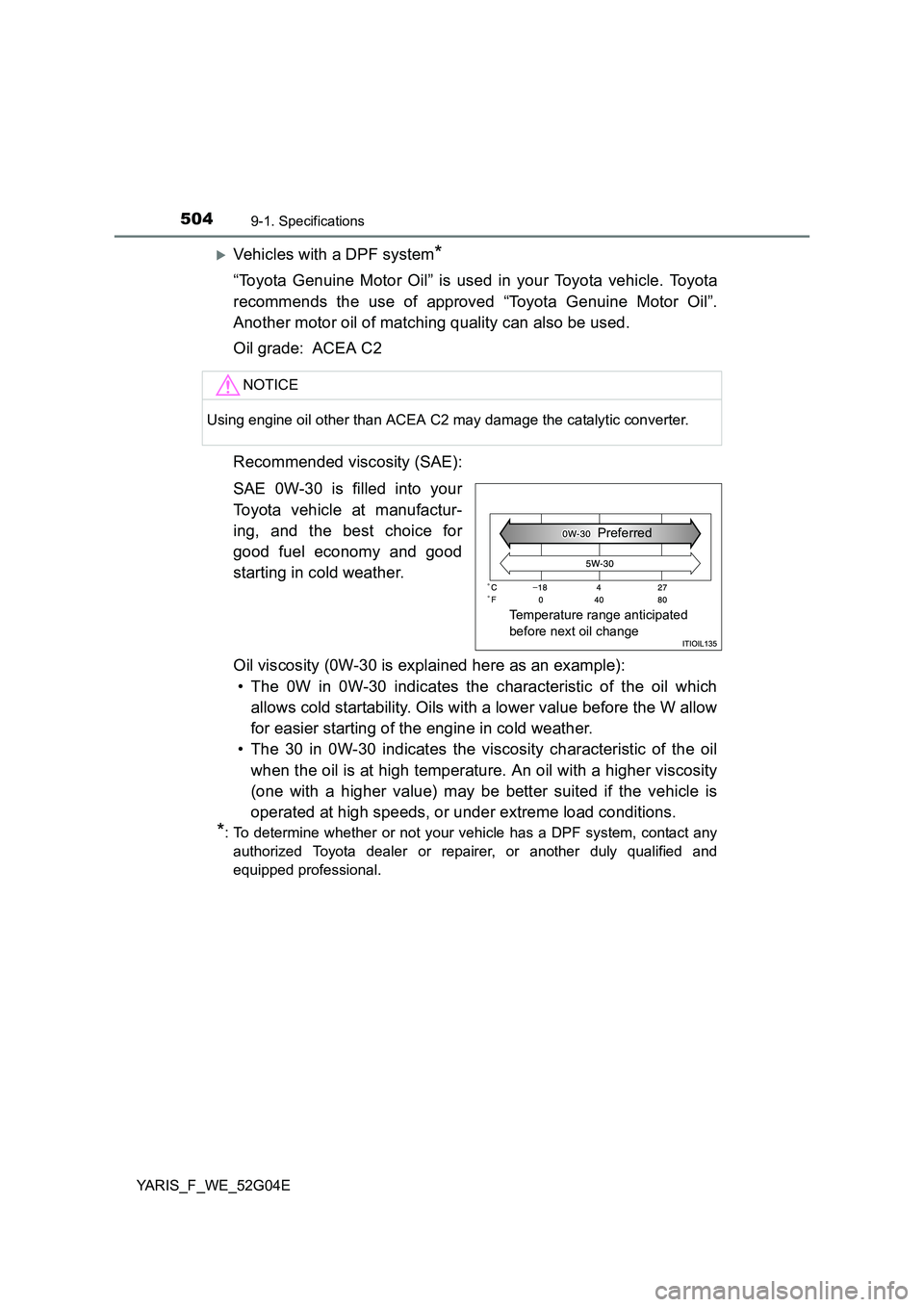
Recommended viscosity (SAE):
SAE 0W-30 is filled into your
Toyota vehicle at manufactur-
ing, and the best choice for
good fuel economy and good
starting in cold weather.
Oil viscosity (0W-30 is explained here as an example):
• The 0W in 0W-30 indicates the characteristic of the oil which
allows cold startability. Oils with a lower value before the W allow
for easier starting of the engine in cold weather.
• The 30 in 0W-30 indicates the viscosity characteristic of the oil
when the oil is at high temperature. An oil with a higher viscosity
(one with a higher value) may be better suited if the vehicle is
operated at high speeds, or under extreme load conditions.
*: To determine whether or not your vehicle has a DPF system, contact any
authorized Toyota dealer or repairer, or another duly qualified and
equipped professional.
NOTICE
Using engine oil other than ACEA C2 may damage the catalytic converter.
Temperature range anticipated
before next oil change
Preferred
Page 522 of 540
522What to do if... (Troubleshooting)
YARIS_F_WE_52G04E
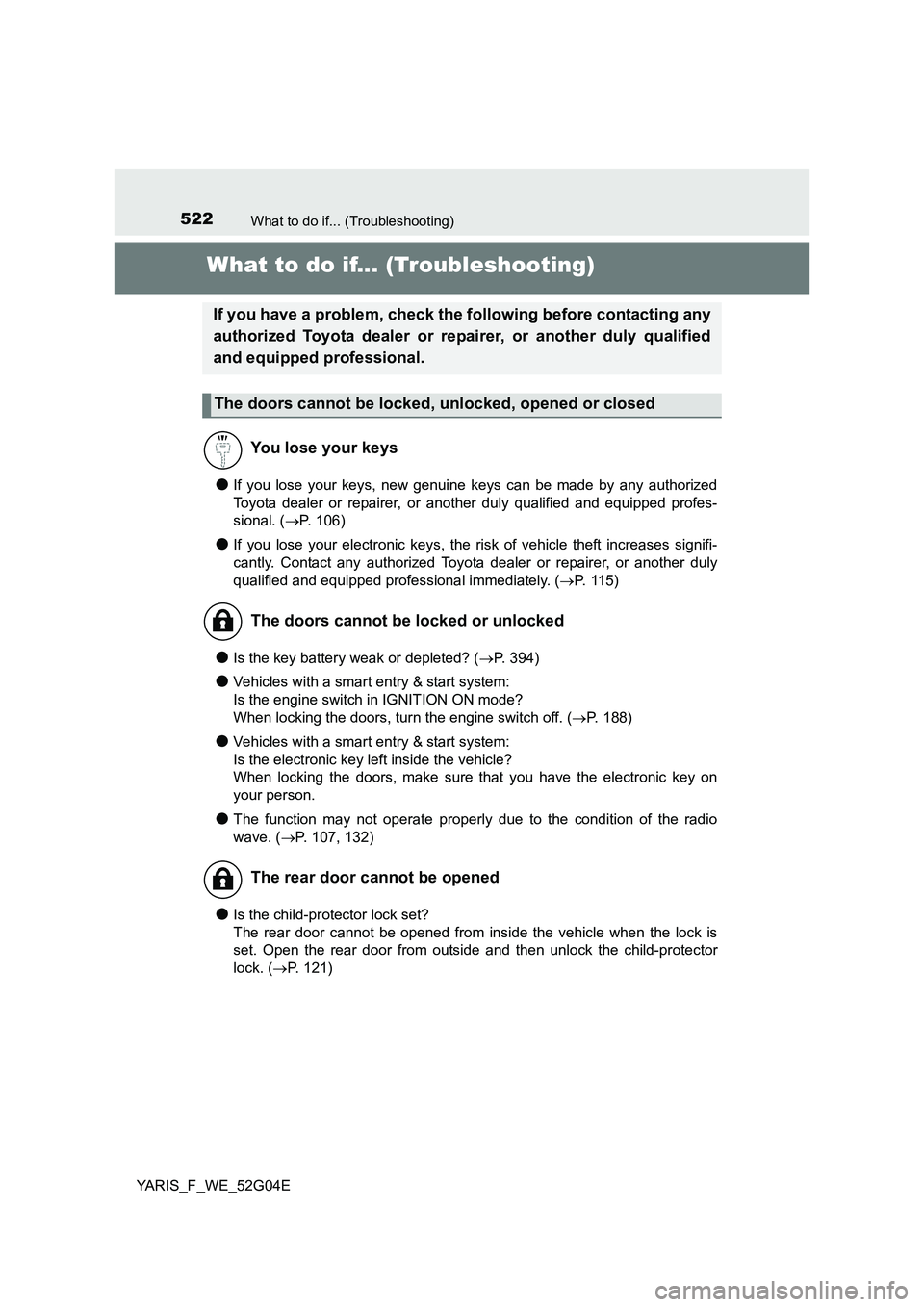
What to do if... (Troubleshooting)
●If you lose your keys, new genuine keys can be made by any authorized
Toyota dealer or repairer, or another duly qualified and equipped profes-
sional. ( P. 106)
●If you lose your electronic keys, the risk of vehicle theft increases signifi-
cantly. Contact any authorized Toyota dealer or repairer, or another duly
qualified and equipped professional immediately. ( P. 115)
●Is the key battery weak or depleted? (P. 394)
●Vehicles with a smart entry & start system:
Is the engine switch in IGNITION ON mode?
When locking the doors, turn the engine switch off. ( P. 188)
●Vehicles with a smart entry & start system:
Is the electronic key left inside the vehicle?
When locking the doors, make sure that you have the electronic key on
your person.
●The function may not operate properly due to the condition of the radio
wave. ( P. 107, 132)
●Is the child-protector lock set?
The rear door cannot be opened from inside the vehicle when the lock is
set. Open the rear door from outside and then unlock the child-protector
lock. ( P. 121)
If you have a problem, check the following before contacting any
authorized Toyota dealer or repairer, or another duly qualified
and equipped professional.
The doors cannot be locked, unlocked, opened or closed
You lose your keys
The doors cannot be locked or unlocked
The rear door cannot be opened
Page 526 of 540
526Alphabetical index
YARIS_F_WE_52G04E
Alphabetical index
A/C..................................... 306, 313
Air conditioning filter.............. 392
Automatic air conditioning
system ................................ 313
Manual air conditioning
system ................................ 306
ABS (Anti-lock Brake
System) .................................. 260
Function ................................ 260
Warning light ......................... 432
Air conditioning filter .............. 392
Air conditioning
system ............................ 306, 313
Air conditioning filter.............. 392
Automatic air conditioning
system ................................ 313
Manual air conditioning
system ................................ 306
Airbag manual on-off system ... 51
Airbags ....................................... 39
Airbag manual on-off
system .................................. 51
Airbag operating conditions .... 46
Airbag precautions for
your child .............................. 41
Airbag warning light .............. 432
Correct driving posture............ 30
Curtain shield airbag
operating conditions ............. 46
Curtain shield airbag
precautions ........................... 43
General airbag precautions..... 41
Locations of airbags................ 39
Modification and
disposal of airbags................ 45
Side airbag operating
conditions ............................. 46
Side airbag precautions .......... 43
Side and curtain shield
airbags operating
conditions ............................. 46
Side and curtain shield
airbags precautions .............. 43
SRS airbags............................ 39
Alarm
Warning buzzer..................... 431
Anchor brackets ........................ 69
Antenna
Radio ............................ 282, 342
Smart entry &
smart system ...................... 129
Anti-lock Brake System
(ABS) ...................................... 260
Function ................................ 260
Warning light ......................... 432
Armrest ..................................... 339
Ashtray ..................................... 336
Assist grips .............................. 340
Audio system (with a navigation/
multimedia system)*
Audio system
(without a navigation/
multimedia system)............... 272
CD player .............................. 283
iPod....................................... 292
MP3/WMA disc ..................... 283
Optimal use........................... 276
Radio .................................... 278
Steering wheel audio
switch ................................. 274
USB memory ........................ 299
USB port ............................... 275
A