brake TOYOTA YARIS HATCHBACK 2017 Owner's Manual
[x] Cancel search | Manufacturer: TOYOTA, Model Year: 2017, Model line: YARIS HATCHBACK, Model: TOYOTA YARIS HATCHBACK 2017Pages: 400, PDF Size: 23.17 MB
Page 141 of 400
1394-2. Driving procedures
4
Driving
YARIS_HB_OM_USA_OM52G64U
Automatic transmission
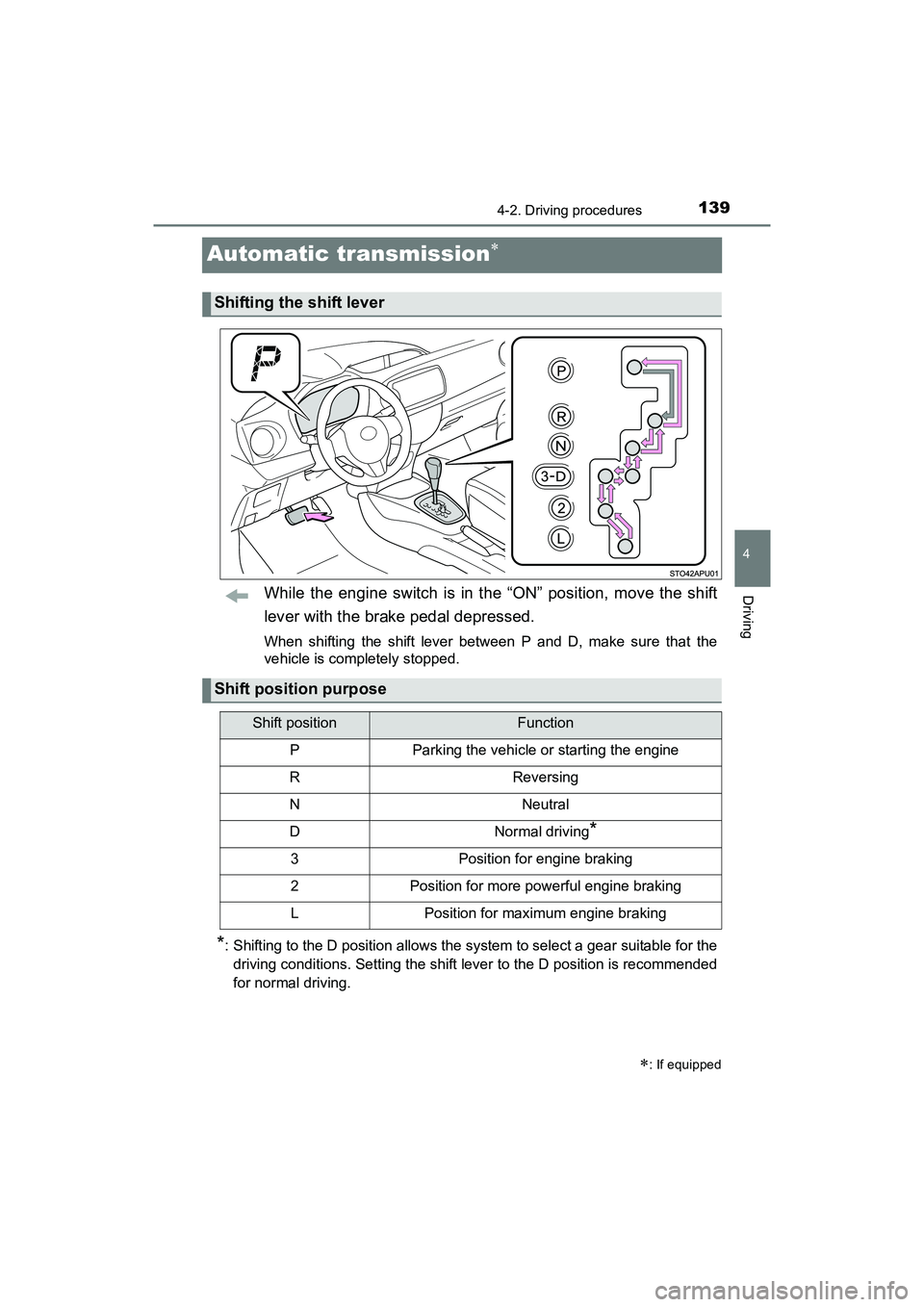
While the engine switch is in the “ON” position, move the shift
lever with the brake pedal depressed.
When shifting the shift lever between P and D, make sure that the
vehicle is completely stopped.
*: Shifting to the D position allows the system to select a gear suitable for thedriving conditions. Setting the shift lever to the D position is recommended
for normal driving.
: If equipped
Shifting the shift lever
Shift position purpose
Shift positionFunction
PParking the vehicle or starting the engine
RReversing
NNeutral
DNormal driving*
3Position for engine braking
2Position for more powerful engine braking
LPosition for maximum engine braking
YARIS_HB_OM_USA_OM52G64U.book 139 ページ 2016年2月16日 火曜日 午後3時20分
Page 142 of 400
1404-2. Driving procedures
YARIS_HB_OM_USA_OM52G64U
■Downshift restriction
The maximum allowable speeds are as follows.
■ AI-SHIFT
AI-SHIFT automatically selects the suitable gear according to driver perfor-
mance and driving conditions.
AI-SHIFT automatically operates when the shift lever is in the D position.
■ When driving with cruise control activated (if equipped)
Even when performing the following acti ons with the intent of enabling engine
braking, engine braking will not activate while downshifting to 3 because
cruise control will not be canceled. ( P. 190)
■ Shift lock system
The shift lock system is a system to prevent accidental operation of the shift
lever in starting.
The shift lever can be shifted from P only when the engine switch is in the
“ON” position and the brake pedal is being depressed.
■ If the shift lever cannot be shifted from P
First, check whether the brake pedal is being depressed.
If the shift lever cannot be shifted with your foot on the brake pedal, there may
be a problem with the shift lock system. Have the vehicle inspected by your
Toyota dealer immediately.
The following steps may be used as an emergency measure to ensure that
the shift lever can be shifted.
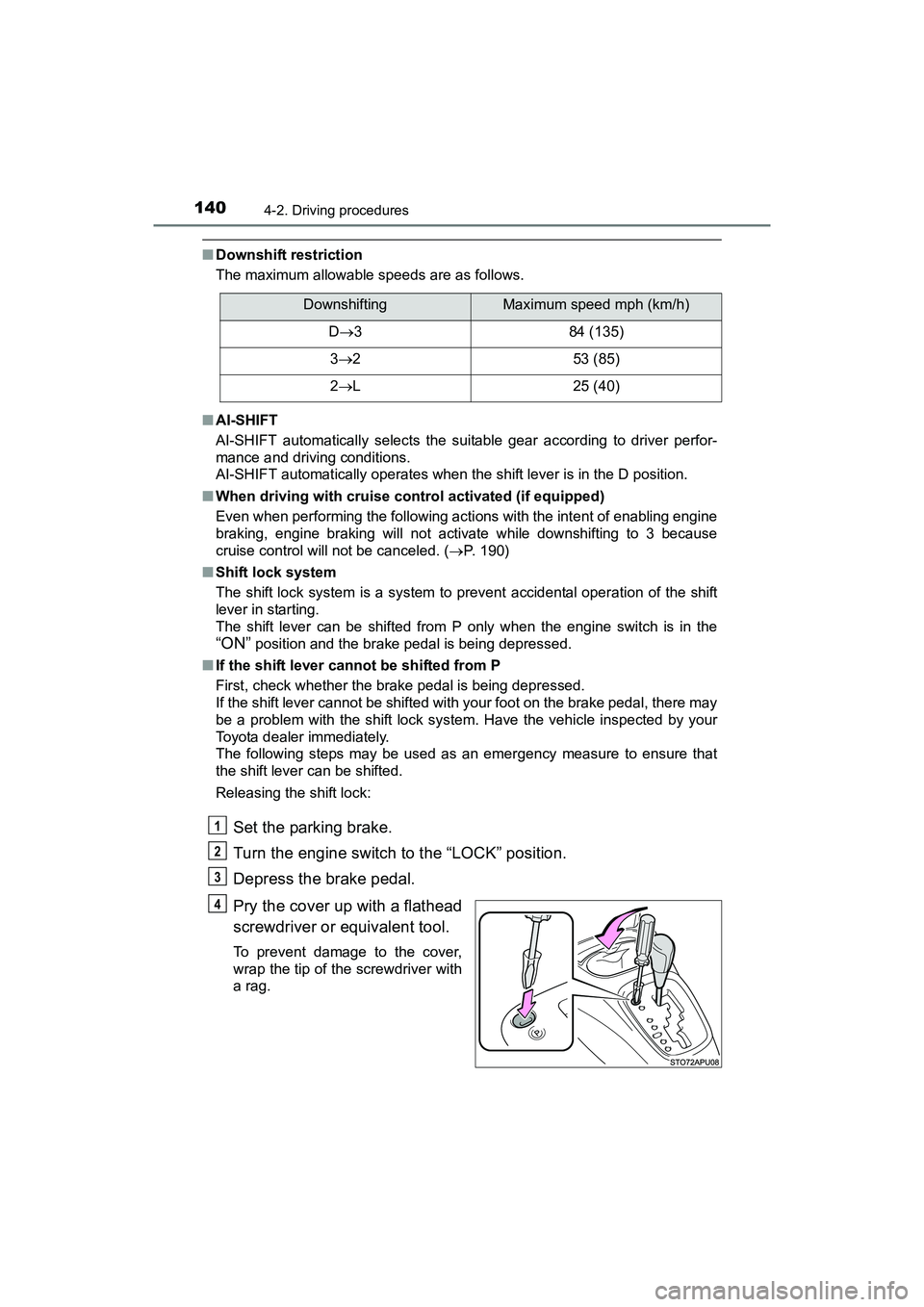
Releasing the shift lock:
Set the parking brake.
Turn the engine switch to the “LOCK” position.
Depress the brake pedal.
Pry the cover up with a flathead
screwdriver or equivalent tool.
To prevent damage to the cover,
wrap the tip of the screwdriver with
a rag.
DownshiftingMaximum speed mph (km/h)
D384 (135)
3253 (85)
2L25 (40)
1
2
3
4
YARIS_HB_OM_USA_OM52G64U.book 140 ページ 2016年2月16日 火曜日 午後3時20分
Page 143 of 400
1414-2. Driving procedures
4
Driving
YARIS_HB_OM_USA_OM52G64U
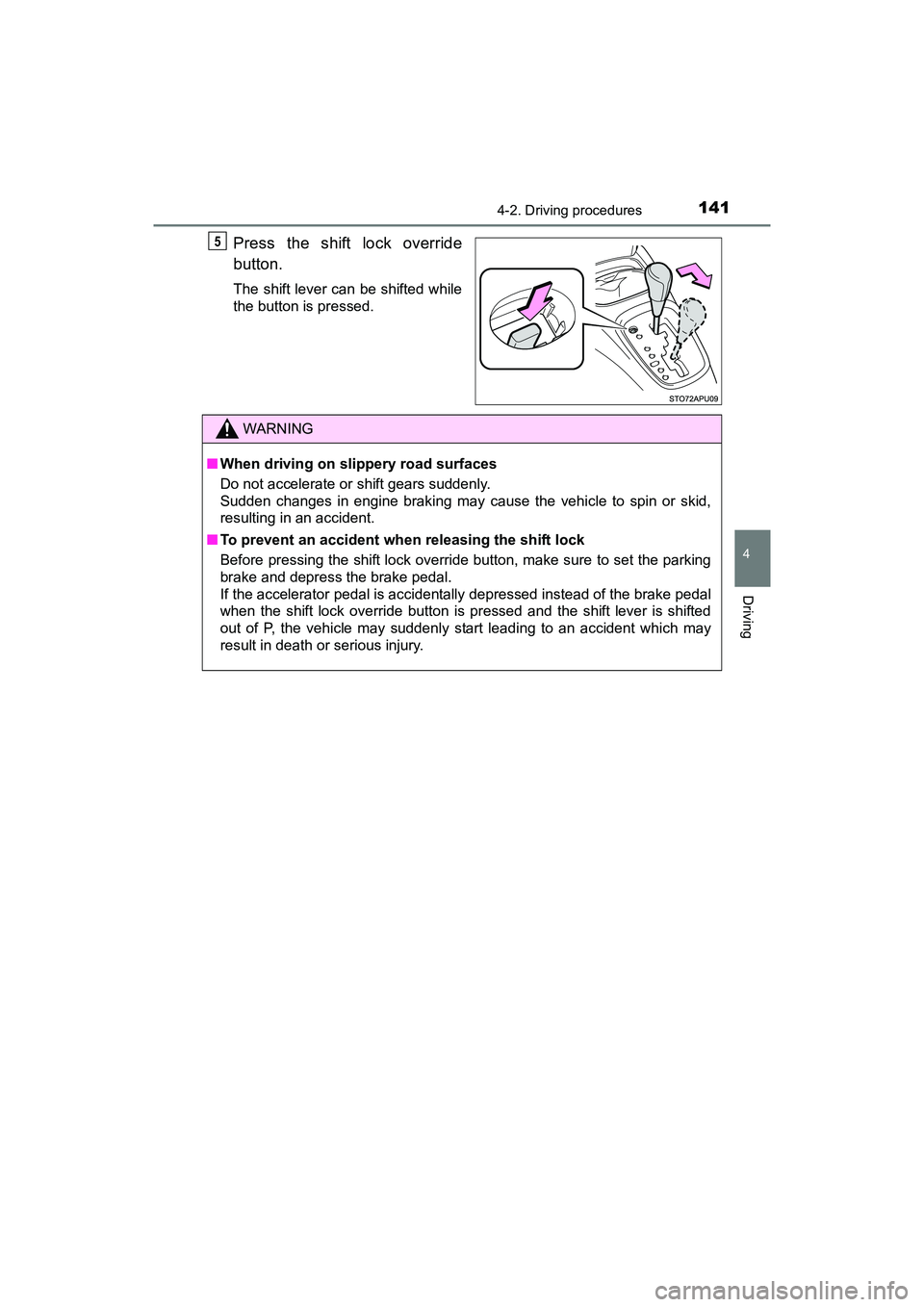
Press the shift lock override
button.
The shift lever can be shifted while
the button is pressed.
5
WARNING
■When driving on slippery road surfaces
Do not accelerate or shift gears suddenly.
Sudden changes in engine braking may cause the vehicle to spin or skid,
resulting in an accident.
■ To prevent an accident when releasing the shift lock
Before pressing the shift lock override button, make sure to set the parking
brake and depress the brake pedal.
If the accelerator pedal is accidentally depressed instead of the brake pedal
when the shift lock override button is pressed and the shift lever is shifted
out of P, the vehicle may suddenly start leading to an accident which may
result in death or serious injury.
YARIS_HB_OM_USA_OM52G64U.book 141 ページ 2016年2月16日 火曜日 午後3時20分
Page 146 of 400
1444-2. Driving procedures
YARIS_HB_OM_USA_OM52G64U
Parking brake
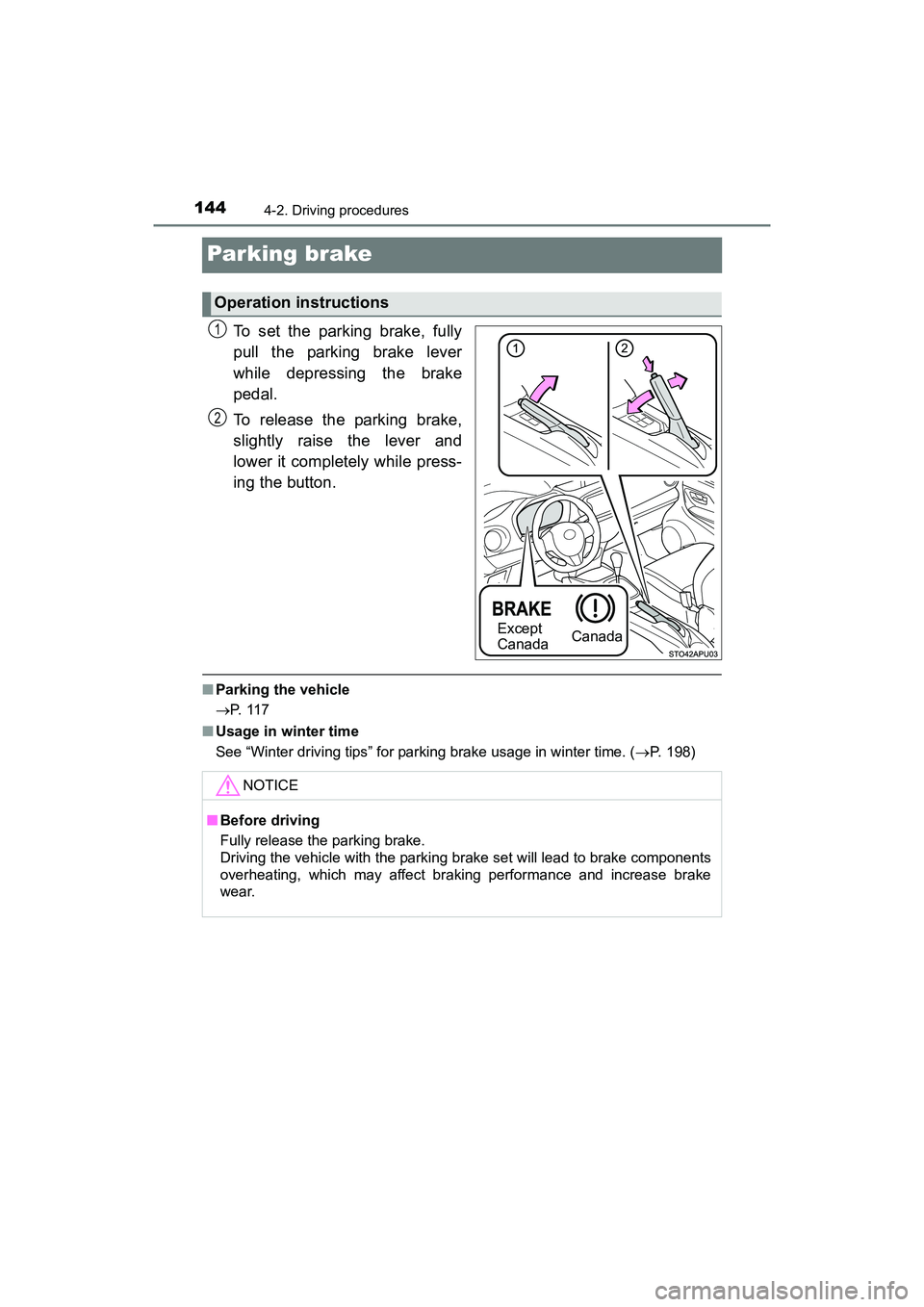
To set the parking brake, fully
pull the parking brake lever
while depressing the brake
pedal.
To release the parking brake,
slightly raise the lever and
lower it completely while press-
ing the button.
■Parking the vehicle
P. 1 1 7
■ Usage in winter time
See “Winter driving tips” for parking brake usage in winter time. ( P. 198)
Operation instructions
Except
CanadaCanada
1
2
NOTICE
■Before driving
Fully release the parking brake.
Driving the vehicle with the parking brake set will lead to brake components
overheating, which may affect braking performance and increase brake
wear.
YARIS_HB_OM_USA_OM52G64U.book 144 ページ 2016年2月16日 火曜日 午後3時20分
Page 149 of 400
1474-3. Operating the lights and wipers
4
Driving
YARIS_HB_OM_USA_OM52G64U
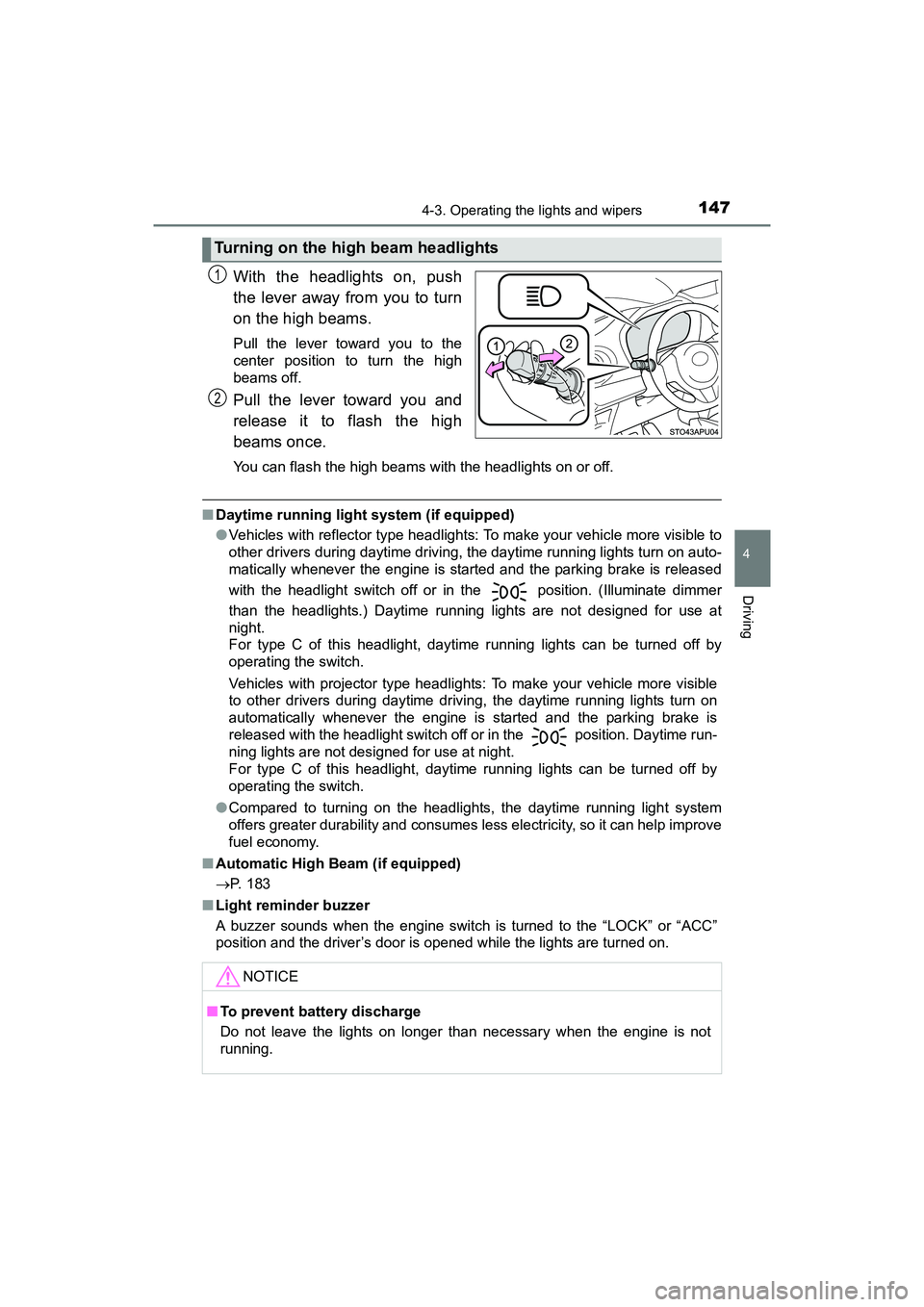
With the headlights on, push
the lever away from you to turn
on the high beams.
Pull the lever toward you to the
center position to turn the high
beams off.
Pull the lever toward you and
release it to flash the high
beams once.
You can flash the high beams with the headlights on or off.
■Daytime running light system (if equipped)
●Vehicles with reflector type headlights: To make your vehicle more visible to
other drivers during daytime driving, the daytime running lights turn on auto-
matically whenever the engine is started and the parking brake is released
with the headlight switch off or in the position. (Illuminate dimmer
than the headlights.) Daytime running lights are not designed for use at
night.
For type C of this headlight, daytime running lights can be turned off by
operating the switch.
Vehicles with projector type headlights: To make your vehicle more visible
to other drivers during daytime driving, the daytime running lights turn on
automatically whenever the engine is started and the parking brake is
released with the headlight switch off or in the position. Daytime run-
ning lights are not designed for use at night.
For type C of this headlight, daytime running lights can be turned off by
operating the switch.
● Compared to turning on the headlights, the daytime running light system
offers greater durability and consumes less electricity, so it can help improve
fuel economy.
■ Automatic High Beam (if equipped)
P. 183
■ Light reminder buzzer
A buzzer sounds when the engine switch is turned to the “LOCK” or “ACC”
position and the driver’s door is opened while the lights are turned on.
Turning on the high beam headlights
1
2
NOTICE
■To prevent battery discharge
Do not leave the lights on longer than necessary when the engine is not
running.
YARIS_HB_OM_USA_OM52G64U.book 147 ページ 2016年2月16日 火曜日 午後3時20分
Page 162 of 400
1604-5. Toyota Safety Sense C
YARIS_HB_OM_USA_OM52G64U
The pre-collision system is equipped with a sophisticated computer
that will record certain data, such as:• Accelerator status
• Brake status
• Vehicle speed
• Operation status of the pre-collision system functions
• Information (such as the distance and relative speed between your vehicle and the vehicle ahead or other objects)
• Images from the front sensor (available only when the pre-collision
braking function was operating)
The pre-collision system does not record conversations or other
sounds and does not record images of the inside of the vehicle.
● Data usage
Toyota may use the data recorded in this computer to diagnose
malfunctions, conduct research and development, and improve
quality.
Toyota will not disclose the recorded data to a third party except:
• With the consent of the vehicle owner or with the consent of the
lessee if the vehicle is leased
• In response to an official request by the police, a court of law or a
government agency
• For use by Toyota in a lawsuit
• For research purposes where the data is not tied to a specific vehicle or vehicle owner
● Recorded images can be erased using a specialized device.
The image recording function can be disabled. However, if the func-
tion is disabled, data from when the pre-collision system operates
will not be available.
Vehicle data recording
sec_04-05.fm 160 ページ 2016年2月17日 水曜日 午前11時35分
Page 167 of 400
1654-5. Toyota Safety Sense C
4
Driving
YARIS_HB_OM_USA_OM52G64U
PCS (Pre-Collision system)
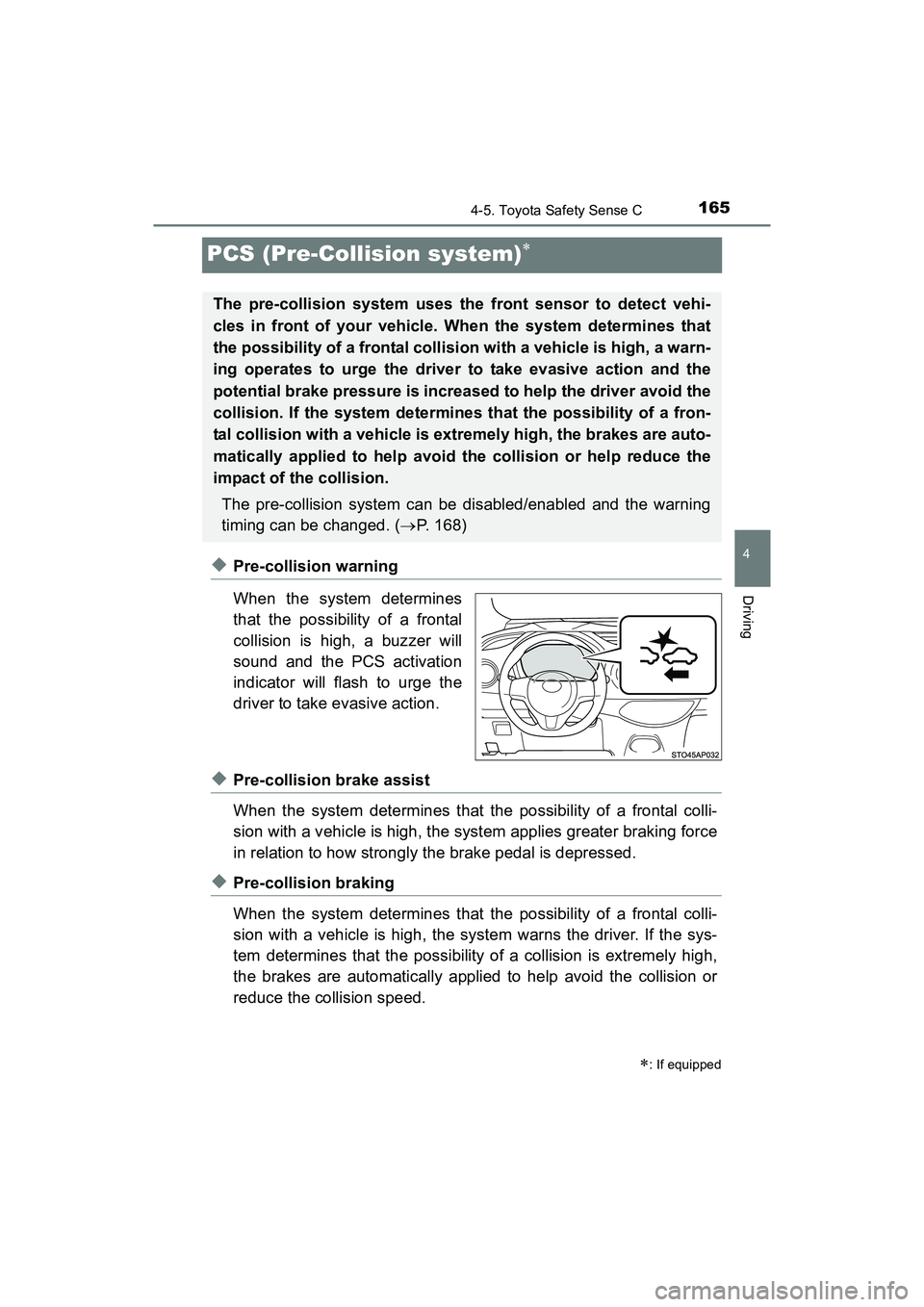
◆Pre-collision warning
When the system determines
that the possibility of a frontal
collision is high, a buzzer will
sound and the PCS activation
indicator will flash to urge the
driver to take evasive action.
◆Pre-collision brake assist
When the system determines that the possibility of a frontal colli-
sion with a vehicle is high, the system applies greater braking force
in relation to how strongly the brake pedal is depressed.
◆Pre-collision braking
When the system determines that the possibility of a frontal colli-
sion with a vehicle is high, the system warns the driver. If the sys-
tem determines that the possibility of a collision is extremely high,
the brakes are automatically applied to help avoid the collision or
reduce the collision speed.
: If equipped
The pre-collision system uses the front sensor to detect vehi-
cles in front of your vehicle. When the system determines that
the possibility of a frontal collision with a vehicle is high, a warn-
ing operates to urge the driver to take evasive action and the
potential brake pressure is increased to help the driver avoid the
collision. If the system determines that the possibility of a fron-
tal collision with a vehicle is extremely high, the brakes are auto-
matically applied to help avoid the collision or help reduce the
impact of the collision.The pre-collision system can be disabled/enabled and the warning
timing can be changed. ( P. 168)
sec_04-05.fm 165 ページ 2016年2月17日 水曜日 午前11時35分
Page 168 of 400
1664-5. Toyota Safety Sense C
YARIS_HB_OM_USA_OM52G64U
WARNING
■Limitations of the pre-collision system
●The driver is solely responsible for sa fe driving. Always drive safely, taking
care to observe your surroundings.
Do not use the pre-collision system instead of normal braking operations
under any circumstances. This system will not prevent collisions or lessen
collision damage or injury in every situation. Do not overly rely on this sys-
tem. Failure to do so may lead to an accident, resulting in death or serious
injury.
● Although this system is designed to help avoid and reduce the impact of a
collision, its effectiveness may change according to various conditions,
therefore the system may not always be able to achieve the same level of
performance.
Read the following conditions carefully. Do not overly rely on this system
and always drive carefully.
• Conditions under which the system may operate even if there is no pos-
sibility of a collision: P. 170
• Conditions under which the system may not operate properly: P. 174
● Do not attempt to test the operation of the pre-collision system yourself, as
the system may not operate properly, possibly leading to an accident.
■ Pre-collision braking
●The pre-collision braking function may not operate if certain operations are
performed by the driver. If the accelerator pedal is being depressed
strongly or the steering wheel is being turned, the system may determine
that the driver is taking evasive action and possibly prevent the pre-colli-
sion braking function from operating.
● In some situations, while the pre-collision braking function is operating,
operation of the function may be canceled if the accelerator pedal is
depressed strongly or the steering w heel is turned and the system deter-
mines that the driver is taking evasive action.
● A large amount of braking force is applied while the pre-collision braking
function is operating. Additionally, as the operation of the pre-collision
braking function will be canceled after the vehicle has been stopped for
approximately 2 seconds if it is stopped by the operation of the pre-colli-
sion braking function, the driver should depress the brake pedal as neces-
sary.
● If the brake pedal is being depressed, the system may determine that the
driver is taking evasive action and possibly delay the operation timing of
the pre-collision braking function.
sec_04-05.fm 166 ページ 2016年2月17日 水曜日 午前11時35分
Page 171 of 400
1694-5. Toyota Safety Sense C
4
Driving
YARIS_HB_OM_USA_OM52G64U
■Operational conditions
The pre-collision system is enabled and determines that the possibility of a
frontal collision with a vehicle is high.
Each function is operational at the following speeds:
●Pre-collision warning:
• Vehicle speed is approximately 10 to 86 mph (15 to 140 km/h).
• The relative speed between your vehicle and a preceding vehicle is
approximately 10 mph (15 km/h) or more.
● Pre-collision brake assist:
• Vehicle speed is approximately 19 to 49 mph (30 to 80 km/h).
• The relative speed between your vehicle and a preceding vehicle is
approximately 19 mph (30 km/h) or more.
● Pre-collision braking:
• Vehicle speed is approximately 7 to 49 mph (10 to 80 km/h).
• The relative speed between your vehicle and a preceding vehicle is
approximately 7 mph (10 km/h) or more.
The system may not operate in the following situations:
● If a battery terminal has been disconnected and reconnected and then the
vehicle has not been driven for a certain amount of time
● If the shift lever is in R
● If VSC is disabled (only the pre-collision warning function will be opera-
tional)
● If the PCS warning light is flashing or illuminated
■ Cancelation of the pre-collision braking
●If either of the following occur whil e the pre-collision braking function is
operating, it will be canceled:
• The accelerator pedal is depressed strongly.
• The steering wheel is turned sharply or abruptly.
● If the vehicle is stopped by the operation of the pre-collision braking func-
tion, the operation of the pre-collision braking function will be canceled after
the vehicle has been stopped for approximately 2 seconds.
sec_04-05.fm 169 ページ 2016年2月17日 水曜日 午前11時35分
Page 178 of 400
1764-5. Toyota Safety Sense C
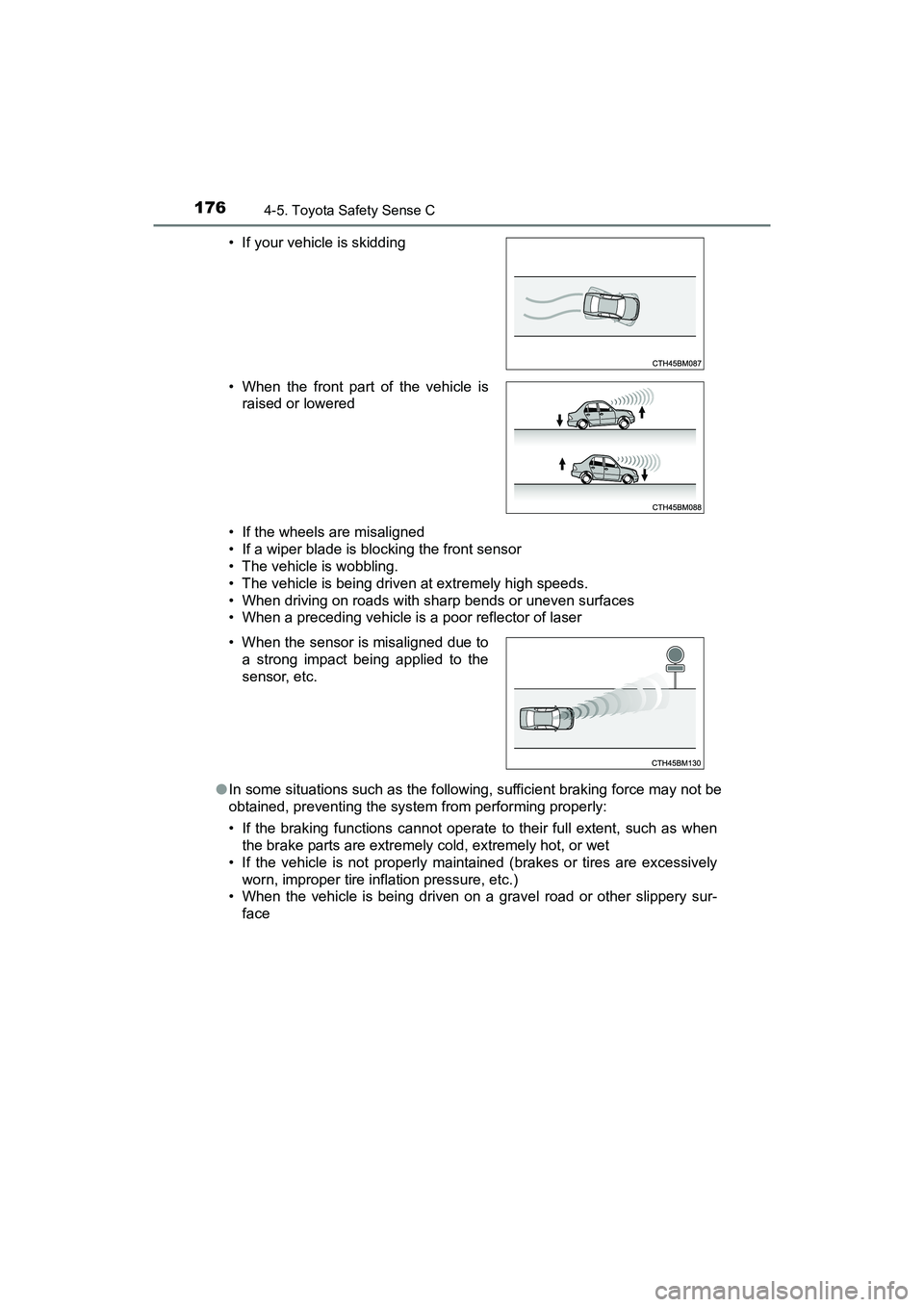
YARIS_HB_OM_USA_OM52G64U• If the wheels are misaligned
• If a wiper blade is blocking the front sensor
• The vehicle is wobbling.
• The vehicle is being driven at extremely high speeds.
• When driving on roads with sharp bends or uneven surfaces
• When a preceding vehicle is a poor reflector of laser
● In some situations such as the following, sufficient braking force may not be
obtained, preventing the system from performing properly:
• If the braking functions cannot operate to their full extent, such as when
the brake parts are extremely cold, extremely hot, or wet
• If the vehicle is not properly maintained (brakes or tires are excessively worn, improper tire inflation pressure, etc.)
• When the vehicle is being driven on a gravel road or other slippery sur-
face
• If your vehicle is skidding
• When the front part of the vehicle is
raised or lowered
• When the sensor is misaligned due to a strong impact being applied to the
sensor, etc.
sec_04-05.fm 176 ページ 2016年2月17日 水曜日 午前11時35分