automatic transmission TOYOTA YARIS HATCHBACK 2018 Owner's Manual
[x] Cancel search | Manufacturer: TOYOTA, Model Year: 2018, Model line: YARIS HATCHBACK, Model: TOYOTA YARIS HATCHBACK 2018Pages: 520, PDF Size: 8.69 MB
Page 418 of 520
4188-2. Steps to take in an emergency
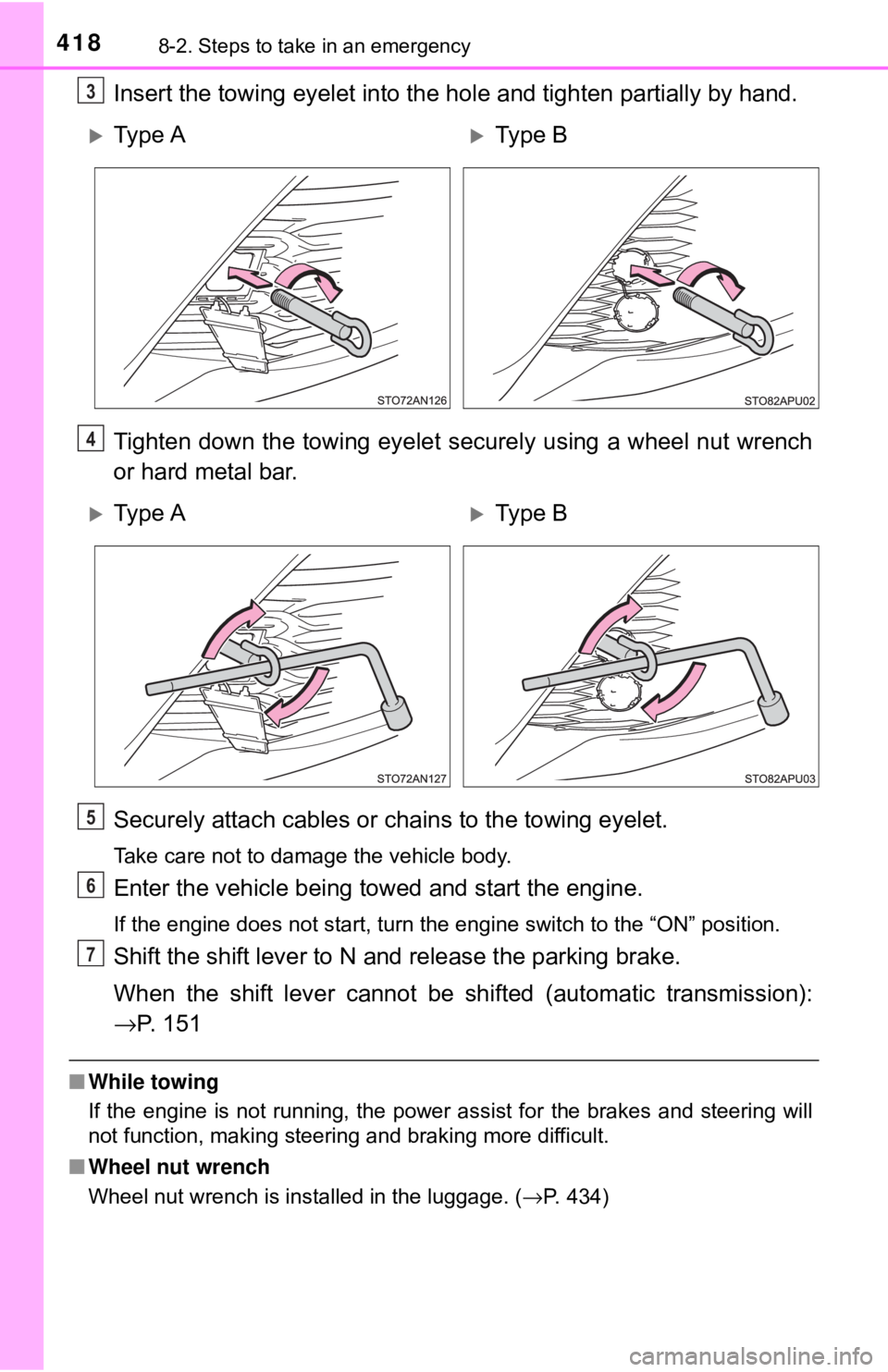
Insert the towing eyelet into the hole and tighten partially by hand.
Tighten down the towing eyelet securely using a wheel nut wrench
or hard metal bar.
Securely attach cables or chains to the towing eyelet.
Take care not to damage the vehicle body.
Enter the vehicle being towed and start the engine.
If the engine does not start, turn the engine switch to the “ON” p\
osition.
Shift the shift lever to N and release the parking brake.
When the shift lever cannot be sh ifted (automatic transmission):
→ P. 1 5 1
■While towing
If the engine is not running, the power assist for the brakes and steering will
not function, making steering and braking more difficult.
■ Wheel nut wrench
Wheel nut wrench is installed in the luggage. ( →P. 434)
3
Ty p e AType B
4
Ty p e AType B
5
6
7
Page 423 of 520
4238-2. Steps to take in an emergency
8
When trouble arises
(Except Canada)(Canada)
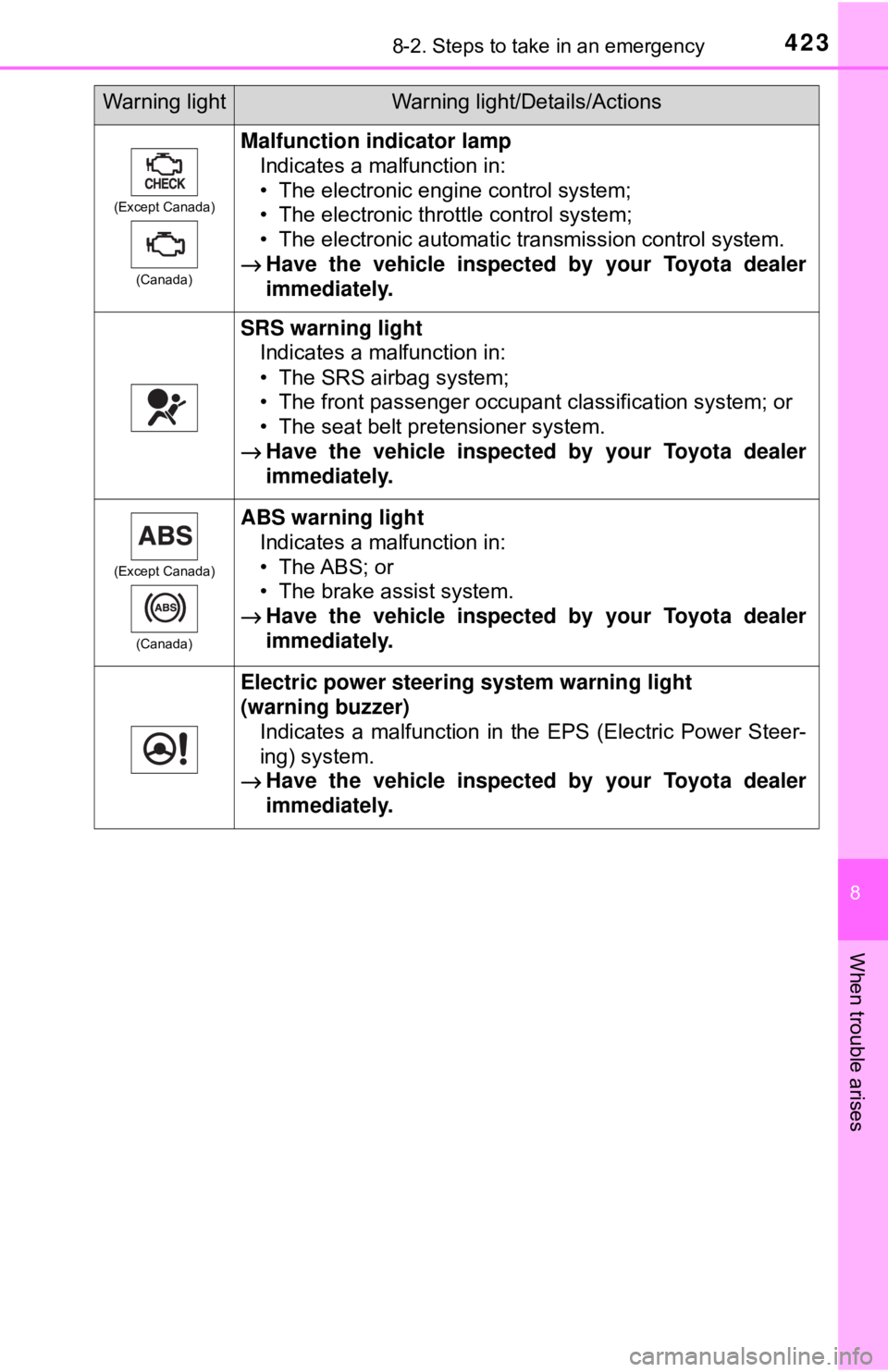
Malfunction indicator lampIndicates a malfunction in:
• The electronic engine control system;
• The electronic throttle control system;
• The electronic automatic transmission control system.
→ Have the vehicle inspected by your Toyota dealer
immediately.
SRS warning light
Indicates a malfunction in:
• The SRS airbag system;
• The front passenger occupant classification system; or
• The seat belt pretensioner system.
→ Have the vehicle inspected by your Toyota dealer
immediately.
(Except Canada)
(Canada)
ABS warning lightIndicates a malfunction in:
• The ABS; or
• The brake assist system.
→ Have the vehicle inspected by your Toyota dealer
immediately.
Electric power steering system warning light
(warning buzzer)
Indicates a malfunction in the EPS (Electric Power Steer-
ing) system.
→ Have the vehicle inspected by your Toyota dealer
immediately.
Warning lightWarning light/Details/Actions
Page 433 of 520
4338-2. Steps to take in an emergency
8
When trouble arises
If you have a flat tire
●Stop the vehicle in a safe pl ace on a hard, flat surface.
● Set the parking brake.
● Shift the shift lever to P (automatic transmission) or R (manual
transmission).
● Stop the engine.
● Turn on the emergency flashers. ( →P. 412)
Your vehicle is equipped with a spare tire. The flat tire can be
replaced with the spare tire.
For details about tires: →P. 3 7 0
WARNING
■If you have a flat tire
Do not continue driving with a flat tire.
Driving even a short dist ance with a flat tire can damage the tire and the
wheel beyond repair, which could result in an accident.
Before jacking up the vehicle
Page 451 of 520

4518-2. Steps to take in an emergency
8
When trouble arises
Start the engine of the second vehicle. Increase the engine speed
slightly and maintain at that level for approximately 5 minutes to
recharge the batter y of your vehicle.
Maintain the engine speed of t he second vehicle and start the
engine of your vehicle.
Once the vehicle’s engine has star ted, remove the jumper cables in
the exact reverse order from which they were connected.
Once the engine starts, have the v ehicle inspected at your Toyota
dealer as soon as possible.
■ Starting the engine when the batt ery is discharged (vehicles with an
automatic transmission)
The engine cannot be started by push-starting.
■ To prevent battery discharge
●Turn off the headlights and the audio system while the engine is not running.
● Turn off any unnecessary electrical components when the vehicle is running
at a low speed for an extended period, such as in heavy traffic.
■ Charging the battery
The electricity stored in the battery will discharge gradually even when the
vehicle is not in use, due to natural discharge and the draining effects of cer-
tain electrical appliances. If the vehicle is left for a long time, the battery may
discharge, and the engine may be unable to start. (The battery recharges
automatically during driving.)
3
4
5
Page 456 of 520
4568-2. Steps to take in an emergency
If the vehicle becomes stuck
Stop the engine. Set the parking brake and shift the shift lever to P
(automatic transmission) or N (manual transmission).
Remove the mud, snow or sand from around the front wheels.
Place wood, stones or some othe r material under the front wheels
to help provide traction.
Restart the engine.
Shift the shift lever to D or R (a utomatic transmission) or 1 or R
(manual transmission) and releas e the parking brake. Then, while
exercising caution, depre ss the accelerator pedal.
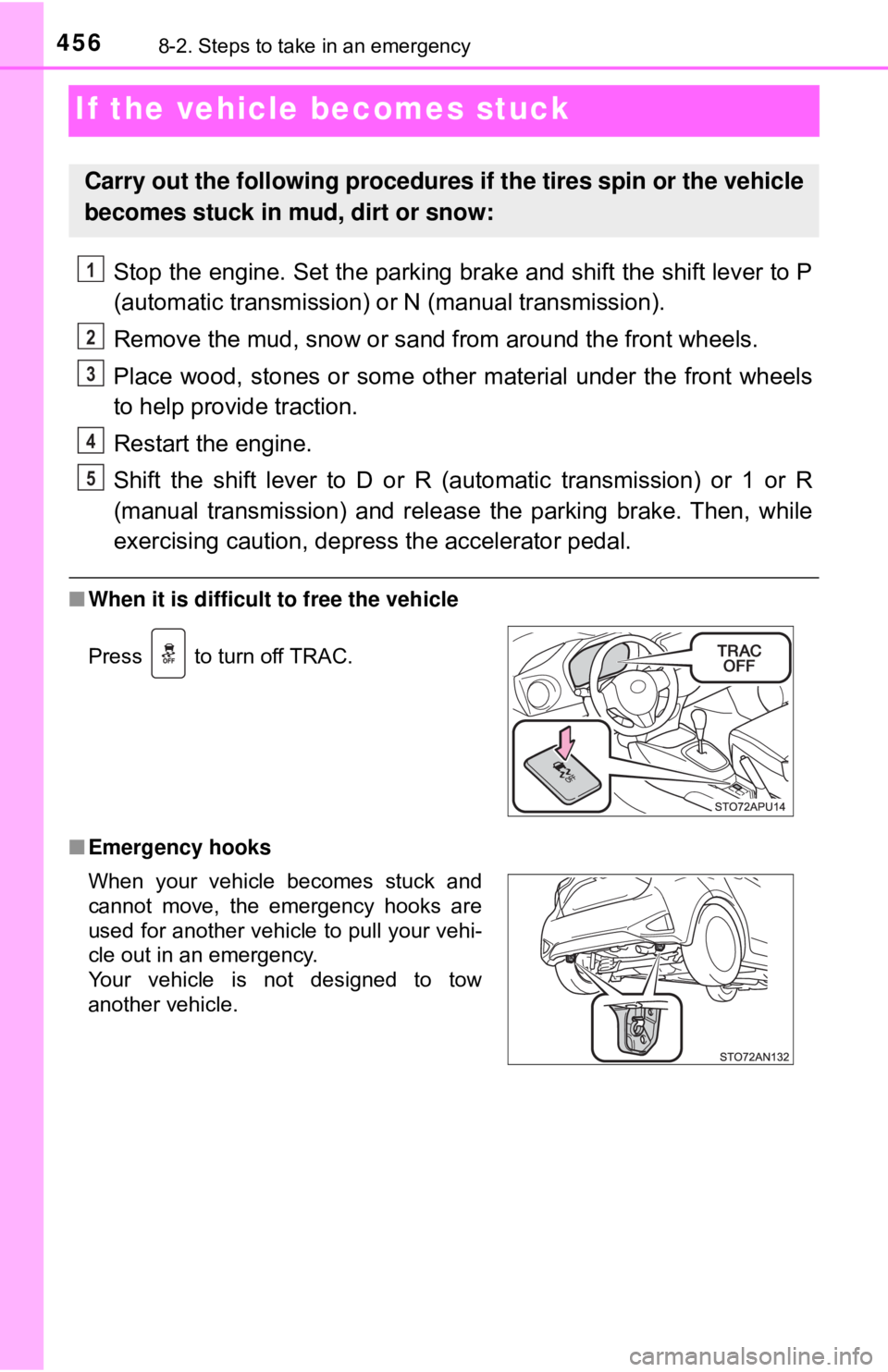
■When it is difficult to free the vehicle
■ Emergency hooks
Carry out the following procedures if the tires spin or the vehicle
becomes stuck in mud, dirt or snow:
Press to turn off TRAC.
When your vehicle becomes stuck and
cannot move, the emergency hooks are
used for another vehicle to pull your vehi-
cle out in an emergency.
Your vehicle is not designed to tow
another vehicle.
1
2
3
4
5
Page 457 of 520

4578-2. Steps to take in an emergency
8
When trouble arises
WARNING
■When attempting to free a stuck vehicle
If you choose to push the vehicle back and forth to free it, make sure the
surrounding area is clear to avoid striking other vehicles, objects or people.
The vehicle may also lunge forward or lunge back suddenly as it becomes
free. Use extreme caution.
■ When shifting the shift lever (automatic transmission)
Be careful not to shift the shift lever with the accelerator pedal depressed.
This may lead to unexpected rapid acceleration of the vehicle that may
cause an accident resulting in death or serious injury.
NOTICE
■ To avoid damage to the tran smission and other components
● Avoid spinning the front wheels and depressing the accelerator pedal
more than necessary.
● If the vehicle remains stuck even after these procedures are performed,
the vehicle may require towing to be freed.
Page 465 of 520
4659-1. Specifications
9
Vehicle specifications
Oil viscosity (5W-30 is explained here as an example): • The 5W in 5W-30 indicates the characteristic of the oil which
allows cold startability. Oils with a lower value before the W allow
for easier starting of the engine in cold weather.
• The 30 in 5W-30 indicates the viscosity characteristic of the oil when the oil is at high temperature. An oil with a higher viscosity
(one with a higher value) may be better suited if the vehicle is
operated at high speeds, or under extreme load conditions.
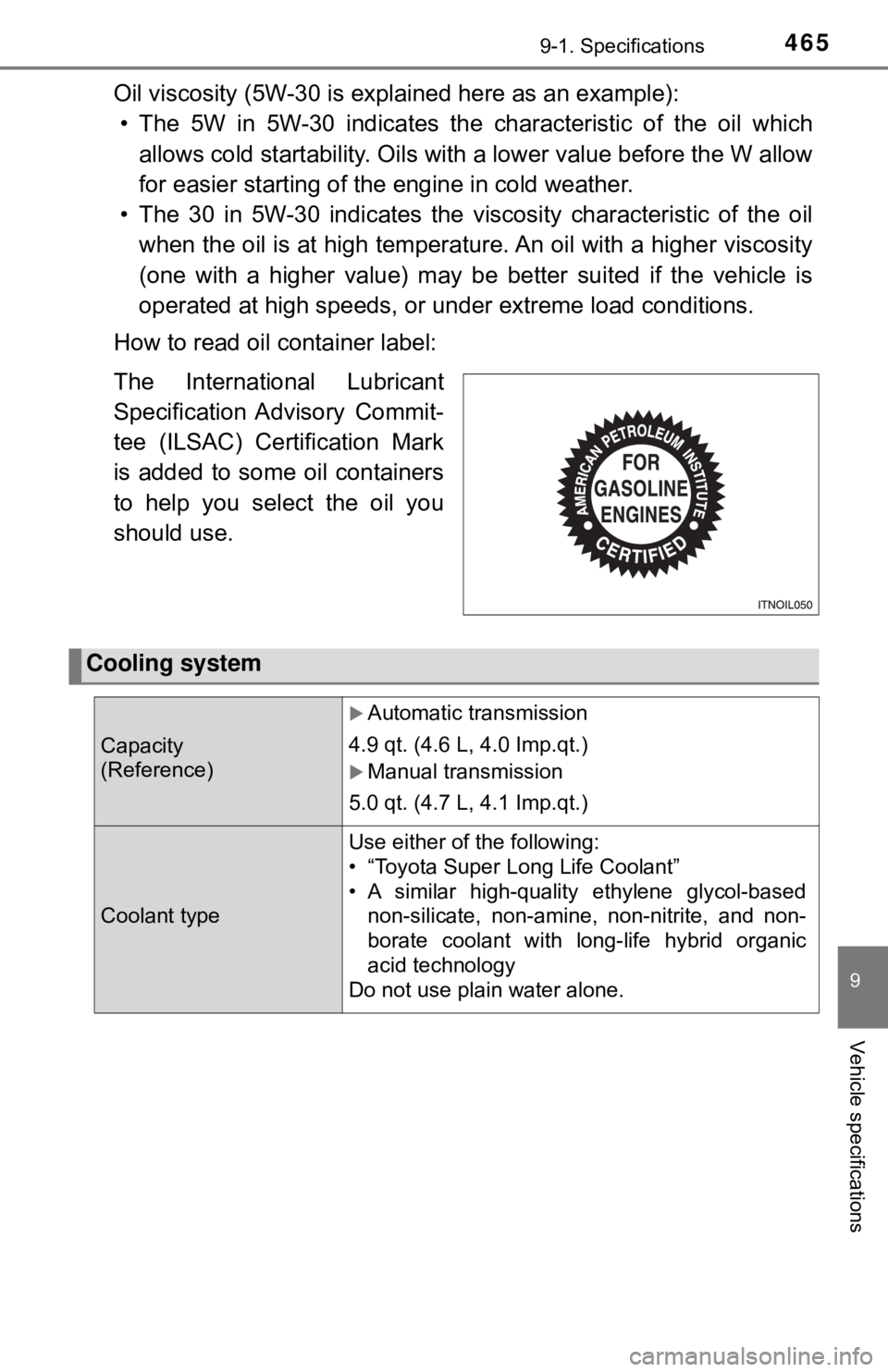
How to read oil container label:
The International Lubricant
Specification Advisory Commit-
tee (ILSAC) Certification Mark
is added to some oil containers
to help you select the oil you
should use.
Cooling system
Capacity
(Reference)
Automatic transmission
4.9 qt. (4.6 L, 4.0 Imp.qt.)
Manual transmission
5.0 qt. (4.7 L, 4.1 Imp.qt.)
Coolant type
Use either of the following:
• “Toyota Super Long Life Coolant”
• A similar high-quality ethylene glycol-based non-silicate, non-amine, non-nitrite, and non-
borate coolant with long-life hybrid organic
acid technology
Do not use plain water alone.
Page 466 of 520
4669-1. Specifications
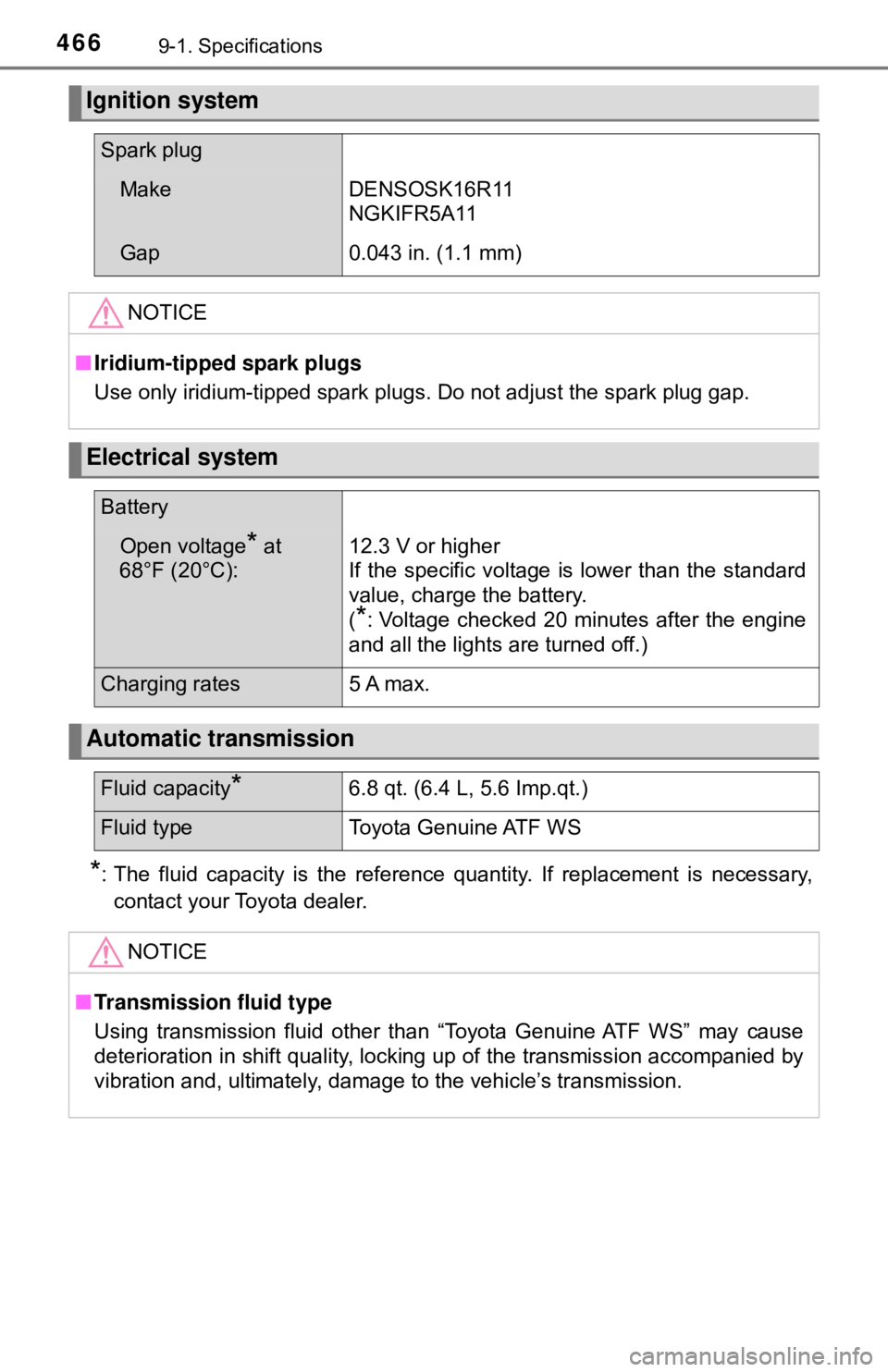
*: The fluid capacity is the reference quantity. If replacement is necessary,contact your Toyota dealer.
Ignition system
Spark plug
MakeDENSOSK16R11
NGKIFR5A11
Gap0.043 in. (1.1 mm)
NOTICE
■ Iridium-tipped spark plugs
Use only iridium-tipped spark plugs. Do not adjust the spark plug gap.
Electrical system
Battery
Open voltage* at
68°F (20°C): 12.3 V or higher
If the specific voltage is lower than the standard
value, charge the battery.
(
*: Voltage checked 20 minutes after the engine
and all the lights are turned off.)
Charging rates 5 A max.
Automatic transmission
Fluid capacity*6.8 qt. (6.4 L, 5.6 Imp.qt.)
Fluid typeToyota Genuine ATF WS
NOTICE
■Transmission fluid type
Using transmission fluid other than “Toyota Genuine ATF WS” may cause
deterioration in shift quality, locking up of the transmission accompanied by
vibration and, ultimately, damage to the vehicle’s transmission.
Page 507 of 520
507What to do if... (Troubleshooting)
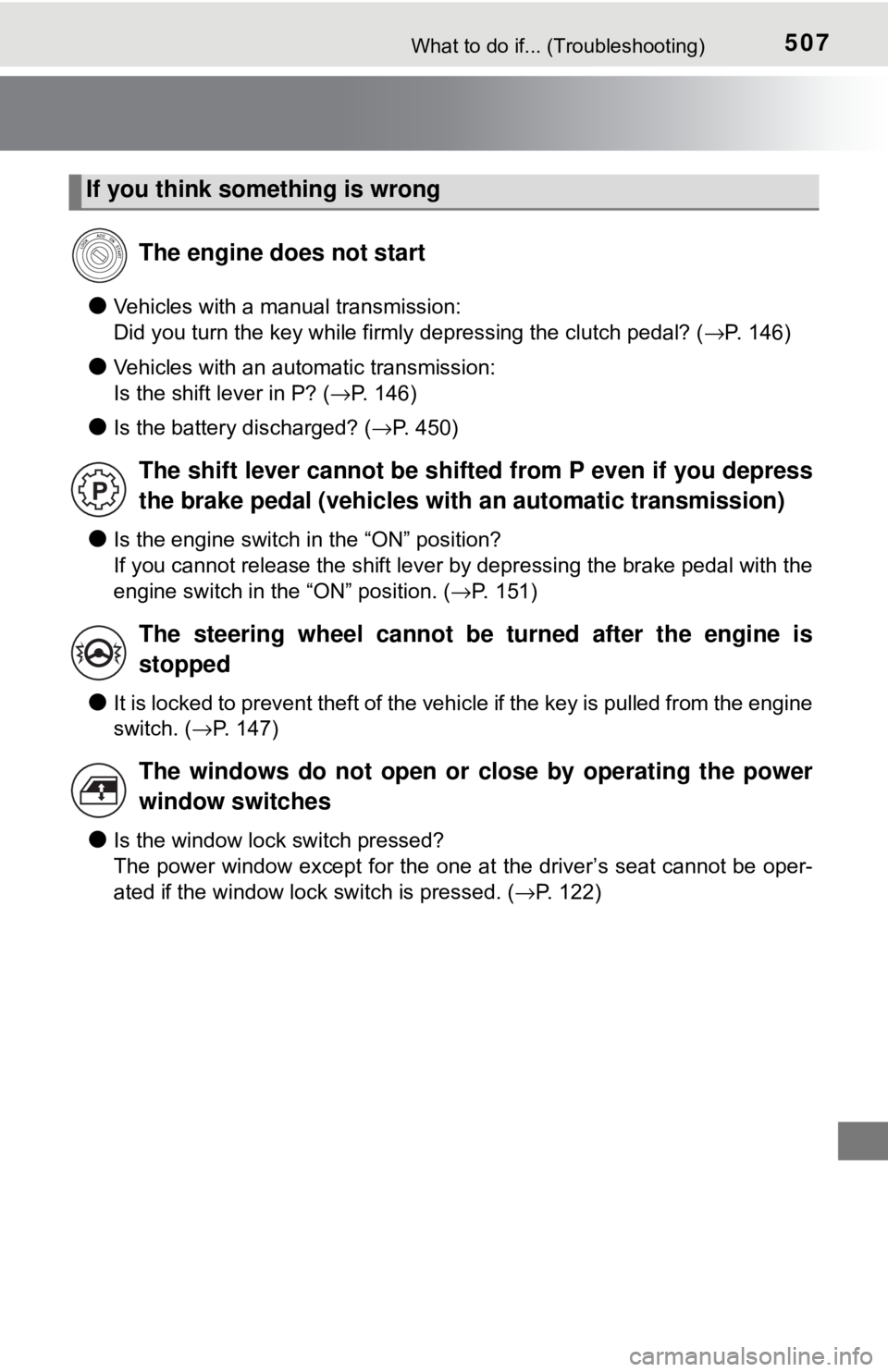
●Vehicles with a manual transmission:
Did you turn the key while firmly depressing the clutch pedal? (→P. 146)
●Vehicles with an automatic transmission:
Is the shift lever in P? (→P. 146)
●Is the battery discharged? ( →P. 450)
●Is the engine switch in the “ON” position?
If you cannot release the shift lever by depressing the brake pedal with the
engine switch in the “ON” position. ( →P. 151)
●It is locked to prevent theft of the vehicle if the key is pulled from the engine
switch. (→P. 147)
●Is the window lock switch pressed?
The power window except for the one at the driver’s seat cannot be oper-
ated if the window lock switch is pressed. ( →P. 122)
If you think something is wrong
The engine does not start
The shift lever cannot be shifted from P even if you depress
the brake pedal (vehicles with an automatic transmission)
The steering wheel cannot be turned after the engine is
stopped
The windows do not open or close by operating the power
window switches
Page 509 of 520
509Alphabetical index
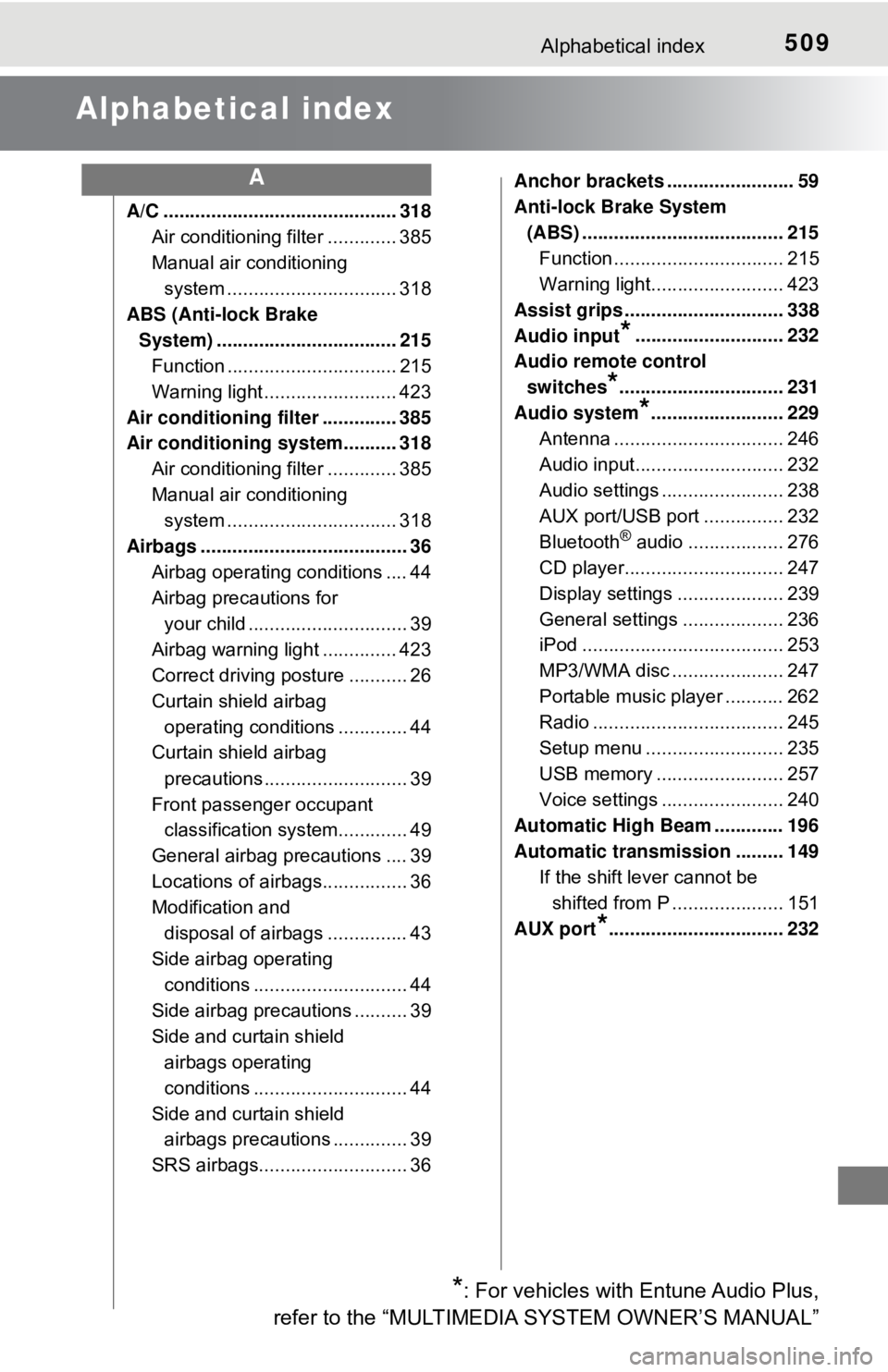
Alphabetical index
A/C ............................................ 318Air conditioning filter ............. 385
Manual air conditioning system ......... ....................... 318
ABS (Anti-lock Brake System) .................................. 215 Function ................................ 215
Warning light ......................... 423
Air conditioning filter .............. 385
Air conditioning system.......... 318 Air conditioning filter ............. 385
Manual air conditioning system ......... ....................... 318
Airbags ....................................... 36 Airbag operating conditions .... 44
Airbag precautions for your child .............................. 39
Airbag warning light .............. 423
Correct driving posture ........... 26
Curtain shield airbag operating conditions ............. 44
Curtain shield airbag
precautions ........................... 39
Front passenger occupant classification syst em............. 49
General airbag precautions .... 39
Locations of airbags................ 36
Modification and disposal of airbags ............... 43
Side airbag operating conditions ............................. 44
Side airbag precautions .......... 39
Side and curtain shield airbags operating
conditions ............................. 44
Side and curtain shield airbags precautions .............. 39
SRS airbags............................ 36 Anchor brackets ........................ 59
Anti-lock Brake System
(ABS) ...................................... 215
Function ................................ 215
Warning light......................... 423
Assist grips .............................. 338
Audio input
*............................ 232
Audio remote control switches
*............................... 231
Audio system
*......................... 229
Antenna ................................ 246
Audio input............................ 232
Audio settings ....................... 238
AUX port/USB port ............... 232
Bluetooth
® audio .................. 276
CD player.............................. 247
Display settings .................... 239
General settings ................... 236
iPod ...................................... 253
MP3/WMA disc ..................... 247
Portable music player ........... 262
Radio .................................... 245
Setup menu .......................... 235
USB memory ........................ 257
Voice settings ....................... 240
Automatic High Beam ............. 196
Automatic transmission ......... 149 If the shift lever cannot be
shifted from P ..................... 151
AUX port
*................................. 232
A
*: For vehicles with Entune Audio Plus,
refer to the “MULTIMEDIA SYSTEM OWNER’S MANUAL”