warning light TOYOTA YARIS HATCHBACK 2018 Repair Manual
[x] Cancel search | Manufacturer: TOYOTA, Model Year: 2018, Model line: YARIS HATCHBACK, Model: TOYOTA YARIS HATCHBACK 2018Pages: 520, PDF Size: 8.69 MB
Page 426 of 520
4268-2. Steps to take in an emergency
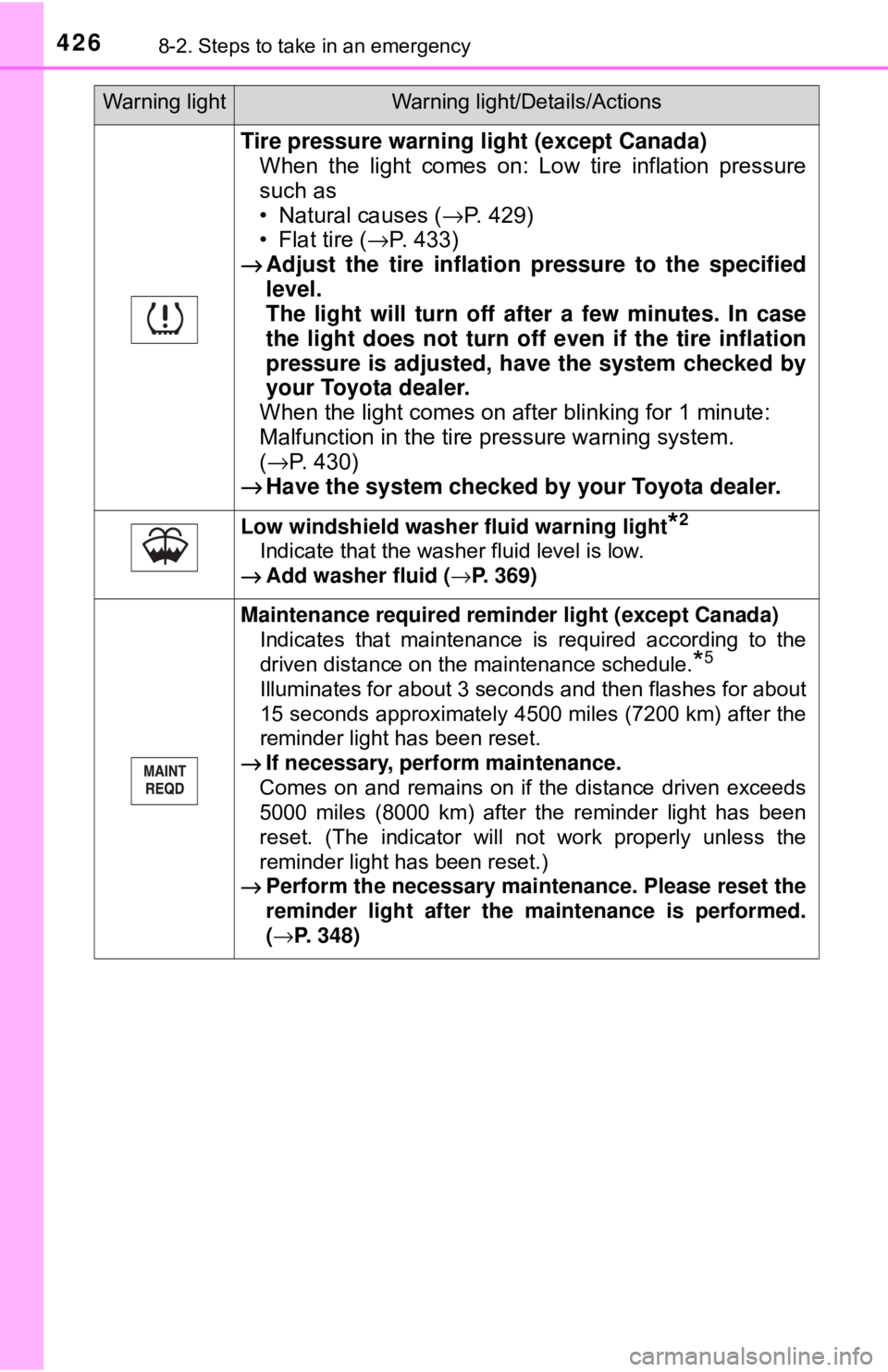
Tire pressure warning light (except Canada)When the light comes on: Low tire inflation pressure
such as
• Natural causes ( →P. 429)
• Flat tire ( →P. 433)
→ Adjust the tire inflation pressure to the specified
level.
The light will turn off af ter a few minutes. In case
the light does not turn off even if the tire inflation
pressure is adjusted, have the system checked by
your Toyota dealer.
When the light comes on after blinking for 1 minute:
Malfunction in the tire pressure warning system.
( → P. 430)
→ Have the system checked by your Toyota dealer.
Low windshield washer fluid warning light*2
Indicate that the washer fluid level is low.
→ Add washer fluid ( →P. 369)
Maintenance required reminder light (except Canada)
Indicates that maintenance is required according to the
driven distance on the maintenance schedule.
*5
Illuminates for about 3 seconds and then flashes for about
15 seconds approximately 4500 miles (7200 km) after the
reminder light has been reset.
→ If necessary, perform maintenance.
Comes on and remains on if the distance driven exceeds
5000 miles (8000 km) after the reminder light has been
reset. (The indicator will not work properly unless the
reminder light has been reset.)
→ Perform the necessary maintenance. Please reset the
reminder light after the maintenance is performed.
(→P. 348)
Warning lightWarning light/Details/Actions
Page 428 of 520

4288-2. Steps to take in an emergency
■SRS warning light
This warning light system monitors the airbag sensor assembly, front impact
sensors, side impact sensors (front), side impact sensors (front door\
), side
impact sensors (rear), driver’s seat belt buckle switch, front passenger occu-
pant classification system (ECU and sensors), “AIR BAG ON” indicator, “AIR
BAG OFF” indicator, front passenger’s seat belt buckle switch, seat belt pre-
tensioners, airbags, interconnecting wiring and power sources. ( →P. 36)
■ Front passenger detection sensor, passenger seat belt reminder and
warning buzzer
● If luggage is placed on the front passenger seat, the front passenger de\
tec-
tion sensor may cause the warning light to flash and the warning buzzer to
sound even if a passenger is not sitting in the seat.
● If a cushion is placed on the seat, the sensor may not detect a passenger,
and the warning light may not operate properly.
■ Electric power steering system warning light (warning buzzer)
When the battery charge becomes insufficient or the voltage temporarily
drops, the electric power steering system warning light may come on and \
the
warning buzzer may sounds.
■ If the malfunction indicator la mp comes on while driving
First check the following:
● Is the fuel tank empty?
If it is, fill the fuel tank immediately.
● Is the fuel tank cap loose?
If it is, tighten it securely.
The malfunction indicator lamp will go off after several driving trips.
If the malfunction indicator lamp does not go off even after several trips, con-
tact your Toyota dealer as soon as possible.
■
When the tire pressure warning light comes on (vehicles with a tire
pressure warning system)
Check the tire inflation pressure and adjust to the appropriate level. Push-
ing the tire pressure warning reset switch will not turn off the tire pressure
warning light.
Page 429 of 520

4298-2. Steps to take in an emergency
8
When trouble arises
■The tire pressure warning light may come on due to natural causes
(vehicles with a tire pressure warning system)
The tire pressure warning light may come on due to natural causes such
as natural air leaks and tire inflation pressure changes caused by tem-
perature. In this case, adjusting the ti re inflation pressure will turn off the
warning light (afte r a few minutes).
■When a tire is replaced with a spare tire (vehicles with a tire pressure
warning system)
The compact spare tire is not equipped with a tire pressure warning valve
and transmitter. If a tire goes flat, the tire pressure warning light will not
turn off even though the flat tire ha s been replaced with the spare tire.
Replace the spare tire with the repair ed tire and adjust the tire inflation
pressure. The tire pressu re warning light will go off after a few minutes.
■If the tire pressure warning system is not functioning (vehicles with a
tire pressure warning system)
The system will be disabled in the following conditions:
(When the condition be comes normal, the system will work properly.)
●If tires not equipped with tire pressure warning valves and transmitters
are used
●If the ID code on the tire pressure warning valves and transmitters are
not registered in the tire pressure warning computer
●If the tire inflation pressure is 73 psi (500 kPa, 5.1 kgf/cm2 or bar) or
higher
The tire pressure warning system may be disabled in the following condi-
tions:
(When the condition be comes normal, the system will work properly.)
●If electronic devices or facilities using similar radio wave frequencies are
nearby
●If a radio set at a similar frequency is in use in the vehicle
●If a window tint that affects the radio wave signals is installed
●If there is a lot of snow or ice on the vehicle, particularly around the
wheels or wheel housings
●If non-genuine Toyota wheels are us ed (Even if you use Toyota wheels,
the tire pressure warning system may not work properly with some types
of tires.)
●If tire chains are used
Page 430 of 520
4308-2. Steps to take in an emergency
■If the tire pressure warning light frequently comes on after blinking
for 1 minute (vehicles with a tire pressure warning system)
If the tire pressure warning light frequently comes on after blinking for
1 minute when the engine switch is turned to the “ON” position, have it
checked by your Toyota dealer.
■ Customization that can be co nfigured at Toyota dealer
The vehicle speed linked seat belt reminder buzzer can be disabled.
(Customizable features →P. 488) However, Toyota recommends that the seat
belt reminder buzzer be operational to alert the driver and front passenger
when seat belts are not fastened.
WARNING
■ If both the ABS and the brake system warning lights remain on
Stop your vehicle in a safe place immediately and contact your Toyota
dealer. The vehicle will become extremely unstable during braking, and the
ABS system may fail, which could cause an accident resulting in death or
serious injury.
■ When the electric power steerin g system warning light comes on
The steering wheel may become extremely heavy.
When steering wheel operations are heavier than usual, grip the steering
wheel firmly and operate it using more force than usual.
■
If the tire pressure warning light comes on (vehicles with a tire
pressure warning system)
Be sure to observe the following precautions. Failure to do so could
cause a loss of vehicle control and result in death or serious injury.
●Stop your vehicle in a safe place as soon as possible. Adjust the tire
inflation pressure immediately.
●If the tire pressure warning light co mes on even after tire inflation pres-
sure adjustment, it is probable that you have a flat tire. Check the tires.
If a tire is flat, change it with the spare tire and have the flat tire
repaired by the nearest Toyota dealer.
●Avoid abrupt maneuvering and braking. If the vehicle tires deteriorate,
you could lose control of the steering wheel or the brakes.
■If a blowout or sudden air leakage should occur (vehicles with a tire
pressure warning system)
The tire pressure warning system may not activate immediately.
Page 431 of 520

4318-2. Steps to take in an emergency
8
When trouble arises
WARNING
■Maintenance of the tire (vehicles with a tire pressure warning sys-
tem)
Each tire, including the spare (if provided), should be checked monthly
when cold and inflated to the inflation pressure recommended by the
vehicle manufacturer on the vehicle placard or tire inflation pressure
label (tire and load information label). (If your vehicle has tires of a dif-
ferent size than the size indicated on the vehicle placard or tire inflation
pressure label [tire and load information label], you should determine
the proper tire inflation pressure for those tires.)
As an added safety feature, your vehicle has been equipped with a tire
pressure monitoring system (TPMS-ti re pressure warning system) that
illuminates a low tire pre ssure telltale (tire pressure warning light) when
one or more of your tires is significantly under-inflated. Accordingly,
when the low tire pressure telltale (tire pressure warning light) illumi-
nates, you should stop and check your tires as soon as possible, and
inflate them to the proper pressure. Driving on a significantly under-
inflated tire causes the tire to overheat and can lead to tire failure.
Under-inflation also reduces fuel effi ciency and tire tread life, and may
affect the vehicle’s hand ling and stopping ability.
Please note that the TPMS (tire pressure warning system) is not a sub-
stitute for proper ti re maintenance, and it is the driver’s responsibility to
maintain correct tire pressure, even if under-inflation has not reached
the level to trigger illumination of the TPMS low tire pressure telltale (tire
pressure warning light).
Your vehicle has also been equipped with a TPMS (tire pressure warn-
ing system) malfunction indicator to indicate when the system is not
operating properly. The TPMS (tire pressure warning system) malfunc-
tion indicator is combined with the lo w tire pressure telltale (tire pressure
warning light). When the system detects a malfunction, the telltale will
flash for approximately one minute and then remain continuously illumi-
nated. This sequence w ill continue upon subsequ ent vehicle start-ups
as long as the malfunction exists. When the malfunction indicator is illu-
minated, the system may not be able to detect or signal low tire pres-
sure as intended.
TPMS (tire pressure warning system) malfunctions may occur for a vari-
ety of reasons, including the installation of replacement or alternate tires
or wheels on the vehicle that prevent the TPMS (tire pressure warning
system) from functioning properly. Always check the TPMS (tire pres-
sure warning system) malfunction te lltale after replacing one or more
tires or wheels on your vehicle to ensure that the replacement or alter-
nate tires and wheels allow the TPMS (tire pressure warning system) to
continue to function properly.
Page 444 of 520

4448-2. Steps to take in an emergency
■The compact spare tire
●The compact spare tire is identified by the label “TEMPORARY USE
ONLY” on the tire sidewall.
Use the compact spare tire temporarily, and only in an emergency.
●Make sure to check the tire inflation pressure of the compact spare tire.
(→ P. 469)
■After completing the tire change (vehicles with a tire pressure warn-
ing system)
The tire pressure warning system must be reset. ( →P. 372)
■When using the compact spare tire (vehicles with a tire pressure
warning system)
As the compact spare tire is not equipped with a tire pressure warning
valve and transmitter, low inflation pressure of the spare tire will not be
indicated by the tire pressure warning system. Also, if you replace the
compact spare tire after the tire pressure warning light comes on, the light
remains on.
■When the compact spare tire is equipped
The vehicle height may become lower when driving with the compact
spare tire compared to when driving with standard tires.
■If you have a flat front tire on a road covered with snow or ice
Install the compact spare tire on one of the rear wheels of the vehicle.
Perform the following steps and fit tire chains to the front tires:
Replace a rear tire with the compact spare tire.
Replace the flat front tire with the tire removed from the rear of the
vehicle.
Fit tire chains to the front tires.
1
2
3
Page 452 of 520
4528-2. Steps to take in an emergency
WARNING
■Avoiding battery fires or explosions
Observe the following precautions to prevent accidentally igniting the flam-
mable gas that may be emitted from the battery:
● Make sure each jumper cable is connected to the correct terminal and that
it is not unintentionally in contact with anything other than the intended ter-
minal.
● Do not allow the other end of the jumper cable connected to the “+” termi-
nal to come into contact with any other parts or metal surfaces in the area,
such as brackets or unpainted metal.
● Do not allow the + and - clamps of the jumper cables to come into contact
with each other.
● Do not smoke, use matches, cigarette lighters or allow open flame near
the battery.
■ Battery precautions
The battery contains poisonous and corrosive acidic electrolyte, while
related parts contain lead and lead compounds. Observe the following pre-
cautions when handling the battery:
● When working with the battery, always wear safety glasses and take care
not to allow any battery fluids (acid) to come into contact with skin, clothing
or the vehicle body.
● Do not lean over the battery.
● In the event that battery fluid comes into contact with the skin or eyes,
immediately wash the affected area with water and seek medical attention.
Place a wet sponge or cloth over the affected area until medical attention
can be received.
● Always wash your hands after handling the battery support, terminals, an\
d
other battery-related parts.
● Do not allow children near the battery.
■ To prevent damage to the vehicle
Do not pull- or push-start the vehicle as the three-way catalytic conver\
ter
may overheat and become a fire hazard.
NOTICE
■When handling jumper cables
When connecting the jumper cables, ensure that they do not become entan-
gled in the cooling fans or engine drive belt.
Page 453 of 520
4538-2. Steps to take in an emergency
8
When trouble arises
If your vehicle overheats
●The high engine coolant temperature warning light ( →P. 422)
comes on or flashes, or a loss of engine power is experienced. (For
example, the vehicle sp eed does not increase.)
● Steam comes out from under the hood.
Stop the vehicle in a safe place and turn off the air conditioning sys-
tem, and then stop the engine.
If you see steam:
Carefully lift the hood after the steam subsides.
If you do not see steam:
Carefully lift the hood.
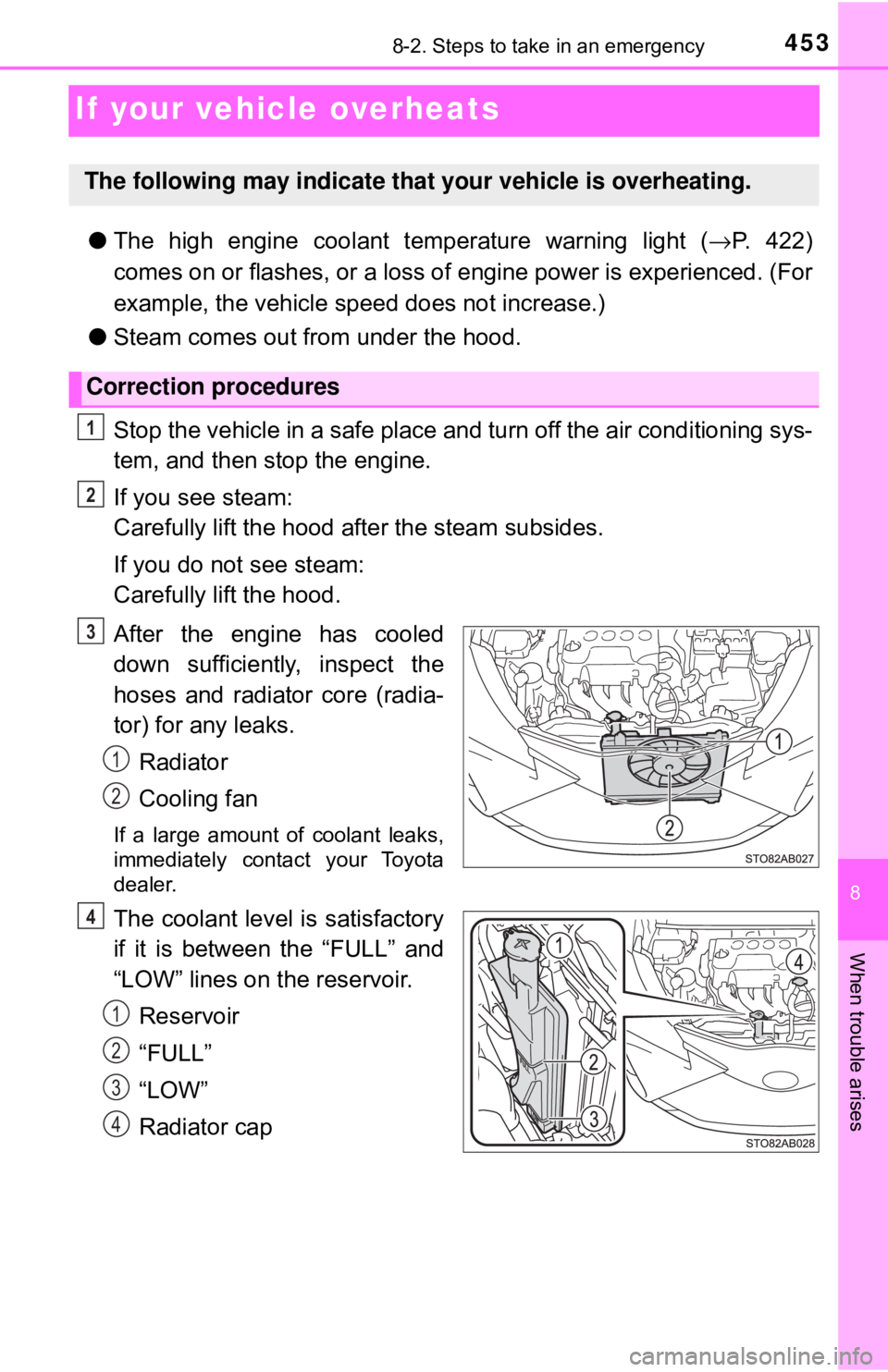
After the engine has cooled
down sufficient ly, inspect the
hoses and radiator core (radia-
tor) for any leaks.
Radiator
Cooling fan
If a large amount of coolant leaks,
immediately contact your Toyota
dealer.
The coolant level is satisfactory
if it is between the “FULL” and
“LOW” lines on the reservoir.Reservoir
“FULL”
“LOW”
Radiator cap
The following may indicate that your vehicle is overheating.
Correction procedures
1
2
3
1
2
4
1
2
3
4
Page 489 of 520
4899-2. Customization
9
Vehicle specifications
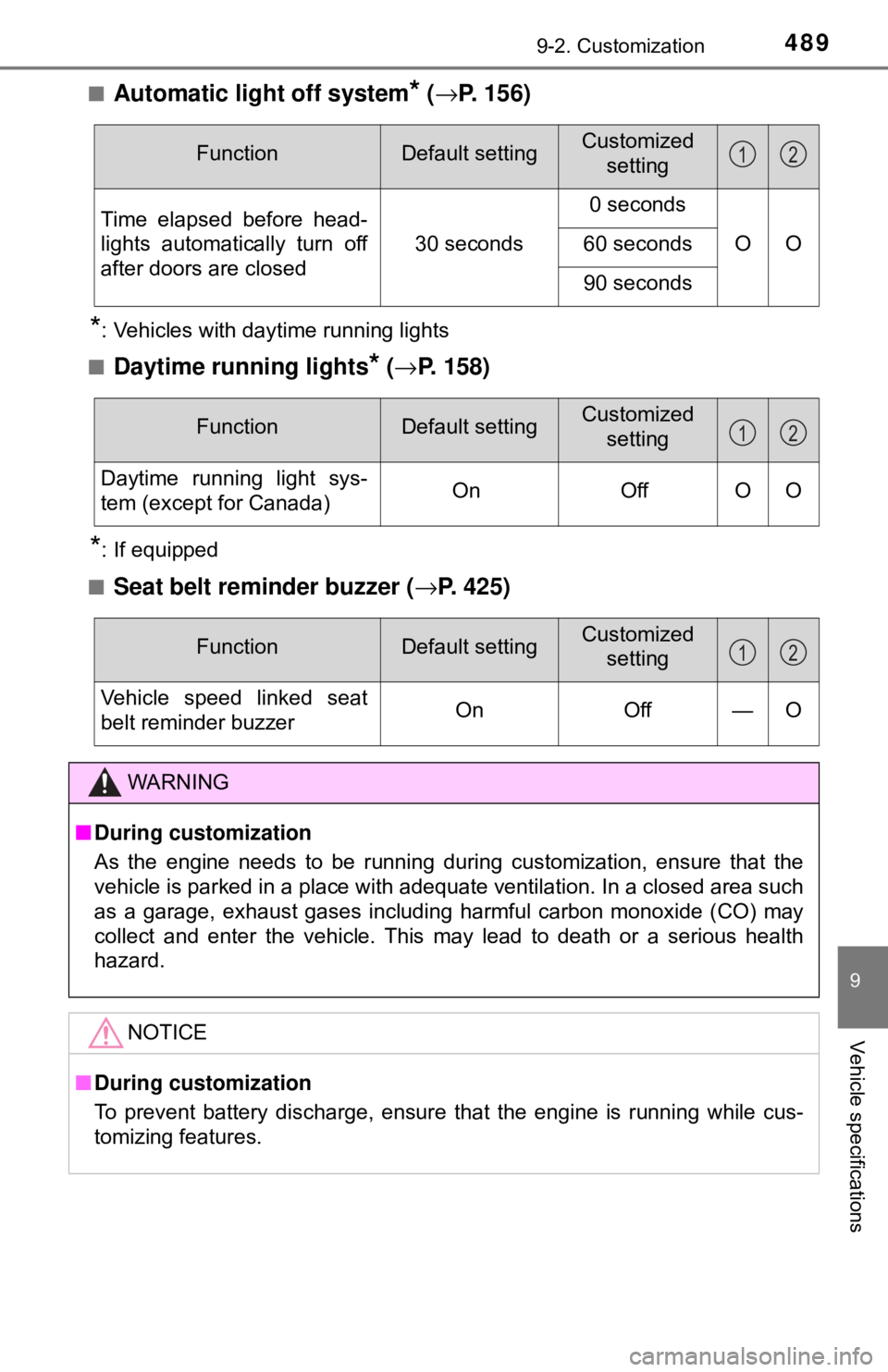
■Automatic light off system* (→ P. 156)
*: Vehicles with daytime running lights
■
Daytime running lights* ( → P. 158)
*: If equipped
■
Seat belt reminder buzzer ( →P. 425)
FunctionDefault settingCustomized
setting
Time elapsed before head-
lights automatically turn off
after doors are closed 30 seconds0 seconds
OO
60 seconds
90 seconds
12
FunctionDefault settingCustomized
setting
Daytime running light sys-
tem (except for Canada) On OffOO
12
FunctionDefault settingCustomized
setting
Vehicle speed linked seat
belt reminder buzzer On Off—O
WARNING
■
During customization
As the engine needs to be running during customization, ensure that the
vehicle is parked in a place with adequate ventilation. In a closed area such
as a garage, exhaust gases including harmful carbon monoxide (CO) may
collect and enter the vehicle. This may lead to death or a serious health
hazard.
NOTICE
■During customization
To prevent battery discharge, ensure that the engine is running while cus-
tomizing features.
12
Page 490 of 520
4909-2. Customization
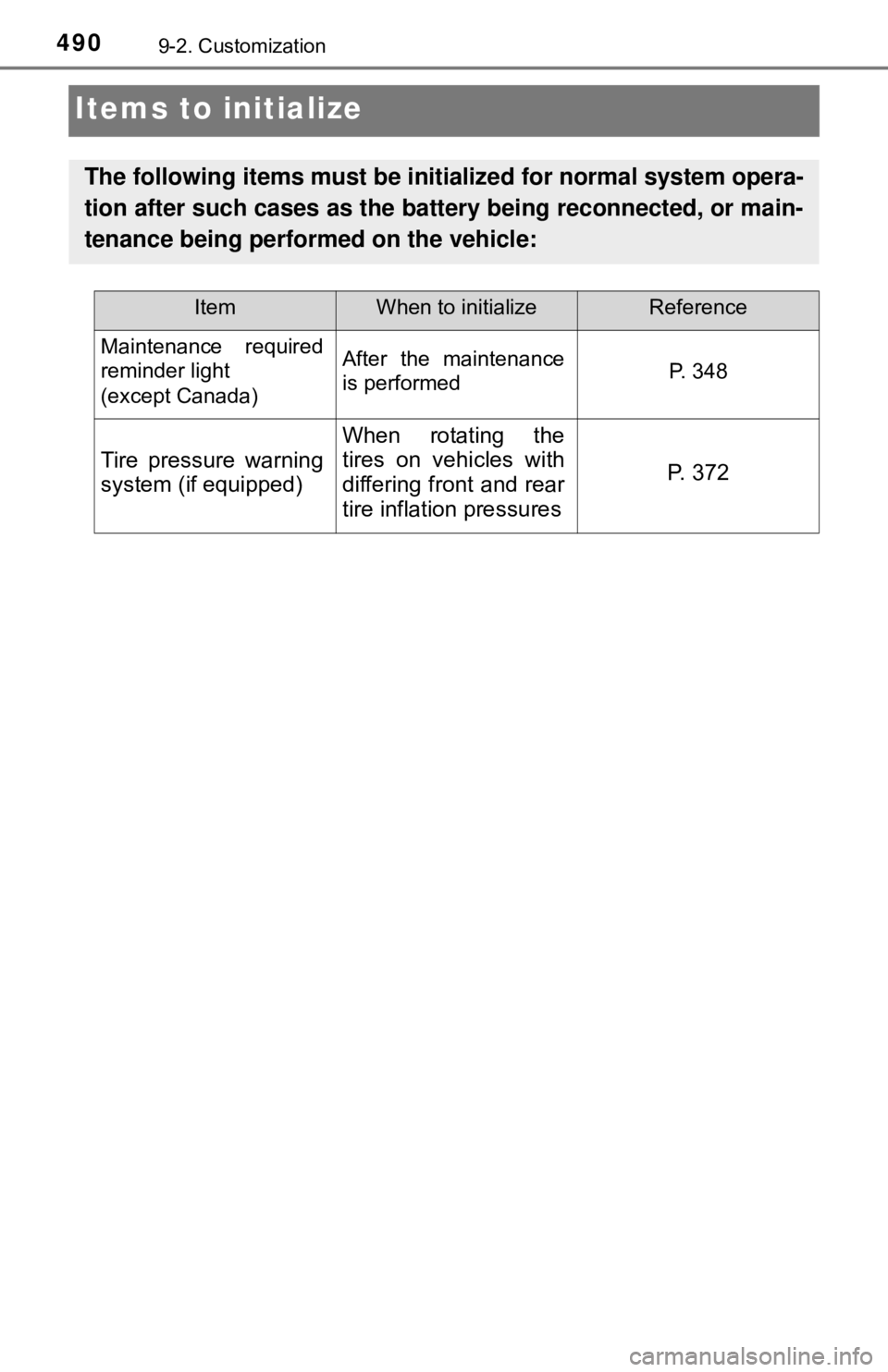
Items to initialize
The following items must be initialized for normal system opera-
tion after such cases as the battery being reconnected, or main-
tenance being performed on the vehicle:
ItemWhen to initializeReference
Maintenance required
reminder light
(except Canada)After the maintenance
is performedP. 348
Tire pressure warning
system (if equipped)
When rotating the
tires on vehicles with
differing front and rear
tire inflation pressures
P. 3 7 2