Start TOYOTA YARIS HYBRID 2012 Owners Manual
[x] Cancel search | Manufacturer: TOYOTA, Model Year: 2012, Model line: YARIS HYBRID, Model: TOYOTA YARIS HYBRID 2012Pages: 704, PDF Size: 27.58 MB
Page 325 of 704
325 2-4. Using other driving systems
2
When driving
YARIS_F (including HV)_WE_52C79E
NOTICE
To ensure the system operates correctly
If any one of the following situations occurs, the Stop & Start system may not
operate correctly, thus, please have your vehicle checked by any authorized
Toyota dealer or repairer, or another duly qualified and equipped profes-
sional.
While the driver’s seat belt is fastened, the driver’s and front passenger’s
seat belt reminder light flashes.
Even when the driver’s seat belt is not fastened, the driver’s and front pas-
senger’s seat belt reminder light remains off.
Even when the driver’s door is closed, the open door warning light comes
on, or the interior light comes on when the interior light switch is in the door
position.
Even when the driver’s door is opened, the open door warning light does
not come on, or the interior light does not come on when the interior light
switch is in the door position.
Page 326 of 704
326
2-4. Using other driving systems
YARIS_F (including HV)_WE_52C79E
Driving assist systems
To help enhance driving safety and performance, the following sys-
tems operate automatically in response to various driving situations.
Be aware, however, that these systems are supplementary and
should not be relied upon too heavily when operating the vehicle.
ABS (Anti-lock Brake System)
Helps to prevent wheel lock when the brakes are applied suddenly, or if
the brakes are applied while driving on a slippery road surface
Brake assist
Generates an increased level of braking force after the brake pedal is
depressed when the system detects a panic stop situation
VSC (Vehicle Stability Control) (if equipped)
Helps the driver to control skidding when swerving suddenly or turning
on slippery road surfaces
TRC (Traction Control) (if equipped)
Helps to maintain drive power and prevent the drive wheels from spin-
ning when starting the vehicle or accelerating on slippery roads
Hill-start assist control
Except hybrid vehicle (vehicles with a Stop & Start system and a
Multidrive)
Helps to prevent the vehicle from rolling backward when the brake
pedal is released to restart the engine
Hybrid vehicle
P. 332
EPS (Electric Power Steering)
Employs an electric motor to reduce the amount of effort needed to turn
the steering wheel
Page 327 of 704
327 2-4. Using other driving systems
2
When driving
YARIS_F (including HV)_WE_52C79E
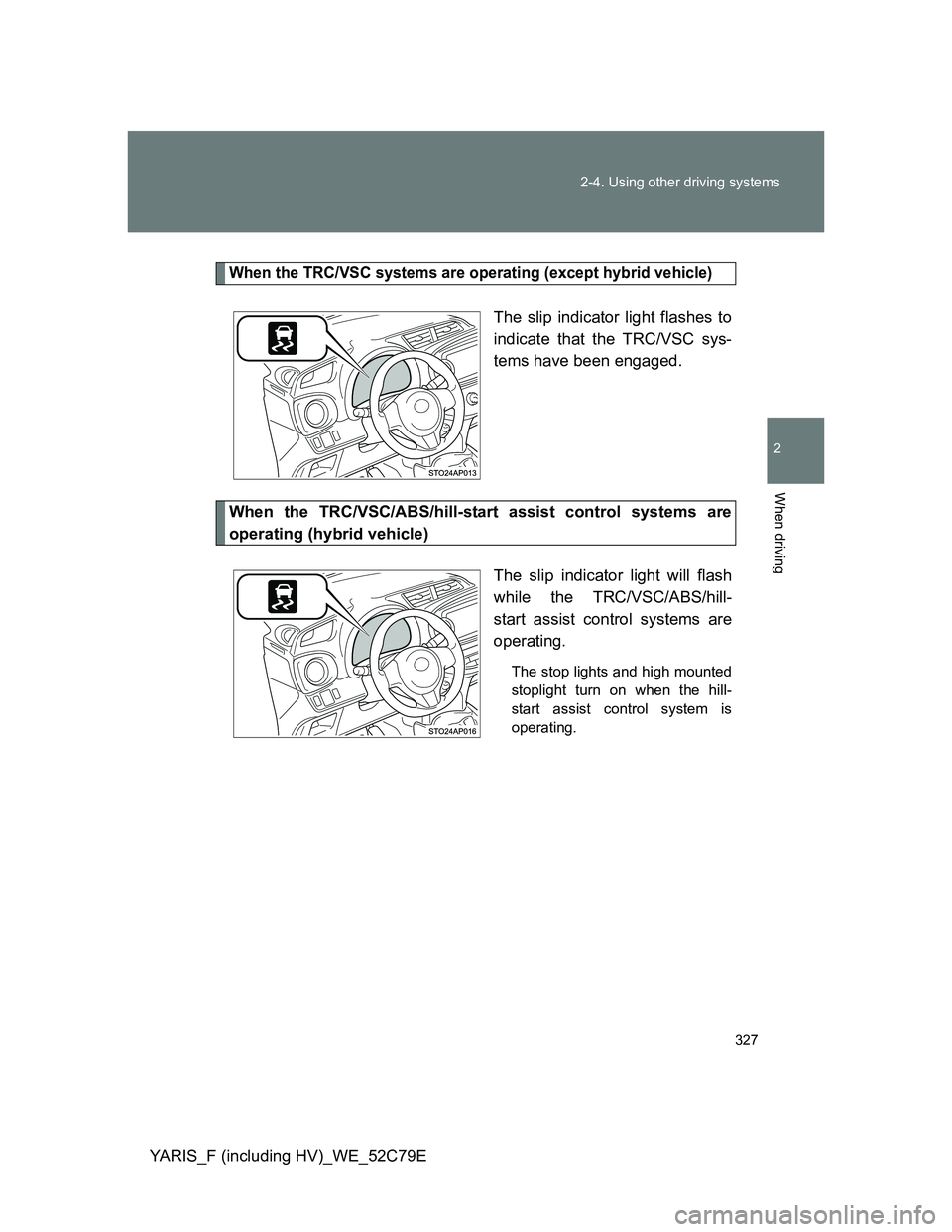
When the TRC/VSC systems are operating (except hybrid vehicle)
The slip indicator light flashes to
indicate that the TRC/VSC sys-
tems have been engaged.
When the TRC/VSC/ABS/hill-start assist control systems are
operating (hybrid vehicle)
The slip indicator light will flash
while the TRC/VSC/ABS/hill-
start assist control systems are
operating.
The stop lights and high mounted
stoplight turn on when the hill-
start assist control system is
operating.
Page 329 of 704
329 2-4. Using other driving systems
2
When driving
YARIS_F (including HV)_WE_52C79E
Hill-start assist control operation conditions (except hybrid vehicle)
The shift lever is in D or M.
The brake pedal is not depressed.
When the “TRC OFF” indicator light comes on even if the VSC OFF
switch has not been pressed (except hybrid vehicle)
TRC and hill-start assist control cannot be operated. Contact any authorized
Toyota dealer or repairer, or another duly qualified and equipped profes-
sional.
Sounds and vibrations caused by the ABS, brake assist, TRC and VSC
systems
A sound may be heard from the engine compartment when the brake
pedal is depressed repeatedly, when the engine is started or just after the
vehicle begins to move. This sound does not indicate that a malfunction
has occurred in any of these systems.
Any of the following conditions may occur when the above systems are
operating. None of these indicates that a malfunction has occurred.
• Vibrations may be felt through the vehicle body and steering.
• A motor sound may be heard after the vehicle comes to a stop.
• The brake pedal may pulsate slightly after the ABS is activated.
• The brake pedal may move down slightly after the ABS is activated.
EPS operation sound
When the steering wheel is operated, a motor sound (whirring sound) may
be heard. This does not indicate a malfunction.
Reactivation of the TRC/VSC systems after turning off the engine
(except hybrid vehicle)
Even after the TRC/VSC systems have been turned off, turning the engine
off and then on again will automatically reactivate the TRC/VSC systems.
Reactivation of the TRC system linked to vehicle speed (except hybrid
vehicle)
When only the TRC system is turned off, the TRC system will turn on when
vehicle speed increases. However, when both TRC and VSC systems are
turned off, the systems will not turn on even when vehicle speed increases.
Page 330 of 704
330 2-4. Using other driving systems
YARIS_F (including HV)_WE_52C79E
Reduced effectiveness of the EPS system
The effectiveness of the EPS system is reduced to prevent the system from
overheating when there is frequent steering input over an extended period of
time. The steering wheel may feel heavy as a result. Should this occur,
refrain from excessive steering input or stop the vehicle and turn the engine
(except hybrid vehicle) or hybrid system (hybrid vehicle) off. The EPS sys-
tem should return to normal within 10 minutes.
If the slip indicator comes on
It may indicate a malfunction in the driving assist systems. Contact any
authorized Toyota dealer or repairer, or another duly qualified and equipped
professional.
CAUTION
The ABS does not operate effectively when
Tires with inadequate gripping ability are used (such as excessively worn
tires on a snow covered road).
The vehicle hydroplanes while driving at high speed on wet or slick roads.
Stopping distance when the ABS is operating may exceed that of nor-
mal conditions
The ABS is not designed to shorten the vehicle’s stopping distance. Always
maintain a safe distance from the vehicle in front of you in the following situ-
ations:
When driving on dirt, gravel or snow-covered roads
When driving with tire chains
When driving over bumps in the road
When driving over roads with potholes or roads with uneven surfaces
TRC may not operate effectively when
Directional control and power may not be achievable while driving on slip-
pery road surfaces, even if the TRC system is operating.
Do not drive the vehicle in conditions where stability and power may be lost.
Hill-start assist control does not operate effectively when
Do not overly rely on the hill-start assist control. The hill-start assist control
may not operate effectively on steep inclines and roads covered with ice.
Page 332 of 704
332
2-4. Using other driving systems
YARIS_F (including HV)_WE_52C79E
Hill-start assist control (hybrid vehicle)
Hill-start assist control operating conditions
The system operates in the following situations:
• The shift lever is in a position other than P.
• The parking brake is not applied.
• The accelerator pedal is not depressed.
Hill-start assist control cannot be operated while the slip indicator light is
illuminated.
Hill-start assist control
While hill-start assist control is operating, the brakes remain automati-
cally applied after the driver releases the brake pedal. The stop lights and
the high mounted stoplight turn on.
Hill-start assist control operates for about 2 seconds after the brake pedal
is released.
If the slip indicator does not flash and the buzzer does not sound when
the brake pedal is further depressed, slightly reduce the pressure on the
brake pedal (do not allow the vehicle to roll backward) and then firmly
depress it again. If the system still does not operate, check that the oper-
ating conditions explained above have been met.
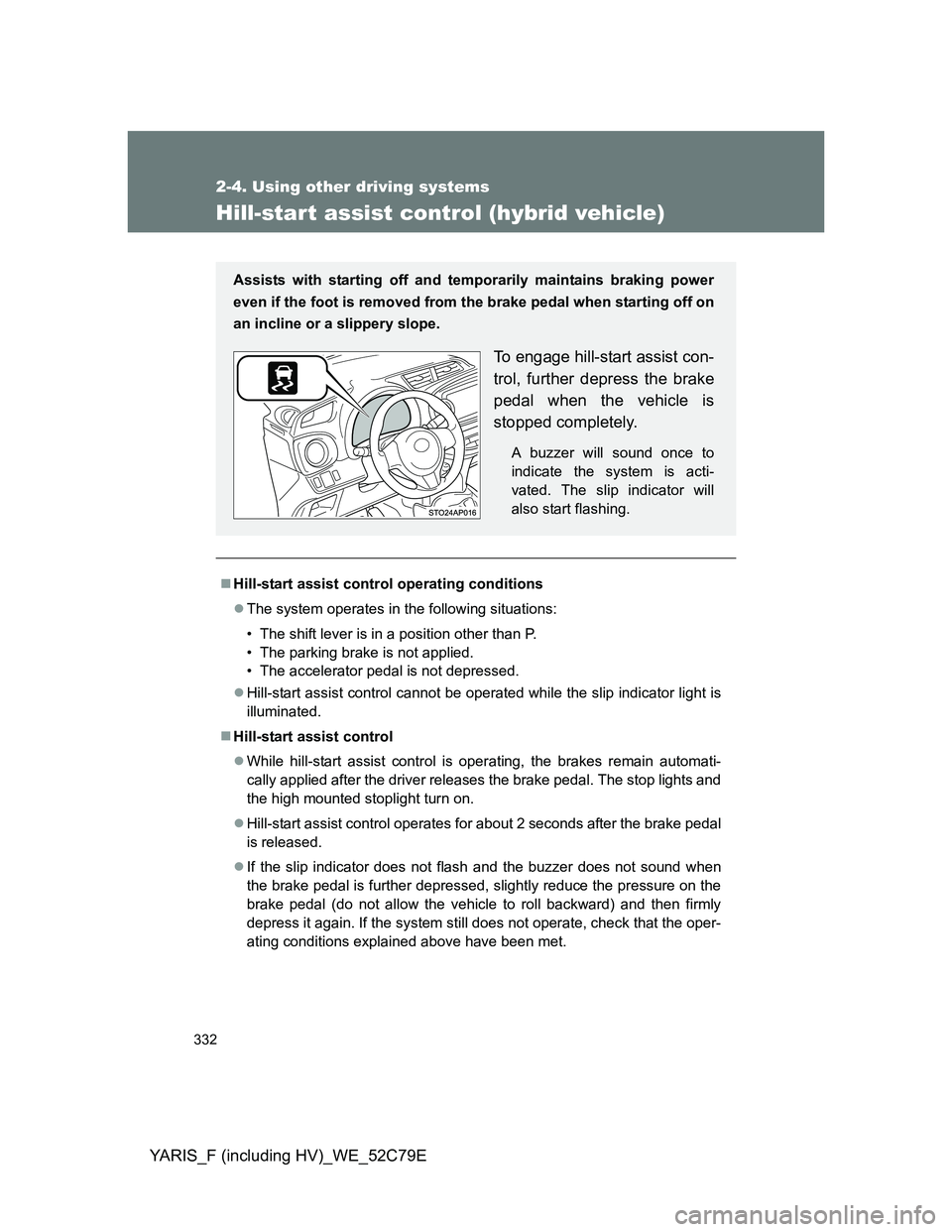
Assists with starting off and temporarily maintains braking power
even if the foot is removed from the brake pedal when starting off on
an incline or a slippery slope.
To engage hill-start assist con-
trol, further depress the brake
pedal when the vehicle is
stopped completely.
A buzzer will sound once to
indicate the system is acti-
vated. The slip indicator will
also start flashing.
Page 333 of 704
333 2-4. Using other driving systems
2
When driving
YARIS_F (including HV)_WE_52C79E
Hill-start assist control buzzer
When hill-start assist control is activated, the buzzer will sound once.
In the following situations, hill-start assist control will be canceled and the
buzzer will sound twice.
• No attempt is made to drive the vehicle within approximately 2 seconds
of releasing the brake pedal.
• The shift lever is moved to P.
• The parking brake is applied.
• The brake pedal is depressed again.
• The brake pedal has been depressed for more than approximately 3
minutes.
If a buzzer other than the hill-start assist control buzzer is sounding, the
hill-start assist control buzzer may not sound.
If the slip indicator comes on
It may indicate a malfunction in the system. Contact any authorized Toyota
dealer or repairer, or another duly qualified and equipped professional.
CAUTION
Hill-start assist control
Do not overly rely on hill-start assist control. Hill-start assist control may
not operate effectively on steep inclines and roads covered with ice.
Unlike the parking brake, hill-start assist control is not intended to hold the
vehicle stationary for an extended period of time. Do not attempt to use
hill-start assist control to hold the vehicle on an incline, as doing so may
lead to an accident.
Page 334 of 704
334
2-4. Using other driving systems
YARIS_F (including HV)_WE_52C79E
Diesel particulate filter system
: If equipped
Replacing the engine oil
P. 471
When the deposit collected by the filter reaches a predetermined
amount, it is automatically cleaned.
Cleaning the DPF catalytic converter
Cleaning the DPF catalytic converter is performed as necessary
in accordance with driving conditions.
Equipment characteristics
The DPF system has the following characteristics:
Idle speed increases during cleaning
The smell of the exhaust gas changes
When starting the engine, white-colored steam (water vapor)
may be expelled during cleaning
Acceleration performance may degrade during cleaning
Page 350 of 704
350 2-5. Driving information
YARIS_F (including HV)_WE_52C79E
Guidance
Your vehicle will handle differently when towing a trailer. In order to
avoid accident, death or serious injury, keep the following in mind
when towing:
Checking connections between trailer and lights
Stop the vehicle and check the operation of the connection
between the trailer and lights after driving for a brief period as well
as before starting off.
Practicing driving with a coupled trailer
Get the feel for turning, stopping and reversing with the trailer
coupled by practicing in an area with no or light traffic.
When reversing with a coupled trailer, hold the section of the
steering wheel nearest to you and rotate clockwise to turn the
trailer left or counterclockwise to turn it right. Always rotate a lit-
tle at a time to prevent steering error. Have someone guide you
when reversing to lessen the risk of an accident.
NOTICE
When the rear bumper strengthening material is aluminum
Ensure the steel bracket part does not come directly in contact with that
area.
When steel and aluminum come into contact, there is a reaction similar to
corrosion, which will weaken the section concerned and may result in dam-
age. Apply a rust inhibitor to parts that will come in contact when attaching a
steel bracket.
Page 351 of 704
351 2-5. Driving information
2
When driving
YARIS_F (including HV)_WE_52C79EIncreasing vehicle-to-vehicle distance
At a speed of 10 km/h (6 mph), the distance to the vehicle running
ahead of you should be equivalent to or greater than the combined
length of your vehicle and trailer. Avoid sudden braking that may
cause skidding. Otherwise, the vehicle may spin out of control.
This is especially true when driving on wet or slippery road sur-
faces.
Sudden acceleration/steering input/cornering
Executing sharp turns when towing may result in the trailer collid-
ing with your vehicle. Decelerate well in advance when approach-
ing turns and take them slowly and carefully to avoid sudden
braking.
Important points regarding turning
The wheels of the trailer will travel closer to the inside of the curve
than the wheels of the vehicle. To make allowance for this, take the
turns wider than you would normally do.
Important points regarding stability
Vehicle movement resulting from uneven road surfaces and strong
crosswinds will affect handling. The vehicle may also be rocked by
passing buses or large trucks. Frequently check behind when mov-
ing alongside such vehicles. As soon as such vehicle movement
occurs, immediately start to decelerate smoothly by slowly apply-
ing the brakes. Always steer the vehicle straight ahead while brak-
ing.
Passing other vehicles
Consider the total combined length of your vehicle and trailer and
ensure that the vehicle-to-vehicle distance is sufficient before exe-
cuting lane changes.