Start TOYOTA YARIS HYBRID 2012 User Guide
[x] Cancel search | Manufacturer: TOYOTA, Model Year: 2012, Model line: YARIS HYBRID, Model: TOYOTA YARIS HYBRID 2012Pages: 704, PDF Size: 27.58 MB
Page 50 of 704
50 1-1. Hybrid system (hybrid vehicle)
YARIS_F (including HV)_WE_52C79E
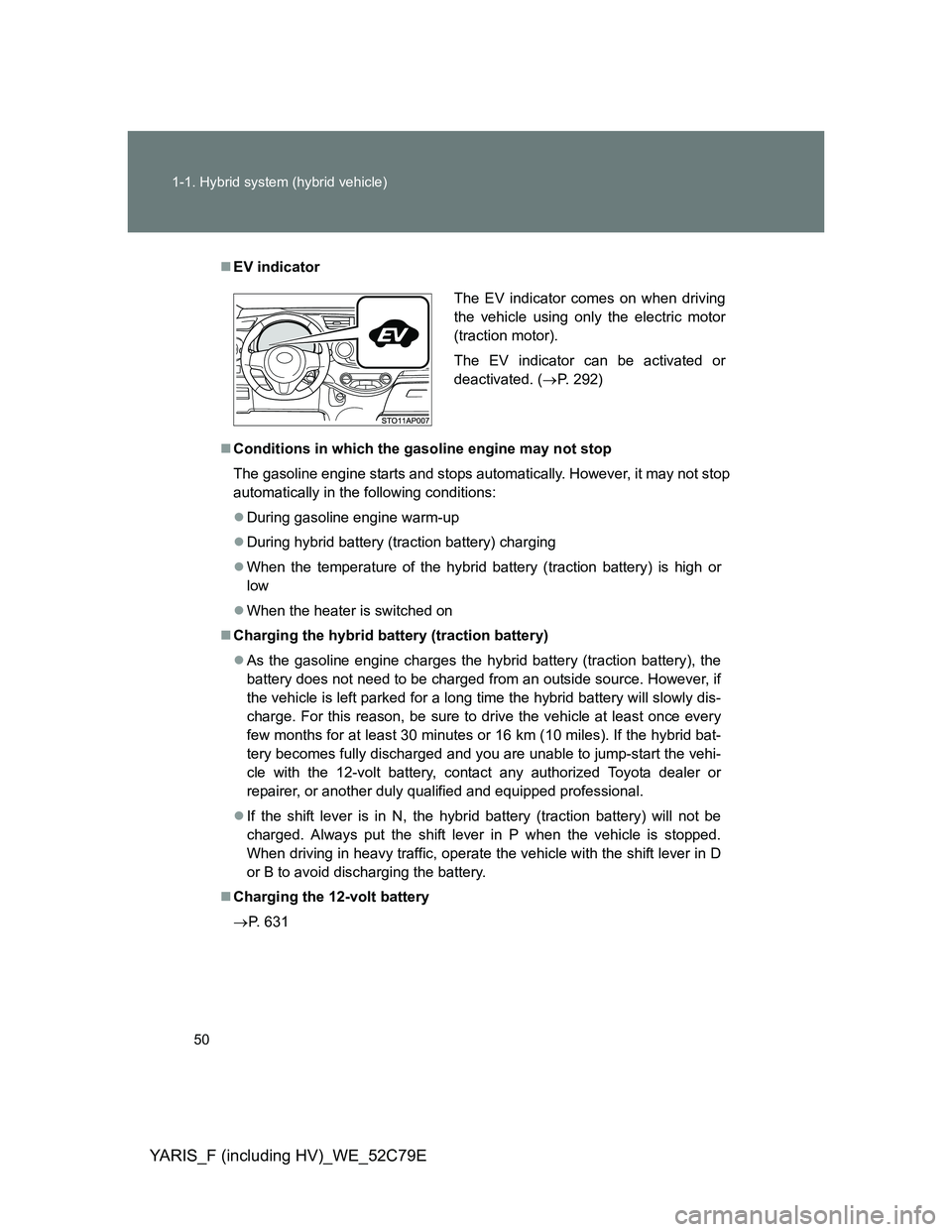
EV indicator
Conditions in which the gasoline engine may not stop
The gasoline engine starts and stops automatically. However, it may not stop
automatically in the following conditions:
During gasoline engine warm-up
During hybrid battery (traction battery) charging
When the temperature of the hybrid battery (traction battery) is high or
low
When the heater is switched on
Charging the hybrid battery (traction battery)
As the gasoline engine charges the hybrid battery (traction battery), the
battery does not need to be charged from an outside source. However, if
the vehicle is left parked for a long time the hybrid battery will slowly dis-
charge. For this reason, be sure to drive the vehicle at least once every
few months for at least 30 minutes or 16 km (10 miles). If the hybrid bat-
tery becomes fully discharged and you are unable to jump-start the vehi-
cle with the 12-volt battery, contact any authorized Toyota dealer or
repairer, or another duly qualified and equipped professional.
If the shift lever is in N, the hybrid battery (traction battery) will not be
charged. Always put the shift lever in P when the vehicle is stopped.
When driving in heavy traffic, operate the vehicle with the shift lever in D
or B to avoid discharging the battery.
Charging the 12-volt battery
P. 631
The EV indicator comes on when driving
the vehicle using only the electric motor
(traction motor).
The EV indicator can be activated or
deactivated. (P. 292)
Page 51 of 704
51 1-1. Hybrid system (hybrid vehicle)
1
Before driving
YARIS_F (including HV)_WE_52C79E
After the 12-volt battery has discharged or has been changed or
removed
The gasoline engine may not stop even if the vehicle is running on the hybrid
battery (traction battery). If this continues for a few days, contact any autho-
rized Toyota dealer or repairer, or another duly qualified and equipped pro-
fessional.
Sounds and vibrations specific to a hybrid vehicle
There may be no engine sounds or vibration even though the vehicle is able
to move. For safety, apply the parking brake and make sure to shift the shift
lever to P when parked.
The following sounds or vibrations may occur when the hybrid system is
operating and are not a malfunction:
Motor sounds may be heard from the engine compartment.
Sounds may be heard from the hybrid battery (traction battery) under the
rear seats when the hybrid system starts or stops.
Sounds from the hybrid system may be heard when the back door is
open.
Sounds may be heard from the transmission when the gasoline engine
starts or stops, when driving at low speeds, or during idling.
Engine sounds may be heard when accelerating sharply.
Sounds may be heard due to regenerative braking when the brake pedal
is depressed and accelerator is loosened.
Vibration may be felt when the gasoline engine starts or stops.
Cooling fan sounds may be heard from the air intake vent on the side of
the lower part of the rear left seats.
Maintenance, repair, recycling, and disposal
Contact any authorized Toyota dealer or repairer, or another duly qualified
and equipped professional regarding maintenance, repair, recycling and dis-
posal. Do not dispose of the vehicle yourself.
Page 53 of 704
53 1-1. Hybrid system (hybrid vehicle)
1
Before driving
YARIS_F (including HV)_WE_52C79E
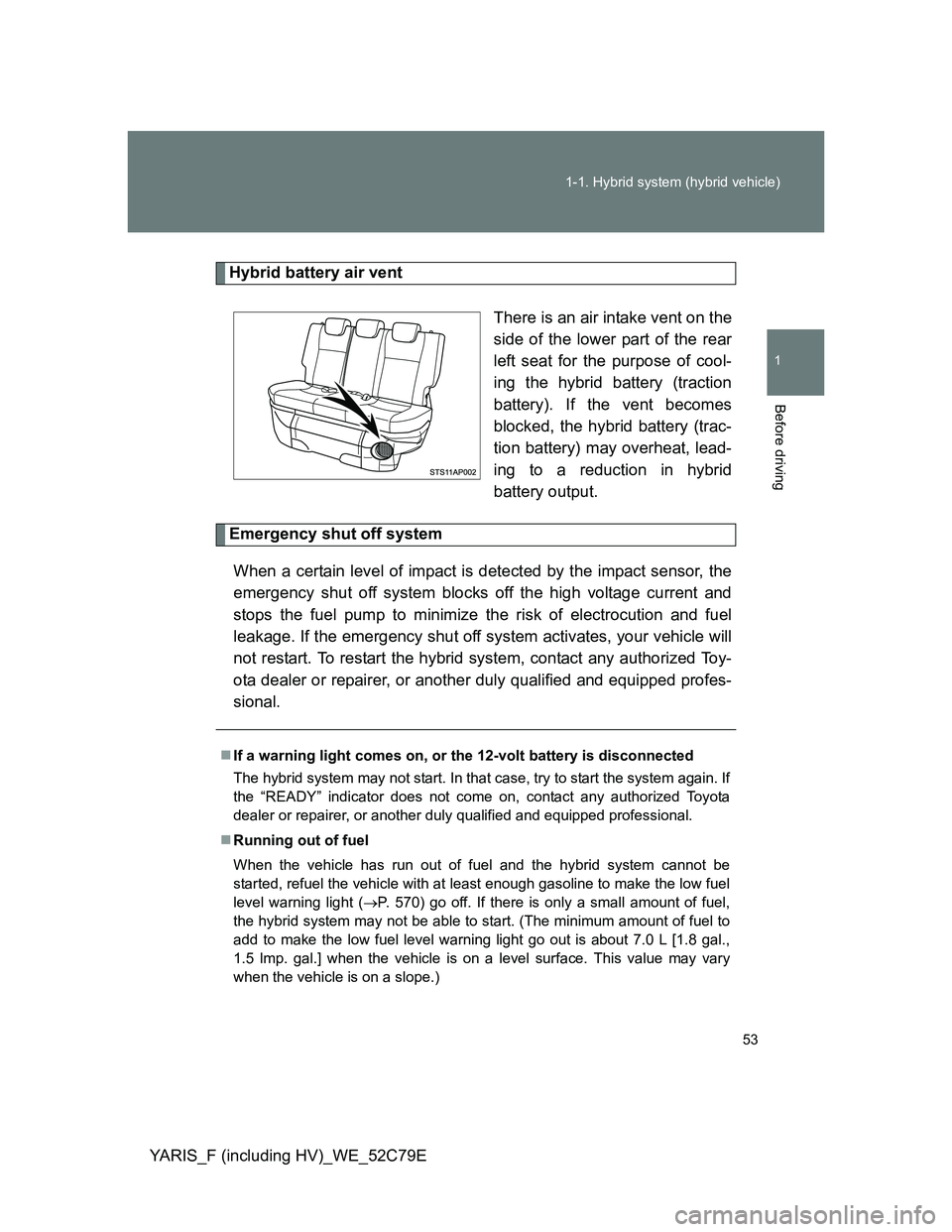
Hybrid battery air vent
There is an air intake vent on the
side of the lower part of the rear
left seat for the purpose of cool-
ing the hybrid battery (traction
battery). If the vent becomes
blocked, the hybrid battery (trac-
tion battery) may overheat, lead-
ing to a reduction in hybrid
battery output.
Emergency shut off system
When a certain level of impact is detected by the impact sensor, the
emergency shut off system blocks off the high voltage current and
stops the fuel pump to minimize the risk of electrocution and fuel
leakage. If the emergency shut off system activates, your vehicle will
not restart. To restart the hybrid system, contact any authorized Toy-
ota dealer or repairer, or another duly qualified and equipped profes-
sional.
If a warning light comes on, or the 12-volt battery is disconnected
The hybrid system may not start. In that case, try to start the system again. If
the “READY” indicator does not come on, contact any authorized Toyota
dealer or repairer, or another duly qualified and equipped professional.
Running out of fuel
When the vehicle has run out of fuel and the hybrid system cannot be
started, refuel the vehicle with at least enough gasoline to make the low fuel
level warning light (P. 570) go off. If there is only a small amount of fuel,
the hybrid system may not be able to start. (The minimum amount of fuel to
add to make the low fuel level warning light go out is about 7.0 L [1.8 gal.,
1.5 lmp. gal.] when the vehicle is on a level surface. This value may vary
when the vehicle is on a slope.)
Page 54 of 704
54 1-1. Hybrid system (hybrid vehicle)
YARIS_F (including HV)_WE_52C79E
Electromagnetic waves
High voltage parts and cables on the hybrid vehicles incorporate electro-
magnetic shielding, and therefore emit approximately the same amount
of electromagnetic waves as conventional gasoline powered vehicles or
home electronic appliances.
Your vehicle may cause sound interference in some third party-produced
radio parts.
Hybrid battery (traction battery)
The hybrid battery (traction battery) has a limited service life. The lifespan of
the hybrid battery (traction battery) can change in accordance with driving
style and driving conditions.
CAUTION
High voltage precautions
The vehicle has high voltage DC and AC systems as well as a 12-volt sys-
tem. DC and AC high voltage is very dangerous and can cause severe burns
and electric shock that may result in death or serious injury.
Never touch, disassemble, remove or replace the high voltage parts,
cables or their connectors.
The hybrid system will become hot after starting as the system uses high
voltage. Be careful of both the high voltage and the high temperature, and
always obey the caution labels attached to the vehicle.
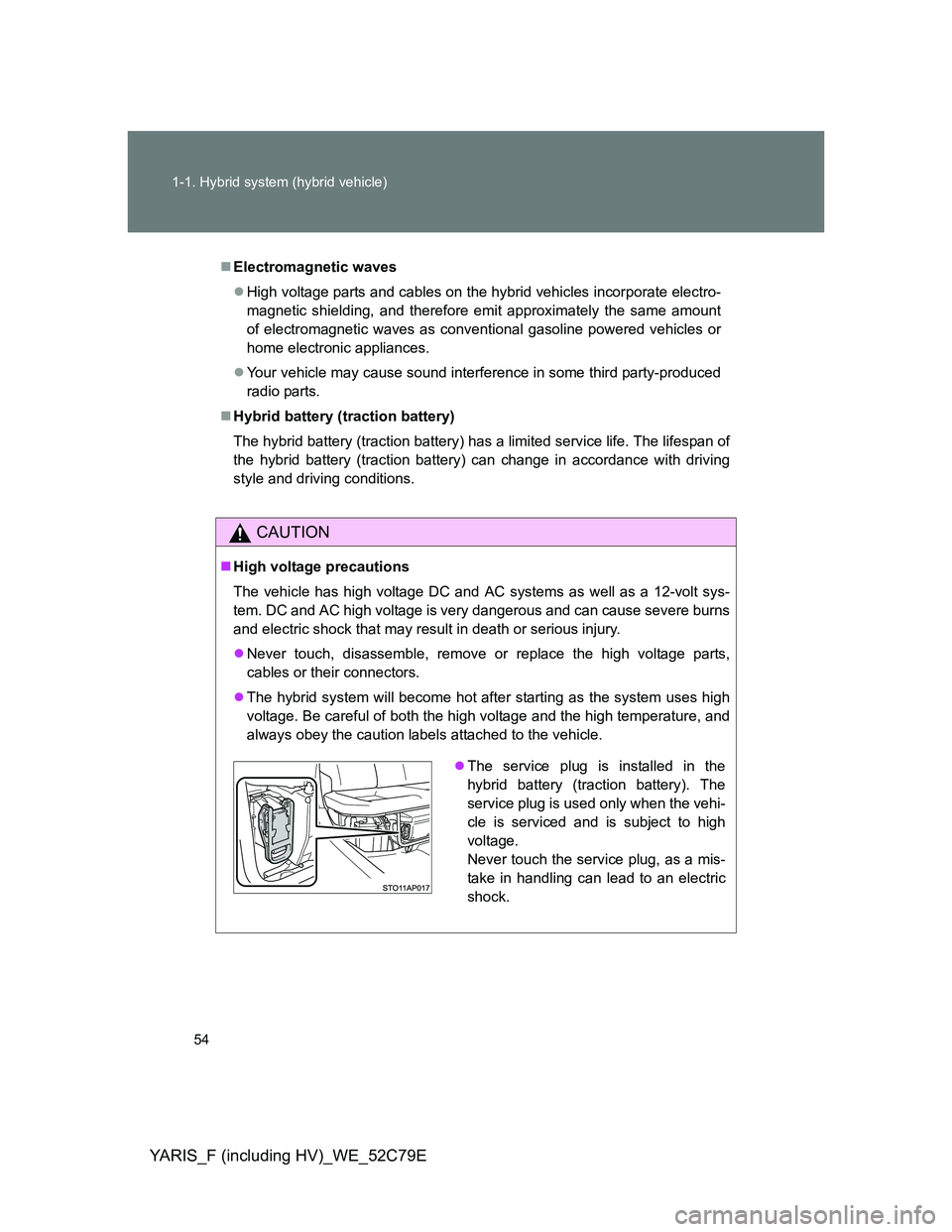
The service plug is installed in the
hybrid battery (traction battery). The
service plug is used only when the vehi-
cle is serviced and is subject to high
voltage.
Never touch the service plug, as a mis-
take in handling can lead to an electric
shock.
Page 63 of 704
63 1-1. Hybrid system (hybrid vehicle)
1
Before driving
YARIS_F (including HV)_WE_52C79E
Checking tire inflation pressure
Make sure to check the tire inflation pressure frequently. Improper tire
inflation pressure can cause poor fuel consumption.
Also, as snow tires can cause large amounts of friction, their use on dry
roads can lead to poor fuel consumption. Use a tire that is appropriate
for the season.
Luggage
Carrying heavy luggage can lead to poor fuel consumption. Avoid car-
rying unnecessary luggage. Installing a large roof rack can also cause
poor fuel consumption.
Warming up before driving
Since the gasoline engine starts up and cuts out automatically when
cold, warming up the engine is unnecessary. Moreover, frequently driv-
ing short distances will cause the engine to repeatedly warm up, which
can lead to poor fuel consumption.
Page 64 of 704
64
YARIS_F (including HV)_WE_52C79E
1-2. Key information
Keys
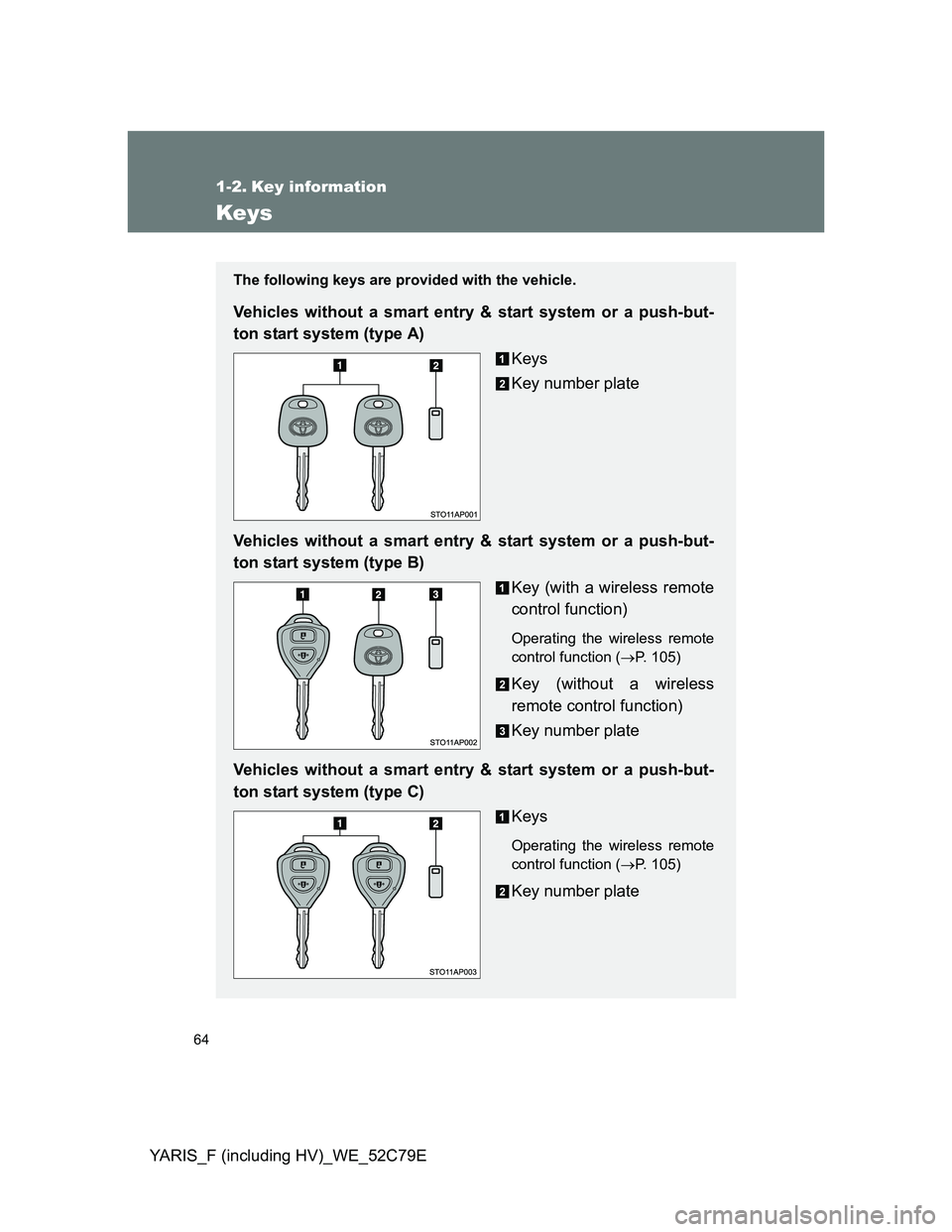
The following keys are provided with the vehicle.
Vehicles without a smart entry & start system or a push-but-
ton start system (type A)
Keys
Key number plate
Vehicles without a smart entry & start system or a push-but-
ton start system (type B)
Key (with a wireless remote
control function)
Operating the wireless remote
control function (P. 105)
Key (without a wireless
remote control function)
Key number plate
Vehicles without a smart entry & start system or a push-but-
ton start system (type C)
Keys
Operating the wireless remote
control function (P. 105)
Key number plate
Page 65 of 704
65 1-2. Key information
1
Before driving
YARIS_F (including HV)_WE_52C79E
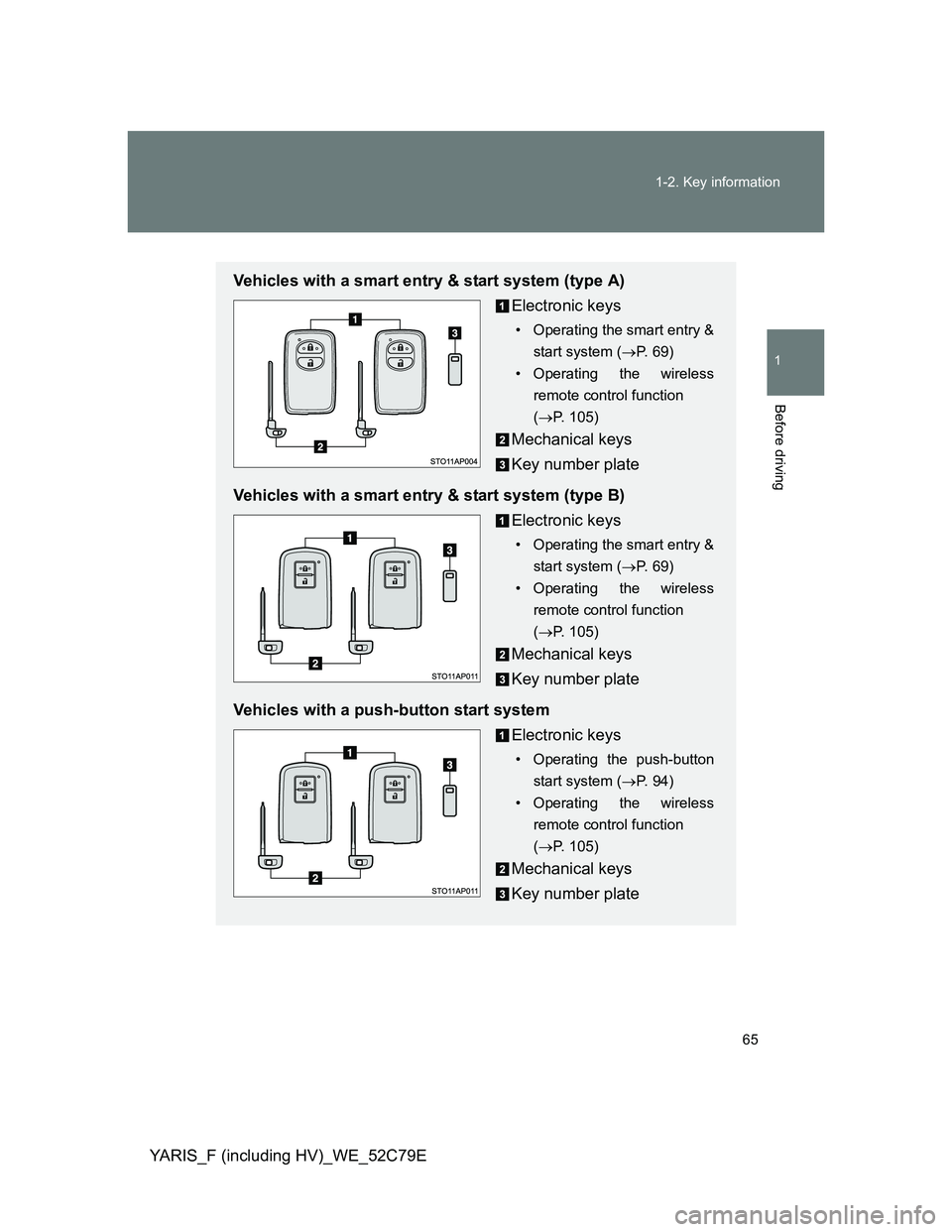
Vehicles with a smart entry & start system (type A)
Electronic keys
• Operating the smart entry &
start system (P. 69)
• Operating the wireless
remote control function
(P. 105)
Mechanical keys
Key number plate
Vehicles with a smart entry & start system (type B)
Electronic keys
• Operating the smart entry &
start system (P. 69)
• Operating the wireless
remote control function
(P. 105)
Mechanical keys
Key number plate
Vehicles with a push-button start system
Electronic keys
• Operating the push-button
start system (P. 94)
• Operating the wireless
remote control function
(P. 105)
Mechanical keys
Key number plate
Page 66 of 704
66 1-2. Key information
YARIS_F (including HV)_WE_52C79E
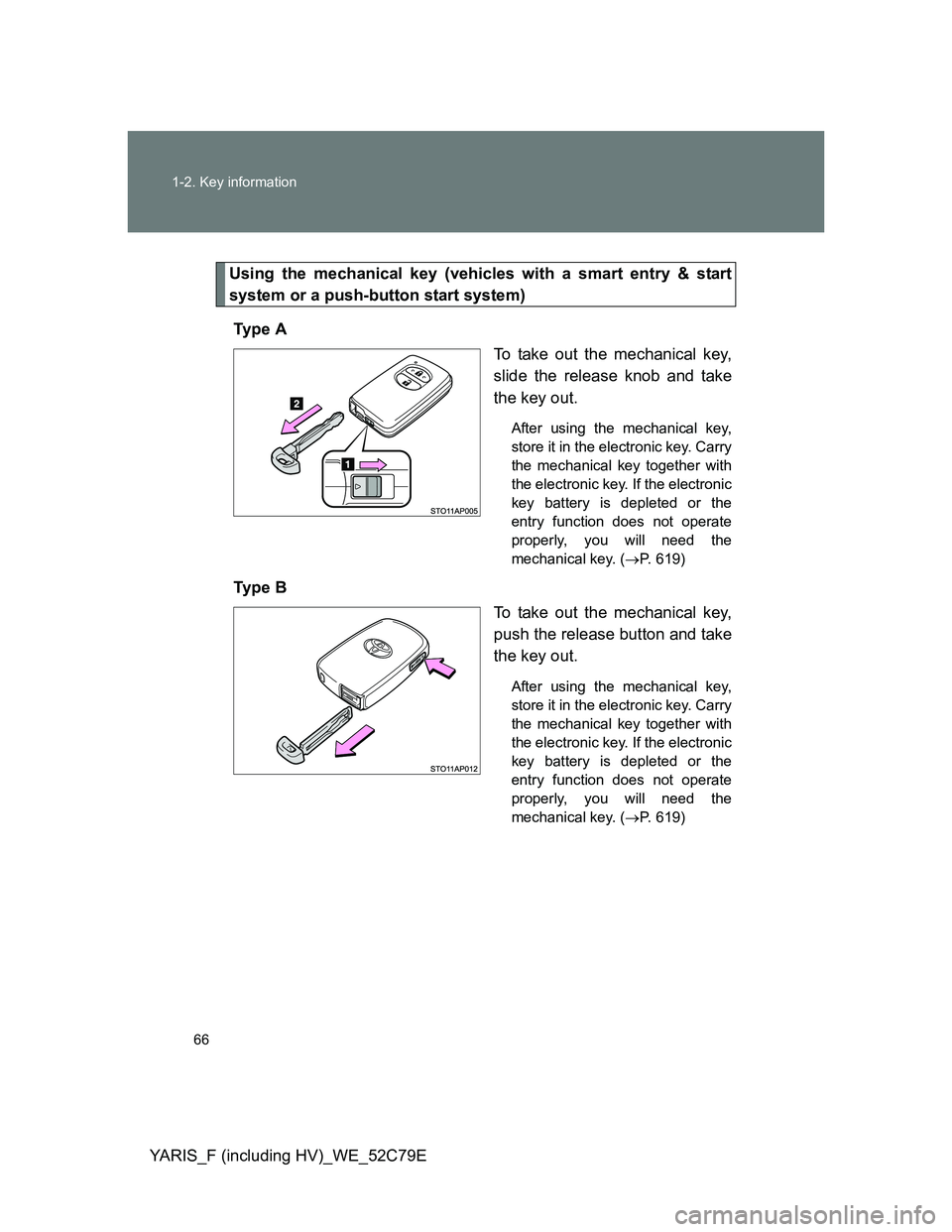
Using the mechanical key (vehicles with a smart entry & start
system or a push-button start system)
Ty p e A
To take out the mechanical key,
slide the release knob and take
the key out.
After using the mechanical key,
store it in the electronic key. Carry
the mechanical key together with
the electronic key. If the electronic
key battery is depleted or the
entry function does not operate
properly, you will need the
mechanical key. (P. 619)
Ty p e B
To take out the mechanical key,
push the release button and take
the key out.
After using the mechanical key,
store it in the electronic key. Carry
the mechanical key together with
the electronic key. If the electronic
key battery is depleted or the
entry function does not operate
properly, you will need the
mechanical key. (P. 619)
Page 67 of 704
67 1-2. Key information
1
Before driving
YARIS_F (including HV)_WE_52C79E
Key number plate
Keep the plate in a safe place such as your wallet, not in the vehicle. In the
event that a key (vehicles without a smart entry & start system or a push-but-
ton start system) or a mechanical key (vehicles with a smart entry & start
system or a push-button start system) is lost, a new key can be made by any
authorized Toyota dealer or repairer, or another duly qualified and equipped
professional using the key number plate. (P. 618)
When riding in an aircraft
When bringing a key with wireless remote control function onto an aircraft,
make sure you do not press any buttons on the key while inside the aircraft
cabin. If you are carrying the key in your bag etc., ensure that the buttons
are not likely to be pressed accidentally. Pressing a button may cause the
key to emit radio waves that could interfere with the operation of the aircraft.
NOTICE
To prevent key damage
Observe the following:
Do not drop the keys, subject them to strong shocks or bend them.
Do not expose the keys to high temperatures for a long period of time.
Do not get the keys wet or wash them in an ultrasonic washer etc.
Vehicles with a smart entry & start system or a push-button start system:
Do not attach metallic or magnetic materials to the keys or place the keys
close to such materials.
Do not disassemble the keys.
Do not attach a sticker or anything else to the surface of the key.
Vehicles with a smart entry & start system or a push-button start system:
Do not place the keys near objects that produce magnetic fields, such as
TVs, audio systems, glass top ranges, or medical electrical equipment,
such as low-frequency therapy equipment.
Page 68 of 704
68 1-2. Key information
YARIS_F (including HV)_WE_52C79E
NOTICE
Carrying the electronic key on your person (vehicles with a smart entry
& start system or a push-button start system)
Carry the electronic key 10 cm (3.9 in.) or more away from electric appli-
ances that are turned on. Radio waves emitted from electric appliances
within 10 cm (3.9 in.) of the electronic key may interfere with the key, causing
the key to not function properly.
In case of a smart entry & start system or a push-button start system
malfunction or other key-related problems (vehicles with a smart entry
& start system or a push-button start system)
Take your vehicle with all the electronic keys provided with your vehicle to
any authorized Toyota dealer or repairer, or another duly qualified and
equipped professional.
When a vehicle key is lost (vehicles with a smart entry & start system
or a push-button start system)
If the key remains lost, the risk of vehicle theft increases significantly. Visit
any authorized Toyota dealer or repairer, or another duly qualified and
equipped professional immediately with all remaining electronic keys that
was provided with your vehicle.