Toyota yaris TOYOTA YARIS HYBRID 2013 Owners Manual
[x] Cancel search | Manufacturer: TOYOTA, Model Year: 2013, Model line: YARIS HYBRID, Model: TOYOTA YARIS HYBRID 2013Pages: 700, PDF Size: 28.68 MB
Page 38 of 700
YARIS_F (including HV)_WE_52D27E
38
For your information
Main Owner’s Manual
Please note that this manual applies to all models and all equipment, includ-
ing options. Therefore, you may find some explanations for equipment not
installed on your vehicle.
All specifications provided in this manual are current at the time of printing.
However, because of the Toyota policy of continual product improvement, we
reserve the right to make changes at any time without notice.
Depending on specifications, the vehicle shown in the illustrations may differ
from your vehicle in terms of equipment.
Accessories, spare parts and modification of your Toyota
Both genuine Toyota and a wide variety of other spare parts and accessories
for Toyota vehicles are currently available on the market. Should it be
determined that any of the genuine Toyota parts or accessories supplied with
the vehicle need to be replaced, Toyota recommends that genuine Toyota
parts or accessories, be used to replace them. Other parts or accessories of
matching quality can also be used. Toyota cannot accept any liability or
guarantee spare parts and accessories which are not genuine Toyota
products, nor for replacement or installation involving such parts. In addition,
damage or performance problems resulting from the use of non-genuine
Toyota spare parts or accessories may not be covered under warranty.
Page 39 of 700
YARIS_F (including HV)_WE_52D27E
39
Installation of an RF-transmitter system (except hybrid vehicle)
The installation of an RF-transmitter system in your vehicle could affect elec-
tronic systems such as:
Multiport fuel injection system/sequential multiport fuel injection system
Cruise control system (if equipped)
Anti-lock brake system
SRS airbag system
Seat belt pretensioner system
Be sure to check with any authorized Toyota dealer or repairer, or another
duly qualified and equipped professional for precautionary measures or spe-
cial instructions regarding installation of an RF-transmitter system.
Further information regarding frequency bands, power levels, antenna posi-
tions and installation provisions for the installation of RF-transmitters is avail-
able on request at any authorized Toyota dealer or repairer, or another duly
qualified and equipped professional.
Installation of an RF-transmitter system (hybrid vehicle)
The installation of an RF-transmitter system in your vehicle could affect elec-
tronic systems such as:
Multiport fuel injection system/sequential multiport fuel injection system
Cruise control system (if equipped)
Anti-lock brake system
SRS airbag system
Seat belt pretensioner system
Be sure to check with any authorized Toyota dealer or repairer, or another
duly qualified and equipped professional for precautionary measures or spe-
cial instructions regarding installation of an RF-transmitter system.
Further information regarding frequency bands, power levels, antenna posi-
tions and installation provisions for the installation of RF-transmitters is avail-
able on request at any authorized Toyota dealer or repairer, or another duly
qualified and equipped professional.
Page 40 of 700
YARIS_F (including HV)_WE_52D27E
40
High voltage parts and cables on the hybrid vehicles emit approximately the
same amount of electromagnetic waves as the conventional gasoline pow-
ered vehicles or home electronic appliances despite of their electromagnetic
shielding.
Unwanted noise may occur in the reception of the RF-transmitter.
Vehicle data recordings
Your Toyota is equipped with several sophisticated computers that will record
certain data, such as:
• Engine speed
• Electric motor speed (traction motor speed)
• Accelerator status
• Brake status
• Vehicle speed
• Shift position (except manual transmission)
• Hybrid battery (traction battery) status
The recorded data varies according to the vehicle grade level and options
with which it is equipped. Furthermore, these computers do not record con-
versations, sounds or pictures.
Data usage
Toyota may use the data recorded in these computers to diagnose malfunc-
tions, conduct research and development, and improve quality.
Toyota will not disclose the recorded data to a third party except:
• With the consent of the vehicle owner or with the consent of the lessee if
the vehicle is leased
• In response to an official request by the police, a court of law or a govern-
ment agency
• For research purposes where the data is not tied to a specific vehicle or
vehicle owner
: If equipped
Page 41 of 700
YARIS_F (including HV)_WE_52D27E
41
Event data recorder
This vehicle is equipped with an event data recorder (EDR). The main pur-
pose of an EDR is to record, in certain crash or near crash-like situations,
such as an air bag deployment or hitting a road obstacle, data that will assist
in understanding how a vehicle’s systems performed. The EDR is designed
to record data related to vehicle dynamics and safety systems for a short
period of time, typically 30 seconds or less.
The EDR in this vehicle is designed to record such data as:
• How various systems in your vehicle were operating;
• How far (if at all) the driver was depressing the accelerator and/or brake
pedal; and,
• How fast the vehicle was traveling.
These data can help provide a better understanding of the circumstances in
which crashes and injuries occur.
NOTE: EDR data are recorded by your vehicle only if a non-trivial crash situ-
ation occurs; no data are recorded by the EDR under normal driving condi-
tions and no personal data (e.g., name, gender, age, and crash location) are
recorded. However, other parties, such as law enforcement, could combine
the EDR data with the type of personally identifying data routinely acquired
during a crash investigation.
To read data recorded by an EDR, special equipment is required, and access
to the vehicle or the EDR is needed. In addition to the vehicle manufacturer,
other parties, such as law enforcement, that have the special equipment, can
read the information if they have access to the vehicle or the EDR.
Disclosure of the EDR data
Toyota will not disclose the data recorded in an EDR to a third party except
when:
• An agreement from the vehicle’s owner (or the lessee for a leased vehicle)
is obtained
• In response to an official request by the police, a court of law or a govern-
ment agency
• For use by Toyota in a law suit
However, if necessary, Toyota may:
• Use the data for research on vehicle safety performance
• Disclose the data to a third party for research purposes without disclosing
information about the specific vehicle or vehicle owner
Page 42 of 700
YARIS_F (including HV)_WE_52D27E
42
Scrapping of your Toyota
The SRS airbag and seat belt pretensioner devices in your Toyota contain
explosive chemicals. If the vehicle is scrapped with the airbags and seat belt
pretensioners left as they are, this may cause an accident such as fire. Be
sure to have the systems of the SRS airbag and seat belt pretensioner
removed and disposed of by a qualified service shop or by any authorized
Toyota dealer or repairer, or another duly qualified and equipped profes-
sional, before you scrap your vehicle.
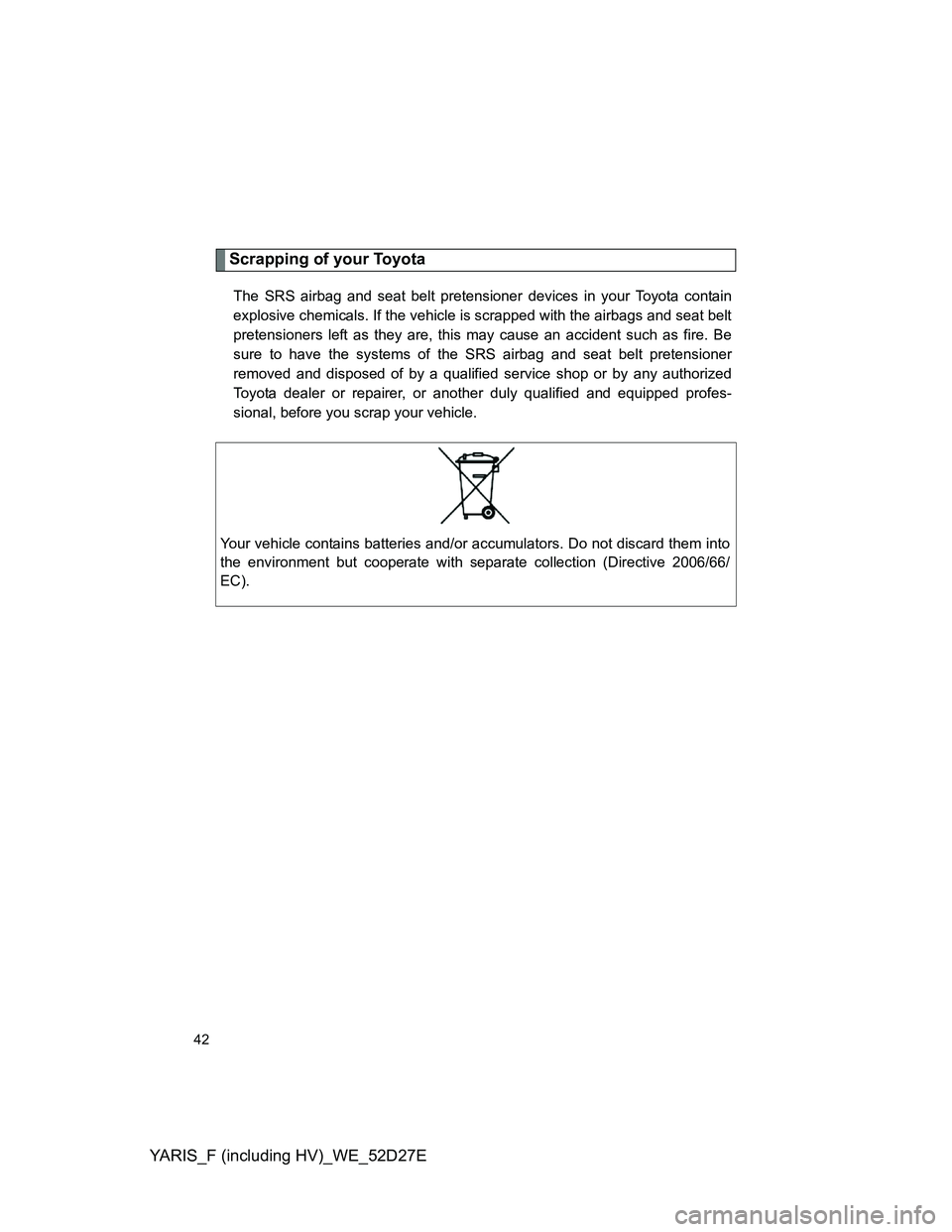
Your vehicle contains batteries and/or accumulators. Do not discard them into
the environment but cooperate with separate collection (Directive 2006/66/
EC).
Page 44 of 700
YARIS_F (including HV)_WE_52D27E
44
CAUTION
Hybrid battery (traction battery)
Never resell, hand over or modify the hybrid battery. To prevent accidents,
hybrid batteries that have been removed from a disposed vehicle are col-
lected through any authorized Toyota dealer or repairer, or another duly
qualified and equipped professional. Do not dispose of the battery yourself.
Unless the battery is properly collected, the following may occur, resulting in
death or serious injury:
The hybrid battery may be illegally disposed of or dumped, and someone
may touch a high voltage part, resulting in an electric shock.
The hybrid battery is intended to be used exclusively with your hybrid vehi-
cle. If the hybrid battery is used outside of your vehicle or modified in any
way, accidents such as electric shock, heat generation, smoke generation,
an explosion and electrolyte leakage may occur.
When reselling or handing over your vehicle, the possibility of an accident is
extremely high because the person receiving the vehicle may not be aware
of these dangers.
Disposal of the hybrid battery (traction battery)
If your vehicle is disposed of without the hybrid battery having been
removed, there is a danger of serious electric shock if high voltage parts,
cables and their connectors are touched. In the event that your vehicle must
be disposed of, the hybrid battery must be disposed of by any authorized
Toyota dealer or repairer, or another duly qualified and equipped profes-
sional. If the hybrid battery is not disposed of properly, it may cause electric
shock that can result in death or serious injury.
Page 45 of 700
YARIS_F (including HV)_WE_52D27E
45
Symbols used throughout this manual
Cautions & Notices
Symbols used in illustrations
CAUTION
This is a warning against something which, if ignored, may cause death or
serious injury to people. You are informed about what you must or must not do
in order to reduce the risk of death or serious injury to yourself and others.
NOTICE
This is a warning against something which, if ignored, may cause damage to
the vehicle or its equipment. You are informed about what you must or must
not do in order to avoid or reduce the risk of damage to your Toyota and its
equipment.
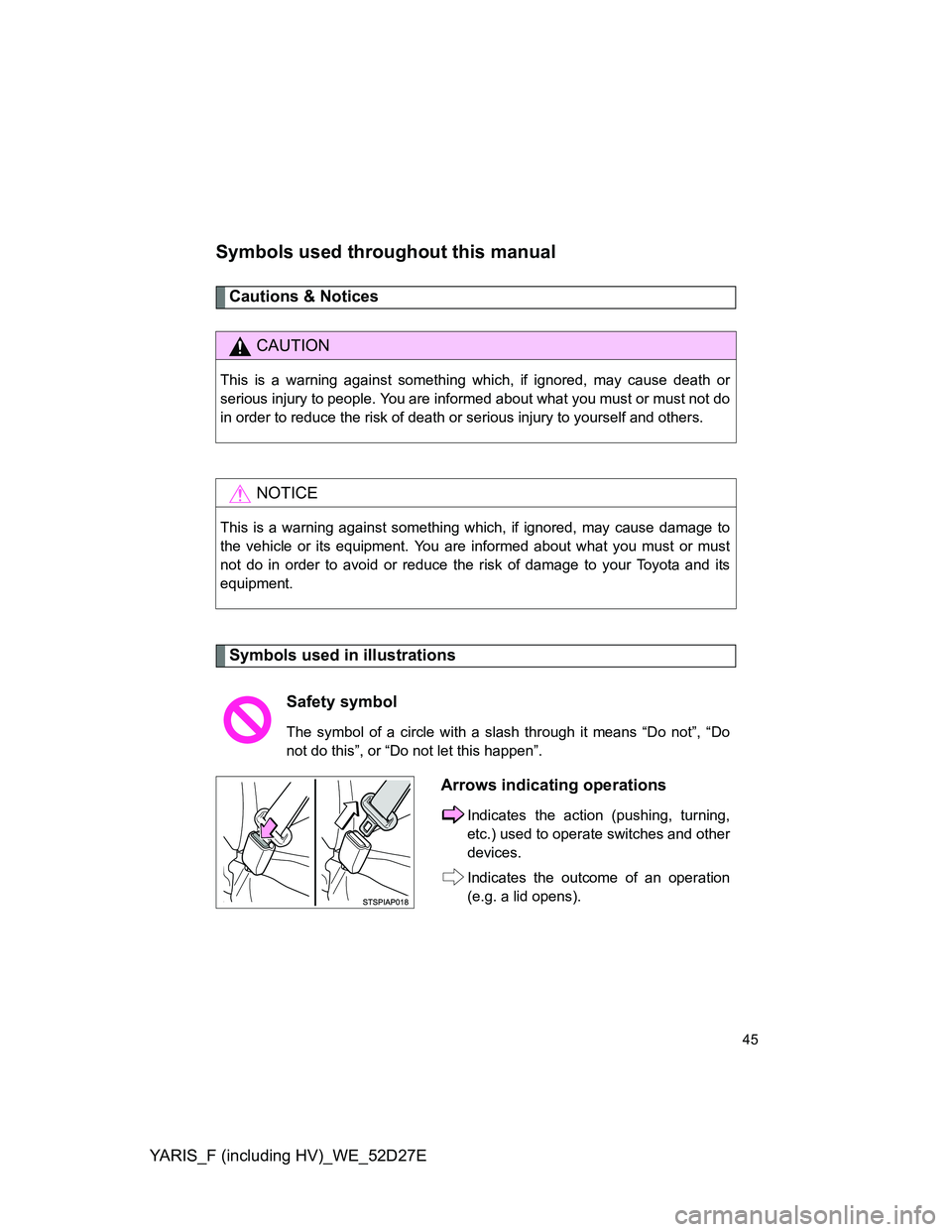
Safety symbol
The symbol of a circle with a slash through it means “Do not”, “Do
not do this”, or “Do not let this happen”.
Arrows indicating operations
Indicates the action (pushing, turning,
etc.) used to operate switches and other
devices.
Indicates the outcome of an operation
(e.g. a lid opens).
Page 50 of 700
50 1-1. Hybrid system (hybrid vehicle)
YARIS_F (including HV)_WE_52D27E
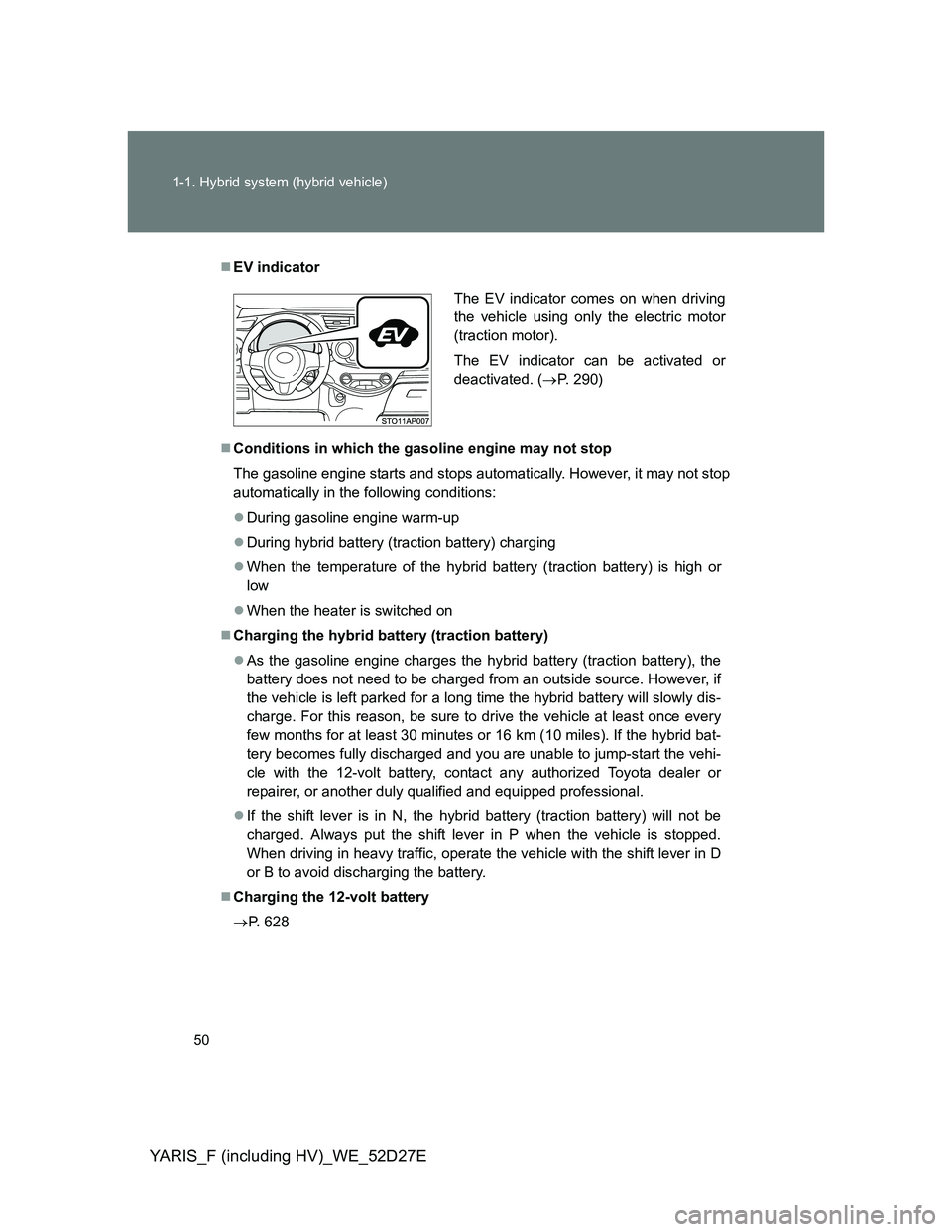
EV indicator
Conditions in which the gasoline engine may not stop
The gasoline engine starts and stops automatically. However, it may not stop
automatically in the following conditions:
During gasoline engine warm-up
During hybrid battery (traction battery) charging
When the temperature of the hybrid battery (traction battery) is high or
low
When the heater is switched on
Charging the hybrid battery (traction battery)
As the gasoline engine charges the hybrid battery (traction battery), the
battery does not need to be charged from an outside source. However, if
the vehicle is left parked for a long time the hybrid battery will slowly dis-
charge. For this reason, be sure to drive the vehicle at least once every
few months for at least 30 minutes or 16 km (10 miles). If the hybrid bat-
tery becomes fully discharged and you are unable to jump-start the vehi-
cle with the 12-volt battery, contact any authorized Toyota dealer or
repairer, or another duly qualified and equipped professional.
If the shift lever is in N, the hybrid battery (traction battery) will not be
charged. Always put the shift lever in P when the vehicle is stopped.
When driving in heavy traffic, operate the vehicle with the shift lever in D
or B to avoid discharging the battery.
Charging the 12-volt battery
P. 628
The EV indicator comes on when driving
the vehicle using only the electric motor
(traction motor).
The EV indicator can be activated or
deactivated. (P. 290)
Page 51 of 700
51 1-1. Hybrid system (hybrid vehicle)
1
Before driving
YARIS_F (including HV)_WE_52D27E
After the 12-volt battery has discharged or has been changed or
removed
The gasoline engine may not stop even if the vehicle is running on the hybrid
battery (traction battery). If this continues for a few days, contact any autho-
rized Toyota dealer or repairer, or another duly qualified and equipped pro-
fessional.
Sounds and vibrations specific to a hybrid vehicle
There may be no engine sounds or vibration even though the vehicle is able
to move. For safety, apply the parking brake and make sure to shift the shift
lever to P when parked.
The following sounds or vibrations may occur when the hybrid system is
operating and are not a malfunction:
Motor sounds may be heard from the engine compartment.
Sounds may be heard from the hybrid battery (traction battery) under the
rear seats when the hybrid system starts or stops.
Sounds from the hybrid system may be heard when the back door is
open.
Sounds may be heard from the transmission when the gasoline engine
starts or stops, when driving at low speeds, or during idling.
Engine sounds may be heard when accelerating sharply.
Sounds may be heard due to regenerative braking when the brake pedal
is depressed and accelerator is loosened.
Vibration may be felt when the gasoline engine starts or stops.
Cooling fan sounds may be heard from the air intake vent on the side of
the lower part of the rear left seats.
Maintenance, repair, recycling, and disposal
Contact any authorized Toyota dealer or repairer, or another duly qualified
and equipped professional regarding maintenance, repair, recycling and dis-
posal. Do not dispose of the vehicle yourself.
Page 53 of 700
53 1-1. Hybrid system (hybrid vehicle)
1
Before driving
YARIS_F (including HV)_WE_52D27E
Hybrid battery air vent
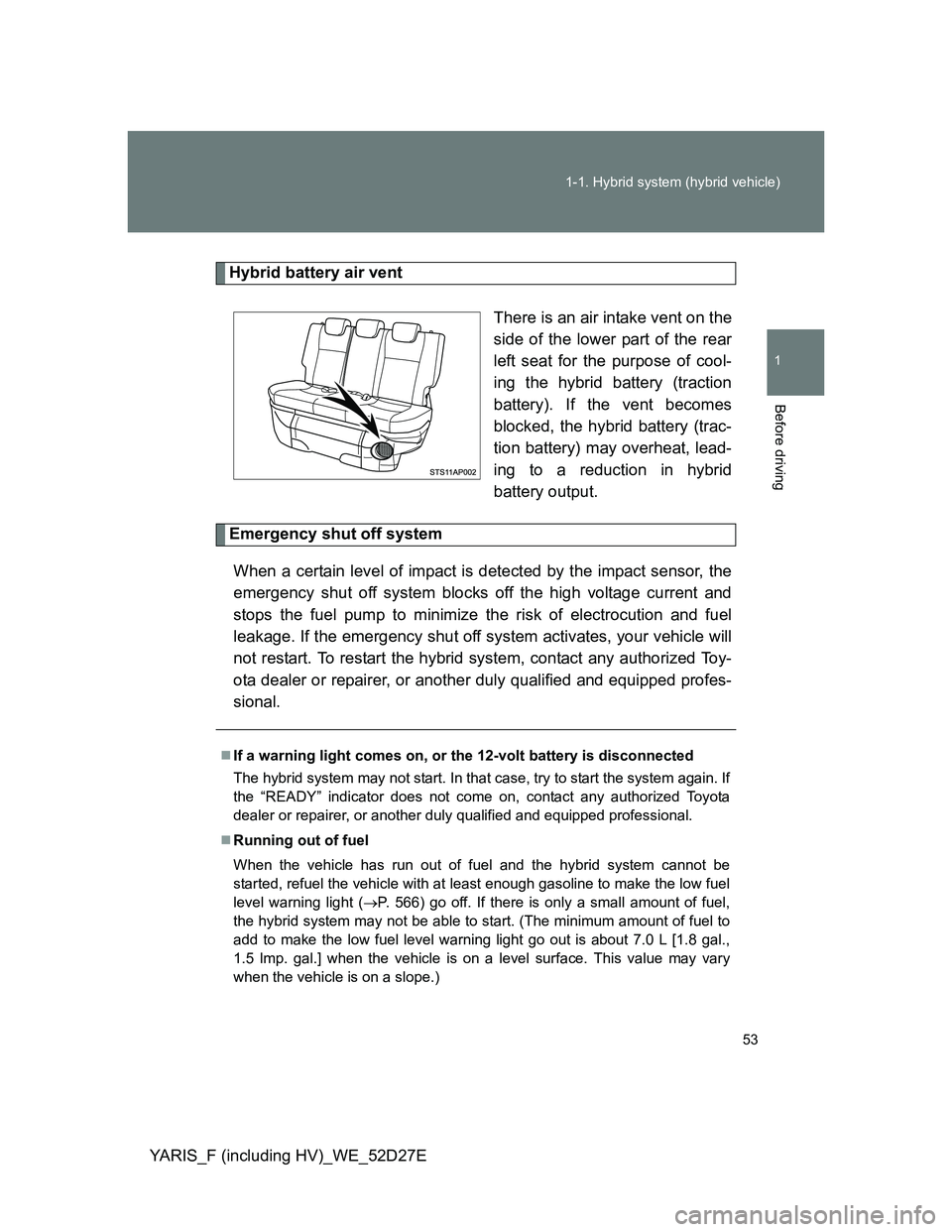
There is an air intake vent on the
side of the lower part of the rear
left seat for the purpose of cool-
ing the hybrid battery (traction
battery). If the vent becomes
blocked, the hybrid battery (trac-
tion battery) may overheat, lead-
ing to a reduction in hybrid
battery output.
Emergency shut off system
When a certain level of impact is detected by the impact sensor, the
emergency shut off system blocks off the high voltage current and
stops the fuel pump to minimize the risk of electrocution and fuel
leakage. If the emergency shut off system activates, your vehicle will
not restart. To restart the hybrid system, contact any authorized Toy-
ota dealer or repairer, or another duly qualified and equipped profes-
sional.
If a warning light comes on, or the 12-volt battery is disconnected
The hybrid system may not start. In that case, try to start the system again. If
the “READY” indicator does not come on, contact any authorized Toyota
dealer or repairer, or another duly qualified and equipped professional.
Running out of fuel
When the vehicle has run out of fuel and the hybrid system cannot be
started, refuel the vehicle with at least enough gasoline to make the low fuel
level warning light (P. 566) go off. If there is only a small amount of fuel,
the hybrid system may not be able to start. (The minimum amount of fuel to
add to make the low fuel level warning light go out is about 7.0 L [1.8 gal.,
1.5 lmp. gal.] when the vehicle is on a level surface. This value may vary
when the vehicle is on a slope.)