force TOYOTA YARIS HYBRID 2015 Owners Manual
[x] Cancel search | Manufacturer: TOYOTA, Model Year: 2015, Model line: YARIS HYBRID, Model: TOYOTA YARIS HYBRID 2015Pages: 492, PDF Size: 21.93 MB
Page 33 of 492
331-1. For safe use
1
For safety and security
YARIS_HV_EE_OM52F30E
WARNING
Observe the following precautions.
Failure to do so may result in death or serious injury.
● Do not adjust the position of the driver’s seat while driving.
Doing so could cause the driver to lose control of the vehicle.
● Do not place a cushion between the driver or passenger and the seatback.
A cushion may prevent correct posture from being achieved, and reduce
the effectiveness of the seat belt and head restraint.
● Do not place anything under the front seats.
Objects placed under the front seats may become jammed in the seat
tracks and stop the seat from locking in place. This may lead to an acci-
dent and the adjustment mechanism may also be damaged.
● When driving over long distances, take regular breaks before you start to
feel tired.
Also, if you feel tired or sleepy while driving, do not force yourself to con-
tinue driving and take a break immediately.
Page 42 of 492
421-1. For safe use
YARIS_HV_EE_OM52F30E
*: If equipped
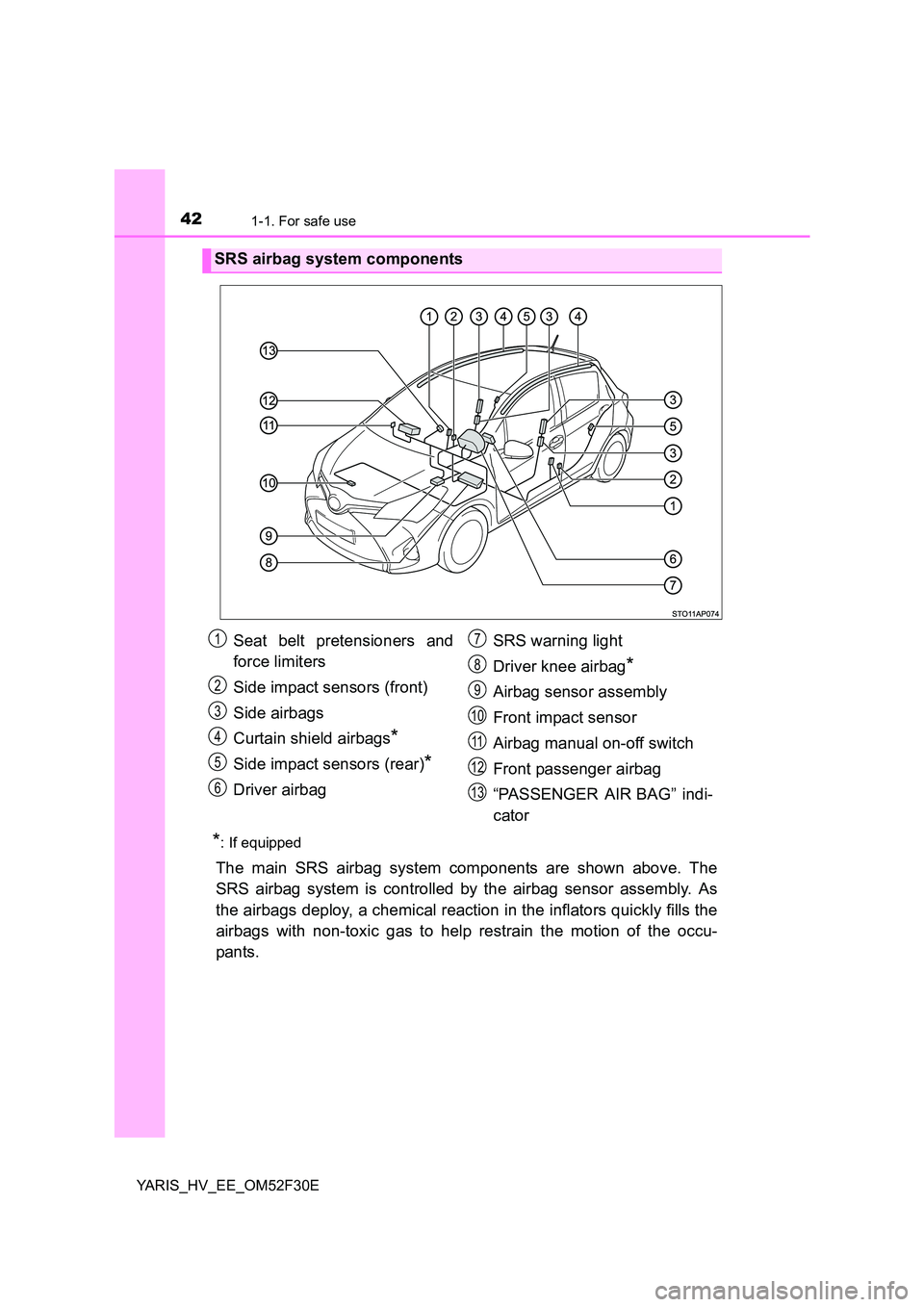
The main SRS airbag system components are shown above. The
SRS airbag system is controlled by the airbag sensor assembly. As
the airbags deploy, a chemical reaction in the inflators quickly fills the
airbags with non-toxic gas to help restrain the motion of the occu-
pants.
SRS airbag system components
Seat belt pretensioners and
force limiters
Side impact sensors (front)
Side airbags
Curtain shield airbags*
Side impact sensors (rear)*
Driver airbag
SRS warning light
Driver knee airbag*
Airbag sensor assembly
Front impact sensor
Airbag manual on-off switch
Front passenger airbag
“PASSENGER AIR BAG” indi-
cator
1
2
3
4
5
6
7
8
9
10
11
12
13
Page 43 of 492
431-1. For safe use
1
For safety and security
YARIS_HV_EE_OM52F30E
WARNING
■ SRS airbag precautions
Observe the following precautions regarding the SRS airbags.
Failure to do so may cause death or serious injury.
● The driver and all passengers in the vehicle must wear their seat belts
properly.
The SRS airbags are supplemental devices to be used with the seat belts.
● The SRS driver airbag deploys with considerable force, and can cause
death or serious injury especially if the driver is very close to the airbag.
Since the risk zone for the driver’s airbag is the first 50 - 75 mm (2 - 3 in.)
of inflation, placing yourself 250 mm ( 10 in.) from your driver airbag pro-
vides you with a clear margin of safety. This distance is measured from
the center of the steering wheel to your breastbone. If you sit less than
250 mm (10 in.) away now, you can change your driving position in sev-
eral ways:
• Move your seat to the rear as far as you can while still reaching the ped-
als comfortably.
• Slightly recline the back of the seat. Although vehicle designs vary,
many drivers can achieve the 250 mm (10 in.) distance, even with the
driver seat all the way forward, simply by reclining the back of the seat
somewhat. If reclining the back of your seat makes it hard to see the
road, raise yourself by using a firm, non-slippery cushion, or raise the
seat if your vehicle has that feature.
• If your steering wheel is adjustable, tilt it downward. This points the
airbag toward your chest instead of your head and neck.
The seat should be adjusted as recommended above, while still maintain-
ing control of the foot pedals, steering wheel, and your view of the instru-
ment panel controls.
● The SRS front passenger airbag also deploys with considerable force, and
can cause death or serious injury especially if the front passenger is very
close to the airbag. The front passenger seat should be as far from the
airbag as possible with the seatback adjusted, so the front passenger sits
upright.
● Improperly seated and/or restrained infants and children can be killed or
seriously injured by a deploying airbag. An infant or child who is too small
to use a seat belt should be properly secured using a child restraint sys-
tem. Toyota strongly recommends that all infants and children be placed in
the rear seats of the vehicle and proper ly restrained. The rear seats are
safer for infants and children than the front passenger seat. ( →P. 55)
Page 45 of 492
451-1. For safe use
1
For safety and security
YARIS_HV_EE_OM52F30E
WARNING
■ SRS airbag precautions
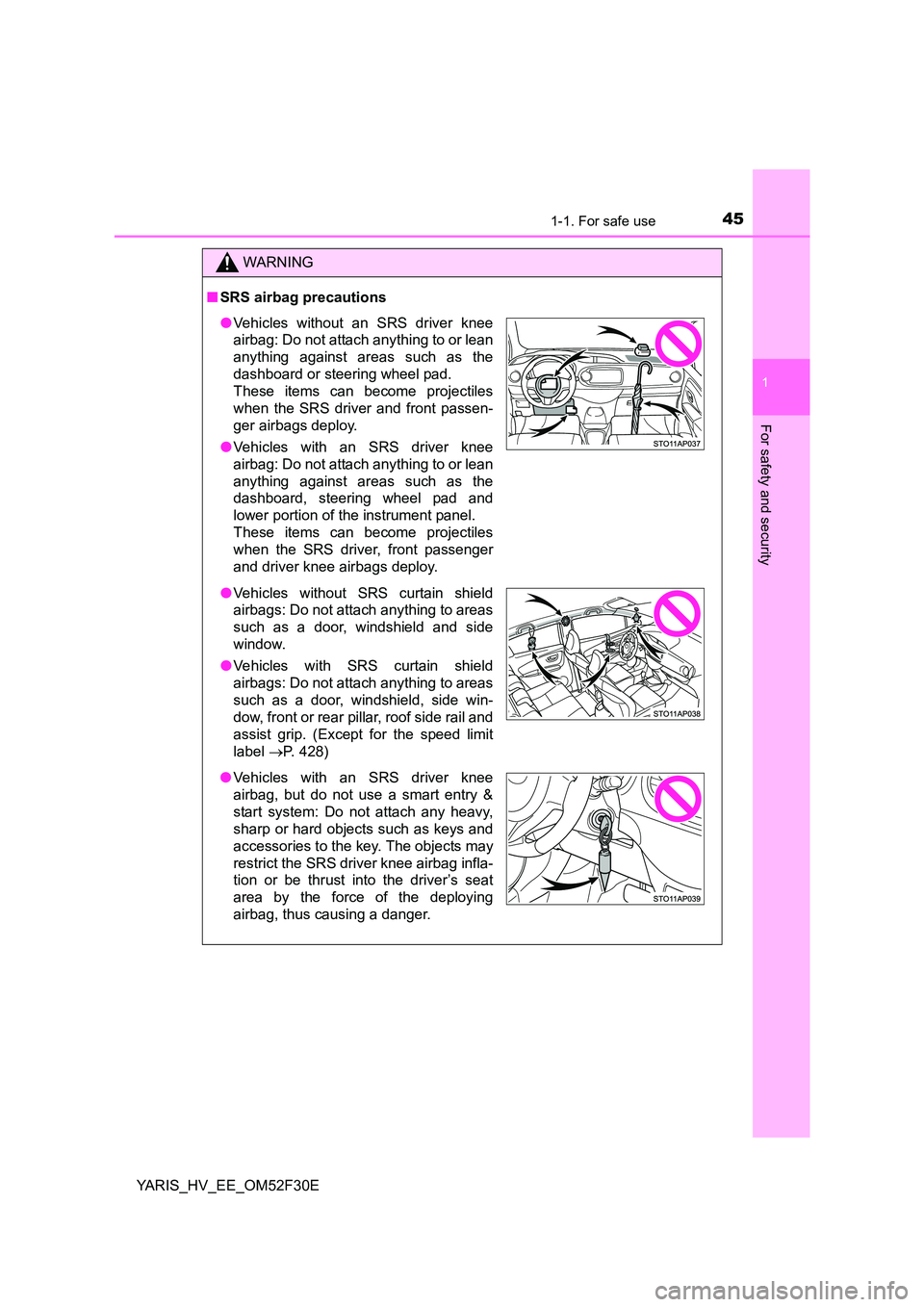
●Vehicles without an SRS driver knee
airbag: Do not attach anything to or lean
anything against areas such as the
dashboard or steering wheel pad.
These items can become projectiles
when the SRS driver and front passen-
ger airbags deploy.
● Vehicles with an SRS driver knee
airbag: Do not attach anything to or lean
anything against areas such as the
dashboard, steering wheel pad and
lower portion of the instrument panel.
These items can become projectiles
when the SRS driver, front passenger
and driver knee airbags deploy.
● Vehicles without SRS curtain shield
airbags: Do not attach anything to areas
such as a door, windshield and side
window.
● Vehicles with SRS curtain shield
airbags: Do not attach anything to areas
such as a door, windshield, side win-
dow, front or rear pillar, roof side rail and
assist grip. (Except for the speed limit
label →P. 428)
● Vehicles with an SRS driver knee
airbag, but do not use a smart entry &
start system: Do not attach any heavy,
sharp or hard objects such as keys and
accessories to the key. The objects may
restrict the SRS driver knee airbag infla-
tion or be thrust into the driver’s seat
area by the force of the deploying
airbag, thus causing a danger.
Page 46 of 492
461-1. For safe use
YARIS_HV_EE_OM52F30E
WARNING
■ SRS airbag precautions
● Vehicles with SRS curtain shield airbags: Do not hang coat hangers or
other hard objects on the coat hooks. All of these items could become pro-
jectiles and may cause death or serious injury, should the SRS curtain
shield airbags deploy.
● Vehicles with an SRS driver knee airbag: If a vinyl cover is put on the area
where the SRS driver knee airbag will deploy, be sure to remove it.
● Do not use seat accessories which cover the parts where the SRS side
airbags inflate as they may interfere with inflation of the SRS airbags.
Such accessories may prevent the si de airbags from activating correctly,
disable the system or cause the side ai rbags to inflate accidentally, result-
ing in death or serious injury.
● Do not strike or apply significant levels of force to the area of the SRS
airbag components.
Doing so can cause the SRS airbags to malfunction.
● Do not touch any of the component parts immediately after the SRS
airbags have deployed (inflated) as they may be hot.
● If breathing becomes difficult after the SRS airbags have deployed, open a
door or window to allow fresh air in, or leave the vehicle if it is safe to do
so. Wash off any residue as soon as possible to prevent skin irritation.
● Vehicles without SRS curtain shield airbags: If the areas where the SRS
airbags are stored, such as the steering wheel pad, are damaged or
cracked, have them replaced by any authorized Toyota dealer or repairer,
or another duly qualified and equipped professional.
● Vehicles with SRS curtain shield airbags: If the areas where the SRS
airbags are stored, such as the steer ing wheel pad and front and rear pillar
garnishes, are damaged or cracked, have them replaced by any autho-
rized Toyota dealer or repairer, or another duly qualified and equipped pro-
fessional.
Page 48 of 492
481-1. For safe use
YARIS_HV_EE_OM52F30E
■If the SRS airbags deploy (inflate)
● Bruising and slight abrasions may result from contact with a deploying
(inflating) SRS airbag.
● A loud noise and white powder will be emitted.
● Vehicles without SRS curtain shield airbags: Parts of the airbag module
(steering wheel hub, airbag cover and inflator) as well as the front seats may
be hot for several minutes. The airbag itself may also be hot.
● Vehicles with SRS curtain shield airbags: Parts of the airbag module (steer-
ing wheel hub, airbag cover and inflator) as well as the front seats, parts of
the front and rear pillars, and roof side rails, may be hot for several minutes.
The airbag itself may also be hot.
● The windshield may crack.
■ SRS airbag deployment conditions (SRS front airbags)
● The SRS front airbags will deploy in the event of an impact that exceeds the
set threshold level (the level of force corresponding to an approximately 20 -
30 km/h [12 - 18 mph] frontal collision with a fixed wall that does not move or
deform).
However, this threshold velocity will be considerably higher in the following
situations:
• If the vehicle strikes an object, such as a parked vehicle or sign pole,
which can move or deform on impact
• If the vehicle is involved in an underride collision, such as a collision in
which the front of the vehicle “underrides”, or goes under, the bed of a
truck
● Depending on the type of collision, it is possible that only the seat belt
pretensioners will activate.
■ SRS airbag deployment conditions (SRS side airbags and SRS curtain
shield airbags [if equipped])
The SRS side and curtain shield airbags will deploy in the event of an impact
that exceeds the set threshold level (the level of force corresponding to the
impact force produced by an approximately 1500 kg [3300 lb.] vehicle collid-
ing with the vehicle cabin from a direction perpendicular to the vehicle orien-
tation at an approximate speed of 20 - 30 km/h [12 - 18 mph]).
Page 63 of 492
631-1. For safe use
1
For safety and security
YARIS_HV_EE_OM52F30E
WARNING
■ Using a child restraint system
The use of a child restraint system not suitable for the vehicle may not prop-
erly secure the infant or child. It may result in death or serious injury (in the
event of sudden braking or an accident).
■ Child restraint precautions
● For effective protection in automobile accidents and sudden stops, a child
must be properly restrained, using a seat belt or child restraint system
depending on the age and size of the child. Holding a child in your arms is
not a substitute for a child restraint system. In an accident, the child can be
crushed against the windshield, or between you and the vehicle’s interior.
● Toyota strongly urges the use of a proper child restraint system that con-
forms to the size of the child, installed on the rear seat. According to acci-
dent statistics, the child is safer when properly restrained in the rear seat
than in the front seat.
● Never use a rear-facing child restraint system on the front passenger seat
when the airbag manual on-off switch is on. ( →P. 52)
In the event of an accident, the force of the rapid inflation of the front pas-
senger airbag can cause death or serious injury to the child.
● A forward-facing child restraint system may be installed on the front pas-
senger seat only when it is unavoidable. A child restraint system that
requires a top strap should not be used in the front passenger seat since
there is no top strap anchor for the front passenger seat. Adjust the seat-
back as upright as possible and always move the seat as far back as pos-
sible because the front passenger airbag could inflate with considerable
speed and force. Otherwise, the child may be killed or seriously injured.
● Vehicles without SRS curtain shield airbags: Do not allow the child to lean
his/her head or any part of his/her body against the door or the area of the
seat from which the SRS side airbags deploy even if the child is seated in
the child restraint system. It is dangerous if the SRS side airbags inflate,
and the impact could cause death or serious injury to the child.
Page 72 of 492
721-1. For safe use
YARIS_HV_EE_OM52F30E
WARNING
■ When installing a child restraint system
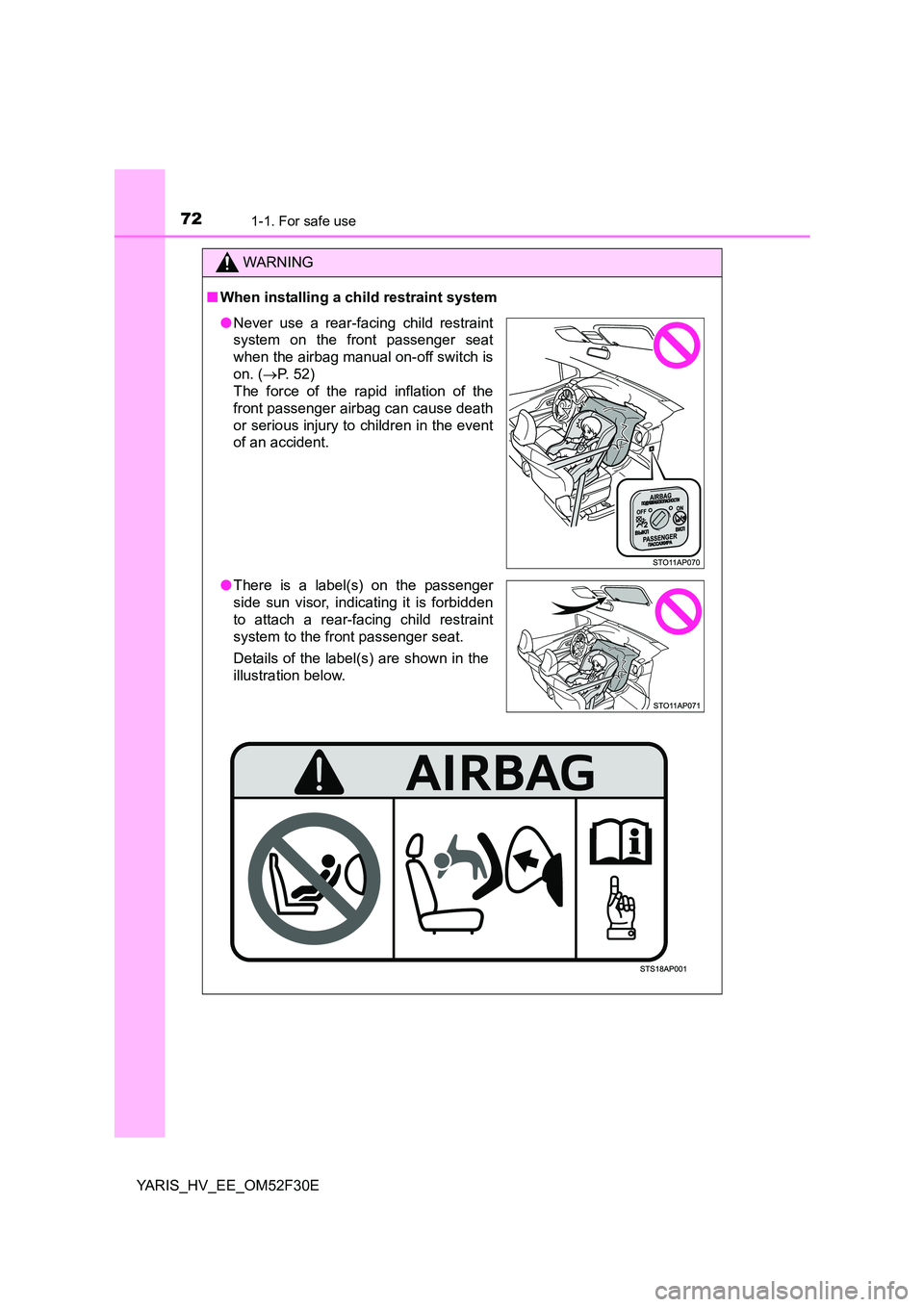
●Never use a rear-facing child restraint
system on the front passenger seat
when the airbag manual on-off switch is
on. ( →P. 52)
The force of the rapid inflation of the
front passenger airbag can cause death
or serious injury to children in the event
of an accident.
● There is a label(s) on the passenger
side sun visor, indicating it is forbidden
to attach a rear-facing child restraint
system to the front passenger seat.
Details of the label(s) are shown in the
illustration below.
Page 77 of 492
771-2. Hybrid system
1
For safety and security
YARIS_HV_EE_OM52F30E
■Regenerative braking
In the following situations, kinetic ener gy is converted to electric energy and
deceleration force can be obtained in conjunction with the recharging of the
hybrid battery (traction battery).
● The accelerator pedal is released while driving with the shift lever in D or B.
● The brake pedal is depressed while driving with the shift lever in D or B.
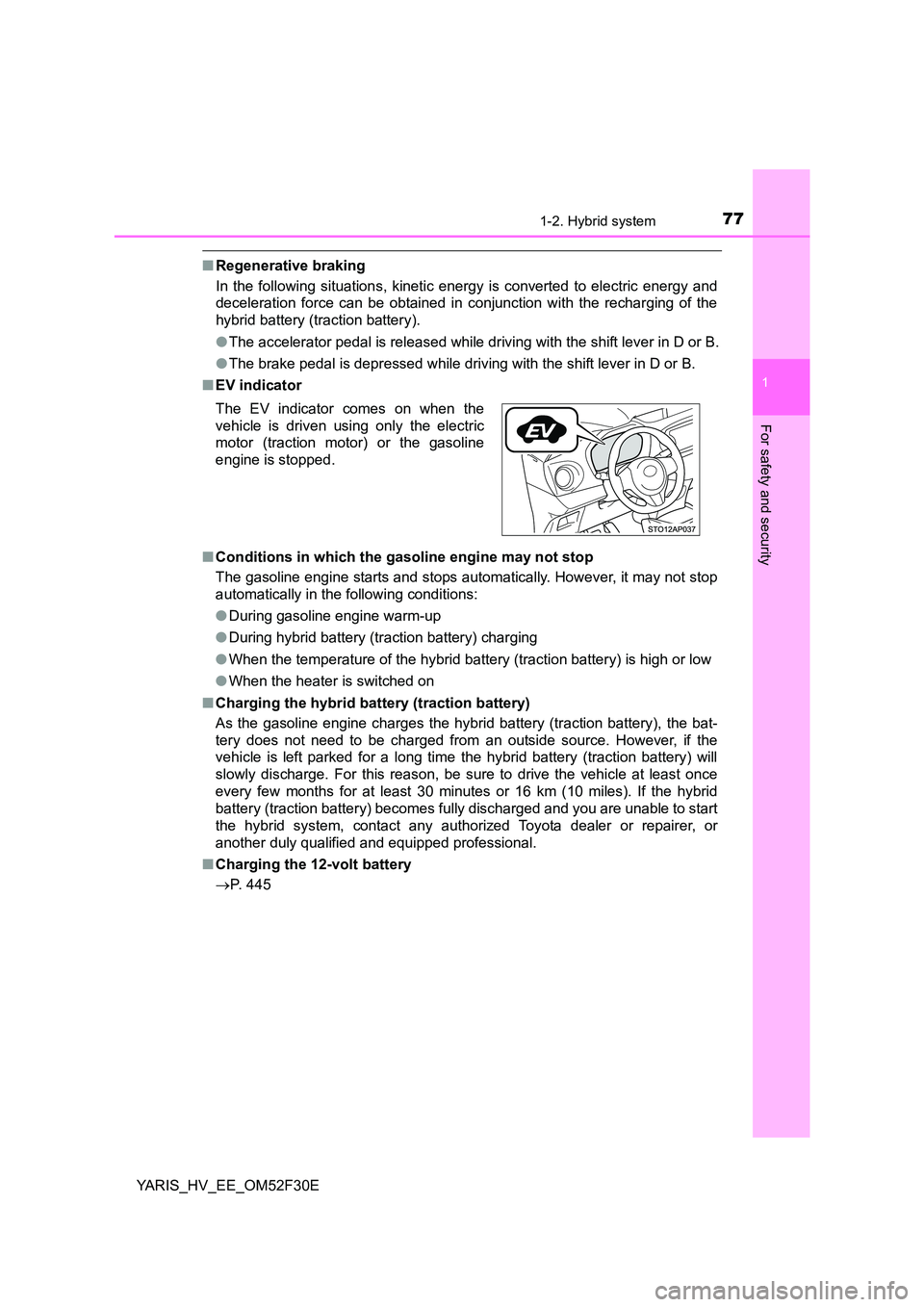
■ EV indicator
■ Conditions in which the gasoline engine may not stop
The gasoline engine starts and stops automatically. However, it may not stop
automatically in the following conditions:
● During gasoline engine warm-up
● During hybrid battery (traction battery) charging
● When the temperature of the hybrid battery (traction battery) is high or low
● When the heater is switched on
■ Charging the hybrid battery (traction battery)
As the gasoline engine charges the hybrid battery (traction battery), the bat-
tery does not need to be charged from an outside source. However, if the
vehicle is left parked for a long time t he hybrid battery (traction battery) will
slowly discharge. For this reason, be sure to drive the vehicle at least once
every few months for at least 30 minutes or 16 km (10 miles). If the hybrid
battery (traction battery) becomes fully discharged and you are unable to start
the hybrid system, contact any authorized Toyota dealer or repairer, or
another duly qualified and equipped professional.
■ Charging the 12-volt battery
→ P. 445
The EV indicator comes on when the
vehicle is driven using only the electric
motor (traction motor) or the gasoline
engine is stopped.
Page 127 of 492
1273-2. Opening, closing and locking the doors
3
Operation of each component
YARIS_HV_EE_OM52F30E
■Impact detection door lock release system
In the event that the vehicle is subject to a strong impact, all the doors are
unlocked. Depending on the force of the impact or the type of accident, how-
ever, the system may not operate.
■ Using the mechanical key (vehicles with a smart entry & start system)
The doors can also be locked and unlocked with the mechanical key.
( →P. 441)
■ Conditions affecting the operation of the wireless remote control or
smart entry & start system
→ P. 113, 137
■ If the smart entry & start system has been deactivated in a customized
setting (vehicles with a smart entry & start system)
Use the wireless remote control or mechanical key. ( →P. 123, 441)
WARNING
■ To prevent an accident
Observe the following precautions while driving the vehicle.
Failure to do so may result in a door opening and an occupant falling out,
resulting in death or serious injury.
● Always use a seat belt.
● Ensure that all the doors are properly closed.
● Do not pull the inside handle of the doors while driving.
The doors may be opened and the passengers are thrown out of the vehi-
cle and it may result in serious injury or death.
Be especially careful for the front doors, as the doors may be opened
even if the inside lock buttons are in locked position.
● Set the rear door child-protector locks when children are seated in the rear
seats.