window TOYOTA YARIS iA 2018 Owners Manual (in English)
[x] Cancel search | Manufacturer: TOYOTA, Model Year: 2018, Model line: YARIS iA, Model: TOYOTA YARIS iA 2018Pages: 576, PDF Size: 5.5 MB
Page 1 of 576
YARIS iA_OM_OM99Q46z_(U)
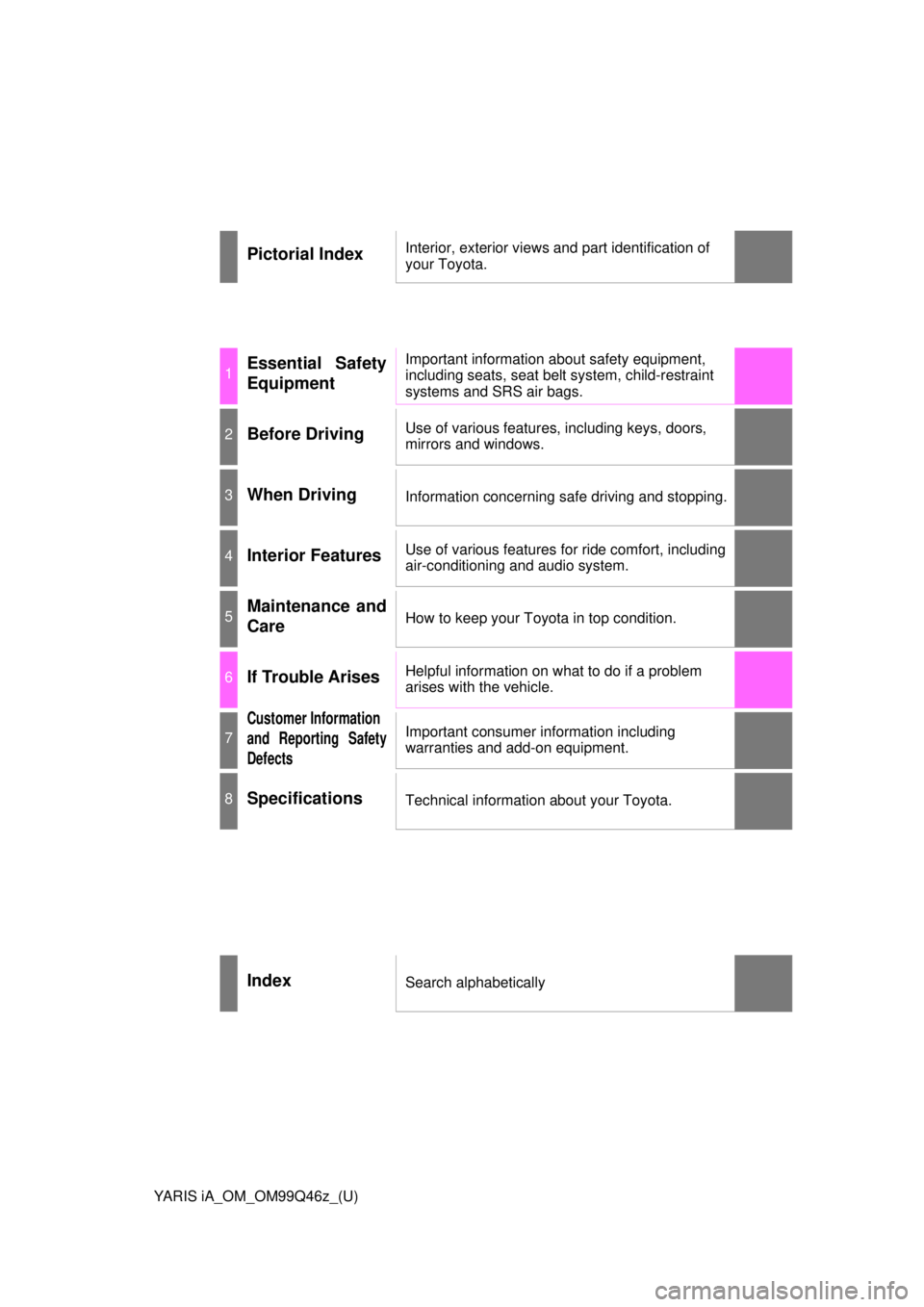
Pictorial IndexInterior, exterior views and part identification of
your Toyota.
1Essential Safety
EquipmentImportant information about safety equipment,
including seats, seat belt system, child-restraint
systems and SRS air bags.
2Before DrivingUse of various features, including keys, doors,
mirrors and windows.
3When DrivingInformation concerning safe driving and stopping.
4Interior FeaturesUse of various features for ride comfort, including
air-conditioning and audio system.
5Maintenance and
CareHow to keep your Toyota in top condition.
6If Trouble ArisesHelpful information on what to do if a problem
arises with the vehicle.
7
Customer Information
and Reporting Safety
DefectsImportant consumer information including
warranties and add-on equipment.
8SpecificationsTechnical information about your Toyota.
IndexSearch alphabetically
Page 3 of 576
3
1
8 7
6 4 3
2
YARIS iA_OM_OM99Q46z_(U)
5
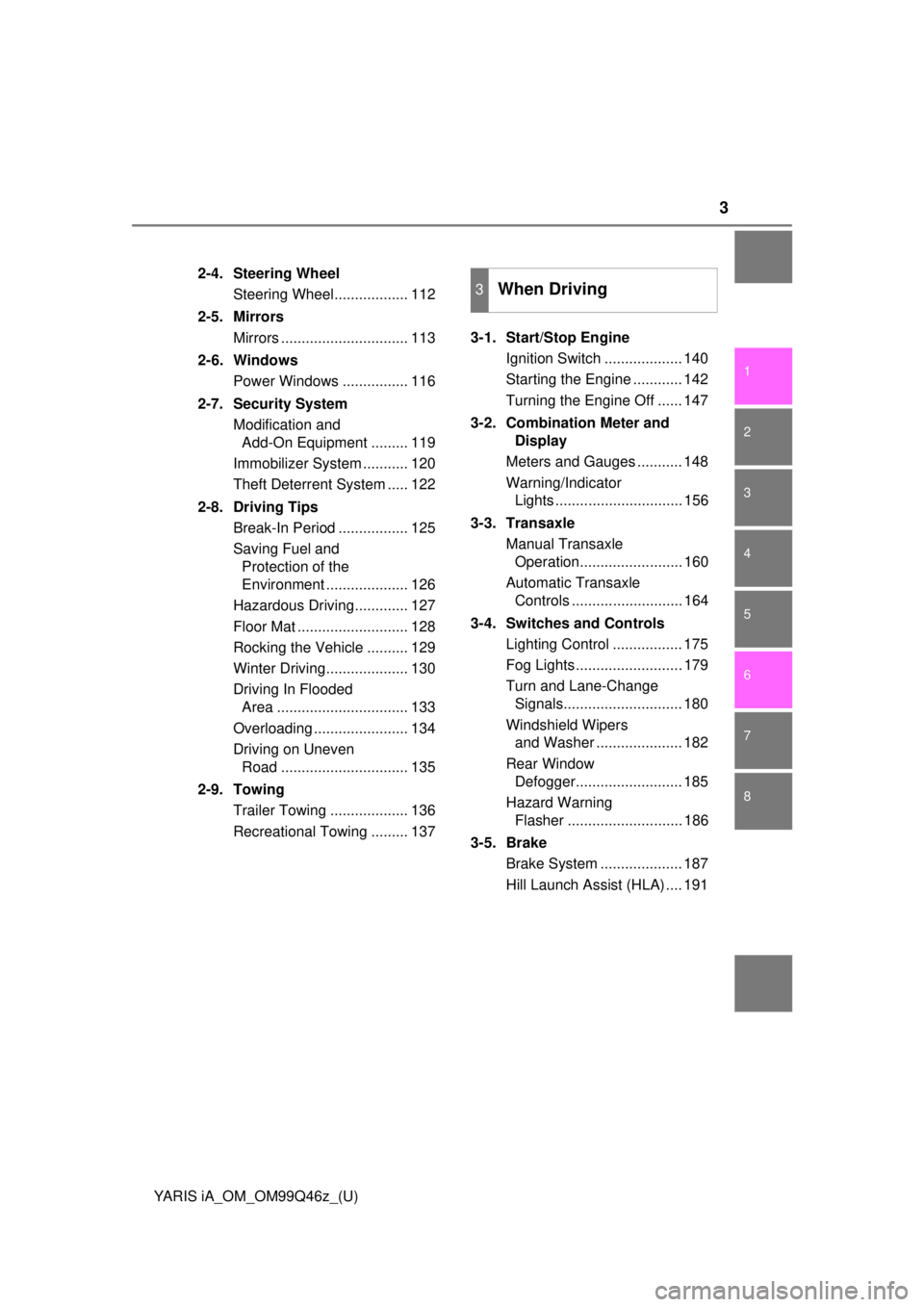
2-4. Steering WheelSteering Wheel.................. 112
2-5. Mirrors Mirrors ............................... 113
2-6. Windows Power Windows ................ 116
2-7. Security System Modification and Add-On Equipment ......... 119
Immobilizer System ........... 120
Theft Deterrent System ..... 122
2-8. Driving Tips Break-In Period ................. 125
Saving Fuel and Protection of the
Environment .................... 126
Hazardous Driving............. 127
Floor Mat ........................... 128
Rocking the Vehicle .......... 129
Winter Driving.................... 130
Driving In Flooded Area ................................ 133
Overloading ....................... 134
Driving on Uneven Road ............................... 135
2-9. Towing Trailer Towing ................... 136
Recreational Towing ......... 137 3-1. Start/Stop Engine
Ignition Switch ................... 140
Starting the Engine ............ 142
Turning the Engine Off ...... 147
3-2. Combination Meter and Display
Meters and Gauges ........... 148
Warning/Indicator Lights ............................... 156
3-3. Transaxle Manual Transaxle Operation......................... 160
Automatic Transaxle Controls ........................... 164
3-4. Switches and Controls Lighting Control ................. 175
Fog Lights .......................... 179
Turn and Lane-Change Signals............................. 180
Windshield Wipers and Washer ..................... 182
Rear Window Defogger.......................... 185
Hazard Warning Flasher ............................ 186
3-5. Brake Brake System .................... 187
Hill Launch Assist (HLA) .... 191
3When Driving
Page 5 of 576
5
1
8 7
6 4 3
2
YARIS iA_OM_OM99Q46z_(U)
5
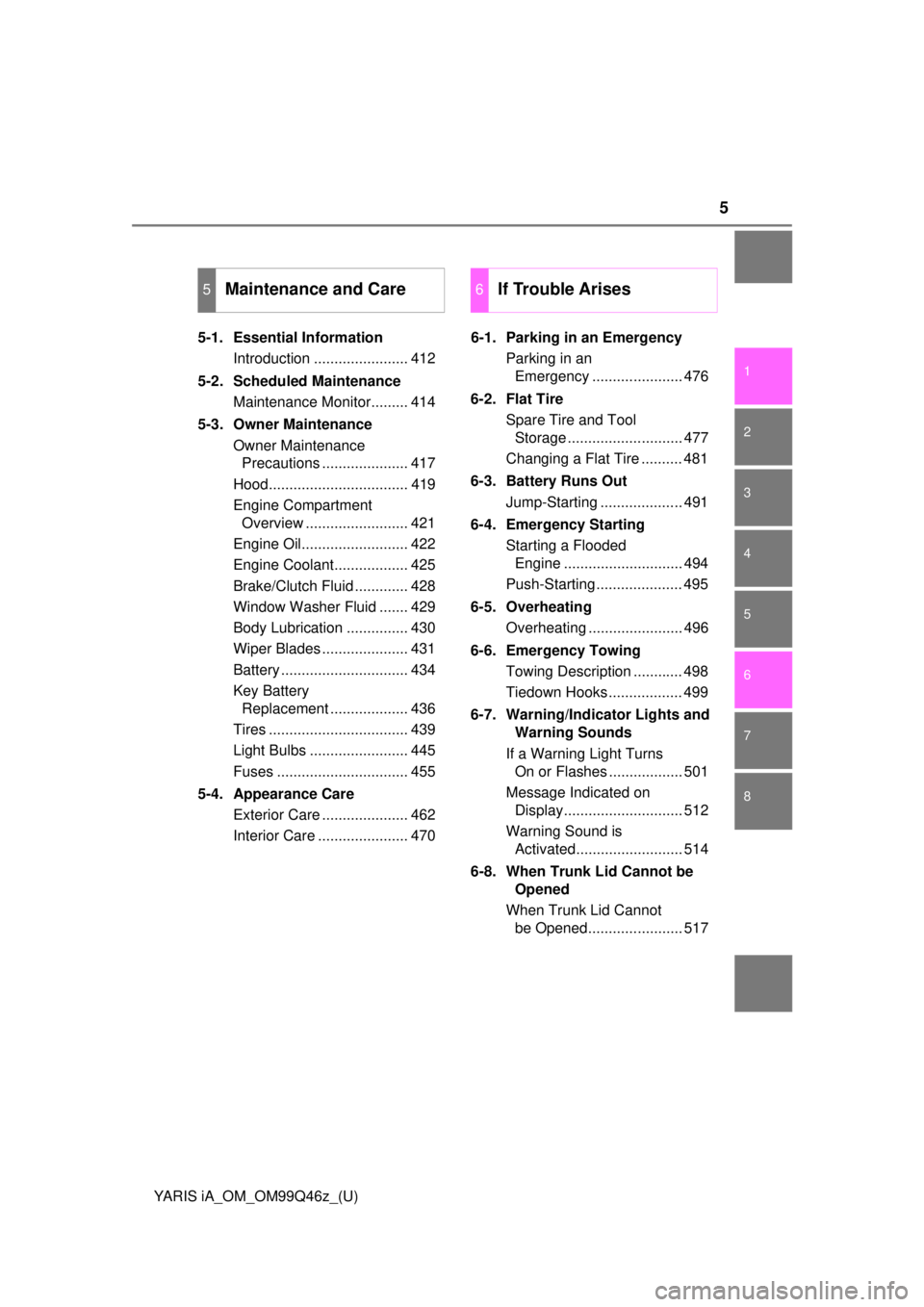
5-1. Essential InformationIntroduction ....................... 412
5-2. Scheduled Maintenance Maintenance Monitor......... 414
5-3. Owner Maintenance Owner Maintenance Precautions ..................... 417
Hood.................................. 419
Engine Compartment Overview ......................... 421
Engine Oil.......................... 422
Engine Coolant.................. 425
Brake/Clutch Fluid ............. 428
Window Washer Fluid ....... 429
Body Lubrication ............... 430
Wiper Blades ..................... 431
Battery ............................... 434
Key Battery Replacement ................... 436
Tires .................................. 439
Light Bulbs ........................ 445
Fuses ................................ 455
5-4. Appearance Care Exterior Care ..................... 462
Interior Care ...................... 470 6-1. Parking in an Emergency
Parking in an Emergency ...................... 476
6-2. Flat Tire Spare Tire and Tool Storage ............................ 477
Changing a Flat Tire .......... 481
6-3. Battery Runs Out Jump-Starting .................... 491
6-4. Emergency Starting Starting a Flooded Engine ............................. 494
Push-Starting ..................... 495
6-5. Overheating Overheating ....................... 496
6-6. Emergency Towing Towing Description ............ 498
Tiedown Hooks .................. 499
6-7. Warning/Indicator Lights and Warning Sounds
If a Warning Light Turns On or Flashes .................. 501
Message Indicated on Display............................. 512
Warning Sound is Activated.......................... 514
6-8. When Trunk Lid Cannot be Opened
When Trunk Lid Cannot be Opened....................... 517
5Maintenance and Care6If Trouble Arises
Page 12 of 576
12Pictorial index
YARIS iA_OM_OM99Q46z_(U)
Pictorial Index
■
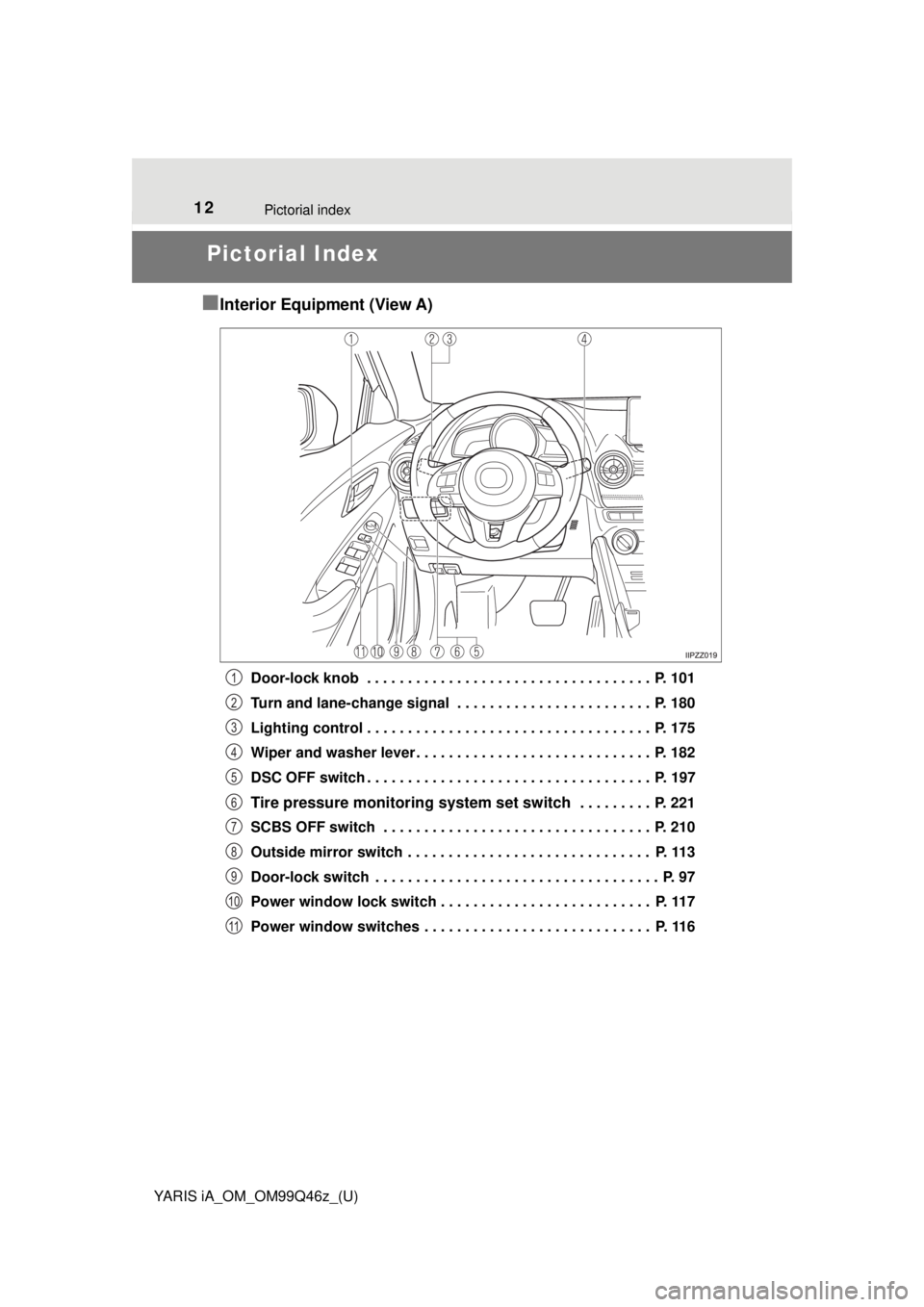
Interior Equipment (View A)
Door-lock knob . . . . . . . . . . . . . . . . . . . . . . . . . . . . . . . . . . . P. 101
Turn and lane-change signal . . . . . . . . . . . . . . . . . . . . . . . . P. 180
Lighting control . . . . . . . . . . . . . . . . . . . . . . . . . . . . . . . . . . . P. 175
Wiper and washer lever . . . . . . . . . . . . . . . . . . . . . . . . . . . . . P. 182
DSC OFF switch . . . . . . . . . . . . . . . . . . . . . . . . . . . . . . . . . . . P. 197
Tire pressure monitoring system set switch . . . . . . . . . P. 221
SCBS OFF switch . . . . . . . . . . . . . . . . . . . . . . . . . . . . . . . . . P. 210
Outside mirror switch . . . . . . . . . . . . . . . . . . . . . . . . . . . . . . P. 113
Door-lock switch . . . . . . . . . . . . . . . . . . . . . . . . . . . . . . . . . . . P. 97
Power window lock switch . . . . . . . . . . . . . . . . . . . . . . . . . . P. 117
Power window switches . . . . . . . . . . . . . . . . . . . . . . . . . . . . P. 116
1
2
3
4
5
6
7
8
9
10
11
Page 14 of 576
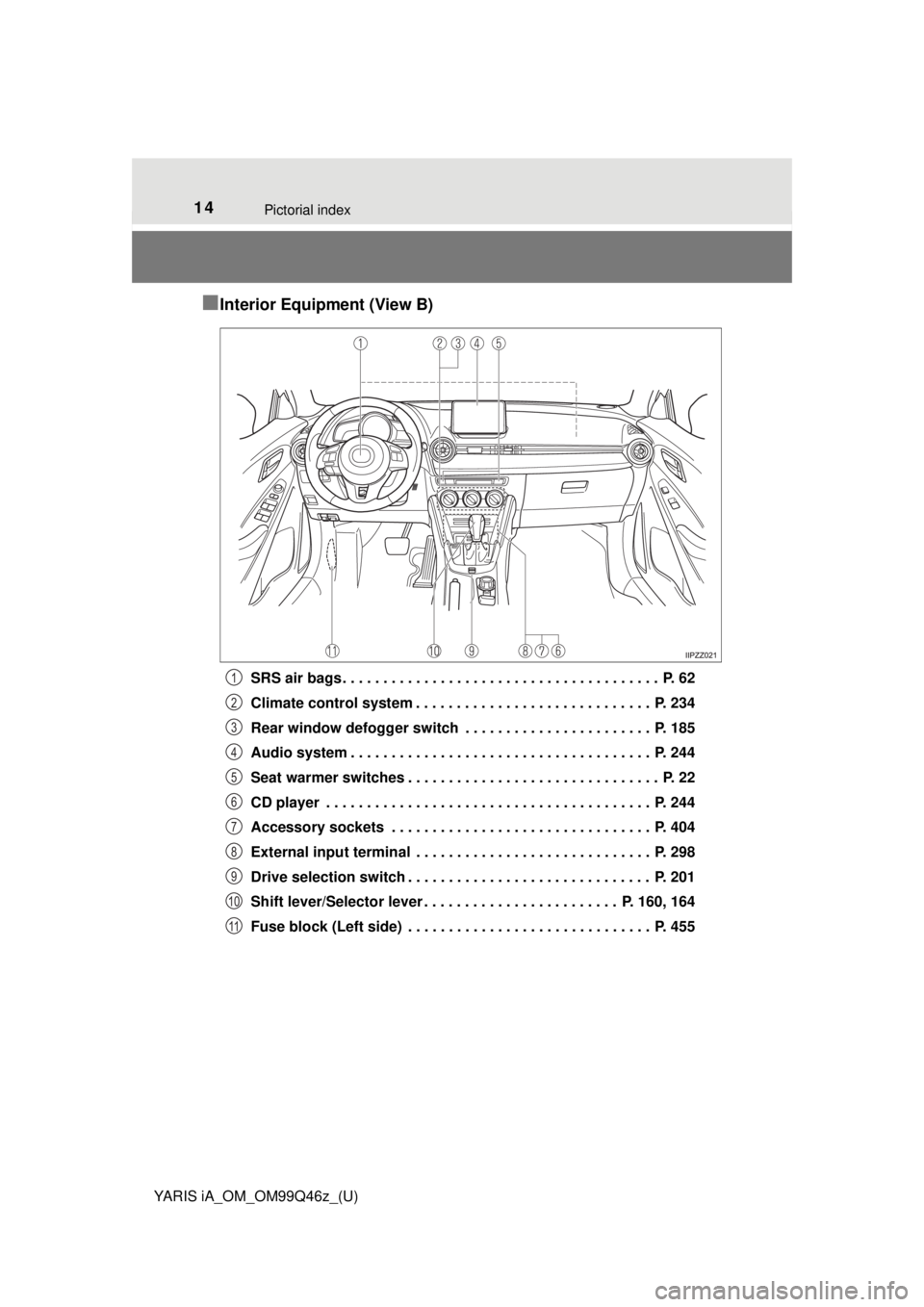
14Pictorial index
YARIS iA_OM_OM99Q46z_(U)
■Interior Equipment (View B)
SRS air bags . . . . . . . . . . . . . . . . . . . . . . . . . . . . . . . . . . . . . . . P. 62
Climate control system . . . . . . . . . . . . . . . . . . . . . . . . . . . . . P. 234
Rear window defogger switch . . . . . . . . . . . . . . . . . . . . . . . P. 185
Audio system . . . . . . . . . . . . . . . . . . . . . . . . . . . . . . . . . . . . . P. 244
Seat warmer switches . . . . . . . . . . . . . . . . . . . . . . . . . . . . . . . P. 22
CD player . . . . . . . . . . . . . . . . . . . . . . . . . . . . . . . . . . . . . . . . P. 244
Accessory sockets . . . . . . . . . . . . . . . . . . . . . . . . . . . . . . . . P. 404
External input terminal . . . . . . . . . . . . . . . . . . . . . . . . . . . . . P. 298
Drive selection switch . . . . . . . . . . . . . . . . . . . . . . . . . . . . . . P. 201
Shift lever/Selector lever . . . . . . . . . . . . . . . . . . . . . . . . P. 160, 164
Fuse block (Left side) . . . . . . . . . . . . . . . . . . . . . . . . . . . . . . P. 4551
2
3
4
5
6
7
8
9
10
11
Page 45 of 576

YARIS iA_OM_OM99Q46z_(U)
451-3. Child Restraint
1
Essential Safety Equipment
WARNING
■Do not allow a child or anyone to lean over or against the side window
of a vehicle with side and curtain air bags
It is dangerous to allow anyone to lean over or against the side window, the
area of the front passenger seat, the front and rear window pillars and the
roof edge along both sides from which the side and curtain air bags deploy,
even if a child-restraint system is used. The impact of inflation from a side or
curtain air bag could cause serious injury or death to an out of position child.
Furthermore, leaning over or against t he front door could block the side and
curtain air bags and eliminate the advantages of supplemental protection.
With the front air bag and the additional side air bag that comes out of the
front seat, the rear seat is always a better location for children. Take special
care not to allow a child to lean over or against the side window, even if the
child is seated in a child-restraint system.
■ Never use one seat belt on more than one person at a time
Using one seat belt for more than one person at a time is dangerous. A seat
belt used in this way cannot spread the impact forces properly and the two
passengers could be crushed together and seriously injured or even killed.
Never use one belt for more than one person at a time and always operate
the vehicle with each occupant properly restrained.
■ To prevent burns
A seat belt or child-restraint system can become very hot in a closed vehicle
during warm weather. To avoid burning yourself or a child, check them
before you or your child touches them.
Page 53 of 576

YARIS iA_OM_OM99Q46z_(U)
531-3. Child Restraint
1
Essential Safety Equipment
If you cannot put all children in the rear seat, at least put the smallest
children in the rear and be sure the largest child up front uses the
shoulder belt over the shoulder.
NEVER put a rear-facing child-restr aint system on the front passenger
seat whether your vehicle is equi pped with a occupant classification
sensor or not.
This seat is also not set up for te thered child-restraint systems, put
them in one of the rear seat pos itions set up with tether anchors.
Likewise the LATCH child-restraint system cannot be secured in the
front passenger’s seat and should be used in the rear seat.
Do not allow anyone to sleep against the side window since your vehi-
cle has side and curtain air bags, it could cause serious injuries to an
out of position occupant. As children mo re often sleep in cars, it is bet-
ter to put them in the rear seat.
If installing the child-restraint syst em on the front seat is unavoidable,
follow these instructions when usin g a front-facing child-restraint sys-
tem in the front passenger’s seat.
● To check if your front seats have side air bags:
The vehicle equipped with side air bag will have a “SRS AIRBAG” tag on the
outboard shoulder of the front seats.
● To check if your vehicle has curtain air bags:
The vehicle equipped with curtain air bag will have an “SRS AIRBAG” mark-
ing on the window pillars along the roof edge.
If You Must Use the Front Seat for Children
Page 54 of 576

54
YARIS iA_OM_OM99Q46z_(U)
1-3. Child Restraint
WARNING
■Always move the front passenger seat as far back as possible if install-
ing a front-facing ch ild-restraint system on it is unavoidable
As your vehicle has front air bags and doubly so because your vehicle has
side air bags, a front-facing child-restraint system should be put on the front
passenger seat only when it is unavoidable.
Even if the front passenger air bag deactivation indicator light illuminates,
always move the seat as far back as possible, because the force of a
deploying air bag could cause serious injury or death to the child.
■ Never use a rear-facing child-restra int system in the front seat with an
air bag that could deploy
Rear-facing child-restraint systems on the front seat are particularly danger-
ous.
Even in a moderate collision, the child-restraint system can be hit by a
deploying air bag and moved violently backward resulting in serious injury
or death to the child. Even though you may feel assured that the front pas-
senger air bag will not deploy based on the fact that the front passenger air
bag deactivation indicator light illuminates, you should not use a rear-facing
child-restraint system in the front seat.
■ Do not allow a child or anyone to lean over or against the side window
of a vehicle with side and curtain air bags
It is dangerous to allow anyone to lean over or against the side window, the
area of the front passenger seat, the front and rear window pillars and the
roof edge along both sides from which the side and curtain air bags deploy,
even if a child-restraint system is used. The impact of inflation from a side or
curtain air bag could cause serious injury or death to an out of position child.
Furthermore, leaning over or against t he front door could block the side and
curtain air bags and eliminate the advantages of supplemental protection.
With the front air bag and the additional side air bag that comes out of the
front seat, the rear seat is always a better location for children. Take special
care not to allow a child to lean over or against the side window, even if the
child is seated in a child-restraint system.
Page 62 of 576

62
YARIS iA_OM_OM99Q46z_(U)
1-4. SRS Air Bags
Supplemental Restraint System (SRS) Pre-
cautions
The front and side supplemental rest raint systems (SRS) include up to
6 air bags. Please verify which ki nds of air bags are equipped on your
vehicle by locating the “SRS AIRBAG” location indicators. These indi-
cators are visible in the area where the air bags are installed.
The air bags are installed in the following locations: • The steering wheel hub (driver air bag)
• The front passenger dashboard (front passenger air bag)
• The outboard sides of the front seatbacks (side air bags) (if equipped)
• The front and rear window pillars, and the roof edge along both
sides (curtain air bags) (if equipped)
The air bag supplemental restrain t systems are designed to provide
supplemental protection in certain situations so seat belts are always
important in the following ways:
Without seat belt usa ge, the air bags cannot provide adequate protec-
tion during an accident. Seat be lt usage is necessary to:
• Keep the occupant from being thrown into an inflating air bag.
• Reduce the possibility of injuries during an accident that is not designed for air bag inflation, such as rear impact.
• Reduce the possibility of injuries in frontal, near frontal or side colli-
sions or roll-over accidents that are not severe enough to activate
the air bags.
• Reduce the possibility of being thrown from your vehicle.
• Reduce the possibility of injuries to lower body and legs during an
accident because the air bags provid e no protection to these parts
of the body.
• Hold the driver in a position which allows better control of the vehi-
cle.
Page 65 of 576

YARIS iA_OM_OM99Q46z_(U)
651-4. SRS Air Bags
1
Essential Safety Equipment
WARNING
■Sit in the center of the seat and wear seat belts properly
Sitting too close to the side air bag modules or placing hands on them, or
sleeping up against the door or hanging out the windows is extremely dan-
gerous. The side and curtain air bags inflate with great force and speed
directly expanding along the door on the side the car is hit. Serious injury
could occur if someone is sitting too close to the door or leaning against a
window, or if rear seat occupants grab the sides of the front seatbacks. Give
the side and curtain air bags room to work by sitting in the center of the seat
while the vehicle is moving with seat belts worn properly.
■ Do not attach objects on or around the area where driver and front pas-
senger air bags deploy
Attaching an object to the driver and front passenger air bag modules or
placing something in front of them is dangerous. In an accident, an object
could interfere with air bag inflation and injure the occupants.
■ Do not attach objects on or around the area where a side air bag
deploys
Attaching objects to the front seat in such a way as to cover the outboard
side of the seat in any way is dangerous. In an accident the object could
interfere with the side air bag, which inflates from the outboard side of the
front seats, impeding the added protection of the side air bag system or
redirecting the air bag in a way that is dangerous. Furthermore, the bag
could be cut open releasing the gas.
Do not hang net bags, map pouches or backpacks with side straps on the
front seats. Never use seat covers on the front seats. Always keep the side
air bag modules in your front seats free to deploy in the event of a sid\
e colli-
sion.
■ Do not attach objects on or arou nd the area where a curtain air bag
deploys
Attaching objects to the areas where the curtain air bag activates such \
as
on the windshield glass, side door glass, front and rear window pillars and
along the roof edge and assist grips is dangerous. In an accident the object
could interfere with the curtain air bag, which inflates from the front and rear
window pillars and along the roof edge, impeding the added protection of
the curtain air bag system or redirecting the air bag in a way that is danger-
ous. Furthermore, the bag could be cut open releasing the gas.
Do not place hangers or any other objects on the assist grips. When hang-
ing clothes, hang them on the coat hook directly. Always keep the curtain air
bag modules free to deploy in the event of a side collision or roll-over acci-
dent.