engine cooling TOYOTA YARIS SEDAN 2008 Owners Manual
[x] Cancel search | Manufacturer: TOYOTA, Model Year: 2008, Model line: YARIS SEDAN, Model: TOYOTA YARIS SEDAN 2008Pages: 384, PDF Size: 6.19 MB
Page 234 of 384
221
4-3. Do-it-yourself maintenance
4
Maintenance and care
CAUTION
The engine compartment contains many mechanisms and fluids that may
move suddenly, become hot, or become electrically energized. To avoid death
or serious injury observe the following precautions.
n
When working on the engine compartment
lKeep hands, clothing, and tools away from the moving fan and engine
drive belt.
l Be careful not to touch the engine, radiator, exhaust manifold, etc. right
after driving as they may be hot. Oil and other fluids may also be hot.
l Do not leave anything that may burn easily, such as paper or rags, in the
engine compartment.
l Do not smoke, cause sparks or expose an open flame to fuel or the bat-
tery. Fuel and battery fumes are flammable.
l Be extremely cautious when working on the battery. It contains poisonous
and corrosive sulfuric acid.
l Take care because brake fluid can harm your hands or eyes and damage
painted surfaces.
If fluid gets on your hands or in your eyes, flush the affected area with
clean water immediately.
If you still experience discomfort, see a doctor.
n When working near the electric cooling fan or radiator grille
Be sure the engine switch is off.
With the engine switch on, the electric cooling fan may automatically start to
run if the air conditioning is on and/or the coolant temperature is high.
n Safety glasses
Wear safety glasses to prevent flying or falling material, fluid spray, etc. from
getting in the eyes.
Page 239 of 384
226
4-3. Do-it-yourself maintenance
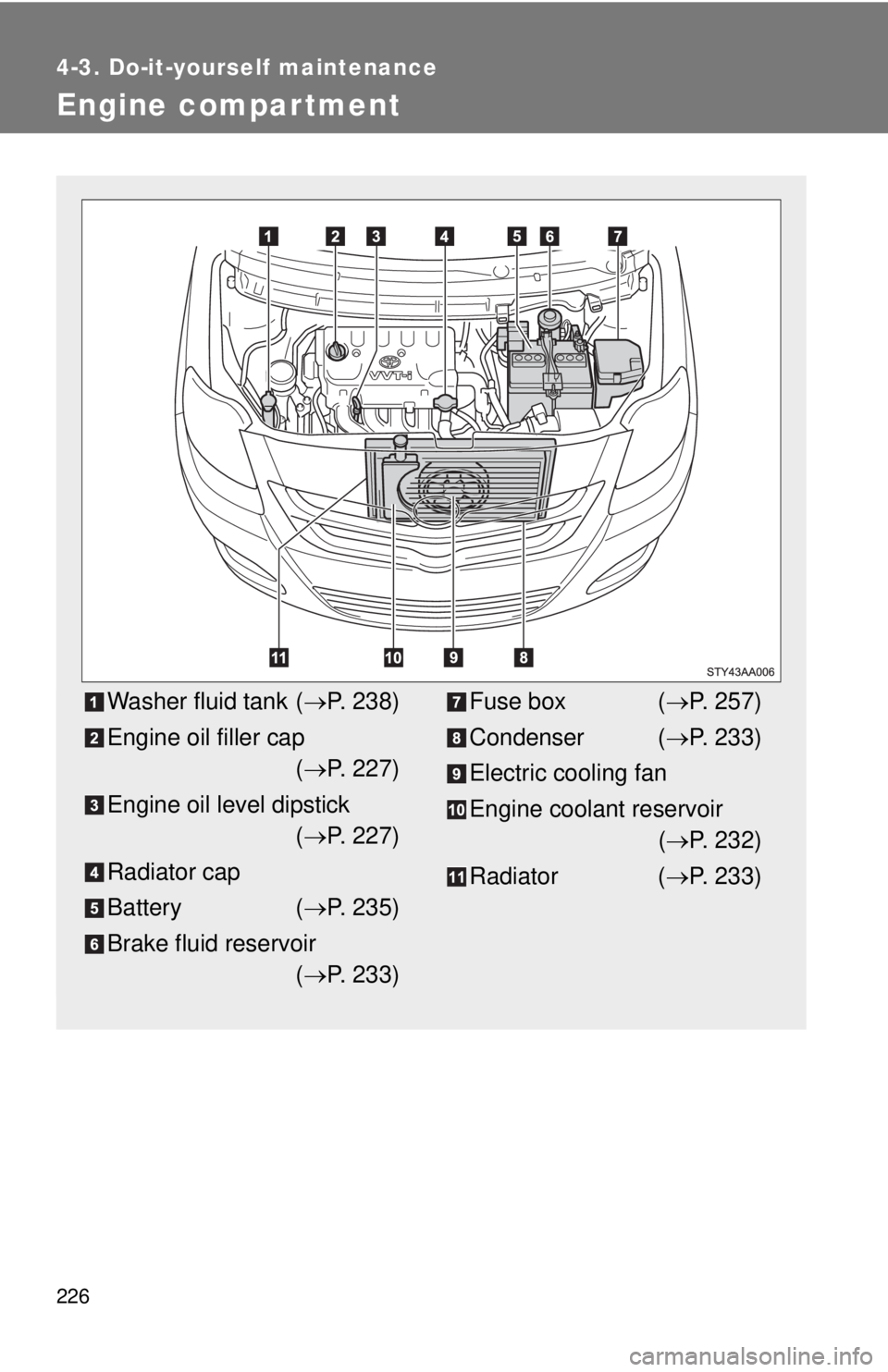
Engine compar tment
Washer fluid tank (→P. 238)
Engine oil filler cap (→ P. 227)
Engine oil level dipstick (→ P. 227)
Radiator cap
Battery ( →P. 235)
Brake fluid reservoir (→ P. 233)Fuse box ( →P. 257)
Condenser ( →P. 233)
Electric cooling fan
Engine coolant reservoir (→ P. 232)
Radiator ( →P. 233)
Page 245 of 384
232 4-3. Do-it-yourself maintenance
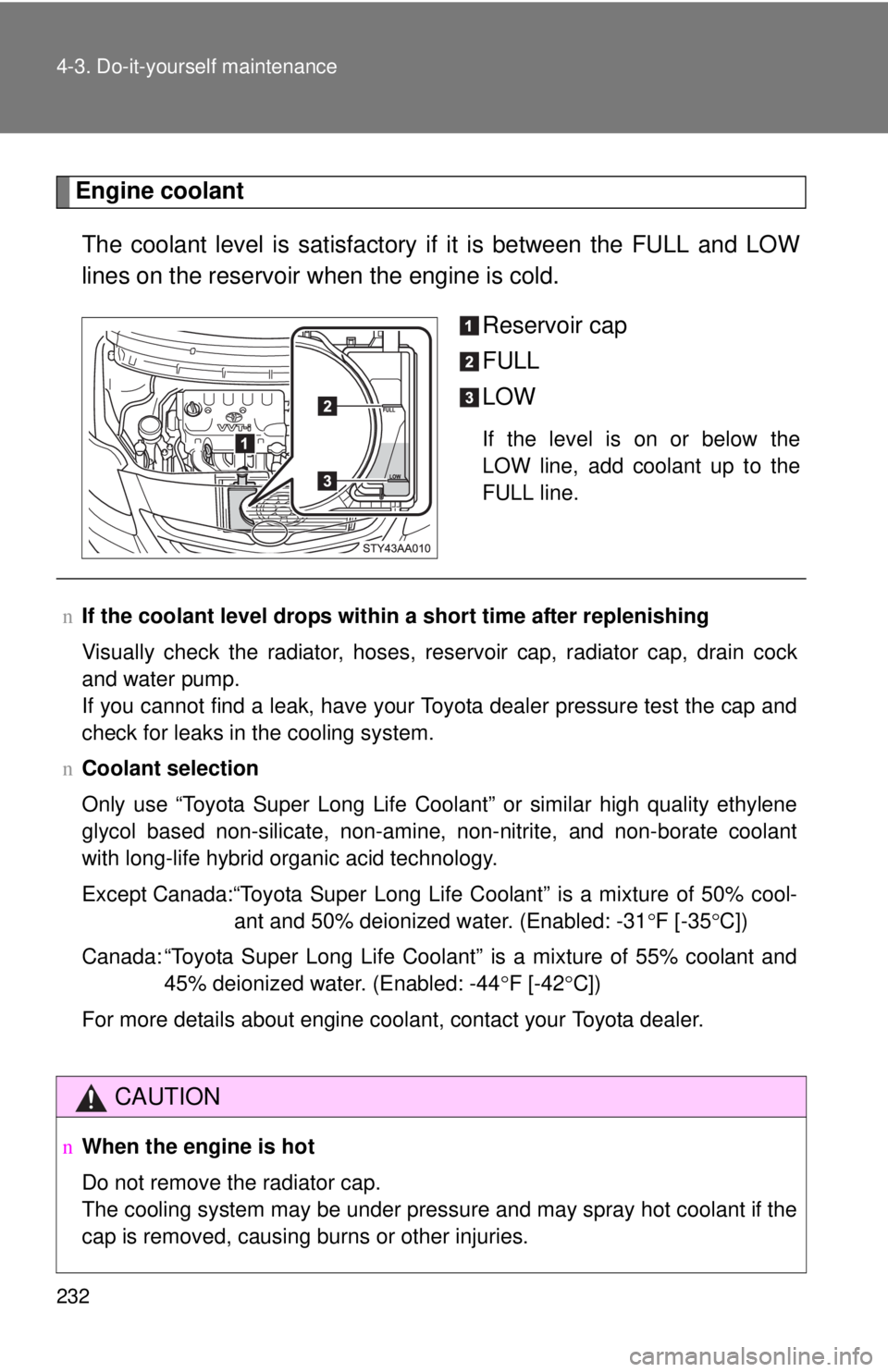
Engine coolantThe coolant level is satisfactory if it is between the FULL and LOW
lines on the reservoir when the engine is cold. Reservoir cap
FULL
LOW
If the level is on or below the
LOW line, add coolant up to the
FULL line.
nIf the coolant level drops within a short time after replenishing
Visually check the radiator, hoses, reservoir cap, radiator cap, drain cock
and water pump.
If you cannot find a leak, have your Toyota dealer pressure test the cap and
check for leaks in the cooling system.
n Coolant selection
Only use “Toyota Super Long Life Coolant” or similar high quality ethylene
glycol based non-silicate, non-amine, non-nitrite, and non-borate coolant
with long-life hybrid organic acid technology.
Except Canada:“Toyota Super Long Life Coolant” is a mixture of 50% cool-
ant and 50% deionized water. (Enabled: -31 °F [-35 °C])
Canada: “Toyota Super Long Life Coolant” is a mixture of 55% coolant and 45% deionized water. (Enabled: -44 °F [-42 °C])
For more details about engine coolant, contact your Toyota dealer.
CAUTION
n When the engine is hot
Do not remove the radiator cap.
The cooling system may be under pressure and may spray hot coolant if the
cap is removed, causing burns or other injuries.
Page 246 of 384
233
4-3. Do-it-yourself maintenance
4
Maintenance and care
Radiator and condenser
Check the radiator and condenser and clear any foreign objects.
If either of the above parts are extremely dirty or you are not sure of
their condition, have your vehicl e checked by your Toyota dealer.
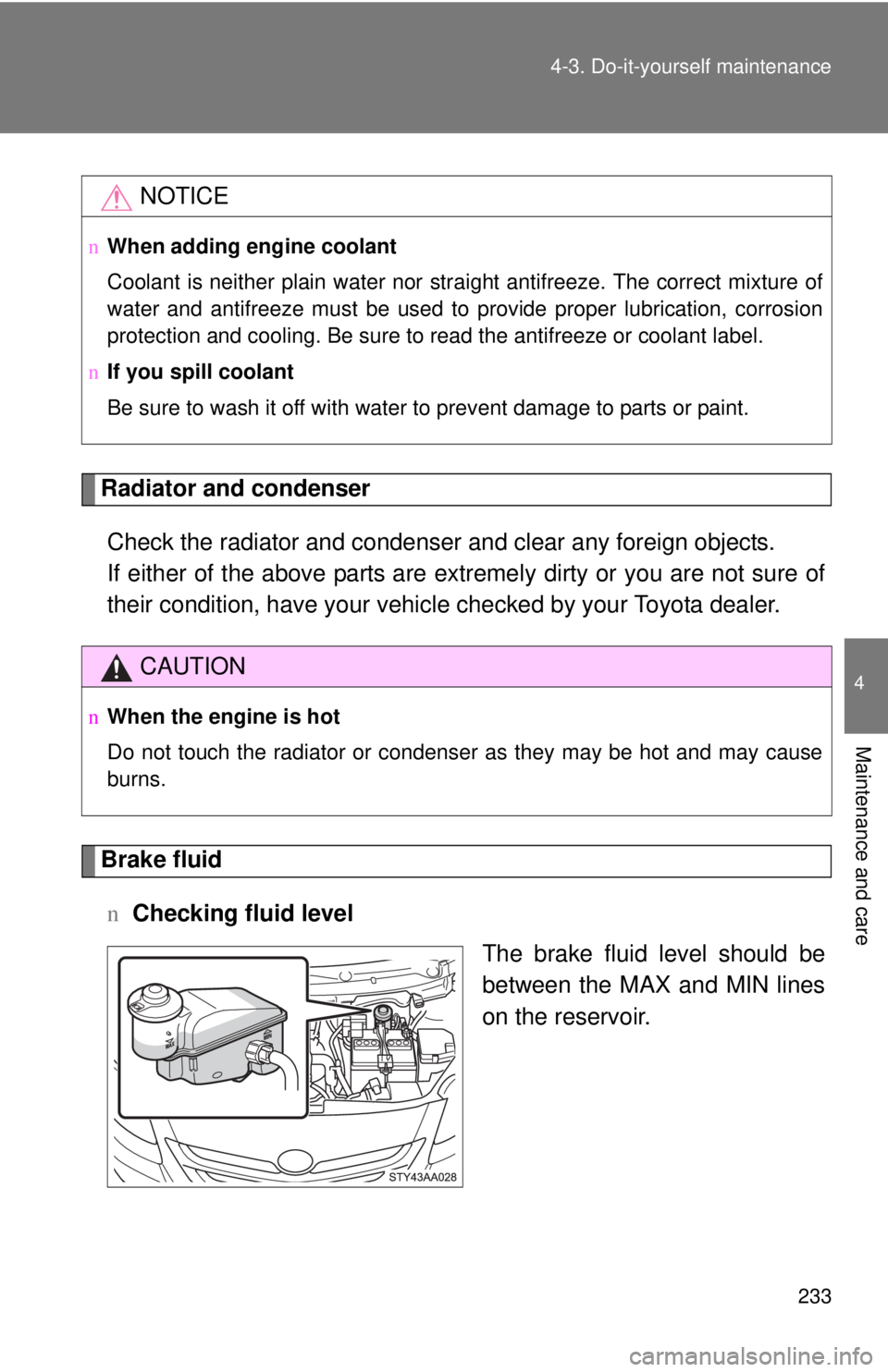
Brake fluid
n Checking fluid level
The brake fluid level should be
between the MAX and MIN lines
on the reservoir.
NOTICE
nWhen adding engine coolant
Coolant is neither plain water nor stra ight antifreeze. The correct mixture of
water and antifreeze must be used to provide proper lubrication, corrosion
protection and cooling. Be sure to read the antifreeze or coolant label.
n If you spill coolant
Be sure to wash it off with water to prevent damage to parts or paint.
CAUTION
nWhen the engine is hot
Do not touch the radiator or condenser as they may be hot and may cause
burns.
Page 276 of 384
263
4-3. Do-it-yourself maintenance
4
Maintenance and care
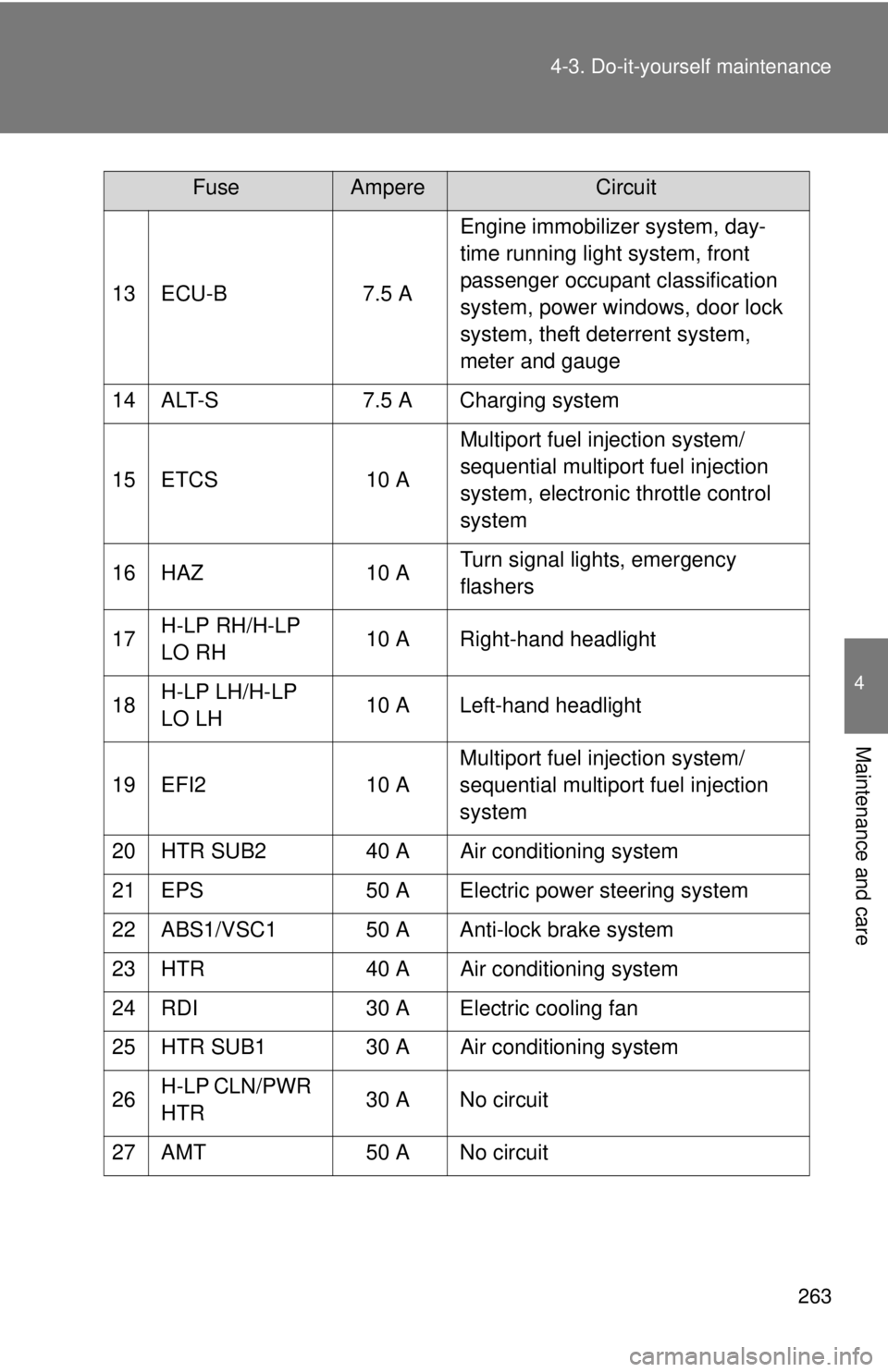
13 ECU-B
7.5 AEngine immobilizer system, day-
time running light system, front
passenger occupant classification
system, power windows, door lock
system, theft deterrent system,
meter and gauge
14 ALT-S 7.5 A Charging system
15 ETCS 10 AMultiport fuel injection system/
sequential multiport fuel injection
system, electronic throttle control
system
16 HAZ 10 ATurn signal lights, emergency
flashers
17 H-LP RH/H-LP
LO RH 10 A Right-hand headlight
18 H-LP LH/H-LP
LO LH 10 A Left-hand headlight
19 EFI2 10 AMultiport fuel injection system/
sequential multiport fuel injection
system
20 HTR SUB2 40 A Air conditioning system
21 EPS 50 A Electric power steering system
22 ABS1/VSC1 50 A Anti-lock brake system
23 HTR 40 A Air conditioning system
24 RDI 30 A Electric cooling fan
25 HTR SUB1 30 A Air conditioning system
26 H-LP CLN/PWR
HTR 30 A No circuit
27 AMT 50 A No circuit
FuseAmpereCircuit
Page 279 of 384
266 4-3. Do-it-yourself maintenance
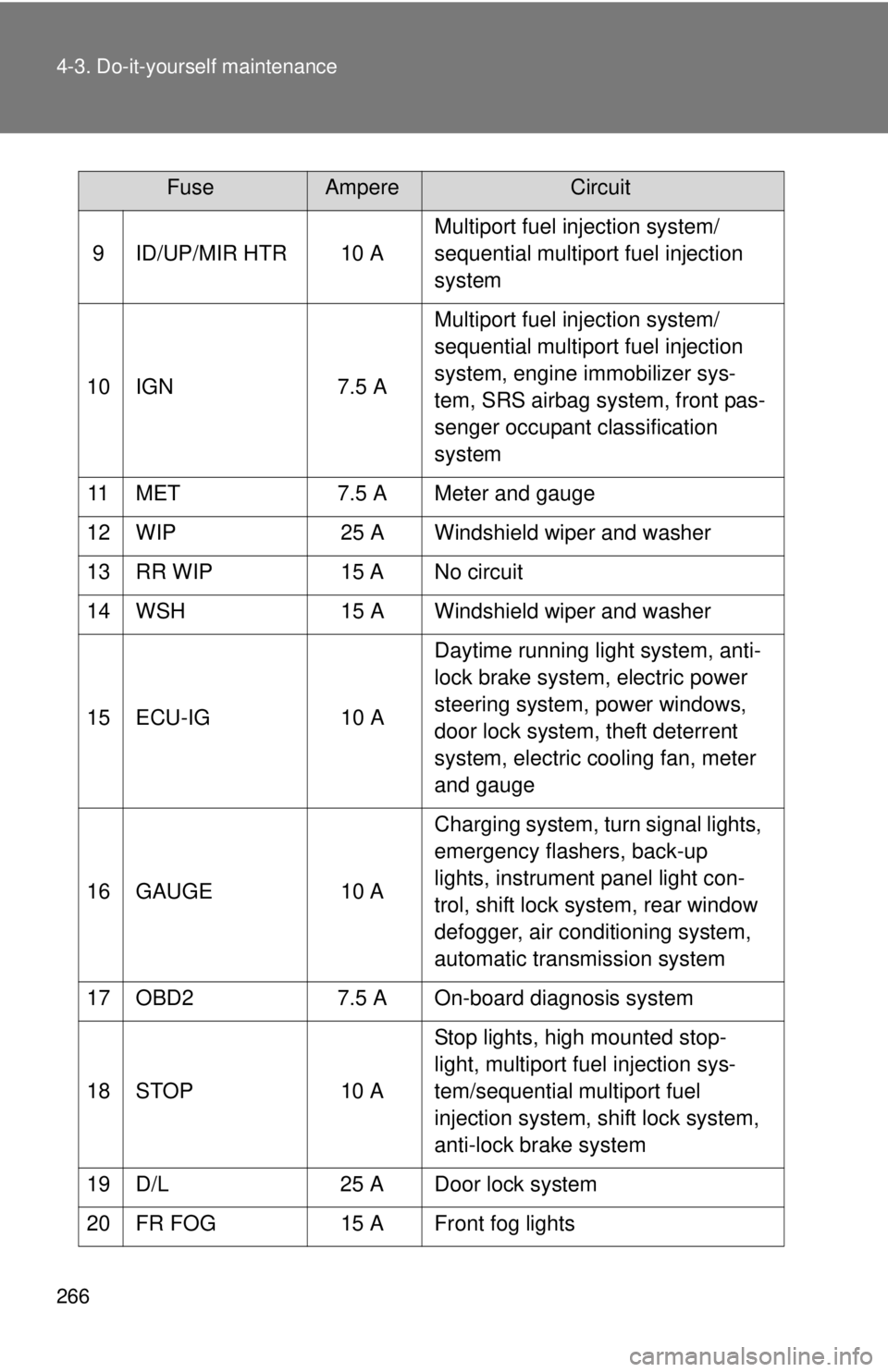
9 ID/UP/MIR HTR 10 AMultiport fuel injection system/
sequential multiport fuel injection
system
10 IGN 7.5 A Multiport fuel injection system/
sequential multiport fuel injection
system, engine immobilizer sys-
tem, SRS airbag system, front pas-
senger occupant classification
system
11 MET 7.5 A Meter and gauge
12 WIP 25 A Windshield wiper and washer
13 RR WIP 15 A No circuit
14 WSH 15 A Windshield wiper and washer
15 ECU-IG 10 A Daytime running light system, anti-
lock brake system, electric power
steering system, power windows,
door lock system, theft deterrent
system, electric cooling fan, meter
and gauge
16 GAUGE 10 A Charging system, turn signal lights,
emergency flashers, back-up
lights, instrument panel light con-
trol, shift lock system, rear window
defogger, air conditioning system,
automatic transmission system
17 OBD2 7.5 A On-board diagnosis system
18 STOP 10 A Stop lights, high mounted stop-
light, multiport fuel injection sys-
tem/sequential multiport fuel
injection system, shift lock system,
anti-lock brake system
19 D/L 25 A Door lock system
20 FR FOG 15 A Front fog lights
FuseAmpereCircuit
Page 332 of 384
320
5-2. Steps to take in an emergency
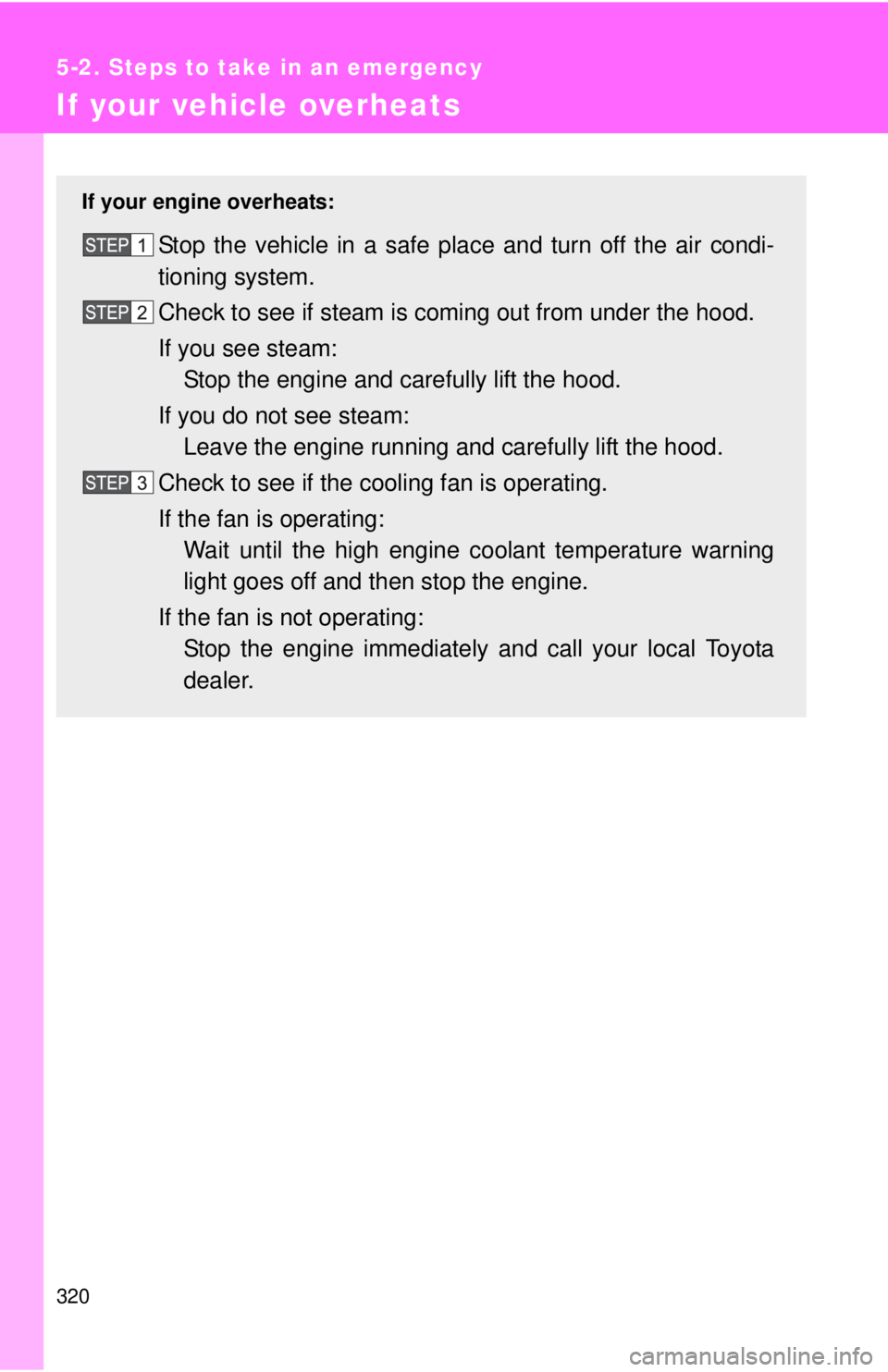
If your vehicle overheats
If your engine overheats:
Stop the vehicle in a safe place and turn off the air condi-
tioning system.
Check to see if steam is coming out from under the hood.
If you see steam: Stop the engine and carefully lift the hood.
If you do not see steam: Leave the engine running and carefully lift the hood.
Check to see if the cooling fan is operating.
If the fan is operating: Wait until the high engine coolant temperature warning
light goes off and then stop the engine.
If the fan is not operating: Stop the engine immediately and call your local Toyota
dealer.
Page 341 of 384
330 6-1. Specifications
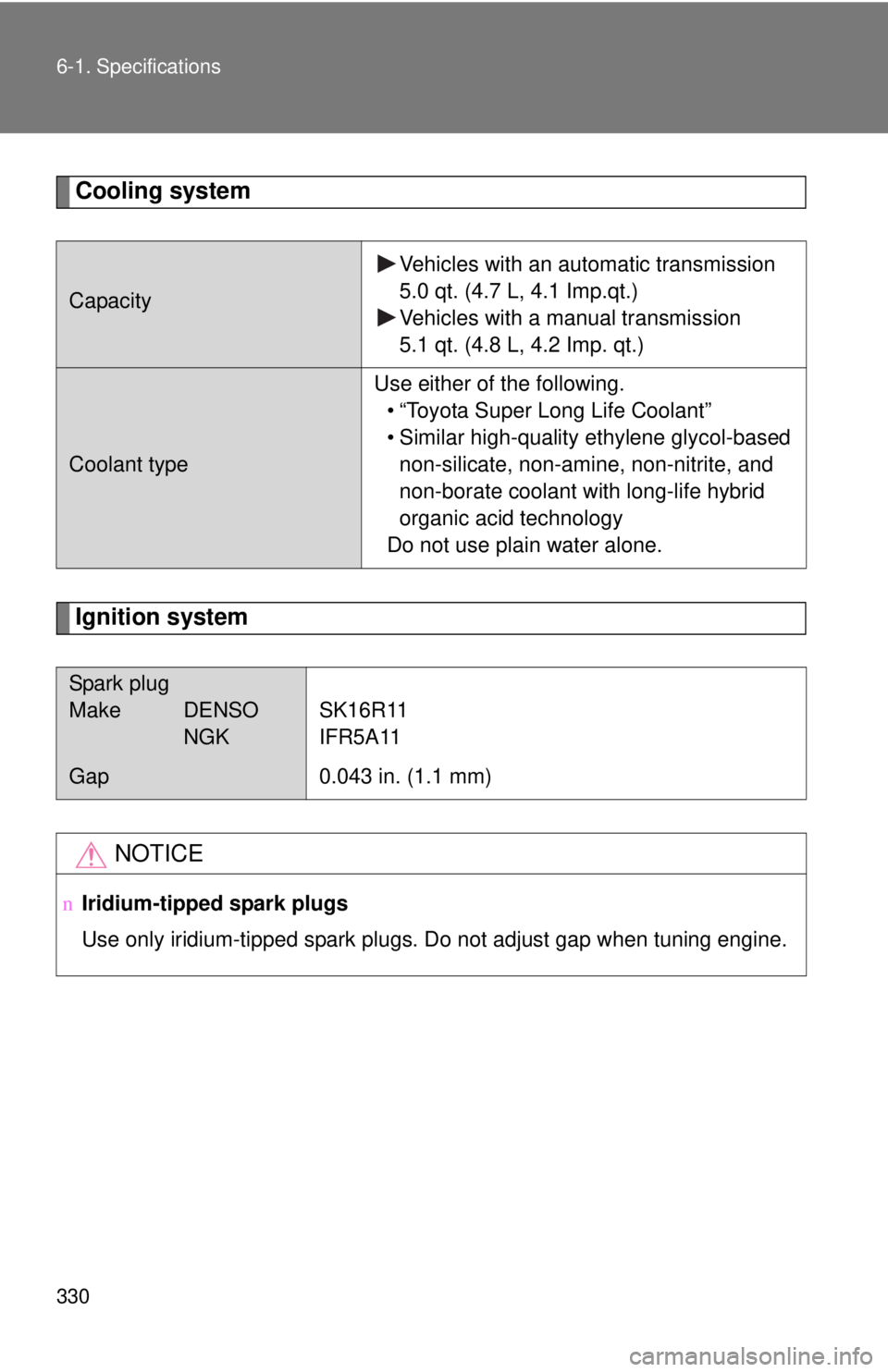
Cooling system
Ignition system
CapacityVehicles with an automatic transmission
5.0 qt. (4.7 L, 4.1 Imp.qt.)
Vehicles with a manual transmission
5.1 qt. (4.8 L, 4.2 Imp. qt.)
Coolant typeUse either of the following.
• “Toyota Super Long Life Coolant”
• Similar high-quality ethylene glycol-based non-silicate, non-amine, non-nitrite, and
non-borate coolant with long-life hybrid
organic acid technology
Do not use plain water alone.
Spark plug
Make DENSO NGK SK16R11
IFR5A11
Gap
0.043 in. (1.1 mm)
NOTICE
nIridium-tipped spark plugs
Use only iridium-tipped spark plugs. Do not adjust gap when tuning engine.