engine TOYOTA YARIS SEDAN 2009 User Guide
[x] Cancel search | Manufacturer: TOYOTA, Model Year: 2009, Model line: YARIS SEDAN, Model: TOYOTA YARIS SEDAN 2009Pages: 388, PDF Size: 6.89 MB
Page 45 of 388
29
1-2. Opening, closing and locking the doors
1
Before driving
Locking the front doors from the outside without a key
Move the inside door lock button to the lock position.
Close the door.
Vehicles with power door lock
The door cannot be locked if the driver’s door is open and the key
is in the engine switch.
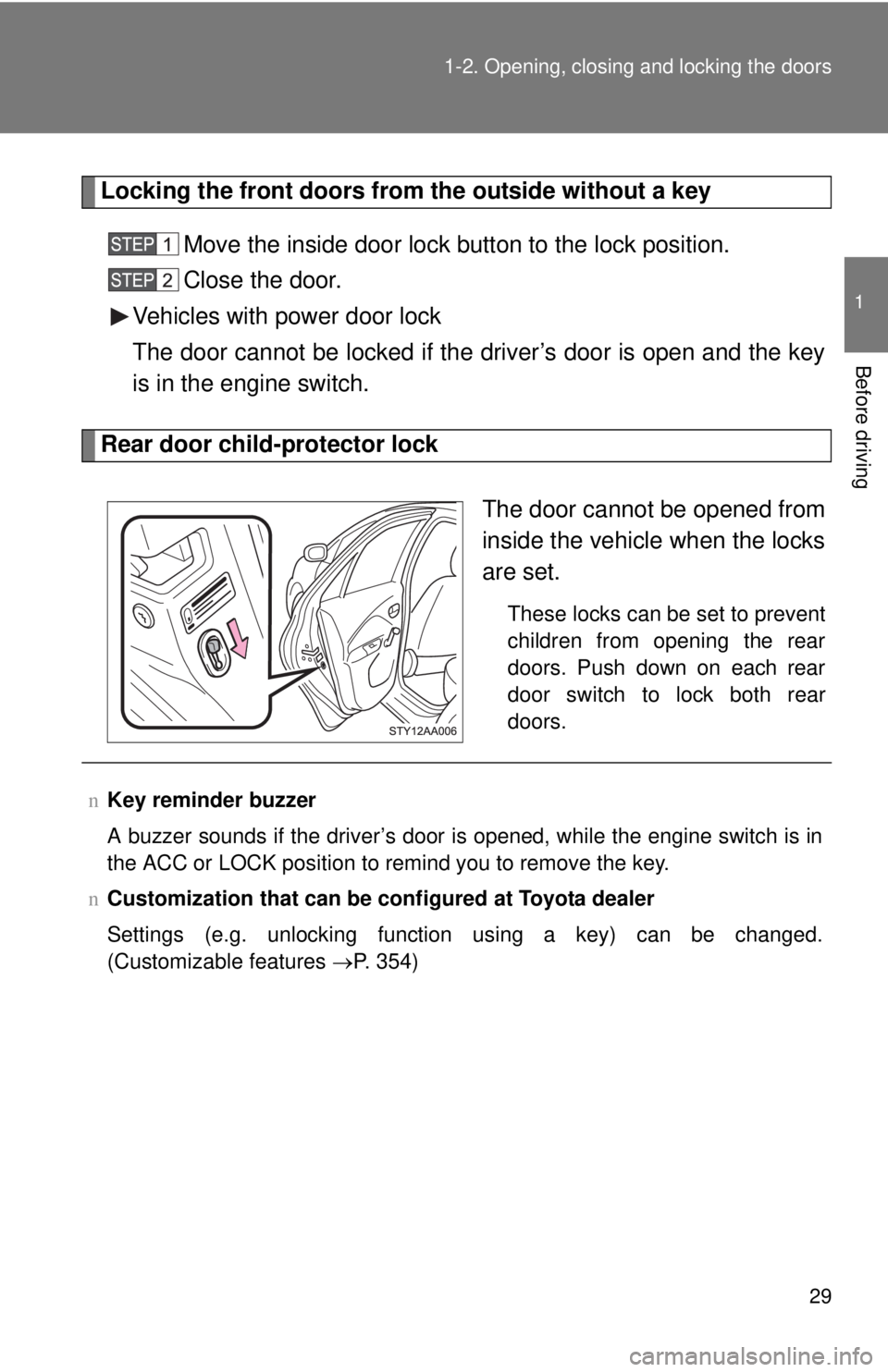
Rear door child-protector lock
The door cannot be opened from
inside the vehicle when the locks
are set.
These locks can be set to prevent
children from opening the rear
doors. Push down on each rear
door switch to lock both rear
doors.
nKey reminder buzzer
A buzzer sounds if the driver’s door is opened, while the engine switch is in
the ACC or LOCK position to remind you to remove the key.
n Customization that can be co nfigured at Toyota dealer
Settings (e.g. unlocking function using a key) can be changed.
(Customizable features →P. 354)
Page 66 of 388
50 1-3. Adjustable components (seats, mirrors, steering wheel)
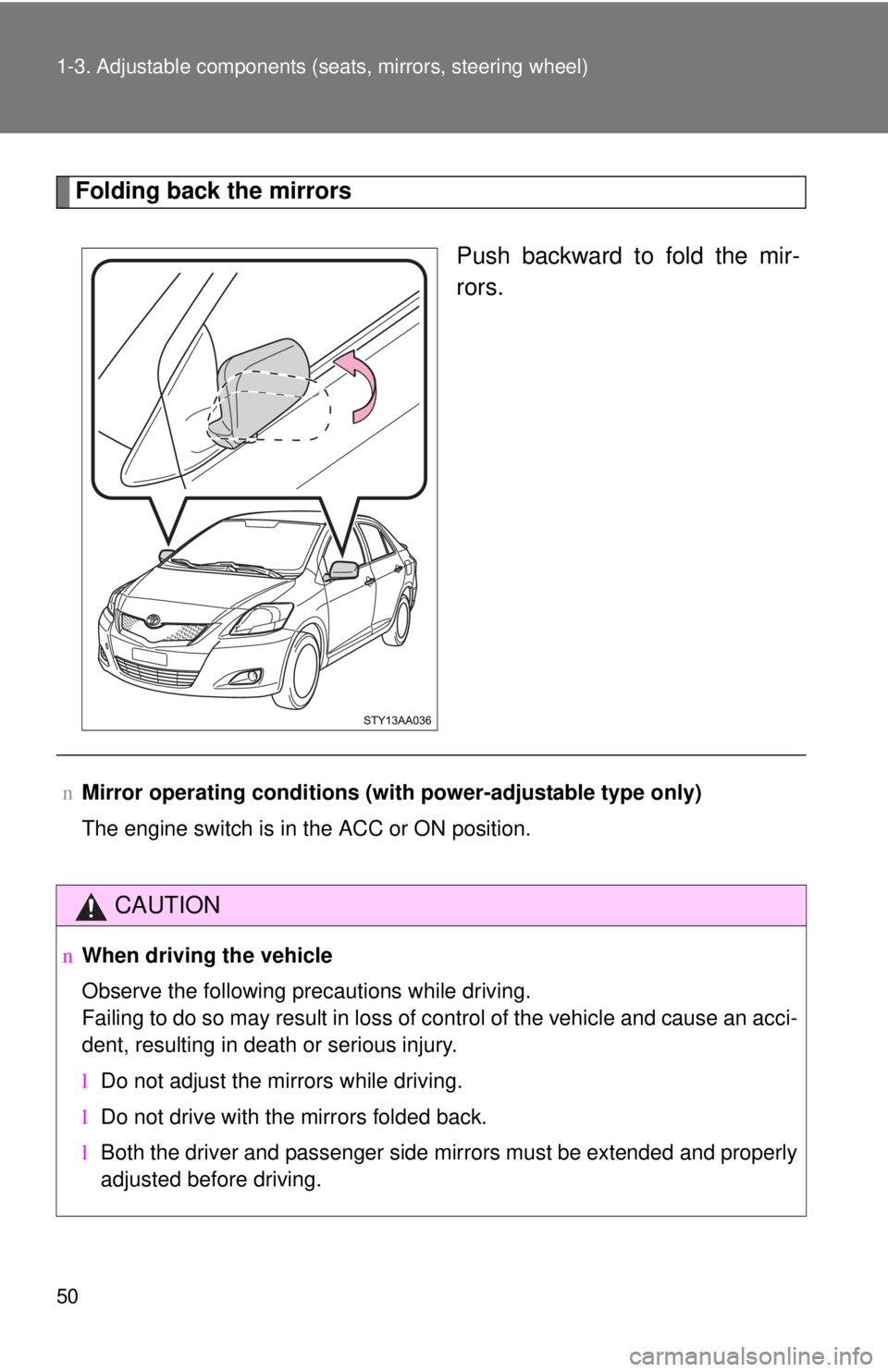
Folding back the mirrors
Push backward to fold the mir-
rors.
nMirror operating conditions (with power-adjustable type only)
The engine switch is in the ACC or ON position.
CAUTION
nWhen driving the vehicle
Observe the following precautions while driving.
Failing to do so may result in loss of control of the vehicle and cause an acci-
dent, resulting in death or serious injury.
lDo not adjust the mirrors while driving.
l Do not drive with the mirrors folded back.
l Both the driver and passenger side mirrors must be extended and properly
adjusted before driving.
Page 69 of 388
53
1-4. Opening and closing the windows
1
Before driving
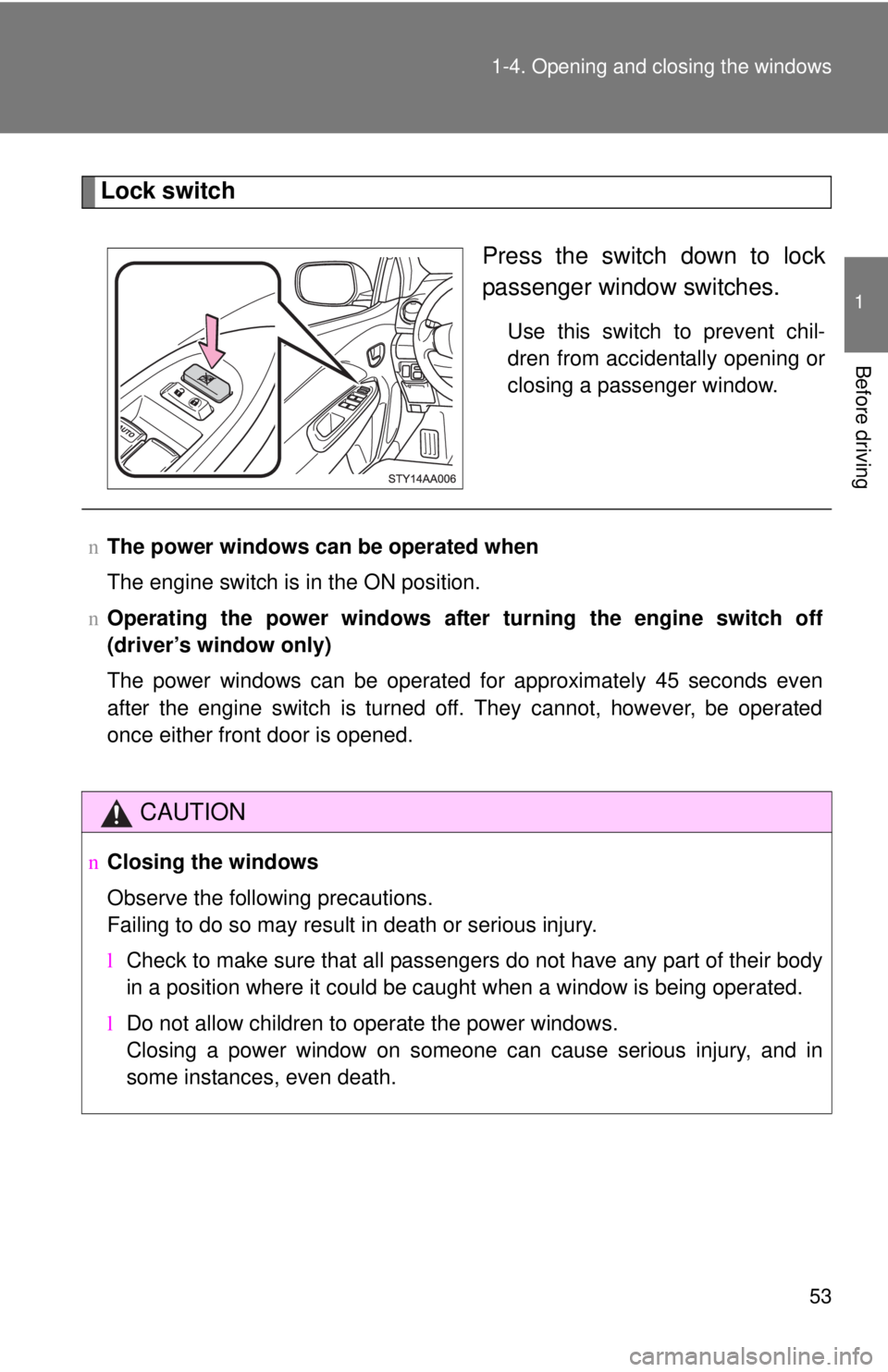
Lock switch
Press the switch down to lock
passenger window switches.
Use this switch to prevent chil-
dren from accidentally opening or
closing a passenger window.
nThe power windows can be operated when
The engine switch is in the ON position.
n Operating the power windows after turning the engine switch off
(driver’s window only)
The power windows can be operated for approximately 45 seconds even
after the engine switch is turned off. They cannot, however, be operated
once either front door is opened.
CAUTION
n Closing the windows
Observe the following precautions.
Failing to do so may result in death or serious injury.
lCheck to make sure that all passengers do not have any part of their body
in a position where it could be caught when a window is being operated.
l Do not allow children to operate the power windows.
Closing a power window on someone can cause serious injury, and in
some instances, even death.
Page 70 of 388
54
1-5. Refueling
Opening the fuel tank cap
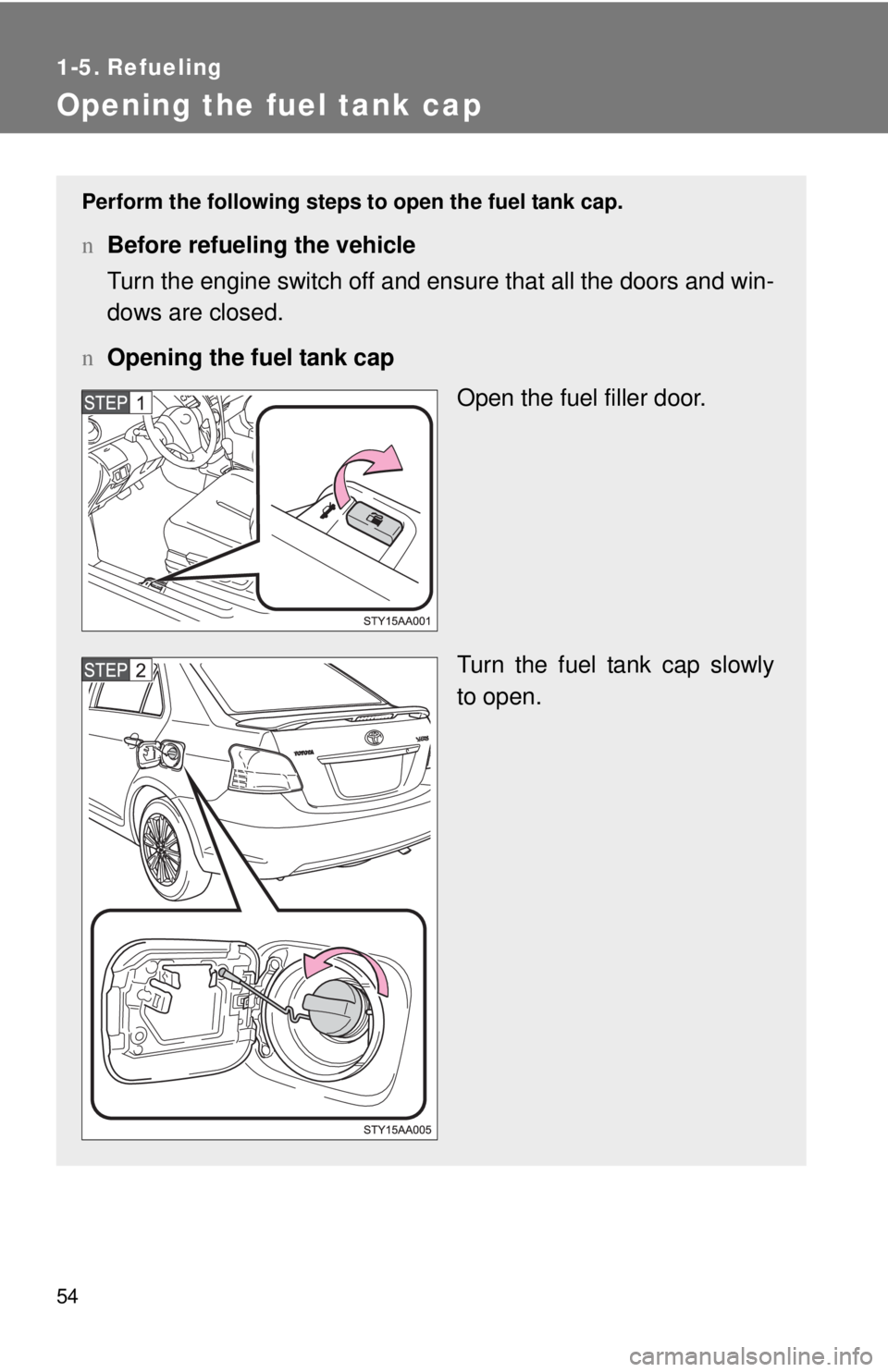
Perform the following steps to open the fuel tank cap.
nBefore refueling the vehicle
Turn the engine switch off and ensure that all the doors and win-
dows are closed.
n Opening the fuel tank cap
Open the fuel filler door.
Turn the fuel tank cap slowly
to open.
Page 74 of 388
58
1-6. Theft deterrent system
Engine immobilizer system (if equipped)
nSystem maintenance
The vehicle has a maintenance-free type of engine immobilizer system.
n Conditions that may cause the system to malfunction
lIf the key is in contact with a metallic object
l If the key is in close proximity to or touching a key to the security system
(key with a built-in transponder chip) of another vehicle
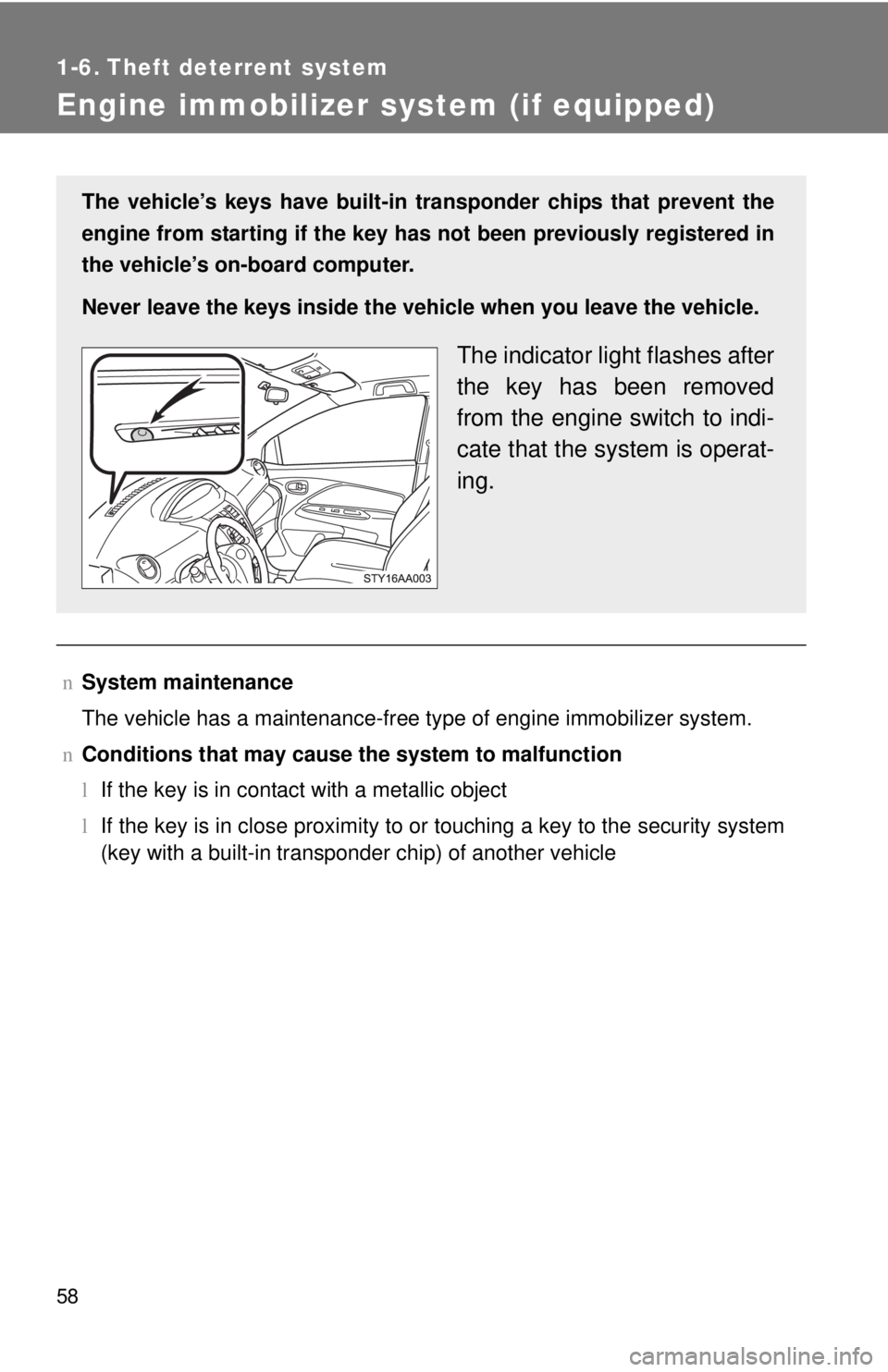
The vehicle’s keys have built-in tr ansponder chips that prevent the
engine from starting if the key has not been previously registered in
the vehicle’s on-board computer.
Never leave the keys inside the vehicle when you leave the vehicle.
The indicator light flashes after
the key has been removed
from the engine switch to indi-
cate that the system is operat-
ing.
Page 75 of 388
59
1-6. Theft deterrent system
1
Before driving
n
Certifications for the engine immobilizer system
For vehicles sold in U.S.A.
FCC ID: MOZRI-20BTY
This device complies with Part 15 of the FCC Rules. Operation is subject to
the following two conditions: (1) this device may not cause harmful interfer-
ence, and (2) this device must accept any interference received, including
interference that may cause undesired operation.
FCC WARNING:
Changes or modifications not expressly approved by the party responsible
for compliance could void the user’s authority to operate the equipment. For vehicles sold in Canada
This device complies with RSS-210 of Industry Canada. Operation is subject
to the following two conditions: (1) this device may not cause interference,
and (2) this device must accept any interference, including interference that
may cause undesired operation of the device.
NOTICE
n To prevent damage to the key
Do not modify, remove or disassemble the engine immobilizer system. If any
unauthorized changes or modifications are made, the proper operation of
the system cannot be guaranteed.
Page 76 of 388
60
1-6. Theft deterrent system
Alarm (Puerto Rico)
The system sounds the alarm and flashes lights when forcible entry
is detected.
n Triggering of the alarm
The alarm is triggered in the following situations.
lA locked door or trunk is unlocked or opened in any way other
than using the key (vehicles without wireless remote control)
or wireless remote control d oor lock function (vehicles with
wireless remote control). (The doors will lock again automati-
cally.)
l The hood is opened while t he vehicle is locked.
l The battery is reconnected.
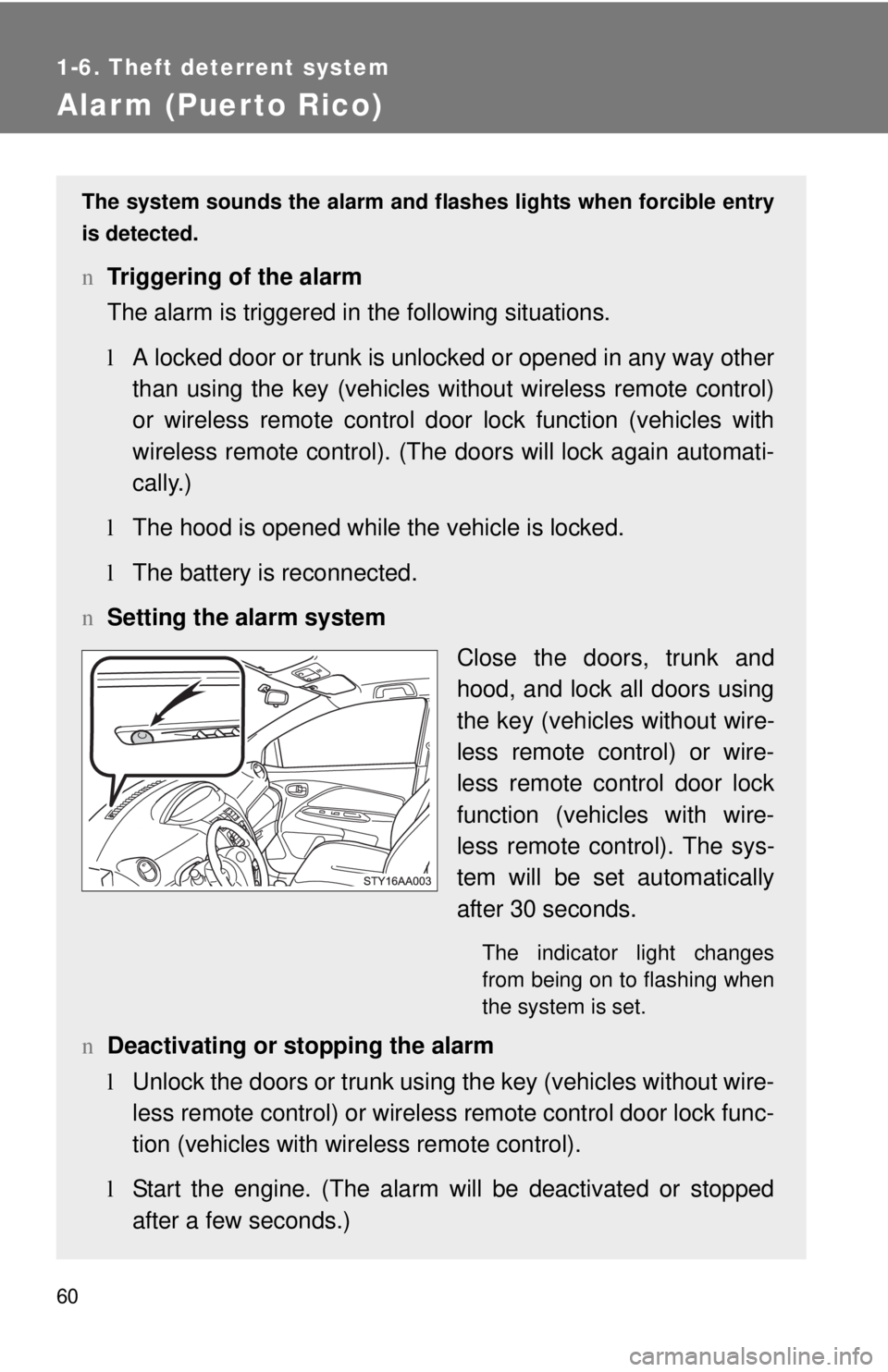
n Setting the alarm system
Close the doors, trunk and
hood, and lock all doors using
the key (vehicles without wire-
less remote control) or wire-
less remote control door lock
function (vehicles with wire-
less remote control). The sys-
tem will be set automatically
after 30 seconds.
The indicator light changes
from being on to flashing when
the system is set.
nDeactivating or stopping the alarm
lUnlock the doors or trunk using the key (vehicles without wire-
less remote control) or wireless remote control door lock func-
tion (vehicles with wireless remote control).
l Start the engine. (The alarm will be deactivated or stopped
after a few seconds.)
Page 111 of 388
96
2-1. Driving procedures
Driving the vehicle
The following procedures should be observed to ensure safe driv-
ing.
n Starting the engine ( → P. 106)
n Driving
Automatic transmission
With the brake pedal depressed, shift the shift lever to D. (→ P. 110)
Release the parking brake. ( →P. 114)
Gradually release the brake pedal and gently depress the
accelerator pedal to accelerate the vehicle.
Manual transmission With the clutch pedal fully depressed, shift the shift lever to
1. (→ P. 112)
Release the parking brake. ( →P. 114)
Gradually release the clutch pedal. At the same time, gently
depress the accelerator pedal to accelerate the vehicle.
n Stopping
Automatic transmission
With the shift lever in D, depress the brake pedal.
If necessary, set the parking brake.
When the vehicle is stopped for an extended period of time, shift
the shift lever to P or N. ( →P. 110)
Manual transmission
With the clutch pedal fully depressed, depress the brake
pedal.
If necessary, set the parking brake.
When the vehicle is stopped for an extended period of time, shift
the shift lever to N. ( →P. 112)
Page 112 of 388
97
2-1. Driving procedures
2
When driving
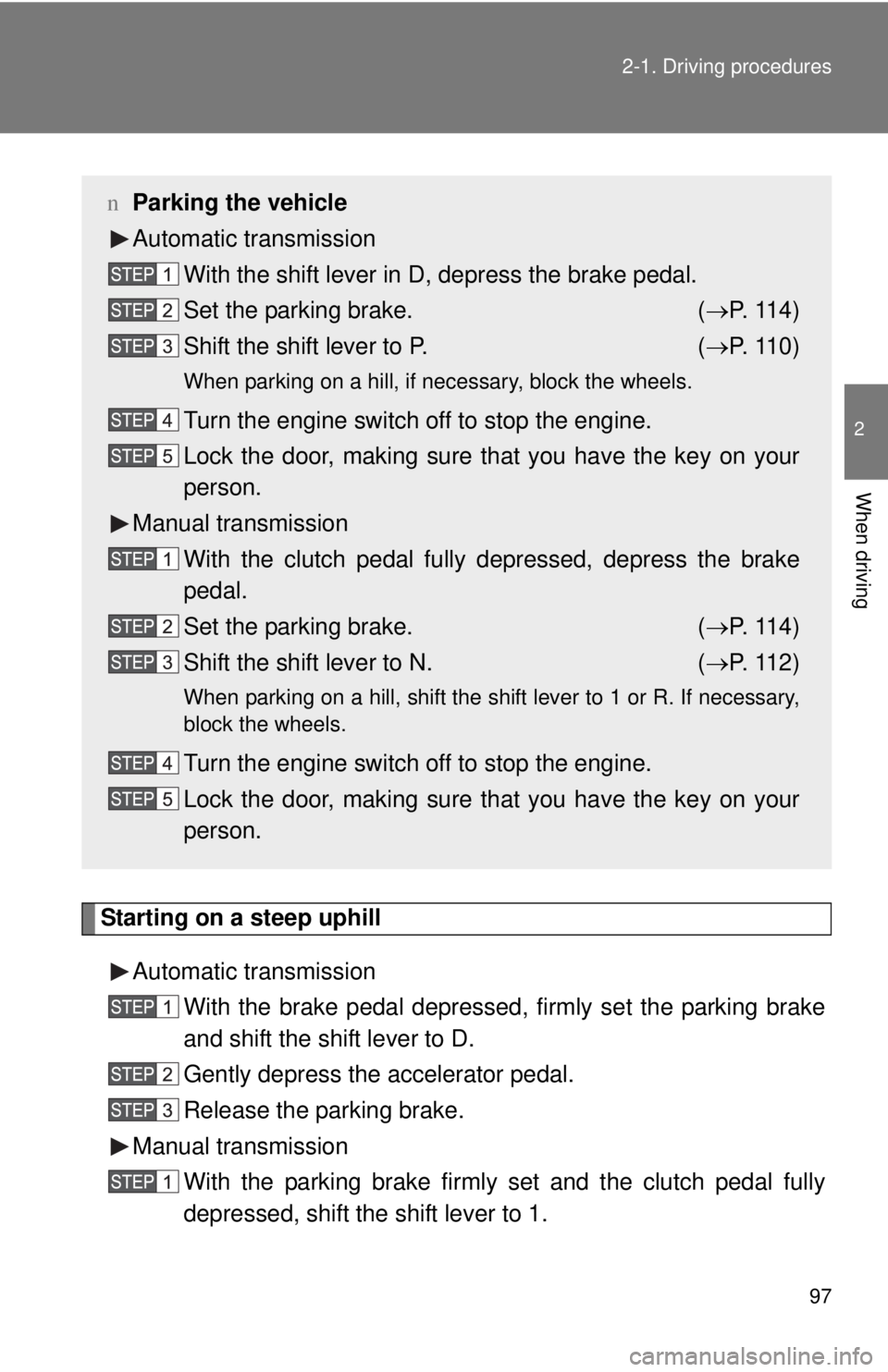
Starting on a steep uphill
Automatic transmission With the brake pedal depressed, firmly set the parking brake
and shift the shift lever to D.
Gently depress the accelerator pedal.
Release the parking brake.
Manual transmission With the parking brake firmly set and the clutch pedal fully
depressed, shift the shift lever to 1.
nParking the vehicle
Automatic transmission
With the shift lever in D, depress the brake pedal.
Set the parking brake. ( →P. 114)
Shift the shift lever to P. ( →P. 110)
When parking on a hill, if necessary, block the wheels.
Turn the engine switch off to stop the engine.
Lock the door, making sure that you have the key on your
person.
Manual transmission
With the clutch pedal fully depressed, depress the brake
pedal.
Set the parking brake. ( →P. 114)
Shift the shift lever to N. ( →P. 112)
When parking on a hill, shift the shift lever to 1 or R. If necessary,
block the wheels.
Turn the engine switch off to stop the engine.
Lock the door, making sure that you have the key on your
person.
Page 113 of 388
98 2-1. Driving procedures
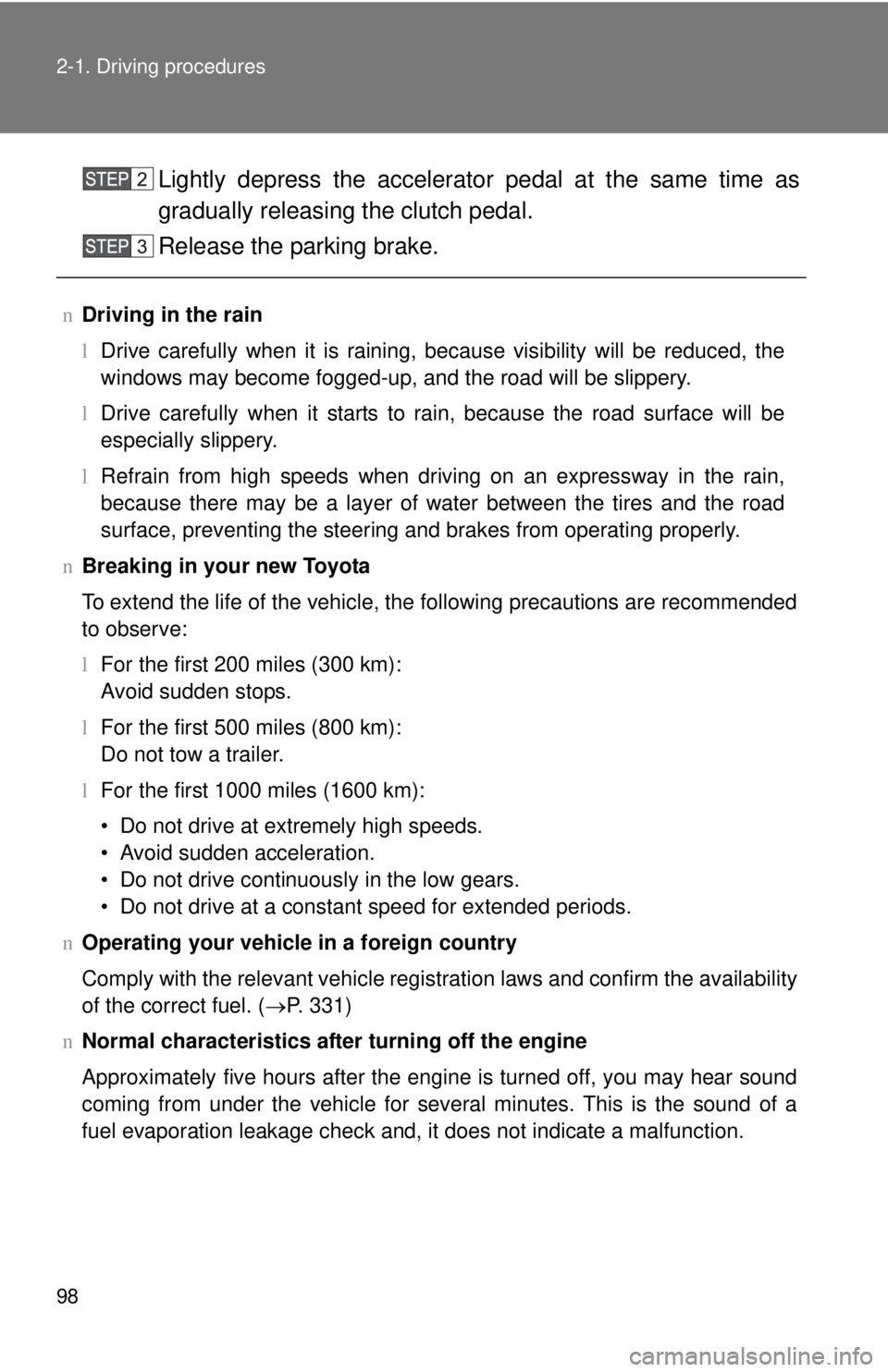
Lightly depress the accelerator pedal at the same time as
gradually releasing the clutch pedal.
Release the parking brake.
nDriving in the rain
lDrive carefully when it is raining, because visibility will be reduced, the
windows may become fogged-up, and the road will be slippery.
l Drive carefully when it starts to rain, because the road surface will be
especially slippery.
l Refrain from high speeds when driving on an expressway in the rain,
because there may be a layer of water between the tires and the road
surface, preventing the steering and brakes from operating properly.
n Breaking in your new Toyota
To extend the life of the vehicle, the following precautions are recommended
to observe:
lFor the first 200 miles (300 km):
Avoid sudden stops.
l For the first 500 miles (800 km):
Do not tow a trailer.
l For the first 1000 miles (1600 km):
• Do not drive at extremely high speeds.
• Avoid sudden acceleration.
• Do not drive continuously in the low gears.
• Do not drive at a constant speed for extended periods.
n Operating your vehicle in a foreign country
Comply with the relevant vehicle registration laws and confirm the availability
of the correct fuel. ( →P. 331)
n Normal characteristics afte r turning off the engine
Approximately five hours after the engine is turned off, you may hear sound
coming from under the vehicle for several minutes. This is the sound of a
fuel evaporation leakage check and, it does not indicate a malfunction.