warning TOYOTA YARIS SEDAN 2010 User Guide
[x] Cancel search | Manufacturer: TOYOTA, Model Year: 2010, Model line: YARIS SEDAN, Model: TOYOTA YARIS SEDAN 2010Pages: 386, PDF Size: 6.95 MB
Page 85 of 386

71
1-7. Safety information
1
Before driving
Your vehicle is equipped with
ADVANCED AIRBAGS designed based
on US motor vehicle safety standards (FMVSS208). The airbag sys-
tem controls airbag deployment po wer for the driver and front pas-
senger. The driver airbag system consists of the driver seat’s position
sensor etc. The front passenger’s airbag system consists of the front
passenger occupant classification sensor etc.
The main SRS airbag system components are shown above. The
SRS airbag system is controlled by the airbag sensor assembly. The
airbag sensor assembly consists of a safing sensor and an airbag
sensor.
In certain types of severe frontal or side impacts, the SRS airbag sys-
tem triggers the airbag inflators. A chemical reaction in the inflators
quickly fills the airbags with non-toxic gas to help rest rain the motion
of the occupants.
n SRS warning light
This warning light system monitors the airbag sensor assembly, front airbag
sensors, side and curtain shield airbag sensors, curtain shield airbag sen-
sors, driver’s seat position sensor, driver’s seat belt buckle switch, front pas-
senger occupant classification system, AIR BAG ON indicator light, AIR
BAG OFF indicator light, front passenger’s seat belt buckle switch, seat belt
pretensioner assemblies, inflators, interconnecting wiring and power
sources. ( →P. 298)
n If the SRS airbags deploy (inflate)
lBruising and slight abrasions may result from contact with a deploying
(inflating) SRS airbag.
l A loud noise and white powder will be emitted.
l Vehicles with side and curtain shield airbags: Parts of the airbag module
(steering wheel hub, airbag cover and inflator) as well as the front seats,
and parts of the front and rear pillars and roof side rail, may be hot for
several minutes. The airbag itself may also be hot.
l Vehicles without side and curtain shield airbags: Parts of the airbag mod-
ule (steering wheel hub, airbag cover and inflator) as well as the front
seats may be hot for several minutes. The airbag itself may also be hot.
Page 95 of 386
81
1
1-7. Safety information
Before driving
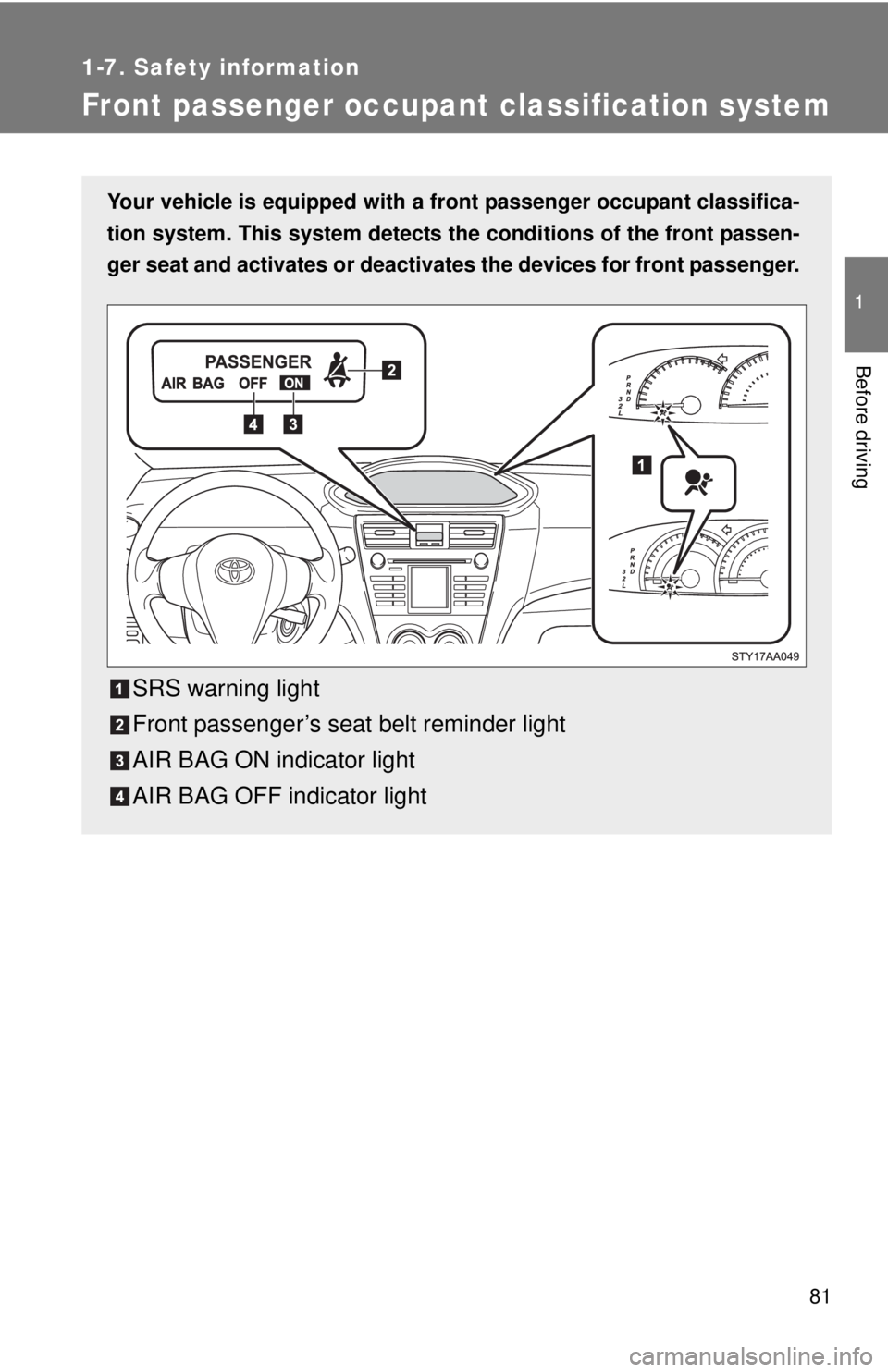
Front passenger occupant classification system
Your vehicle is equipped with a front passenger occupant classifica-
tion system. This system detects the conditions of the front passen-
ger seat and activates or deactivates the devices for front passenger.
SRS warning light
Front passenger’s seat belt reminder light
AIR BAG ON indicator light
AIR BAG OFF indicator light
Page 96 of 386

82 1-7. Safety information
Condition and operation in the front passenger occupant classification system
nAdult*1
nChild*3 or child restraint system*4
nUnoccupied
Indicator/
warning light AIR BAG ON and AIR BAG OFF indicator
lights AIR BAG ON
SRS warning light Off
Front passenger’s seat belt reminder light Flashing
*2
DevicesFront passenger airbag
Activated
Side airbag on the front passenger seat
Curtain shield airbag in the front passenger side
Front passenger’s seat belt pretensioner
Indicator/
warning light AIR BAG ON and AIR BAG OFF indicator
lights AIR BAG
OFF
*5
SRS warning light Off
Front passenger’s seat belt reminder light Flashing
*2
DevicesFront passenger airbag
Deactivated
Side airbag on the front passenger seat
Activated
Curtain shield airbag in the front passenger
side
Front passenger’s seat belt pretensioner
Indicator/
warning light AIR BAG ON and AIR BAG OFF indicator
lights
Not illuminated
SRS warning light Off
Front passenger’s seat belt reminder light
Devices Front passenger airbag Deactivated
Side airbag on the front passenger seat Activated
Curtain shield airbag in the front passenger
side
Front passenger’s seat belt pretensioner Deactivated
Page 97 of 386

83
1-7. Safety information
1
Before driving
n
There is a malfunction in the system
*1:The system judges a person of adult size as an adult. When a
smaller adult sits in the front pa ssenger seat, the system may rec-
ognize him/her as a child dependi ng on his/her physique and pos-
ture.
*2:In the event the front passenge r does not wear a seat belt.
*3:When a larger child who has outgrown a child restraint system sits
in the front passenger seat, the system may recognize him/her as
an adult depending on his/her physique or posture.
*4:Never install a rear-facing child restraint system on the front pas-
senger seat. A forward-facing child restraint system should only be
installed on the front passenger seat when it is unavoidable. ( →P.
86)
*5:In case the indicator is not illum inated, consult this manual as for
installing the child restraint system properly. ( →P. 9 0 )
Indicator/
warning light AIR BAG ON and AIR BAG OFF indicator
lights AIR BAG
OFF
SRS warning light On
Front passenger’s seat belt reminder light Off
Devices Front passenger airbag
Deactivated
Side airbag on the front passenger seat
Activated
Curtain shield airbag in the front passenger
side
Front passenger’s seat belt pretensioner
Page 99 of 386

85
1-7. Safety information
1
Before driving
CAUTION
n
Front passenger occupant cl assification system precautions
l If an adult sits in the front passenger seat, the AIR BAG ON indicator light
is illuminated. If the AIR BAG OFF indicator is illuminated, ask the passen-
ger to sit up straight, well back in the seat, feet on the floor, and with the
seat belt worn correctly. If the AIR BAG OFF indicator still remain illumi-
nated, either ask the passenger to move to the rear seat, or if that is not
possible, move the front passenger seat fully rearward.
l When it is unavoidable to install the forward-facing child restraint system
on the front passenger seat, install the child restraint system on the front
passenger seat in the proper order. ( →
P. 9 0)
l Do not modify or remove the front seats.
l Do not kick the front passenger seat or subject it to severe impact. Other-
wise, the SRS warning light may come on to indicate a malfunction of the
detection system. In this case, contact your Toyota dealer immediately.
l Child restraint systems installed on the rear seat should not contact the
front seatbacks.
Page 132 of 386

119
2-1. Driving procedures
2
When driving
n
Usage in winter time
See “Winter driving tips” for parking brake usage in winter time. (→P. 148)
NOTICE
nBefore driving
Fully release the parking brake.
Driving the vehicle with the parking brake set will lead to brake components
overheating, which may affect braking performance and increase brake
wear.
lParking brake engaged warning buzzer ( →P. 297)
Page 138 of 386
125
2-2. Instrument cluster
2
When driving
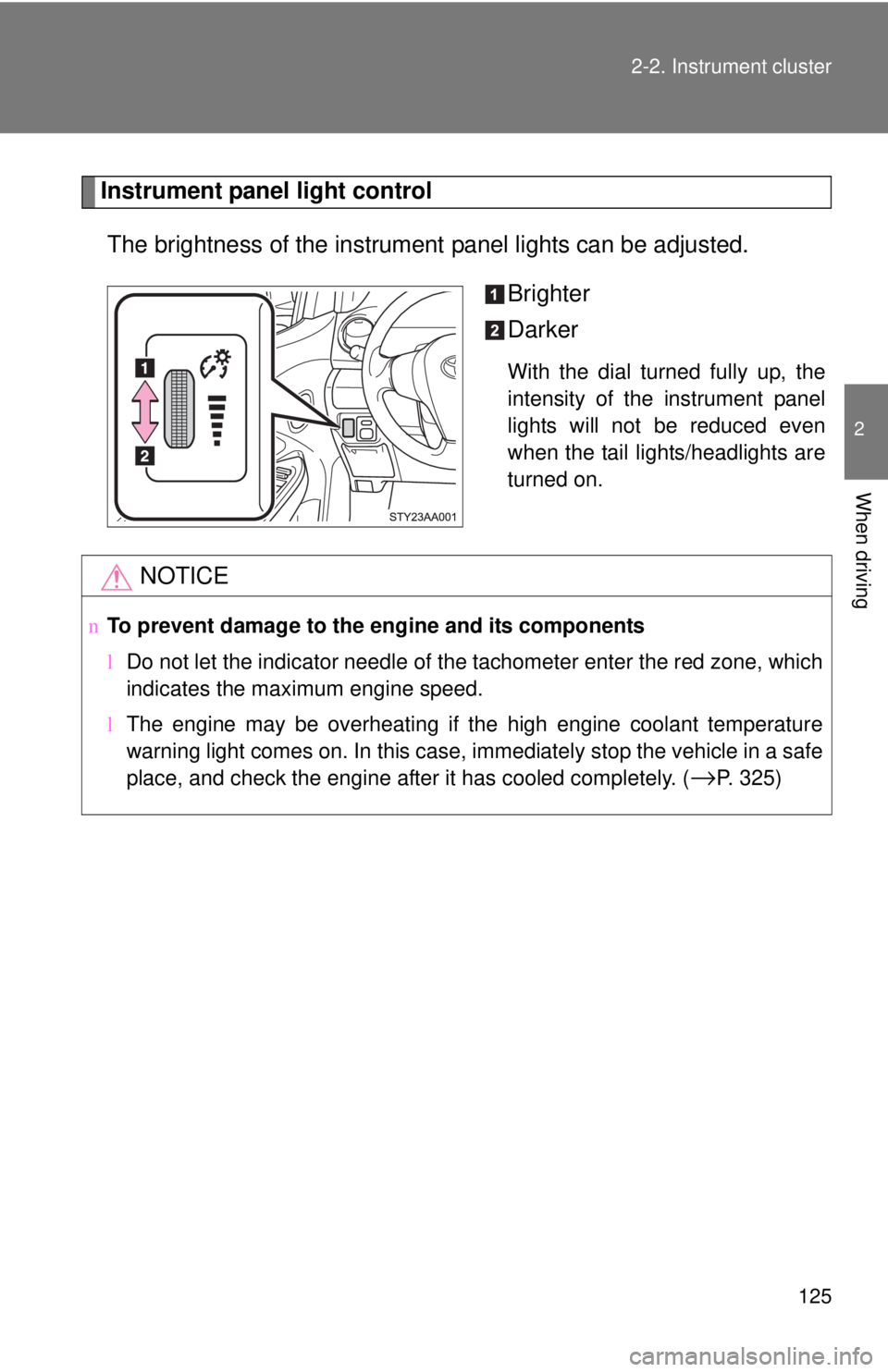
Instrument panel light control
The brightness of the instrument panel lights can be adjusted.
Brighter
Darker
With the dial turned fully up, the
intensity of the instrument panel
lights will not be reduced even
when the tail lights/headlights are
turned on.
NOTICE
nTo prevent damage to the engine and its components
lDo not let the indicator needle of the tachometer enter the red zone, which
indicates the maximum engine speed.
l The engine may be overheating if the high engine coolant temperature
warning light comes on. In this case, immediately stop the vehicle in a safe
place, and check the engine after it has cooled completely. (
→P. 325)
Page 139 of 386
126
2-2. Instrument cluster
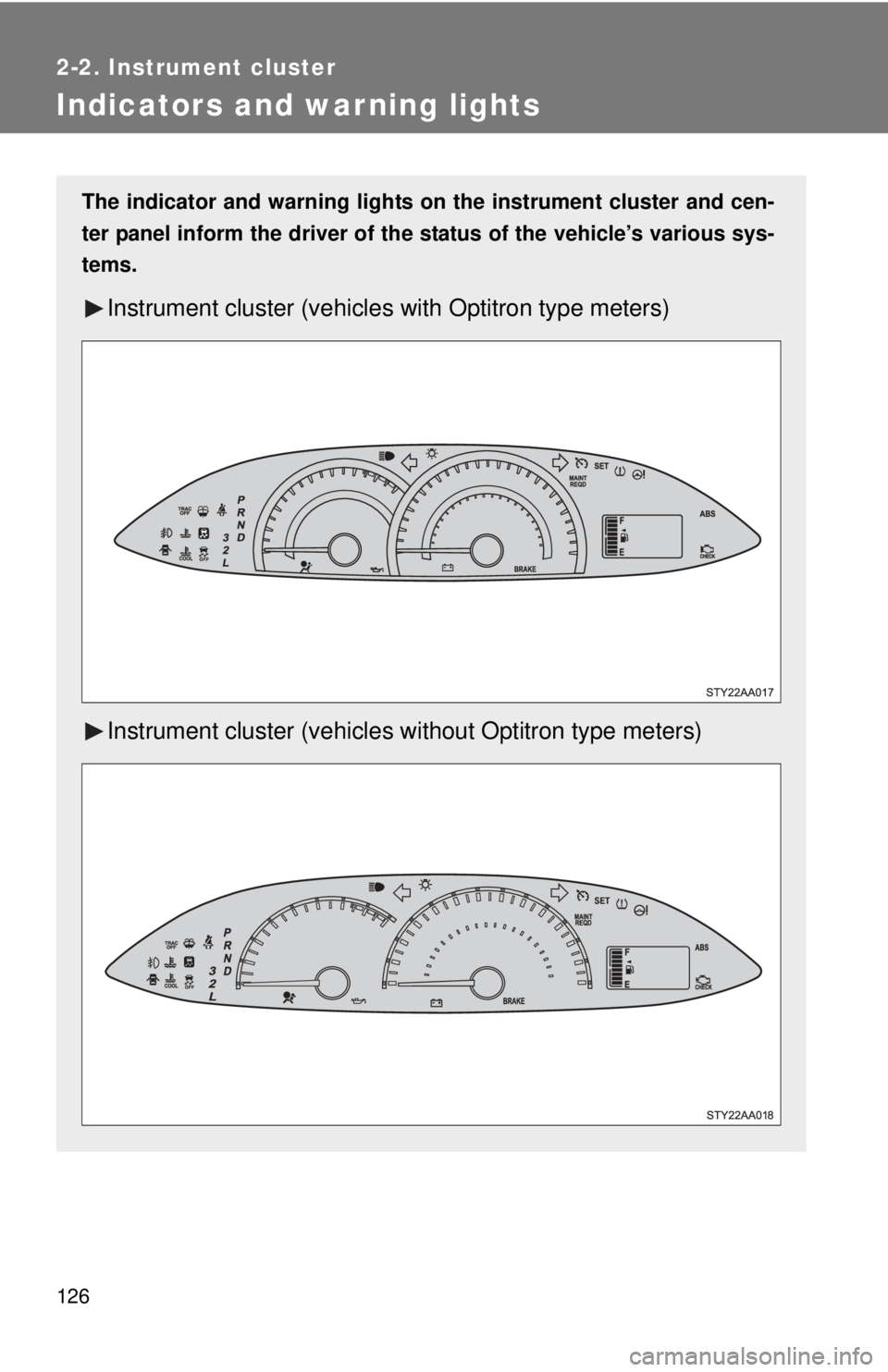
Indicators and warning lights
The indicator and warning lights on the instrument cluster and cen-
ter panel inform the driver of the status of the vehicle’s various sys-
tems.
Instrument cluster (vehicles with Optitron type meters)
Instrument cluster (vehicles without Optitron type meters)
Page 142 of 386
129
2-2. Instrument cluster
2
When driving
CAUTION
n
If a safety system warning light does not come on
Should a safety system light such as ABS and the SRS airbag warning light
not come on when you start the engine, this could mean that these systems
are not available to help protect you in an accident, which could result in
death or serious injury. Have the vehicle inspected by your Toyota dealer
immediately if this occurs.
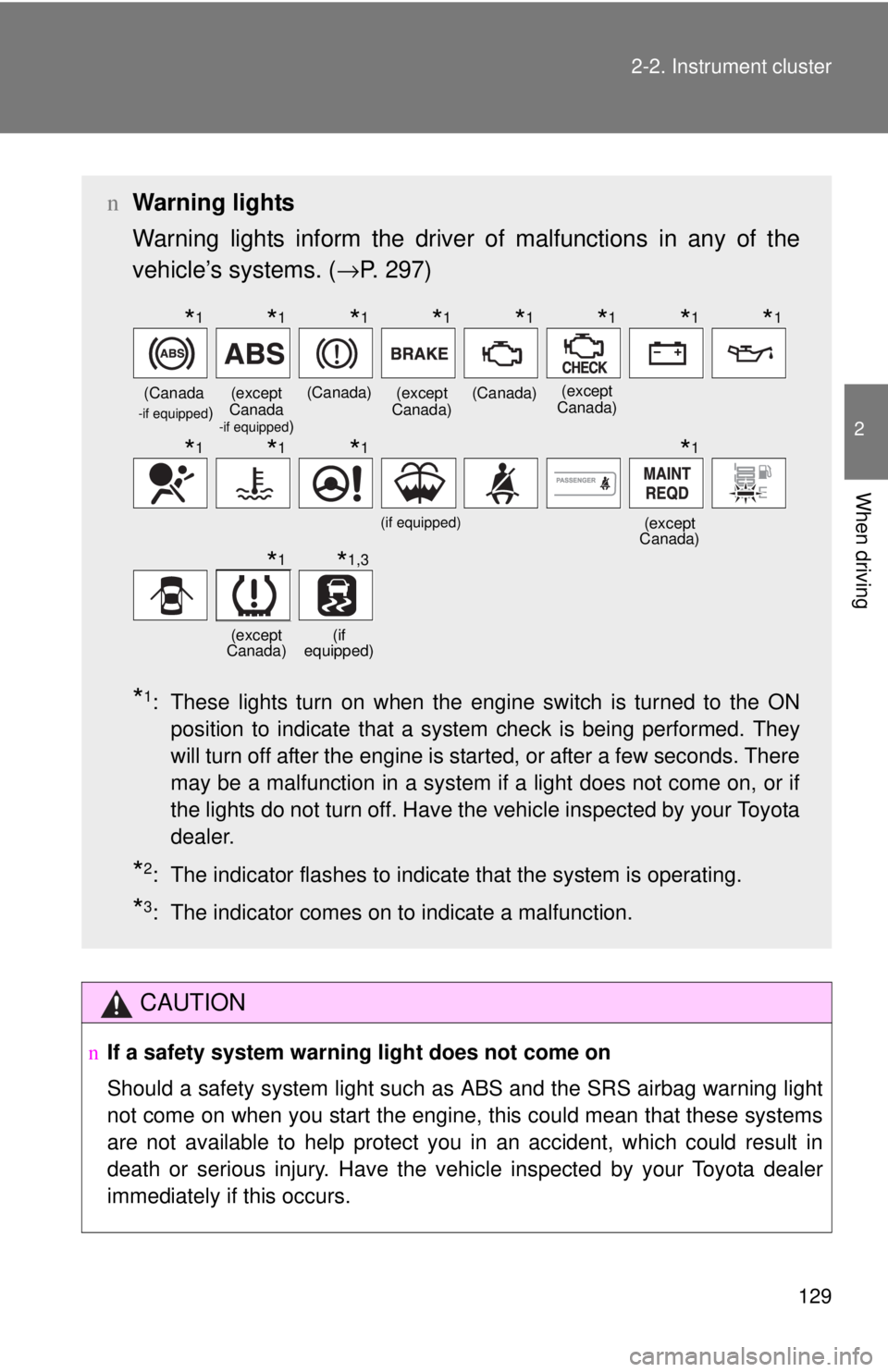
n Warning lights
Warning lights inform the driver of malfunctions in any of the
vehicle’s systems. ( →P. 297)
*1: These lights turn on when the engine switch is turned to the ON
position to indicate that a system check is being performed. They
will turn off after the engine is started, or after a few seconds. There
may be a malfunction in a system if a light does not come on, or if
the lights do not turn off. Have the vehicle inspected by your Toyota
dealer.
*2: The indicator flashes to indicate that the system is operating.
*3: The indicator comes on to indicate a malfunction.
(Canada -if equipped)(except
Canada
-if equipped)
(Canada)(except
Canada)(Canada)(except
Canada)
(if equipped)(except
Canada)
(except
Canada)(if
equipped)
*1*1*1*1*1*1*1*1
*1*1*1*1
*1*1,3
Page 156 of 386

143
2-4. Using other
driving systems
2
When driving
CAUTION
nStopping distance when the ABS is ope rating on the wet or slick roads
The ABS is not designed to shorten the vehicle’s stopping distance. Always
maintain a safe distance from the vehicle in front of you in the following situ-
ations.
l When driving on dirt, gravel or snow-covered roads
l When driving with tire chains
l When driving over bumps in the road
l When driving over roads with potholes or uneven roads
n When VSC is activated
The slip indicator flashes and a warning buzzer sounds. Always drive care-
fully. Reckless driving may cause an accident. Exercise particular care when
the indicator flashes and a buzzer sounds.
n TRAC may not operate effectively when
Directional control and power may not be achievable while driving on slip-
pery road surfaces, even if TRAC is operating.
Do not drive the vehicle in conditions where stability and power may be lost.
n Replacing tires
Make sure that all tires are of the same size, brand, tread pattern and total
load capacity. In addition, make sure that the tires are inflated to the appro-
priate tire pressure level.
The ABS and VSC will not function correctly if different tires are fitted on the
vehicle.
Contact your Toyota dealer for further information when replacing tires or
wheels.
n Handling of tires and suspension
Using tires with any kind of problem or modifying the suspension will affect
the driving assist systems, and may cause the system to malfunction.