check engine light TOYOTA YARIS SEDAN 2010 Owners Manual
[x] Cancel search | Manufacturer: TOYOTA, Model Year: 2010, Model line: YARIS SEDAN, Model: TOYOTA YARIS SEDAN 2010Pages: 386, PDF Size: 6.95 MB
Page 7 of 386
5
OVERVIEW
FEATURES/OPERATIONS
SAFETY AND EMERGENCY FEATURES
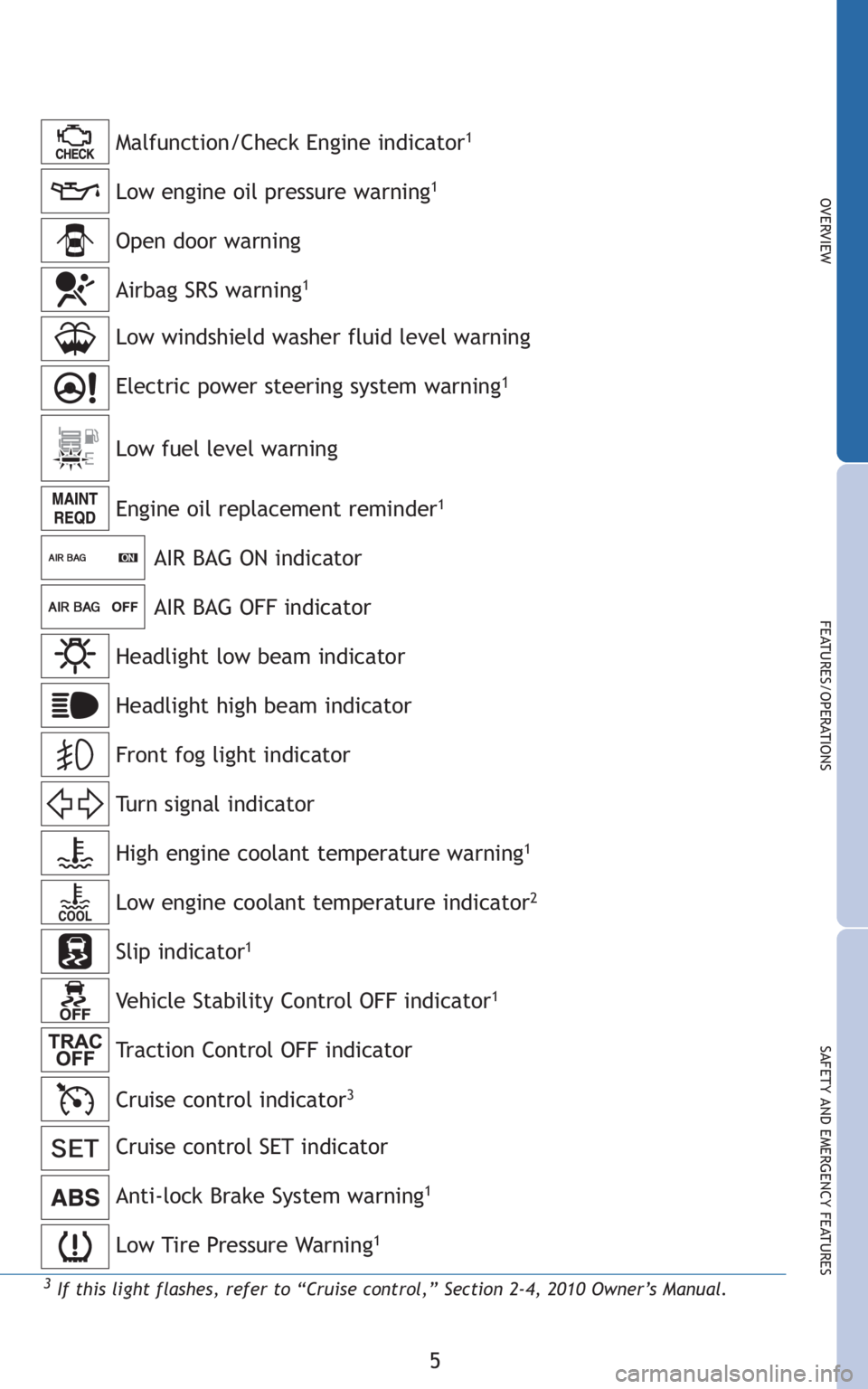
Low engine oil pressure warning1
Anti-lock Brake System warning1
Malfunction/Check Engine indicator1
3If this light flashes, refer to “Cruise control,” Section 2-4, 2010 Owner’s Manual.
Open door warning
Low windshield washer fluid level warning
Engine oil replacement reminder
1
AIR BAG ON indicator
AIR BAG OFF indicator
Headlight low beam indicator
Turn signal indicator
High engine coolant temperature warning1
Low engine coolant temperature indicator2
Headlight high beam indicator
Cruise control indicator
3
Front fog light indicator Airbag SRS warning
1
Low fuel level warning Electric power steering system warning
1
Low Tire Pressure Warning1
Cruise control SET indicator
Slip indicator1
Vehicle Stability Control OFF indicator1
Traction Control OFF indicator
Page 8 of 386
6
OVERVIEW
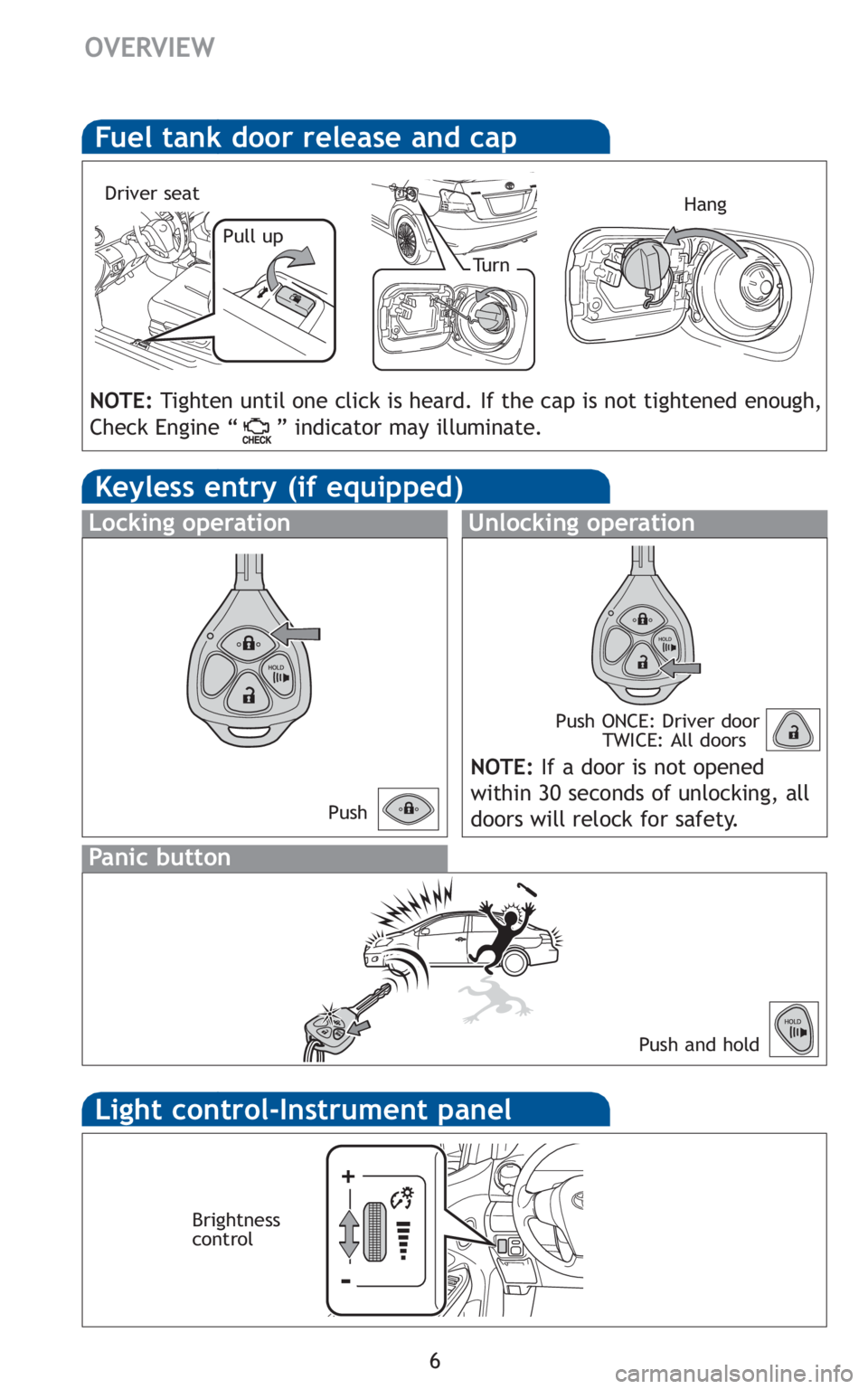
Fuel tank door release and cap
Pull up
Hang
NOTE:Tighten until one click is heard. If the cap is not tightened enough,
Check Engine “ ” indicator may illuminate.
Keyless entry (if equipped)
NOTE: If a door is not opened
within 30 seconds of unlocking, all
doors will relock for safety.
Unlocking operation
Panic button
Push ONCE: Driver door TWICE: All doors
Locking operation
Push and hold
Driver seat
Push
Tu r n
Light control-Instrument panel
Brightness
control
+
-
Page 116 of 386

103
2-1. Driving procedures
2
When driving
CAUTION
n
When driving the vehicle
lDo not drive if you are unfamiliar with the location of the clutch, brake and
accelerator pedals to avoid depressing the wrong pedal.
• Accidentally depressing the accelerator pedal instead of the brake
pedal will result in sudden acceleration that may lead to an accident
that could result in death or serious injury.
• When backing up, you may twist your body around, leading to a diffi- culty in operating the pedals. Make sure to operate the pedals properly.
• Make sure to keep a correct driving posture even when moving the vehicle only slightly, allowing you to depress the brake and accelerator
pedals properly.
• Depress the brake pedal using your right foot. Depressing the brake pedal using your left foot may delay response in an emergency, result-
ing in an accident.
l Do not drive the vehicle over or st op the vehicle near flammable materials.
The exhaust system and exhaust gases can be extremely hot. This may
cause a fire if there is any flammable material nearby.
l Vehicles with an automatic transmission, do not let the vehicle roll back-
wards while the shift lever is in a driving position, or roll forward while the
shift lever is in R.
Doing so may cause the engine to stall or lead to poor brake and steering
performance, resulting in an accident or damage to the vehicle.
l If the smell of exhaust is noticed inside the vehicle, open the windows and
check that the trunk is closed. Large amounts of exhaust in the vehicle can
cause driver drowsiness and an accident, resulting in death or a serious
health hazard. Have the vehicle inspected by your Toyota dealer immedi-
ately.
l On vehicles with an automatic transmission, do not shift the shift lever to P
while the vehicle is moving.
Doing so can damage the transmission and may result in a loss of vehicle\
control.
l Do not shift the shift lever to R while the vehicle is moving forward.
Doing so can damage the transmission and may result in a loss of vehicle\
control.
Page 118 of 386

105
2-1. Driving procedures
2
When driving
CAUTION
n
When driving on slippery road surfaces
lSudden braking, acceleration and steering may cause tire slippage and
reduce your ability to control the vehicle, resulting in an accident.
n When driving on slippery road surfaces
lSudden changes in engine speed, such as engine braking caused by up-
shifting or down-shifting, may cause the vehicle to skid, resulting in an
accident.
l After driving through a puddle, lightly depress the brake pedal to make
sure that the brakes are functioning properly. Wet brake pads may prevent
the brakes from functioning properly. If the brakes on only one side are wet
and not functioning properly, steering control may be affected, resulting in
an accident.
n When shifting the shift lever
Vehicles with an automatic transmission, be careful not to shift the shift lever
with the accelerator pedal depressed.
This may lead to unexpected rapid acceleration of the vehicle that may
cause an accident and result in death or serious injury.
n When the vehicle is stopped
lDo not race the engine.
If the vehicle is in any gear other than P (automatic transmission only) or
N, the vehicle may accelerate suddenly and unexpectedly, and may cause
an accident.
l Do not leave the vehicle with the engine running for a long time.
If such a situation cannot be avoided, park the vehicle in an open space
and check that exhaust fumes do not enter the vehicle interior.
l Vehicles with an automatic transmission: In order to prevent accidents due
to the vehicle rolling away, always keep depressing the brake pedal while
the engine is running, and apply the parking brake as necessary.
l If the vehicle is stopped on an incline, in order to prevent accidents caused
by the vehicle rolling forward or ba ckward, always depress the brake pedal
and securely apply the parking brake as needed.
Page 130 of 386
117
2-1. Driving procedures
2
When driving
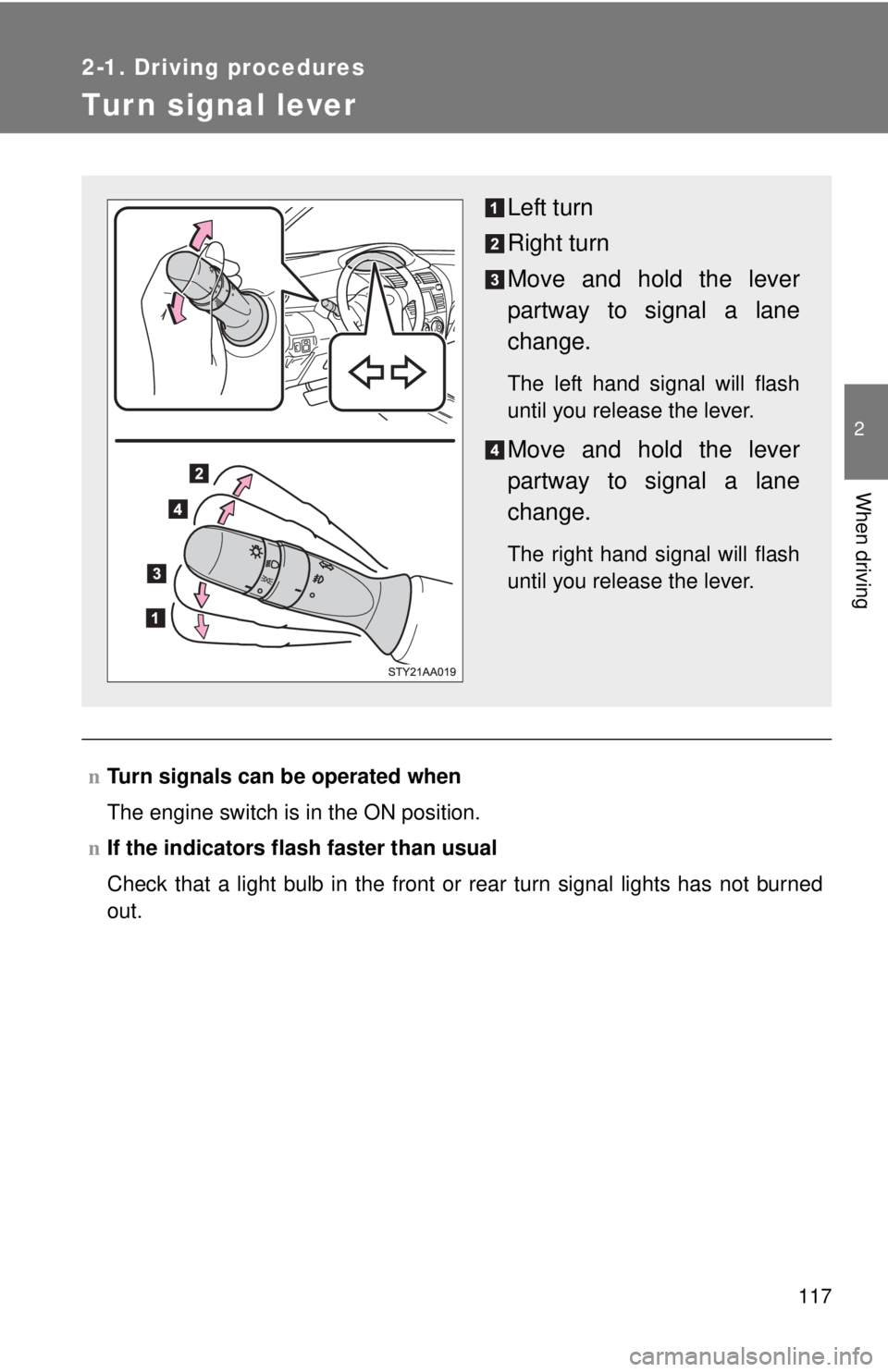
Turn signal lever
nTurn signals can be operated when
The engine switch is in the ON position.
n If the indicators flash faster than usual
Check that a light bulb in the front or rear turn signal lights has not burned
out.
Left turn
Right turn
Move and hold the lever
partway to signal a lane
change.
The left hand signal will flash
until you release the lever.
Move and hold the lever
partway to signal a lane
change.
The right hand signal will flash
until you release the lever.
Page 138 of 386
125
2-2. Instrument cluster
2
When driving
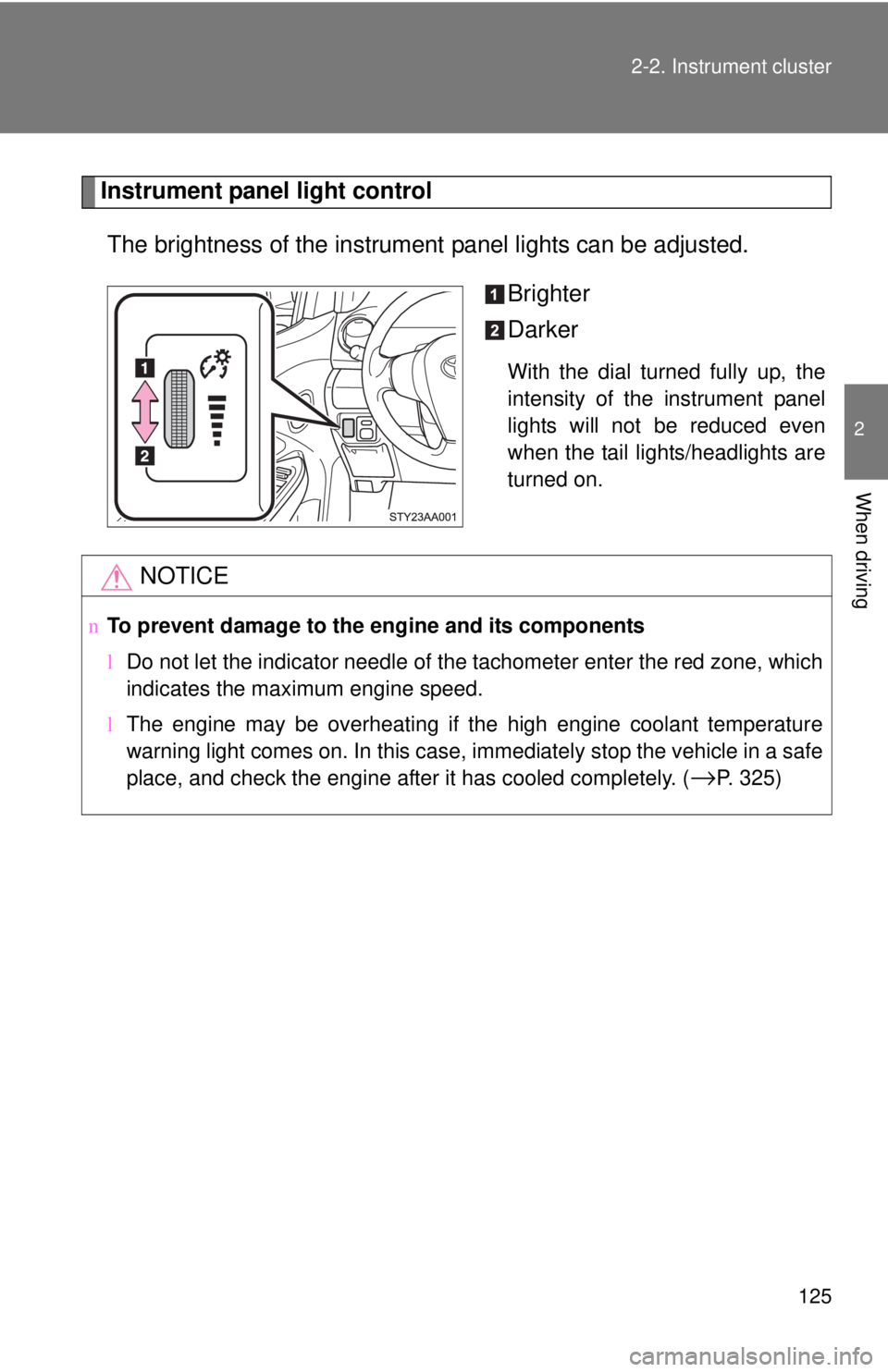
Instrument panel light control
The brightness of the instrument panel lights can be adjusted.
Brighter
Darker
With the dial turned fully up, the
intensity of the instrument panel
lights will not be reduced even
when the tail lights/headlights are
turned on.
NOTICE
nTo prevent damage to the engine and its components
lDo not let the indicator needle of the tachometer enter the red zone, which
indicates the maximum engine speed.
l The engine may be overheating if the high engine coolant temperature
warning light comes on. In this case, immediately stop the vehicle in a safe
place, and check the engine after it has cooled completely. (
→P. 325)
Page 142 of 386
129
2-2. Instrument cluster
2
When driving
CAUTION
n
If a safety system warning light does not come on
Should a safety system light such as ABS and the SRS airbag warning light
not come on when you start the engine, this could mean that these systems
are not available to help protect you in an accident, which could result in
death or serious injury. Have the vehicle inspected by your Toyota dealer
immediately if this occurs.
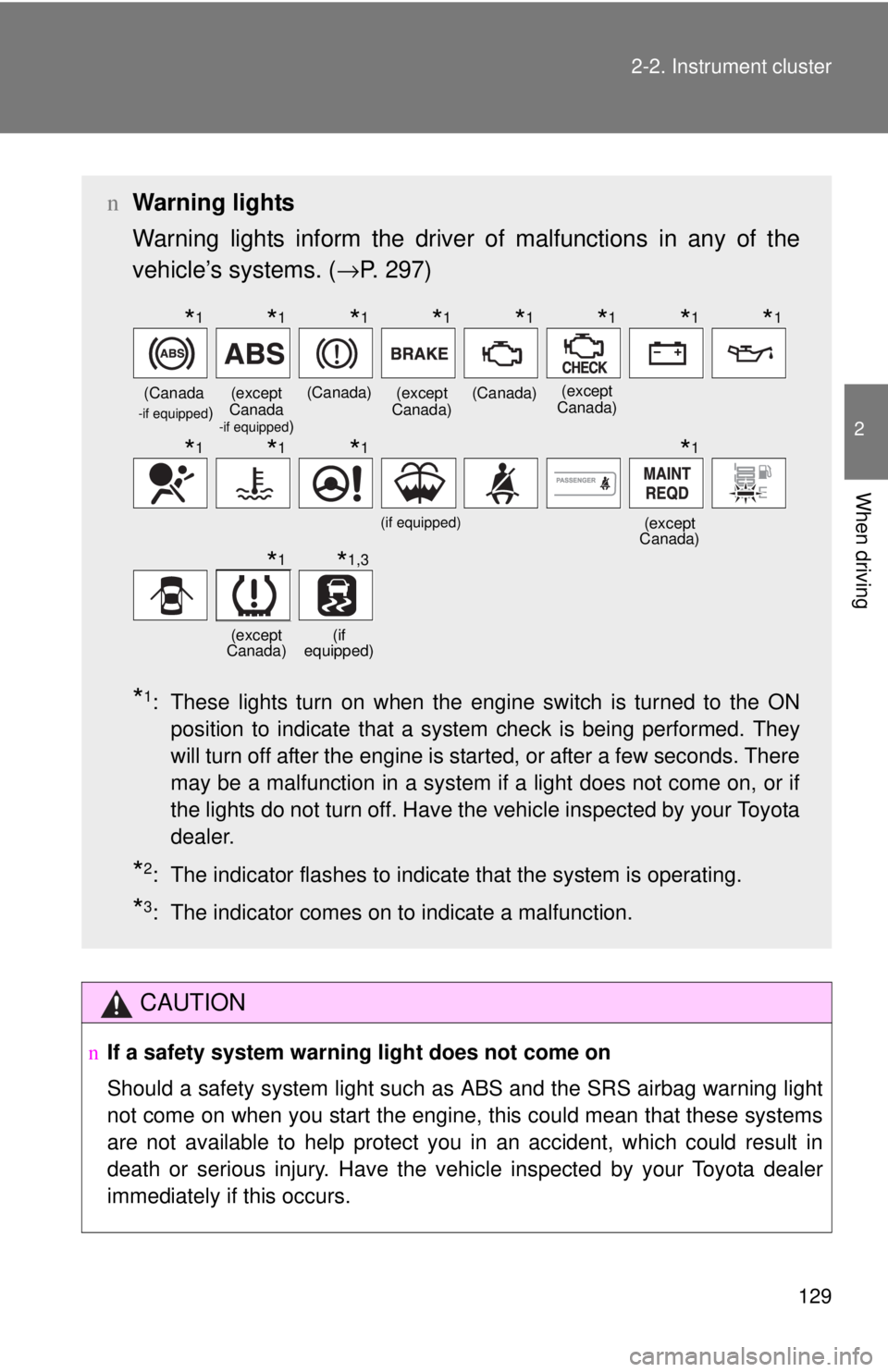
n Warning lights
Warning lights inform the driver of malfunctions in any of the
vehicle’s systems. ( →P. 297)
*1: These lights turn on when the engine switch is turned to the ON
position to indicate that a system check is being performed. They
will turn off after the engine is started, or after a few seconds. There
may be a malfunction in a system if a light does not come on, or if
the lights do not turn off. Have the vehicle inspected by your Toyota
dealer.
*2: The indicator flashes to indicate that the system is operating.
*3: The indicator comes on to indicate a malfunction.
(Canada -if equipped)(except
Canada
-if equipped)
(Canada)(except
Canada)(Canada)(except
Canada)
(if equipped)(except
Canada)
(except
Canada)(if
equipped)
*1*1*1*1*1*1*1*1
*1*1*1*1
*1*1,3
Page 148 of 386
135
2-3. Operating the lights and wipers
2
When driving
n
The windshield wiper and washer can be operated when
The engine switch must be in the ON position.
n If no windshield washer fluid sprays
Check that the washer nozzles are not blocked and if there is washer fluid in
the windshield washer fluid reservoir.
NOTICE
nWhen the windshield is dry
Do not use the wipers, as they may damage the windshield.
n When there is no washer fluid spray from the nozzle
Damage to the washer fluid pump may be caused if the lever is pulled
toward you and held continually.
n When a nozzle becomes block
Do not try to clear it with a pin or other object. The nozzle will be damaged.
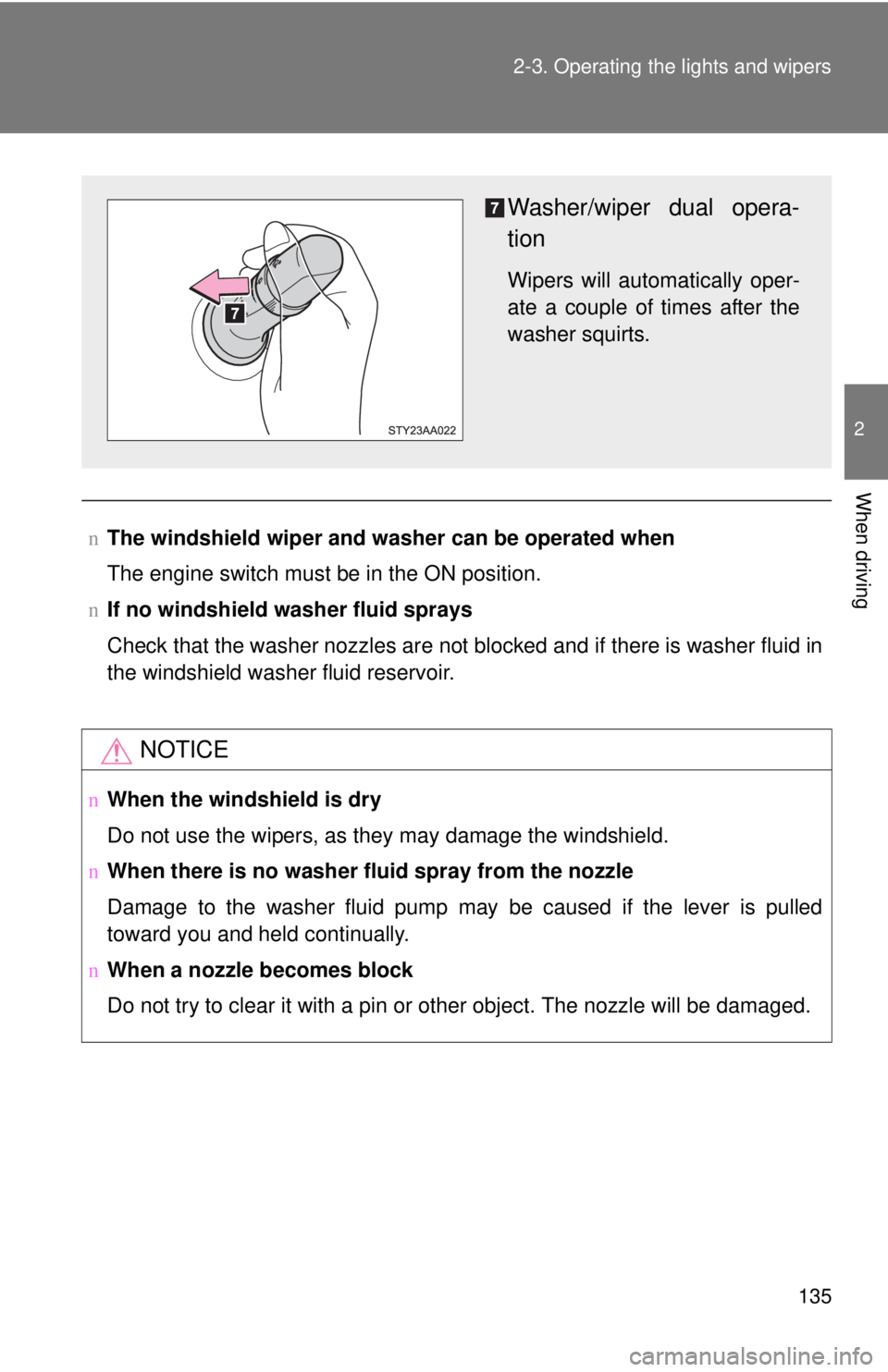
Washer/wiper dual opera-
tion
Wipers will automatically oper-
ate a couple of times after the
washer squirts.
Page 167 of 386

154 2-5. Driving information
Towing a trailerConsult your Toyota dealer for further information about additional
requirements such as a towing kits, etc.
n Before towing
Check that the following conditions are met:
lEnsure that your vehicle’s tires are properly inflated. ( →P. 341)
l Trailer tires should be inflated according to the trailer manufacturer’s rec-
ommendation.
l All trailer lights work to be legal.
l Confirm all lights work each time you connect them.
l Check that your vehicle remains level when a loaded or unloaded trailer
is hitched. Do not drive if the vehicle is not level, and check for improper
tongue load, overloading, worn suspension, or other possible causes.
l Make sure the trailer cargo is securely loaded.
l Check that your rear view mirrors conform to any federal, state/provincial
or local regulations. If they do not, install rear view mirrors appropriate for
towing purposes.
n Break-in schedule
lToyota recommends that you do not use a new vehicle or a vehicle with
any new power train components (engine, transmission, differential,
wheel bearings, etc.) to tow a trailer for the first 500 miles (800 km) of
driving.
n Maintenance
lIf you tow a trailer, your vehicle will require more frequent maintenance
due to the additional load. (See “Scheduled Maintenance Guide” or
“Owner’s Manual Supplement”.)
l Retighten the fixing bolts of the towing ball and bracket after approxi-
mately 600 miles (1000 km).
Page 308 of 386
298 5-2. Steps to take in an emergency
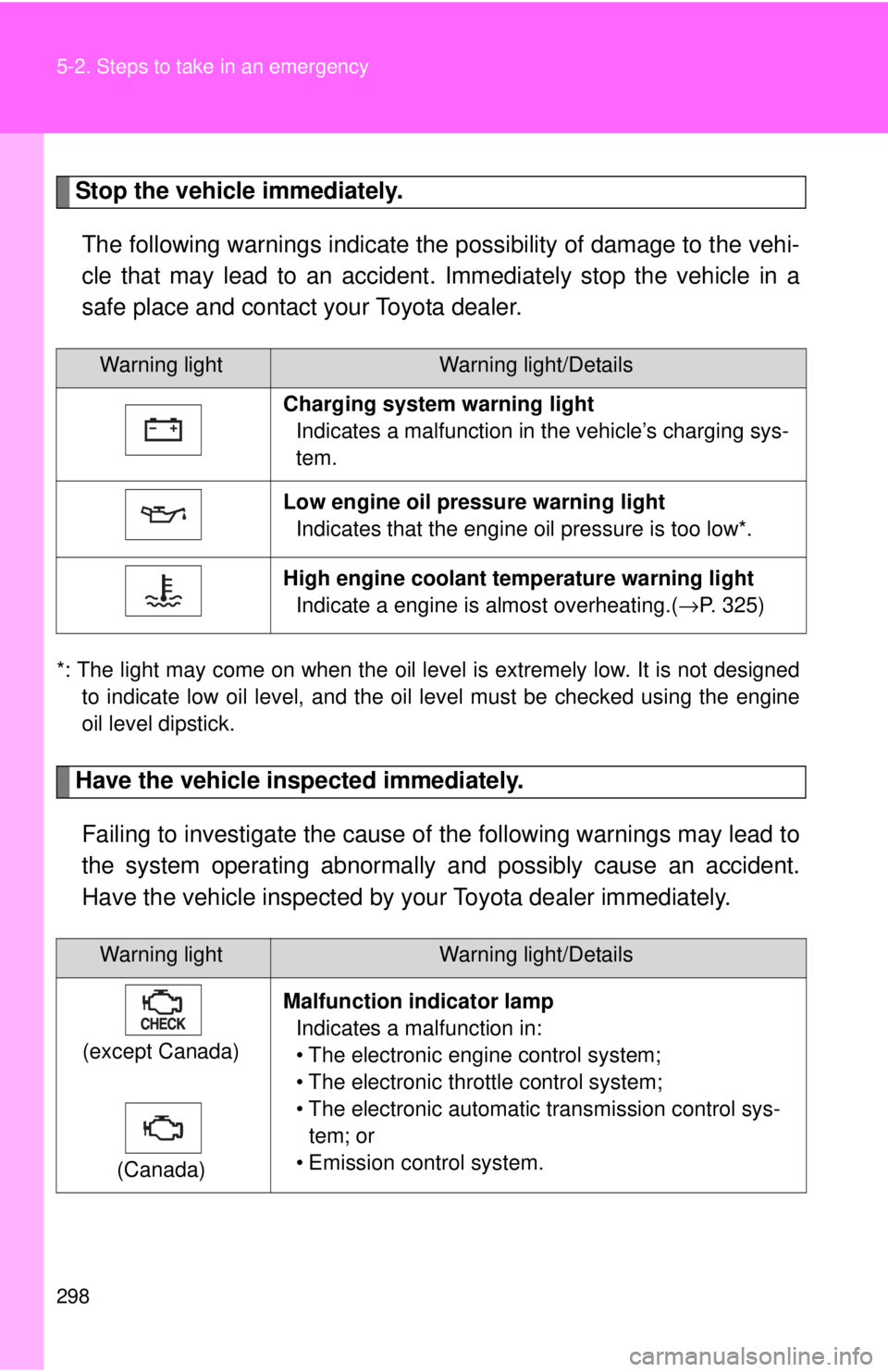
Stop the vehicle immediately.The following warnings indicate the possibility of damage to the vehi-
cle that may lead to an accident. Immediately stop the vehicle in a
safe place and contact your Toyota dealer.
*: The light may come on when the oil level is extremely low. It is not designed to indicate low oil level, and the oil level must be checked using the engine
oil level dipstick.
Have the vehicle inspected immediately.
Failing to investigate the cause of the following warnings may lead to
the system operating abnormally and possibly cause an accident.
Have the vehicle inspected by your Toyota dealer immediately.
Warning lightWarning light/Details
Charging system warning light Indicates a malfunction in the vehicle’s charging sys-
tem.
Low engine oil pressure warning light Indicates that the engine oil pressure is too low*.
High engine coolant temperature warning light Indicate a engine is almost overheating.( →P. 325)
Warning lightWarning light/Details
(except Canada)
(Canada) Malfunction indicator lamp
Indicates a malfunction in:
• The electronic engine control system;
• The electronic throttle control system;
• The electronic automatic transmission control sys-tem; or
• Emission control system.