height VAUXHALL ADAM 2015 Owner's Manual
[x] Cancel search | Manufacturer: VAUXHALL, Model Year: 2015, Model line: ADAM, Model: VAUXHALL ADAM 2015Pages: 225, PDF Size: 6.81 MB
Page 9 of 225
In brief7Seat adjustmentSeat positioning
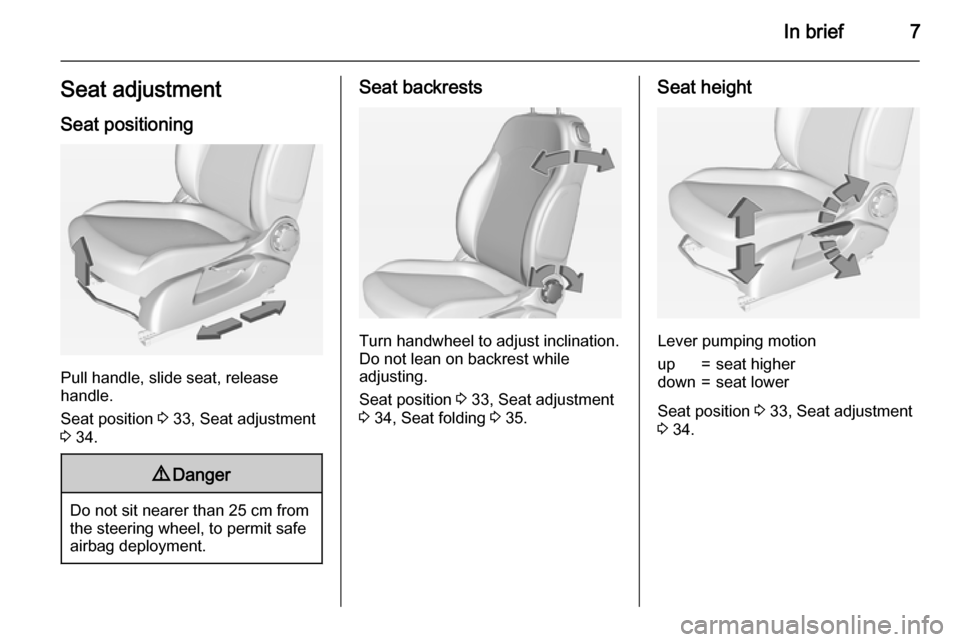
Pull handle, slide seat, release
handle.
Seat position 3 33, Seat adjustment
3 34.
9 Danger
Do not sit nearer than 25 cm from
the steering wheel, to permit safe
airbag deployment.
Seat backrests
Turn handwheel to adjust inclination.
Do not lean on backrest while
adjusting.
Seat position 3 33, Seat adjustment
3 34, Seat folding 3 35.
Seat height
Lever pumping motion
up=seat higherdown=seat lower
Seat position 3 33, Seat adjustment
3 34.
Page 10 of 225
8In briefHead restraint adjustment
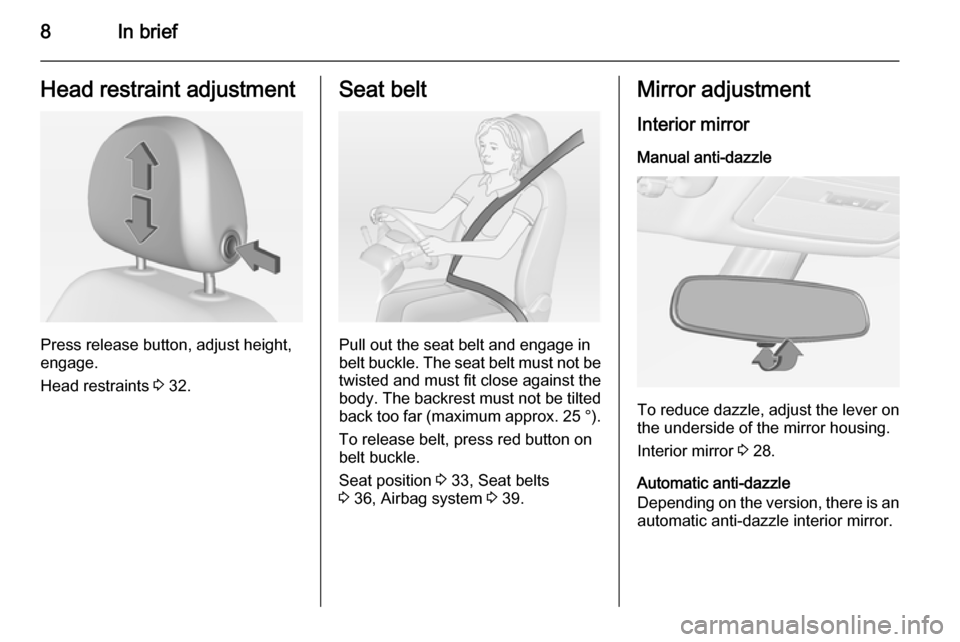
Press release button, adjust height,
engage.
Head restraints 3 32.
Seat belt
Pull out the seat belt and engage in
belt buckle. The seat belt must not be twisted and must fit close against the
body. The backrest must not be tilted
back too far (maximum approx. 25 ° ).
To release belt, press red button on belt buckle.
Seat position 3 33, Seat belts
3 36, Airbag system 3 39.
Mirror adjustment
Interior mirror
Manual anti-dazzle
To reduce dazzle, adjust the lever on the underside of the mirror housing.
Interior mirror 3 28.
Automatic anti-dazzle
Depending on the version, there is an
automatic anti-dazzle interior mirror.
Page 34 of 225
32Seats, restraintsSeats, restraintsHead restraints............................ 32
Front seats ................................... 33
Seat belts ..................................... 36
Airbag system .............................. 39
Child restraints ............................. 45Head restraints
Position9 Warning
Only drive with the head restraint
set to the proper position.
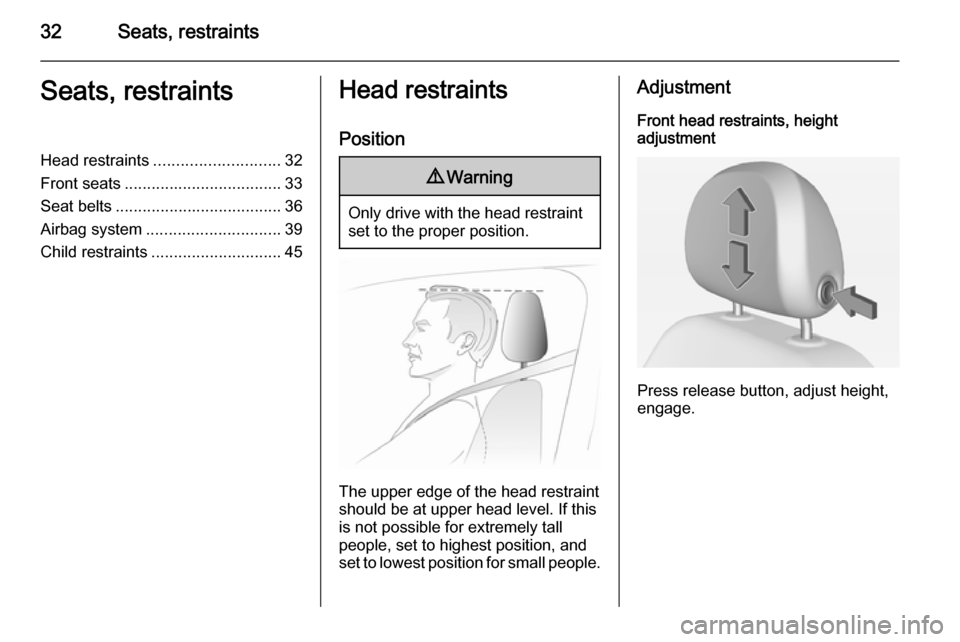
The upper edge of the head restraint
should be at upper head level. If this
is not possible for extremely tall
people, set to highest position, and
set to lowest position for small people.
Adjustment
Front head restraints, height
adjustment
Press release button, adjust height,
engage.
Page 35 of 225
Seats, restraints33
Rear head restraints, heightadjustment
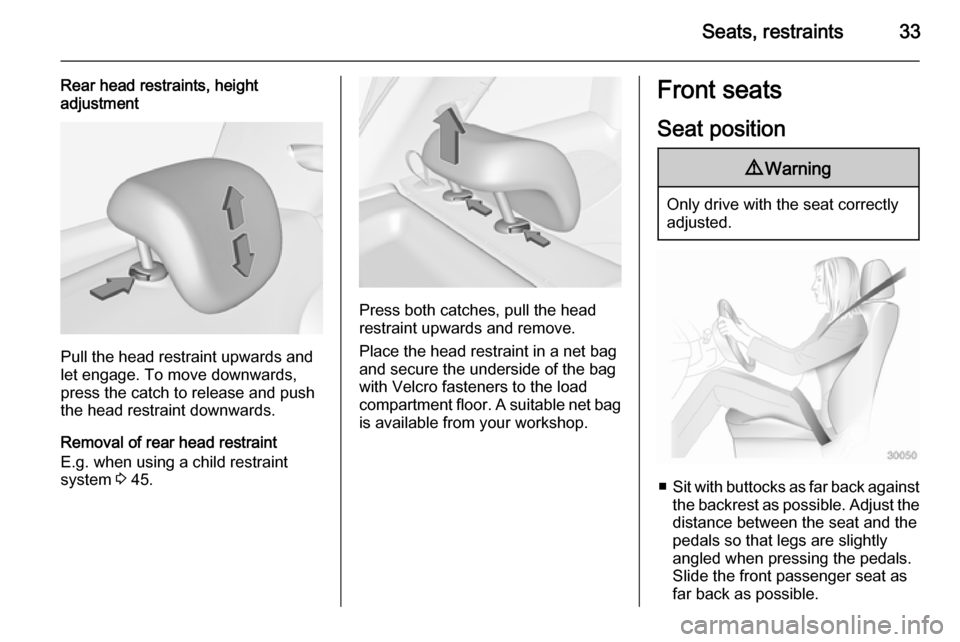
Pull the head restraint upwards and
let engage. To move downwards, press the catch to release and push
the head restraint downwards.
Removal of rear head restraint
E.g. when using a child restraint
system 3 45.
Press both catches, pull the head
restraint upwards and remove.
Place the head restraint in a net bag
and secure the underside of the bag
with Velcro fasteners to the load
compartment floor. A suitable net bag
is available from your workshop.
Front seats
Seat position9 Warning
Only drive with the seat correctly
adjusted.
■ Sit with buttocks as far back against
the backrest as possible. Adjust the distance between the seat and the
pedals so that legs are slightly
angled when pressing the pedals.
Slide the front passenger seat as
far back as possible.
Page 36 of 225
34Seats, restraints
■ Sit with shoulders as far backagainst the backrest as possible.Set the backrest rake so that it is
possible to easily reach the
steering wheel with arms slightly
bent. Maintain contact between
shoulders and the backrest when
turning the steering wheel. Do not
angle the backrest too far back. We recommend a maximum rake ofapprox. 25°.
■ Adjust the steering wheel 3 71.
■ Set seat height high enough to have a clear field of vision on allsides and of all display instruments.
There should be at least one hand
of clearance between head and the
roof frame. Your thighs should rest
lightly on the seat without pressing
into it.
■ Adjust the head restraint 3 32.Seat adjustment9 Danger
Do not sit nearer than 25 cm from
the steering wheel, to permit safe
airbag deployment.
9 Warning
Never adjust seats while driving as
they could move uncontrollably.
9 Warning
Never store any objects under the
seats.
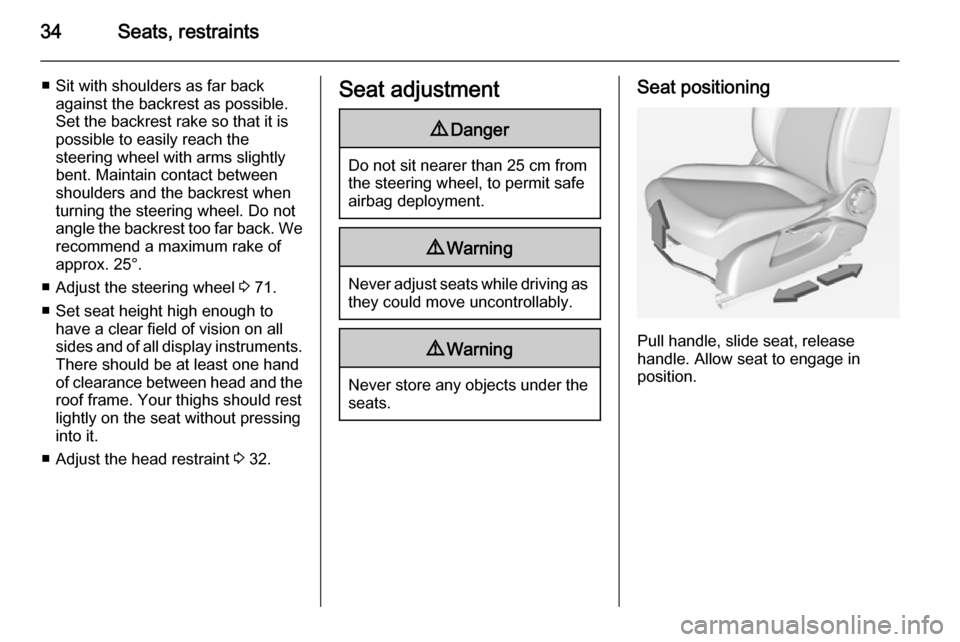
Seat positioning
Pull handle, slide seat, release
handle. Allow seat to engage in
position.
Page 37 of 225
Seats, restraints35
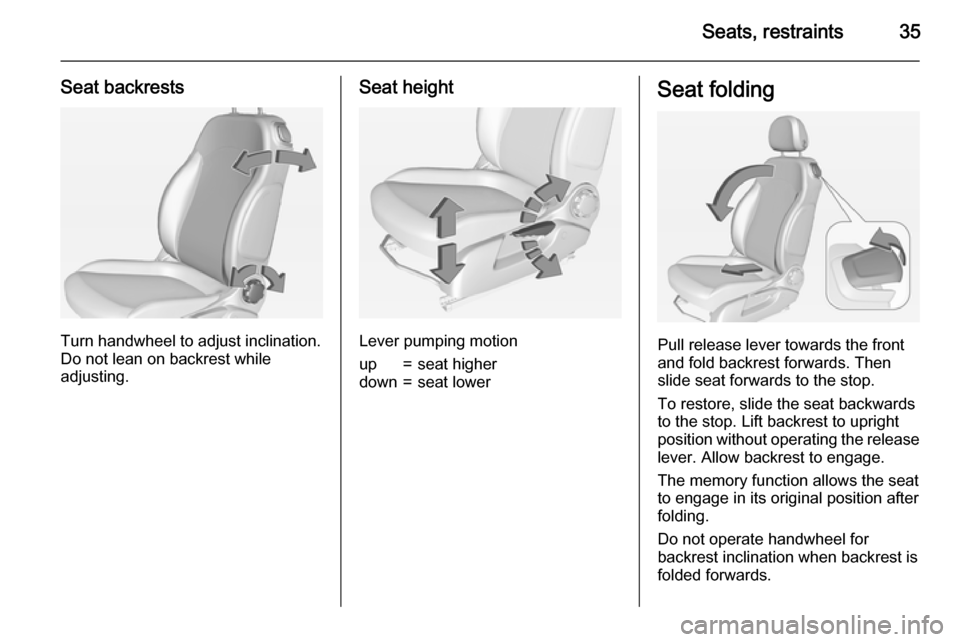
Seat backrests
Turn handwheel to adjust inclination.
Do not lean on backrest while
adjusting.
Seat height
Lever pumping motion
up=seat higherdown=seat lowerSeat folding
Pull release lever towards the front
and fold backrest forwards. Then
slide seat forwards to the stop.
To restore, slide the seat backwards
to the stop. Lift backrest to upright
position without operating the release
lever. Allow backrest to engage.
The memory function allows the seat
to engage in its original position after
folding.
Do not operate handwheel for
backrest inclination when backrest is
folded forwards.
Page 38 of 225
36Seats, restraintsCaution
When seat height is in the highestposition, push head restraints
down and fold up sun visors before
folding backrest forwards.
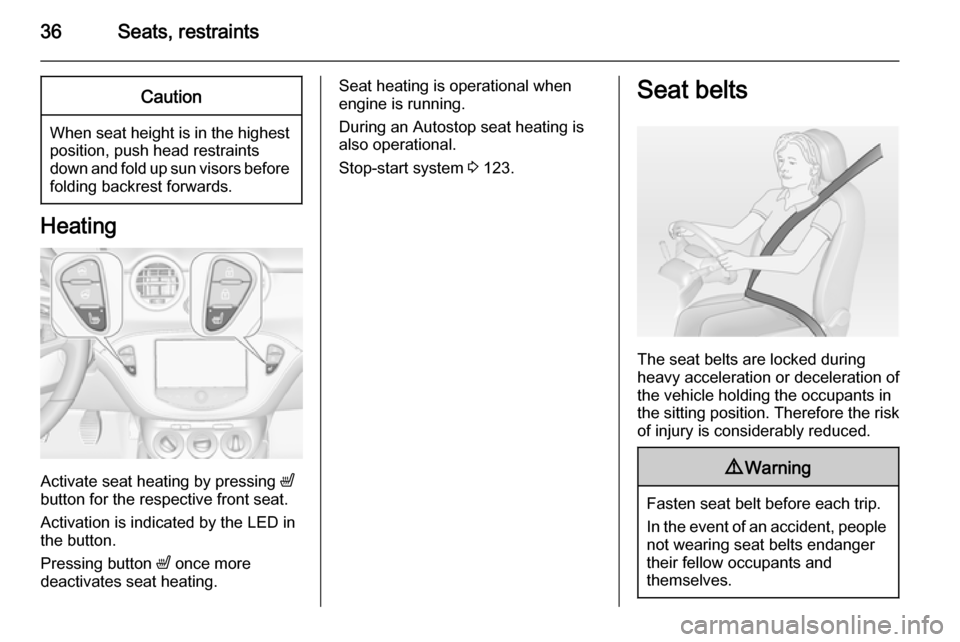
Heating
Activate seat heating by pressing ß
button for the respective front seat.
Activation is indicated by the LED in
the button.
Pressing button ß once more
deactivates seat heating.
Seat heating is operational when engine is running.
During an Autostop seat heating is also operational.
Stop-start system 3 123.Seat belts
The seat belts are locked during
heavy acceleration or deceleration of
the vehicle holding the occupants in
the sitting position. Therefore the risk
of injury is considerably reduced.
9 Warning
Fasten seat belt before each trip.
In the event of an accident, people
not wearing seat belts endanger their fellow occupants and
themselves.
Page 50 of 225

48Seats, restraints
1=if the child restraint system is being secured using a three-point seat belt, move seat height adjustment in the uppermost
position. Adjust seat backrest inclination as far as necessary to a vertical position to ensure that the belt is tight on the buckle side2=remove rear head restraint when using child restraint systems in this group 3 32*=move the respective front seat ahead of the child restraint system to one of the foremost adjustment positions**=move the front passenger seat to the rearmost adjustment position. Move seat height adjustment to the uppermost
position and the headrest to the lowest position. Adjust seat backrest inclination as far as necessary to a vertical position to ensure that vehicle seat belt runs forwards from the upper anchorage pointU=universal suitability in conjunction with three-point seat beltX=no child restraint system permitted in this weight class
Permissible options for fitting an ISOFIX child restraint system
Weight classSize classFixtureOn front passenger seatOn rear seatsGroup 0: up to 10 kg
or approx. 10 monthsEISO/R1XIL *Group 0+: up to 13 kg
or approx. 2 yearsEISO/R1XIL *DISO/R2XXCISO/R3XX
Page 147 of 225

Driving and operating145
Side blind spot alert is active from
speeds of 6 mph up to 87 mph.
Driving faster than 87 mph
deactivates the system, indicated by
low lighting warning symbols B in
both exterior mirrors. Reducing the speed again will extinguish the
warning symbols. If a vehicle is then
detected in the blind zone, the
warning symbols B will illuminate as
normal on the relevant side.
When the vehicle is started, both exterior mirror displays will briefly
come on to indicate that the system is operating.
The system can be activated or
deactivated in the Info-Display,
vehicle personalisation 3 99.
Deactivation is indicated by a
message in the Driver Information
Centre.
Detection zones
The detection zones start at the rear
bumper and extend approx.
3 metres rearwards and to the sides.
The height of the zone is approx.
between 0.5 metres and 2 metres off
the ground.
Side blind spot alert is designed to ignore stationary objects, e.g.
guardrails, posts, curbs, walls and
beams. Parked vehicles or oncoming
vehicles are not detected.
Fault
Occasional missed alerts can occur
under normal circumstances and will
increase in wet conditions.
Side blind spot alert does not operate when the left or right corners of the
rear bumper are covered with mud,dirt, snow, ice, slush, or in heavy
rainstorms. Cleaning instructions
3 197.
In the event of a fault in the system or if the system does not work due to
temporary conditions, a message is
displayed in the Driver Information
Centre. Seek the assistance of a
workshop.
Page 177 of 225
Vehicle care175Wheels and tyresTyre condition, wheel condition
Drive over edges slowly and at right
angles if possible. Driving over sharp
edges can cause tyre and wheel
damage. Do not trap tyres on the kerb
when parking.
Regularly check the wheels for
damage. Seek the assistance of a
workshop in the event of damage or
unusual wear.
We recommend not swapping the
front wheels with the rear wheels and vice versa, as this can affect vehicle
stability. Always use less worn tyres
on the rear axle.
Winter tyres Winter tyres improve driving safety attemperatures below 7 °C and shouldtherefore be fitted on all wheels.
In accordance with country-specific
regulations, affix the speed sticker in
the driver's field of view.Tyre designations
E.g. 195/55 R 16 95 H195=tyre width, mm55=cross-section ratio (tyre height
to tyre width), %R=belt type: RadialRF=type: RunFlat16=wheel diameter, inches95=load index e.g. 95 is equivalent
to 690 kgH=speed code letter
Speed code letter:
Q=up to 100 mphS=up to 112 mphT=up to 118 mphH=up to 130 mphV=up to 150 mphW=up to 168 mph
Directional tyres
Directional tyres must be mounted so
that they rotate in the correct
direction. The proper rotation
direction is indicated by a symbol (e.g. an arrow) on the sidewall.
Tyre pressure
Check the pressure of cold tyres at
least every 14 days and before any
long journey. Do not forget the spare
wheel.
This also applies to vehicles with tyre pressure monitoring system.
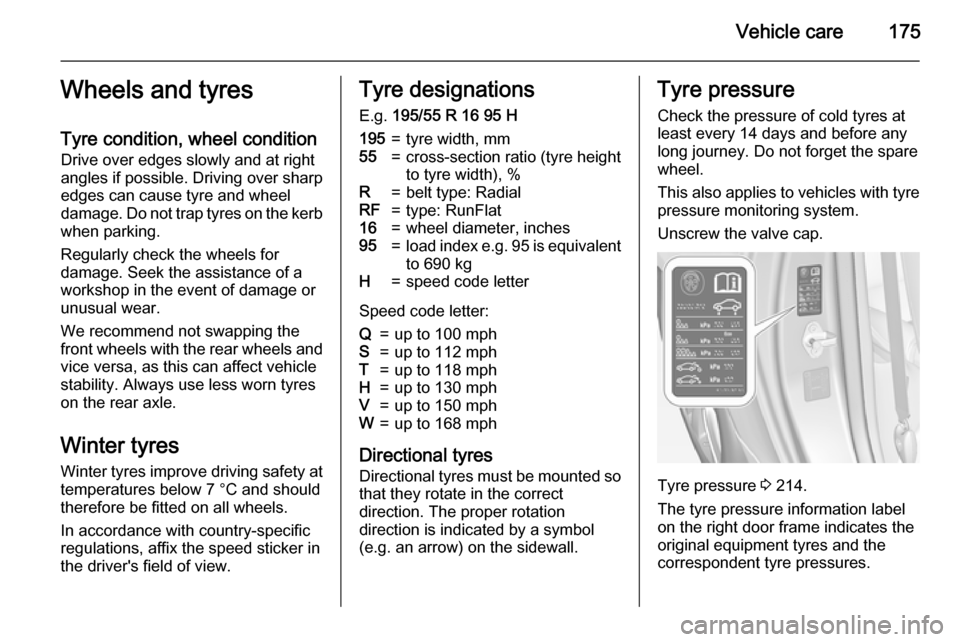
Unscrew the valve cap.
Tyre pressure 3 214.
The tyre pressure information label
on the right door frame indicates the original equipment tyres and the
correspondent tyre pressures.