brake light VAUXHALL ADAM 2019 User Guide
[x] Cancel search | Manufacturer: VAUXHALL, Model Year: 2019, Model line: ADAM, Model: VAUXHALL ADAM 2019Pages: 223, PDF Size: 6.54 MB
Page 150 of 223

148Vehicle careVehicle careGeneral Information...................148
Accessories and vehicle modifications .......................... 148
Vehicle storage ........................149
End-of-life vehicle recovery .....149
Vehicle checks ........................... 150
Performing work ......................150
Bonnet ..................................... 150
Engine oil ................................. 151
Engine coolant ......................... 152
Washer fluid ............................ 152
Brakes ..................................... 153
Brake fluid ............................... 153
Vehicle battery ......................... 153
Wiper blade replacement ........155
Bulb replacement .......................155
Halogen headlights ..................155
Front turn lights .......................158
Tail lights ................................. 159
Side turn lights ......................... 162
Number plate light ...................163
Interior lights ............................ 164
Electrical system ........................164
Fuses ....................................... 164Engine compartment fuse box . 165
Instrument panel fuse box .......167
Vehicle tools .............................. 169
Tools ........................................ 169
Wheels and tyres .......................170
Winter tyres ............................. 170
Tyre designations ....................171
Tyre pressure .......................... 171
Tyre pressure monitoring system .................................... 172
Tread depth ............................. 175
Changing tyre and wheel size . 176
Wheel covers ........................... 176
Tyre chains .............................. 176
Tyre repair kit .......................... 177
Wheel changing .......................181
Spare wheel ............................ 182
Jump starting ............................. 188
Towing ....................................... 190
Towing the vehicle ...................190
Appearance care .......................191
Exterior care ............................ 191
Interior care ............................. 194General Information
Accessories and vehiclemodifications
We recommend the use of genuine
parts and accessories and factory
approved parts specific for your
vehicle type. We cannot assess or
guarantee reliability of other products - even if they have a regulatory or
otherwise granted approval.
Any modification, conversion or other
changes made to standard vehicle
specifications (including, without
limitation, software modifications,
modifications of the electronic control units) may invalidate the warranty
offered by Vauxhall. Furthermore,
such changes may affect driver
assistance systems, fuel
consumption, CO 2 emissions and
other emissions of the vehicle. They
may also invalidate the vehicle
operating permit.
Page 162 of 223
160Vehicle care
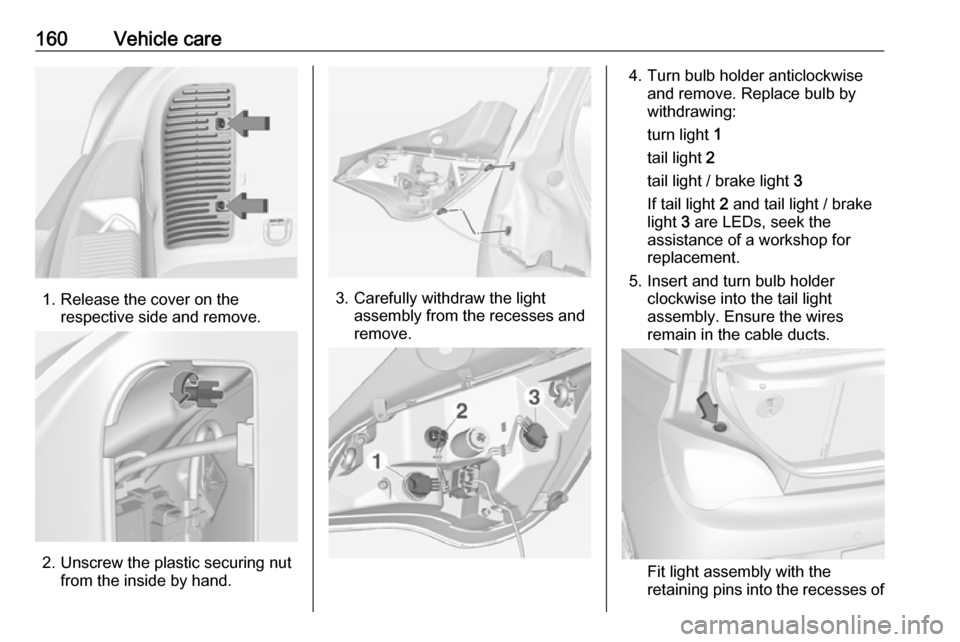
1. Release the cover on therespective side and remove.
2. Unscrew the plastic securing nut from the inside by hand.
3. Carefully withdraw the lightassembly from the recesses and
remove.
4. Turn bulb holder anticlockwise and remove. Replace bulb by
withdrawing:
turn light 1
tail light 2
tail light / brake light 3
If tail light 2 and tail light / brake
light 3 are LEDs, seek the
assistance of a workshop for
replacement.
5. Insert and turn bulb holder clockwise into the tail light
assembly. Ensure the wires
remain in the cable ducts.
Fit light assembly with the
retaining pins into the recesses of
Page 176 of 223
174Vehicle careilluminates. For the further three
tyres, the system remains
operational.
The use of commercially-available liquid tyre repair kits can impair the
function of the system. Factory-
approved repair kits can be used.
Operating electronic devices or being close to facilities using similar wave
frequencies could disrupt the tyre
pressure monitoring system.
Each time the tyres are replaced, tyre
pressure monitoring system sensors
must be dismounted and serviced. For the screwed sensor; replace
valve core and sealing ring. For the
clipped sensor; replace complete
valve stem.
Vehicle loading status
Adjust tyre pressure to load condition according to the tyre information labelor tyre pressure chart 3 206, and
select the appropriate setting in the menu Tyre Load in the Driver
Information Centre, Vehicle
Information Menu 3 80 . This setting is
the reference for the tyre pressure
warnings.The Tyre Load menu only appears if
the vehicle is at a standstill and the parking brake is applied. On vehicles
with automatic transmission the
selector lever has to be in P.
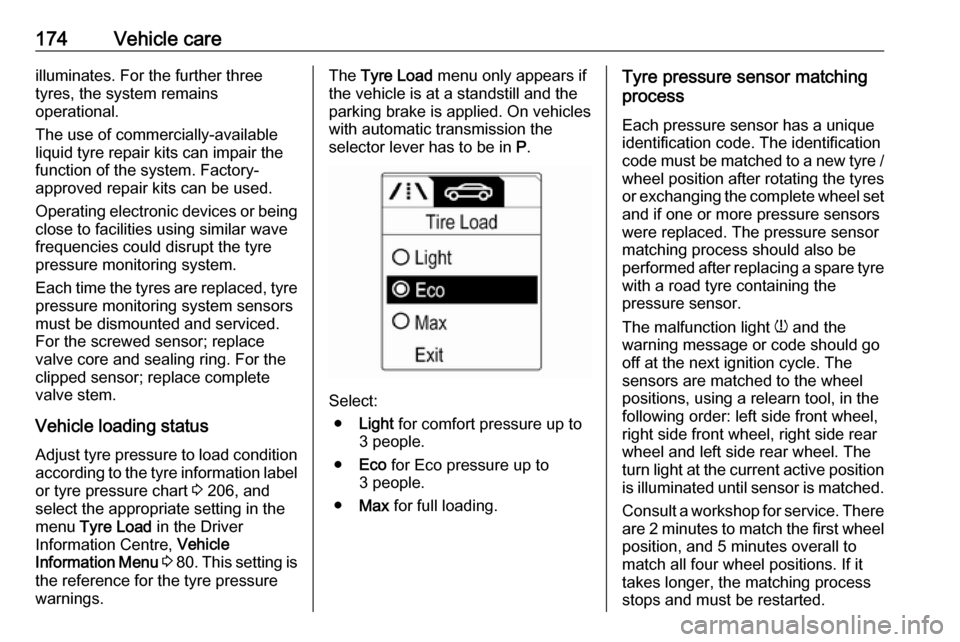
Select:
● Light for comfort pressure up to
3 people.
● Eco for Eco pressure up to
3 people.
● Max for full loading.
Tyre pressure sensor matching
process
Each pressure sensor has a unique
identification code. The identification
code must be matched to a new tyre /
wheel position after rotating the tyres
or exchanging the complete wheel set and if one or more pressure sensors
were replaced. The pressure sensor
matching process should also be
performed after replacing a spare tyre
with a road tyre containing the
pressure sensor.
The malfunction light w and the
warning message or code should go
off at the next ignition cycle. The
sensors are matched to the wheel
positions, using a relearn tool, in the following order: left side front wheel,
right side front wheel, right side rear
wheel and left side rear wheel. The
turn light at the current active position
is illuminated until sensor is matched.
Consult a workshop for service. There are 2 minutes to match the first wheelposition, and 5 minutes overall to
match all four wheel positions. If it
takes longer, the matching process
stops and must be restarted.
Page 183 of 223
Vehicle care181The adapters possibly supplied can
be used to pump up other items e.g.
footballs, air mattresses, inflatable
dinghies etc. They can be located on the underside of the compressor. To
remove, screw on compressor air
hose and withdraw adapter.
Wheel changing
Make the following preparations and
observe the following information:
● Park the vehicle on a level, firm and non-skid surface. The front
wheels must be in the straight- ahead position.
● Apply the parking brake and engage first gear or reverse gear.
● If the ground on which the vehicle
is standing is soft, a solid board
(max. 1 cm thick) should be
placed under the jack.
● Take heavy objects out of the vehicle before jacking up.
● No people or animals may be in the vehicle when it is jacked-up.
● Never crawl under a jacked-up vehicle.●Do not start the vehicle when it is
raised on the jack.
● Before screwing in the wheel bolts, clean them and lightly coat
the taper of each wheel bolt with
commercially available grease.9 Warning
Do not grease the thread of the
wheel bolt.
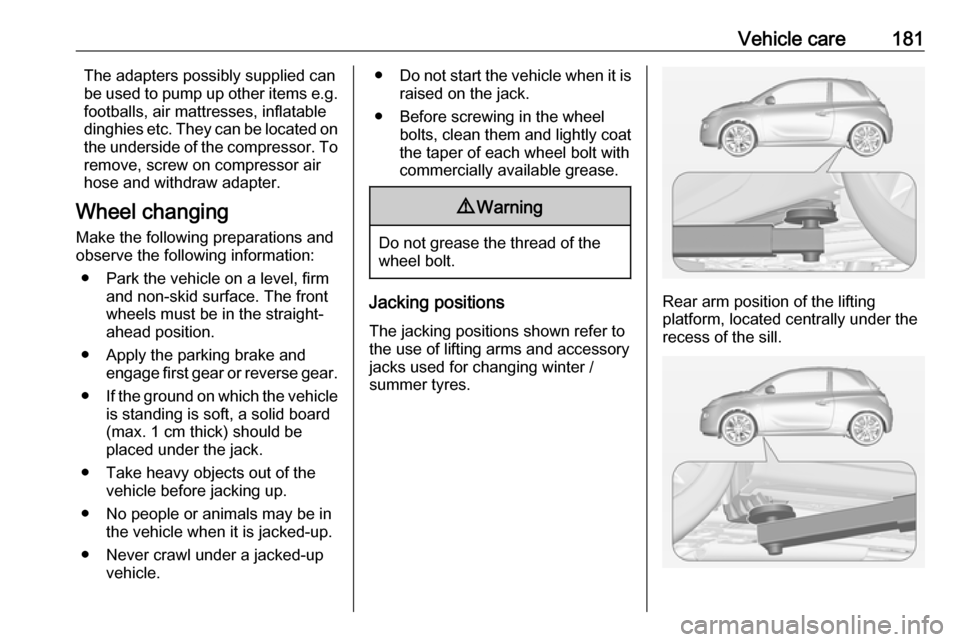
Jacking positions
The jacking positions shown refer to the use of lifting arms and accessory
jacks used for changing winter /
summer tyres.Rear arm position of the lifting
platform, located centrally under the
recess of the sill.
Page 185 of 223

Vehicle care1836.Lift the spare wheel holder slightly
by hand and detach the safety
cable.
7. Lower holder all the way and remove spare wheel.
8. Change the wheel 3 181.
The damaged wheel must be
secured in the load compartment,
see below.
9. Lift the empty spare wheel holder and insert the safety cable.
10. Lift the spare wheel holder farther
and engage in catch. The open
side of the catch must point in the direction of travel.
11. Close the empty spare wheel holder by turning the hexagon boltclockwise successively using the
wheel wrench.
12. Close the load compartment floor.
Fitting the spare wheel
Make the following preparations and
observe the following information:
● Park the vehicle on a level, firm and non-skid surface. The front
wheels must be in the straight-
ahead position.
● Apply the parking brake and engage first gear or reverse gear.
● Remove the spare wheel.
● Never change more than one wheel at once.
● Use the jack only to change wheels in case of puncture, not
for seasonal winter or summer
tyre change.
● The jack is maintenance-free.
● If the ground on which the vehicle
is standing is soft, a solid board
(max. 1 cm thick) should be
placed under the jack.● Take heavy objects out of the vehicle before jacking up.
● No people or animals may be in the vehicle when it is jacked-up.
● Never crawl under a jacked-up vehicle.
● Do not start the vehicle when it is
raised on the jack.
● Before screwing in the wheel bolts, clean them and lightly coat
the taper of each wheel bolt with
commercially available grease.9 Warning
Do not grease the thread of the
wheel bolt.
1. Steel wheels
Pull off the wheel cover.
Alloy wheels with bolt caps Disengage wheel bolt caps with a
screwdriver and remove. To
protect the wheel, place a soft
cloth between the screwdriver
and the alloy wheel.
Alloy wheels with centre cap
Page 191 of 223
Vehicle care189● Apply the parking brake,transmission in neutral.
● Open the positive terminal protection caps of both vehicle
batteries.
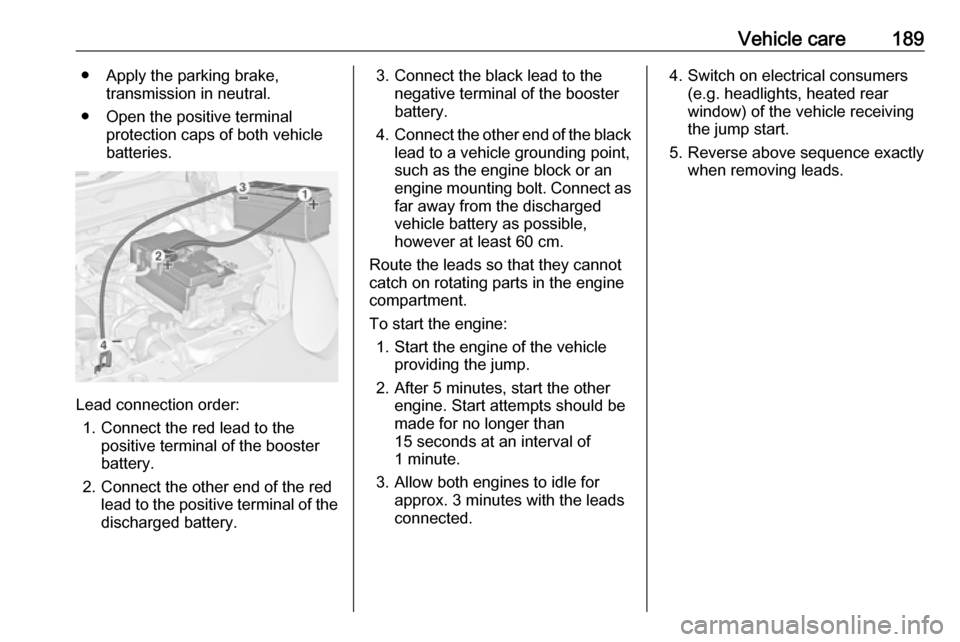
Lead connection order:
1. Connect the red lead to the positive terminal of the booster
battery.
2. Connect the other end of the red lead to the positive terminal of the
discharged battery.
3. Connect the black lead to the negative terminal of the booster
battery.
4. Connect the other end of the black
lead to a vehicle grounding point,
such as the engine block or an
engine mounting bolt. Connect as far away from the discharged
vehicle battery as possible,
however at least 60 cm.
Route the leads so that they cannot
catch on rotating parts in the engine
compartment.
To start the engine: 1. Start the engine of the vehicle providing the jump.
2. After 5 minutes, start the other engine. Start attempts should be
made for no longer than
15 seconds at an interval of
1 minute.
3. Allow both engines to idle for approx. 3 minutes with the leads
connected.4. Switch on electrical consumers (e.g. headlights, heated rear
window) of the vehicle receiving
the jump start.
5. Reverse above sequence exactly when removing leads.
Page 193 of 223
Vehicle care191
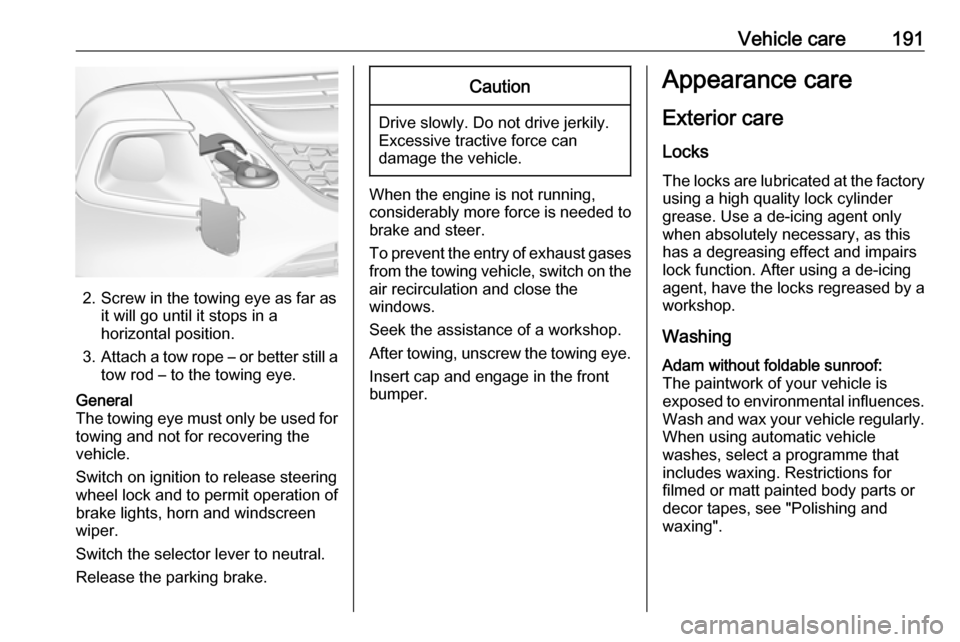
2. Screw in the towing eye as far asit will go until it stops in a
horizontal position.
3. Attach a tow rope – or better still a
tow rod – to the towing eye.
General
The towing eye must only be used for
towing and not for recovering the
vehicle.
Switch on ignition to release steering
wheel lock and to permit operation of
brake lights, horn and windscreen
wiper.
Switch the selector lever to neutral.
Release the parking brake.Caution
Drive slowly. Do not drive jerkily.
Excessive tractive force can
damage the vehicle.
When the engine is not running,
considerably more force is needed to
brake and steer.
To prevent the entry of exhaust gases from the towing vehicle, switch on the
air recirculation and close the
windows.
Seek the assistance of a workshop.
After towing, unscrew the towing eye.
Insert cap and engage in the front
bumper.
Appearance care
Exterior care
Locks The locks are lubricated at the factoryusing a high quality lock cylinder
grease. Use a de-icing agent only
when absolutely necessary, as this has a degreasing effect and impairs
lock function. After using a de-icing
agent, have the locks regreased by a
workshop.
WashingAdam without foldable sunroof:
The paintwork of your vehicle is
exposed to environmental influences.
Wash and wax your vehicle regularly.
When using automatic vehicle
washes, select a programme that
includes waxing. Restrictions for
filmed or matt painted body parts or
decor tapes, see "Polishing and
waxing".
Page 215 of 223

Customer information213Operating data in the vehicleControl units process data for
operation of the vehicle.
This data includes, e.g.: ● vehicle status information (e.g. speed, movement delay, lateral
acceleration, wheel rotation rate,
"seat belts fastened" display)
● ambient conditions (e.g. temperature, rain sensor,
distance sensor)
As a rule such data is transient, not
stored for longer than an operational
cycle, and only processed on board
the vehicle itself. Control units often
include data storage (including the
vehicle key). This is used to allow
information to be documented
temporarily or permanently on vehicle
condition, component stress,
maintenance requirements and
technical events and errors.Depending on technical equipment
levels, the data stored is as follows:
● system component operating states (e.g. fill level, tyre
pressure, battery status)
● faults and defects in important system components (e.g. lights,brakes)
● system reactions in special driving situations (e.g. triggering
of an airbag, actuation of the
stability control systems)
● information on events damaging the vehicle
● for electric vehicles the amount of
charge in the high-voltage
battery, estimated range
In special cases (e.g. if the vehicle
has detected a malfunction), it may be
necessary to save data that would
otherwise just be volatile.
When you use services (e.g. repairs,
maintenance), the operating data
saved can be read together with the
vehicle identification number and
used where necessary. Staff working
for the service network ( e.g. garages,
manufacturers) or third parties (e.g.breakdown services) can read the
data from the vehicle. The same
applies to warranty work and quality
assurance measures.
Data is generally read via the OBD
(On-Board Diagnostics) port
prescribed by law in the vehicle. The operating datawhich is read out,
documents the technical condition of
the vehicle or individual components
and assists with fault diagnosis,
compliance with warranty obligations
and quality improvement. This data,
in particular information on
component stress, technical events,
operator errors and other faults, is
transmitted to the manufacturer
where appropriate, together with the
vehicle identification number. The
manufacturer is also subject to
product liability. The manufacturer
potentially also uses operating data
from vehicles for product recalls. This
data can also be used to check
customer warranty and guarantee
claims.
Fault memories in the vehicle can be
reset by a service company when
carrying out servicing or repairs or at
your request.
Page 218 of 223

216IndexAAccessories and vehicle modifications .......................... 148
Adjustable air vents ...................113
Airbag and belt tensioners ...........75
Airbag deactivation ................43, 75
Airbag label................................... 38 Airbag system .............................. 38
Air conditioning regular operation ................................ 114
Air conditioning system .............. 107
Air intake .................................... 114
Air vents...................................... 113
Antilock brake system ................ 123
Antilock brake system (ABS) .......77
Anti-theft locking system .............. 25
Appearance care ........................191
Ashtrays ....................................... 67
Automatic anti-dazzle ..................27
Automatic light control .................99
Automatic locking ........................23
Autostop ..................................... 118
B Battery discharge protection ......105
Battery voltage ............................. 89
Belts.............................................. 36
Bonnet ....................................... 150
Brake and clutch fluid .................196
Brake and clutch system .............76Brake assist ............................... 125
Brake fluid .................................. 153
Brakes ............................... 123, 153
Breakdown.................................. 190
Bulb replacement ....................... 155
C Capacities .................................. 205
Catalytic converter .....................122
Central locking system ................21
Changing tyre and wheel size ...176
Charging system .......................... 75
Child restraint installation locations ................................... 48
Child restraints.............................. 45
Child restraint systems ................45
Cigarette lighter ........................... 67
City mode ................................... 128
Climate control ............................. 15
Climate control systems .............106
Clock ............................................ 65
Code ............................................. 87
Control indicators.......................... 72
Control of the vehicle .................115
Controls ........................................ 61
Convex shape .............................. 26
Coolant and antifreeze ...............196
Cruise control ...................... 79, 129
Cupholders .................................. 51
Curtain airbag system .................. 43
Page 219 of 223

217DDanger, Warnings and Cautions ...4
Daytime running lights ...............100
Declaration of conformity ............207
Door open .................................... 79
Doors ............................................ 24
Driver assistance systems ..........129
Driver Information Centre .............80
Driving hints ................................ 115
E Electric adjustment ......................26
Electrical system......................... 164
Electronic climate control system 109
Electronic Stability Control.......... 126
Electronic Stability Control and Traction Control system ............77
Electronic Stability Control off....... 77
End-of-life vehicle recovery .......149
Engine compartment fuse box ...165
Engine coolant ........................... 152
Engine coolant temperature gauge ....................................... 70
Engine data ............................... 203
Engine exhaust .......................... 121
Engine identification ...................199
Engine oil ...........151, 196, 200, 205
Engine oil pressure ......................78
Entry lighting .............................. 104
Event data recorders ..................212Exhaust filter ......................... 78, 121
Exit lighting ................................ 104
Exterior care .............................. 191
Exterior light ................................. 79
Exterior lighting ......................12, 98
Exterior mirrors ............................. 26
F First aid ......................................... 57
First aid kit ................................... 57
Fixed air vents ........................... 114
Folding mirrors ............................. 26
Front airbag system .....................42
Front seats.................................... 32
Front storage ................................ 52
Front turn lights .......................... 158
Fuel............................................. 142
Fuel for liquid gas operation .......144
Fuel for petrol engines ...............142
Fuel gauge ................................... 69 Fuel selector ................................ 69
Fuel tank ..................................... 205
Fuses ......................................... 164
G Gauges ......................................... 68
Gear shifting ................................. 77
Glass panel .................................. 30
Glovebox ..................................... 51H
Halogen headlights ....................155
Hand brake ......................... 123, 124
Hazard warning flashers ............100
Headlight flash ............................. 99
Headlight range adjustment ......100
Headlights..................................... 98
Headlights when driving abroad 100
Head restraint adjustment .............8
Head restraints ............................ 31
Heated mirrors ............................. 26
Heated rear window ..................... 29
Heated steering wheel .................61
Heating ........................................ 35
Heating and ventilation system . 106
High beam ............................. 79, 99
Hill start assist ........................... 125
Horn ....................................... 13, 62
I
Identification plate .....................199
Ignition switch positions .............116
Immobiliser ............................ 25, 79
Indicators ...................................... 68
Info Display ................................... 85
Information displays...................... 80
Instrument cluster ........................68
Instrument panel fuse box .........167
Instrument panel illumination control .................................... 102