oil pressure VAUXHALL ADAM 2019 Owner's Manual
[x] Cancel search | Manufacturer: VAUXHALL, Model Year: 2019, Model line: ADAM, Model: VAUXHALL ADAM 2019Pages: 223, PDF Size: 6.54 MB
Page 18 of 223
16In briefTransmission
Manual transmission
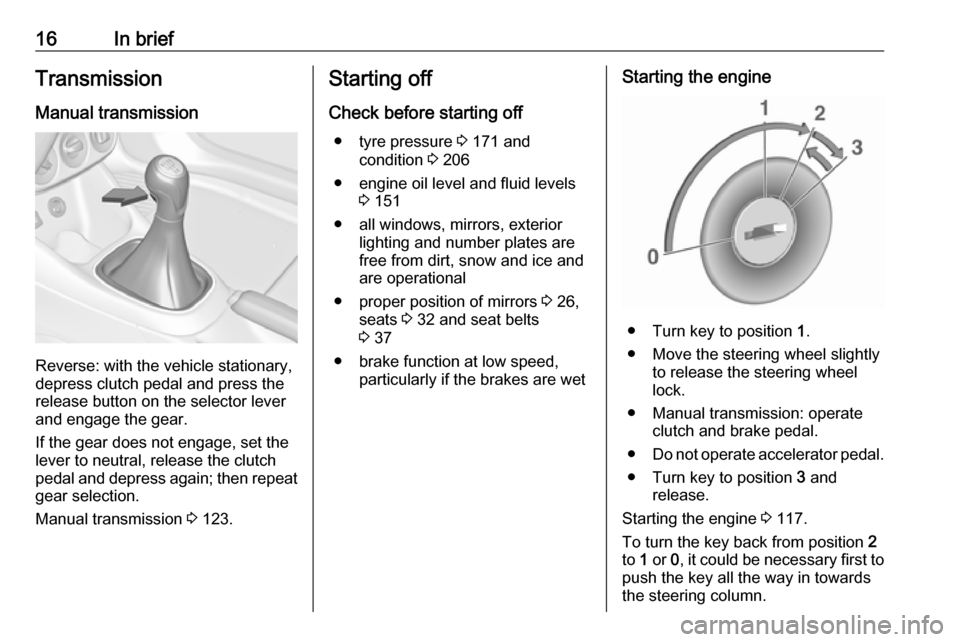
Reverse: with the vehicle stationary,
depress clutch pedal and press the release button on the selector lever
and engage the gear.
If the gear does not engage, set the
lever to neutral, release the clutch
pedal and depress again; then repeat
gear selection.
Manual transmission 3 123.
Starting off
Check before starting off ● tyre pressure 3 171 and
condition 3 206
● engine oil level and fluid levels 3 151
● all windows, mirrors, exterior lighting and number plates are
free from dirt, snow and ice and
are operational
● proper position of mirrors 3 26,
seats 3 32 and seat belts
3 37
● brake function at low speed, particularly if the brakes are wetStarting the engine
● Turn key to position 1.
● Move the steering wheel slightly to release the steering wheel
lock.
● Manual transmission: operate clutch and brake pedal.
● Do not operate accelerator pedal.
● Turn key to position 3 and
release.
Starting the engine 3 117.
To turn the key back from position 2
to 1 or 0, it could be necessary first to
push the key all the way in towards the steering column.
Page 62 of 223

60Instruments and controlsInstruments and
controlsControls ....................................... 61
Steering wheel adjustment ........61
Steering wheel controls .............61
Heated steering wheel ...............61
Horn ........................................... 62
Windscreen wiper and washer ..62
Rear window wiper and washer ...................................... 63
Outside temperature ..................64
Clock ......................................... 65
Power outlets ............................. 66
Cigarette lighter ......................... 67
Ashtrays .................................... 67
Warning lights, gauges and indi‐ cators ........................................... 68
Instrument cluster ......................68
Speedometer ............................. 68
Odometer .................................. 68
Trip odometer ............................ 68
Tachometer ............................... 68
Fuel gauge ................................ 69
Fuel selector .............................. 69
Engine coolant temperature gauge ....................................... 70Service display.......................... 71
Control indicators ......................72
Turn lights .................................. 74
Seat belt reminder .....................74
Airbag and belt tensioners .........75
Airbag deactivation ....................75
Charging system .......................75
Malfunction indicator light ..........76
Service vehicle soon .................76
Brake and clutch system ...........76
Operate pedal ............................ 76
Antilock brake system (ABS) .....77
Gear shifting .............................. 77
Power steering .......................... 77
Parking assist ............................ 77
Electronic Stability Control off ...77
Electronic Stability Control and Traction Control system ...........77
Exhaust filter .............................. 78
Tyre pressure monitoring system ...................................... 78
Engine oil pressure ....................78
Low fuel ..................................... 79
Immobiliser ................................ 79
Exterior light .............................. 79
High beam ................................. 79
Rear fog light ............................. 79
Cruise control ............................ 79
Door open .................................. 79Displays....................................... 80
Driver Information Centre ..........80
Info Display ................................ 85
Vehicle messages ........................87
Warning chimes .........................89
Battery voltage .......................... 89
Vehicle personalisation ................90
Telematics service .......................93
OnStar ....................................... 93
Page 76 of 223
74Instruments and controlsControl indicators in the centre
console
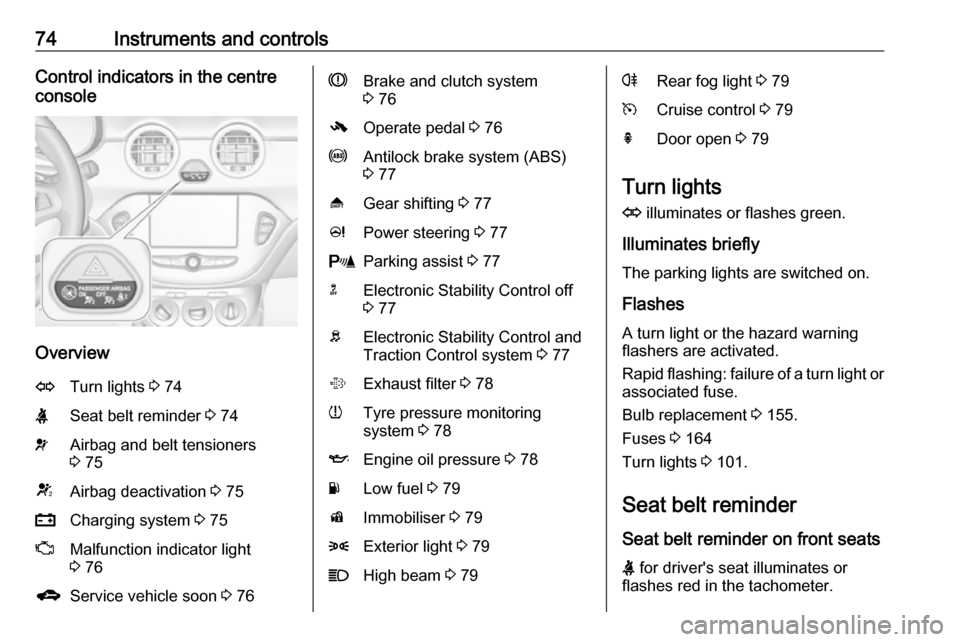
Overview
OTurn lights 3 74XSeat belt reminder 3 74vAirbag and belt tensioners
3 75VAirbag deactivation 3 75pCharging system 3 75ZMalfunction indicator light
3 76gService vehicle soon 3 76RBrake and clutch system
3 76-Operate pedal 3 76uAntilock brake system (ABS)
3 77[Gear shifting 3 77cPower steering 3 77rParking assist 3 77nElectronic Stability Control off
3 77bElectronic Stability Control and
Traction Control system 3 77%Exhaust filter 3 78wTyre pressure monitoring
system 3 78IEngine oil pressure 3 78YLow fuel 3 79dImmobiliser 3 798Exterior light 3 79CHigh beam 3 79rRear fog light 3 79mCruise control 3 79hDoor open 3 79
Turn lights
O illuminates or flashes green.
Illuminates briefly The parking lights are switched on.
Flashes
A turn light or the hazard warning
flashers are activated.
Rapid flashing: failure of a turn light or associated fuse.
Bulb replacement 3 155.
Fuses 3 164
Turn lights 3 101.
Seat belt reminder
Seat belt reminder on front seats
X for driver's seat illuminates or
flashes red in the tachometer.
Page 80 of 223

78Instruments and controlsoperational. Driving stability,
however, may deteriorate depending
on road surface conditions.
Have the cause of the fault remedied
by a workshop.
Electronic Stability Control 3 126.
Traction Control system 3 125.
Exhaust filter % illuminates or flashes yellow.
The exhaust filter requires cleaning.
Continue driving until %
extinguishes. If possible, do not allow engine speed to drop below
2000 rpm.
Illuminates
The exhaust filter is full. Start cleaning
process as soon as possible.
Flashes
The maximum filling level of the filter
is reached. Start cleaning process
immediately to avoid damage to the
engine.
Exhaust filter 3 121.Stop-start system 3 118.
Tyre pressure monitoring system
w illuminates or flashes yellow.
Illuminates
Tyre pressure loss. Stop immediately
and check tyre pressure.
Flashes
Fault in system or tyre without
pressure sensor mounted (e.g. spare
wheel). After 60-90 seconds the
control indicator illuminates
continuously. Consult a workshop.
Tyre pressure monitoring system3 172.
Engine oil pressure
I illuminates red.
Illuminates when the ignition is
switched on and extinguishes shortly
after the engine starts.Illuminates when the engine is
runningCaution
Engine lubrication may be
interrupted. This may result in
damage to the engine and / or
locking of the drive wheels.
1. Depress the clutch.
2. Select neutral gear.
3. Move out of the flow of traffic as quickly as possible without
impeding other vehicles.
4. Switch off ignition.
9 Warning
When the engine is off,
considerably more force is needed
to brake and steer.
During an Autostop the brake
servo unit will still be operational.
Page 90 of 223

88Instruments and controlsNo.Vehicle message28Right rear turn light failure35Replace battery in radio remote
control48Clean side blind spot alert
system53Tighten fuel filler cap55Exhaust filter is full 3 12156Tyre pressure imbalance on
front axle57Tyre pressure imbalance on
rear axle58Winter tyres detection59Open then close driver window60Open then close front
passenger window66Service theft alarm system67Service steering wheel lock68Service power steering75Service air conditioningNo.Vehicle message76Service side blind spot alert
system79Top up engine oil82Change engine oil soon84Engine power reduced89Service vehicle soon90Service brake assist95Service airbag128Bonnet open134Parking assist fault, clean
bumper136Service parking assist151Press clutch to start174Low vehicle battery258Parking assist offVehicle messages on the Uplevel
Display
The vehicle messages are displayed
as text. Follow the instructions given
in the messages.
Vehicle messages on the
Colour Info Display
Some important messages appear
additionally in the
Colour Info Display. Some messages
only pop-up for a few seconds.
Page 97 of 223

Instruments and controls95breakdown, a flat tyre and empty fuel
tank, press Z to establish a
connection to an advisor.
Emergency services
In the case of an emergency situation,
press [ and talk to an advisor. The
advisor then contacts emergency or
assistance service providers and
directs them to your vehicle.
In the case of an accident with
activation of airbags or belt
tensioners, an automatic emergency
call is established. The advisor is
immediately connected to your
vehicle to see whether help is
needed.
Wi-Fi hotspot
The Wi-Fi hotspot of the vehicle
provides internet connectivity with a
maximum speed of 4G/LTE.
Notice
The Wi-Fi hotspot functionality is not
available for all markets.
Notice
Some mobile devices connect to Wi- Fi hotspots automatically and use
mobile data capacity in thebackground, even if they are not in use. This includes automatic
updates, downloads, as well as
programme or app synchronisation
traffic. The data volume purchased
via OnStar might be consumed
rapidly. Turn off automatic
synchronisations in the settings of
your device.
Up to seven devices may be
connected.
To connect a mobile device with the
Wi-Fi hotspot:
1. Press j and then select Wi-Fi
settings on the Info Display. The settings displayed include the
Wi-Fi hotspot name (SSID),
password and connection type.
2. Start a Wi-Fi network search on your mobile device.
3. Select your vehicle hotspot (SSID) when listed.
4. When prompted, enter the password on your mobile device.
Notice
To change the SSID or password,
press Z and talk to an advisor or log
in to your account.To switch off the Wi-Fi hotspot
functionality, press Z to call an
advisor.
Smartphone app
With the My Vauxhall smartphone
app, some vehicle functions can be
operated remotely.
The following functions are available: ● Lock or unlock vehicle.
● Honk horn or flash lights.
● Check fuel level, engine oil life and tyre pressure (only with tyre
pressure monitoring system).
● Send navigation destination to the vehicle, if equipped with a
built-in navigation system.
● Locate vehicle on a map.
● Manage Wi-Fi settings.
To operate these functions, download the app from App Store ®
or
Google Play™ Store.
Page 146 of 223
144Driving and operatingFuel for liquid gas operation
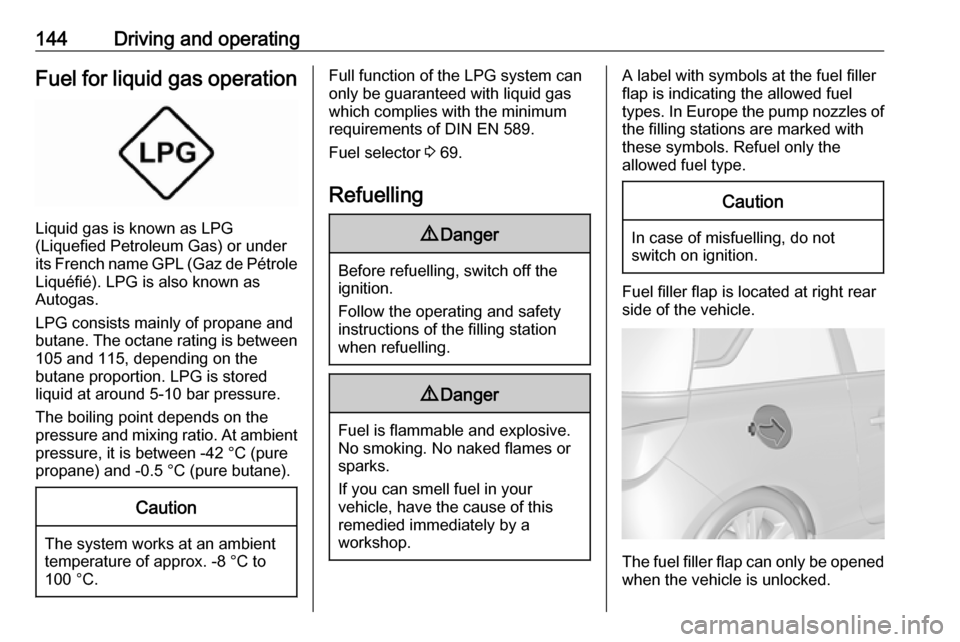
Liquid gas is known as LPG
(Liquefied Petroleum Gas) or under its French name GPL (Gaz de Pétrole Liquéfié). LPG is also known as
Autogas.
LPG consists mainly of propane and
butane. The octane rating is between
105 and 115, depending on the
butane proportion. LPG is stored
liquid at around 5-10 bar pressure.
The boiling point depends on the
pressure and mixing ratio. At ambient pressure, it is between -42 °C (pure
propane) and -0.5 °C (pure butane).
Caution
The system works at an ambient
temperature of approx. -8 °C to
100 °C.
Full function of the LPG system can
only be guaranteed with liquid gas
which complies with the minimum
requirements of DIN EN 589.
Fuel selector 3 69.
Refuelling9 Danger
Before refuelling, switch off the
ignition.
Follow the operating and safety
instructions of the filling station
when refuelling.
9 Danger
Fuel is flammable and explosive.
No smoking. No naked flames or
sparks.
If you can smell fuel in your
vehicle, have the cause of this
remedied immediately by a
workshop.
A label with symbols at the fuel filler
flap is indicating the allowed fuel
types. In Europe the pump nozzles of the filling stations are marked with
these symbols. Refuel only the
allowed fuel type.Caution
In case of misfuelling, do not
switch on ignition.
Fuel filler flap is located at right rear
side of the vehicle.
The fuel filler flap can only be opened
when the vehicle is unlocked.
Page 150 of 223

148Vehicle careVehicle careGeneral Information...................148
Accessories and vehicle modifications .......................... 148
Vehicle storage ........................149
End-of-life vehicle recovery .....149
Vehicle checks ........................... 150
Performing work ......................150
Bonnet ..................................... 150
Engine oil ................................. 151
Engine coolant ......................... 152
Washer fluid ............................ 152
Brakes ..................................... 153
Brake fluid ............................... 153
Vehicle battery ......................... 153
Wiper blade replacement ........155
Bulb replacement .......................155
Halogen headlights ..................155
Front turn lights .......................158
Tail lights ................................. 159
Side turn lights ......................... 162
Number plate light ...................163
Interior lights ............................ 164
Electrical system ........................164
Fuses ....................................... 164Engine compartment fuse box . 165
Instrument panel fuse box .......167
Vehicle tools .............................. 169
Tools ........................................ 169
Wheels and tyres .......................170
Winter tyres ............................. 170
Tyre designations ....................171
Tyre pressure .......................... 171
Tyre pressure monitoring system .................................... 172
Tread depth ............................. 175
Changing tyre and wheel size . 176
Wheel covers ........................... 176
Tyre chains .............................. 176
Tyre repair kit .......................... 177
Wheel changing .......................181
Spare wheel ............................ 182
Jump starting ............................. 188
Towing ....................................... 190
Towing the vehicle ...................190
Appearance care .......................191
Exterior care ............................ 191
Interior care ............................. 194General Information
Accessories and vehiclemodifications
We recommend the use of genuine
parts and accessories and factory
approved parts specific for your
vehicle type. We cannot assess or
guarantee reliability of other products - even if they have a regulatory or
otherwise granted approval.
Any modification, conversion or other
changes made to standard vehicle
specifications (including, without
limitation, software modifications,
modifications of the electronic control units) may invalidate the warranty
offered by Vauxhall. Furthermore,
such changes may affect driver
assistance systems, fuel
consumption, CO 2 emissions and
other emissions of the vehicle. They
may also invalidate the vehicle
operating permit.
Page 151 of 223

Vehicle care149Caution
When transporting the vehicle on
a train or on a recovery vehicle, the
mud flaps might be damaged.
Vehicle storage
Storage for a long period of time
If the vehicle is to be stored for several months:
● Wash and wax the vehicle.
● Have the wax in the engine compartment and underbody
checked.
● Clean and preserve the rubber seals.
● Fill up fuel tank completely.
● Change the engine oil.
● Drain the washer fluid reservoir.
● Check the coolant antifreeze and
corrosion protection.
● Adjust tyre pressure to the value specified for full load.
● Park the vehicle in a dry, wellventilated place. Engage first or
reverse gear. Prevent the vehicle from rolling.
● Do not apply the parking brake.
● Open the bonnet, close all doors and lock the vehicle.
● Disconnect the clamp from the negative terminal of the vehicle
battery. Beware that all systems are not functional.
Putting back into operation
When the vehicle is to be put back into
operation:
● Connect the clamp to the negative terminal of the vehicle
battery. Activate the electronics
of the power windows.
● Check tyre pressure.
● Fill up the washer fluid reservoir. ● Check the engine oil level.
● Check the coolant level.
● Fit the number plate if necessary.End-of-life vehicle recovery
Information on end-of-life vehicle
recovery centres and the recycling of
end-of-life vehicles is available on our website. Only entrust this work to an
authorised recycling centre.
Gas vehicles must be recycled by a
service centre authorised for gas
vehicles.
Page 196 of 223
194Vehicle careAfter the underbody is washed, checkthe underbody and have it waxed if
necessary.
Bitumen / rubber materials could
damage the PVC coating. Have
underbody work carried out by a
workshop.
Before and after winter, wash the
underbody and have the protective
wax coating checked.
Liquid gas system9 Danger
Liquid gas is heavier than air and
can collect in sink points.
Take care when performing work
at the underbody in a pit.
For painting work and when using a
drying booth at a temperature above
60 °C, the liquid gas tank must be
removed.
Do not make any modifications to the
liquid gas system.
Rear carrier system
Clean the rear carrier system with a
steam-jet or high-pressure jet cleaner
at least once a year.
Operate the rear carrier system
periodically if not in regular use, in
particular during winter.
Interior care
Interior and upholstery
Only clean the vehicle interior,
including the instrument panel fascia
and panelling, with a dry cloth or
interior cleaner.
Clean the leather upholstery with
clear water and a soft cloth. In case of heavy soiling, use leather care.
The instrument cluster and the
displays should only be cleaned using
a soft damp cloth. If necessary use a
weak soap solution.
Clean fabric upholstery with a
vacuum cleaner and brush. Remove
stains with an upholstery cleaner.Clothing fabrics may not be
colourfast. This could cause visible
discolourations, especially on light- coloured upholstery. Removable
stains and discolourations should be
cleaned as soon as possible.
Clean seat belts with lukewarm water or interior cleaner.Caution
Close Velcro fasteners as open
Velcro fasteners on clothing could damage seat upholstery.
The same applies to clothing with
sharp-edged objects, like zips or
belts or studded jeans.
Plastic and rubber parts
Plastic and rubber parts can be
cleaned with the same cleaner as
used to clean the body. Use interior cleaner if necessary. Do not use any
other agent. Avoid solvents and petrol
in particular. Do not use high-
pressure jet cleaners.