sunroof VAUXHALL ANTARA 2015 Owner's Manual
[x] Cancel search | Manufacturer: VAUXHALL, Model Year: 2015, Model line: ANTARA, Model: VAUXHALL ANTARA 2015Pages: 223, PDF Size: 6.07 MB
Page 20 of 223

18In briefFor vehicles with automatic
transmission, depress foot
brake and shift into P before
pushing key into ignition switch and removing.
■ If the vehicle is on a level surface or uphill slope, engage
first gear or move the selector
lever to P before switching off
the ignition. On an uphill slope, turn the front wheels away from
the kerb.
If the vehicle is on a downhill
slope, engage reverse gear or
move the selector lever to P
before switching off the ignition. Turn the front wheels towards
the kerb.
■ Close windows and sunroof.
■ Lock the vehicle with button p on
the radio remote control 3 21.
■ Activate the anti-theft alarm system
3 25.
■ The engine cooling fans may run
after the engine has been switched
off 3 153.
■ After running at high engine speeds
or with high engine loads, operate the engine briefly at a low load or
run in neutral for approx.
1 or 2 minutes, before switching off in order to protect the turbocharger.
Keys, locks 3 19, Laying the vehicle
up for a long period of time 3 152.
Page 23 of 223
Keys, doors and windows21
Key with fixed key sectionOpen the unit with a small screwdriver in the notch on the cover. Replace the
battery (battery type CR2032), paying
attention to the installation position.
Close the unit.
Central locking system Unlocks and locks doors, load
compartment and fuel filler flap.
A pull on an interior door handle
unlocks the respective door. Pulling
the handle once more opens the door.
Notice
In the event of an accident in which
airbags or belt pretensioners are
deployed, the vehicle is
automatically unlocked.Unlocking
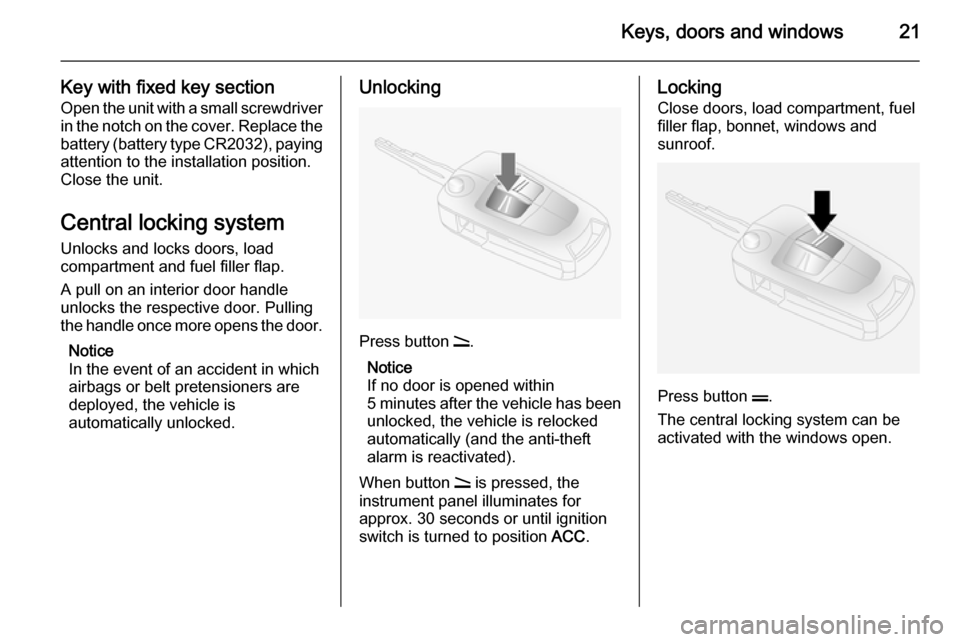
Press button q.
Notice
If no door is opened within
5 minutes after the vehicle has been unlocked, the vehicle is relocked
automatically (and the anti-theft
alarm is reactivated).
When button q is pressed, the
instrument panel illuminates for
approx. 30 seconds or until ignition
switch is turned to position ACC.
Locking
Close doors, load compartment, fuel
filler flap, bonnet, windows and
sunroof.
Press button p.
The central locking system can be
activated with the windows open.
Page 27 of 223
Keys, doors and windows25
Activating
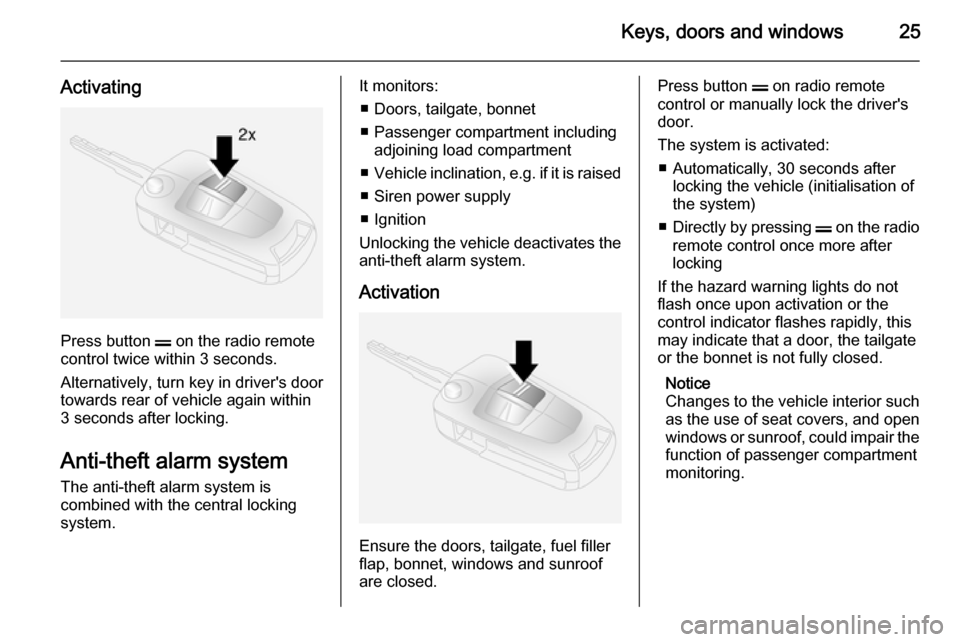
Press button p on the radio remote
control twice within 3 seconds.
Alternatively, turn key in driver's door
towards rear of vehicle again within
3 seconds after locking.
Anti-theft alarm system
The anti-theft alarm system is
combined with the central locking
system.
It monitors:
■ Doors, tailgate, bonnet
■ Passenger compartment including adjoining load compartment
■ Vehicle inclination, e.g. if it is raised
■ Siren power supply
■ Ignition
Unlocking the vehicle deactivates the
anti-theft alarm system.
Activation
Ensure the doors, tailgate, fuel filler
flap, bonnet, windows and sunroof
are closed.
Press button p on radio remote
control or manually lock the driver's
door.
The system is activated: ■ Automatically, 30 seconds after locking the vehicle (initialisation of
the system)
■ Directly by pressing p on the radio
remote control once more after
locking
If the hazard warning lights do not flash once upon activation or the
control indicator flashes rapidly, this
may indicate that a door, the tailgate
or the bonnet is not fully closed.
Notice
Changes to the vehicle interior such
as the use of seat covers, and open
windows or sunroof, could impair the function of passenger compartment
monitoring.
Page 28 of 223
26Keys, doors and windows
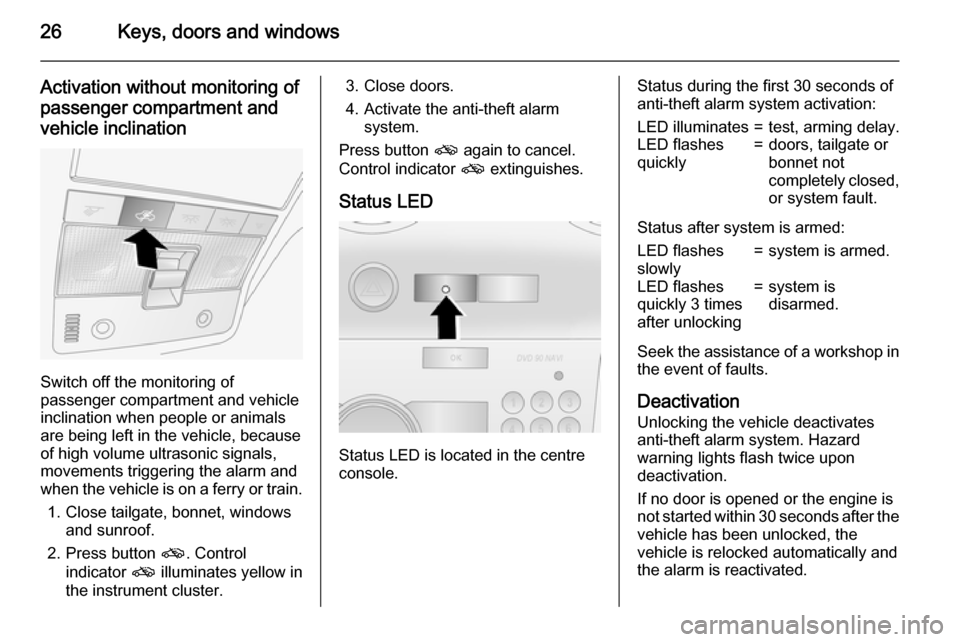
Activation without monitoring of
passenger compartment and
vehicle inclination
Switch off the monitoring of
passenger compartment and vehicle
inclination when people or animals
are being left in the vehicle, because
of high volume ultrasonic signals,
movements triggering the alarm and
when the vehicle is on a ferry or train.
1. Close tailgate, bonnet, windows and sunroof.
2. Press button o. Control
indicator o illuminates yellow in
the instrument cluster.
3. Close doors.
4. Activate the anti-theft alarm system.
Press button o again to cancel.
Control indicator o extinguishes.
Status LED
Status LED is located in the centre
console.
Status during the first 30 seconds of
anti-theft alarm system activation:LED illuminates=test, arming delay.LED flashes
quickly=doors, tailgate or
bonnet not
completely closed,
or system fault.
Status after system is armed:
LED flashes
slowly=system is armed.LED flashes
quickly 3 times
after unlocking=system is
disarmed.
Seek the assistance of a workshop in
the event of faults.
Deactivation
Unlocking the vehicle deactivates
anti-theft alarm system. Hazard
warning lights flash twice upon
deactivation.
If no door is opened or the engine is
not started within 30 seconds after the
vehicle has been unlocked, the
vehicle is relocked automatically and
the alarm is reactivated.
Page 34 of 223
32Keys, doors and windowsHeated rear window
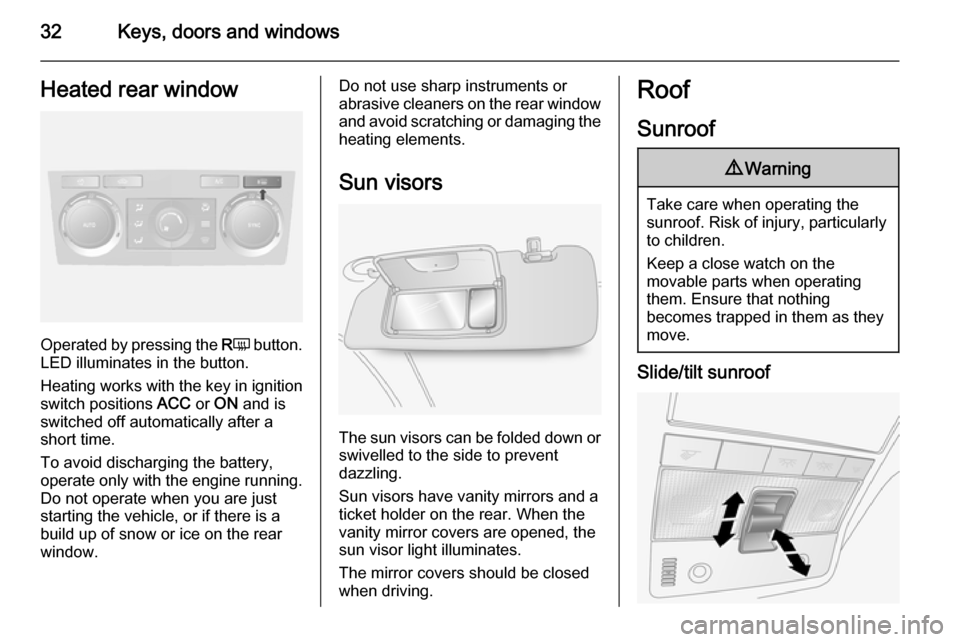
Operated by pressing the RÜ button.
LED illuminates in the button.
Heating works with the key in ignition
switch positions ACC or ON and is
switched off automatically after a
short time.
To avoid discharging the battery, operate only with the engine running. Do not operate when you are juststarting the vehicle, or if there is a
build up of snow or ice on the rear
window.
Do not use sharp instruments or abrasive cleaners on the rear window
and avoid scratching or damaging the
heating elements.
Sun visors
The sun visors can be folded down or swivelled to the side to prevent
dazzling.
Sun visors have vanity mirrors and a
ticket holder on the rear. When the
vanity mirror covers are opened, the
sun visor light illuminates.
The mirror covers should be closed
when driving.
Roof
Sunroof9 Warning
Take care when operating the
sunroof. Risk of injury, particularly to children.
Keep a close watch on the
movable parts when operating
them. Ensure that nothing
becomes trapped in them as they
move.
Slide/tilt sunroof
Page 35 of 223

Keys, doors and windows33
For incremental operation, brieflypress the switch in the required
direction. For automatic opening or
closing, press and hold the switch.
Open
Press switch rearwards; it will open
automatically unless the switch is
pressed again in another direction, or
released.
Notice
If the top of the roof is wet, tilt
sunroof, allow water to run off and
then open sunroof.
Close
Press and hold switch forwards.
Release switch when sunroof
reaches desired position.
Tilt
Press and hold switch upwards.
Release switch when sunroof
reaches desired position.
To return sunroof to its original
position, pull and hold switch
downwards. Release switch when
sunroof reaches desired position.General hints
Function standby
The sunroof can be operated:
■ with ignition on,
■ within 10 minutes of switching ignition off,
After switching off the ignition,
sunroof operation is disabled when
driver's door is opened.
Page 119 of 223

Climate control117
directed to it. If windscreen mists up
from outside, activate windscreen
wiper and deactivate l.
Maximum cooling Briefly open the windows and sunroof
so that hot air can disperse quickly.
■ Press button n to activate air
conditioning.
■ Press button 4 to activate air
recirculation.
■ Set air distribution switch to M.
■ Set temperature control to coldest level.
■ Set fan to highest level.
■ Open all vents.Demisting and defrosting
■ Set the air distribution switch to l
or J.
■ Set temperature control to warmest
level.
■ Set fan to highest level.
■ Close centre air vents.
■ Open side air vents and direct them
towards the door windows.
■ Switch on heated rear window Ü
3 32.
Air conditioning n and air
recirculation 4 are switched on
automatically to improve defrosting
efficiency when position l or J is
selected.
Electronic climate control system The dual zone climate control allows
different climatisation temperatures
for driver and front passenger side.
Controls for:
■ Temperature on driver side
■ Air distribution
Page 130 of 223

128Driving and operating■ Switch off the engine and turnthe ignition key to position
LOCK , push key into ignition
switch and remove.
Turn the steering wheel until the steering wheel lock is felt to
engage.
For vehicles with automatic
transmission, depress foot
brake and shift into P before
pushing key into ignition switch
and removing.
■ If the vehicle is on a level surface or uphill slope, engage
first gear or move the selector
lever to P before switching off
the ignition. On an uphill slope,
turn the front wheels away from
the kerb.
If the vehicle is on a downhill
slope, engage reverse gear or
move the selector lever to P
before switching off the ignition.
Turn the front wheels towards
the kerb.■ Close windows and sunroof.
■ Lock the vehicle with button p on
the radio remote control 3 21.
Activate the anti-theft alarm system
3 25.Engine exhaust9 Danger
Engine exhaust gases contain
poisonous carbon monoxide,
which is colourless and odourless and could be fatal if inhaled.
If exhaust gases enter the interior
of the vehicle, open the windows.
Have the cause of the fault
rectified by a workshop.
Avoid driving with an open load
compartment, otherwise exhaust
gases could enter the vehicle.
Malfunction indicator light 3 85.
Diesel particle filter
The diesel particle filter system filters
harmful soot particles out of the
exhaust gases. The system includes
a self-cleaning function that runs
automatically during driving without
any notification.
Page 177 of 223
Vehicle care175
FuseCircuitRUN 2Power battery
key on runRUN/CRNKRun crankSDM (BATT)Safety Diag‐
nosis Module
(Battery)SDM (IGN 1)Safety Diag‐
nosis Module
(Ignition)SPARE-S/ROOFSunroofS/ROOF BATTSunroof batterySSPSPower steeringSTR/WHL SWSteering wheelTRLRTrailerTRLR BATTTrailer batteryFuseCircuitXBCMExport Body
Control ModuleXM/HVAC/DLCXM satellite
radio, climate
control, data link
connection
After changing of defective fuses
close the fuse box cover and press
until it engages.
If the fuse box cover is not closed
correctly, malfunctions may occur.
Vehicle tools
Tools
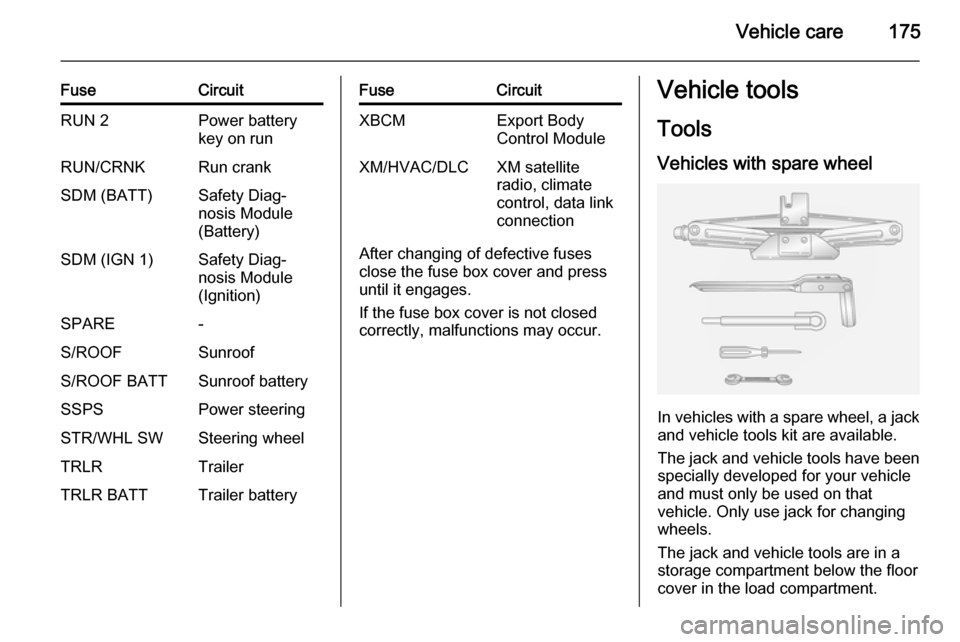
Vehicles with spare wheel
In vehicles with a spare wheel, a jack and vehicle tools kit are available.
The jack and vehicle tools have been
specially developed for your vehicle
and must only be used on that
vehicle. Only use jack for changing
wheels.
The jack and vehicle tools are in a
storage compartment below the floor
cover in the load compartment.
Page 197 of 223

Vehicle care195
When cleaning with a high-pressure
jet cleaner, ensure a minimum
distance of 30 cm when working
around the tailgate to prevent
unintended unlocking.
Thoroughly rinse and leather-off the
vehicle. Rinse leather frequently. Use
separate leathers for painted and
glass surfaces: remnants of wax on
the windows will impair vision.
Exterior lights Headlight and other light covers are
made of plastic. Do not use any
abrasive or caustic agents, do not use
an ice scraper, and do not clean them dry.
Polishing and waxing
Wax the vehicle regularly (at the
latest when water no longer beads).
Otherwise, the paintwork will dry out.
Polishing is necessary only if the paint
has become dull or if solid deposits
have become attached to it.
Paintwork polish with silicone forms a
protective film, making waxing
unnecessary.Plastic body parts must not be treated with wax or polishing agents.
Windows and windscreen wiper blades
Use a soft lint-free cloth or chamois
leather together with window cleaner and insect remover.
When cleaning the rear window,
make sure the heating element inside
is not damaged.
For mechanical removal of ice, use a
sharp-edged ice scraper. Press the
scraper firmly against the glass so
that no dirt can get under it and
scratch the glass.
Clean smearing wiper blades with a
soft cloth and window cleaner.
Sunroof
Never clean with solvents or abrasive
agents, fuels, aggressive media
(e.g. paint cleaner, acetone-
containing solutions etc.), acidic or
highly alkaline media or abrasive
pads. Do not apply wax or polishing
agents to the sunroof.Wheels and tyres
Do not use high-pressure jet
cleaners.
Clean rims with a pH-neutral wheel
cleaner.
Rims are painted and can be treated
with the same agents as the body.
Paintwork damage
Rectify minor paintwork damage with
a touch-up pen before rust forms.
Have more extensive damage or rust areas repaired by a workshop.
Underbody Some areas of the vehicle underbody
have a PVC undercoating while other critical areas have a durable
protective wax coating.
After the underbody is washed, check
the underbody and have it waxed if
necessary.
Bitumen/rubber materials could
damage the PVC coating. Have
underbody work carried out by a
workshop.