lights VAUXHALL ASTRA J 2014 Service Manual
[x] Cancel search | Manufacturer: VAUXHALL, Model Year: 2014, Model line: ASTRA J, Model: VAUXHALL ASTRA J 2014Pages: 329, PDF Size: 10.07 MB
Page 241 of 329

Vehicle care239Tail lights5-door hatchback
1. Release the cover on the respective side and remove it.
2. Unscrew the plastic securing nutfrom the inside by hand.
3. Carefully withdraw the tail lightassembly from recesses and
remove. Make sure that the cable duct remains in position.
4. Detach the cable from the retainer.
5. Detach the wiring plug from the bulb carrier.
6. Unscrew the three screws with a screwdriver and remove the bulb
carrier from the light assembly.
Page 245 of 329

Vehicle care243
2. Remove cover on the respectiveside.
3. Unscrew two plastic securing nuts
from the inside by hand.
4. Carefully withdraw tail light assembly from recesses and
remove. Make sure that the cable duct remains in position.
5. Detach wiring plug from bulb carrier.
6. Remove the bulb holder by turning anticlockwise and replace
the bulb by withdrawing or
pushing the bulb slightly into the
socket and rotating anticlockwise:
Tail lights ( 1 + 2)
Turn signal light ( 3)
Brake light ( 4)
7. Connect the wiring plug and press
the cable into the retainer. Fit light assembly with the retaining pins
into the recesses of the car body
and tighten the securing nuts from
the inside of the load
compartment. Attach cover.
When assembling press the blind
on the left-hand side into the
rubber grommets to reach full
retention force.
Page 248 of 329

246Vehicle care
Only turn signal light (2) can be
changed.
6. Insert and turn bulb holder clockwise into the tail light
assembly. Connect the wiring
plug with the light assembly. Fit
light assembly with the retaining
pins into the recesses of the car
body and tighten the securing
nuts from the inside of the load
compartment. Close cover and
engage.
Light assembly in the tailgate
1. Open the tailgate and remove the
covers on the respective side.
2. Unscrew three screws.
3. Remove the tail light assembly from tailgate.
4. Remove the bulb holder by turning and replace the bulb by
withdrawing or pushing the bulb
slightly into the socket and rotating anticlockwise:
Tail light ( 1)
Rear fog light/Reverse light ( 2),
depending on the side.
( 2 ) (only one side)
version with Light Emitting Diode
(LED)
Only rear fog light respectively
reverse light ( 2), depending on the
side, can be changed.
5. Insert and turn bulb holder clockwise into the tail light
assembly. Fit the tail light
assembly in the tailgate and
tighten the screws. Attach all
covers.
Side turn signal lights 3-door hatchback
To replace bulb, remove lamp
housing:
Page 250 of 329

248Vehicle care
4. Insert bulb holder and turnclockwise.
5. Insert left end of the lamp, slide to
the left and insert right end.
Number plate light
1. Insert screwdriver in recess of the
cover, press to the side and
release spring.
2. Remove lamp downwards, taking care not to pull on the cable.
3. Remove bulb holder from lamp housing by turning anticlockwise.
4. Pull bulb from bulb holder andreplace it.
5. Insert bulb holder into lamp housing and turn clockwise.
6. Insert lamp into bumper and let engage.
Interior lights Courtesy light, reading lights
Have bulbs replaced by a workshop.
Load compartment light Have bulbs replaced by a workshop.
Instrument panel
illumination
Have bulbs replaced by a workshop.
Page 253 of 329

Vehicle care251
No.Circuit15Engine control module16Starter17Transmission control module18Heated rear window19Front power windows20Rear power windows21Rear electrical centre22Left high beam (Halogen)23Headlamp washer system24Right low beam (Xenon)25Left low beam (Xenon)26Front fog lights27Diesel fuel heating28Start stop system29Electric parking brake30ABS31Adaptive cruise controlNo.Circuit32Airbag33Adaptive forward lighting, auto‐
matic light control34Exhaust gas recirculation35Exterior mirror, rain sensor36Climate control37Canister vent solenoid38Vacuum pump39Central control module40Windscreen washer, rear
window washer system41Right high beam (Halogen)42Radiator fan43Windscreen wiper44Windscreen wiper45Radiator fan46–No.Circuit47Horn48Radiator fan49Fuel pump50Headlamp levelling, adaptive
forward lighting51Air shutter52Auxiliary heater, diesel engine53Transmission control module,
engine control module54Vacuum pump, instrument
panel cluster, heating ventila‐
tion, air conditioning system
After having changed defective fuses,
close the fuse box cover and press
until it engages.
If the fuse box cover is not closed
correctly, malfunction may occur.
Page 254 of 329
252Vehicle careInstrument panel fuse box
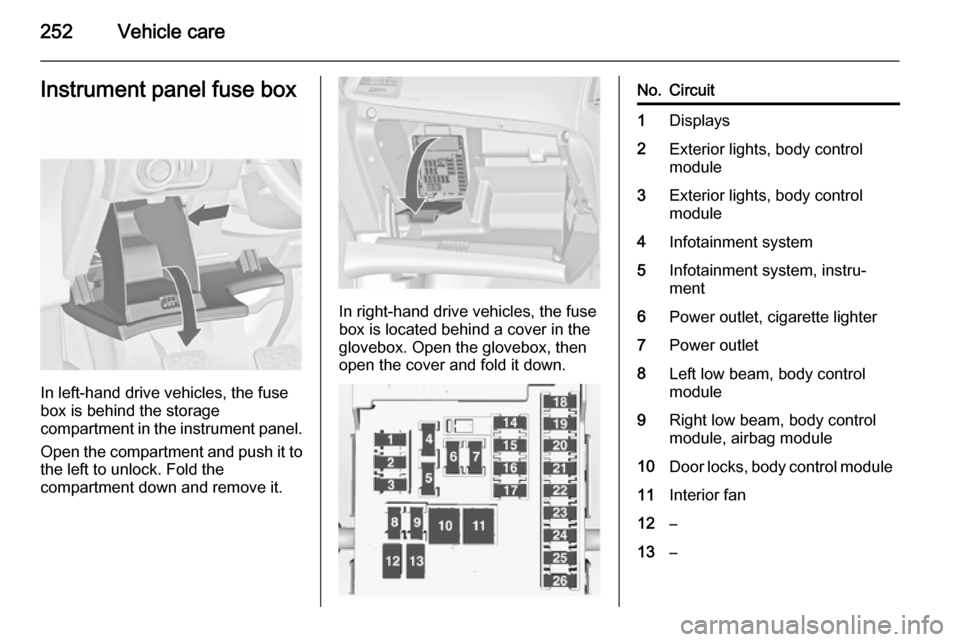
In left-hand drive vehicles, the fuse
box is behind the storage
compartment in the instrument panel.
Open the compartment and push it to the left to unlock. Fold the
compartment down and remove it.
In right-hand drive vehicles, the fuse
box is located behind a cover in the
glovebox. Open the glovebox, then
open the cover and fold it down.
No.Circuit1Displays2Exterior lights, body control
module3Exterior lights, body control
module4Infotainment system5Infotainment system, instru‐
ment6Power outlet, cigarette lighter7Power outlet8Left low beam, body control
module9Right low beam, body control
module, airbag module10Door locks, body control module11Interior fan12–13–
Page 277 of 329
Vehicle care275
Lead connection order:1. Connect the red lead to the positive terminal of the booster
vehicle battery.
2. Connect the other end of the red lead to the positive terminal of the
discharged vehicle battery.
3. Connect the black lead to the negative terminal of the boostervehicle battery.
4. Connect the other end of the black
lead to a vehicle grounding point,
such as the engine block or an
engine mounting bolt. Connect as far away from the discharged
vehicle battery as possible,
however at least 60 cm.
Route the leads so that they cannot
catch on rotating parts in the engine
compartment.
To start the engine: 1. Start the engine of the vehicle providing the jump.2. After 5 minutes, start the otherengine. Start attempts should be
made for no longer than
15 seconds at an interval of
1 minute.
3. Allow both engines to idle for approx. 3 minutes with the leads
connected.
4. Switch on electrical consumers (e.g. headlights, heated rear
window) of the vehicle receiving
the jump start.
5. Reverse above sequence exactly when removing leads.Towing
Towing the vehicle
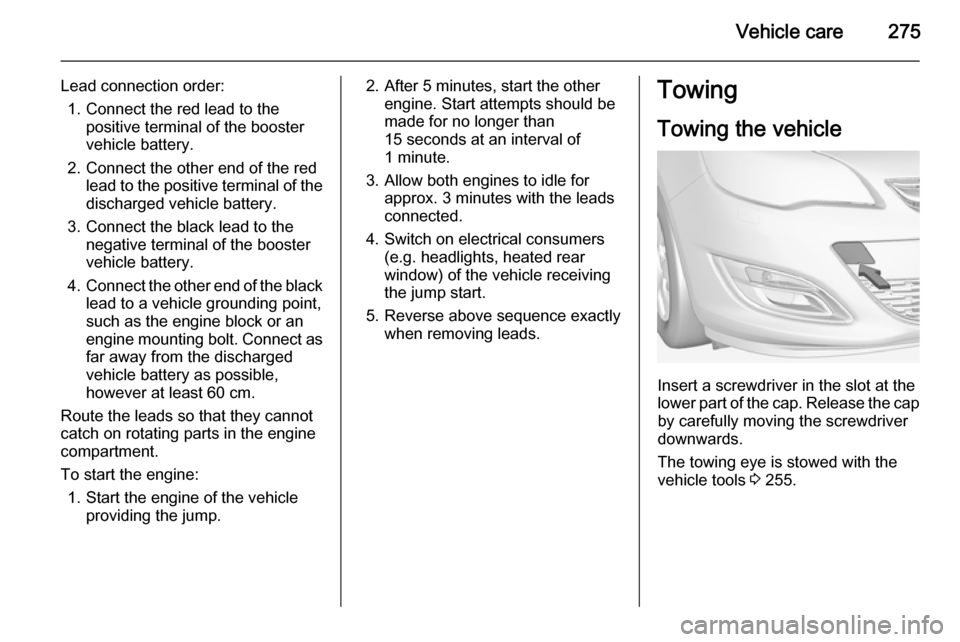
Insert a screwdriver in the slot at the
lower part of the cap. Release the cap
by carefully moving the screwdriver
downwards.
The towing eye is stowed with the
vehicle tools 3 255.
Page 278 of 329

276Vehicle care
Screw in the towing eye as far as it will
go until it stops in a horizontal
position.
Attach a tow rope – or better still a tow
rod – to the towing eye.
The towing eye must only be used for towing and not for recovering the
vehicle.
Switch on ignition to release steering
wheel lock and to permit operation of
brake lights, horn and windscreen
wiper.
Transmission in neutral.
Caution
Drive slowly. Do not drive jerkily.
Excessive tractive force can
damage the vehicle.
When the engine is not running,
considerably more force is needed to
brake and steer.
To prevent the entry of exhaust gases from the towing vehicle, switch on the
air recirculation and close the
windows.
Vehicles with automatic transmission: The vehicle must be towed facing
forwards, not faster than 50 mph nor further than 60 miles. In all other
cases and when the transmission is
defective, the front axle must be
raised off the ground.
Seek the assistance of a workshop. After towing, unscrew the towing eye.
Insert cap at the top and engage
downwards.
Towing another vehicle
Insert a screwdriver in the slot at the
lower bend of the cap. Release the
cap by carefully moving the
screwdriver downwards.
The towing eye is stowed with the
vehicle tools 3 255.
Page 280 of 329
278Vehicle care
If using a vehicle wash, comply with
the vehicle wash manufacturer's
instructions. The windscreen wiper and rear window wiper must be
switched off. Remove antenna and
external accessories such as roof
racks etc.
If you wash your vehicle by hand,
make sure that the insides of the
wheel housings are also thoroughly
rinsed out.
Clean edges and folds on opened
doors and the bonnet as well as the
areas they cover.Caution
Always use a cleaning agent with
a pH value of 4 to 9.
Do not use cleaning agents on hot surfaces.
Have the door hinges of all doors
greased by a workshop.
Do not clean the engine compartment with a steam-jet or high-pressure jet
cleaner.
On vehicles with emblem touchpad:
when cleaning with a high-pressure
jet cleaner ensure a minimum
distance of 30 cm when working
around the tailgate to prevent
unintended unlocking.
Thoroughly rinse and leather-off the
vehicle. Rinse leather frequently. Use
separate leathers for painted and
glass surfaces: remnants of wax on
the windows will impair vision.
Exterior lights
Headlight and other light covers are
made of plastic. Do not use any
abrasive or caustic agents, do not use an ice scraper, and do not clean them
dry.
Polishing and waxing Wax the vehicle regularly (at the
latest when water no longer beads).
Otherwise, the paintwork will dry out.
Polishing is necessary only if the paint
has become dull or if solid deposits
have become attached to it.Paintwork polish with silicone forms a
protective film, making waxing
unnecessary.
Plastic body parts must not be treated with wax or polishing agents.
Windows and windscreen wiper blades
Use a soft lint-free cloth or chamois leather together with window cleanerand insect remover.
When cleaning the rear window from
inside, always wipe in parallel to the
heating element to prevent damage.
For mechanical removal of ice, use a
sharp-edged ice scraper. Press the
scraper firmly against the glass so
that no dirt can get under it and
scratch the glass.
Clean smearing wiper blades with a
soft cloth and window cleaner.
Page 325 of 329

323
Child restraints.............................. 54
Child restraint systems ................54
Cigarette lighter .........................107
Climate control ............................. 17
Climate control systems .............151
Clock........................................... 105
Code ........................................... 126
Control indicators........................ 111
Control of the vehicle .................160
Controls ...................................... 100
Convex shape .............................. 31
Coolant and antifreeze ...............282
Cruise control ....................119, 179
Cupholders .................................. 60
Curtain airbag system .................. 52
Curve lighting.............................. 141
D Danger, Warnings and Cautions ...4
Daytime running lights ...............141
Declaration of conformity ............317
Diesel fuel system bleeding .......228
Diesel particle filter .............117, 166
Door open .................................. 119
Doors ............................................ 26
Driver assistance systems ..........179
Driver Information Centre ...........119
Driving characteristics and towing tips .............................. 215
Driving hints ................................ 160E
Electric adjustment ......................31
Electrical system......................... 249
Electric parking brake .........115, 172
Electric parking brake fault .........115
Electronic climate control system 154
Electronic driving programmes ..169
Electronic Stability Control.......... 175
Electronic Stability Control and Traction Control system .........116
Electronic Stability Control off .... 116
End-of-life vehicle recovery .......222
Engine compartment fuse box ...250
Engine coolant ........................... 224
Engine coolant temperature gauge ..................................... 109
Engine data ............................... 289
Engine exhaust .......................... 166
Engine identification ...................285
Engine oil ................... 223, 282, 286
Engine oil pressure ....................117
Entry lighting .............................. 148
Event data recorders ..................319
Exit lighting ................................ 149
Exterior care .............................. 277
Exterior light ............................... 118
Exterior lighting ....................14, 138
Exterior mirrors ............................. 31F
Fault ........................................... 169
First aid ......................................... 95
First aid kit ................................... 95
Fixed air vents ........................... 159
Flex-Fix system ............................ 64
Fog light ..................................... 119
Fog lights ................................... 234
Folding mirrors ............................. 31
Following distance indication ......192
Forward collision alert................. 189
Front airbag system .....................50
Front fog lights ........................... 145
Front seats.................................... 40
Front storage ................................ 61
Front turn signal lights ...............236
Fuel............................................. 208
Fuel consumption - CO 2-
Emissions ............................... 214
Fuel for diesel engines ..............209
Fuel for liquid gas operation .......209
Fuel for petrol engines ...............208
Fuel gauge ................................. 109
Fuel selector .............................. 109
Fuses ......................................... 249
G Gauges ....................................... 108
General information ...................215