sunroof VAUXHALL ASTRA J 2014 Owner's Manual
[x] Cancel search | Manufacturer: VAUXHALL, Model Year: 2014, Model line: ASTRA J, Model: VAUXHALL ASTRA J 2014Pages: 329, PDF Size: 10.07 MB
Page 22 of 329

20In briefParking■ Always apply the parking brake. Activate the manual parking brake
without pressing the release button. Apply as firmly as possible on a
downhill slope or uphill slope.
Depress foot brake at the same
time to reduce operating force.
For vehicles with electric parking
brake, pull switch m for approx.
one second.
■ Switch off the engine. Turn the ignition key to position 0 and
remove it. Turn the steering wheel
until the steering wheel lock is felt
to engage.
For vehicles with automatic
transmission, the key can only be
removed when the selector lever is in the P position.
■ If the vehicle is on a level surface or
uphill slope, engage first gear or set the selector lever to P before
switching off the ignition. On an
uphill slope, turn the front wheels
away from the kerb.If the vehicle is on a downhill slope, engage reverse gear or set theselector lever to P before switching
off the ignition. Turn the front
wheels towards the kerb.
■ Lock the vehicle with button e on
the radio remote control.
Activate the anti-theft alarm system
3 29.
■ Do not park the vehicle on an easily
ignitable surface. The high
temperature of the exhaust system
could ignite the surface.
■ Close the windows and the sunroof.
■ The engine cooling fans may run after the engine has been switchedoff 3 222.
■ After running at high engine speeds
or with high engine loads, operate
the engine briefly at a low load or
run in neutral for
approx. 30 seconds before
switching off, in order to protect the
turbocharger.
Keys, locks 3 21, Laying the vehicle
up for a long period of time 3 221.
Page 24 of 329
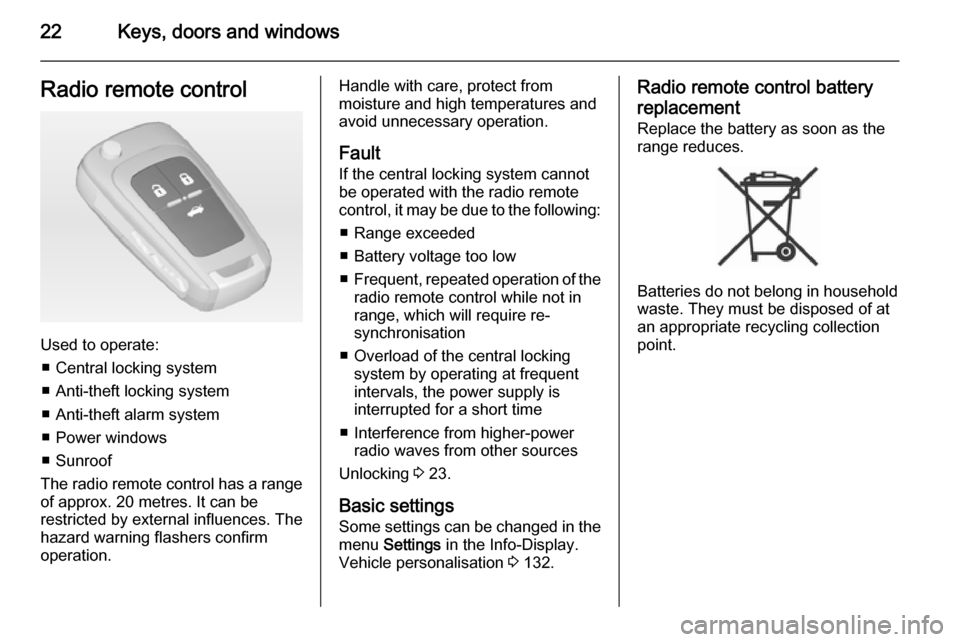
22Keys, doors and windowsRadio remote control
Used to operate:■ Central locking system
■ Anti-theft locking system
■ Anti-theft alarm system
■ Power windows
■ Sunroof
The radio remote control has a range of approx. 20 metres. It can be
restricted by external influences. The
hazard warning flashers confirm
operation.
Handle with care, protect from
moisture and high temperatures and
avoid unnecessary operation.
Fault
If the central locking system cannot
be operated with the radio remote
control, it may be due to the following:
■ Range exceeded
■ Battery voltage too low
■ Frequent, repeated operation of the
radio remote control while not in
range, which will require re-
synchronisation
■ Overload of the central locking system by operating at frequent
intervals, the power supply is
interrupted for a short time
■ Interference from higher-power radio waves from other sources
Unlocking 3 23.
Basic settings
Some settings can be changed in the menu Settings in the Info-Display.
Vehicle personalisation 3 132.Radio remote control battery
replacement
Replace the battery as soon as the
range reduces.
Batteries do not belong in household
waste. They must be disposed of at
an appropriate recycling collection
point.
Page 31 of 329
Keys, doors and windows29
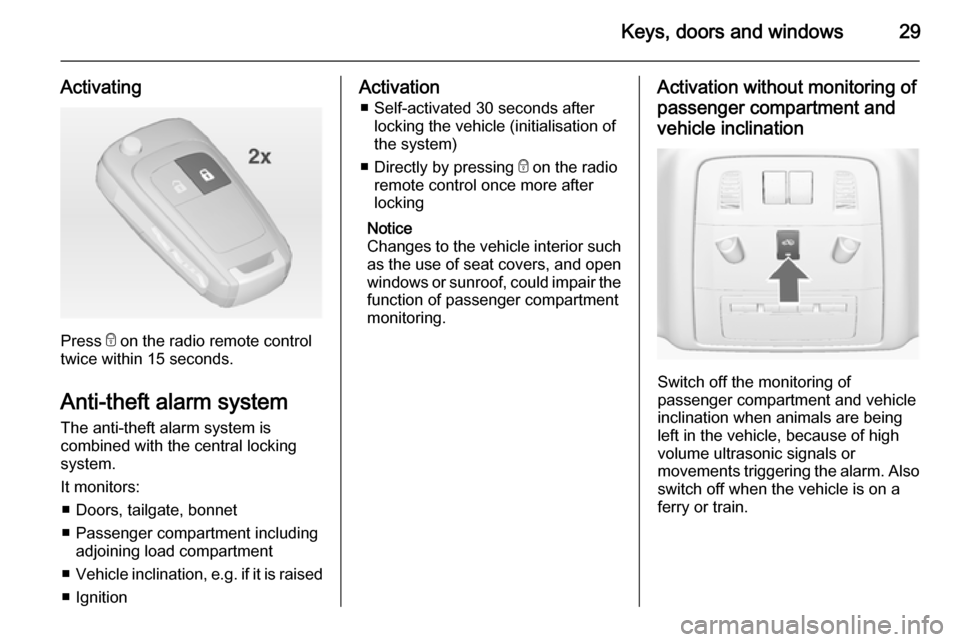
Activating
Press e on the radio remote control
twice within 15 seconds.
Anti-theft alarm system The anti-theft alarm system is
combined with the central locking
system.
It monitors: ■ Doors, tailgate, bonnet
■ Passenger compartment including adjoining load compartment
■ Vehicle inclination, e.g. if it is raised
■ Ignition
Activation ■ Self-activated 30 seconds after locking the vehicle (initialisation of
the system)
■ Directly by pressing e on the radio
remote control once more after
locking
Notice
Changes to the vehicle interior such
as the use of seat covers, and open
windows or sunroof, could impair the
function of passenger compartment
monitoring.Activation without monitoring of
passenger compartment and
vehicle inclination
Switch off the monitoring of
passenger compartment and vehicle
inclination when animals are being
left in the vehicle, because of high
volume ultrasonic signals or
movements triggering the alarm. Also switch off when the vehicle is on a
ferry or train.
Page 32 of 329
30Keys, doors and windows
1. Close tailgate, bonnet, windowsand sunroof.
2. Press button o. LED in the
button o illuminates for a
maximum of 10 minutes.
3. Close doors.
4. Activate the anti-theft alarm system.
Status message is displayed in the
Driver Information Centre.
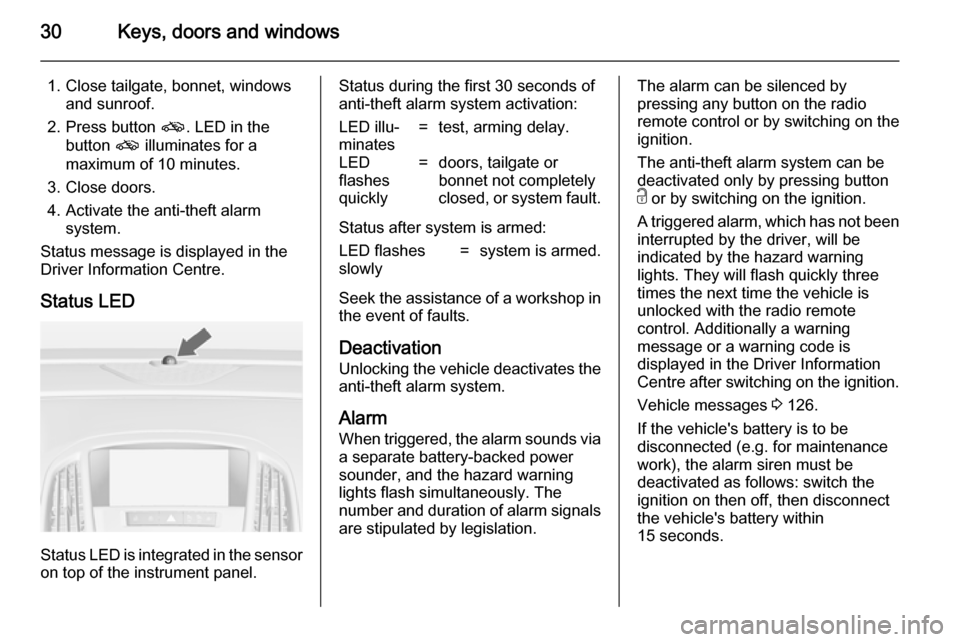
Status LED
Status LED is integrated in the sensor
on top of the instrument panel.
Status during the first 30 seconds of
anti-theft alarm system activation:LED illu‐
minates=test, arming delay.LED
flashes
quickly=doors, tailgate or
bonnet not completely
closed, or system fault.
Status after system is armed:
LED flashes
slowly=system is armed.
Seek the assistance of a workshop in the event of faults.
Deactivation
Unlocking the vehicle deactivates the
anti-theft alarm system.
AlarmWhen triggered, the alarm sounds via
a separate battery-backed power
sounder, and the hazard warning
lights flash simultaneously. The
number and duration of alarm signals are stipulated by legislation.
The alarm can be silenced by
pressing any button on the radio
remote control or by switching on the
ignition.
The anti-theft alarm system can be
deactivated only by pressing button
c or by switching on the ignition.
A triggered alarm, which has not been interrupted by the driver, will be
indicated by the hazard warning
lights. They will flash quickly three
times the next time the vehicle is
unlocked with the radio remote
control. Additionally a warning
message or a warning code is
displayed in the Driver Information
Centre after switching on the ignition.
Vehicle messages 3 126.
If the vehicle's battery is to be
disconnected (e.g. for maintenance
work), the alarm siren must be
deactivated as follows: switch the
ignition on then off, then disconnect
the vehicle's battery within
15 seconds.
Page 38 of 329

36Keys, doors and windows
A ticket holder is located on the
backside of the sun visor.Roof
Sunroof9 Warning
Take care when operating the
sunroof. Risk of injury, particularly to children.
Keep a close watch on the
movable parts when operating
them. Ensure that nothing
becomes trapped in them as they
move.
Switch on ignition to operate the sunroof.
Open or close
Press p or r gently to the first
detent: sunroof is opened or closed
with safety function enabled as long
as the switch is operated.
Press p or r firmly to the second
detent and then release: the sunroof
is opened or closed automatically
with safety function enabled. To stop
movement, operate the switch once
more.
Raise or close
Press q or r : sunroof is raised or
closed automatically with safety
function enabled.
Page 39 of 329

Keys, doors and windows37
If the sunroof is raised, it can be
opened in one step by pressing p.
Sunblind The sunblind is manually operated.
Close or open the sunblind by sliding.
When the sunroof is open, the
sunblind is always open.
General hints Safety function
If the sunroof encounters resistance
during automatic closing, it is
immediately stopped and opened
again.
Override safety function
In the event of closing difficulties,
e.g. due to frost, hold the switch r
pressed to the second detent. The
sunroof closes with safety function
disabled. To stop movement, release the switch.
Closing sunroof from outside
The sunroof can be closed remotely
from outside the vehicle.
Press and hold e button to close the
sunroof.
Release the button to stop the
movement.
Initialising after a power failure
After a power failure, it may only be
possible to operate the sunroof to a
limited extent. Have the system
initialised by your workshop.
Glass panel
Panorama roof
Turn the handle and move the roof
cover to a suitable position.
The roof cover engages in position
after releasing the handle.
Notice
Close the sun visors before sliding
the roof lining.
Page 163 of 329

Driving and operating161Starting and operating
New vehicle running-in Do not brake unnecessarily hard for
the first few journeys.
During the first drive, smoke may
occur because of wax and oil
evaporating off the exhaust system.
Park the vehicle in the open for a
while after the first drive and avoid
inhaling the fumes.
During the running-in period fuel and
engine oil consumption may be
higher and the cleaning process of the diesel particle filter may take
place more often. Autostop may be inhibited to allow for charging the
battery.
Diesel particle filter 3 166.Ignition switch positions0=Ignition off1=Steering wheel lock released,
ignition off2=Ignition on, for diesel engine:
preheating3=Starting
Retained power off
The following electronic systems can
work until the driver's door is opened
or at the latest for 10 minutes after the
ignition is switched off:
■ Power windows
■ Sunroof
■ Power outlets
Power to the Infotainment system will continue to operate for 30 minutes oruntil the key is removed from the
ignition switch, regardless of whether
any door will be opened.
Starting the engine
Manual transmission: operate clutch.
Automatic transmission: operate
brake and move the selector lever to
P or N.
Page 256 of 329

254Vehicle care
Fuse assignmentsNo.Circuit1–2Trailer outlet3Parking assist4–5–6–7Power seat8–9–10–11Trailer module, trailer socket12Trailer module13Trailer outlet14Rear seat, electrical folding15–16Inside mirror, rear view camera17Power outletNo.Circuit18–19Steering wheel heating20Sunroof21Heated front seats22–23–24–25–26–27–28–29–30–31Amplifier, subwoofer32Active damping system, lane
departure warning
Page 281 of 329

Vehicle care279
SunroofNever clean with solvents or abrasive
agents, fuels, aggressive media
(e.g. paint cleaner, acetone-
containing solutions etc.), acidic or
highly alkaline media or abrasive
pads. Do not apply wax or polishing
agents to the sunroof.
Glass panel
Never clean with solvents or abrasive
agents, fuels, aggressive media
(e.g. paint cleaner, acetone-
containing solutions etc.), acidic or
highly alkaline media or abrasive
pads. Do not apply wax or polishing
agents to the glass panel.
Wheels and tyres
Do not use high-pressure jet
cleaners.
Clean rims with a pH-neutral wheel
cleaner.
Rims are painted and can be treated
with the same agents as the body.Paintwork damage
Rectify minor paintwork damage with
a touch-up pen before rust forms.
Have more extensive damage or rust
areas repaired by a workshop.
UnderbodySome areas of the vehicle underbody
have a PVC undercoating while other
critical areas have a durable
protective wax coating.
After the underbody is washed, check
the underbody and have it waxed if
necessary.
Bitumen/rubber materials could
damage the PVC coating. Have
underbody work carried out by a
workshop.
Before and after winter, wash the
underbody and have the protective
wax coating checked.Liquid gas system9 Danger
Liquid gas is heavier than air and
can collect in sink points.
Take care when performing work
at the underbody in a pit.
For painting work and when using a
drying booth at a temperature above
60 °C, the liquid gas tank must be
removed.
Do not make any modifications to the
liquid gas system.
Towing equipment Do not clean the coupling ball bar with
a steam-jet or high-pressure jet
cleaner.
Rear carrier system Clean the rear carrier system with a
steam-jet or high-pressure jet cleaner
at least once a year.
Operate the rear carrier system
periodically if not in regular use, in
particular during winter.
Page 327 of 329

325
PParking ................................ 20, 165
Parking assist ............................ 195
Parking brake ............................ 172
Parking lights ............................. 146
Particulate filter ........................... 166
Performance .............................. 292
Performing work ........................222
Pollen filter ................................. 159
Power outlets ............................. 106
Power seat adjustment ................44
Power steering............................ 116
Power steering fluid ....................225
Power windows ............................ 33
Preheating ................................. 117
Puncture ..................................... 265
Q
Quickheat ................................... 158
R Radio Frequency Identification (RFID) .................................... 320
Radio remote control ...................22
Reading lights ............................ 148
Rear carrier system ......................64
Rear floor storage cover ..............88
Rear fog light ............................. 119
Rear fog lights ........................... 146
Rear seats .................................... 47Rear storage................................. 86
Rear view camera ...................... 202
Rear window wiper/washer ........ 104
Recommended fluids and lubricants ........................ 282, 286
Reduced engine power ..............118
Refuelling ................................... 211
Retained power off ....................161
Reversing lights .........................146
Ride control systems ..................174
Roof .............................................. 36
Roof load ...................................... 98
Roof rack ..................................... 97
S Safety belts ................................... 47
Safety net .................................... 93
Seat adjustment ....................... 7, 40
Seat belt ...................................... 10
Seat belt reminder .....................113
Seat belts ..................................... 47
Seat folding .................................. 43
Seat position ................................ 40
Selector lever ............................. 168
Service ............................... 159, 281
Service display .......................... 110
Service information ....................281
Service vehicle soon .................. 114
Side airbag system ......................51
Side blind spot alert ....................201Sidelights.................................... 138
Side turn signal lights ................246
Smartphone controller ................126
Spare wheel ............................... 269
Speed limiter............................... 181
Speedometer ............................. 108
Starting and operating ................161
Starting off ................................... 19
Starting the engine ....................161
Steering ...................................... 160
Steering wheel adjustment ..11, 100
Steering wheel controls .............100
Stop-start system........................ 163
Storage ......................................... 60
Storage compartments .................60
Sunroof ........................................ 36
Sunvisor lights ........................... 148
Sun visors .................................... 35
Symbols ......................................... 4
T
Tachometer ............................... 108
Tail lights ................................... 239
Three-point seat belt .................... 48
Tools .......................................... 255
Top-tether fastening eyes ............59
Tow bar....................................... 215
Towing ................................ 215, 275
Towing another vehicle .............276
Towing equipment .....................216