lock VAUXHALL ASTRA J 2016.25 Repair Manual
[x] Cancel search | Manufacturer: VAUXHALL, Model Year: 2016.25, Model line: ASTRA J, Model: VAUXHALL ASTRA J 2016.25Pages: 267, PDF Size: 7.72 MB
Page 211 of 267
Vehicle care209
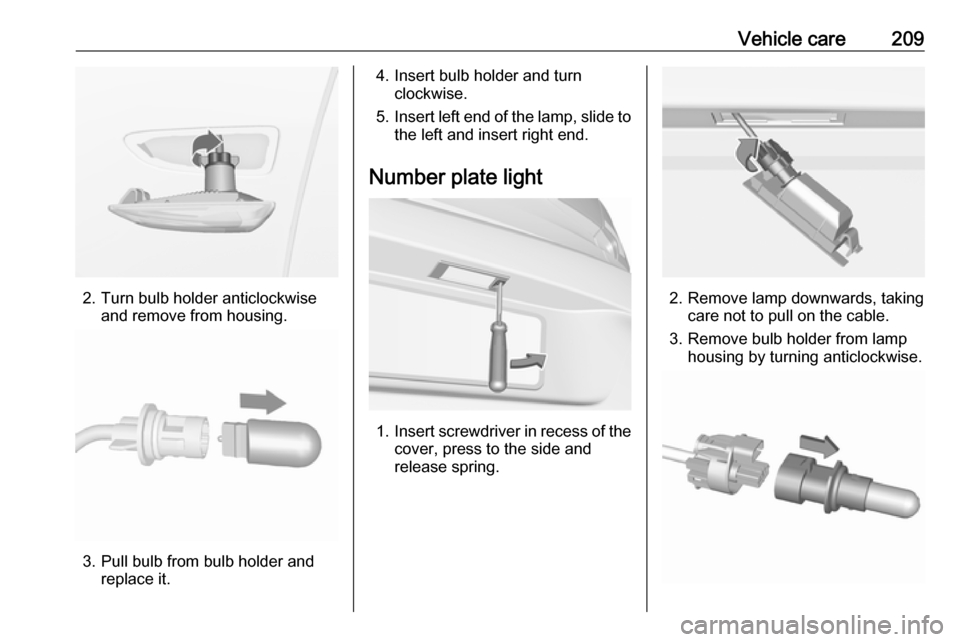
2. Turn bulb holder anticlockwiseand remove from housing.
3. Pull bulb from bulb holder andreplace it.
4. Insert bulb holder and turnclockwise.
5. Insert left end of the lamp, slide to
the left and insert right end.
Number plate light
1. Insert screwdriver in recess of the
cover, press to the side and
release spring.
2. Remove lamp downwards, taking care not to pull on the cable.
3. Remove bulb holder from lamp housing by turning anticlockwise.
Page 212 of 267
210Vehicle care4. Pull bulb from bulb holder andreplace it.
5. Insert bulb holder into lamp housing and turn clockwise.
6. Insert lamp into bumper and let engage.
Interior lights Courtesy light, reading lights
Have bulbs replaced by a workshop.
Load compartment light
Have bulbs replaced by a workshop.
Instrument panel illumination
Have bulbs replaced by a workshop.Electrical system
Fuses Data on the replacement fuse mustmatch the data on the defective fuse.
There are three fuse boxes in the vehicle:
● engine compartment
● instrument panel
● load compartment
Before replacing a fuse, turn off the
respective switch and the ignition.
A blown fuse can be recognized by its melted wire. Do not replace the fuse
until the cause of the fault has been
remedied.
Some functions are protected by
several fuses.
Fuses may also be inserted without existence of a function.
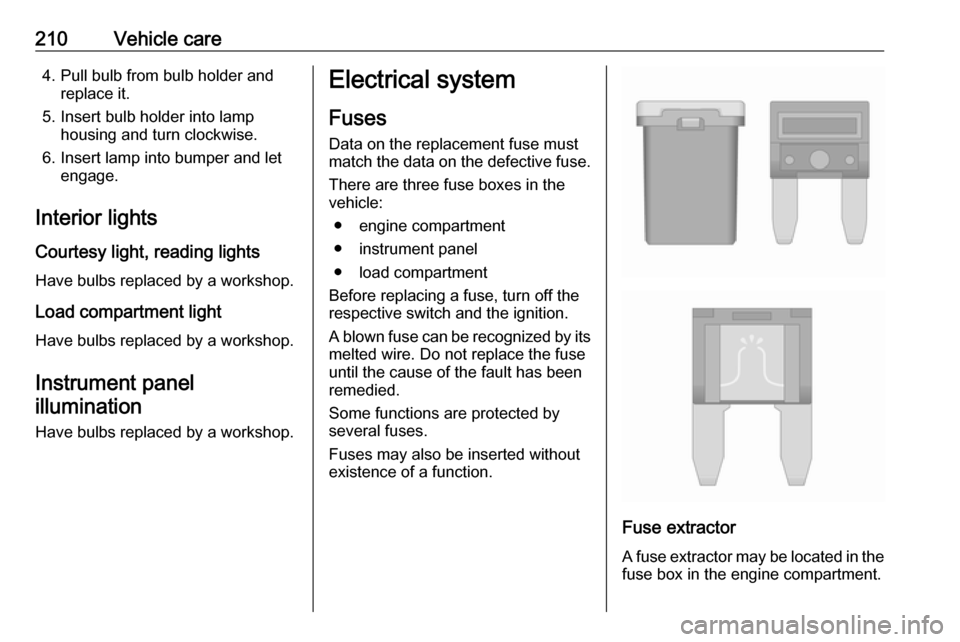
Fuse extractor
A fuse extractor may be located in the fuse box in the engine compartment.
Page 214 of 267

212Vehicle careNo.Circuit1Starter2Starter3Exhaust sensor4Engine control module5Engine functions6Transmission control module7–8Engine control module9Climate control system10–11Tailgate locking system12Seat lumbar massage13After boil pump14–15Exhaust sensor16Fuel injection17Fuel injectionNo.Circuit18–19–20–21–22ABS23Washer system for windscreen
and rear window24–25Diesel fuel heating26Transmission control module27Power tailgate module28–29Heated rear window30–31–32DC transformer/LED display/
Electrical heater/Climate
control/Glow plug controller/
Fuel pumpNo.Circuit33–34Horn35Power outlet load compartment36Right high beam (Halogen)/
Right low beam (LED)37Left high beam (Halogen)38LED headlight/Automatic head‐
light range adjustment39Front fog light40OnStar41Water in fuel sensor/Water
pump42Manual headlight range adjust‐
ment43Fuel pump44Rear view camera/Inside rear
view mirror/Trailer module/
Power connector45LED headlight left/Automatic
headlight range adjustment left
Page 215 of 267
Vehicle care213No.Circuit46Instrument cluster47Steering column lock48Rear wiper49Heated mirror50LED headlight right/Automatic
headlight range adjustment
right51Left low beam (LED)52Engine control module/Trans‐
mission control module53–54Windscreen wiper55–56–57–
After having changed defective fuses,
close the fuse box cover and press
until it engages.
If the fuse box cover is not closed
correctly, malfunction may occur.
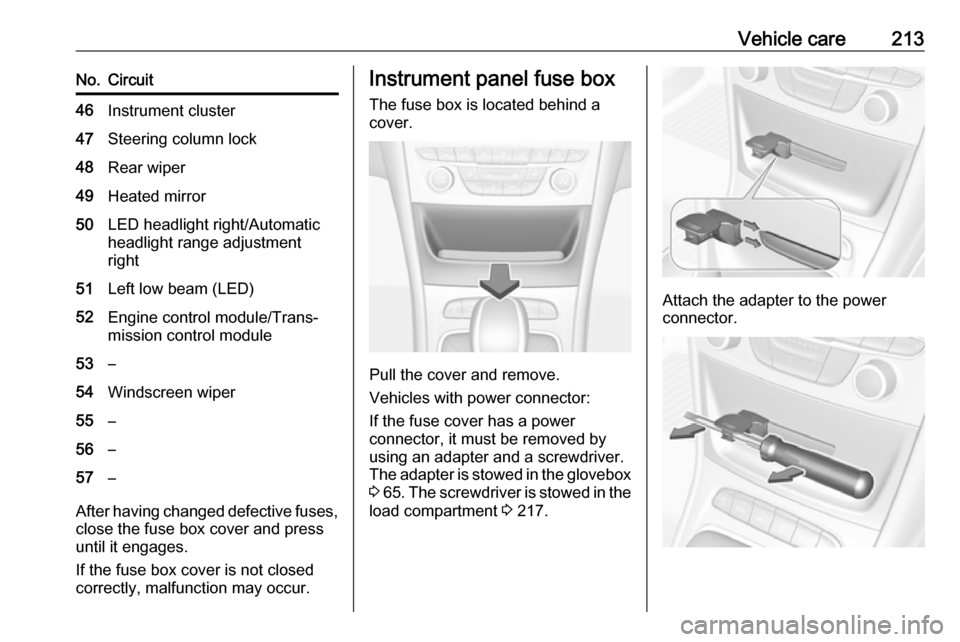
Instrument panel fuse box
The fuse box is located behind a
cover.
Pull the cover and remove.
Vehicles with power connector:
If the fuse cover has a power
connector, it must be removed by
using an adapter and a screwdriver.
The adapter is stowed in the glovebox 3 65 . The screwdriver is stowed in the
load compartment 3 217.
Attach the adapter to the power
connector.
Page 216 of 267
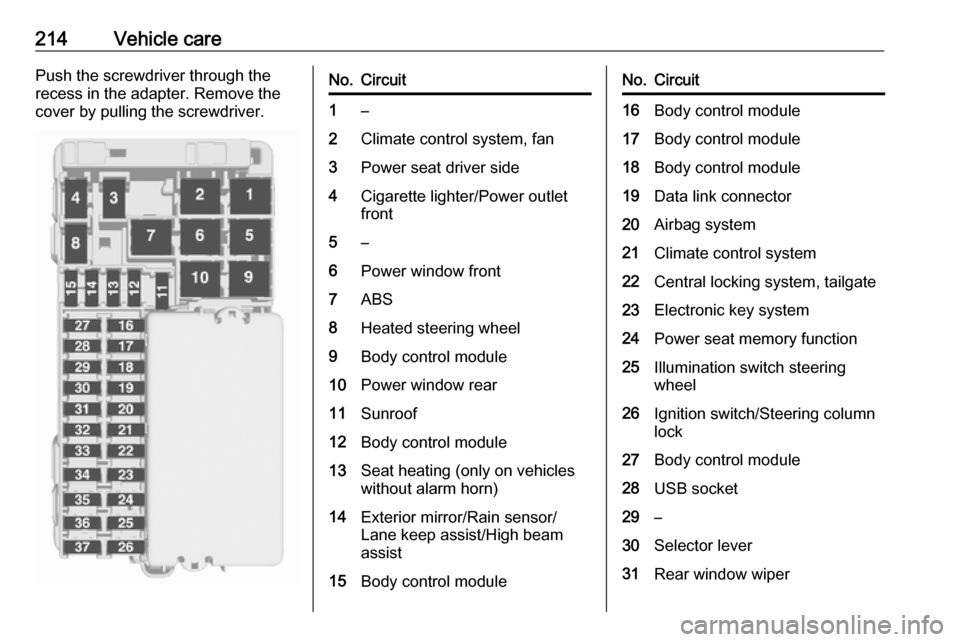
214Vehicle carePush the screwdriver through therecess in the adapter. Remove the
cover by pulling the screwdriver.No.Circuit1–2Climate control system, fan3Power seat driver side4Cigarette lighter/Power outlet
front5–6Power window front7ABS8Heated steering wheel9Body control module10Power window rear11Sunroof12Body control module13Seat heating (only on vehicles
without alarm horn)14Exterior mirror/Rain sensor/
Lane keep assist/High beam
assist15Body control moduleNo.Circuit16Body control module17Body control module18Body control module19Data link connector20Airbag system21Climate control system22Central locking system, tailgate23Electronic key system24Power seat memory function25Illumination switch steering
wheel26Ignition switch/Steering column
lock27Body control module28USB socket29–30Selector lever31Rear window wiper
Page 226 of 267
224Vehicle careChanging tyre and wheel
size
If tyres of a different size than thosefitted at the factory are used, it may be necessary to reprogramme the
speedometer as well as the nominal
tyre pressure and make other vehicle modifications.
After converting to a different tyre
size, have the label with tyre
pressures replaced.
Furthermore, the advanced parking
assist must be calibrated 3 170.9 Warning
Use of unsuitable tyres or wheels
may lead to accidents and will
invalidate the vehicle type
approval.
Wheel covers
Wheel covers and tyres that are
factory approved for the respective
vehicle and comply with all of the
relevant wheel and tyre combination requirements must be used.
If the wheel covers and tyres used are
not factory approved, the tyres must
not have a rim protection ridge.
Wheel covers must not impair brake
cooling.9 Warning
Use of unsuitable tyres or wheel
covers could lead to sudden
pressure loss and thereby
accidents.
Tyre chains
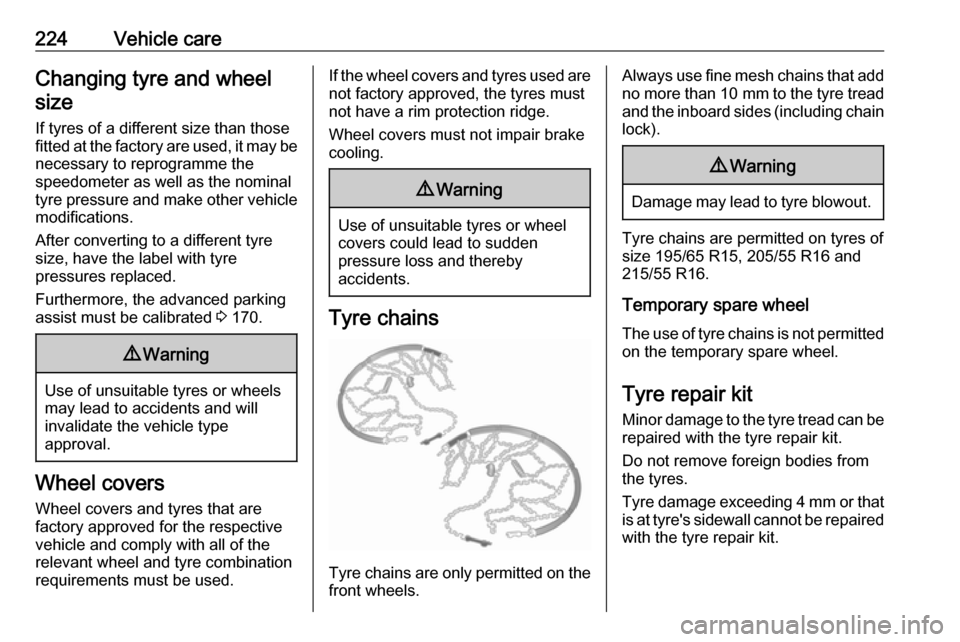
Tyre chains are only permitted on the
front wheels.
Always use fine mesh chains that add no more than 10 mm to the tyre tread
and the inboard sides (including chain lock).9 Warning
Damage may lead to tyre blowout.
Tyre chains are permitted on tyres of
size 195/65 R15, 205/55 R16 and
215/55 R16.
Temporary spare wheel
The use of tyre chains is not permitted on the temporary spare wheel.
Tyre repair kit Minor damage to the tyre tread can be
repaired with the tyre repair kit.
Do not remove foreign bodies from
the tyres.
Tyre damage exceeding 4 mm or that is at tyre's sidewall cannot be repairedwith the tyre repair kit.
Page 236 of 267
234Vehicle careTowingTowing the vehicle
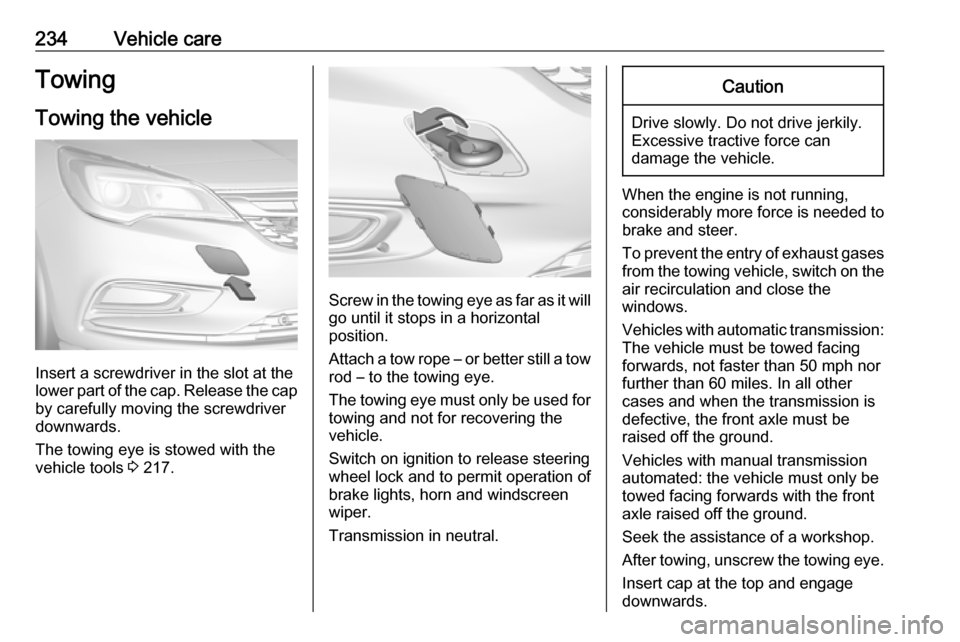
Insert a screwdriver in the slot at the
lower part of the cap. Release the cap
by carefully moving the screwdriver
downwards.
The towing eye is stowed with the
vehicle tools 3 217.
Screw in the towing eye as far as it will
go until it stops in a horizontal
position.
Attach a tow rope – or better still a tow
rod – to the towing eye.
The towing eye must only be used for
towing and not for recovering the
vehicle.
Switch on ignition to release steering wheel lock and to permit operation of
brake lights, horn and windscreen
wiper.
Transmission in neutral.
Caution
Drive slowly. Do not drive jerkily.
Excessive tractive force can
damage the vehicle.
When the engine is not running,
considerably more force is needed to
brake and steer.
To prevent the entry of exhaust gases from the towing vehicle, switch on the
air recirculation and close the
windows.
Vehicles with automatic transmission: The vehicle must be towed facing
forwards, not faster than 50 mph nor further than 60 miles. In all other
cases and when the transmission is
defective, the front axle must be
raised off the ground.
Vehicles with manual transmission
automated: the vehicle must only be
towed facing forwards with the front
axle raised off the ground.
Seek the assistance of a workshop. After towing, unscrew the towing eye.
Insert cap at the top and engage
downwards.
Page 238 of 267

236Vehicle careAppearance careExterior care
Locks The locks are lubricated at the factoryusing a high quality lock cylinder
grease. Use de-icing agent only when
absolutely necessary, as this has a
degreasing effect and impairs lock function. After using a de-icing agent, have the locks regreased by a
workshop.
Washing The paintwork of your vehicle is
exposed to environmental influences. Wash and wax your vehicle regularly.
When using automatic vehicle
washes, select a programme that
includes waxing.
Bird droppings, dead insects, resin,
pollen and the like should be cleaned
off immediately, as they contain
aggressive constituents which can
cause paint damage.If using a vehicle wash, comply with
the vehicle wash manufacturer's
instructions. The windscreen wiper and rear window wiper must be
switched off. Remove antenna and
external accessories such as roof
racks etc.
If you wash your vehicle by hand,
make sure that the insides of the
wheel housings are also thoroughly
rinsed out.
Clean edges and folds on opened
doors and the bonnet as well as the
areas they cover.
Clean bright metal mouldings with a
cleaning solution approved for
aluminium to avoid damages.Caution
Always use a cleaning agent with
a pH value of four to nine.
Do not use cleaning agents on hot surfaces.
Do not clean the engine compartmentwith a steam-jet or high-pressure jet
cleaner.
Thoroughly rinse and leather-off the vehicle. Rinse leather frequently. Use
separate leathers for painted and
glass surfaces: remnants of wax on
the windows will impair vision.
Have the door hinges of all doors
greased by a workshop.
Exterior lights
Headlight and other light covers are
made of plastic. Do not use any
abrasive or caustic agents, do not use an ice scraper, and do not clean them
dry.
Polishing and waxing
Wax the vehicle regularly (at the
latest when water no longer beads).
Otherwise, the paintwork will dry out.
Polishing is necessary only if the paint
has become dull or if solid deposits
have become attached to it.
Paintwork polish with silicone forms a
protective film, making waxing
unnecessary.
Plastic body parts must not be treated with wax or polishing agents.
Page 260 of 267

258Customer informationWhen using the vehicle, situations
may occur in which these technical
data related to other information
(accident report, damages on the
vehicle, witness statements etc.) may be associated with a specific person -
possibly, with the assistance of an
expert.
Additional functions contractually
agreed upon with the client (e.g.
vehicle location in emergency cases)
allow the transmission of particular vehicle data from the vehicle.
Radio Frequency
Identification (RFID)
RFID technology is used in some
vehicles for functions such as tyre
pressure monitoring and ignition
system security. It is also used in
connection with conveniences such
as radio remote controls for door
locking/unlocking and starting, and in-
vehicle transmitters for garage door
openers. RFID technology in
Vauxhall vehicles does not use or
record personal information or link
with any other Vauxhall system
containing personal information.
Page 262 of 267

260IndexAAccessories and vehicle modifications .......................... 194
Active emergency braking ..........169
Adjustable air vents ...................136
Airbag and belt tensioners ...........92
Airbag deactivation ................56, 92
Airbag label................................... 52 Airbag system .............................. 52
Air conditioning regular operation ................................ 137
Air conditioning system .............. 129
Air intake .................................... 137
Air vents...................................... 136
Antilock brake system ................ 156
Antilock brake system (ABS) .......94
Anti-theft alarm system ................30
Anti-theft locking system .............. 30
Appearance care ........................236
Armrest ................................... 47, 49
Armrest storage ........................... 66
Ashtrays ....................................... 83
Automatic anti-dazzle ..................35
Automatic light control ...............118
Automatic locking ........................27
Automatic transmission .............150
Auxiliary heater ........................... 136B
Battery discharge protection ......127
Battery voltage ........................... 106
Belts.............................................. 49
Bonnet ....................................... 196
Brake and clutch fluid .................240
Brake and clutch system .............93
Brake assist ............................... 159
Brake fluid .................................. 199
Brakes ............................... 156, 199
Breakdown.................................. 234
Bulb replacement ....................... 202
C Capacities .................................. 252
Catalytic converter .....................149
Central locking system ................23
Centre console lighting ..............126
Changing tyre and wheel size ...224
Charging system .......................... 92
Child locks ................................... 28
Child restraint installation locations ................................... 61
Child restraints.............................. 58
Child restraint systems ................58
Climate control ............................. 15
Climate control systems .............128
Clock............................................. 79
Collision damage repair ..............255
Control indicators.......................... 91