trailer VAUXHALL ASTRA J 2016 User Guide
[x] Cancel search | Manufacturer: VAUXHALL, Model Year: 2016, Model line: ASTRA J, Model: VAUXHALL ASTRA J 2016Pages: 341, PDF Size: 10.35 MB
Page 211 of 341
Driving and operating209● The tailgate is not closedcorrectly.
● The vehicle had a rear end accident.
● There are extreme temperature changes.
Traffic sign assistant Functionality
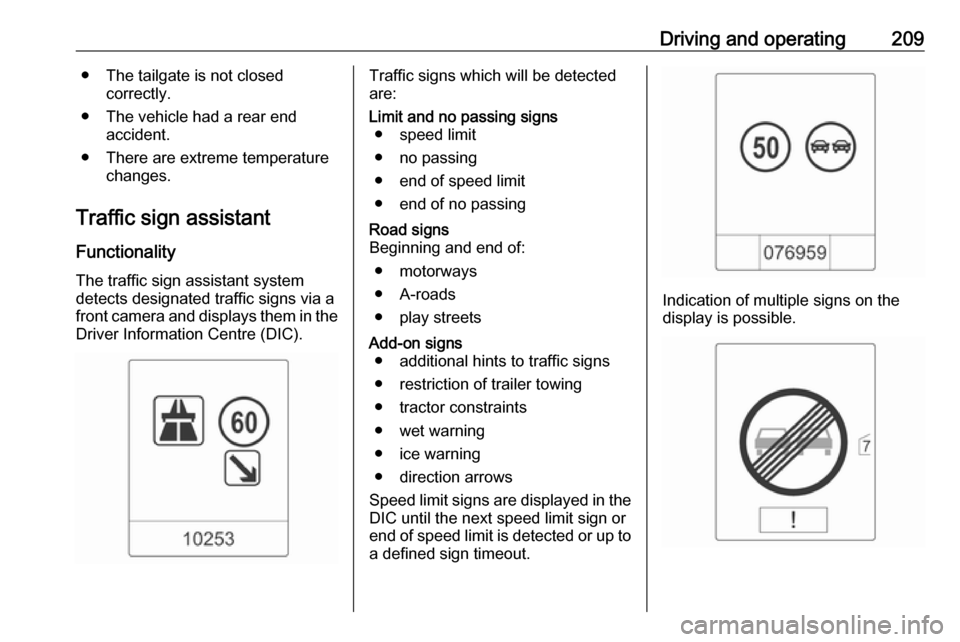
The traffic sign assistant system
detects designated traffic signs via a
front camera and displays them in the
Driver Information Centre (DIC).Traffic signs which will be detected
are:Limit and no passing signs ● speed limit
● no passing
● end of speed limit
● end of no passingRoad signs
Beginning and end of:
● motorways
● A-roads
● play streetsAdd-on signs ● additional hints to traffic signs
● restriction of trailer towing
● tractor constraints
● wet warning
● ice warning
● direction arrows
Speed limit signs are displayed in the
DIC until the next speed limit sign or
end of speed limit is detected or up to a defined sign timeout.
Indication of multiple signs on the
display is possible.
Page 221 of 341

Driving and operating219Fuel consumption - CO2-
Emissions
The fuel consumption (combined) of the model Vauxhall Astra is within a
range of 36 to 78 mpg.
The CO 2 emission (combined) is
within a range of 184 to 94 g/km.
For the values specific to your
vehicle, refer to the EEC Certificate of
Conformity provided with your vehicle or other national registration
documents.
General information
The official fuel consumption and
specific CO 2 emission figures quoted
relate to the EU base model with
standard equipment.
Fuel consumption data and CO 2
emission data are determined
according to regulation
R (EC) No. 715/2007 (in the latest
applicable version), taking into
consideration the vehicle weight in running order, as specified by the
regulation.The figures are provided only for the purpose of comparison between different vehicle variants and mustnot be taken as a guarantee for the
actual fuel consumption of a
particular vehicle. Additional
equipment may result in slightly
higher results than the stated
consumption and CO 2 figures.
Furthermore, fuel consumption is
dependent on personal driving style
as well as road and traffic conditions.Trailer hitch
General information
Only use towing equipment that has
been approved for your vehicle.
Entrust retrofitting of towing
equipment to a workshop. It may be
necessary to make changes that
affect the cooling system, heat
shields or other equipment.
The bulb outage detection function for
trailer brake light cannot detect a
partial bulb outage, e.g. in case of 4 x
5 Watt bulbs, the function only detects lamp outage when only a single
5 Watt lamp remains or none remain.
Fitting of towing equipment could
cover the opening of the towing eye.
If this is the case use the coupling ball
bar for towing. Always keep the
coupling ball bar in the vehicle.
Page 222 of 341

220Driving and operatingDriving characteristics andtowing tips
Before attaching a trailer, lubricate the coupling ball. However, do not do
so if a stabiliser, which acts on the coupling ball, is being used to reduce snaking movements.
For trailers with low driving stability
and caravan trailers with a permitted
gross vehicle weight of more than
1300 kg (Sports tourer: 1200 kg) the
use of a stabiliser is strongly
recommended when driving above
50 mph.
If the trailer starts snaking, drive more slowly, do not attempt to correct the
steering and brake sharply if
necessary.
When driving downhill, drive in the
same gear as if driving uphill and
drive at a similar speed.
Adjust tyre pressure to the value
specified for full load 3 307.Trailer towing
Trailer loads The permissible trailer loads are
vehicle and engine-dependent
maximum values which must not be
exceeded. The actual trailer load is the difference between the actual
gross weight of the trailer and the
actual coupling socket load with the
trailer coupled.
The permissible trailer loads are
specified in the vehicle documents. In general, they are valid for gradients
up to max. 12%.
The permitted trailer load applies up to the specified incline and up to an
altitude of 1000 metres above sea
level. Since engine power decreases
as altitude increases due to the air
becoming thinner, therefore reducing
climbing ability, the permissible gross
train weight also decreases by 10%
for every 1000 metres of additional
altitude. The gross train weight does
not have to be reduced when driving
on roads with slight inclines (less than
8%, e.g. motorways).The permissible gross train weight
must not be exceeded. This weight is specified on the identification plate
3 288.
Vertical coupling load
The vertical coupling load is the load
exerted by the trailer on the coupling
ball. It can be varied by changing the
weight distribution when loading the
trailer.
The maximum permissible vertical
coupling load (75 kg) is specified on
the towing equipment identification
plate and in the vehicle documents.
Always aim for the maximum load,
especially in the case of heavy
trailers. The vertical coupling load
should never fall below 25 kg.
Page 223 of 341
Driving and operating221Rear axle loadWhen the trailer is coupled and the
towing vehicle fully loaded, the
permissible rear axle load (see
identification plate or vehicle
documents) may be exceeded by
60 kg , the gross vehicle weight rating
may be exceeded by 60 kg. If the
permissible rear axle load is
exceeded, a maximum speed of
60 mph applies.
Towing equipmentCaution
When operating without a trailer,
remove the coupling ball bar.
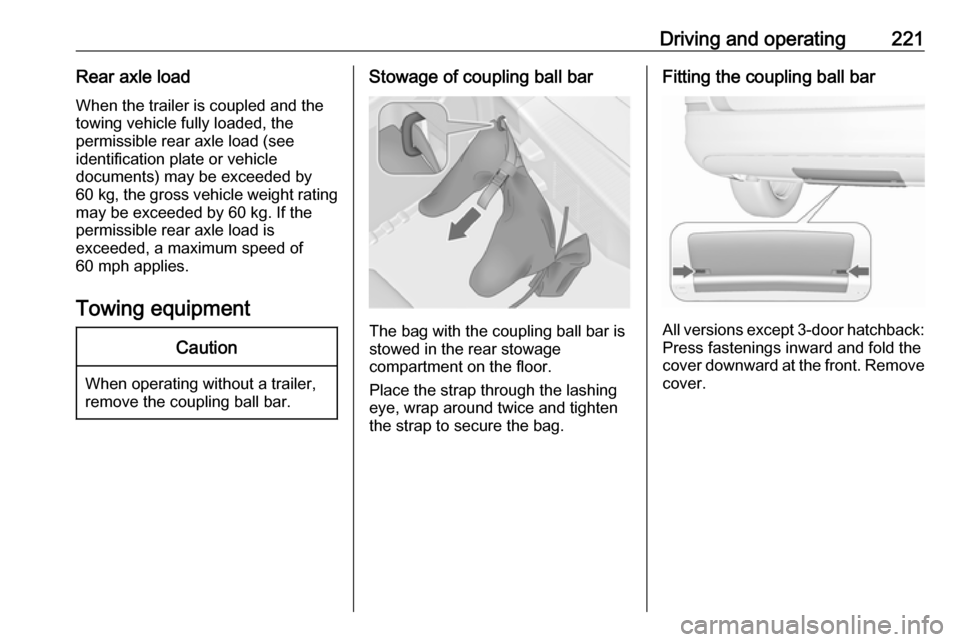
Stowage of coupling ball bar
The bag with the coupling ball bar is
stowed in the rear stowage
compartment on the floor.
Place the strap through the lashing
eye, wrap around twice and tighten
the strap to secure the bag.
Fitting the coupling ball bar
All versions except 3-door hatchback:
Press fastenings inward and fold the
cover downward at the front. Remove
cover.
Page 225 of 341
Driving and operating223Insert the tensioned coupling ball bar
in the opening and push firmly
upwards until it audibly engages.
The rotary handle snaps back into its
original position resting against the
coupling ball bar without a gap.9 Warning
Do not touch rotary handle during
insertion.
Lock the coupling ball bar by turning
the key to position e. Remove the key
and close the protective flap.
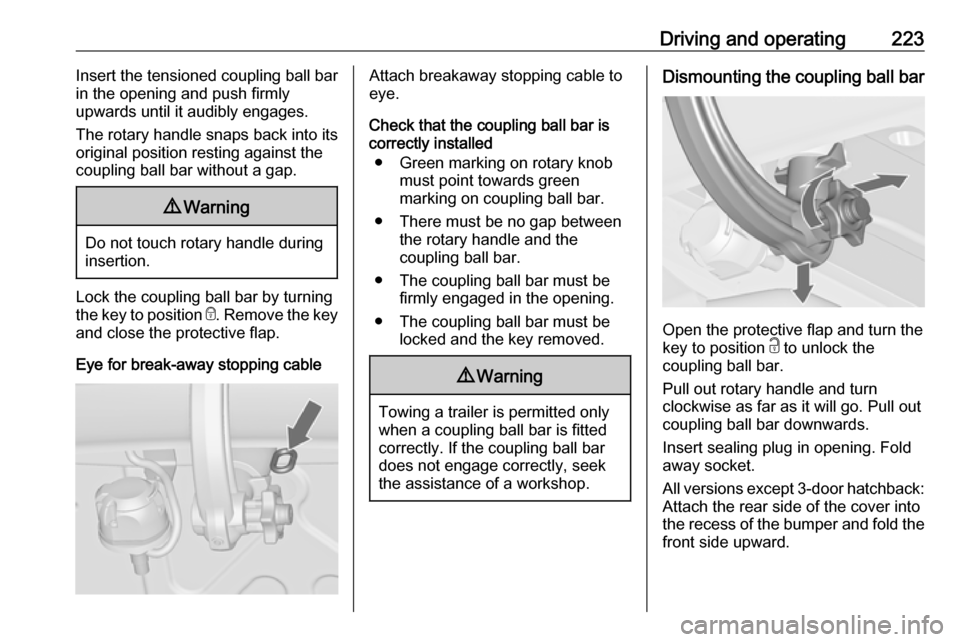
Eye for break-away stopping cable
Attach breakaway stopping cable to
eye.
Check that the coupling ball bar is correctly installed
● Green marking on rotary knob must point towards green
marking on coupling ball bar.
● There must be no gap between the rotary handle and the
coupling ball bar.
● The coupling ball bar must be firmly engaged in the opening.
● The coupling ball bar must be locked and the key removed.9Warning
Towing a trailer is permitted only
when a coupling ball bar is fitted correctly. If the coupling ball bardoes not engage correctly, seekthe assistance of a workshop.
Dismounting the coupling ball bar
Open the protective flap and turn the
key to position c to unlock the
coupling ball bar.
Pull out rotary handle and turn
clockwise as far as it will go. Pull out coupling ball bar downwards.
Insert sealing plug in opening. Fold away socket.
All versions except 3-door hatchback:
Attach the rear side of the cover into
the recess of the bumper and fold the
front side upward.
Page 226 of 341
224Driving and operating
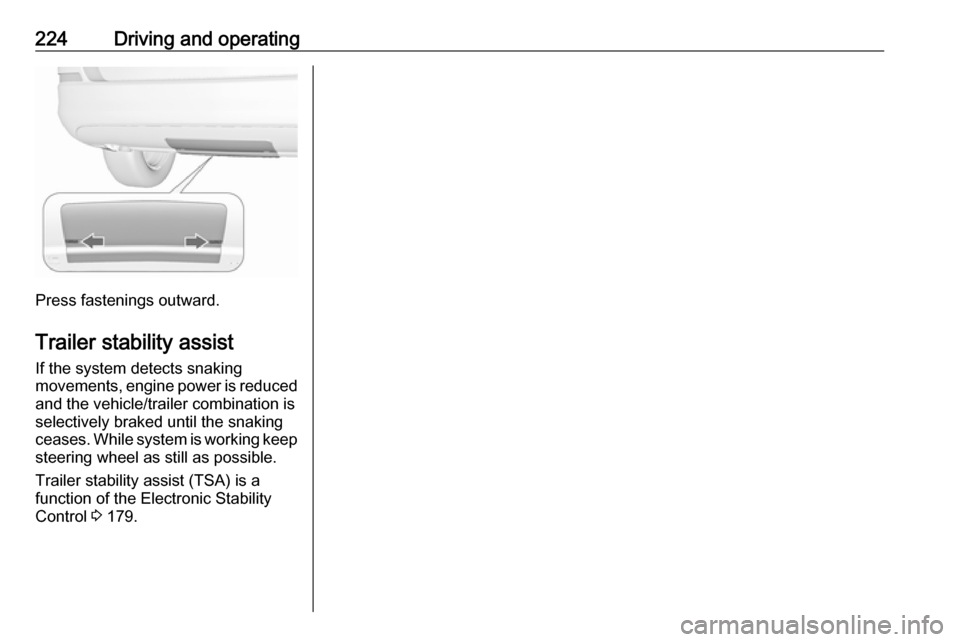
Press fastenings outward.
Trailer stability assist
If the system detects snaking
movements, engine power is reduced and the vehicle/trailer combination is
selectively braked until the snaking
ceases. While system is working keep
steering wheel as still as possible.
Trailer stability assist (TSA) is a
function of the Electronic Stability
Control 3 179.
Page 260 of 341

258Vehicle careNo.Circuit1–2Trailer outlet3Parking assist4–5–6–7Power seat8–9–10–11Trailer module/Trailer socket12Trailer module13Trailer outlet14Rear seat/Electrical folding15–16Interior mirror/Rear view
cameraNo.Circuit17Power outlet18–19Steering wheel heating20Sunroof21Heated front seats22–23–24–25–26Deactivated logistic mode27–28–29–30–31Amplifier/Subwoofer32Active damping system/Lane
departure warning
When assembling press the blind into
the rubber grommets to reach full
retention force.
Page 339 of 341

337Pollen filter ................................. 161
Power outlets ............................. 104
Power seat adjustment ................43
Power steering............................ 114
Power steering fluid ....................230
Power windows ............................ 33
Preheating ................................. 115
Puncture ..................................... 270
Q
Quickheat ................................... 160
R Radio Frequency Identification (RFID) .................................... 333
Radio remote control ...................21
Reading lights ............................ 150
Rear carrier system ......................63
Rear floor storage cover ..............86
Rear fog light ............................. 117
Rear fog lights ........................... 148
Rear seats .................................... 46
Rear storage ................................. 84
Rear view camera ...................... 207
Rear window wiper/washer ........ 102
Recommended fluids and lubricants ........................ 286, 290
Reduced engine power ..............117
Refuelling ................................... 215 Retained power off .....................165
Reversing lights .........................149Ride control systems ..................178
Roof .............................................. 35
Roof load ...................................... 95
Roof rack ..................................... 94
S Safety belts ................................... 46
Safety net .................................... 91
Seat adjustment ....................... 7, 39 Seat belt ........................................ 9
Seat belt reminder .....................112
Seat belts ..................................... 46
Seat folding .................................. 42
Seat heating ................................. 45
Seat position ................................ 39
Selector lever ............................. 172
Service ............................... 162, 285
Service display .......................... 108
Service information ....................285
Service vehicle soon .................. 113
Side airbag system ......................50
Side blind spot alert ....................206
Sidelights .................................... 140
Side turn signal lights ................250
Smartphone controller ................124
Software acknowledgement .......331
Spare wheel ............................... 274
Speed limiter............................... 185
Speedometer ............................. 106
Starting and operating ................164Starting off ................................... 18
Starting the engine ....................165
Steering ...................................... 164
Steering wheel adjustment ....10, 99
Steering wheel controls ...............99
Stop-start system........................ 166
Storage ......................................... 59
Storage compartments .................59
Sunroof ........................................ 35
Sunvisor lights ........................... 150
Sun visors .................................... 35
Symbols ......................................... 4
T
Tachometer ............................... 106
Tail lights ................................... 242
Three-point seat belt .................... 47
Tools .......................................... 259
Top-tether fastening eyes ............58
Tow bar....................................... 219
Towing ................................ 219, 280
Towing another vehicle .............281
Towing equipment .....................221
Towing the vehicle .....................280
Traction Control system ............. 178
Traction Control system off ........ 115
Traffic sign assistant ...................209
Trailer coupling ........................... 219
Trailer stability assist .................224
Trailer towing ............................. 220