automatic transmission VAUXHALL ASTRA K 2017 Owner's Guide
[x] Cancel search | Manufacturer: VAUXHALL, Model Year: 2017, Model line: ASTRA K, Model: VAUXHALL ASTRA K 2017Pages: 293, PDF Size: 8.27 MB
Page 234 of 293

232Vehicle care
Select:● Light for comfort pressure up to
3 people.
● Eco for Eco pressure up to
3 people.
● Max for full load.
Tyre pressure sensor matching
process
Each tyre pressure sensor has a
unique identification code. The
identification code must be matched
to a new wheel position after rotating the wheels or exchanging the
complete wheel set and if one or more
tyre pressure sensors were replaced.
The tyre pressure sensor matching
process should also be performed
after replacing a spare wheel with a
road wheel containing the tyre
pressure sensor.
The malfunction light w and the
warning message or code should
extinguish at the next ignition cycle.
The sensors are matched to the
wheel positions using a relearn tool,
in the following order: left side front
wheel, right side front wheel, right
side rear wheel and left side rear
wheel. The turn signal light at the
current active position is illuminated
until the sensor is matched.
Consult a workshop for service. There
are two minutes to match the first
wheel position, and five minutes
overall to match all four wheel
positions. If it takes longer, the
matching process stops and must be
restarted.
The tyre pressure sensor matching
process is:
1. Apply the parking brake.
2. Turn the ignition on.3. On vehicles with automatic transmission: set the selector
lever to P.
On vehicles with manual
transmission: select neutral.
4. Use MENU on the turn signal
lever to select the Vehicle
Information Menu in the Driver
Information Centre.
5. Turn the adjuster wheel to scroll to
the tyre pressure menu.
6. Press SET/CLR to begin the
sensor matching process. A
message requesting acceptance
of the process should be
displayed.
Press SET/CLR again to confirm
the selection. The horn sounds
twice to indicate the receiver is in
relearn mode.
7. Start with the left side front wheel.
8. Place the relearn tool against the tyre sidewall, near the valve stem.Then press the button to activate
the tyre pressure sensor. A horn
chirp confirms that the sensor
identification code has been
matched to this wheel position.
Page 247 of 293
Vehicle care245Jump starting
Do not start with quick charger.
A vehicle with a discharged vehicle
battery can be started using jump
leads and the vehicle battery of
another vehicle.9 Warning
Be extremely careful when starting
with jump leads. Any deviation
from the following instructions can
lead to injuries or damage caused
by battery explosion or damage to the electrical systems of both
vehicles.
9 Warning
Avoid contact of the battery with
eyes, skin, fabrics and painted
surfaces. The fluid contains
sulphuric acid which can cause
injuries and damage in the event
of direct contact.
● Never expose the vehicle battery
to naked flames or sparks.
● A discharged vehicle battery can already freeze at a temperature
of 0 °C. Defrost the frozen vehicle
battery before connecting jump leads.
● Wear eye protection and protective clothing when
handling a vehicle battery.
● Use a booster vehicle battery with the same voltage ( 12 Volts).
Its capacity (Ah) must not be
much less than that of the
discharged vehicle battery.
● Use jump leads with insulated terminals and a cross section of
at least 16 mm 2
(25 mm 2
for
diesel engines).
● Do not disconnect the discharged
vehicle battery from the vehicle.
● Switch off all unnecessary electrical consumers.
● Do not lean over the vehicle battery during jump starting.
● Do not allow the terminals of one
lead to touch those of the other
lead.● The vehicles must not come into contact with each other during
the jump starting process.
● Apply the parking brake, transmission in neutral,
automatic transmission in P.
● Open the positive terminal protection caps of both vehicle
batteries.
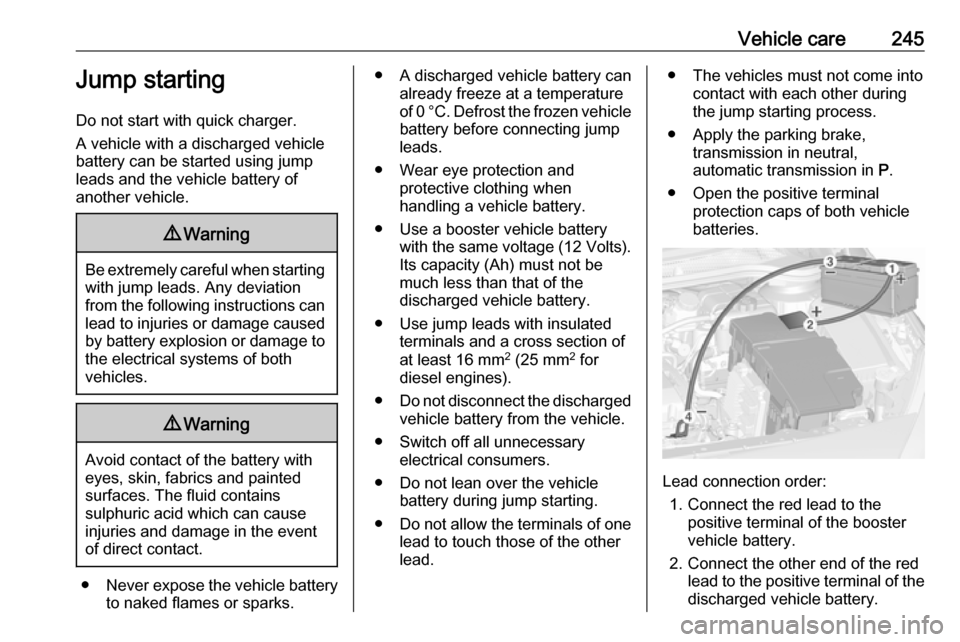
Lead connection order:
1. Connect the red lead to the positive terminal of the booster
vehicle battery.
2. Connect the other end of the red lead to the positive terminal of the
discharged vehicle battery.
Page 249 of 293

Vehicle care247
Screw in the towing eye as far as it will
go until it stops in a horizontal
position.
Attach a tow rope – or better still a tow
rod – to the towing eye.
The towing eye must only be used for towing and not for recovering the
vehicle.
Switch on ignition to release steering
wheel lock and to permit operation of
brake lights, horn and windscreen
wiper.
Transmission in neutral.
Caution
Drive slowly. Do not drive jerkily.
Excessive tractive force can
damage the vehicle.
When the engine is not running,
considerably more force is needed to
brake and steer.
To prevent the entry of exhaust gases from the towing vehicle, switch on the
air recirculation and close the
windows.
Vehicles with automatic transmission: The vehicle must be towed facing
forwards, not faster than 50 mph nor further than 60 miles. In all other
cases and when the transmission is
defective, the front axle must be
raised off the ground.
Seek the assistance of a workshop. After towing, unscrew the towing eye.
Insert cap at the top and engage
downwards.
Towing another vehicle
Insert a screwdriver in the slot at the
lower bend of the cap. Release the
cap by carefully moving the
screwdriver downwards.
The towing eye is stowed with the
vehicle tools 3 226.
Page 265 of 293
![VAUXHALL ASTRA K 2017 Owners Guide Technical data263Performance
3-door hatchbackEngineA14XERB14NELB14NETA16LETA16XHTB16SHTB16SHLMaximum speed [mph]Manual transmission111 5)120125137136143–Automatic transmission––124–––1345)](/img/38/19365/w960_19365-264.png "VAUXHALL ASTRA K 2017 Owners Guide Technical data263Performance
3-door hatchbackEngineA14XERB14NELB14NETA16LETA16XHTB16SHTB16SHLMaximum speed [mph]Manual transmission111 5)120125137136143–Automatic transmission––124–––1345)")
Technical data263Performance
3-door hatchbackEngineA14XERB14NELB14NETA16LETA16XHTB16SHTB16SHLMaximum speed [mph]Manual transmission111 5)120125137136143–Automatic transmission––124–––1345)
4th gear.
EngineA18XERB20NFTB16DTHB16DTL
A20DTH
121 kWA20DTH
96 kW
A20DTR
Maximum speed [mph]Manual transmission124155123113134– 6)140Automatic transmission––––131––6)
Value was not available at time of printing.
Page 266 of 293
![VAUXHALL ASTRA K 2017 Owners Guide 264Technical data4-door saloon
EngineB14XERB14NET
B14NET
LPG
A16LETB16XERA16XHT
Maximum speed [mph]Manual transmission114 5)129126139120138Automatic transmission–127–1321151335)
4th gear.EngineA13](/img/38/19365/w960_19365-265.png "VAUXHALL ASTRA K 2017 Owners Guide 264Technical data4-door saloon
EngineB14XERB14NET
B14NET
LPG
A16LETB16XERA16XHT
Maximum speed [mph]Manual transmission114 5)129126139120138Automatic transmission–127–1321151335)
4th gear.EngineA13")
264Technical data4-door saloon
EngineB14XERB14NET
B14NET
LPG
A16LETB16XERA16XHT
Maximum speed [mph]Manual transmission114 5)129126139120138Automatic transmission–127–1321151335)
4th gear.EngineA13DTEB16DTHB16DTLB16SHLMaximum speed [mph]Manual transmission112127118–Automatic transmission–124–133
Page 267 of 293
![VAUXHALL ASTRA K 2017 Owners Guide Technical data265Vehicle weightKerb weight, basic model without any optional equipment3-door hatchbackEngineManual transmissionAutomatic transmissionwithout/with air conditioning
[kg]A14XER1393/1408â€](/img/38/19365/w960_19365-266.png "VAUXHALL ASTRA K 2017 Owners Guide Technical data265Vehicle weightKerb weight, basic model without any optional equipment3-door hatchbackEngineManual transmissionAutomatic transmissionwithout/with air conditioning
[kg]A14XER1393/1408â€")
Technical data265Vehicle weightKerb weight, basic model without any optional equipment3-door hatchbackEngineManual transmissionAutomatic transmissionwithout/with air conditioning
[kg]A14XER1393/1408–B14NEL–/1437–B14NET–/1437–/1471A16LET1471–A16XHT–/1503–B16SHT–/1503–B16SHL––/1503A18XER–/1437–B20NFT–/1550–B16DTH1503/1518–B16DTL1503/1518–A20DTH–/1550–/1571A20DTR–/1571–
Optional equipment and accessories increase the kerb weight.
Loading information 3 69.
Page 268 of 293
![VAUXHALL ASTRA K 2017 Owners Guide 266Technical dataKerb weight, basic model without any optional equipment4-door saloonEngineManual transmissionAutomatic transmissionwithout/with air conditioning
[kg]B14XER1393/1405–B14NET1437/1449â](/img/38/19365/w960_19365-267.png "VAUXHALL ASTRA K 2017 Owners Guide 266Technical dataKerb weight, basic model without any optional equipment4-door saloonEngineManual transmissionAutomatic transmissionwithout/with air conditioning
[kg]B14XER1393/1405–B14NET1437/1449â")
266Technical dataKerb weight, basic model without any optional equipment4-door saloonEngineManual transmissionAutomatic transmissionwithout/with air conditioning
[kg]B14XER1393/1405–B14NET1437/1449–/1483B14NET
LPG1503/1515–A16LET–/14711503B16XER1393/1405–/1449A16XHT–/1503–/1503A13DTE1471/1483–B16SHL––/1503B16DTH1491/1503–/1550B16DTL1491/1503–
Optional equipment and accessories increase the kerb weight.
Loading information 3 69.
Page 288 of 293

286IndexAAccessories and vehicle modifications .......................... 199
Active Emergency Braking .........171
Active head restraints ..................38
Adaptive cruise control .........90, 160
Adaptive forward lighting ....90,
118, 210
Adjustable air vents ...................135
Airbag and belt tensioners ...........85
Airbag deactivation ................51, 85
Airbag system .............................. 49
Air conditioning regular operation ................................ 136
Air conditioning system .............. 128
Air intake .................................... 135
Air vents...................................... 135
Antilock brake system ................ 149
Antilock brake system (ABS) .......87
Anti-theft alarm system ................27
Anti-theft locking system .............. 27
Appearance care ........................248
Armrest .................................. 45, 46
Armrest storage ........................... 61
Ashtrays ....................................... 78
Automatic anti-dazzle ..................31
Automatic light control ...............115
Automatic locking ........................24
Automatic transmission .............145Autostop..................................... 140
Auxiliary heater ........................... 134
B Battery discharge protection ......126
Battery voltage ........................... 100
Belts.............................................. 46 Bonnet ....................................... 200
Brake and clutch fluid .................253
Brake and clutch system .............86
Brake assist ............................... 152
Brake fluid .................................. 204
Brakes ............................... 149, 204
Breakdown.................................. 246
Bulb replacement ....................... 207
C Capacities .................................. 268
Car Pass ...................................... 21
Catalytic converter .....................144
Central locking system ................23
Centre console lighting ..............125
Centre console storage ...............62
Changing tyre and wheel size ...233
Charging system .......................... 86
Child locks ................................... 25
Child restraint installation locations ................................... 55
Child restraints.............................. 53
Child restraint systems ................53
Cigarette lighter ........................... 78