belt VAUXHALL ASTRA K 2019 Owner's Guide
[x] Cancel search | Manufacturer: VAUXHALL, Model Year: 2019, Model line: ASTRA K, Model: VAUXHALL ASTRA K 2019Pages: 315, PDF Size: 9.64 MB
Page 193 of 315

Driving and operating191●The vehicle is being held to a stop
by the system for more than
five minutes.
● The vehicle stops, the driver's seat belt is unbuckled and thedriver's door is opened.
When adaptive cruise control is
deactivated, the control indicator C
changes from green to white and a
pop-up message is displayed in the
Driver Information Centre.
The stored speed is maintained.
On Midlevel display, the stored speed is indicated in brackets in the Driver
Information Centre when the system
is deactivated but not switched off.
On Uplevel display, the adaptive
cruise control symbol C changes
from green to white when the system
is deactivated but not switched off.
9 Warning
When adaptive cruise control is
deactivated, the driver must take
over full brake and engine control
immediately.
Switching off the system
Press v to switch off adaptive cruise
control. The control indicator C
extinguishes in the Driver Information Centre. The stored speed is deleted.
Switching off the ignition also
switches off adaptive cruise control
and deletes the stored speed.
Driver's attention ● Use adaptive cruise control carefully on bends or mountainroads, as it can lose the vehicle
ahead and needs time to detect it again.
● Do not use the system on slippery roads as it can create
rapid changes in tyre traction
(wheel spinning), so that you
could lose control of the vehicle.
● Do not use adaptive cruise control during rain, snow or
heavy dirt, as the radar sensor
can be covered by a water film,
dust, ice or snow. This reduces or suppresses completely the
visibility. In case of sensor
blockage, clean the sensor
cover.
System limits9 Warning
The system's automatic brake
force does not permit hard braking and the braking level may not be
sufficient to avoid a collision.
● After a sudden lane change, the system needs a certain time to
detect the next preceding
vehicle. So if a new vehicle is
detected, the system may
accelerate instead of braking.
Page 201 of 315
Driving and operating199After a sudden lane change, the
system needs a certain time to
detect the next preceding vehicle.
The complete attention of the
driver is always required while
driving. The driver shall always be ready to take action and apply the
brakes and steer to avoid
collisions. The system is designed to work with all occupants wearingtheir seat belts.
Intelligent Brake Assist
If the vehicle is equipped with radar
sensor Intelligent brake assist may
activate when the brake pedal is
applied quickly by providing a boost
to braking based on the speed of
approach and distance to a vehicle
ahead.
Minor brake pedal pulsations or pedal movement during this time is normal
and the brake pedal should continue to be applied as needed. Intelligent
brake assist will automatically
disengage only when the brake pedal is released.
9 Warning
Intelligent brake assist may
increase vehicle braking in
situations when it may not be
necessary. You could block the
flow of traffic. If this occurs, take
your foot off the brake pedal and
then apply the brakes as needed.
Deactivation
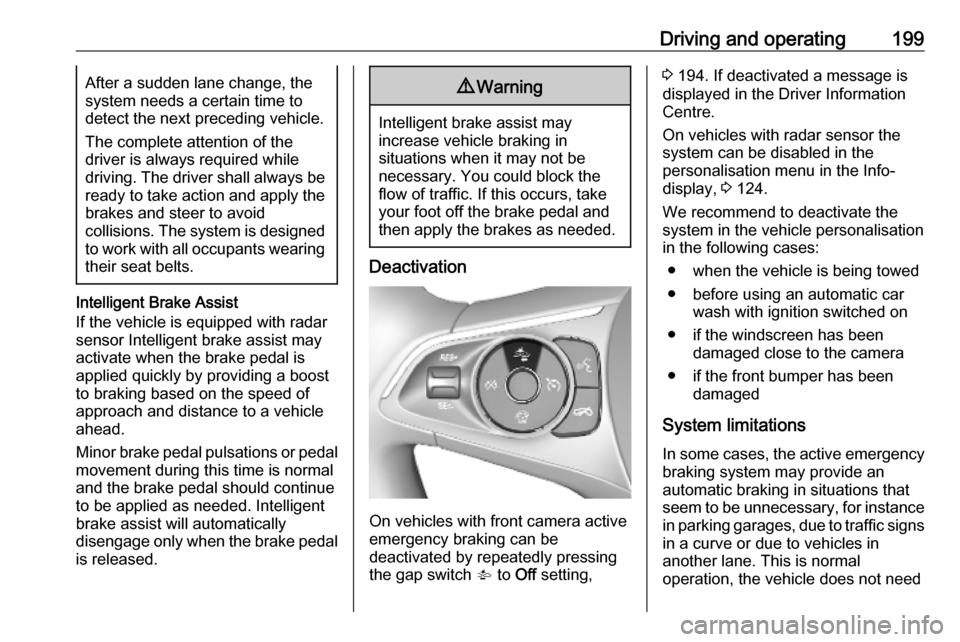
On vehicles with front camera active
emergency braking can be
deactivated by repeatedly pressing
the gap switch V to Off setting,
3 194. If deactivated a message is
displayed in the Driver Information
Centre.
On vehicles with radar sensor the
system can be disabled in the
personalisation menu in the Info-
display, 3 124.
We recommend to deactivate the system in the vehicle personalisation
in the following cases:
● when the vehicle is being towed
● before using an automatic car wash with ignition switched on
● if the windscreen has been damaged close to the camera
● if the front bumper has been damaged
System limitations In some cases, the active emergencybraking system may provide an
automatic braking in situations that
seem to be unnecessary, for instance
in parking garages, due to traffic signs
in a curve or due to vehicles in
another lane. This is normal
operation, the vehicle does not need
Page 257 of 315
Vehicle care255Tyre designations
E.g. 215/50 R 16 95 H215:Tyre width, mm50:Cross-section ratio (tyre height
to tyre width), %R:Belt type: RadialRF:Type: RunFlat16:Wheel diameter, inches95:Load index e.g. 95 is
equivalent to 690 kgH:Speed code letter
Speed code letter:
Q:up to 100 mphS:up to 112 mphT:up to 118 mphH:up to 130 mphV:up to 150 mphW:up to 168 mph
Choose a tyre appropriate for the
maximum speed of your vehicle.
The maximum speed is achievable at kerb weight with driver (75 kg) plus
125 kg payload. Optional equipment
could reduce the maximum speed of
the vehicle.
Performance 3 288.
Tyre pressure
Check the pressure of cold tyres at
least every 14 days and before any
long journey. Do not forget the spare
wheel.
This also applies to vehicles with tyre pressure monitoring system.
Tyre pressure 3 294.
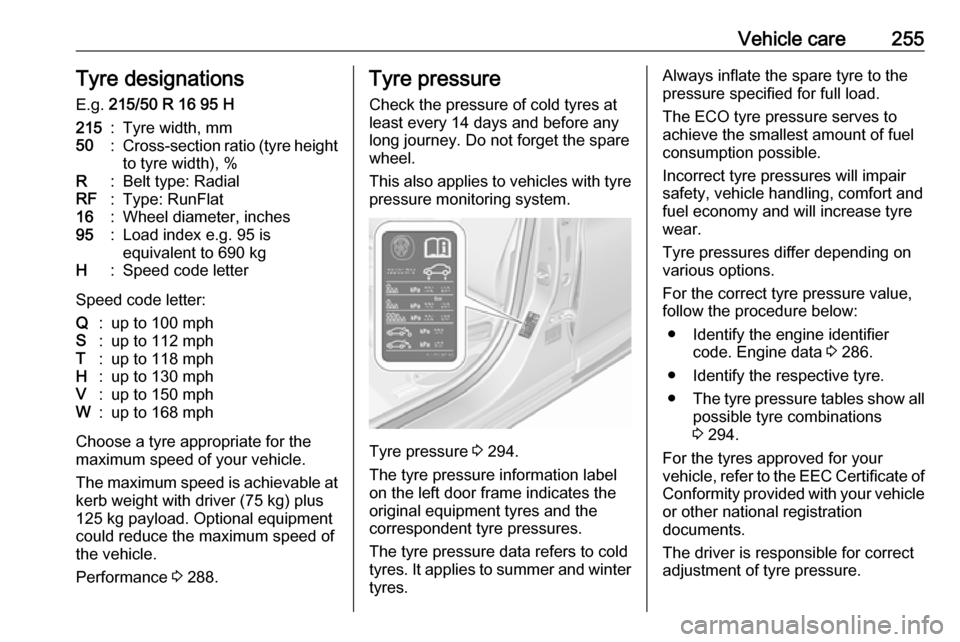
The tyre pressure information label
on the left door frame indicates the
original equipment tyres and the
correspondent tyre pressures.
The tyre pressure data refers to cold
tyres. It applies to summer and winter tyres.
Always inflate the spare tyre to the
pressure specified for full load.
The ECO tyre pressure serves to
achieve the smallest amount of fuel
consumption possible.
Incorrect tyre pressures will impair
safety, vehicle handling, comfort and
fuel economy and will increase tyre
wear.
Tyre pressures differ depending on
various options.
For the correct tyre pressure value,
follow the procedure below:
● Identify the engine identifier code. Engine data 3 286.
● Identify the respective tyre. ● The tyre pressure tables show all
possible tyre combinations
3 294.
For the tyres approved for your
vehicle, refer to the EEC Certificate of Conformity provided with your vehicle
or other national registration
documents.
The driver is responsible for correct
adjustment of tyre pressure.
Page 278 of 315

276Vehicle careClean the leather upholstery with
clear water and a soft cloth. In case of heavy soiling, use leather care.
The instrument cluster and the
displays should only be cleaned using
a soft damp cloth. If necessary use a
weak soap solution.
Clean fabric upholstery with a
vacuum cleaner and brush. Remove
stains with an upholstery cleaner.
Clothing fabrics may not be
colourfast. This could cause visible
discolourations, especially on light-
coloured upholstery. Removable
stains and discolourations should be
cleaned as soon as possible.
Clean seat belts with lukewarm water or interior cleaner.Caution
Close Velcro fasteners as open
Velcro fasteners on clothing could damage seat upholstery.
The same applies to clothing with
sharp-edged objects, like zips or
belts or studded jeans.
Plastic and rubber parts
Plastic and rubber parts can be
cleaned with the same cleaner as
used to clean the body. Use interior cleaner if necessary. Do not use any
other agent. Avoid solvents and petrol in particular. Do not use high-
pressure jet cleaners.
Page 307 of 315

Customer information305Operating data in the vehicleControl units process data for
operation of the vehicle.
This data includes, e.g.: ● vehicle status information (e.g. wheel rotation rate, speed,
movement delay, lateral
acceleration, "seatbelts
fastened" display),
● ambient conditions (e.g. temperature, rain sensor,
distance sensor).
As a rule such data is transient, not
stored for longer than an operational
cycle, and only processed on board
the vehicle itself. Control units often
include data storage (including the
vehicle key). This is used to allow information to be documented
temporarily or permanently on vehicle
condition, component stress,
maintenance requirements and
technical events and errors.Depending on the technical
equipment level, the data stored is as follows:
● system component operating states (e.g. fill level, tyre
pressure, battery status)
● faults and defects in important system components (e.g. lights,
brakes)
● system reactions in special driving situations (e.g. triggering
of an airbag, actuation of the
stability control systems)
● information on events damaging the vehicle
● for electric vehicles the amount of
charge in the high-voltage
battery, estimated range
In special cases (e.g. if the vehicle
has detected a malfunction), it may be
necessary to save data that would
otherwise just be volatile.
When you use services (e.g. repairs,
maintenance), the operating data
saved can be read together with the
vehicle identification number and
used when necessary. Staff working
for the service net-work ( e.g. garages,manufacturers) or third parties (e.g.
breakdown services) can read the
data from the vehicle. The same
applies to warranty work and quality
assurance measures.
Data is generally read via the OBD
(On-Board Diagnostics) port
prescribed by law in the vehicle. The operating data which is read out,
documents the technical condition of
the vehicle or individual components
and assists with fault diagnosis,
compliance with warranty obligations
and quality improvement. This data,
in particular information on
component stress, technical events,
operator errors and other faults, is
transmitted to the manufacturer
where appropriate, together with the
vehicle identification number. The
manufacturer is also subject to
product liability. The manufacturer
potentially also uses operating data
from vehicles for product recalls. This
data can also be used to check
customer warranty and guarantee
claims.
Fault memories in the vehicle can be
reset by a service company when
carrying out servicing or repairs.
Page 310 of 315

308IndexAAccessories and vehicle modifications .......................... 228
Active emergency braking ..........197
Adaptive cruise control .......113, 186
AdBlue ................................ 111, 168
Adjustable air vents ...................153
Airbag and belt tensioners .........108
Airbag deactivation ..............63, 108
Airbag label................................... 58
Airbag system .............................. 58
Air conditioning regular operation ................................ 154
Air conditioning system .............. 146
Air intake .................................... 154
Air vents...................................... 153
Antilock brake system ................ 177
Antilock brake system (ABS) .....110
Anti-theft alarm system ................36
Anti-theft locking system .............. 36
Appearance care ........................274
Armrest ................................... 53, 55
Armrest storage ........................... 72
Ashtrays ....................................... 98 Automatic anti-dazzle ..................41
Automatic light control ...............135
Automatic locking ........................29
Automatic transmission .............170
Autostop ..................................... 161
Auxiliary heater ........................... 153B
Battery discharge protection ......144
Battery voltage ........................... 123 Belts.............................................. 56
BlueInjection ............................... 168
Bonnet ....................................... 230
Brake and clutch fluid .................278
Brake and clutch system ...........109
Brake assist ............................... 180
Brake fluid .................................. 233
Brakes ............................... 177, 233
Breakdown.................................. 272
Bulb replacement ....................... 236
C Capacities .................................. 293
Cargo management system ........82
Catalytic converter .....................167
Central locking system ................24
Centre console lighting ..............143
Changing tyre and wheel size ...261
Charging system ........................ 109 Child locks ................................... 30
Child restraint installation locations ................................... 67
Child restraints.............................. 65
Child restraint systems ................65
Climate control ............................. 15
Climate control systems .............145
Clock............................................. 95
Page 313 of 315

311Power seat adjustment ................50
Power windows ............................ 41
Preheating ................................. 111
Puncture ..................................... 265
Q
Quickheat ................................... 153
R Radio Frequency Identification (RFID) ..................................... 307
Radio remote control ...................21
REACH ....................................... 301
Reading lights ............................ 142
Rear floor storage cover ..............81
Rear fog light .............113, 141, 239
Rear seats .................................... 55
Rear storage ................................. 79
Rear view camera ...................... 209
Rear window wiper and washer ..94
Recommended fluids and lubricants ........................ 278, 283
Refuelling ................................... 220
Registered trademarks ...............304
Retained power off .....................159
Reversing lights .........................141
Ride control systems ..................180
Roof .............................................. 44
Roof load ...................................... 88
Roof rack ..................................... 88S
Safety belts ................................... 56
Safety net .................................... 84
Seat adjustment ............................. 7 Seat belt ........................................ 8
Seat belt reminder .....................107
Seat belts ..................................... 56
Seat heating Seat heating, front .....................54
Seat heating, rear .....................56
Seat position ................................ 47
Selective catalytic reduction .......168
Selector lever ..................... 171, 175
Service ............................... 154, 277
Service display .......................... 106
Service information ....................277
Side airbag system ......................62
Side blind spot alert ....................208
Sidelights .................................... 134
Side turn lights ........................... 245
Software acknowledgement .......301
Software update ......................... 303
Spare wheel ............................... 265
Speed limiter....................... 113, 185
Speedometer ............................. 102
Sport mode ................................ 182
Starting and operating ................156
Starting off ................................... 16
Starting the engine ....................159
Steering ...................................... 156Steering wheel adjustment ......9, 91
Steering wheel controls ...............91
Stop-start system........................ 161
Storage ......................................... 71
Storage compartments .................71
Sunroof ........................................ 44
Sunvisor lights ........................... 143
Sun visors .................................... 43
Symbols ......................................... 4
T
Tachometer ............................... 104
Tail lights ................................... 239
Three-point seat belt .................... 57
Tools .......................................... 253
Tow bar....................................... 223 Towing ................................ 223, 272
Towing another vehicle .............273
Towing equipment .....................224
Towing the vehicle .....................272
Traction Control system ............. 180
Traction Control system off......... 111
Traffic sign assistant ...........113, 211
Trailer coupling ........................... 223
Trailer stability assist .................227
Trailer towing ............................. 223
Transmission ............................... 15
Transmission display .........170, 174
Tread depth ............................... 260
Trip odometer ............................ 103