ECU VAUXHALL CASCADA 2015.5 User Guide
[x] Cancel search | Manufacturer: VAUXHALL, Model Year: 2015.5, Model line: CASCADA, Model: VAUXHALL CASCADA 2015.5Pages: 255, PDF Size: 7.56 MB
Page 67 of 255

Seats, restraints65Child restraint installation locationsPermissible options for fitting a child restraint system
Weight and age class
On front passenger seat
On rear seats
activated airbagdeactivated airbagGroup 0: up to 10 kg
or approx. 10 monthsXU 1UGroup 0+: up to 13 kg
or approx. 2 yearsXU 1UGroup I: 9 to 18 kg
or approx. 8 months to 4 yearsXU 1U2Group II: 15 to 25 kg
or approx. 3 to 7 yearsXXUGroup III: 22 to 36 kg
or approx. 6 to 12 yearsXXU1=If the child restraint system is being secured using a three-point seat belt, move seat into the rear adjustment area and set seat height to uppermost position. Adjust seat backrest inclination as far as necessary to a vertical position to ensure
that the belt is tight on the buckle side.2=Remove rear head restraint when using child restraint systems in this weight group 3 45.U=Universal suitability in conjunction with three-point seat belt.X=No child restraint system permitted in this weight class.
Page 72 of 255

70StorageCupholders
Cupholders are located in the centre
console.
Depending on the version,
cupholders are located under a cover
in the centre console.
Slide cover backwards. Bottles can
be stowed after folding up the
intermediate shelf 3 71.
Additional cupholders are located
between the rear seats.
Front storage
A storage compartment is located
next to the steering wheel.
Page 75 of 255

Storage739Warning
Take care when operating the
electric foldable rear seats. The seat backrest is folded with
considerable power. Risk of injury, particularly to children.
Ensure that nothing is attached to
the rear seats or located on the
seat cushion.
■ Remove big wind deflector if installed 3 41.
■ Press the catches and push down the head restraints 3 45.
■ Pull the release switch p on one or
both sides of the load
compartment, to fold down the
backrests onto the seat cushion.
■ To fold up, raise the backrest and guide it into an upright position until
it engages audibly.9 Warning
When folding up, ensure that
backrests are securely locked in
position before driving. Failure to
do so may result in personal injury or damage to the load or vehicle in the event of hard braking or a
collision.
Pass-through flap behind rear seats
For transporting long objects in the
load compartment, a pass-through
flap between load compartment and
vehicle interior can be opened:
■ Remove the installed big wind deflector or the bag with the stowed
wind deflectors behind the rear seats 3 41.
■ Close soft top 3 34.
■ Push the load compartment partition at the loop area upwards
to the inside 3 72.
Page 77 of 255

Storage75Lashing eyes
The lashing eyes are designed to
secure items against slippage, e.g.
using lashing straps or luggage net.
Warning triangle
Warning triangle is stowed in the
space on the inside of the boot lid
behind the straps.
First aid kit
The first aid kit is stowed on the right
side in the load compartment behind
a strap.
Page 78 of 255

76StorageLoading information■ Heavy objects in the load compartment should be placed as
far forward as possible. Ensure that the backrests are securely
engaged. If objects can be stacked,
heavier objects should be placed at the bottom.
■ Secure objects with lashing straps attached to the lashing eyes 3 75.
■ Use the hooks in the load compartment for hanging up carrier
bags 3 74 . Maximum load: 5 kg per
hook.
■ Secure loose objects in the load compartment to prevent them from
sliding.
■ When transporting objects in the load compartment, the backrests ofthe rear seats must not be angled
forward.
■ Do not place any objects on the instrument panel, and do not cover
the sensor on top of the instrument
panel.■ The load must not obstruct the operation of the pedals, parking
brake and gear selector lever, or
hinder the freedom of movement of the driver. Do not place any
unsecured objects in the interior.
■ Do not place any objects on the covers of the anti-roll bars behind
the head restraints.
■ Do not drive with an open load compartment.9 Warning
Always make sure that the load in
the vehicle is securely stowed.
Otherwise objects can be thrown
around inside the vehicle and
cause personal injury or damage
to the load or car.
■ The payload is the difference between the permitted gross
vehicle weight (see identification
plate 3 231) and the EC kerb
weight.
To calculate the payload, enter the
data for your vehicle in the Weights
table at the front of this manual.
The EC kerb weight includes
weights for the driver (68 kg),
luggage (7 kg) and all fluids (tank
90 % full).
Optional equipment and
accessories increase the kerb
weight.
Page 105 of 255

Instruments and controls103
Messages in the
Colour-Info-Display Some important messages may
appear additionally in the
Colour-Info-Display. Press the
multifunction knob to confirm a
message. Some messages only pop
up for a few seconds.
Warning chimes
When starting the engine or
whilst driving
Only one warning chime will sound at a time.
The warning chime regarding
unfastened seat belts has priority
over any other warning chime.
■ If seat belt is not fastened.
■ If a door or the boot lid is not fully closed when starting off.
■ If the soft top is not completely opened or closed.
■ If the soft top lid is not completely closed.■ If the load compartment partition isfolded in when operating the soft
top.
■ If a certain speed is exceeded with parking brake applied.
■ If a certain speed is exceeded when
operating the soft top.
■ If a programmed speed or speed limit is exceeded.
■ If a warning message appears in the Driver Information Centre
(DIC).
■ If the parking assist detects an object.
■ If unintended lane change occurs.
■ If the diesel particle filter has reached the maximum filling level.
■ If AdBlue needs to be refilled.
When the vehicle is parked and/ or the driver's door is opened ■ When the key is in the ignition switch.
■ With exterior lights on.During an Autostop ■ If the driver's door is opened.
Battery voltage
When the vehicle battery voltage is
running low, a warning message will
appear in the Driver Information
Centre (DIC).
1. Switch off immediately any electrical consumers which are
not required for a safe ride, e.g.
seat heating, heated rear window
or other main consumers.
2. Charge the vehicle battery by driving continuously for a while or
by using a charging device.
The warning message will disappear after the engine has been started
twice consecutively without a voltage
drop.
If the vehicle battery cannot be
recharged, have the cause of the fault remedied by a workshop.
Page 146 of 255

144Driving and operating
Do not accelerate while engaging a
gear. Never depress the accelerator
pedal and brake pedal at the same
time.
When a gear is engaged, the vehicle
slowly begins to creep when the
brake is released.
Engine braking To utilise the engine braking effect,
select a lower gear in good time when
driving downhill, see manual mode.
Rocking the vehicle
Rocking the vehicle is only
permissible if the vehicle is stuck in
sand, mud or snow. Move the selector
lever between D and R in a repeat
pattern. Do not race the engine and
avoid sudden acceleration.
Parking
Apply the parking brake and engage P .
The ignition key can only be removed
when the selector lever is in position
P .Manual mode
Move selector lever out of position D
towards the left to select manual
mode M.
Tap selector lever
forwards <=shift to a higher gearbackwards ]=shift to a lower gear
The selected gear is indicated in the
instrument cluster.
If a higher gear is selected when
vehicle speed is too low, or a lower
gear when vehicle speed is too high,
the shift is not executed. This can
cause a message in the Driver
Information Centre.
In manual mode, no automatic
shifting to a higher gear takes place
at high engine revolutions.
Electronic driving
programmes ■ Following a cold start, the operating
temperature programme increases
engine speed to quickly bring the
catalytic converter to the required
temperature.
■ The automatic neutral shift function
automatically shifts to idling when
the vehicle is stopped with a
forward gear engaged and the
brake pedal is pressed.
■ When SPORT mode is engaged, the vehicle shifts at higher engine
speeds (unless cruise control is
on). SPORT mode 3 151.
■ Special programmes automatically adapt the shifting points when
driving up inclines or down hills.
Page 182 of 255
180Driving and operating
Rear axle loadWhen the trailer is coupled and the
towing vehicle fully loaded, the
permissible rear axle load (see
identification plate or vehicle
documents) may be exceeded by
100 kg, the gross vehicle weight
rating may be exceeded by 100 kg. If
the permissible rear axle load is
exceeded, a maximum speed of
60 mph applies.
Towing equipmentCaution
When operating without a trailer,
remove the coupling ball bar.
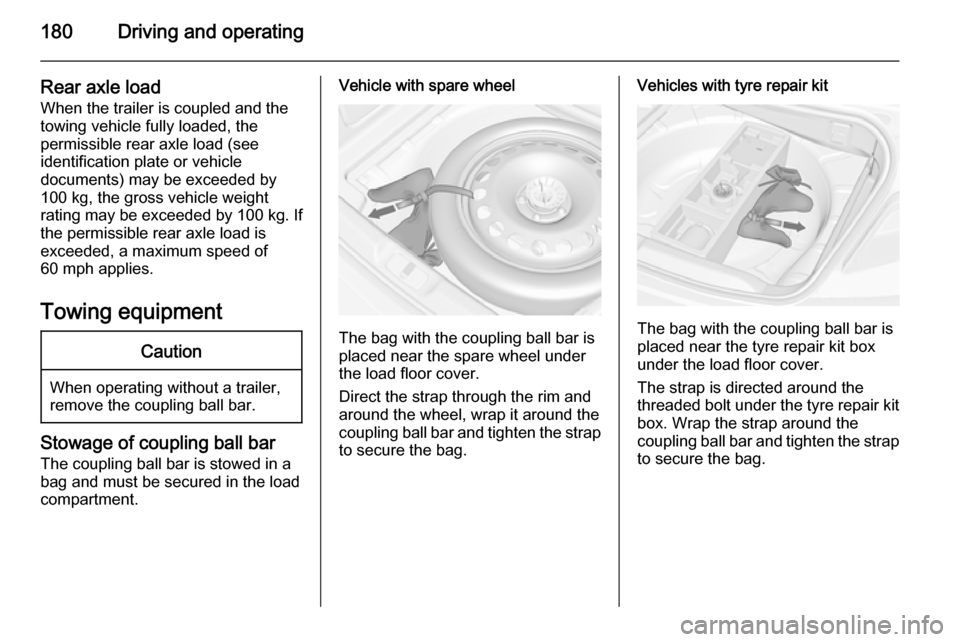
Stowage of coupling ball bar
The coupling ball bar is stowed in a
bag and must be secured in the load
compartment.
Vehicle with spare wheel
The bag with the coupling ball bar is
placed near the spare wheel under
the load floor cover.
Direct the strap through the rim and around the wheel, wrap it around the
coupling ball bar and tighten the strap
to secure the bag.
Vehicles with tyre repair kit
The bag with the coupling ball bar is
placed near the tyre repair kit box
under the load floor cover.
The strap is directed around the
threaded bolt under the tyre repair kit box. Wrap the strap around the
coupling ball bar and tighten the strap
to secure the bag.
Page 183 of 255

Driving and operating181
Vehicles with flat load compartment
floor
The bag with the coupling ball bar is
stowed on the right side of the load
compartment floor.
Direct the strap through the rear right
lashing eye, wrap it twice around the
coupling ball bar and tighten the strap
to secure the bag.
Fitting the coupling ball bar
Disengage and fold down the socket. Remove the sealing plug from the
opening for the coupling ball bar and
stow it.
Checking the tensioning of the
coupling ball bar
■ Red marking on rotary knob must
point towards green marking on
coupling ball bar.
■ The gap between the rotary knob and the coupling ball bar must beapprox. 6 mm.
■ The key must be in position c.
Otherwise, the coupling ball bar must be tensioned before being inserted:
■ Unlock coupling ball bar by turning key to position c.
Page 185 of 255

Driving and operating183
■The coupling ball bar must be firmly
engaged in the opening.
■ The coupling ball bar must be locked and the key removed.9 Warning
Towing a trailer is permitted only
when a coupling ball bar is fitted correctly. If the coupling ball bardoes not engage correctly, seekthe assistance of a workshop.
Dismounting the coupling ball
bar
Open the protective flap and turn the
key to position c to unlock the
coupling ball bar.
Pull out rotary handle and turn
clockwise as far as it will go. Pull out coupling ball bar downwards.
Insert sealing plug in opening. Fold away socket.
Stow and secure the coupling ball bar
as mentioned above.