automatic transmission VAUXHALL CASCADA 2015.5 User Guide
[x] Cancel search | Manufacturer: VAUXHALL, Model Year: 2015.5, Model line: CASCADA, Model: VAUXHALL CASCADA 2015.5Pages: 255, PDF Size: 7.56 MB
Page 150 of 255

148Driving and operatingTo reduce the operating forces ofthe parking brake, depress the
foot brake at the same time.
Control indicator R 3 90.
Electric parking brake
Applying when vehicle is stationary
9 Warning
Pull switch m for approx.
one second, the electric parking
brake operates automatically with
adequate force. For maximum
force, e.g. parking with trailer or on
inclines, pull switch m twice.
The electric parking brake is
applied when control indicator m
illuminates 3 91.
The electric parking brake can always
be activated, even if the ignition is off.
Do not operate electric parking brake
system too often without engine
running as this will discharge the
vehicle battery.
Before leaving the vehicle, check the electric parking brake status. Control
indicator m 3 91.
Releasing
Switch on ignition. Keep brake pedal
depressed and then push switch m.
Drive away function
Depressing clutch pedal (manual
transmission) or engaging drive gear
(automatic transmission) and then
depressing the accelerator pedal
releases the electric parking brake
automatically. This is not possible
when the switch is pulled at the same
time.
This function also helps driving away
on inclines.
Aggressive drive away may reduce
life time of wear parts.
Dynamic braking when vehicle is
moving
When the vehicle is moving and the
switch m is kept pulled, the electric
parking brake system will decelerate the vehicle, but will not apply
statically.
As soon as the switch m is released,
dynamic braking will be stopped.
Fault
Failure mode of electric parking brake
is indicated by control indicator j and
by a vehicle message which is
displayed in the Driver Information Centre (DIC).
Page 153 of 255

Driving and operating151
ESC is operational after each engine
start as soon as the control indicator
b extinguishes.
When ESC operates b flashes.9 Warning
Do not let this special safety
feature tempt you into taking risks
when driving.
Adapt speed to the road
conditions.
Control indicator b 3 92.
Deactivation
For a more sporty behaviour ESC and
TC can be deactivated separately:
■ Press button b briefly: only
Traction control system is inactive,
ESC remains active, k illuminates
■ Hold button b pressed for min.
5 seconds: TC and ESC are
deactivated, k and n illuminate.
Additionally the selected mode is
displayed as status message in the
Driver Information Centre (DIC).
If the vehicle comes into threshold
with deactivated ESP, the system will reactivate ESP for the time duration
of the threshold, when the brake
pedal is depressed once.
ESC is reactivated by pressing the
b button again. If the TC system was
previously disabled, both TC and
ESC are reactivated.
ESC is also reactivated the next time
the ignition is switched on.Interactive driving system
Flex Ride
Flex Ride driving system allows the
driver to select between three driving
modes:
■ SPORT mode: press button SPORT , LED illuminates.
■ TOUR mode: press button TOUR,
LED illuminates.
■ NORMAL mode: both buttons SPORT and TOUR are not
pressed, no LED illuminates.
Deactivate SPORT mode and TOUR
mode by pressing corresponding
button once more.
In each driving mode, Flex Ride networks the following electronic
systems:
■ Continuous Damping Control.
■ Accelerator Pedal Control.
■ Steering Control.
■ Electronic Stability Control (ESC).
■ Antilock brake system (ABS) with cornering brake control (CBC).
■ Automatic transmission.
Page 154 of 255

152Driving and operating
SPORT mode
The settings of the systems are
adapted to a sportier driving style:
■ Damping of shock absorbers reacts
more stiffly to provide better contact with the road surface.
■ The engine reacts more quickly to the accelerator pedal.
■ Steering support is reduced.
■ Shift points of automatic transmission occur later.
■ With SPORT mode activated, the illumination of main instruments
changes from white to red.
TOUR mode
The settings of the systems are
adapted to a comfort driving style:
■ Damping of shock absorbers reacts
more softly.
■ Accelerator pedal reacts with standard settings.
■ Steering support is in standard mode.
■ Shift points of automatic transmission occur in a comfort
mode.
■ Illumination of main instruments is white.
NORMAL mode
All settings of the systems are
adapted to standard values.
Drive mode control Within each manually selected drivingmode SPORT, TOUR or NORMAL,
the Drive Mode Control (DMC)
detects and analyses continuously
the real driving characteristic,
responses by the driver, and the
active dynamic state of the vehicle. If
necessary, the control unit of DMC
automatically changes the settings
within the selected driving mode or,
when recognising greater variations,
the driving mode is changed for the
length of variation.
If, for example, NORMAL mode is
selected and DMC detects a sporty
driving behaviour, DMC changes
several settings of the Normal mode
into sporty settings. The DMC
changes to SPORT mode in case of
very sporty driving behaviour.
If, for another example, TOUR mode
is selected and whilst driving on a
winding road a sudden hard brake is
necessary, DMC will detect the
Page 155 of 255

Driving and operating153
dynamic vehicle condition and
changes the settings for suspension
to SPORT mode to increase vehicle
stability.
When the driving characteristic or the
dynamic vehicle state returns to the
former state, DMC will change the
settings to the preselected driving
mode.
Personalised settings in the
SPORT mode The driver can select the functions of
the SPORT mode when SPORT
button is pressed. These settings can
be changed in the Settings menu in
the Info-Display. Vehicle
personalisation 3 104.Driver assistance
systems9 Warning
Driver assistance systems are
developed to support the driver
and not to replace the driver's
attention.
The driver accepts full
responsibility when driving the
vehicle.
When using driver assistance
systems, always take care
regarding the current traffic
situation.
Cruise control
The cruise control can store and
maintain speeds of approx. 20 to
120 mph. Deviations from the stored
speeds may occur when driving uphill or downhill.
For safety reasons the cruise controlcannot be activated until the foot
brake has been operated once.
Activating in first gear is not possible.
Do not use the cruise control if it is not advisable to maintain a constant
speed.
With automatic transmission, only
activate cruise control in automatic
mode.
Control indicator m 3 94.
Switching on
Press m; control indicator m in
instrument cluster illuminates white.
Page 212 of 255

210Vehicle care
Each time the tyres are replaced, tyrepressure monitoring system sensors
must be dismounted and serviced. For the screwed sensor: replace
valve core and sealing ring. For
clipped sensor: replace complete
valve stem.
Vehicle loading status Adjust tyre pressure to load condition according to tyre information label or
tyre pressure chart 3 242, and select
the relevant setting in the menu Tire
Load in the DIC, Vehicle Information
Menu 3 95.Select:
■ Light for comfort pressure up to
3 people
■ Eco for Eco pressure up to
3 people
■ Max for full loading
TPMS sensor matching process
Each TPMS sensor has a unique
identification code. The identification
code must be matched to a new tyre/
wheel position after rotating the tyres
or exchanging the complete wheel set and if one or more TPMS sensors
were replaced. The TPMS sensor
matching process should also be
performed after replacing a spare tyre
with a road tyre containing the TPMS
sensor.
The malfunction light and the warning
message or code should go off at the next ignition cycle. The sensors are
matched to the tyre/wheel positions,
using a TPMS relearn tool, in the
following order: left side front tyre,
right side front tyre, right side rear tyreand left side rear tyre. The turn signal
light at the current active position is
illuminated until sensor is matched.
Consult your workshop for service or
to purchase a relearn tool. There are
2 minutes to match the first tyre/wheel position, and 5 minutes overall to
match all four tyre/wheel positions. If
it takes longer, the matching process
stops and must be restarted.
The TPMS sensor matching process
is:
1. Apply the parking brake; on vehicles with automatic
transmission set the selector lever to P.
2. Turn the ignition on.
3. Use the MENU button on the turn
signal lever to select the Vehicle
Information Menu in the DIC.
4. Turn the adjuster wheel to scroll to
the tyre pressure menu.
5. Press the SET/CLR button to
begin the sensor matching process. A message requesting
acceptance of the process should
display.
Page 224 of 255

222Vehicle care
■ Never expose the battery to nakedflames or sparks.
■ A discharged vehicle battery can already freeze at a temperature of
0 °C. Defrost the frozen battery
before connecting jump leads.
■ Wear eye protection and protective
clothing when handling a battery.
■ Use a booster battery with the same voltage (12 Volts). Its
capacity (Ah) must not be much less than that of the discharged
battery.
■ Use jump leads with insulated terminals and a cross section of at
least 16 mm 2
(25 mm 2
for diesel
engines).
■ Do not disconnect the discharged battery from the vehicle.
■ Switch off all unnecessary electrical
consumers.
■ Do not lean over the battery during jump starting.
■ Do not allow the terminals of one lead to touch those of the other
lead.■ The vehicles must not come into contact with each other during the
jump starting process.
■ Apply the parking brake, transmission in neutral, automatictransmission in P.
■ Open the positive terminal protection caps of both batteries.
Lead connection order:
1. Connect the red lead to the positive terminal of the booster
battery.
2. Connect the other end of the red lead to the positive terminal of the
discharged battery.
3. Connect the black lead to the negative terminal of the booster
battery.
4. Connect the other end of the black
lead to a vehicle grounding point,
such as the engine block or an
engine mounting bolt. Connect as far away from the discharged
battery as possible, however at
least 60 cm.
Route the leads so that they cannot
catch on rotating parts in the engine
compartment.
To start the engine: 1. Start the engine of the vehicle providing the jump.
2. After 5 minutes, start the other engine. Start attempts should be
made for no longer than
15 seconds at an interval of
1 minute.
3. Allow both engines to idle for approx. 3 minutes with the leads
connected.
Page 226 of 255
224Vehicle careCaution
Drive slowly. Do not drive jerkily.
Excessive tractive force can
damage the vehicle.
When the engine is not running,
considerably more force is needed to
brake and steer.
To prevent the entry of exhaust gases from the towing vehicle, switch on the
air recirculation and close the
windows, when soft top is closed.
Vehicles with automatic transmission: The vehicle must be towed facing
forwards, not faster than 50 mph nor further than 60 miles. In all other
cases and when the transmission is
defective, the front axle must be
raised off the ground.
Seek the assistance of a workshop. After towing, unscrew the towing eye
clockwise.
Insert cap at the top and engage
downwards.
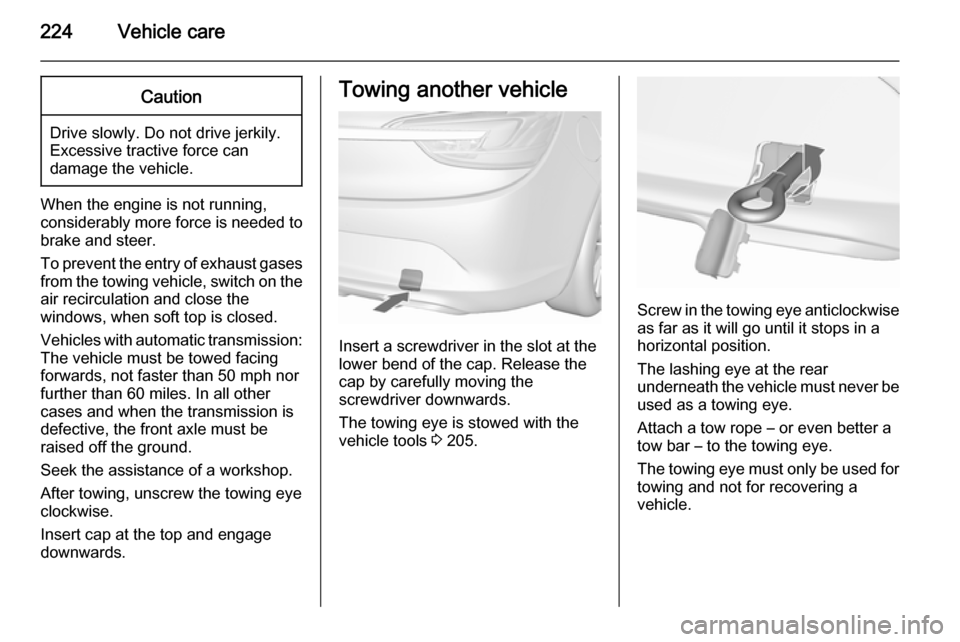
Towing another vehicle
Insert a screwdriver in the slot at the
lower bend of the cap. Release the
cap by carefully moving the
screwdriver downwards.
The towing eye is stowed with the
vehicle tools 3 205.
Screw in the towing eye anticlockwise
as far as it will go until it stops in a
horizontal position.
The lashing eye at the rear
underneath the vehicle must never be used as a towing eye.
Attach a tow rope – or even better a
tow bar – to the towing eye.
The towing eye must only be used for
towing and not for recovering a
vehicle.
Page 240 of 255
![VAUXHALL CASCADA 2015.5 User Guide 238Technical dataPerformanceEngineB14NELB14NETA16XHTA16SHTB16SHTB16SHLMaximum speed4)
[mph]Manual transmission121129138146146–Automatic transmission–––––1364) The maximum speed indicated](/img/38/19379/w960_19379-239.png "VAUXHALL CASCADA 2015.5 User Guide 238Technical dataPerformanceEngineB14NELB14NETA16XHTA16SHTB16SHTB16SHLMaximum speed4)
[mph]Manual transmission121129138146146–Automatic transmission–––––1364) The maximum speed indicated")
238Technical dataPerformanceEngineB14NELB14NETA16XHTA16SHTB16SHTB16SHLMaximum speed4)
[mph]Manual transmission121129138146146–Automatic transmission–––––1364) The maximum speed indicated is achievable at kerb weight (without driver) plus 200 kg payload. Optional equipment could reduce the specified maximum
speed of the vehicle.EngineA20DTHB20DTHA20DTRMaximum speed 5)
[mph]Manual transmission135135143Automatic transmission132––5) The maximum speed indicated is achievable at kerb weight (without driver) plus 200 kg payload. Optional equipment could reduce the specified maximum
speed of the vehicle.
Page 241 of 255
![VAUXHALL CASCADA 2015.5 User Guide Technical data239Vehicle weight
Kerb weight, basic model without any optional equipmentEngineManual transmissionAutomatic transmissionwithout/with air conditioning
[kg]B14NEL1701/1714–B14NET1701/171](/img/38/19379/w960_19379-240.png "VAUXHALL CASCADA 2015.5 User Guide Technical data239Vehicle weight
Kerb weight, basic model without any optional equipmentEngineManual transmissionAutomatic transmissionwithout/with air conditioning
[kg]B14NEL1701/1714–B14NET1701/171")
Technical data239Vehicle weight
Kerb weight, basic model without any optional equipmentEngineManual transmissionAutomatic transmissionwithout/with air conditioning
[kg]B14NEL1701/1714–B14NET1701/1714–A16XHT–/1733–A16SHT–/1733–B16SHT–/1733–B16SHL––/1733A20DTH–/1816–/1816B20DTH–/1843–A20DTR–/1816–
Optional equipment and accessories increase the kerb weight.
Loading information 3 76.
Page 250 of 255

248IndexAAccessories and vehicle modifications .......................... 184
Active head restraints ...................46
Adaptive forward lighting ....94,
113, 194
AdBlue .................................. 93, 140
Adjustable air vents ...................130
Airbag, belt tensioners and anti- roll bars ..................................... 89
Airbag deactivation ................62, 89
Airbag label................................... 57 Airbag system .............................. 57
Air conditioning regular operation ................................ 131
Air conditioning system .............. 123
Air intake .................................... 131
Air vents...................................... 130
Antilock brake system ................ 146
Antilock brake system (ABS) .......91
Anti-theft alarm system ................27
Anti-theft locking system .............. 26 Appearance care ........................225
Armrest ......................................... 53
Armrest storage ........................... 71
Ashtrays ....................................... 84
Automatic anti-dazzle ..................31
Automatic light control ...............110
Automatic locking ........................24Automatic transmission .............142
Auxiliary heater ........................... 130
B Battery discharge protection ......120
Battery voltage ........................... 103 BlueInjection ............................... 140
Bonnet ....................................... 186
Brake and clutch fluid .................229
Brake and clutch system .............90
Brake assist ............................... 149
Brake fluid .................................. 189
Brakes ............................... 146, 189
Breakdown.................................. 223
Bulb replacement ....................... 192
C Capacities .................................. 241
Car Pass ...................................... 20
Catalytic converter .....................139
Central locking system ................22
Centre console storage ...............71
Changing tyre and wheel size ...212
Charging system .......................... 90
Child restraint installation locations ................................... 65
Child restraints.............................. 63
Child restraint systems ................63
Cigarette lighter ........................... 84
Climate control ............................. 16